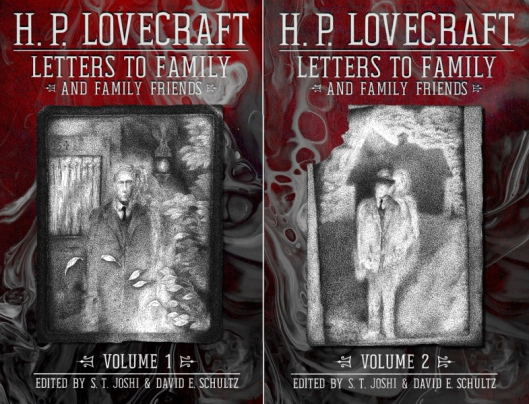
A new Ken Faig book is forthcoming

S.T. Joshi’s Blog has updated again. He reveals the forthcoming…

new collection of Ken Faig’s writings on some of the more obscure corners of the Lovecraftian world. Some of these writings have been published in very limited editions by Ken himself as part of his “Moshassuck Monographs” series, but we intend to gather them and others together into a solid volume that will display the depth of Ken’s researches.

I’d known about this planned book via email, but now the good news is public.

‘Picture Postals’ from Lovecraft: Robinson Hall, the first Brown Library

Until he was aged about age 9 or 10 this would have been “the University library” (1878) that the boy Lovecraft knew of, as he mentally mapped the topography of College Hill and the wider city. The Library, being rather small for the growing university, was replaced by the current larger one in which Lovecraft’s letters are now housed.

The old Library then became simply “Robinson Hall”. The Economics Dept. relocated there in 1912 and, since Lovecraft was economically illiterate, it seems unlikely he knew it further other than by sight. The decorative exterior ironwork was lost due to decades of neglect, and when the ivy became unfashionable in the 1980s it was also removed. Like many desirable spaces in universities, by the early 1990s it was being used not by teachers and creatives but by the university admin staff. The building hung on until about 2017, when local press reports state it was demolished and replaced by an unremarkable modern admin block. One can’t help thinking what a wonderful ‘H.P. Lovecraft Museum and Archives’ it might have made, from the 1970s onward, serving as a significant tourist and visitor attraction for the city.

It was here that a strange final act of Lovecraft’s Providence life was staged. A large crowd gathered outside one Sunday in the fall/autumn of 1959, to see the surreal sight of H.P. Lovecraft’s entire house slowly moving through the streets of his city…

Truly, I never saw such fixed attention in a large crowd. I remember one elderly lady in tweeds who seated herself on a granite curb on the edge of the lawn at Robinson Hall to watch the show and enjoy a cigarette or two: she never once looked away from the slowly advancing house as she smoked.


Added to Open Lovecraft

* B. Granic, Aesthetics of the Underworld, 2020. (Masters dissertation for the Department of English, University of Split. Includes the chapter “The concepts of aesthetics and the underworld in the work of H.P. Lovecraft”).

* M. Rosen (Ed.), Diseases of the Head: Essays on the Horrors of Speculative Philosophy, PunctumBooks, 2020. (Has the chapters: “Horror of the Real: H.P. Lovecraft’s Old Ones and Contemporary Speculative Philosophy”; “When the Monstrous Object Becomes a Tremendous Non-Event: Rudolf Otto’s Monster-Gods, H.P. Lovecraft’s Cthulhu, and Graham Harman’s Theory of Everything”; and “Encountering Weird Objects: Lovecraft, LARP, and Speculative Philosophy”).

More on Lovecraft in Harlem

Dipping at random into my newly arrived book of Letters to Donald and Howard Wandrei has yielded up a new addition to my recent Harlem post at Tentaclii. In a 1927 letter Lovecraft talks of the sights the lad must see in New York, and one of these was Harlem…

sinister and fascinating — not a white face for blocks. Lenox Ave. subway to 125th St. — walk north.

This most likely indicates a route Lovecraft was familiar with. Possibly the one he took to visit Morton, who lived in a Harlem brownstone, or one that Morton took to give Lovecraft a taste of Harlem. We know from Lovecraft’s day-by-day 1925 Diary that he made a trip into Harlem at least once.

Update: There was at least one meeting of the Kalem Club in Harlem, at Morton’s place in the heat of August 1924, and this is attested by a Lovecraft letter in Letters to Family and a mention in Kirk’s Diary.

Also found was a new addition to the ‘Lovecraft as character’ list, albeit not extant. In a 1931 letter Lovecraft revealed that Frank Belknap Long was busy writing a novel with Lovecraft and his circle as lightly-veiled characters. This work has evidently not survived. Although Long’s “The Black Druid” (1930) has, in which Lovecraft is the lightly-veiled “Stephen Benefield”. Possibly the novel was an expansion of “The Black Druid”?

WordPress.com Classic Editor restored

There’s now a robust fix for automatically reaching the Classic Editor, for users of free WordPress.com blogs.

This means that, for the time being at least, free blog users at WordPress.com don’t have to use the free offline-blogging software Open Live Writer. It was looking like that was going to be the only viable option, to avoid the horrible Block editor at WordPress.

The only element of the UI that you won’t be able to get via the older interface is the “Bell” alerts. Because the “Bell” sidebar (showing alerts from across your blogs) now no longer loads up in the older UI. To see these alerts you need to temporarily click into “My sites”, take a peek at the slide-out Bell sidebar there, then go back again.