Jack London’s Fantastic Tales

Sandy Ferber has a long and appreciative review of Jack London’s prehistoric work Before Adam (1907), read in what sounds like a nice 2000 edition from Bison Books. The review has many spoilers, but is also a fine summary if you’re not all that likely to read the book.

As many pulp historians will know there was quite a crop of such stone-age books and stories during this period, and from many of the leading writers. Late in the day R.E. Howard broke into print with such a tale, “Spear and Fang”, and Lovecraft remarks that Howard was a perceptive admirer of Jack London.

But melodramatic grunt n’ weep Stone Age tales have never been something that’s greatly appealed to me, and I guess I prefer a mix of the specific and a grand sweep of history. As such I’ve enjoyed Mithen’s non-fiction door-stopper After the Ice and I find authentic “through the ages” re-creations of prehistoric life interesting in art. There’s a wealth of stamp and card-art of this type, most of it seemingly from inter-war Germany which had a large industry in quality colour-card printing, and which you can today find flowing through eBay…

Anyway, at the end of the review Ferber notes that…

I see that Dover has also put out a book of Jack London’s short stories dealing with the fantastic, entitled, uh, Fantastic Tales.

It’s actually from the University of Nebraska’s trade books imprint, Bison Books, who also re-published Before Adam. Turns out to be a limited edition from 1998 in their Bison Frontiers of Imagination series. The hardback is nudging toward silly prices, but the paperback is still affordable on Amazon though it doesn’t appear on the Bison website.

I then discovered that Fantastic Tales used to be titled Jack London’s tales of fantasy (1975). As such it is now on Archive.org to borrow, alongside The Science Fiction of Jack London: an anthology; and The Science Fiction Stories of Jack London, all books with what looks like quite a bit of crossover in their contents. This non-doggie side of London’s work thus seems quite manageable, and I may well get around to it one day.

CLIJ : Cuadernos de Literatura Infantil y Juvenil

Now online, public Open Access back-issues of the CLIJ : Cuadernos de Literatura Infantil y Juvenil, 1988-2009. This is the venerable Spanish monthly on children’s literature and illustrators, and the online archive from #1 in 1988 runs to over 2,000 articles. The magazine’s focus is on young and middle-childhood, and as such the magazine is very well illustrated. It doesn’t appear to cover things for more mature teen readers, like the Toutain empire of the Heavy Metal-like comics magazines of the 1980s and 90s.

Search and viewing is per-page and as such rather clunky. One easier way to get full-issue PDFs is via Google Search…

site:www.cervantesvirtual.com/obra/ Lovecraft filetype:pdf

This also picks up post-2009 issues in .PDF format, and for instance I can get one from 2010 which would not be accessible via the site’s archive list. Some of the issue numbering seems to be astray, too. For instance, what downloads as clij-cuadernos-de-literatura-infantil-y-juvenil-137.pdf turns out to actually be #151.

Lead articles in CLIJ appear from random sampling to have a substantial focus on imported British and American culture in translation, and I see specials on R. L. Stevenson, J.M. Barrie, and American superhero comics as experienced in Spain (issue #151)…

#32 (1991) was a special on Gisbert, who was apparently strongly influenced by Lovecraft.

#80 (1996) had a survey of the stranger ends of fantasy literature, “From Zeus to Lovecraft”.

#236 (2010) had a long feature surveying horror literature in Spanish, for younger readers. Probably there are more specials to be found, if one wants to dig in.

“I felt a tingling sensation as when a theatre curtain rises….”

New at the HPLHS Store, Dark Adventure Radio Theatre: The Curse of Yig. Available either as MP3 downloads or CD (said to be shipping in the second week of of November).

Mrs. Reed [‘Zelia Bishop’] is a client for whom Long & I have done oceans of work, & this story is about 75% mine. All I had to work on was a synopsis … There was no plot or motivation — no prologue or aftermath to the incident — so that one might say the story, as a story, is wholly my own. … Also, I worked up the geographic & other incidental colour — getting some data from the alleged authoress, who knows Oklahoma, but more from books.

Lovecraft also provided the title and charged his client just $20 for the tale.

I Am Providence set for a Russian translation

S.T. Joshi’s Lovecraft biography I Am Providence is now set for a 2021 Russian translation, reportedly from major publisher Eksmo. Apparently Eksmo also has a strong line in fantasy and science-fiction, and recently produced an arty pocket-book edition of “The Call of Cthulhu” in Russian, so should be well placed to promote the book.

David J. Goodwin, author of the non-fiction Left Bank of the Hudson: Jersey City and the Artists of 111 1st Street (2017) has also announced a partial new biography…

Lovecraft & New York: My Second Book … will chronicle Lovecraft’s experiences in Gotham and discuss his lifelong relationship with cities. … The book is several years away.

“Gotham”? No, Lovecraft was not secretly resurrected and rejuvenated as the 1939 Batman… it’s just a nick-name for the city that’s used by locals.

H.P. Lovecraft at Christmas

A Patreon patron has sent in a question for me: “What did Lovecraft write or say about Christmas? There’s the short story “The Festival,” of course. Anything else? Did he ever comment on a connection between Christmas and ghosts, beyond the observation that M.R. James read many of his tales to the boys at Eton at Christmastime?”


H.P. Lovecraft grew up with a traditional enjoyment of Christmas as a homely event. The trimming of the home with holly and evergreen boughs. Carol-singing in the parlour on Christmas Eve. The garlanded and lit star-topped Christmas tree, with a glittering drift of parcelled gifts and purling ribbons spread beneath it. The “old-time Christmas feast with plum pudding and all” and mince pies too. His ideal festive meal (here actually Thanksgiving, but very similar) being…

Enchanted soup — apotheosised roast turkey with dressing of chestnuts & all the rare spices & savoury herbs that camel-caravans with tinkling bells bring secretly from forgotten orients of eternal spring across the deserts beyond the Oxus — cauliflower with cryptical creaming — cranberry sauce with the soul of Rhode Island bogs in it — salads that emperors have dreamed into reality — sweet potatoes with visions of pillar’d Virginia plantation-houses — gravy for which Apicius strove & Lucullus sigh’d in vain — plum pudding such as Irving never tasted at Bracebridge Hall — & to crown the feast, a gorgeous mince pie fairly articulate with memories of New-England fireplaces & cold-cellars. All the glory of earth sublimated in one transcendent repast — one divides one’s life into periods of before & after having consumed — or even smelled or dream’d of — such a meal!

We can better judge his early regard for Christmas by his poetry rather than his fiction (of which only “The Festival” makes use of “the Yule-time”). For instance, the very long poem “Old Christmas” (written late 1917). S.T. Joshi sums it up as…

a re-creation of a typical Christmas night in the England of Queen Anne’s time [with] its resolutely wholesome and cheerful couplets. The sheer geniality of the poem eventually wins one over if one can endure the antiquated diction.

It reads better for a British reader, perhaps, and seems fine to me. Lovecraft himself called it “a rhymed essay — light verse, verging on the whimsical”. Lovecraft was pleased to find that his poem had successfully evoked an olde English winter coach-road topography… “I rejoice that Mr. Bullen, a native of the Mother Land, should find my pictures reasonably accurate.” The poem’s title likely points us to Washington Irving’s “Old Christmas” (1820) which has a very similar British setting and set of concerns, and which itself followed on from Scott’s Marmion (1808).

Lovecraft was also aware of the deeper Roman and pre-historical roots of Christmas, as evidenced in his local newspaper astronomy article “The December Sky” of 1914. There he talks of the winter solstice date and that the Christian festival was likely partly a 4th century absorption of “the ancient Roman Saturnalia, which was [itself] a development of the primitive [Italian] winter festival called Brumalia.” Of the Northern pagan customs, equally intertwined into the Christmas festivities, he notes in the same article that… “Many of our present Yuletide customs are derived from the winter festivals of the Druids and of our Saxon ancestors.” Here he was likely thinking of things like the Yule log and the red-berried evergreen holly.

For Lovecraft Christmas and New Year was usually a time for some sustained personal writing, beginning with some personal poems to ‘limber up’. Lovecraft penned and sent witty and personally-tailored “Yuletide” verses to his friends and sometimes also to their cats. For instance, in mid December 1925 his friend Sechrist received a verse that began… “May Polynesian skies thy Yuletide bless”. Sechrist had spent many years as a missionary on the islands. A great many more of these verses are to be found in the latest edition of The Ancient Track: The Complete Poetical Works of H. P. Lovecraft.

It should go without saying that Lovecraft, as an atheist, enjoyed Christmas as a festive tradition and not as a religious festival. Though he was not above wishing people like Derleth, Sechrist and the Rev. Whitehead a straight “Merry Christmas” in letters (rather than his usual use of “Yuletide”). He also sent plain Christmas cards, almost cursory in this instance, to his less favoured correspondents…

In his later years he could also stretch to hearing (but perhaps not singing) Christmas carols sung in the courtyard of the local Handicraft Club in College Street. He also found enjoyment in “decking the halls” and setting up a Christmas tree to surprise his surviving aunt, and in then accompanying her to the adjacent Paxton guest-house to enjoy a Christmas dinner with the old folks.

What of ghost stories? While admiring Victorian idealism and spread of manners Lovecraft disliked nearly all other aspects of mid-Victorian culture and architecture, and especially its sentimental “mind bred on Dickens”. He writes… “I have my pet detestations amongst the later English [authors, with the first of these being] “the sentimental hypocrite Charles Dickens” whose works made him “nauseatedly weary”. It then follows that this dislike may have extended to the maudlin and political Dickensian accretions on Christmas (Scrooge, Tiny Tim, etc), together with the British tradition of the ‘ghost story told at Christmas’. The latter first emerged in the late 1820s in the north of England, though we only have one unreliable source for that. Possibly the reception of Washington Irving’s “Old Christmas” (1820) helped spur such things, since at one point it notes an old antiquarian Parson “dealing forth strange accounts of popular superstitions and legends of the surrounding country” by the fireside. But the ‘Christmas ghost story’ as such first emerged in print in the 1830s, from the prolific pen of Dickens. By the 1860s a genteel ghost story was a commonplace in the Christmas annuals, but it is said to have mostly faded away by the start of the First World War in Europe. As an oral read-out-loud tradition it has now also largely faded away in the home — being now only a seasonal stock-in-trade reached for by weary magazine editors and TV programmers. The greatest British tradition may well be ‘the invention of tradition’, but such invention does not always stand the test of time.

What of America? So far as I know ghost stories were not told at Christmas in Rhode Island in Lovecraft’s youth. The Puritans had of course frowned on such things, to the extent that printed early Victorian accounts of a British Christmastime had to be peppered with footnotes to explain our curious doings and festive frolics to Americans. But it is not impossible that families of British origin continued the Dickensian tradition into the period of Lovecraft’s boyhood, the 1900s, via British magazines. If they did then it could not have been with ghost tales from M.R. James, who from circa 1904 onward was telling an annual self-penned ghost story to the boys at Eton, since Lovecraft did not even discover M.R. James until “mid-December 1925” (Joshi, I Am Providence). Nor, so far as I can tell, was there a wider American tradition of Christmas oral readings of ghost stories by other more local writers, though some pre-1914 Christmas annuals in America evidently followed the British tradition of printing a sentimental moralistic Christmas ghost story among the festive fare — and there is the possibly-isolated example of the famous “The Turn of the Screw” (1898) with its Christmas framing. Lovecraft’s grandfather also told him oral weird tales, but so far as I recall this was not done as a Christmas tradition.

However, Lovecraft’s long “Old Christmas” poem of 1917 does very briefly depict a “Granny Goodwife” telling small children a ghost tale on Christmas Eve in the pre-Victorian reign of Queen Anne, so evidently he knew of the British tradition and believed that it went back beyond Dickens and the 1830s. Possibly he had read Hervey’s Book of Christmas (1838), a book deeply unconvincing on the supposed antiquity of the ghost-story “tradition”, but which does have an evocative drawing of just such a “Granny Goodwife” and her little charges. Hervey would have us believe this is good evidence of ghost storytelling at Christmastime, and he leans on it heavily…

But note that there is nothing in the picture to suggest this depicts Christmas rather than Halloween, or the general telling of “winter tales” of the sort evoked by the British playwright Marlowe, who in a play of 1589 had a Maltese character recall these from childhood…

Now I remember those old women’s words,
Who in my wealth would tell me winter’s tales,
And speak of spirits and ghosts that glide by night
About the place where treasure hath been hid.

That there were undoubtedly supernatural fireside tales told during long winter nights does not, however, mean that some about ghosts were traditionally recounted on Christmas Eve. “Winter” here could equally imply Halloween or post-Christmas.

My feeling is that ‘the Christmas ghost tale’ as we know it was a confabulation that first arose organically in the 1820s, perhaps in local English responses to Scott’s best-selling Marmion (1808) and the visiting American Washington Irving (1820), and this trend in grassroots re-creation was then picked up and promoted commercially by Dickens and Hervey in the 1830s.

But ironically Lovecraft was right in his poem of “Old Christmas”… in a way. There was once some sort of Christmas tradition in Britain, but it had almost certainly long been broken by the 1820s. Sir Gawain and the Green Knight (c. 1377) is clear evidence that a supernatural ‘Christmas-set tale’ could have had a hearing at Christmas in the northern Midlands, but the poem was lost and was not recovered in good form until 1864. Another such ‘lost’ tale is the first horror novel Beware the Cat (1561), first published in accessible form by the Chetham Society in Remains, Historical & Literary (1860). The narrator tells his cycle of tales of talking cats to his bedfellows on a chilly Christmas night.

Origins of Religion & H.P. Lovecraft

MythVision podcast is hosting a new regular podcast series from Robert M. Price. I almost didn’t recognise him in the recent YouTube videos, and I think I’d last seen him properly on video back when someone was filming a documentary on him. That has to be about six years ago now. But here he seems to have had a startling rejuvenation, worthy of Lovecraft’s Robert Suydam…

Mostly the show appears to be about helping the lay reader to correct some of their more astray myths-and-misconceptions on the Bible and Biblical scholarship, in which he’s of course an expert (see his other show, The Bible Geek). But the general underlying gist of it appears to be that many of the Christ stories in the New Testament can be shown to have been shaped or embroidered with reference to older stories. Sounds fair enough, if that can be proved.

But he also has a few Lovecraft podcasts on the list, such as “Origins of Religion & H.P. Lovecraft” (June 2020).

His last The Lovecraft Geek podcast episode was back in May 2020.

Friday ‘picture postals’ from Lovecraft: steamer across the Mississippi

This week I follow Lovecraft way out… across the Mississippi river. Dealing again with steamboats, this post is thus a follow-on to last week’s post on Lovecraft’s steamboat trips to Newport, RI. Yes, he actually once made it to the Mississippi, but he also encountered and was delighted by a rail journey along…

… the sinuous windings of the yellow Tennessee River. … After a couple of days in Chattanooga I rode across southern Tennessee to Memphis, where I saw the mighty Mississippi for the first time in my life. This ride involved some of the most magnificent sights of the whole trip — for most of it lay in or beside what is whimsically called the ‘Grand Canyon of the Tennessee River’ — the magnificent bluffs forming part of the Cumberland Mountain system [as they coil above] golden-tinted waters.

Once settled into the old quarter of New Orleans he crossed over “Old Father Mississippi” via the Algiers ferry…

for the first time treading soil west of the Mississippi….

Did he also see the big old river steamers? It’s quite possible, as it was summer 1932 and they were working on the river to be seen and photographed until at least 1936. As seen here in 1936…

He was also riding south on steam trains. In summer 1932 Lovecraft was still living in the last few years of the great age of steam power. At home in Providence, he would the next year move into a new home heated by steam.


His visit to Lookout Mountain, also while in Tennessee, had however been via a nippy electrified mountain rail-car…

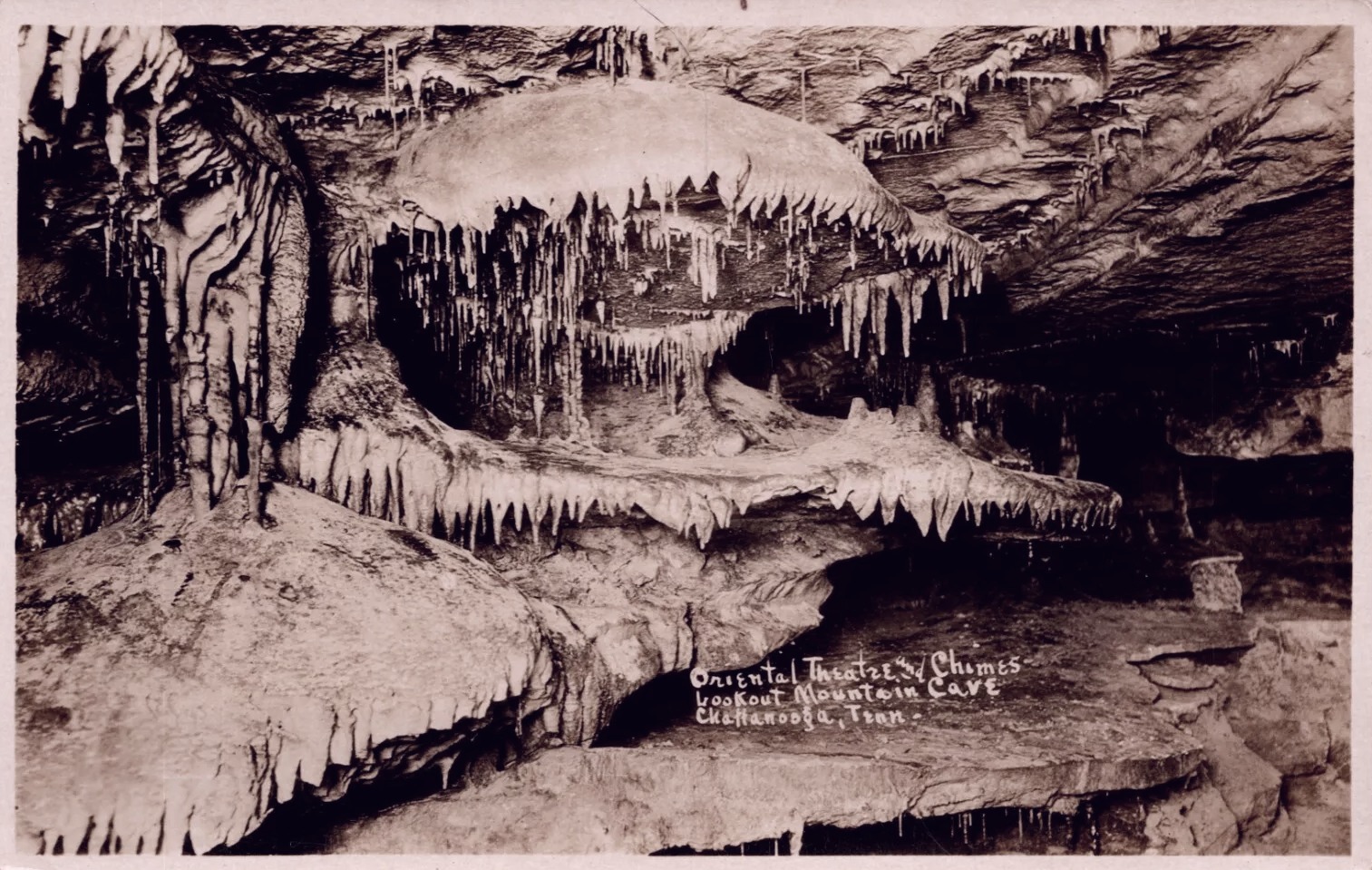
This precipitous car hauled him aloft Lookout Mountain and then he descended via a deep elevator shaft to explore another large and spectacular cave system. His first such descent having been in summer 1928 at the Endless Caverns.

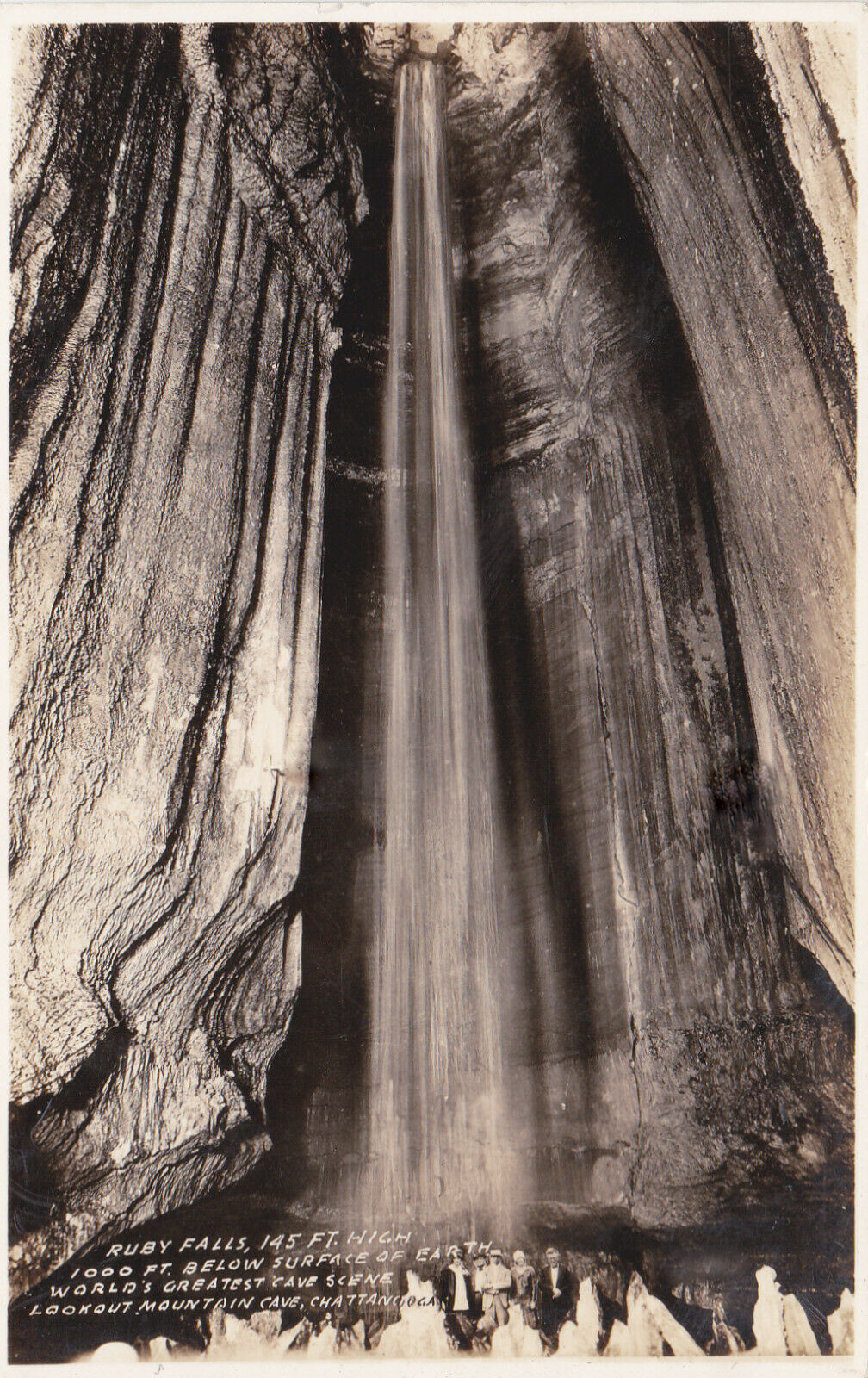
I went up Lookout Mountain and revelled in the view and afterward descended into the spectral caverns inside the mountain — where in a vast vaulted chamber a 145-foot waterfall thunders endlessly in eternal night. This chamber and waterfall were discovered only ten years ago — at the end of sealed galleries whose geological formations prove them never to have been entered by mankind before.

I went all over Lookout Mountain [Tennessee], & explored the magnificent network of limestone caverns inside it — culminating in the vast & new-discovered [1923] chamber called “Solomon’s Temple” where a 145-foot waterfall bursts forth from the side — near the roof — & dashes down to a pool whose outlet no man knows.

“There were awed sessions in libraries amongst the massed lore…”

New on JSTOR in digital form, the latest Lovecraft Annual No. 14, 2020. JSTOR has one-page public previews for all items except the “Brief Notes”, and full-text access for subscribing universities. Rather amusingly, JSTOR’s TOCs have Lovecraft apparently reviewing his own letters, and to one “Hoard Wandrei”.

Also available from Hippocampus Press.

I only need this latest Lovecraft Annual, plus #1 (2007) and #4 (2010), and then I’ll have the complete set in paper. Note that #1 is not on Amazon and never comes up on eBay, but can currently be had in print from Hippocampus.

Call of the Dreamlands

I’d always been vaguely put off the Call of Cthulhu RPG’s “Dreamlands” supplement by its naff current cover. Partly because the cover recalls for me the boredom engendered in a boy by C.S. Lewis’s show-stopping The Voyage of the Dawn Treader (I think it was that one, in Narnia series), rather than the creepy wonders of encountering Lovecraft’s Dreamlands. And then there’s that awful garish typography and equally off-putting subtitle: Roleplaying Beyond the Wall of Sleep. When did “Beyond the Wall of Sleep” enter the Dreamlands canon? Nothing about the cover invites confidence in the likely contents.

But who knew there was this older cover, which makes the thing look very much more appealing and is a nice bit of Lovecraftian art in its own right…

Anyway, if you want to check out the CoC Dreamlands as it currently stands (with Gazetteer, creature guide and map, as well as RPG adventures), there’s no need to pay silly collector prices for it. The 2011 printing is currently available in print for $10 at the Chaosium site, although shipping is extra.

Here’s a peek at the contents for the two books and map found in the original box…

New book: Annotated Guide to Robert E. Howard’s Weird Fantasy

Fred Blosser has a new book, the Annotated Guide to Robert E. Howard’s Weird Fantasy

The Annotated Guide to Robert E. Howard’s Weird Fantasy scrutinizes this full range of Howard’s dark fiction by listing, summarizing, and critically analyzing more than 50 tales.

Blosser is also the author of 2018’s Western Weirdness and Voodoo Vengeance: An Informal Guide to Robert E. Howard’s American Horrors, and Ar-I-E’ch and the Spell of Cthulhu: An Informal Guide to Robert E. Howard’s Lovecraftian Fiction. All three would make a pleasing Christmas gift-set in paperback, I’d imagine.