Northeast monsters

The Northeast Popular Culture/American Culture Association seeks

papers that explore and highlight the Northeast’s contributions to monster lore, including authors, events, individuals, locations, and, of course, monsters.

This is for an online session. Proposals by: 1st August 2021. I can’t find a map of what they count as being “Northeast” (now there’s an opportunity for an map-artist/illustrator, potentially) but it definitely includes New England.

Rather surprisingly there appears to be no New England historical folk bestiary other than the 64-page children’s book Ghastly Perils of the Great Outdoors (1986), though I’m not sure how historically grounded its whimsies are…

Here for the first time the truth about the Womkeag, Rumweevil, Gouger, Pakroc and dozens of other snaggers, shuckers, nitters, fumblers, grinders, chuckers, and twangers infesting the Great Outdoors

Possibly the region is just too big to bring sales for a comprehensive survey, since most likely readers will only be interested in their own smaller sub-region? From a British perspective it would probably be like expecting people to be interested in a survey from the Orkneys in Scotland down to Brittany in northern France. When what you really want is a county survey. However, the region’s sea monsters are surveyed in The Great New England Sea Serpent (1999) and several other books.

Possibly a good stocking-filler for a child in New England?

More notes on Letters to Family

I’ve now reached 1925 in Letters to Family. Bringing the notes up to date…

* In summer 1924 Arthur Leeds was at the Cort on 49th Street, New York City, but moved across the road to the Ray in September. The Cort appears to have been a theatre, not a hotel?

* Loveman was working at Stone’s rare bookshop in the autumn of 1924, on 4th Ave. & 13th St. Publishers Weekly of the period has this as “Stone’s Book Store”, and it had been long established. There are no photos to be had at 1940s.nyc.

* Lovecraft saw Poe’s Planters’ Hotel twice (at least) in 1924, and he and his circle explored Greenwich Village extensively. Colonial districts of the city tended to abound with cats, adding to their appeal to Lovecraft.

* Lovecraft remarks that African “Congo masks” were in vogue among New York’s modernist artists in summer 1924.

* Lovecraft usually approached Morton’s place in Harlem “from downtown”. Several Kalem Club meetings were held there, and Lovecraft was not averse to walking through Harlem in the early hours of the morning.

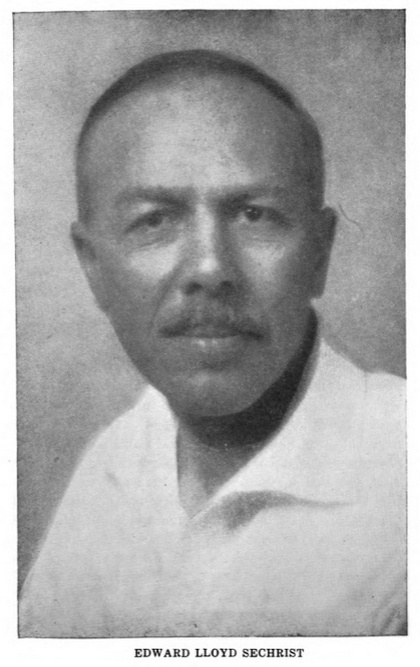
* Sechrist appears to have had a book of the Polynesian tales he collected and translated while living with a storytelling clan, for which he was seeking a publisher. Evidently it never appeared.

* A month prior to Lovecraft’s move to Red Hook, Long rather cheekily gave him a book in praise of the monastic life, which Lovecraft enjoyed and devoured avidly. We also get more detail about the famous The Time Machine by H.G. Wells, read by Lovecraft in November 1924. It was a library copy, borrowed for Lovecraft by Long, and thus did not come from the Wandrei collection of early science fiction. Lovecraft thought it gripping from start to finish.

* We learn the price of Loveman’s radio (later stolen from Lovecraft’s room on the edge of Red Hook). It was very expensive, a powerful “$100” radio set and evidently portable as it made an appearance at several Kalem meetings.

* Lovecraft comments on getting some 10 and 5 cent scrapbooks for his press and magazine cuttings collection. [This did not happen, it seems].

* Trigger-ban’s eyes were green, not the common yellow.

Ernest La Touche Hancock

I now have a full version of the caricature of Lovecraft’s New York friend and correspondent Ernest La Touche Hancock (1857-1926). It was only available previously as a tiny thumbnail, back in 2013.

The name on the donkey appears to be “Pegasus” (the immortal winged horse of myth), and the lettering on the tiny toon tableau in the bottom-right corner cannot be read. The figure in the Union Flag waistcoat is “John Bull”, the archetypal beef-fed 18th century British squire. Hancock wears a small ‘mortar board’ hat, which once symbolised a teacher. The only thing that can be fathomed today is “John Bull” — like Lovecraft, Hancock was an ardent Anglophile.

Hancock was familiar with many cartoonists of the 1890-1925 period and his long survey article “The American Comic and Caricature Art” (the American The Bookman, Nov 1902), he praised the young Herriman of Krazy Kat fame: “Art combined with poetry is the characteristic of George Herriman. Were his drawings not so well known one would think he had mistaken his vocation.” It’s thus not impossible that Hancock, knowing of Lovecraft’s liking for cats, might have mentioned the poetick Kat in a letter.

‘Picture postals’ from Lovecraft: family carriages and fine views

This week, more on the transport theme. Letters to Family briefly reveals that, as a young boy, Lovecraft and his grandfather used to drive out in a horse and carriage/gig named “Tom”. Evidently they would enjoy getting purposely lost in the country east of Providence…

… we wandered interestingly in the young dusk, and became picturesquely lost — as when Grandpa and I used to get lost driving “Tom” in East Providence — on some unknown height…

The implication here is that, being lost, he and Grandpa would then need to find elevated viewing points to drive up to or halt by, presumably partly to-reorient themselves but also to enjoy unexpected views.

(The above quote is not indexed: in the Index to Letters to Family add “p. 145” to Phillips, Whipple and to Lovecraft, H.P. … and Whipple Phillips).

Not Lovecraft and his grandfather, but evocative of riding “Tom” into a field to enjoy a sunset vista.

These were the days before any substantial automobile ownership, and it would have been very safe and quiet on the roads and lanes. Most likely the field and track gates were only latched, not padlocked as they might be now. The only danger and noise was likely from the occasional fierce farm-dog, but dog training was far better in those days and they were also trained not to spook horses.

What was “Tom”? Possibly Lovecraft’s “Tom” was a large four-seater family ‘city carriage’ with the sides down or off for the better weather, but the type of East Providence backroads and lanes travelled probably meant this was not practical. The roads, especially back-roads on which one might become lost, would not have been as good as today. True, the turnpikes (toll-roads) had been abandoned in Rhode Island by the 1880s, and a decade or two later one could go where one liked. But the patchwork of local upkeep is said to have left much to be desired, being good in places, but poor and uneven a mile further on, then good again. Rhode Island’s famous scientific ‘road surfacing’ experiment was not until 1907. This saw the laying of 14 ‘experimental sections’ to discover which was the best-wearing and most dust-free option. They were, surprisingly, the first such state in the nation to actually do such rigorous tests and the results came in 1909. A simple mix of “tar with natural stone macadam” beat all the fancy expensive mixes that contractors recommended. But the state’s new roads were not laid until after 1909. Thus the pre-tarmac roads encountered by Lovecraft and his grandpa circa 1895-1900 would have been quite varied, especially if one was trying to take a semi-random route in outlying rural districts.
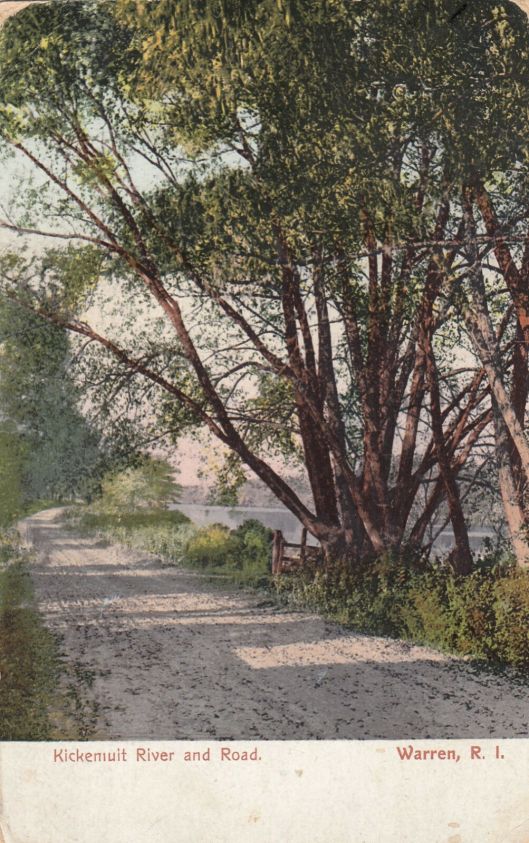
The unpaved road to Warren, in the far south of East Providence.

This means that a city-type carriage was probably not practical. Could there have been another lighter buggy-style carriage? Well we know the family kept several “carriages”, before financial problems meant…

the horses and carriages were sold too, so that I had a gorgeous, glorious, titanic, and unbelievable new playhouse — the whole great stable with its immense carriage room, its neat-looking ‘office’, and its vast upstairs, with the colossal (almost scareful) expanse of the grain loft…

Lovecraft somewhat hazily recalled this loss/gain as being “ca. 1895”, but S.T. Joshi dates the departure of the carriages and live-in coachman-groom a little later…

“when the coachmen left (probably around 1900)” (I Am Providence).

Whatever the dating we can thus be sure there were once several horse-drawn vehicles, hence the large size of the stable. The trips with his grandfather could then equally have been in a lighter runabout gig of the sort seen above. Possibly the formative vista-seeking trips were enjoyed when Lovecraft aged four or five, but if Joshi’s “1900” dating is a better informed guess they may have been a little later, perhaps at age seven or eight.

Anyway the dating of the stable probably does not matter for the dating of the trips. Since I assume that a sixty-something businessman like Grandpa Whipple would have still required hired horse transport to get around, even if he could no longer afford to have it located in the home stable. Experts on the Whipple finances may know more, but my guess is that he retained local access to at least a horse and buggy, even if it had to be hired in from nearby. He also likely retained the local ‘pull’ to borrow one from a friendly neighbour on a fine evening, even if finances were tight.

As quick-eyed photographers know, being on a bicycle (ideally tirelessly electric, or in this case a horse-buggy) enables one to discover exponentially more photographic possibilities than when plodding along on foot. If getting psychogeographically lost on purpose to find “picturesque” sights, Grandpa’s random turnings and likely exploration of spectrally embowered by-ways must have had much the same effect, offering many more ‘picture views’ than for the walker. I assume that the views were not simply for mundane re-orientation after becoming lost, and would have been enjoyed for their own sake.

But I also suspect the apparently random nature of the trips were about more than stacking up the probabilities of finding a really good near-sunset view. Recall, for instance, that his grandfather also gave the boy other forms of training at this time, such as finding his way through what Lovecraft called “a certain chains of dark rooms” to cure his fear of the dark. On a New York walk he recalled that he had also enjoyed becoming purposely lost in the local Cat Swamp as a boy…

Remembering that I had no map & knew nothing of the country, [I went] trusting with chance with a very agreeable sense of adventure into the unknown; just as I used to enjoy getting “lost” on walks around Cat Swamp, East Providence, or somewhere, with you [his aunt], Gramp, or my mother in the early and middle ‘nineties.” Letters to Family, page 421.

These things were also a form of navigation training. Thus getting lost with “Tom” could also have been another form of training, with purposeful random turnings aiming to teach the boy some skills of ‘natural navigation’ (the sort of things now found in best-selling books such as The Natural Navigator). But, if finding the way home at dusk, then also navigation by key stars and the moon. The adult Lovecraft often displayed an aristocrat’s hazy sense of time re: being less than prompt for meetings, but he seems to have had a countryman’s navigational skills. He was able to quickly find his way in situations when his clueless companions had their heads spinning. One suspects that this innate skill was honed early, firstly with his grandfather and later independently on his bicycle.

His grandfather had, once, been a rural man likely to value such skills. There was still at the back of the family horse-stable “the orchard”, which the boy Lovecraft would regularly raid for summer fruit. And there was also a field beside the house which pastured the family cow

… the family cow — a beloved possession reminiscent of the prehistoric Greene days ere my grandfather became an urban dweller.” (Lovecraft, letter to Kleiner)
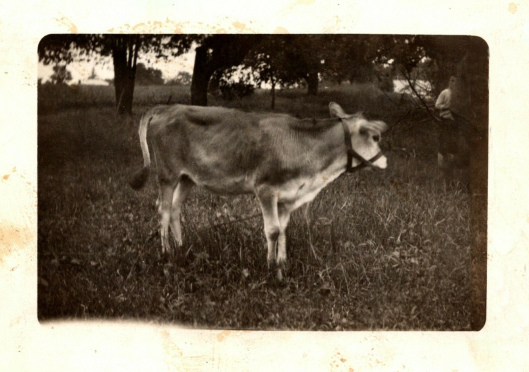
Again, not actually the boy Lovecraft and the family cow, but somewhat evocative of the likely scene.

It was, he later recalled…

an open field with a stone wall where great elms grew [and] a cow pastured under the gardener’s care. Here, when I was five, they built me a playhouse…

“What’s that you say, kitty..?”

Well, another April Fools’ Day gone. My favorite was Vet Times, which reported… “Tech breakthrough translates cat calls, meows and purrs”. The runner up was the report that French scientists have cross-bred and tweaked banana plants… to grow meaty-tasting sausages instead of bananas. And solar panels that work in the dark, though I think that one’s been done before.

The favourite “not an April Fools’ Day joke” is Project Gemini which revives Gopher, and has built a lightweight texty altWeb with ascii-art and Atom RSS on top. There’s a Windows browser for it and a search engine [gemini://geminispace.info/documentation/searching]. Homepages are ‘capsules’, blogs are ‘gemlogs’. No pictures allowed, except ascii-art [gemini://dgold.eu/17.gmi]. You could probably do dancing hamsters, if you scrolled a page of that stuff fast enough.

Sadly WordPress can’t handle gemini: links, and thus they’re here given [in the WordPress 'code' tags]. But once you have the Gemini browser installed and are at a live gemini: protocol link, your regular Web browser should ask if you always want the Gemini browser to open links of that type. The browser can also handle gopher: links. Bring on the dancing gophers…

March on Tentaclii

I’m pleased to say that Tentaclii Towers has survived the first plague-winter. Not that there was much to survive, other than the lockdown itself. My fairly large electoral area registers just 17 deaths since last March, little more than the usual flu might bring. But now the winter is over and the surrounding rolling acres of inner-city Stoke-on-Trent are looking rather pleasant again, as the early springtime simmers through a string of warm days. A rhyme of magpies performs delightful acrobatics across the wide gravel driveway of the Towers. At night a peculiar smell bubbles up from ripening ponds.

This month my weekly ‘Picture Postals’ post looked at: Lovecraft and the Providence Opera house; discovered that a giant octopus and squid had once hung from the roof of the Brooklyn Museum; climbed aboard a typical motor-coach interior of the early-mid 1930s; and eyed the Museum of Natural History, Roger Williams Park, with particular reference to the ‘cosmic’ Lowell exhibition held there in 1916. As a post for a Patreon patron I also made a quick preliminary survey of ‘Poe’s home places and H.P Lovecraft’, with pictures. There were also photo-surveys which ventured inside both Weird Tales buildings in Chicago, the Dunham Building and then the Michigan-Chestnut, during the prime ‘Lovecraft years’.

I looked briefly at Samuel Loveman’s “young” friend Gervaise Butler and found two candidates. I suspect he is the younger of the two, a Gervaise Butler born 1904. Lovecraft knew him in 1929, and seems to have thought enough of him to have given him a little one-to-one mentoring in early 1929. In return Gervaise gave Lovecraft a scarce anthology of New England children’s rhymes and games. I also took a look for “Bernstein, late of the Golden Ball Inn”, Lovecraft’s alterations tailor in Providence. I found a fine picture of the young Robert Bloch at his typewriter, and new auction pictures of Lovecraft’s poem “Despair” (c. February 1919). I also rescued an engraving of the Ladd Observatory, 1890. I’ve started reading Lovecraft’s Letters to Family, and it should prove a mine of information. More on that and other volumes of letters over the coming months.

In new books I noted the non-fiction guidebook Le guide Lovecraftien de Providence; the revisionist The Emotional Life of the Great Depression from Oxford University Press; and Joshi’s new essay collection Progression of the Weird Tale as an ebook. Over on S.T. Joshi’s blog he noted that “Lovecraft’s Letters to E. Hoffmann Price and Richard F. Searight … will be out soon from Hippocampus.” I also came across an overlooked non-fiction book from 2018, El sonador de Providence. In imaginative works I see that The Last Oblivion: Best Fantastic Poems of Clark Ashton Smith has appeared in an affordable format, and I also took a look at the Sonia/Lovecraft play “Lovecraft, mon amour” which is now being staged in France.

In new resources, I was pleased to find the Spanish comics journal Cuadernos de Comic (CuCo) has issues online from 2013-2020 in open access. Also a Lovecraft-era run of the journal Old-time New England. Elsewhere The Story Paper Collector (1941-66) is now freely available. Which reminds me that we really could do with the run of Lovecraft Studies online in full, at some point.

I surveyed DeviantArt for a choice gallery of recent new pictures of Lovecraft himself, and brought news that Archive.org has loaded up a million Thingiverse 3D models under Creative Commons, thus providing abundant artist reference and source material. Also in art, Lovecraft paperback-cover artist Ian Miller now has prints of the cover-paintings available. In comics I untangled and surveyed the various Toutain-edited and Toutain-sourced comics magazines of the 1970s and 80s, and suggested where one might find these amazing cultural artefacts today.

Not much in games this month, worth noting. The usual flow of indie-student ‘Lovecraft inspired’ games continues, but nothing big or remarkable. In RPGs the German Lovecraft Society has kindly been able to provide Germans with a full Lovecraftian open-source game framework based on Delta Green, which may bear fruit in due course. In the precarious world of movie-making it seems the suddenly ‘greenlit’ Lovecraft trilogy, being two movies set to follow the big-screen success of The Colour out of Space, has now been just as abruptly cancelled. Oh well, ‘easy come, easy go’.

There was very little new in audio this month, but the curious New England field recordings The Swamp In June and The Frog Pond were discovered on Archive.org. On YouTube there was the usual tidal-wave of Lovecraft readings, but in other types of material only a long survey-lecture of Lovecraft’s influence in Chile. In podcasts I find that the PodCatr service has become a lazy moggie and has failed to purr in my ear about the three new Voluminous episodes so far in 2021. Go get ’em.

As always, please consider becoming my Patron on Patreon. Even getting a boost of $1 a month is an encouragement. This month my Patrons have enabled me to grab a £12 bargain in the form of the new expanded Letters To Reinhardt Kleiner and Others (inc. 100 pages of letters and cards to Arthur Leeds), and also to pop the Lovecraft Annual 2020 into the same order for an extra £9. Expect a review in due course.