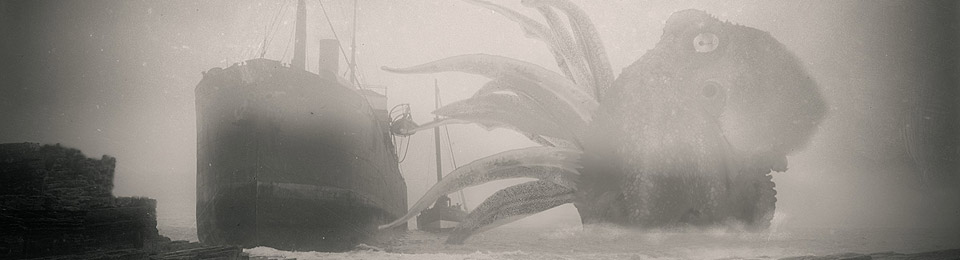
September on Tentaclii

September proved to be a moist month here in the English Midlands. A grey mantle of rain often covered even the top-most turrets of Tentaclii Towers, and down below the rain encouraged unctuous fungi to coil above the dewy lawns. But for now the sun shines, picking out treetops of fallow gold among the still-green swathes of surrounding woodland. Faintly from beyond these woods one sometimes hears the grumbling of peasants, as they queue for their meagre doles of donkey-fuel. Thankfully the Towers needs no donkeys and the great estate is, of course, powered purely by cosmic rays and shoe-leather.

This month the Tentaclii ‘Picture Postals’ posts sat with Lovecraft on the shore at Sakonnet, waited for the night bus in Providence, journeyed to Cykranosh (Saturn) with Barlow, squinted through the keyhole-of-time at his friend Everett McNeil, and dug out the forgotten location of Dana’s Bookshop in Providence. The latter being the last resting place of the remains of Lovecraft’s library, until it burned. I suspect Cthulhu cultists.

The original handwritten “Pickman’s Model” is up for auction with Heritage Auctions. It currently has about 11 days to before the hammer, and is at $6,000. But will surely go much higher. I’d expect that you’ll need to cash in at last three Bitcoin to be in with a chance of carrying it off.

The Lovecraft Annual 2021 appears to be emerging now from the cargo-hold of its Atlantic tramp-steamer, or is just about to (Amazon UK seems uncertain on that point). It is mooted be an excellent issue. Joshi’s new Penumbra mega-journal has now reached No. 2, and has at least five articles that may interest Lovecraftians. The R.E. Howard journal The Dark Man is also now available for summer 2021 and has several items of interest. It seems worth obtaining, at just £5 in paper.

S.T. Joshi announced the imminent arrival of his insider-history book The Recognition of H.P. Lovecraft. The Lovecraft/Long travel book collaboration for Long’s aunt, Old World Footprints, is now available as an affordable ebook. It appears that the Italians have released Io Sono Providence, vol. 3, this being their final volume of the eminent Lovecraft biography I Am Providence in translation. The French can look forward to their Lovecraftian ‘Campus Miskatonic’ event later in October. The Germans bagged the second volume of Klinger’s annotated Lovecraft in translation.

I found several scholarly journals new to me, the Journal of Science Fiction and Philosophy; Volupte: Interdisciplinary Journal Of Decadence Studies; and Iris, a long-running French journal “to promote and to disseminate research in the field of myths, images, symbols and cultural history”. New scholarly-popular books were spotted, on Poe and Science, and 18th century hoaxes — both relevant to Lovecraft. A call-for-papers was spotted from the Taiwan’s Wenshan Review of Literature and Culture (special issue on the Asian Gothic, some of which Lovecraft has influenced). Several museum exhibitions were noted, including major shows for the macabre dream-artist Redon and Sir Walter Scott (a minor influence on Lovecraft, though at a formative time).

New fan journals noted here included the newly magazine-ized Cthulhu Libria #2 (German, Lovecraft and railways theme), the slick oversized SICK #5 (English, Lovecraft special ‘designer arts’ issue), Bare.Bones #7 (English, leads with a Lovecraft in the movies essay), and Providence Tales No. 8 (Italian, a Mearle Prout special). In old journals arriving on Archive.org I spotted the substantial biographical article “Hannes Bok: Artist and Man”.

In audio, Libribox released a three-part “An appreciation of Poe” reading, giving a useful pre-PC appraisal of one of Lovecraft’s key influences; the Italian podcast Voice of Arda completed an epic 12-part Tolkien and Lovecraft comparison series of short podcasts; Morgoth’s Review had a pithy podcast lecture on “Lovecraft, Nyarlathotep And Our Changing World”; and the prolific Horrorbabble read “The Space-Eaters” by Frank Belknap Long. I wondered if the 1928 cartoon header for this story was the first public ‘cartoonizing’ of Lovecraft as a character.

In Lovecraftian arts I spotted Providence Blue, a major new novel featuring Lovecraft (and possibly Wilum Pugmire) as a character and written from a Catholic perspective; I found a major new Lovecraft graphic novel of Dream-Quest, H.P. Lovecraft: Kadath (in Spanish); the fine stop-motion “Report From the Ghooric Zone” animation had an extensive ‘making of’ post; Junji Ito has a new and ambitious Lovecraftian 240-page graphic novel called Sensor; and manga master Gou Tanabe announced and dated his forthcoming adaptation of Lovecraft’s “The Dunwich Horror”.

I posted another ‘New on DeviantArt’ survey, and found a fine new 3D rigged Cthulhu on ArtStation Marketplace. I dug out and looked back at the covers for Kaja Saudek’s Lovecraft editions and for various editions of Bilal’s early semi-Lovecraftian Le Bol Maudit. I discovered a lengthy ‘Timeline of Botanical Fictions’, mostly weird or science-fiction and also encompassing fungi and spores.

I completed my series of posts on ‘Notes on Letters to Family’. I pondered the best season for pavement pounding walking in what remains of Lovecraft’s Providence. I gave readers some advice on translation add-ons and bulk PDF download from Archive.org. Not yet mentioned on the blog, this month I was pleased to discover the old abandonware Digital Film Tools Rays 2.1.2.2 plugin for Photoshop, that being the last version. Their DFT 55mm I know well, but I had no idea their old Rays plugin was so powerful. Definitely one for spooking up your Halloween pictures, if you can get hold of it. Though I daresay there’s now some phone-app that can do something similar.

And finally, the next issue of the free Digital Art Live magazine will be a bumper Halloween issue themed “The Gothic”, and is currently in progress. This is, I think, the first time we’ve strayed into the macabre for a full issue.

That’s it for September. What with a hard winter in the offing, I’m holding fire on book purchases at present. But having a few more generous Patreon patrons could encourage me to spring for selected bargains. Even a dollar or two extra per month is an encouragement. One-off PayPal donations are also very welcome — you can always find the PayPal button on the sidebar of this blog. Many thanks.

New book: Providence Blue

Providence Blue is a new ‘Lovecraft as character’ fantasy novel. Warning: general ‘structure-of-the-novel’ spoilers below.

In Rhode Island mysterious creatures were…

encountered by renegade preacher Roger Williams on his historical journey that ended with the founding of Providence, Rhode Island. [Later in Providence] Lovecraft is an accomplished and impish ‘Magus’”.

He investigates these historical encounters, as these seem to have foreshadowed his own monsters and to have links with a real Cthulhu cult. Even later in Providence…

An anxiety-filled former punk-rocker [Wilum Pugmire?], a drifting Athenaeum employee, and an entire cast of unique and well-developed characters find themselves thrown into a puzzling and some harrowing ride around Providence [and beyond]

Catholic World Report newspaper has an interview with the author (with some detailed spoilers, and also a horrid pop-up page-blocking overlay and nags)…

Pinault is a Professor of Religous Studies at Santa Clara University, and a native of Providence. … The author’s Catholic faith is evident throughout the story, as each character seeks redemption and an ultimate answer to the myriad sufferings of mankind.

Sounds fun but there’s no ebook or audiobook version, sadly, just a paperback. Might make for a good chunky graphic novel, by the sound of it, it you were looking for such a book to adapt.

Das Werk II

Leslie Klinger’s annotated Lovecraft with Joshi’s texts, now complete in two volumes in German translation. Das Werk II: Große kommentierte Ausgabe was published in Germany a few days ago.

Actually, thinking back… it was the Joshi texts that were used for the English edition. But I’m guessing that perhaps they swopped that out for a good German translation, already available?

Also, “Hypnos” was missing from the English edition for some reason. Also others. So not quite “Das Werk” complete that the publishers are implying.

Notes on Letters to Family – final instalment

Here is the final instalment of my notes on the Letters to Family volumes.


Lovecraft states that his edition of Poe was a cheap one, until he was given a more handsome illustrated edition in the late 1920s.

For Lovecraft, in the 1920s, “my favorite Downyflake doughnuts” was the fare for breakfast and eaten with cheese. “Untouched by human hands” proclaims the marketing of the 1930s.

Gervaise Butler was “that young friend of Loveman’s” (p. 737), further confirming my idea (see my earlier post) that he was not the older dance critic of the same name. Earlier in the Letters to Family we also learn that Loveman had a string of young male proteges.

Lovecraft had acquired a book on the practice of drawing in January 1929, and wistfully still hoped he might one day improve at the art.

He was greatly impressed by “my new acquaintance Troop” (p. 744-746), but it appears this brilliant fellow (Oxford and Harvard) has not yet been identified.

In April 1929 he saw a marvellously arranged exhibition of “the strange and sinister deep-sea fishes discovered by William Beebe on his Arcturus expedition” [1925]. This might seem to contradict the recent claim that interest in deep-sea biology was effectively in abeyance from 1900-1945. In January 1934 he saw the newly opened Hall of Oceanic Life (later the Milstein Hall of Ocean Life) at the American Museum of Natural History. Science may well have been largely uninterested in deep-water biology, but celebrity explorers and the public were evidently still occasionally fascinated.

Book on William Beebe.

The Hall being refurbished, probably in the early 1950s.

Lovecraft plotted a tale for his friend Orton (pages 747, 748, 749 x 2, 752) as a way of repaying him for copious hospitality. Seemingly this was all plot, as “Orton can write the prose but has no plot ideas”, and also involved adding motivation while untangling contradictions. “Wednesday evening I spent devising a complicated plot for his coming story.” This was April 1929, and two more sessions saw the synopsis to a “tentative conclusion”. He gives no indication of the nature of the tale, and the footnotes can shine no light on its survival or folding into a later Lovecraft tale. A few weeks later, perhaps made gun-shy by intensive plotting sessions with Lovecraft, Orton teamed up with a young crank-’em-out plot-maker (who Lovecraft found rather uncouth) with the aim of targeting the “cheap magazines”.

He recalls that he saw Shakespeare’s Cymbeline at the Opera House, aged 7.

In 1929 Frank Belknap Long acquired a large “night-black were-hound” as a pet, and Lovecraft helped to walk it through the streets of New York City.

Lovecraft gives the address of his regular “Jake’s restaurant in Canal Street”, which he later describes in May 1930 as growing “rabbly” in terms of clientele, mentioning rough stevedores and trucking men who worked the dock-side. Trucking presumably means the operators of ship-unloading hand-trucks, not drivers of 18-wheelers.

Munn drove a high-explosives nitro-glycerine truck for high wages. (p. 858).

Lovecraft did actually make good on his comedy-threat to mail home a sea-horse from the aquarium (p. 800), a visit which I have a post on. Presumably it was not live, but I think it was possible to ship such things live by mail in those days.

In the Philadelphia museums he saw “a gigantic sphinx”.

In spring 1929 he was reading Time, Scribner’s, and Harper’s magazines. At the end of his life he was reading Scribner’s when he had a chance to get to the reading room of the Providence Public Library.

“West Deerfield — what visions and memories that name evokes!” (p. 807)

He read Kruch’s “work on Poe” in early summer 1929.

He recalled that 1926 was a superb year for the aurora (‘northern lights’).

He was still wearing “arrow softs” collars into early summer 1930, but found them increasingly difficult to obtain in the shops. These appear to have been a brand, with many types. Presumably he favoured their older and more conventional forms.

By summer 1930 the family’s repair-tailor appears to be a Mr. Seagrave, in Somerset St. (p. 852). Lovecraft was anticipating seeing his old Providence pal Eddy again at this point (p. 855), and also Kleiner.

He found the cinema of 1929-1930 mostly very tedious, despite the advent of the new “talking device”. Though he was impressed by the African adventure movie Trader Horn (1930) and felt “the atmosphere of cryptic Africa in every inch of it”. Still available in a fine print today. The 1975 remake was a dire quickie made with old Tarzan footage, incidentally.

He makes a lone remark, the only one that I know of, which indicates he saw the news-reels that then accompanied most cinema shows at that time. Which means he must also have seen the cartoon shorts.

He read the Montague Summers book on vampires in early June 1930. Whitehead gave him a present of Paul Morand’s book Black Magic, which was Morand’s account of his travels in Sub-Saharan Africa. Both feed into my notion that Lovecraft would have explored ideas about Africa’s Ancient Roman frontier and vampires, had he lived.

At Whitehead’s informal local boys’ club in Florida, Lovecraft read not only a now-lost ‘re-written from memory’ version of “The Cats of Ulthar” but also his “The Outsider”. The latter had appeared in the latest Weird Tales, which Whitehead presumably had mailed to him and was thus available in the house. (p. 906). Such clubs are usually split in two by age, and I would imagine the younger boys heard “The Cats of Ulthar”, while the older ones heard “The Outsider” at a later session.

Lovecraft talked of his “gold bows”, meaning his spectacles. Solid gold would presumably not cause an allergic skin reaction.

He did “quite a bit on a new story” in June 1930, but quit it when he heard of a rejection from Weird Tales editor Wright. The tale and theme are unknown.

He revisited the Cloisters in New York City, albeit in a blazing July rather than in more suitably medieval mist and fog. (p. 943). I have a long post on the Cloisters.

In July 1931 Arthur Leeds was running a Coney Island bookshop (p. 935), revealed a page later to be The Half Moon on Surf Ave., the main drag. Lovecraft purchased there a 10c copy of Beowulf in “a good school translation” and presumably later read it. Possibly the bookshop was in the lobby of The Half Moon Hotel (opened 1927) on Coney Island, later a haunt of 1930s gangsters.

He visited the Museum of Modern Art and only made the terse observation that… “The collection did not greatly impress me”. He went from there to see real gorillas and found them vastly more interesting than the MoMA, even witnessing the creatures standing and chest-drumming. Seeing them for the first time, outside of cinema newsreels, he found the species to be “a very sinister-looking customer”.

In September 1931 he managed to replace the Atlas supplement for Burritt’s Geography of the Heavens, having lost his inherited original in March 1926.

Leeds was a strong anti-communist at Christmas 1932, as he and Lovecraft did their best to persuade Long out of his communist affectations.

He read Pitkin’s History of Human Stupidity over Christmas 1932.

John H. Briss was one of Lovecraft’s correspondents (p. 960).

In January 1934 Lovecraft writes briefly of Morton’s luminous rock collection (p. 967), being rocks “which shine with strange colours”. It was located in the attic of the Patterson Museum, which Morton ran. Earlier we learn that his friend Morton also wrote weird poetry (p. 757).

He skimmed a borrowed book on Mu, probably The Lost Continent of Mu (1926).

He read a sheaf of recent unpublished stories by Arthur Leeds and gave his opinion to Leeds… “Some are really rather good” he observed in a letter. In January 1935 Leeds was working for the winter in a 4th Ave. bookstore in New York City, and there he pointed the visiting Lovecraft to a cheap copy of the old gothic horror The Monk.

By March 1936 Lovecraft was buying catnip by the box-full (p. 984), commenting on his “new box”. He habitually kept some on his person, in case he encountered a kitty that needed enticing.

Toward the end of his life he evidently took up, once again, his exploratory walks around urban Providence. For instance he encountered an abandoned dome and explored the “monstrous ruin” (p. 990). Seemingly trespassing, “I stepped inside the spectral abyss — a mere dot in the midst of utterly empty shadowy immensity.” HPL, urban explorer… before urban exploring was a thing.

He saw Peck’s Providence show at the Art Club in 1936, and recalled he had seen the earlier show in 1928 (p. 1036). I have a post on Peck.

He fondly recalled “the old Sea View line” as once marking one of the boundaries of his youthful world. (p. 1037). This was a trolley-car line operated by The Rhode Island Company. The line appears to have ended at Narragansett Pier, suggesting this was once a terminus of Lovecraft’s young world. Shipwrecks on the shingle and a fanciful water-tower could have been memorable items for a young lad.

One wonders if there were other large and whimsical creatures on the Narragansett Pier sea-front, and how Cthulhu-like they became.

‘Picture Postals’ from Lovecraft: Dana’s Bookshop

The card shows the old and the new Turks Head.

Just across the street from here was the Dana Bookshop. This bookshop, and possibly some lingering Lovecraft materials, was burned and flooded out just as the Lovecraft revival was getting underway. Lovecraft knew it as the “Old Corner Bookshop” (Letters to Family, p. 612), and named it such in recalling the poignant sight of his mother’s books on display and for sale in the window. Later the Dana shop took some of Lovecraft’s own Library after his death. There is no vintage photo of the shop-front that I can find, so the postcard of the adjacent Turks Head building must suffice.

Here are some reminiscences of the bookshop…

“Wonderful old things continued to vanish [from Providence in the late 1960s]. During my first few weeks at Brown. when I knew nobody, I used to walk most days at lunchtime front my office down College Hill and crossing the Providence River [by the long bridge, no longer there,] I would gawk my way down Weybosset Street. There I would have lunch at the almost deserted lunch counter of the Weybosset Market [only] a bit larger than a mom and pop store. There was sawdust on the floor: ancient fans whirred overhead. […] Dana’s, a wonderful secondhand bookstore run by a most elderly couple […] in the basement of the Wilcox Building where there was a serious fire in the early 1970s. The bookstore was technically saved. but the water damage was so extensive that Mrs. Dana was forced to dispose of her water logged stock and go out of business. Dana’s had wonderful nineteenth-century children’s books.” — Abbott Gleason, A Liberal Education.

“… the wonderful old Dana’s Book Shop which was in the financial district of Providence just across the street from the Turks Head building. I would stop there now and then on my lunch hour […] I once got treated to a ride to their store room on the 3rd or 4th floor of the ancient building they were in, and the elevator was one of the old 1910 era hydraulics with a rope running down the middle. The elevator operator would pull on the ropes, without too much effort and we would go up or down as needed. This was around 1970.” — James Pannozzi.

“The reek of wet ashes and smoke greeted us harshly as soon as we reached the canal. Crossing over, we began to feel the heat before we were able to see exactly what was burning. The closer we got, however, the more sickeningly I felt that I knew. And I wailed aloud when I saw I was right. The fire was speedily gutting part of an old business block, unbelievably right on Weybosset Street, where everything was brick and granite. Flames roared out from shattered windows, illuminating a modestly ornate 1880’s facade [of the Wilcox Building …] Under the torrential discharge of the fire hoses, the inferno was successfully contained. […] Books lay sodden and trampled all over the street and in the gutters. Dana’s, housed in the basement, must have flooded quickly under the hose-attack. A vintage copy of Alice in Wonderland, matted and splayed, was close by my feet. […] finding [Dana’s had been like finding] a bit of London, magically landed in Providence. I lived for those afternoons when I could escape here, with my two or three bucks in my pocket, and idle away the time till rush hour…” — C.A. Bourdon, Charleyville Revisited (fiction, though seemingly semi-autobiographical).

Fine Books later had an article-memoir on the store…

“The shop was on the ground floor of the building, entered from street level down a few steps. […] when the great hurricane of 1938 flooded downtown Providence it escaped, but just barely, as the floodwaters lapped at its bottom edges. The surviving stock had then been moved up to a storeroom on an upper floor [which by the 1960s had become] an enormous warehouse-like room filled with thousands of books, all neatly categorized and shelved, just as in an open bookstore. My jaw dropped at the sight – for me it was like stumbling into King Tut’s tomb, or Ali Baba’s cave. […] Sadly, the building housing Dana’s burned just a few years later and the bookstore, with nearly all of its stock, was destroyed. Ironically, the books in the ground floor shop itself didn’t burn, but were lost to water damage, once again. As for the storeroom upstairs, no mention is made of it in accounts of the fire.” — Martin J. Murphy.

The Wilcox Building is mentioned above, but a 1970s photo shows the ornamented Wilcox Building and adjacent Equitable Building…

the Equitable Building incorporates the Victorian custom of splitting the street-level tenants in half – a shop half a floor down and the principle business half a floor up. At the right is the Wilcox building.

This view must be of Weybosset because the L-shaped building having two frontages, and another source remarks on the “delightfully asymmetrical, sculpturally ornamented one on Weybosset Street”.

Given the Fine Books recollection that… “The shop was on the ground floor of the building, entered from street level down a few steps” this suggests that it could have been on the lower-ground ‘exposed basement’ floor of the Equitable Building seen here.

Yet a 1890s picture hints at a possible down-steps in the centre of the adjacent Wilcox Building…

A 1980s(?) picture of the same spot…

Then a further recollection of the Dana Bookshop places it definitely in the “basement” of the Wilcox Building…

“I discovered a used bookstore called Dana’s, in the basement of the Wilcox Building. They had children’s books from the 1800s, ones I’d only heard about reading other children’s books. Alas, before I ever had the money to make acquisitions, the Wilcox Building caught fire. Dana’s was spared the fire, but the water damage destroyed all those lovely books.” — memories of the 1960s in Providence, by Linda M. Young.

The Antiquarian Bookman journal for summer 1966 gives its address as “Dana’s Old Corner Book Shop, 44½ Weybosset St.” And indeed on Google Streetview this address takes one to the expected place, with “44” seen painted on the shopfront window-glass…

Thus the top two floors of the Wilcox Building are the resting (and burning) place of the last of Lovecraft’s library.


The city’s preservationists recorded the Wilcox Building’s neo-Gothic frontage in a detailed description in 1969, shortly before the fire…

“The Wilcox Building, designed by Edwin O. Howland, dates from 1875. It is one of the city’s first office buildings in the polychromatic High Victorian Gothic style. This L-shaped structure, built around the Equitable Building, has facades on Weybosset and Custom House Streets. The brick facades are trimmed with stone and their regular fenestration serves as a pattern from which a complex decorative scheme is elaborated. The ground floor of the Weybosset Street elevation is arcaded; the voussoirs of its segmental arches are alternate-blocks of pudding stone and grey granite. The capitals of the piers and polished granite columns are richly carved with foliage, flowers and birds. More abstract motifs embellish the stone belt courses and fancifully-shaped window caps of the upper stories. The Weybosset Street facade is accented by a slight projection of the two right hand window bays, terminated by a fake gable rising above the otherwise flat roofline. “The Wilcox Building” is inscribed above the third-story windows of this tower-like projection.”

Arkham Reporter on the new VR “Dagon”

Arkham Reporter decides that the new VR story-game DAGON: By H.P. Lovecraft 2021

is absolutely brilliant.

I’m not sure how easy to parse “brilliant” is, for those outside the UK. It’s a common British word approximating to ‘superb, scintillating, inspired, very pleasing’.

For those without the VR kit / powerful PC to run VR, Arkham Reporter also offers a YouTube run-through. Dagon 2021 is available on Steam.

Walking in Providence

Pre-Halloween 2021 H.P. Lovecraft Walking Tour & Film Screening Tickets, October 2021 in Providence. Booking now.

Not sure what the best time of year is for hard up-and-down hillside walking in Providence, if there’s ever a good time for walking in what is apparently a very car-centric city. The Web is useless on that. Astro-turfed with what are obviously robo-written pages on ‘best time to visit’ for gullible tourists, written as it temperature and rainfall is all that matters. And the increasingly crappy search-engines are happy to rank them highly.

Back when NecronomiCon was a big thing for Lovecraftians, I recall that August was deemed a rather hot/humid time to visit and not ideal for strenuous walking tours. But I’d imagine that the first strong cold/dry snap at the end of the Autumn/Fall could be good. Cold enough to have driven the students and any lingering sneer-do-wells indoors, but the chilly breeze nicely cooling down a hot and puffing hill-walker. And at that point the leaves would be more or less off the trees, and not so thickly mushed on the sidewalks as they might be in October. Lack of leaves would also mean that the buildings and views could be seen better. Indeed, my hunch on the best timing seems to be backed up by Humble Fabulist. He evidently found 24th November a good date to try it.

If it were me I’d also want one of these in the backpack.

New book: The Recognition of H.P. Lovecraft

S.T. Joshi’s blog has updated. The main good news is his new history book which surveys Lovecraft’s 1938-1988 period…

The Recognition of H.P. Lovecraft should appear within a few weeks, enhanced by a fine cover design by Jason Van Hollander.

Google Books suggest the full title is to be The Recognition of H. P. Lovecraft: His Rise from Obscurity to World Renown, but can as yet provide no table-of-contents or cover.

Among other items Joshi notes is the arrival of the new expanded Samuel Loveman collection Out of the Immortal Night (original book was 2004), and the slight delaying of the expected premiere of the new Lovecraft documentary. It has originally been mooted for the Lovecraft Film Festival, but is now to be shown via streaming only and “occurring a week after” the Festival.

Deep-sea biology in the time of Lovecraft

The History of Oceanography blog has a new article, “The Abyss: Resurrecting Deep-Sea Biology in the Mid Twentieth Century”. This adds some interesting historical context to Lovecraft’s ‘turn to deeps’ in his fiction…

“After the publication of the last Challenger Report in 1895, deep-sea biology fell out of favor with marine biologists. [… then] after 1900 deep-sea biology disappeared from the scientific stage and the lights dimmed on biological work in deep water for close to half a century […] Biology — [then in the process of] professionalizing in universities and in government — moved on the one hand toward [lab-work investigating marine] cellular structure and mechanism, and on another hand toward solving [the] practical problems of fisheries. Deep-sea biology became a side-issue, pursued by very few. […] Only after World War Two did deep-sea biology come back into favor.”

Morgoth’s Review on “Nyarlathotep”

New on Archive.org today, a Morgoth’s Review podcast lecture on “Lovecraft, Nyarlathotep And Our Changing World”. This turns out to be a YouTube podcaster with a slightly-difficult accent and obvious high intelligence, who has discovered Lovecraft’s fiction via the Warhammer game of all things. Here he’s bowled over by Lovecraft’s prose-poem “Nyarlathotep”, and points out the congruence of the short tale with our current times, and many pithy points are made. An entertaining and illuminating view from a Lovecraft newcomer.

But worthy of automatic censorship? He does seem to be from that wing of the Christian-Right which believes in the existence of evil-as-an-active-force (but presumably doesn’t frown on the likes of Warhammer as an abode-of-demons?). But there’s nothing objectionable in his lecture and partial reading that I can hear. Nevertheless spotting it popping up on Archive.org made me aware of the existence of the curious ‘Deemphasized Collections at Internet Archive’ category, to which the lecture has presumably been auto-added by bots rather than the uploader. The category includes “Adult and Mature Comics” and “Vintage Men’s Magazines”, and in general is an amazing collection of weirdness and smut. All of which is presumably suppressed in searches. But which Archive.org then allows you to search all in one go, very conveniently for some.

Here ‘lovecraft’ means something very different, though a search for his name does sometimes give a few results in contexts other than a tawdry scan of a 1970s Busty British Bar-maids Vol. 1 and suchlike. For instance I see that Thomas Ligotti’s acclaimed The Conspiracy Against The Human Race and even Lovecraft’s Collected Works languishes in this suppressed category, nestling against the ‘Ancient Aliens’ Collection and other such high weirdness. Possibly the crap front-cover and the word “Conspiracy” in the title were enough to damn a great writer, but who can fathom the unexplained caprices of censorship these days? A lone copy of a 1920s Weird Tales is even consigned to the category, once deemed suitable fare for juvenile readers and distributed to every city news-stand in America.

Two major Odilon Redon shows

“Collecting Dreams: Odilon Redon” runs from 19th September 2021, through 23rd January 2022, at the Cleveland Museum of Art. Includes a newly acquired…

“group of drawings that Redon termed ‘noirs’ for their use of black materials, such as charcoal, and their foreboding mood”

Meanwhile, at the Van Gogh Museum in Amsterdam, “Bonger and Redon, Friendship and Collecting” from 29th October 2021 up and until 30th January 2022…

“The finest works by Redon will be presented at the museum from the end of October: dark charcoal drawings, but also colourful pastels, paintings and wall decorations, illuminating the special interplay between the artist and collector.”

“Hideous Larvae” (1896)