As Easy as A.B.C

Following my recent post on Kipling’s classic early science-fiction “With the Night Mail: A Story of 2000 A.D.” (1905, written 1904) I was pleased to find the sequel on YouTube: “As Easy as A.B.C: A Tale of 2150 A.D.” (1912 two-part serial, written circa 1907, in book form 1917). Comparing the two titles might make you think the sequel moves ahead by 150 years. It did, at least for the serial magazine publication. But as the authoritative Kipling Society says, Kipling later rolled the date back to 2065.

The year 2000 is an orderly world of high-technology, in which the British Empire appears to have been untroubled by either world war. The Empire has imperceptibly shrunk and morphed into the relatively light-touch global Aerial Board of Control (A.B.C.). A sort of ‘Commonwealth of the Air’, melded with a global Post Office and Merchant Shipping Service and in efficient charge of the world’s commerce and communications.

Heinlein is said to have been strongly influenced by the overall style of the first story, which was a huge ‘hard sci-fi’ breakthrough for its time. This second story is less serious in tone, probably Kipling’s wise choice. The wry humour sweetens the digestion of a clutch of grim themes.

[Spoilers follow]

By 2065 the A.B.C. has become a no-nonsense world government of-a-kind, with a garden-city London as the capital. It is efficient and incorruptible, partly because a kind of libertarian affluence is now ubiquitous and no-one can be bothered by such hard work. Human “executive capacity” has anyway become so hard to find, in a world in which a plague has reduced the global population to some 500 million, that the A.B.C could not rule the world even if they wanted to. The supine 1920s League of Nations or aggressive 1930s Axis it is not, and the A.B.C. ably services a world in which a plague has caused people to become nomadic and extremely averse to crowds and public touching, and to largely live very private and isolated lives. Under the benign oversight of the A.B.C. the world’s people can seemingly go anywhere they like, affluent and seasonally flitting from place to place in their fliers in search of privacy. Robot-like machines work the farm fields. So long as they do not interfere with commerce or the food supply or badger their neighbours, the tall and long-lived people of the time seem free to go live where they want. Think wild camping, gone high-tech glamping with airships, and with healthy ‘social distancing’ enforced by genetically-engineered screens of super-fast growing trees.

There are of course a tiny number of remaining anti-civilisation luddites, short and aged-looking and emotion-fuelled. Their cult-like groups flare up rarely in places such as the re-forested farming backwater of Chicago, where they aggressively agitate for the old ways and annoy the hell out of normal people. They can sometimes be reasoned out of their madness (as Russia tries to do), or can be persuaded to go about their amusingly primitive ways in a quasi-zoo akin to our ‘living museum’ format.

In terms of the technology Kipling’s ideas about a future ‘world-government based on airpower’ would become a commonplace by the 1930s (the later Wells, etc). Kipling’s original airship utopia had already gone beyond such things (“war went out of fashion”), though a small airship fleet armed with crowd pacifier-rays and sonic-stunners is maintained in case of need.

The talk of “plague” in the second tale throws a rather ghoulish back-light on the ‘isolated Greenland sanitariums’ of the first tale, and perhaps tells us why the airship crew solemnly ‘doffed their caps’ as the hospital ship passed in the dawn. In the second tale there are hints that the plague was linked to a tuberculosis that had developed in the abhorred “crowds” of the old world, who had once engaged in endless “talking” and “touching” due to their “settled living” in one place. There are hints that the Aerial Board of Control’s real problems for the post-2065 future will arise from other factors. The dwindling world birthrates in a post-plague world. The ennui and growing lack of curiosity among small-enclave populations, most still living in a plague-defence mindset. The obsessive yearning for privacy in a world of ubiquitous communication and open travel. It all sounds rather familiar.

Though it should be said that there is one strong hint that the birthrate problem will have a technological solution, so this is not a doomed ‘Radium Age’ civilisation, just one with its own interlocking set of problems to solve. Kipling seems there to be setting himself up for a third story. Yet he wrote no other A.B.C. tales, and not a single later author appears to have adopted Kipling’s Aerial Board of Control universe.

Anyway, I was pleased to find “A.B.C.” available on YouTube. Several other YouTubers have it but in a rather poor bathtub Librivox recording.

For those wanting a text to work from for their own audio production, note that The SF Encyclopedia warns that “Night Mail” is presented “incomplete” in the volume Kipling’s Science Fiction (Tor, 1992), though doesn’t state why or what was cut. I can see no problem with the first story. Perhaps the commenter was not aware of the marked differences to be found between the two 1905 versions, and again with the 1909 version. The British 1905 version has a section of about 20 lines entirely missing from later printings, for instance.

For those wanting the original art, Marcus L. Rowland’s free PDF edition of both tales collects the various original illustrations/paintings and also has the original surrounding…

weather advisories, classified advertisements, shipping notices, and a wide range of other snippets, intended to suggest that the tale was in fact appearing in a magazine published in 2000.

Some of these are delightfully humorous and also informative, so don’t skip them in the audiobook.

DAW at 50

Deuce Richardson celebrates “The Fiftieth Anniversary of DAW Books” and the role of Donald A. Wollheim therein.

For about fifteen years—under Wollheim’s firm guidance — there was an SFF golden age at DAW Books that may never be equalled.

I certainly have fond memories of several of them, though I seem to recall that relatively few made it to the UK other than on the used bookstalls. I’m uncertain if they were ever distributed new on the spinner-racks, over here. Other than in the UK’s rare specialist sci-fi shops and the dealer tables at 1980s conventions. Now there’s a topic for a fannish dissertation if someone is looking for such, Perhaps titled: Laser Focus: how British literary sci-fi fans built collections and developed tastes in the 1970s and 80s.

For those who can afford to collect DAW, rather than just pick up a couple of fondly remembered titles again, there’s a Starmont book which comprehensively covers the period, Future and Fantastic Worlds : A Bibliographical Retrospective of DAW Books (1972-1987) by Sheldon Jaffery. Not on Archive.org.

Gawd, look at those dates though. Actually they help me get into the world of Lovecraft a bit, in that (by comparison with the 2020s), those still living in Lovecraft’s 1920s could easily recall how things were in the 1870s and 80s. Much as many can today. Such drifting-away eras and their worldviews must have still been mentally and emotionally close to many oldsters in 1920s and even into the 1930s.

The Rainbow, Vol. 2 No. II

Sonia’s amateur journalism The Rainbow, Vol. 2 No. II (1922), now on Archive.org as an excellent scan. With fine pictures of Mrs. Miniter, Morton, Loveman, Lilian Middleton (S. Lilian McMullen), and a picture of a young Moe that I had never seen before. Plus “Celephias” by one H.P. Lovecraft.

No. 1 was reprinted as a facsimile, but No. 2 has never been widely available until now.

Deep Cuts has a new long post on The Rainbow.

Munsey’s Magazine, 1891-1929

Currently being uploaded to Archive.org from microfilm, Munsey’s Magazine 1891-1929. Not fully loaded yet, it seems, but what there is has been made usefully keyword searchable at the text level.

On its connection with and influence on Lovecraft, Joshi’s I Am Providence has…

One specific type of fiction we know he read in great quantities was the early pulp magazines. … As avid a dime novel reader as Lovecraft appears to have been, it is in no way surprising that he would ultimately find the Munsey magazines a compelling if guilty pleasure. What he did not know at the time was that they would radically transform his life and his career — largely, but not uniformly, for the better. There is no evidence of how long Lovecraft had read Munsey’s prior to the October 1903 issue (which, as with most popular magazines, was on the stands well before the cover date), nor how long he continued to read it.

Joshi explores this further in his essay “Lovecraft and the Munsey Magazines” (in Primal Sources and also the latest collection of Joshi’s essays on Lovecraft).

The first editor of Weird Tales had published many tales in Munsey’s. The magazine published Sax Rohmer in 1923, and was evidently publishing strange stories well into the 1920s.

Lovecraft’s local friend and collaborator C. M. Eddy found it a market…

He began his career writing short stories for a broad range of pulp fiction magazines such as … Munsey’s Magazine

Indeed, in 1923 Lovecraft had tried to break into Munsey’s. Most likely the target was their Argosy All-Story, but presumably the Manager Editor could have placed it in Munsey’s itself if he had a mind. Lovecraft had not yet established himself with Weird Tales and the tale was sent to Munsey’s at Eddy’s insistence…

It will interest you to observe the professional rejection of this piece [“The Rats in the Walls”] by R. H. Davis, Esq. of the Munsey Co., to whom I sent it at the insistence of my adopted son Eddy.” (8th November 1923, to Long)

One wonders what the thinking was here. The All-Story had sentimental value for Lovecraft, and also a wider circulation that would have some impact locally. But at the same time, to ‘land’ there would have then put him in a better bargaining position with Weird Tales, once (as Eddy probably anticipated) he quickly became a regular with WT.

New book set: Robert H. Waugh Library of Lovecraftian Criticism

The Robert H. Waugh Library of Lovecraftian Criticism, newly announced in three volumes at Hippocampus.

I’m fairly sure the first two have already been published, though not in this handsome three-volume shelf-trembler set. The third book appears to be new for 2021…

This third volume of his essays continues the pattern of his earlier books, The Monster in the Mirror and A Monster of Voices. Here we have studies of Lovecraft’s use of the imagery of wells in “The Colour out of Space”; the cosmic history of alien species in At the Mountains of Madness and “The Shadow out of Time”; the role that the fictional Miskatonic University plays in Lovecraft’s fiction; and the influence of Sir Arthur Conan Doyle on several Lovecraft tales. Other essays discuss Lovecraft’s influence on such science fiction writers as Arthur C. Clarke, Fritz Leiber, and Philip K. Dick, as well as such understudied tales as “Cool Air” and The Dream-Quest of Unknown Kadath. And Waugh’s long rumination about Lovecraft’s response to the Nobel Prize winners of his day displays to the full the author’s wide-ranging expertise on world literature.

‘Picture postals’ from Lovecraft: In the soda-fountain

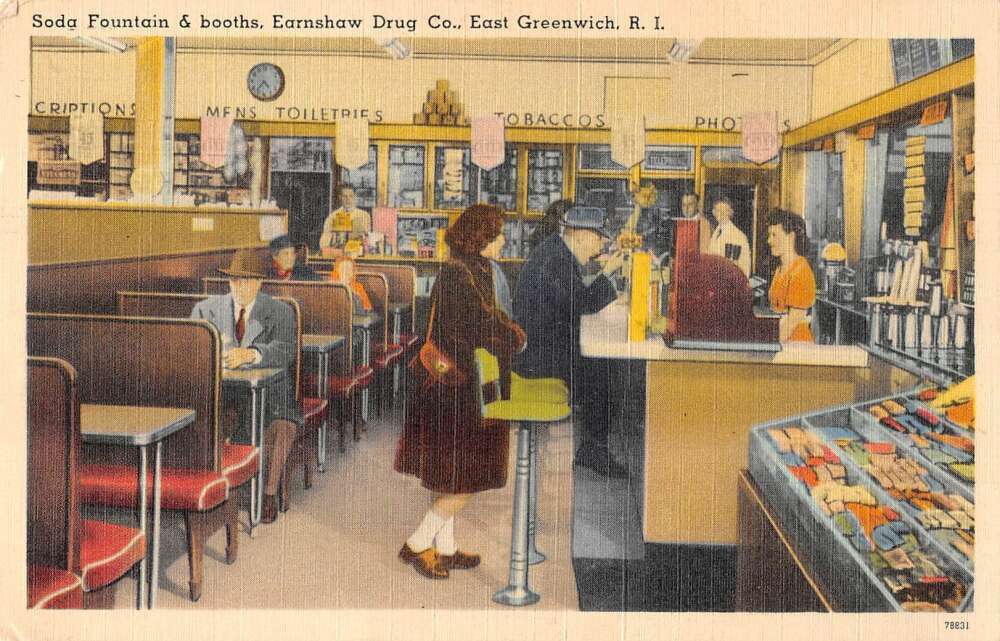
This week, a picture that evokes Lovecraft satisfying his craving for sugar.

Here we see what appears to be typical soda-fountain inside a Rhode Island drug store. The British have never had quite the same thing in retail, but chemist shop would be about the nearest term. That doesn’t quite catch it, though, as in America the retail mix included tobacco sales and the soda-fountain counter/corner. Large doses of sugar and strong tobacco were considered healthy, back then.

The date is perhaps the late 1940s, a few years after the war? Though some may be able to date it more precisely by knowing at what point the wearing of ‘bobbie-sox’ became a student fashion among the girls of Rhode Island.

But even if as late as the early 1950s, it’s still generally indicative both of the look and the all-ages / all-genders nature of such places back in the 1930s. Note the good selection of candy bars, and the Lovecraft-a-like man at the counter. Possibly about to try the ice-cream and give his verdict.

Lovecraft knew East Greenwich, noting in his ‘homecoming from New York’ letter the train passing through… “East Greenwich with its steep Georgian alleys climbing up from the railway”. He had had close family ancestors there, and in the archives is a card he sent from there to Morton. Thus it’s not impossible he may have once stopped for a summer ice-cream at the East Greenwich soda fountain.

Lovecraft notes in Travels in the Provinces of America (1929) the jobs of “Everybody one speaks to”, talking of the usual pattern for his visits to place. His short list includes “soda-fountain men”, which indicates he frequented such places…

hotel clerks, soda-fountain men, [train] conductors, [tram car] motormen, coach-drivers

Why not coffee shops? I assume they might have been more heavily tobacco-smoky sort of places, their ice-cream could have been more expensive and in smaller portions, the staff could have been less buffed, and there could also be less opportunity to select one of the cheaper candy-bars to sustain him on a long walk. Being also a chemist shop, they were probably reliably ‘open all hours’.

They were also suitable place to take young friends. For instance, I recall reading that when Lovecraft arrived in De Land, to meet Barlow for the first time, they immediately repaired to such a place.


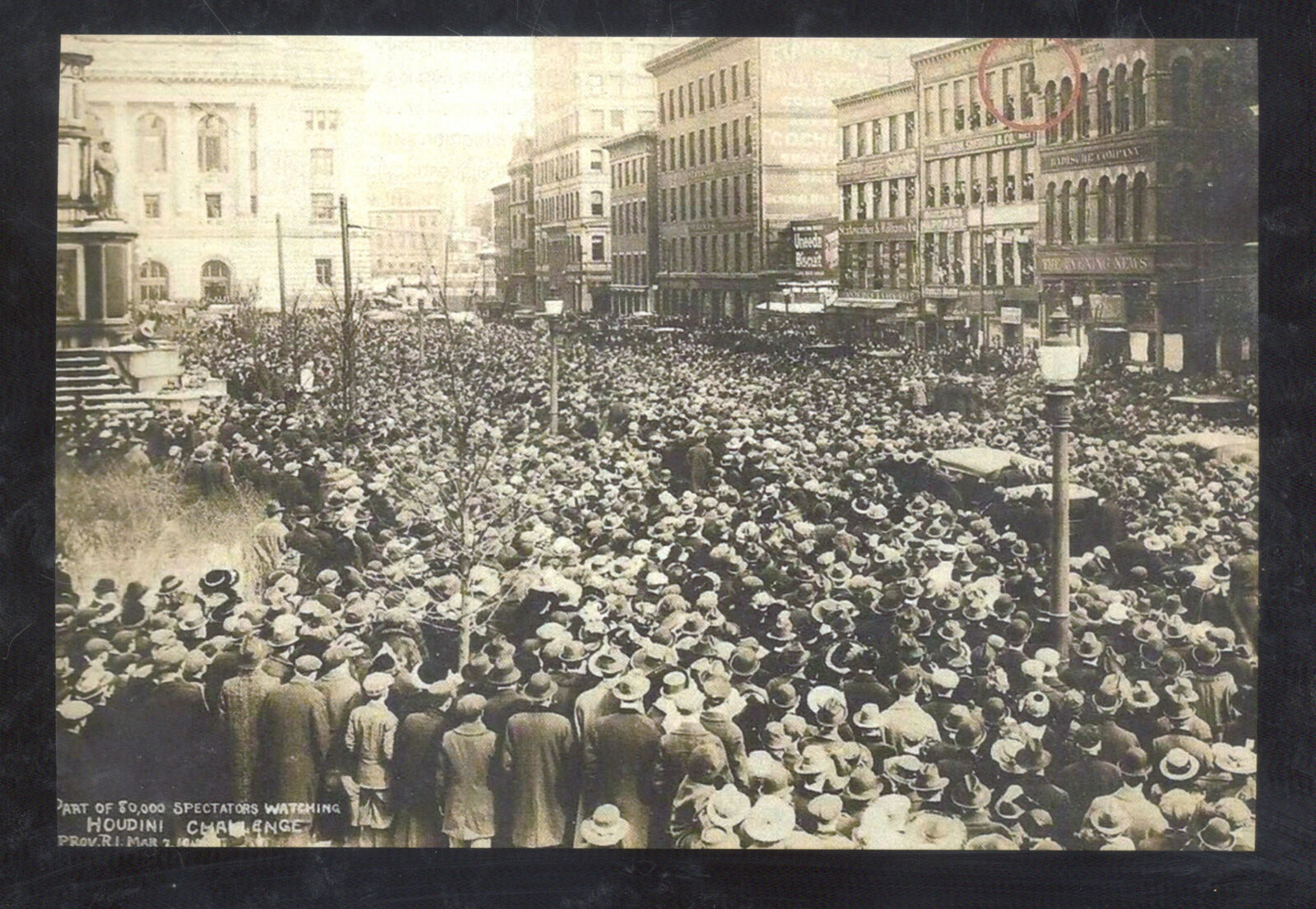
Also, back in January 2020 I found a postcard showing Houdini in Providence, performing in 1917 for a vast crowd outside the building showing “Evening News” on its facade. The picture was relatively small, though. I’ve just this week found a better larger version…

Mapping Cthulhu

Humble Software Bundle: The Maps Bonanza. This is a current fundraiser bundle of fantasy/sci-fi mapping software. £22+ (about $30) gets you the core Campaign Cartographer software for RPG map makers, plus a lot of add-on packs including “The Age of Cthulhu” (not to be confused with the Goodman game of the same name).

I can’t find this “Cthulhu” add-on pack anywhere except for the bundle, and local searches of the Campaign Cartographer site, store and blog all come up empty. I suspect it’s a combo of two of the packs they release inside the Annuals they release each year? One obviously being Cthulhu City (December 2017), which appears to be free if you dig into their blog.

October on Tentaclii

Tentaclii saw the blog move to a new web address at jurn .org in October. Quite why the old blog was suspended I still haven’t been told. It wasn’t for anything you haven’t seen posted here already. Too many bare-chested barbarians? Linking to the wrong podcasters? Showing how to hack WordPress a little with the Classic Editor script? One too many Amazon links for books? Who knows. Anyway, all the posts and about a quarter of the pictures have been saved. The more important historical pictures should still be present here, as I keep local copies of those for future books. If anyone has a complete capture of the Tentaclii blog (with Win HTTrack or similar), then I would welcome a Dropbox .ZIP with just the 400Mb or so of pictures. All my other free WordPress blogs now have full and current local backups including pictures and PDFs.

Many thanks to my Patreon patrons for sticking with me, it’s much appreciated. I lost one $6 patron a few days ago, but thankfully a leading Lovecraft scholar has kindly increased his patronage to the same amount… and thus made up the loss. Hopefully people will start filtering back, especially once Tentaclii is indexed on Google Search, and then the Patreon won’t drop further. I know times are hard for all, what with inflation spiralling upward and with mortgages soon to follow. But if just three or four people could increase their patronage by a $1 or two it would be a great encouragement. Even now I still have hopes of reaching $100 a month. Until then the heating is staying off for as long as possible this winter, at Tentaclii Towers, to try to save cash and cover the electricity inflation and impending mortgage rise. Layers of clothes, a scarf/hat and a draft-excluder can together work wonders in keeping the heater switched off, I find!

The Voluminous podcast returned this month with “The Wind That Is in the Grass”, the Barlow-Lovecraft correspondence. This welcome news spurred my hunt for the exact spot in De Land, Florida, where Lovecraft would have alighted from the long-distance bus to meet Barlow. I was also pleased to track down at last the illustrated 10-cent British history books that Lovecraft admired and used as visual reference. They turned out to be his partial set of Our Empire’s Story, told in Pictures. I’m told he also later managed to complete the set. It would be good to see these as crisp scans on Archive.org at some point.

This month my Friday ‘Picture Postals’ visited the observatory in Nantucket where Lovecraft saw Saturn, gazed up at the imposing 1935-41 new entrance to the Brooklyn Public Library, slipped into the shoreline country at the back of Lovecraft’s favourite local destination of Newport, and took another look at De Land.

A run of Scientific American 1845-2016 began to appear on Archive.org from microfilm, providing ample insight into the science of Lovecraft’s day. I hear there is also a book in the offing dedicated to Lovecraft’s astronomy, telescopes and other scientific devices, and presumably also his observatory and planetarium visits and eclipse observations. Also popping up on Archive.org was the 1943 “Fungi From Yuggoth” stencil-duplicated edition, which was an evocative sight.

In scholarly journals I was pleased to see the first Miskatonic Missives funded so quickly and handsomely. I also brought news of a special journal issue on ‘Fungi in Contemporary Art and Research’, and noted the fine-looking new Heinlein Journal. My own copy of the new Lovecraft Annual 2021 also arrived at last, heavily delayed by the paper shortages. Thanks to my patrons who made that vital purchase possible. There will likely be a review here at some point.

In books I discovered that the Lovecraft ‘autobiography’ Lord of a Visible World can now be had from Amazon as a £5 ebook. It was duly publicised in the back of the Halloween issue of Digital Art Live magazine. Gary Gianni’s The Call of Cthulhu shipped, and a sumptuous edition of A Voyage to Arcturus was announced. I was pleased to find that the Lovecraftian Ramsay Campbell had an apparently enjoyable sword & sorcery collection Far Away & Never. Another find was the very little publicised but very well-regarded series of Lovecraftian mystery books by Jeffrey E. Barlough, though when I shall find the time and money for them I don’t know.

In podcasts S.T. Joshi did a long podcast with the worthy Save Ancient Studies Association, now on YouTube. For Halloween The National Review magazine’s widely listened-to Great Books podcast was on ‘The Call of Cthulhu’ by H.P. Lovecraft.

In the arts I was pleased to find a superb 3D H.P. Lovecraft by Khoi Nguyen, having been thinking along those lines myself (I’m also an expert on the Poser and DAZ Studio 3D figure software). In comics I discovered another Kadath adaptation, tucked away at the back of Fantasy Classics #15 (2008), and rather nicely done too. Various other shorter comics adaptations were noted. Though only slightly Lovecraftian (shoreline setting, flying polyps, surreal and dream-like) I was pleased to see that Claveloux and Zha’s classic comic Dead Season (aka “Off Season”, in Heavy Metal) is finally to get a good English edition next spring. I also produced a pre-Halloween ‘Gothic’ issue of Digital Art Live this month, as editor, which paid a suitable amount of attention to Lovecraft.

Well… what a month, what with the temporary loss of Tentaclii and several other unwelcome surprises. Please consider becoming my patron on Patreon, or increasing your amount there a bit. You can also just send a one-off PayPal donation via the link on my “About Tentaclii” page. You can also buy my books, which are not just on Lovecraft, but also offer things such as a deep investigation into the identity of H.G Wells’ famous Time Traveller (H.G. Wells in the Potteries), or the Gawain-poet (Strange Country). Both figures are local to me in Stoke-on-Trent. There’s also my comprehensive survey of the ‘hidden stories’ in The Lord of the Rings (The Cracks of Doom: Untold Tales in Middle-earth) as an Amazon ebook. You could also review these books somewhere, perhaps. So far as I know none has yet had a review, though I did try.

Thanks for reading, and please help spread the word about the new Tentaclii location. Update: Now at https://www.jurn.link/tentaclii/

On discovering and navigating pulp

Bloody, Spicy, Books has a new post The Shadow & Me, which points to the way in which even terrible movies can be formative experiences for kids who (at the time) knew no better. The 1990s screen world of Batman, Dick Tracy (ugh), The Rocketeer (Disney lavish version, ok-ish), and early Indiana Jones series all proved a formative environment for Bloody, Spicy, and led to print and to the ‘better Batman‘ of The Shadow, and Doc Savage. Of course, a lad who gets into print is perhaps a rarity, and I imagine that many other kids of the period may also have been influenced by the related pulpy games of the time (the classic videogame Crimson Skies springs to mind) and went haring off into a lifelong focus on videogames and RPGs.

But that was the 1990s, still largely a ‘take it when you can get it’ media world, even with VHS tapes and later DVDs. Even DVDs were expensive until the ‘3 for £10’ discounting of the early/mid 2000s allowed the creation of fledgling personal collections. The mass Internet only really arrived in 1995/6 and a lukewarm broadband and casual movie-downloading a decade later (for most people). 25 years later we are of course in a different world of abundance, with increasingly few rarities — usually obscurities that sit at the fringes.

As such it’s interesting to muse on how the ‘all you can eat, all tastes catered for’ superfast buffet of media has been affecting kids over the last decade, when ‘new’ is no longer a reliable synonym for ‘better than what came before’.

How do savvy kids now hack a way through the astro-turfing which serves to market the ‘latest thing’, and instead find routes to the best of the past? I guess careful roadmaps for pulp culture would be especially valuable here. Guides that highlight which would be the best item to introduce a character, author or sub-genre (‘sub-tropical lost world, with scientists’ etc), and if an audiobook has been produced for such. Perhaps we need a Big Bumper Guide to Powering into Powerful Pulp, aimed at 13 year olds rather than collectors or connoisseurs. A guide which discriminating lays out all the options and best starting points. Done in a visually attractive 8″ x 10″ manner, across 300 pages. So far as I’m aware, such a book does not yet exist. Though there are of course many worthy pulp history websites.

If you’re thinking of making such a guide book then the new non-PC guide to general children’s literature Before Austen Comes Aesop: The Children’s Great Books and How to Experience Them might be useful to look at, to see how such things can be structured and approached. There are also text-only survey books such as Don Hutchison’s The Great Pulp Heroes.

Legacies in wills might even help here. The affluent collector might set aside $20,000 to have a superb introductory for-teens guide produced, dedicated to a certain author or character which they have loved all their life. Better than a park bench or a 20-year plaque on a home for stray cats, I’d suggest.

A lot of those back-roads destinations in pulp culture can then be a bit bumpy to actually reach, especially with all the mis-selling on Amazon and the confusion generated by cynical reboots (the later dire Rocketeer cash-in comics spring to mind). As such it would probably also help to encourage a kid to break from the idle ‘just ask my clueless mates’ approach (Twitter, Reddit, insert this month’s teen social media fad) and instead cultivate good search-skills. In that case, simply being told that one can place good filters on one’s keywords and title searches (e.g. browser addons like Google Hit Hider by Domain, and about useful meta-engines like eTools), would be probably be a good start. (Sadly Google Hit Hider does not yet work with eTools, but hopefully it will soon).

More on the Barlow-Lovecraft meeting

I find that the Barlow-Lovecraft meeting in Florida has been subject to at least one artistic rendering, on the cover of Lovecraft Studies #42-43. The style suggests it must be by Jason Eckhardt. Tentaclii readers will recall my several recent posts on the likely terminus in the centre of De Land.

This Autumn 2001 issue also featured the article “H.P. Lovecraft in Florida,” by Stephen J. Jordan.