A new free sample essay from my book Lovecraft In Historical Context: the fifth collection (2014). “H.P. Lovecraft and Great Zimbabwe”.

Update: due to popular demand I’ve re-uploaded it in colour rather than black and white.

17 Saturday Nov 2018
Posted in Historical context, Scholarly works
A new free sample essay from my book Lovecraft In Historical Context: the fifth collection (2014). “H.P. Lovecraft and Great Zimbabwe”.
Update: due to popular demand I’ve re-uploaded it in colour rather than black and white.
16 Friday Nov 2018
Posted in Historical context, Scholarly works
Now free on Archive.org, a huge encyclopaedic compendium of folk-beliefs about the ‘active supernatural’, that could still be found being expressed by folks in America during the 1930s. The beliefs are exhaustively categorised by type, in the manner of the theme-sorting ethnographic folklorists and fairy-tale sifters of the period (sadly, sci-fi has never had a similarly completist look-up volume containing an index of all of its themes and concepts).
Many of the book’s ‘folklore collecting points’ overlap with areas encompassed by Lovecraft’s annual summer travels.

My red dots, for clarity. South Carolina is a probable dot as well, but I can’t be sure.
This defunct historical lore is possibly most useful, these days, as a set of Oblique Strategies-like ideas which writers can use to inspire new works. Open at random three times, pick an idea randomly from each of the three pages, then think of a setting that might contain and combine them all in some way. Add characters, and devise the skeleton plot framework.
13 Tuesday Nov 2018
Posted in Censorship, New books, Scholarly works
S.T. Joshi’s new book 21st-Century Horror: Weird Fiction at the Turn of the Millennium is now available in paper. It’s had to be self-published, in order to beat leftist threats of a ‘boycott’ of any publisher who dared publish the book. The threats simply had the effect of moving the title from a limited-edition PS Publishing niche hardback, to an affordable mass-market paperback on Amazon. No Kindle edition is yet visible to Amazon UK, but I expect there will also be a Kindle ebook edition soon, hopefully with a more appealing front cover. (Update: £3 Kindle edition now available).
The book surveys recent weird fiction with the usual Joshi straightforwardness, familiar to readers of similar books such as The Rise, Fall, and Rise of the Cthulhu Mythos (2015).
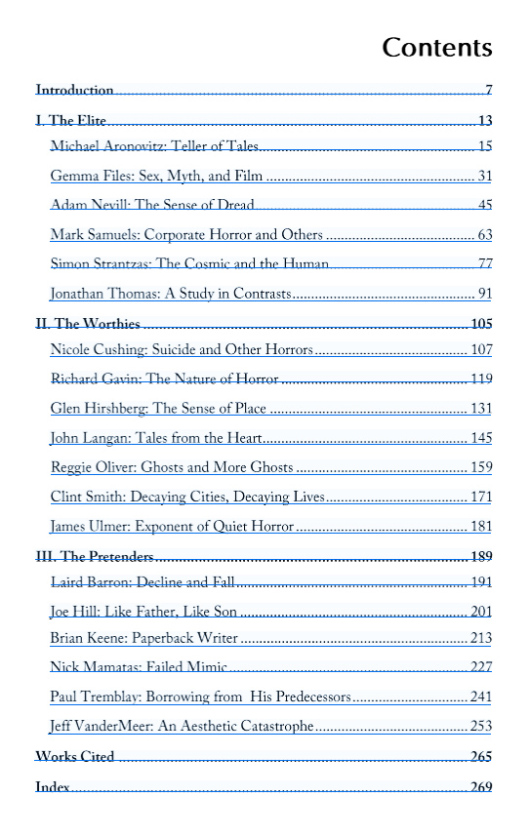
And, by silent implication… “The Unmentionables”.
11 Sunday Nov 2018
Posted in REH, Scholarly works
Messages from Crom spots the online pages for the Glenn Lord Collection of Robert E. Howard: A Preliminary Inventory of the Collection at the Harry Ransom Center. A huge 32 archival boxes, complete with a 2.6Mb .XLS spreadsheet download — which an internal date-stamp says was last updated October 2018.
11 Sunday Nov 2018
Posted in New books, Scholarly works
The long-running Europe literary journal had a Lovecraft and Tolkien special in April 2016 (No. 1044), with essays in French.

J.R.R. Tolkien et Georges Dumezil.
J.R.R. Tolkien et (l’)Europe.
Peut-on (re)traduire J.R.R. Tolkien?
Tolkien et la fantasy, encore et toujours.
H.P. Lovecraft et l’imaginaire Americain.
Lovecraft a l’ecran.
Le jour ou Cthulhu a traverse les Pyrenees.
Une reinvention du fantastique.
Entre la magie et la terreur.
Plus many reviews and lecture reports.
J.R.R. Tolkien and Georges Dumezil.
J.R.R. Tolkien and Europe.
Can we (re)translate J.R.R. Tolkien?
Tolkien and fantasy, again and again.
H.P. Lovecraft and the American imagination.
Lovecraft and the screen.
The day Cthulhu crossed the Pyrenees.
A reinvention of the fantastic.
Between magic and terror.
08 Thursday Nov 2018
Posted in New books, Scholarly works
A call for abstracts, for the academic book Theology and Horror.
Explorations of the relationship between religion and horror are fairly well established. However, this is not the case for theology and horror. Many times explorations of theology and horror involve simplistic readings in which theological concepts or doctrines are spotted within horror narratives and noted as points of connection. While this approach has its place, great possibilities exist for going deeper and wider in the exploration of horror and theology.
[The book will explore] how theology is present in horror [and suggest] how theology can be changed and shaped by an interaction with horror. [It will be] co-edited by John Morehead and Brandon R. Grafius. Morehead is the proprietor of TheoFantastique.com, and is a contributor, editor and co-editor to a number of books including The Undead and Theology, Joss Whedon and Religion, The Supernatural Cinema of Guillermo del Toro, and Fantastic Fan Cultures and the Sacred (forthcoming). Grafius is assistant professor of Biblical Studies at Ecumenical Theological Seminary.
Abstracts of 300-500 words with CVs should be sent to johnwmorehead@msn.com and bgrafius@etseminary.edu by 15th January 2019. The submission deadline for drafts of manuscripts of 6,000-8,000 words is scheduled for 1st September 2019.
06 Tuesday Nov 2018
Posted in New books, Scholarly works
The Pulpster magazine calls for contributions for 2019. The associated PulpFest 2019 convention theme is to be “Children of the Pulps”, which seems to mean the continuation of pulp characters into other media. But The Pulpster editor is casting his net wider. Advertising space is also up for grabs.

Picture: #24 (2015) the Lovecraft special of The Pulpster.
05 Monday Nov 2018
Posted in Scholarly works
I’ve added a ‘Further Reading’ section to my long post “Rediscovering Clifford D. Simak” of a few days ago. Includes a link to a PDF of the excellent biographical profile by Sam Moskowitz, “The Saintly Heresy of Clifford D. Simak”, Amazing Stories, June 1962.
02 Friday Nov 2018
Posted in Scholarly works
Now recruiting, a Part-time (0.7) Librarian for the Science Fiction Collections at the University of Liverpool. It’s our leading centre for Science Fiction Studies in the UK, and has a fine collection. The disadvantage here is you’d most likely have to live in Liverpool, a coastal shipping city in the North-West of England that’s seen better days.
28 Sunday Oct 2018
Posted in Historical context, New books, Scholarly works
I see that S. T. Joshi’s H. P. Lovecraft: The Decline of the West was made available as a Kindle ebook since the end of summer 2018, and now sports a very reasonable pocket-money price.

It’s the fullest account of ‘Lovecraft the philosopher’ and his wide range of influences in that field. Also the influence on him of what might be called ‘the phantasm of decline’ — that strangely popular but nebulous apparition that haunts gloomy intellectuals, and which leads them to believe that civilisational collapse is forever just around the corner. (As a corrective, see heavyweight books such as: Ridley’s The Rational Optimist; Paul Johnson’s Intellectuals; Herman’s The Idea of Decline in Western History, and my ongoing 2020 blog). Perhaps also Staring Into Chaos: Explorations in the Decline of Western Civilization; and The Perennial Apocalypse: How the End of the World Shapes History.
Joshi writes clearly and precisely as usual, and the book is usefully untainted by airy academic genuflections toward the latest idols of literary-political theory. The Decline of the West was previously available as an oversize paperback, which has a two-column layout — which some may prefer for the task of ploughing through dense philosophical triangulations. On the other hand, the ebook is keyword-searchable, which means that Lovecraft scholars may want to own both editions — though you may chuckle at such a heavyweight ebook having a toy-like ‘stop-motion Cthulhu’ on the front cover. Such are the demands of trigger-finger ebook marketing today, I suppose — ‘no monster, no sales’.
Purchasers will also want to have on their Kindle the texts available from my 2014 blog post Lovecraft as Philosopher, these being a sniffy review of Decline of the West and Joshi’s magisterial demolition of the review.
28 Sunday Oct 2018
Posted in New books, Scholarly works
S. T. Joshi’s latest blog post reveals that the new Lovecraft Annual #12 has reached him, together with latest door-stopper volume of Lovecraft’s annotated letters. Joshi reveals that Letters to Maurice W. Moe and Others has more than letters in it. It…
“contains numerous writings by Moe, Dwyer, and Loveman, and a letter by Starrett to Sam Loveman.”
Beyond the simple problem of wrangling a 628-page print volume thought a tiny modern letterbox by the regular postal service, I do wish that more of these Letters volumes were available as ebooks for the Kindle. Whence they would become keyword searchable, and one could make the font bigger and more readable etc. But only the Morton letters were briefly available that way, and even that volume has recently vanished from the Kindle store at both Amazon UK and USA. Thankfully the Morton ebook, purchased in 2017, is still on my Kindle.
28 Sunday Oct 2018
Posted in Historical context, New books, Scholarly works
Falling Felines Research: the history book, successfully crowd-funding now.

If you can’t wait for the book, the author has a long blog post on the topic of lab research on falling cats.
It turns out that that aerodynamics, molecular physics, mathematics, mechanical control systems, and other branches of science and engineering were all strongly informed by the study of tumbling kitties which (of course) always landed on their feet. Perhaps Lovecraft was right (again), when he said that inherent in the very form of the cat lay cosmic secrets, a potent symbolisation of the universe, and that this was “just as true kinetically as statically”.
A quick search of Google Scholar and JURN shows that such research is still ongoing, and that the same science may yet inform the design of human-interacting robots, autonomous drones, space-elevator nano-ribbons, and many other sqwerky uses as yet undreamed. Robo-tentacles, perhaps.