Protected: The words from R’lyeh
21 Thursday Jan 2021
Posted in Lovecraftian arts, Scholarly works
≈ Enter your password to view comments.

21 Thursday Jan 2021
Posted in Lovecraftian arts, Scholarly works
≈ Enter your password to view comments.
19 Tuesday Jan 2021
Posted in Scholarly works
Call for workshop papers: The Reception of Ancient Egypt in Science Fiction. For a workshop conference to perhaps be held in the UK in early July 2021, if the ever-rolling lockdowns allow it….
The ways in which Egyptological scholarship informs science fiction in particular still remain to be explored. The aim of this workshop is to explore the reception and reconstruction of Egypt in science fiction, fostering a dialogue among Egyptologists, cultural historians, literary scholars, and creatives.
18 Monday Jan 2021
Posted in New books, REH, Scholarly works
Renegades and Rogues: The Life and Legacy of Robert E. Howard is officially available in full from tomorrow (it’s been partly available via Google Books page-scans since early November). Author Todd B. Vick has a new blog post on why he wrote the book…
Renegades and Rogues establishes a solid foundation for current and future fans and scholars providing them with an objective, unexaggerated, unromanticized examination of Robert E. Howard’s life and work. It includes the vast amount of new data that has been uncovered over the last ten years presented on blogs with limited readership.

16 Saturday Jan 2021
Posted in New books, Scholarly works
More news from S.T. Joshi. His blog announces… “another collection of my miscellaneous essays, reviews, introductions, etc” and gives the table of contents. Said to be imminent, The Progression of the Weird Tale will include a substantial central section of items on Lovecraft and Barlow, plus a critical assessment of two novels by Frank Belknap Long. Also memoirs of several fellow Lovecraftians.
Not to be confused with his already available collection The Advance of the Weird Tale.
14 Thursday Jan 2021
Posted in Scholarly works
I see Wildside now has an affordable $5 Kindle ebook edition of Clark Ashton Smith: A Critical Guide to the Man and His Work. This is the second edition of Summer 2013, said to have been lightly corrected by the author Steve Behrends for errors of fact. Though he was not in a position to take account of the wealth of new Smith scholarship, new critical editions and letters published after 1985.
It’s well thought-of and looks like it could use a review on the Wildside Press site, where at present it has none.
I’ve now heard the Harlan Ellison reading of Smith’s “The City of the Singing Flame” and sequel, and am duly impressed. Slightly over-written and with some of the early “cosmic” dabs rather forced, but a very enjoyable listen and… somewhat like an 80-minute audio version of one of the less convoluted graphic novels of Moebius.
11 Monday Jan 2021
Posted in Historical context, Scholarly works
Publishers Weekly 1872-2016. New on Archive.org and likely to be useful for researchers interested in Lovecraft’s era, re: what books were available and being reviewed in any given year. It offered a regular list of exactly when they appeared.
There are also photos, including at least one interior of a Boston bookstore, but the pages are from microfilm and so the quality of the pictures is poor.
09 Saturday Jan 2021
Posted in New books, Odd scratchings, Scholarly works
I was expecting some ‘post Black Friday’ Amazon Warehouse deals, as bumped and damaged stock was returned to the warehouses. I’m pleased to say that, by looking out for such items, I’ve bagged both volumes of the new H.P. Lovecraft: Letters to Family and Family Friends. The cost for both together was a bargain £30, ‘half price’ and with no extra shipping to pay — Amazon was willing to send them to a local locker for free.
My thanks to my Patreon patrons who’ve made this vital purchase possible, and you’ll doubtless benefit from improved posts here at Tentaclii in the coming years.
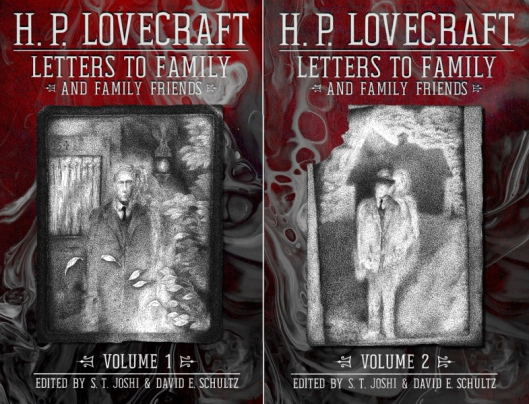
It may well be the springtime before I get around to reading them now, as my Lovecraft interest tends to be seasonal from May-October. But for now they look mighty pretty on the shelf. Only very slightly bumped on a few of the cover-corners, and otherwise fine. They’re going to be read and consulted quite thoroughly, so I don’t bother about such minor blemishes.
I also managed to bag Frank Belknap Long’s The Black Druid for $10 on eBay. This being the mid-1970s Panther paperback of his stories, and the uniform paperback companion to his The Hounds of Tindalos. Which I had bagged at about the same price from eBay about 18 months ago. Most of the time they’re offered for silly ‘collector’ prices. There were only two such volumes of his stories here in the UK, if you were wondering, both with fine Bruce Pennington covers.


06 Wednesday Jan 2021
Posted in New books, Scholarly works
S. T. Joshi’s Blog updated just before Christmas. The Italian translation of his I Am Providence has now published its second volume, of three, and covers Lovecraft’s life and work to 1928. Joshi also notes that the comprehensive overview 20 Years of Hippocampus Press should appear soon, with full TOCs for every item published.
10 Thursday Dec 2020
Posted in Scholarly works
Added to the ‘Open Lovecraft’ page on this blog…
* Y. Hashimoto, “Spectacular Tentacular: Transmedial Tentacles and Their Hegemonic Struggles in Cthulhu and Godzilla”, Between: Journal of the Italian Association for the Theory and Comparative History of Literature, Vol. 10, No. 20, November 2020.
* J. Olivia, “Lovecraft’s Fear of the Unknown and Unimaginable” (Undergraduate dissertation for Charles University in Prague, 2020).
* E. Taxier, “Two Ambiguities in Object-Oriented Aesthetic Interpretation”, Open Philosophy, Vol. 3, Issue 1, 2020. (Sees two ambiguities forming a problem to aesthetic commentary arising from Graham Harman’s discussions of Lovecraft).
06 Sunday Dec 2020
Posted in Odd scratchings, Podcasts etc., Scholarly works
S.T. Joshi’s Blog has updated. He notes the passing of Joseph Altairac (1957-2020)…
a leading French scholar and publisher devoted to Lovecraft. He was the editor of Études Lovecraftiennes, a fine small-press journal that published many trenchant articles on Lovecraft from both French and American critics.
I’ve looked online, but there appears to be no way to get the TOCs for this French Lovecraft Studies equivalent and thus craft a translated English summary of these after the first two issues (which had offered selected Lovecraft Studies translations). Possibly an English obituary of Altairac, likely destined for the Lovecraft Annual of late summer 2021, could be followed by an itemisation of the journal’s contents in English? Note that his Études Lovecraftiennes is not to be confused with the later and similarly named Cahiers Études Lovecraftiennes which it appears were more of a series of bookshop-quality monographs. You can see the difference here…


In other Lovecraft-related news from S.T. Joshi, there is a two hour talk on YouTube between S.T. Joshi and leading Brazilian scholar Emilio S. Ribeiro.
25 Wednesday Nov 2020
Posted in Lovecraftian arts, Scholarly works
The 10th issue of Fantasy Art and Studies will be “dedicated to music” and is calling for creative work. While the journal is French, for this issue they appear to be also open to work in English. Deadline 5th January 2021.
24 Tuesday Nov 2020
Posted in Historical context, Kittee Tuesday, New books, Scholarly works
I’m currently reading the recent Tolkien biography by Raymond Edwards, newly in Kindle ebook in 2020. At least one Amazon reviewer has spluttered at the book’s occasional informed speculation, such as the suggestion that Tolkien read Ker’s classic scholarly synthesis The Dark Ages. Yes, it was a key book of the time and a highly readable and yet erudite synthesis. Edwards doesn’t put a date on it, but I’d say Tolkien probably read it and circa summer 1912 is the most likely date. The Amazon reviewer is anyway tripped up by not consulting a footnote on the matter — which reveals that Tolkien did read it and by the early 1930s, when he “quoted extensively from it”.
But for me Edwards is very usefully conversant with the ins-and-outs and ways of Oxford University life and its nomenclature, and has a keen insight into the mindset of intelligent lads of that era. Some further observations and phrasing suggest he’s writing from a traditionalist Catholic perspective, but this is offered very lightly and not laid on with a trowel. Despite its readability and seemingly reliability this is not the biography to read first, and it needs to be filled-in with the use of the Chronology (lucky Tolkien scholars have a vast day-by-day / week-by-week Chronology of his life, assiduously compiled by Hammond and Scull). But the new biography generally presents a readable and insightful narrative.
Lovecraft occasionally makes an appearance, being Tolkien’s contemporary. Here is Edwards on cat-demons and Lovecraft, about a quarter of the way through his book and at the point when Tolkien has been invalided home to Birmingham (early November 1916) after a fierce and victorious battle in France, and then stays at Great Haywood in mid Staffordshire (early Dec – late Feb 1917)…
The style of the Tales [very early First World War works, collected in Lost Tales] is a deliberate mixture of archaizing prose in the best William Morris manner, with a faintly precious Edwardian ‘fairy’ or ‘elfin’ quality, all flittermice and flower-lanterns and diminutives (partly down to [the whimsical side of the Catholic poet, Tolkien’s favourite] Francis Thompson, partly we may guess to [Tolkien’s young wife] Edith’s fondness for such things), with a dash of whimsy (cat-demons, talking hounds) that may owe something to Lord Dunsany. At moments, the effect is most like not Morris or Dunsany but, oddly, the later Randolph Carter stories of H.P. Lovecraft, which are explicit dream-narratives. The [key work in Lovecraft’s Dreamlands cycle was] not written until [1926–27]*, and [Dream-Quest] not published until after Lovecraft’s death, so there can be no question of influence either way, but there is a certain occasional likeness of tone. Lovecraft was two years older than Tolkien, and their backgrounds were not really alike; but there was perhaps something in the air. Both men, as well, had clearly read their Dunsany.
* I’ve corrected his dating.
There is another comparison to make, and at more or less the same time. Compared to Lovecraft, Tolkien at the end of 1919 saw the…
widening of modern knowledge of the universe & consequent opening up of new fields of ideas, should more than compensate for any blunting of our capacity for imaginative appreciation of certain aspects of nature, as compared with the ancients.
By which he means the nature-appreciation not only of the Egyptians, Greeks, Babylonians etc, but also the Northern tribes and peoples. And their ability to ‘spring’ imaginative stories from a local nature on which they relied for their very being. Here he also implicitly harks back to a long British Christian tradition that saw the natural sciences as a positive thing in terms of helping to reveal the works and workings of God.
Lovecraft worried about how such things might play out negatively on a longer time-scale, and in a mutually-reinforcing manner. In the mid 1920s he famously stated that…
the piecing together of dissociated knowledge will open up such terrifying vistas of reality, and of our frightful position therein, that we shall either go mad from the revelation or flee from the deadly light into the peace and safety of a new dark age.
However, the Tolkien of 1919 was not the Tolkien of the mid 1930s. Later, as 1934 dawned and the darkness of the mid 1930s settled in, Tolkien too felt much as Lovecraft did about the changing times. Like…
A lost survivor in an alien world after the real world had passed away.