Tolkien Gleanings, tracking selected Tolkien scholarship and exhibitions.
Tolkien Gleanings
27 Sunday Nov 2022
Posted in Odd scratchings, Scholarly works
27 Sunday Nov 2022
Posted in Odd scratchings, Scholarly works
Tolkien Gleanings, tracking selected Tolkien scholarship and exhibitions.
25 Friday Nov 2022
Posted in Scholarly works
New on Archive.org to borrow, The Twentieth Century British Supernatural Novel (1958). Includes an early positive appreciation of Tolkien as a supernatural writer. And by someone who had actually read The Lord of the Rings (most critics of the time didn’t, something which is obvious from their reviews and comments). The text also has some discussion of Lovecraft.
24 Thursday Nov 2022
Posted in Scholarly works
Possibly of interest to Tentaclii readers, a call for papers for “To sleep, perchance to dream”: Dreamscapes in Shakespearean Plays and Adaptations. For a British Shakespeare Association (BSA) 2023 Conference in Liverpool, a port city in the north-west of England, from 25th-28th July 2023.
23 Wednesday Nov 2022
Posted in Scholarly works
Wormwoodiana looks at ‘Mazes and Labyrinths’…
There may well still be lost turf maze sites still to be discovered, using detailed place-name evidence or possibly local traditions: I came across one by chance a while ago in a church guide.
… and there’s the potential for newly-created ones, I imagine. One can of course make a temporary ‘summer maze’ of simple mown grass, which may better suit the hand-wringing nay-sayers on the Parish Council. But a more permanent turf-sod maze can’t be too difficult to make once you have a few tons of thick sods delivered to the land. Some drainage pipes too. Since, as Shakespeare pointed out, anything built as channels-in-turf is liable to gather muddy water in our British climate…
The nine-men’s-morris is filled up with mud,
And the quaint mazes in the wanton green,
For lack of tread, are undistinguishable.
The Wormwoodiana article usefully makes me aware of the Caerdroia journal, a long-running scholarly journal dedicated to the topic of mazes and their cultural uses. Possibly a home for your prospective article discussing notable pulp / early-SF mazes, such as the Lovecraft/Sterling story “In the Walls of Eryx”?
The Caerdroia Archive has a range of free public PDFs. Such as “Arthur Machen and the Maze Theme” (1991), which may interest some Tentaclii readers. Also out-of-print 2003-17 back-issues as free .PDFs. I’ve added the indexing URL to JURN and the .PDFs can now be found via my JURN search-engine.
22 Tuesday Nov 2022
Posted in Kittee Tuesday, Scholarly works
New this week on Archive.org, Four centuries of cat books: a bibliography, 1570-1970 (1972). Only manages to note Cats in Prose and Verse (1948) as containing any Lovecraft items, and that only the short poem “Little Sam Perkins”. No mention of “The Cats of Ulthar” in a cat anthology before 1970. At a guess, perhaps Derleth did not allow it to be anthologised?
19 Saturday Nov 2022
Posted in New books, Scholarly works
WARNING: A printing problem has been discovered, and the publisher now advises… “Please do not purchase the book until the problem is investigated and fixed.”
The Collected Letters of Robert E. Howard, Volume 3 (1932-1936). According to Amazon this is now published. Which means the Robert E. Howard Foundation Press is to be heartily congratulated, as it now has all three volumes published as affordable paperbacks.
I see there was also a new issue of The Dark Man: Journal of Robert E. Howard and Pulp Studies (12.2), dated December 2021 and available March 2022 on Amazon. Among other items, an article on “Howard and Strange Tales” and a review of the expanded book The Weird Tales Story.
16 Wednesday Nov 2022
Posted in New books, Scholarly works
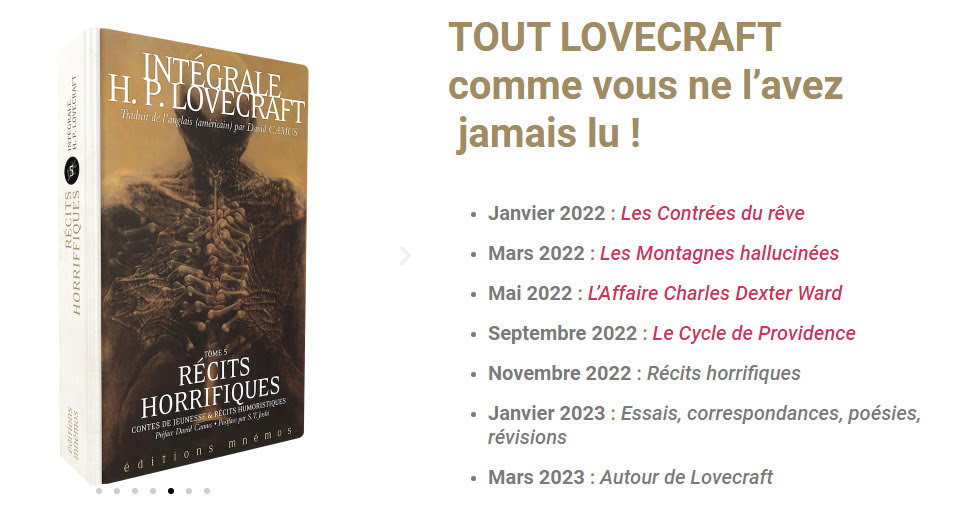
The sumptuous Mnemos edition of Lovecraft’s Horror Tales is soon to publish in France. Amazon lists it as 25th November 2022.
It appears this will complete their new multi-volume translation of the main fiction. Still to come is ‘Essays, correspondence, poetry, revisions’ and finally ‘About Lovecraft’ (although that may be a mis-translation for ‘The Lovecraft Circle’?).
15 Tuesday Nov 2022
Posted in Kittee Tuesday, New discoveries, Scholarly works
Lovecraft derived his pseudonym ‘Lewis Theobald Jr.’, later ‘Grandpa Theobald’ and variants, from the pioneering but much put-upon Shakespeare scholar Lewis Theobald (1688-1744). I’ve now discovered a curious thing relating to this choice.
The discovery occurred this way. I was looking at the early medieval talking-fox cycle Reynard the Fox as a source for Tolkien. Part of the evidence is found in one early version of Tolkien’s “The Tale of Tinuviel”, in which the hero is enslaved by the evil Melko’s lieutenant (“he was in Melko’s constant following”) who is a demon cat called Tiberth, Prince of Cats (“whom the Gnomes have called Tiberth”). This name is very similar to the central tom-cat character in the long and often ribald Flemish tale of Reynard the Fox — Tibert (Flemish). In Dutch Tybert; Old French Tibert; English Gilbert via Chaucer and his translation of the French Tibert; and then the name roots back via philological methods to the Germanic Theobald.
Skeat has… “I take Tybalt to be a shorter form of Theobald, which again is short for Theodbald … The A.S. [Anglo-Saxon] form is Theodbald, which occurs in Beda, [Bede] Hist. Eccl, book. i. c. 34.” (Skeat, Notes on English etymology). The American Century dictionary concurs with… “Thibault, a form of Theobald“.
So, these words were once the common descriptor for a male cat, most likely a dominant and bold one with a long tail. Now, I wonder if Grandpa Theobald knew that?
We can be certain that Lovecraft knew his Pope, and indeed he had minutely studied The Dunciad. He would then have been well aware of the character of Tibbald, the dunce poet in Pope’s Dunciad. We see him in the lines…
in Tibbald’s monster-breeding breast,
sees gods with demons in strange league engage
That sounds very suitable then, for a Lovecraft pseudonym, on these lines alone. The lines are explicated with the pointed footnote… “Lewis Tibbald (as pronounced) or “Theobald (as written) … He was Author of some forgotten Plays, Translations, and other pieces.” The poem’s lines continued on, describing Tibbalt sitting without any supper but surrounded by his library of books and unable to pawn them. He is thus at that very moment selected by a goddess as the most suitable earthly candidate for the ‘Throne of Dullness’, and he ascends to the throne after being initiated by her. Nothing is said by Pope of the connection of the name with cats, and apparently Reynard the Fox was something of a forgotten wonder-of-literature in England until a grand popular revival in the 1850s. In Pope’s time Gilbert or gib-cat was the English name for a male cat, also starting to have the implication of castrated (as society became less rural and thus randy tom-cats became less welcome, in terms of keeping up the local cat population in order to remove mice and rats). Thus if Pope did know the connection of the name with Reynard’s tom-cat, he doesn’t say.
So there’s no evidence there that Lovecraft knew Theobald was the root of a name for a cat. However Lovecraft wrote once to his friend Moe as “Grandpaw Tibbald”, suggesting he was well aware of the Tibbald – Theobald crossover in Pope. He evidently expected Moe to see the allusion, and perhaps even groan at the cat-pun in paw.
Though Lovecraft would also have known that in Shakespeare the character Tybalt is jokingly called ‘Prince of Cats’, ‘good King of Cats’ and ‘rat-catcher’ in Romeo and Juliet. One might then assume he had seen some footnote that explained this obvious allusion and connected it to the variant cat names. According to Lovecraft’s Library (3rd Ed.) Lovecraft owned three Shakespeare editions: Halliwell, 1860; Richard Grant White, 1883-84; William J. Rolfe, 1898. Could any of these have explained things in a note? Halliwell does not note the phrases, and nor does White. Rolfe does, with…
“Prince of cats: Tybert is the name of the cat in Reynard the Fox. Steevens quotes Dekker, Satiromastix, 1602: “tho’ you were Tybert, the long-tail’d prince of cats;” and Have with You, etc.: “not Tibalt, prince of cats.” As St. notes, Tibert, Tybert, and Tybalt are forms of the ancient name Thibault.”
Close, but not quite. We still have to assume that Lovecraft knew Thibault = Theobald. This seems likely, but I can find no firmer evidence that he did. Possibly he just associated Theobald with the common old English personal name, which meant people|bold, shorthand for something akin to ‘prince who boldly defends his people’.
The cat-name survives today in the form of the affectionate name Tibbles, and we can thank Pope for pointing out that this (as Tibbald) was once the correct English pronunciation of Theobald. Thus a suitably historical, and also rather mellifluous, name for a Lovecraftian cat today would be ‘Theobald Tibble’. The ‘s’ being omitted because modern, and also because cats do not care to hear ‘s’ sounds.

14 Monday Nov 2022
Posted in Scholarly works
This seems relevant to Lovecraft, re: the creation of Lovecraftian music, perhaps relating to the topography/hydrology and hauntology of Providence…
Applications are invited for a Ph.D. in Music and Multimedia Composition (MMC) at Brown University. Fully-funded with a generous stipend and benefits.
MMC will host an online Open House event on 18th November 2022, from noon to 2pm EST. MMC faculty and current students will be available to answer questions.
Application deadline: 15th December 2022.
They appear to encompass a wide variety of musical styles and approaches, and seem to favour someone capable of a similar range. It’s not mentioned, but I assume that similarly advanced multimedia/coding skills will be needed.
Off the top of my head I’d propose Brown’s monstrous Art History block, being the site of Lovecraft’s house, as an instrument to be ‘played’ in a Lovecraftian manner. Possibly by being linked in some generative way to the city’s relic underground tunnels and the Twin Islands (Lovecraft used to land on these in his boat, probable inspiration for “Dagon”) in the Seekonk, such that subtle and uncanny noises are generated via sensors in the tunnels and in the tidal flows of the Seekonk. To lighten the mood in places, also mingling with a brighter sonic evocation of Lovecraft’s lost Cat Swamp in summer. One might further use cosmic rays above Providence as data inputs to generate occasional symphonic washes of sound.
13 Sunday Nov 2022
Posted in Scholarly works
Archive.org had a new influx of books to borrow. New or newly-spotted…
So many lovely days : the Greenwich Village years. Family history of Lovecraft’s friend George Kirk, including a picture of the Chelsea Bookshop in summer 1930. Appears to be very much out-of-print today.
Cross Plains universe : Texans celebrate Robert E. Howard (2006)
Robert Silverberg’s many trapdoors : critical essays on his science fiction (1992)
12 Saturday Nov 2022
Posted in Odd scratchings, Scholarly works
Serif’s Affinity has launched its version 2.0 suite of Adobe-killers. Of interest to scholars and writers is that there are now footnotes, as a new feature in its Publisher DTP software for desktop. Seemingly this feature is also in the iPad app version of Publisher. I assume the footnotes work as they do in Word.
Affinity Publisher v2 on its own can currently be had on an introductory discount for £35.99 UK ($40.99 US), if you don’t need the other Affinity software (equivalents of Photoshop and Illustrator). That’s an excellent one-off price for such a polished DTP software, though note that…
* the InDesign-like UI is going to be a bit scary for the first week for some users
* it’s very eye-straining, since on Windows you can’t scale the UI with its tiny fonts and labels. Mac users can at least scale up the UI font size.
* Windows 7 users should note that Publisher 1.9.2 was apparently the last that could run on Windows 7.
What you don’t get is, compared to the competitors…
* The user-friendliness and Word-like UI of Microsoft Publisher.
* Adobe InDesign’s plugin ecosystem.
* QuarkXpress’s integrated HTML5 output.
Also, I see that at long last Scrivener 3.x is out for Windows, after years and years of waiting.
11 Friday Nov 2022
Posted in Picture postals, Scholarly works
The final part of my notes on Letters with Donald and Howard Wandrei.
We open in late summer 1935, among the letters sent to Petaja.
Various pages. Both 1935 and 1936 appear to have had cold and late spring-times, which did not help to bolster Lovecraft’s failing health.
p. 450. Lovecraft sees a rare “lunar rainbow” in Florida, cast by the full moon, and describes it as “faint but perfect”.
p. 451. He recalls that he had seen Indians (i.e. native Americans) once “in their native habitat” in 1931. These were Seminoles “who still maintain their tribal organisation”. They had a large camp at Musa Isle in the Florida everglades, and did their best to maintain traditional dress and customs under tribal leadership. The forthcoming book Lovecraft in Florida will likely have more details on such visits.
p. 458. Shows evidence that he is aware of the gay movement in Germany, by October 1935. In a brief discussion of Burton’s 1885 musings on a geographical “Sodatic Zone”, he notes… “at present Germany is said to suffer from such perverted attitudes”. Although by that time Lovecraft was increasingly out-of-date re: the Nazi Party under Hitler (who had seized control of the Party in June 1934).
p. 463. He did not actually own a copy of The Witch Cult in Western Europe (1921), and it appears he never had… “I wish I could get hold of it, but it is infernally hard to find”. p. 466 has him stating “I’d give a lot to own a copy”.
p. 468. He would also like to have read the great Finnish epic The Kalevala.. “which I have for years been meaning to read”. Also p. 483, “my long-standing wish to read the Kalevala“.
p. 469. “Choreography [i.e. the dance] is an art I can appreciate even less than music”.
p. 474. Reports that he undertook a “titanic file cleaning” over many days in June 1936, and as a result he has “thrown away a couple of tons of junk”. And among it probably papers and letters that today would fetch substantial sums, and would be of much interest to scholars.
p. 486. Following the letters, a reprint of an article on Howard Wandrei. Wandrei tells the interviewers that he once owned a complete run of the pre-Weird Tales magazine The Black Cat, and Wandrei retails the story that it folded (shortly before Weird Tales appeared on the stands) because it ran one especially gruesome story involving pain experiments on cats and dogs, then a man. The magazine’s circulation vanished as a result, apparently, and it folded. However, the story of that title was actually in The Black Mask in early 1924, and cannot be found in the old The Black Cat. I suspect that a crackly telephone interview allowed the confusion of the two titles. The Black Mask (est. 1920) may well have dipped in circulation as a result, but appears to have run on until July 1951.
p. 488. A dealer-listing of letters from Lovecraft to Wandrei is given. These letters either no longer exist, or else are salted away in a private collection. But the listing does quote a few lines here and there. A 7th November 1935 postcard was sent by Lovecraft from the rooms above the “Julius” bar in New York City, where Lovecraft was staying. Later a long-time and famous gay bar, although its 1935 status is unknown other than it was then the “Julius” bar.
‘Julius’ bar, 155 West 10th St., now No. 159.
Lovecraft assures the recipient of the card that he is “NOT patronising the barroom beneath” his room, although Donald Wandrei is. He had earlier noted Wandrei was living above a “well-known ‘bohemian’ restaurant” in one letter, but that was presumably before his actual arrival. On arrival, and seeing the place, he is obviously more inclined to call it simply a “barroom”. He spent two weeks living there with Howard Wandrei. The address was 155 West 10th St., now numbered as 159 and it has since become one of the most famous bars in gay history.