Issue 10 of Dead Reckonings: a review of horror literature, out now. Includes an index to the first ten issues.
Dead Reckonings #10
06 Sunday Nov 2011
Posted in New books, Scholarly works

06 Sunday Nov 2011
Posted in New books, Scholarly works
Issue 10 of Dead Reckonings: a review of horror literature, out now. Includes an index to the first ten issues.
02 Wednesday Nov 2011
Posted in Lovecraftian arts, New books, Scholarly works
Miskatonic Books announces pre-orders for S.T. Joshi’s Medusa’s Coil and Others. The Annotated Revisions and Collaborations of H.P. Lovecraft, Vol.2.. Superb cover artwork by Zach McCain.


150 print-run, collector’s hardback. Only eight copies left of the first volume, apparently.
28 Friday Oct 2011
Posted in New books, Scholarly works
JAS Arqueologia has published a special academic monograph by Riccardo Frigoli, in Spanish, called: “Las excavaciones de R’Lyeh: La arqueología como metodo, la prehistoria como idea y la literatura fantastica de H.P. Lovecraft”. I very roughly translate this as… “The Excavations at R’Lyeh: the methods of archaeology and the prehistory of this [profession, as found] in the fantastical works of H.P. Lovecraft.” The Introduction, in Spanish, is online as a free PDF, if anyone wants to create an accurate English abstract.
21 Friday Oct 2011
Posted in New books, Podcasts etc., Scholarly works
S.T. Joshi’s blog has updated with a long post on his activities, including a link to a 10-minute MP3 interview between a Penguin Classics Editor, Elda Rotor, and Joshi. The second half of the podcast is a del Toro interview.
I found his mention of this forthcoming book especially interesting…
“John C. Tibbetts’s The Gothic Imagination (Palgrave Macmillan, 2011), a substantial collection of interviews with past and current figures in the horror field.”
It seems The Gothic Imagination will be shipping in a few weeks.
[ Hat-tip: Wilum Pugmire ]
28 Wednesday Sep 2011
Posted in Historical context, New books, Scholarly works
The two-volume I Am Providence, currently direct from Amazon with free shipping, for just $63. I doubt it’ll ever get much lower than this?
12 Monday Sep 2011
Posted in Historical context, Scholarly works
An interesting new article on a topic little-addressed outside of SF circles: “Modifiable Futures: Science Fiction at the Bench“…
“the function of science fiction […] in the history of scientific and technological innovation has often been obscured, misconstrued, or repudiated” [but] “they have a relationship of ongoing and productive mutual modification.”
01 Thursday Sep 2011
Posted in Historical context, New books, New discoveries, Scholarly works
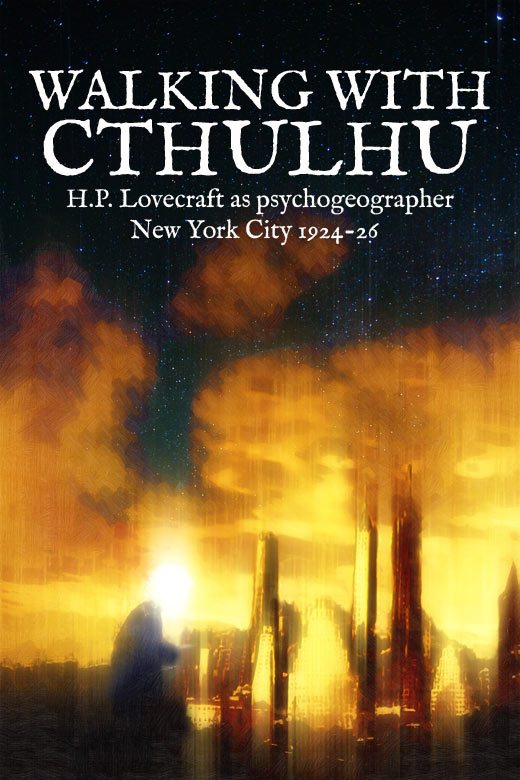
My new book is here! Walking With Cthulhu : H.P. Lovecraft as psychogeographer, New York City 1924-26. 55,000 words, 198 pages. Illustrated.
Another good haul of new discoveries! Including two new possible sources for Cthulhu. All heavily referenced and footnoted.
Buy a new paperback copy here! Kindle user? It’s also on the USA Kindle Store and the U.K. Kindle Store.
CONTENTS:
Timeline of Key Dates.
Introduction: A Walk in New York.
SURFACE: Walking the Streets of the City:
1. H.P. Lovecraft and the psychogeographers.
2. H.P. Lovecraft’s night walks in New York: psychogeographic techniques
3. The nature of the New York streets.
4. A note on H.P. Lovecraft and immigrants.
5. H.P. Lovecraft’s New York coffee houses and ice-cream parlours.
UNDERGROUND: On the Monstrous, Occult, and Hidden:
6. H.P. Lovecraft and the subway.
7. It emerged from the subways!
8. On mystical and occult New York.
9. On H.P. Lovecraft and Franz Boas
10. New York as R’lyeh, sunken city of Cthulhu.
“Nyarlathotep” annotated.
Bibliography.
Index.
26 Friday Aug 2011
Posted in Scholarly works
Scott Herring calls for a new academic approach that might ferry the study of English Literature back from the land of limbo. It’s an approach that the history-venerating Lovecraft would have approved of…
History gives us the facts, sort of, but from literary works we can learn what the past smelled like, sounded like, and felt like, the forgotten gritty details of a lost era. Literature brings us as close as we can come to reinhabiting the past. […]
The past is not another country; it is another life. The texture of daily living is different now than in the past, more different the further back we look, until we find people whose experiences created a psychology we might find baffling or rude. Many details that once made up the daily round are lost to us because people considered them too trivial to write down. […]
Let the dead French theorists lie. Instead, literary scholars can become guides to the physical reality of the past. If you think about it, that’s what we’ve been doing in class for the last hundred years […] Once ordinary people note that we’re doing something useful again, they might stop looking at us like we’re nuts.
That seems fine when the literature in question directly describes that re-imagined past. Such an apparently straightforward approach and lack of obscurantist clutter might well appeal to both students and administrators, if not to many English Lit academics. Although I can imagine the historical approach morphing into ‘Political Correctness 101’ in many left-leaning classrooms, with the life of the author wheeled in as Exhibit A for the prosecution. I can also see a great many authors being avoided altogether, to ‘avoid offending’, if one had to focus as much on the history as on the text.
A more interesting approach might be cross-disciplinary and tailored to each student. Let each student start by discovering their specific family history and tree, gaining basic research skills along the way — then spiral out from there into the relevant fiction, social histories, economics, topography, frameworks of ideas, visual representations, etc.
But what of science fiction? One might run into problems there, with a historical approach. Not because one can’t show that these forms and stories arise partly from the events and concerns present in their time-of-writing. But it seems a tall order to ask students to discover such factors independently, as a part of answering assigned essay questions. Students would need to be: pretty good historians already; able to read widely across many books (each with only a small nugget that tangentially illuminates the story in question); and generally have top-notch online search and information-handling skills. That level of ability is unreachable for all but the top 10% of dedicated students, at a time when history is being dropped in many (UK) schools, when the USA is playing tug-o-war with history in the classroom, and when online search-skills are only very cursorily taught (if at all) in the English-speaking world.
25 Thursday Aug 2011
Posted in Scholarly works
Some forthcoming conferences that may interest…
Monsters and The Monstrous 2011 (Oxford, UK, Sept 2011)
Monstrosity and Humanity conference (English Midlands, UK, Nov 2011)
Vampires: Myths of the Past and the Future (London, UK, Nov 2011)
The Monstrous Fantastic (Florida, March 2012)
The Monstrous City (New York, USA, March 2012) (See also the forthcoming Urban Monstrosities book)
Urban Fantasies: Magic and the Supernatural (Prague, Eastern Europe, March 2012)
Bram Stoker and Gothic Transformations (Hull, North of England, UK, April 2012)
17 Wednesday Aug 2011
Posted in Historical context, New books, Scholarly works
The new Library of America e-Newsletter interviews
S.T. Joshi about Ambrose Bierce (PDF link, full interview).
14 Sunday Aug 2011
Posted in New books, Scholarly works
Shipping now, the Lovecraft Annual No.5 (2011).
Locked Dimensions out of Reach: The Lost Stories of H. P. Lovecraft
Cosmic Maenads and the Music of Madness: Lovecraft’s Borrowings from the Greeks
Blacks, Boxers, and Lovecraft
On H. P. Lovecraft’s “The House”
From Bodily Fear to Cosmic Horror (and Back Again): The Tentacle Monster from Primordial Chaos to Hello Cthulhu
Lovecraft and I
Lovecraft and the Sublime: A Reinterpretation
Lovecraft: A Gentleman without Five Senses
Endless Bacchanal: Rome, Livy, and Lovecraft’s Cthulhu Cult
“Cool Air,” the Apartment Above Us, and Other Stories
Lovecraft’s “The City”
08 Monday Aug 2011
Posted in New books, Scholarly works
Book Review: I Am Providence (Hippocampus Press, 2010).
I’ve finally finished reading S.T. Joshi’s magnificently expanded two-volume life of H.P. Lovecraft, I Am Providence. I came to it without reading through the earlier versions, although I had consulted Joshi’s books extensively via Google Books.
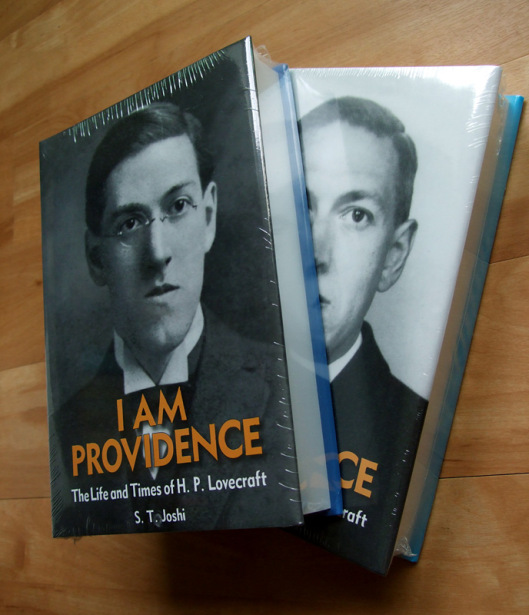
I Am Providence is certainly a hefty treasure, both in terms of the weight and the $100 cost. It is handsomely presented in two volumes between firm black boards, and was printed on good paper. The binding stood up well to my robust first reading, the boards staying flat and the spine only becoming very slightly slippy. Some have suggested (seemingly at a first glance?) that the font choice is a little small, but I had no problem at all with eye-strain while reading through the 1150 pages. I was reading the volumes in a bright summer light, though — so perhaps those reading by a single bulb in the winter, and with older eyes than mine, may have more trouble with the font size. More photographs might have been welcome, and on glossy rather than matte paper, though I expect that the cost of reproduction rights was a factor here. I spotted about ten very minor and trivial typos, but these are obvious and don’t affect the meaning of the passage or the word used. In a work of this size it is no doubt impracticable for a niche small press to get all the typos out, without crowd-sourcing the job or paying a small fortune to professional proof-readers. Both in terms of their tactile nature and their readability / technical precision, the two volumes are very pleasing.
I Am Providence is clearly written in plain English, and it has a straightforward organisation and a substantial index and bibliography. Overall I felt that the book was not a whit too long, although I admit I did skim-read perhaps thirty pages or so, mostly pages that detail petty squabbles within the amateur journalism movement of the 1910s and 20s. Joshi laces the volumes with reams of fascinating facts that must have taken platoons of scholars and fans years of time and trouble to unearth during the last 70 years. Those of us who may be becoming interested in Lovecraft scholarship in the 2010s really do owe an immense debt of gratitude to these grand old fellows for all their painstaking work, some of which has apparently still not been published. In addition, some of the facts in I Am Providence are quite new, arising from quite recent scholarship and discoveries. There is also a useful end chapter giving a distilled summation of the later development of the Lovecraft mythos, its adaptation in other media, and the outlines of Lovecraftian scholarship from 1937 to about 2009.
Are there flaws? There are a few, and it’s probably very churlish of me to mention them but I’m going to anyway. Joshi’s socialism pokes its giant elbow in here and there, but it is always eminently detectable and dissolvable. Homosexuality in Lovecraft’s circle is often left unmentioned or barely treated at certain points, where some very useful elaborations might have been made in the same manner as Joshi elaborates elsewhere on the racial aspects. I was especially curious to see if Barlow’s homosexuality was a factor in Barlow being bullied out of the Lovecraft estate by Derleth. Possibly not, but this occurrence is very vaguely despatched by Joshi in one rather curt and short line, with no reference to where one might find the full facts.
In general the book only allows the various historical contexts to play rather lightly in the background. But to be fair, to have fully treated these would no doubt have required another complete volume of appendices, and the reading of a great many weighty history books from university presses (many of which have appeared only in the last decade, with 1920s New York and the Great Depression being especially well covered with new scholarship). In particular, though, Joshi’s view of the political response to the early years of the Great Depression seems to me to rest too much on out-of-date and partisan leftist histories of the era.
But these are relatively minor and carping points, when set against the grand and impressive sweep of the book. The Lovecraft that emerges from the pages is certainly not ‘the isolated mad freak’ that many have claimed (and some would still like to believe) Lovecraft was. Nor does the book give the slightest encouragement to those who wish to claim Lovecraft as some kind of occult practitioner or prophet. Some have apparently quibbled at the way Joshi inserts his critical opinions on the worth of each of Lovecraft’s stories. I found these short comments and asides to be useful, especially since they do not arise from trendy academic theories and are not obscured by lit-crit jargon. Over the last year I have returned to Lovecraft and have re-read nearly all of the fiction, and I found myself in general agreement with Joshi’s opinions and his plainly-worded rankings of the various works. Likewise the attention Joshi pays to issues of anti-semitism and racialism seems fair-minded and careful, and the broader context of the ubiquity of such ideas in the 1920s and 30s is introduced and considered. In conclusion, I Am Providence is a highly recommended and valuable grounding for those becoming interested in Lovecraft’s life and works, and it is likely to remain so long into the future. Next on my list is the sadly out-of-print Lord Of A Visible World: an autobiography in letters (Ohio University Press, 2000), in which Lovecraft effectively gives us his life in his own words via the letters. It should make a fine bookshelf-companion for Joshi’s two monumental volumes.