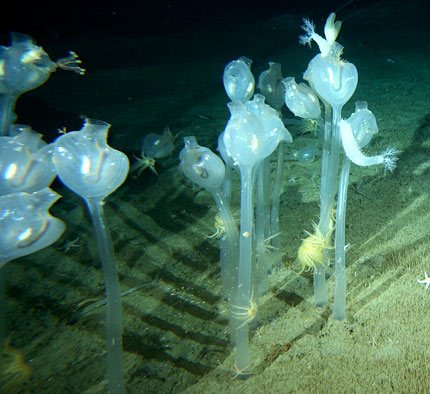
Scientific American fisks the geology of At The Mountains of Madness.

Above: tunicates that live in the coastal water of Antarctica.
19 Monday Dec 2011
Posted in Scholarly works
Scientific American fisks the geology of At The Mountains of Madness.

Above: tunicates that live in the coastal water of Antarctica.
12 Monday Dec 2011
Posted in New books, Scholarly works
S.T. Joshi’s blog has updated. It includes, among other items, news of the new illustrated version of the biography which should be published in Autumn 2012…
“…heavily illustrated biography of Lovecraft (the tentative title — which I don’t care for — is H.P. Lovecraft: Nightmare Countries), to be distributed exclusively in Barnes & Noble bookstores. […] I hope to suggest or supply numerous illustrative matter, including photographs of Lovecraft (probably drawing on the extensive collection assembled by Donovan Loucks), copies of letters or manuscripts, and so forth.”
12 Monday Dec 2011
Posted in New books, Scholarly works
A couple of non-Joshi scholarly items, noted as due for publication in 2012…
Green, Matthew (2012). “A Darker Magic: Heterocosms and bricolage in Moore’s recent reworkings of Lovecraft”. In: Alan Moore and the Gothic Tradition. Manchester University Press. (Forthcoming, 2012).
Weird Realism: Lovecraft and Philosophy. Zero Books, (Forthcoming, 2012). Seems to have been due since 2010, and “will deal with a small number of H.P. Lovecraft’s greatest stories” when it finally appears.
10 Saturday Dec 2011
Posted in Historical context, New books, Scholarly works
Interesting-sounding new book coming from Oxford University Press… As If: Modern Enchantment and the Literary Prehistory of Virtual Reality by Michael Saler. Out in January 2012, but there’s a Kindle edition already available in the USA (published 3rd Dec, not available the UK). Looks very interesting, although OUP have saddled it with an unappealing front cover which has dreadfully bad typography.
Edward Castronova says of the book… “This is the best cultural study of fantasy I have ever read. A powerful, liberating argument, woven together from an impressive array of sources, all treated well and fairly. Saler routs the assumption that enchantment and reason oppose one another”. Here’s some of the offical blurb…
“Many people throughout the world inhabit fantastic imaginary worlds [online, in videogames or in fan communities]. These activities are often dismissed as harmless escapism or bemoaned as pernicious wish-fulfillments that distract from the serious business of life. Saler challenges such claims by excavating the history of imaginary worlds in the West since the late nineteenth century, when the communal and long-term immersion in such worlds first began with Sherlock Holmes. The book contends that imaginary worlds emerged at this time as sites of rational and secular enchantments for the modern age. They continue to represent distinct social practices informing political, social, and spiritual life. Individuals often use imaginary worlds as a playful space to debate serious issues in the real world; they also use them to hone their understandings of the interplay of reason and imagination and the provisional nature of all representations. Saler provides an overview of how imaginary worlds went from being feared by the Victorians to being inhabited by the Edwardians, and discusses in detail the creation and reception of the worlds of A.C. Doyle’s Sherlock Holmes, H.P. Lovecraft’s Cthulhu Mythos, and J.R.R. Tolkien’s Middle-earth, among many others. […] Saler’s book contributes the historical back-story of those deeply engaging imaginary universes, highlighting their vital lessons for how we can remain enchanted but not deluded in an age that privileges the imagination as much as reason.”
Of course there were also many other technical precusors of virtual reality in the Victorian and Edwardian eras — such as giant panoramas, fraudulent spiritualist seances, grand Wagnerian ‘immersive’ theater, fairground ‘haunted houses’, etc. A number of history books on these have appeared in recent years. And literature was not without its own technologies that were both individuating and communal at the same time, such as techniques of coded layering such as that found the ‘reserved’ forms used by the likes of Christina Rossetti or the secret codes of queer poetry. One of the interesting changes in genre fiction is that this ‘depth coding’ was no longer available as a literary technology for such writers, since everything had to be “out in the open” in terms of readability. In this respect, what’s interesting about Lovecraft is that his best work finds some potent ways to slip a little ambiguity and ‘difficulty’ back into genre fiction.

09 Friday Dec 2011
Posted in New books, Scholarly works
Vague news of a new S.T. Joshi project — H.P. Lovecraft: Nightmare Countries is apparently set to be a heavily illustrated life of Lovecraft, something which previous biographies have not really been able to do. Publisher’s Marketplace reports it has sold to a publishing house.
“is illustrated with photographs, documents, and other images and telling the story of Lovecraft’s life”
26 Saturday Nov 2011
Posted in Scholarly works
Monsters: Subject, Object, Abject :: April 12th-13th 2012. The Manchester Museum, Manchester (northern England), United Kingdom
From children’s toys to religious architecture, from medical and legal definitions to Gothic romance – cultural products resonate with fear, obsession and desire for the monster.
CALL FOR PAPERS: Proposals are sought for 20-minute papers. Possible topics include (but are not limited to)…
Monsters in literature, art, music and film
Architectural monsters
Subjectivity and the monster
Objectification and the monster
Historical definition of the monstrous
Medical and legal monsters
Theorisations of the monstrous
Mythology, folklore and legends
Hybrids and hybridity
Cyborgs and the posthuman
Please send 300-word abstracts to conference@hic-dragones.co.uk by Sunday 1st January 2012. For more information, please see our website: www.hic-dragones.co.uk/events.
Following the conference, there will be a two-day public Monsters Convention in Manchester. We would be interested in hearing from anyone interested in offering a talk or seminar at this convention. Please email Dr. Hannah Priest for more info: events@hic-dragones.co.uk
25 Friday Nov 2011
Posted in Scholarly works
Another quick trawl for recent Lovecraft scholarship published in out-of-the-way places…
* Micheal Gentry. “Parser at the Threshold: Lovecraftian horror in interactive fiction“. In the book: IF Theory Reader, March 2011. (Online, free.)
Also related to IF (interactive fiction), an English summary of a talk given at the Storyworlds Across Media conference (Johannes Gutenberg-Universitat Mainz, 30th June — 2nd July 2011)…
“In a talk on “The Developing Storyworld of H.P. Lovecraft”, Van Leavenworth (Umea) demonstrated that Lovecraft’s works hold two mythical concepts that appeal to his followers who have not only developed a number of textual, audio-visual and interactive fictions but also integrated elements of his stories into obscure cults: the loss of control or ‘cosmic fear’ and humanity’s inability to understand cosmic knowledge. Apparently, these universal human concerns adapt well to different uses and invite recipients to engage in the spiritual and transcendent body of thought that is attributed to the author’s name and persona. Hence, Leavenworth, as the previous speakers, put Ryan’s criteria of consistency and media-exclusiveness of the storyworld up for debate.”
* David Marks (2011). From the will to Wessex to Arkham: Lovecraft’s geophilosophical debt to Hardy. California State University, M.A. dissertation. (Hardy as in Thomas Hardy. Not yet online.)
* Julio Franca (Oct 2011). “Fundamentos Esteticos da Literatura de Horror: A influencia de Edmund Burke sobre H. P. Lovecraft“. (Article in Spanish on the influence of Edmund Burke’s A Philosophical Enquiry into the origin of our ideas of the sublime and beautiful, on Lovecraft. Online.)
* Matthew Strohack (2011). “The City under the Hill: Allegorical Tradition and H. P. Lovecraft’s America.” A chapter in the book American Exceptionalisms: From Winthrop to Winfrey, SUNY Press, December 2011. (Already available to read online at Google Books.)
24 Thursday Nov 2011
Posted in Scholarly works
Forthcoming in the second issue of The Heretic’s Torch print zine…
“[a] lengthy interview with […] S.T. Joshi (the Lovecraft scholar)”
“a [heavy] metal-adapted version of Lovecraft’s Supernatural Horror in Literature essay discussing weird fiction in [heavy] metal [music]”
22 Tuesday Nov 2011
Posted in Lovecraftian arts, Scholarly works
I’ve added a new bookseller to my ‘Lovecraft on the Web’ list. It’s Cold Tonnage, whose new list leads off with a new Tartarus Press limited-edition of Robert Aickman’s Dark Entries (originally 1964).
There’s also an article on Aickman titled “Some Notes on Aickman’s Plays” by Douglas A. Anderson, in the Tartarus Press journal Wormwood #17. Just published, #17 leads with “World Gone Wrong: H.P. Lovecraft’s mythology of loss (part one)” by Joel Lane.
17 Thursday Nov 2011
Posted in Scholarly works
An interesting new empirical / industry-structure analysis of the rise of SF in America: David Reinecke, “From the Pulps to the Stars: The Making of the American Science Fiction Magazine, 1923-1973”. Princeton University CACPS Working Paper #44, Fall 2011.
16 Wednesday Nov 2011
Posted in New books, Scholarly works
Marina Warner’s new book on magic and the reception of the Arabian Nights, Stranger Magic: Charmed States and the Arabian Nights, reviewed…
“The second part attends to the Arab and European habit of attributing foreignness to evil magicians. These dark enchanters come from dark places (Africa and India) and profess dark (pre-Islamic) faiths. During the Enlightenment, black magic became inevitably dark skinned; necromancy became inseparable from “nigromancy”.
Of obvious relevance to much weird fiction from the 1920s and 30s, and Lovecraft’s use of mad Arab wizards, etc. Warner is not your usual theory-clotted lit crit academic, she’s a proper historian and independent scholar.
16 Wednesday Nov 2011
Posted in Scholarly works
The New York Times obituary for Les Daniels — horror author of Providence, and “one of the earliest historians of comic books” with books such as Comix: A History of Comic Books In America (1971).
Also… “The subject of his master’s thesis was the horror author H.P. Lovecraft” and he wrote on Lovecraft for the local Providence press. It seems S.T. Joshi has a section on the Daniels vampire novels, in the book The Evolution of the Weird Tale. Joshi also suggests, in one interview, that Daniels’s Living in Fear: A History of Horror in the Mass Media (1975)… “is probably the best we have, but of course it is very much out of date”.