• About
  • Directory
  • Free stuff
  • Lovecraft for beginners
  • My Books
  • Open Lovecraft
  • Reviews
  • Travel Posters
  • SALTES

Tentaclii

~ News & scholarship on H.P. Lovecraft

Tentaclii

Category Archives: Picture postals

Views of Providence

18 Friday Nov 2022

Posted by asdjfdlkf in Picture postals

≈ 2 Comments

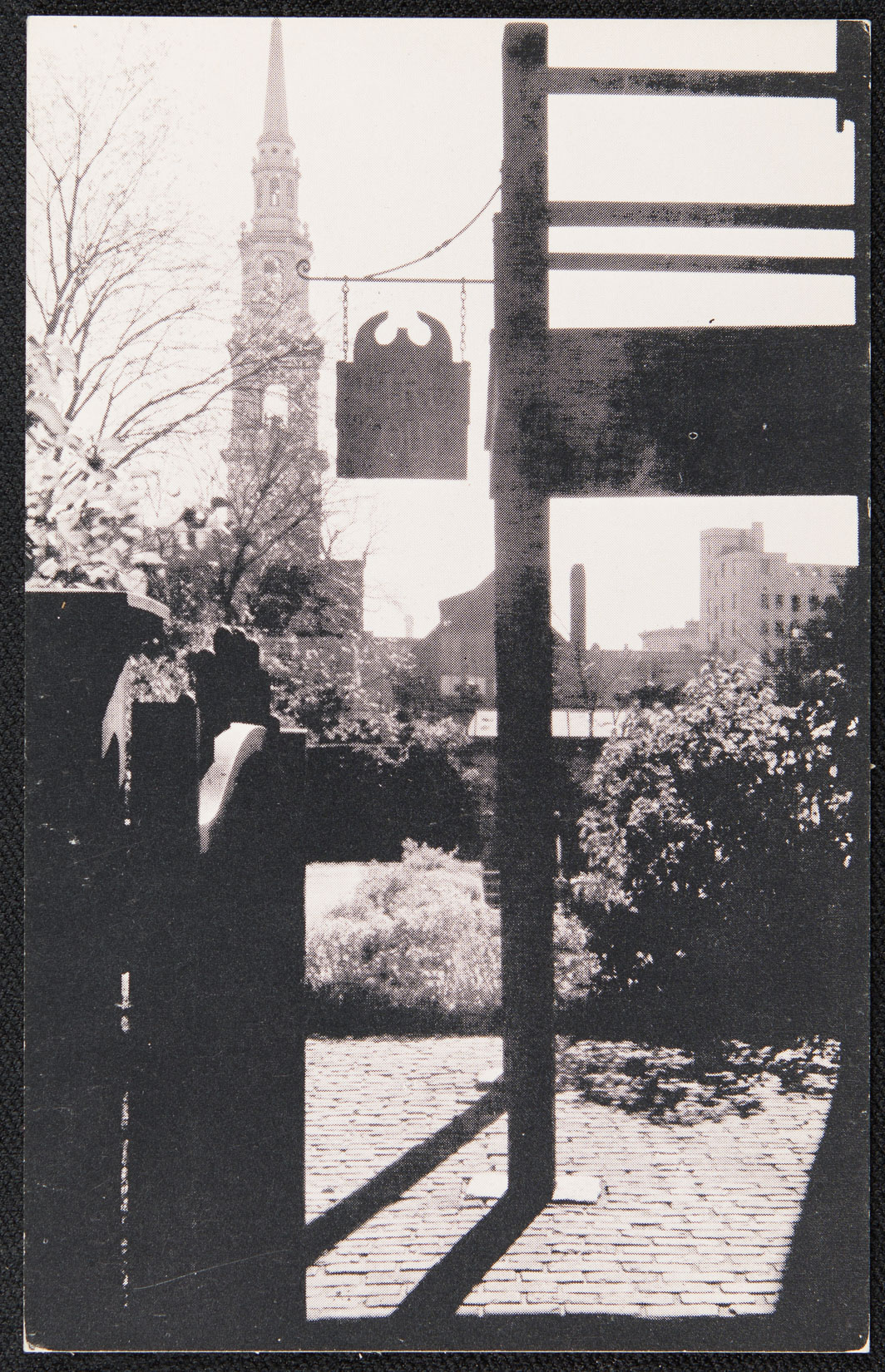
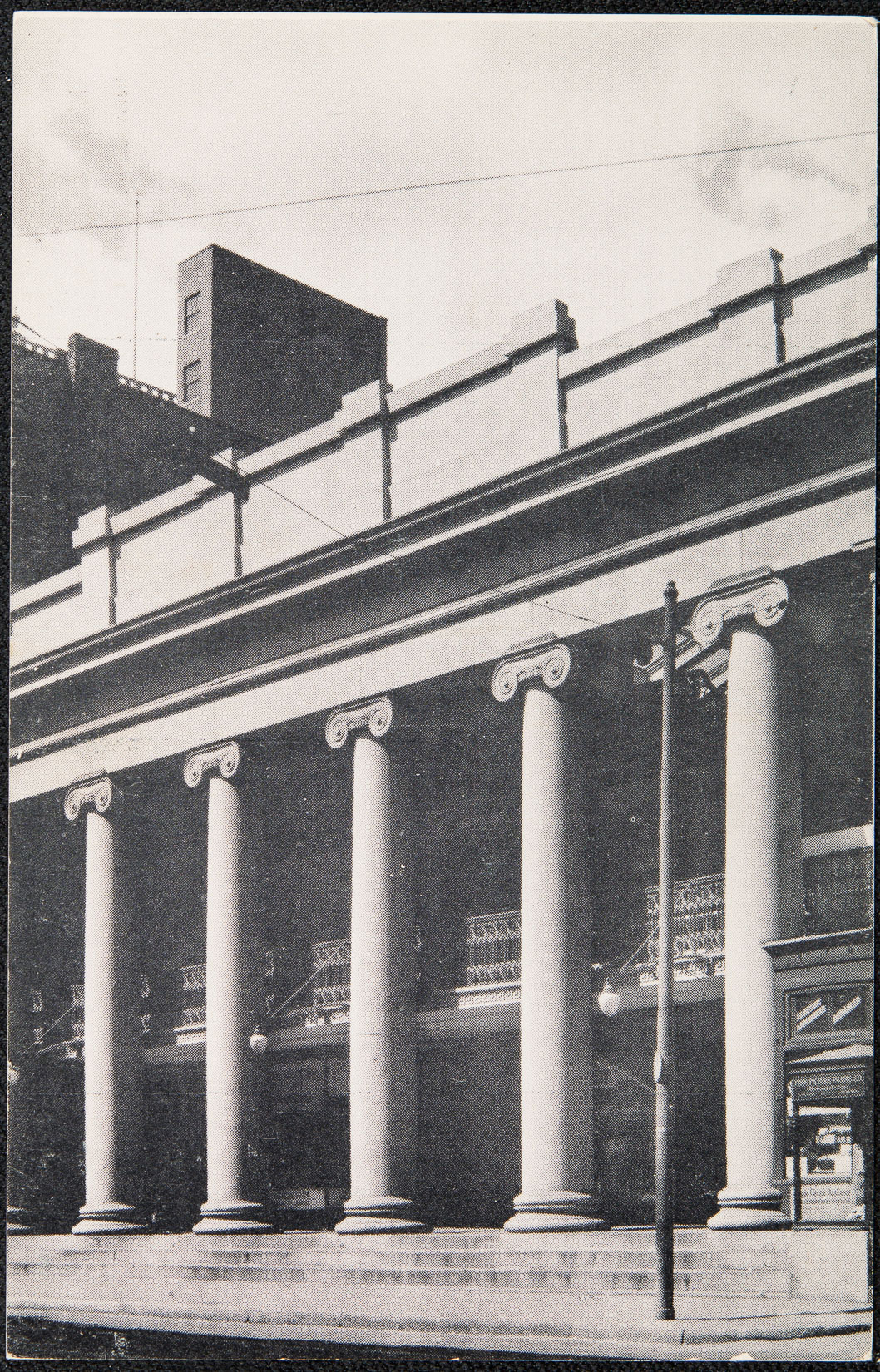
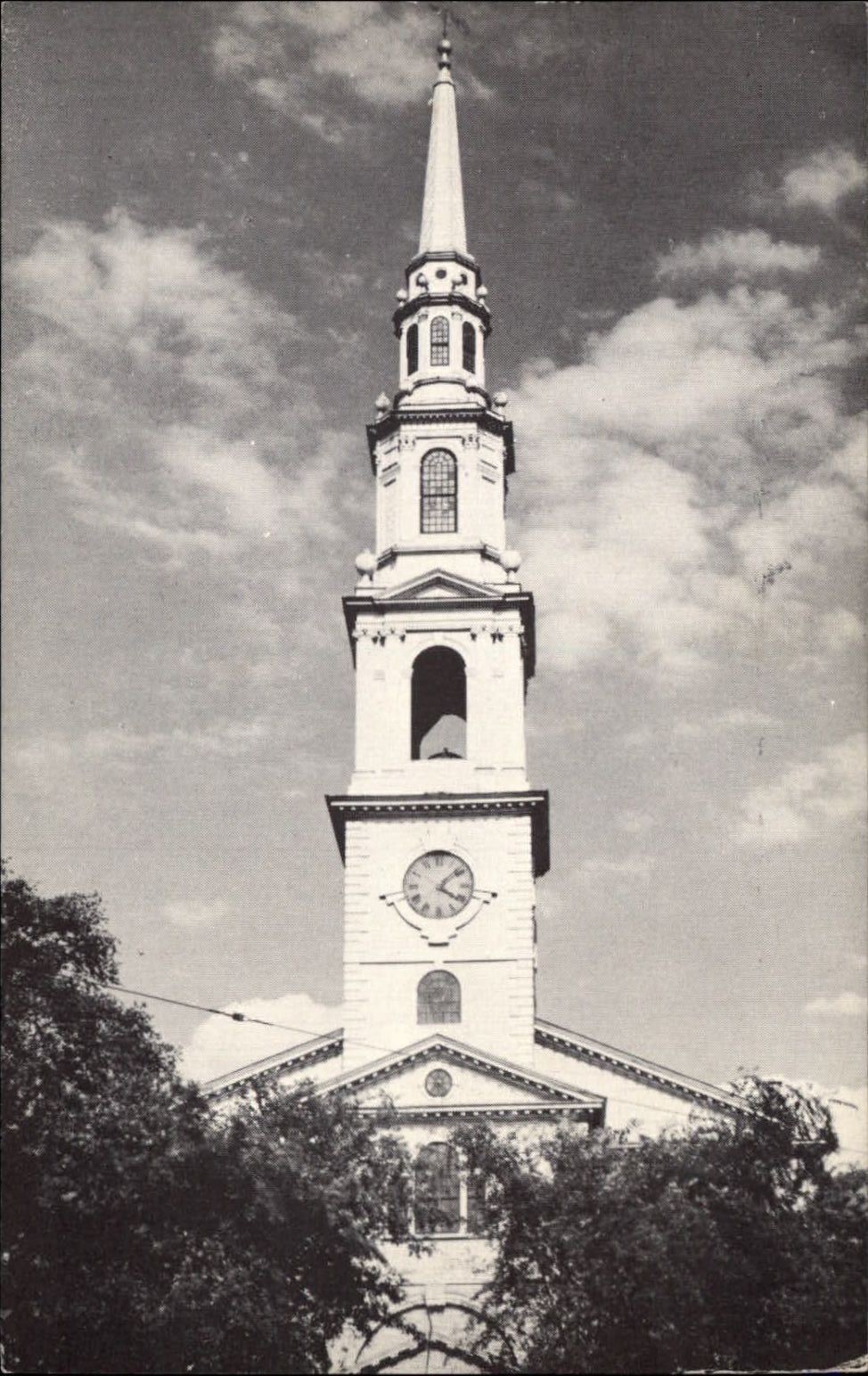
This week in ‘Picture Postals’, part of The Beth Murray collection of Providence photographs. My thanks to the Providence Public Library, which has large scans of the screened postcard version of these Providence postcards, postcards once issued as sets by the city’s Book Shop. I’ve selected the views and places more relevant to Lovecraft.

Benefit Street, Providence.

Thomas Street, Providence. Appears in “The Call of Cthulhu”.

The view from the garden of the Shakespeare’s Head.

“John Carter … His old shop & office, the Sign of Shakespeare’s Head, in Gaol-Lane” (Lovecraft, speaking of Providence)

The John Carter house on Benefit Street.

Along the River Seekonk, Providence. On the way to one of Lovecraft’s favourite places, the wooded bluff above York Pond. The spot is around the corner in the distance. The young Lovecraft used to row on this river, most likely hiring a boat from the boat-house rather than Red Bridge, and would land on the Twin Islands in the river’s stream.

George Street, Providence. City centre and the then-new Industrial Trust building in the distance.

Looking up College Hill toward’s Lovecraft’s last home. The olde left side swept away for new RSID buildings, though somewhat sympathetically done with an old courtyard archway retained.

The Handicraft Club half-way up College Hill. Lovecraft’s aunt lived here for a while.

Another view of the Handicraft Club half-way up College Hill.

One of the entrances to the covered shopping Arcade, Providence. A favourite childhood haunt of the young Lovecraft.

View across to the new State House.

Another State House view.

Street market in the Italian quarter, Federal Hill. Setting of the late story “The Haunter of the Dark”.

The Baptist church, where Lovecraft tried to play “Yes, We Have No Bananas” on the organ.

I haven’t tried to foist colourising on them, since most of them are too contrasty (which doesn’t take colour well). There are more pictures to be found at the Library’s website and even more if you root around and hang around on eBay. Usually noted there as a “Book Shop” card…

I’ve found that Murray (1913-?) also issued a 34-page photobook for Lovecraft’s favourite local day-tip location, This is Newport: A book of photographs (1948).

Therefore she was also photographing in the mid-late 1940s. Interestingly she also issued the presumably similar title This is Providence: Photographs (1947). These dates suggest the dates of her pictures may well be earlier than the circa 1960 dates of the Book Shop’s postcard-set. We may be looking at Providence circa the mid 1940s, less than a decade after Lovecraft died. This earlier date would explain the somewhat rough ‘immediate post-war’ feel re: the b&w quality of the prints. At that time she would have been limited in materials and camera, and was likely printing them up for cheap reproduction in her books rather than as big art-prints.

There is no trace of either of her books on Archive.org. It’s possible there may be better quality / more pictures in the books, and possibly even some biography. There appears to be no institutional archive with her negatives, from which better prints might now be made.

Notes on ‘Letters with Donald and Howard Wandrei’, part four

11 Friday Nov 2022

Posted by asdjfdlkf in Picture postals, Scholarly works

≈ Leave a comment

The final part of my notes on Letters with Donald and Howard Wandrei.

We open in late summer 1935, among the letters sent to Petaja.


Various pages. Both 1935 and 1936 appear to have had cold and late spring-times, which did not help to bolster Lovecraft’s failing health.

p. 450. Lovecraft sees a rare “lunar rainbow” in Florida, cast by the full moon, and describes it as “faint but perfect”.

p. 451. He recalls that he had seen Indians (i.e. native Americans) once “in their native habitat” in 1931. These were Seminoles “who still maintain their tribal organisation”. They had a large camp at Musa Isle in the Florida everglades, and did their best to maintain traditional dress and customs under tribal leadership. The forthcoming book Lovecraft in Florida will likely have more details on such visits.

p. 458. Shows evidence that he is aware of the gay movement in Germany, by October 1935. In a brief discussion of Burton’s 1885 musings on a geographical “Sodatic Zone”, he notes… “at present Germany is said to suffer from such perverted attitudes”. Although by that time Lovecraft was increasingly out-of-date re: the Nazi Party under Hitler (who had seized control of the Party in June 1934).

p. 463. He did not actually own a copy of The Witch Cult in Western Europe (1921), and it appears he never had… “I wish I could get hold of it, but it is infernally hard to find”. p. 466 has him stating “I’d give a lot to own a copy”.

p. 468. He would also like to have read the great Finnish epic The Kalevala.. “which I have for years been meaning to read”. Also p. 483, “my long-standing wish to read the Kalevala“.

p. 469. “Choreography [i.e. the dance] is an art I can appreciate even less than music”.

p. 474. Reports that he undertook a “titanic file cleaning” over many days in June 1936, and as a result he has “thrown away a couple of tons of junk”. And among it probably papers and letters that today would fetch substantial sums, and would be of much interest to scholars.

p. 486. Following the letters, a reprint of an article on Howard Wandrei. Wandrei tells the interviewers that he once owned a complete run of the pre-Weird Tales magazine The Black Cat, and Wandrei retails the story that it folded (shortly before Weird Tales appeared on the stands) because it ran one especially gruesome story involving pain experiments on cats and dogs, then a man. The magazine’s circulation vanished as a result, apparently, and it folded. However, the story of that title was actually in The Black Mask in early 1924, and cannot be found in the old The Black Cat. I suspect that a crackly telephone interview allowed the confusion of the two titles. The Black Mask (est. 1920) may well have dipped in circulation as a result, but appears to have run on until July 1951.

p. 488. A dealer-listing of letters from Lovecraft to Wandrei is given. These letters either no longer exist, or else are salted away in a private collection. But the listing does quote a few lines here and there. A 7th November 1935 postcard was sent by Lovecraft from the rooms above the “Julius” bar in New York City, where Lovecraft was staying. Later a long-time and famous gay bar, although its 1935 status is unknown other than it was then the “Julius” bar.

‘Julius’ bar, 155 West 10th St., now No. 159.

Lovecraft assures the recipient of the card that he is “NOT patronising the barroom beneath” his room, although Donald Wandrei is. He had earlier noted Wandrei was living above a “well-known ‘bohemian’ restaurant” in one letter, but that was presumably before his actual arrival. On arrival, and seeing the place, he is obviously more inclined to call it simply a “barroom”. He spent two weeks living there with Howard Wandrei. The address was 155 West 10th St., now numbered as 159 and it has since become one of the most famous bars in gay history.

Lovecraft on a Comet

04 Friday Nov 2022

Posted by asdjfdlkf in Historical context, Picture postals

≈ Leave a comment

A post title like ‘Lovecraft on a Comet’ might seem a nice co-incidence for Bonfire/Fireworks Night. Though here the Comet in question is a train, and not a blazing hunk of ice hurtling through the cosmos.

Many will recall that Lovecraft had a lifelong love of railway trains. This was not only confined to his youth, when he appears to have read the entire run of Railroad man’s Magazine, made scale-model tracks in the old carriage-house, then taken solo journeys in middle-childhood, and even published his own The Railroad Review ‘zine for family and friends (1901, one issue known) — complete with long humorous verse, perhaps his first really successful original narrative for an audience.

Some of his most enjoyable travels were had by train carriage and railway station, especially when fine landscape views were streaming past his window. Sometimes, an alternative view of a place gave him a completely different and more favourable impression, as when an unfamiliar rail route once took him into his friend Morton’s mundane New Jersey town. He also enjoyed the arrivals and departures, such as riding into New York City above the sidewalks on the famous ‘Elevated’, or departing the city for his honeymoon from the mighty gothic/classical Pennsylvania Station.

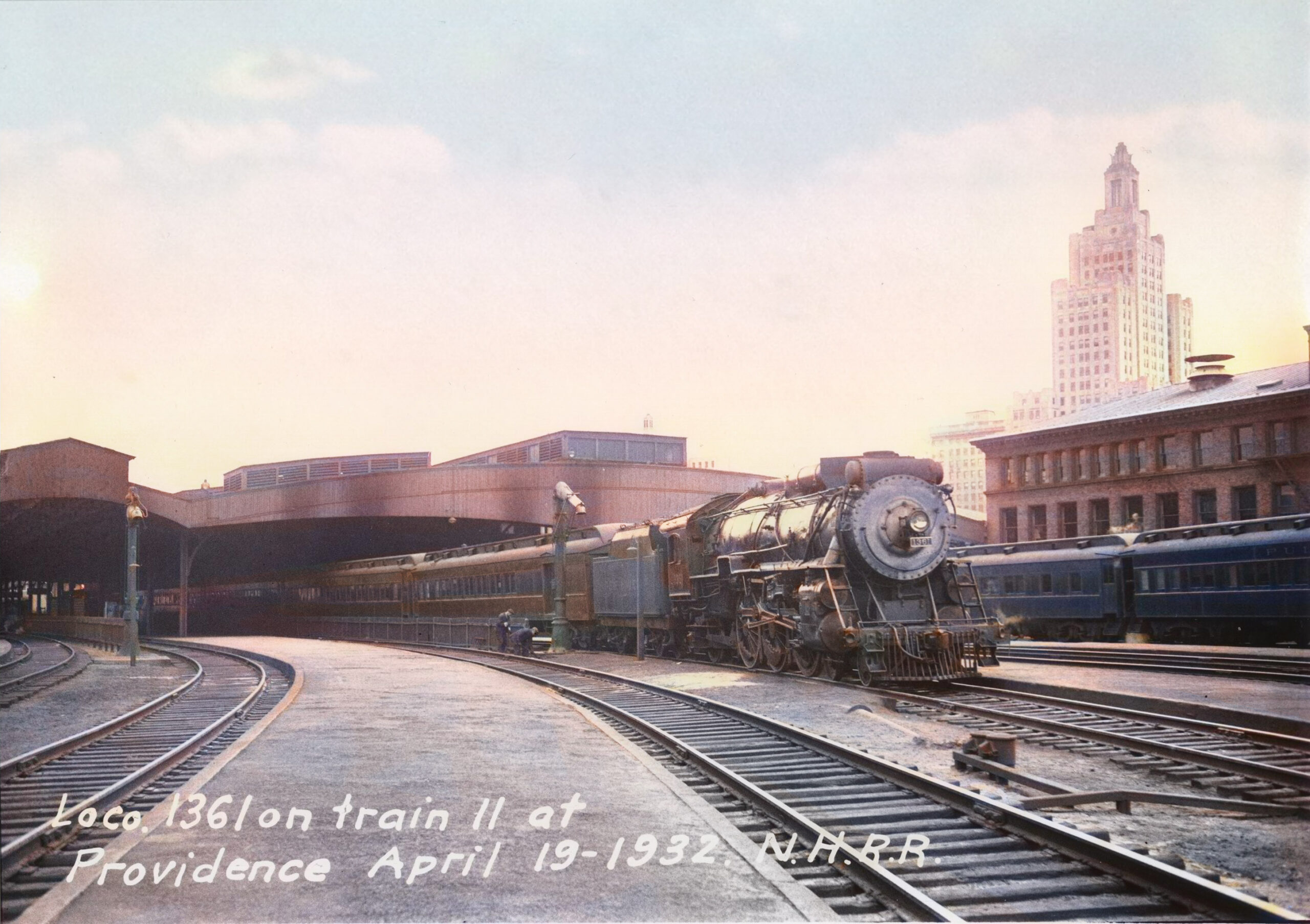
But what of Providence? We have a few wide pictures of the city station frontage, but what about behind the frontage in the last years of the great Age of Steam? I’ve found this vintage 1932 picture which gives a feel for the sort of mighty steam trains to be found there, on which Lovecraft would have departed and entered his city. Here the train is about to head westward and so presumably reach New York City. With thanks to the Providence Public Library. I’ve here colourised their scan of the picture.

[the pronunciation of ‘Cthulhu’] “is more like the sound a man makes when he tries to imitate a steam-whistle…” (Lovecraft).

Late in his life Lovecraft also managed to get aboard a new Providence ‘super-train’ for a guided tour, when the train first arrived in his city. This was a new super-streamlined tubular-aluminium and air-conditioned diesel train named The Comet…

Early artist’s impression of what the new train might look like.

The service in operation.

Sadly I can’t re-find Lovecraft’s account of the tour he was given, but I recall it filled at least a long paragraph or so. It’s in the published Letters somewhere, probably given to one of his younger correspondents. April/May 1935 appears to be the target date, judging by press photos and news coverage at that time. But I can find nothing in the Bloch or Rimel letters.

Apparently the design was a one-off and it was the only train ever designed by Zeppelin in Germany. Some in the press billed it as a “rail-Zeppelin”. In those pre-war days the Germans and Americans could work on such joint projects. Lovecraft no doubt approved of the Teutonic styling, with the train-ends rather resembling Wagnerian helmets. The Comet went into service in June 1935 on the Providence to Boston (South Station) run, making the run in 44 minutes including a stop at Back Bay in Boston. The train was double-ended for a quick turnaround at its destinations. The livery was “blue, silver, and white”, and was very plush inside for its 160 passengers. It was a great success, and proved itself totally reliable during the following 1935/36 New England winter.

Such a ‘new’ train must have seemed a remarkable change from the grimy and older steam-trains Lovecraft was used to, and quite a harbinger of the future. Steam-trains may have their charms. You could slide down the carriage windows for fresh air, for one, and passengers were not sealed in a “pre-paid suffocation chamber” (as Lovecraft once termed air-sealed public-transport). But they were also heavy and noisy, and one might encounter soots and smoke as one boarded.

I don’t know if he ever actually travelled to Boston on The Comet. He preferred a more leisurely landscape view from his train windows, and even a one-way ticket may have been deemed an expensive extravagance. He did visit the Boston area to see Cole and his family, from 3rd-5th May 1935, as he notes for several correspondents (e.g. Rimel letters, p. 273), and did so again some time later. But he would surely have mentioned it to them if he had ridden on the new Comet to reach Boston.

Departing Newport

28 Friday Oct 2022

Posted by asdjfdlkf in Maps, Picture postals

≈ Leave a comment

Lovecraftians are well aware that Newport, Rhode Island, was one of the master’s favourite local places. Many will also recall that this old coastal town was only readily and affordably accessible to him by occasional passenger-boat, especially when discounted day-trip tickets were on offer. Though as you can see from this map from the same era, there was a back automobile road to it from the north. But presumably he found the boat preferable to taking a series of stuffy summer buses and juddering trams from Providence. Possibly the big bridge seen on the map also charged a toll.

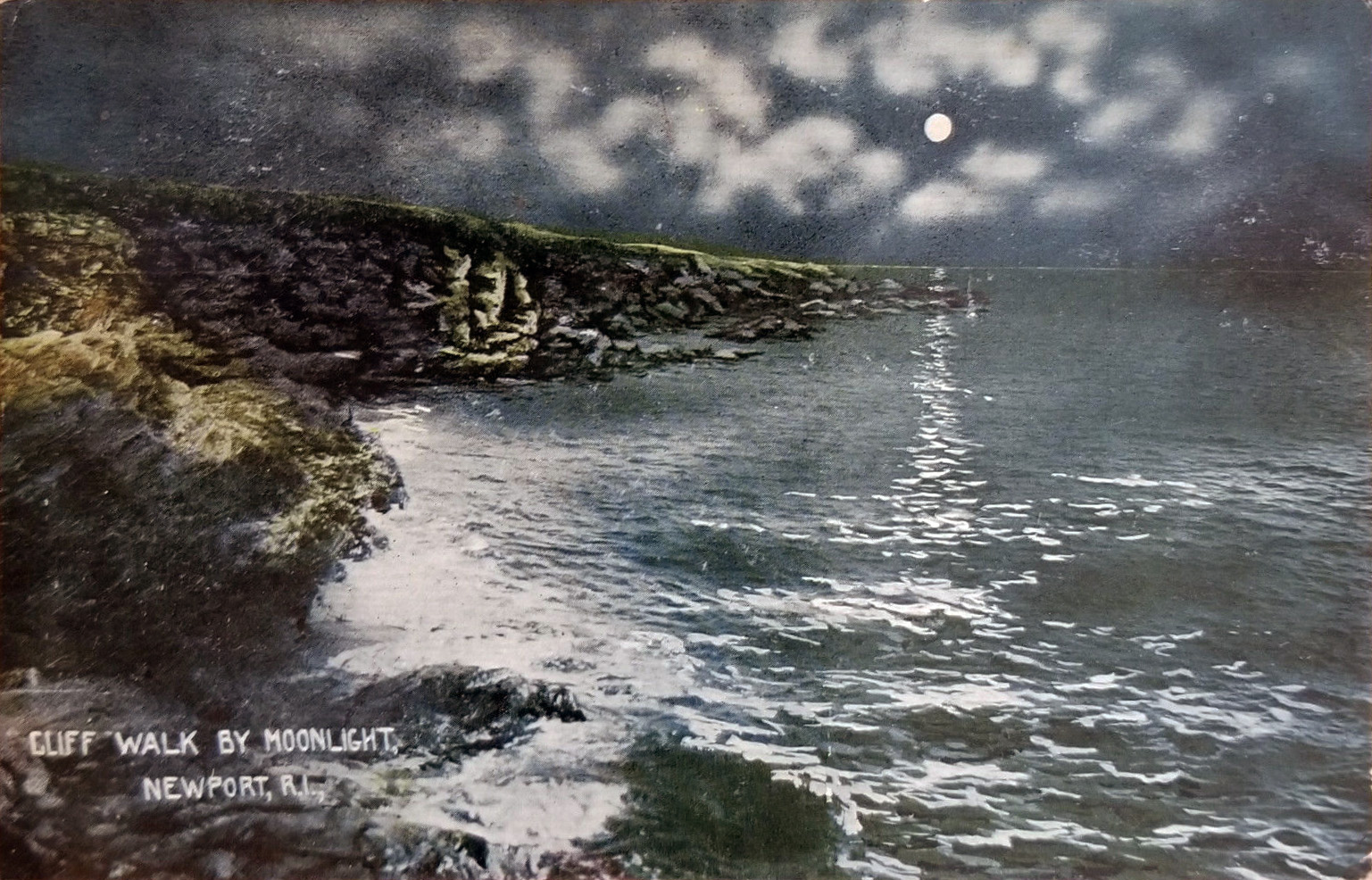
So far as I recall he always departed the town at the end of the day. Mythos writers may spot an opportunity in that fact, for a new story explaining why spending a night in Newport might be a fearsome thing. I’ve found some ‘night in Newport’ visual prompts for such a story.

This is quite possibly a dusk view that Lovecraft knew, seen from the stern as the passenger boat eased from the passenger docks at Newport Harbour and ran out past the Goat Island light. In some instances, the cheaper boat he favoured went back later than the more expensive one. In the picture one can see the rounded sterns of two docked passenger boats, beyond Goat Island Light.

Above is the same view but in a fine early silhouette picture. I recall he did at least once visit the town in winter, so an evening departure might well have displayed such a scene. The lights seen on the right are of docked passenger boats, rather than the town rising behind them.

Here are a few others of Newport by (painted-in) moonlight…


And finally a delightful card which some Lovecraftian RPG artist will surely want as a picture-reference, though it is not of Newport.

This is Bristol, which sits on the same coast but is some miles above Newport. Lovecraft visited Bristol in 1933 during a long visit by Morton…

we walked south to Bristol, another quaint 18th century seaport.

When Moe’s son visited with his car in 1935, Lovecraft showed him…

the quaint little seaports down both sides of Narragansett Bay – Warren & Bristol on the east shore

Lovecraft also appears to have passed through as a venturesome eleven year-old in late 1900, since that was when the new electric trains first went to Warren and Bristol and Fall River. It appears to have been winter, judging by the “delightfully witty poem” (Joshi) that Lovecraft wrote based on the journey…

One winter’s morn, when all man kind did shiver, / I took a train, directed toward Fall-River.

The new-fangled “monstrous car” (i.e. train carriage) appears to run on electrickery rather than steam, and quickly turns into a train disaster as it ceases to run. Thus Lovecraft alights and cadges a ride in the frozen twilight, from a…

willing yokel with an ox-drawn cart

…and thus he presumably reaches and passes through Bristol. He spends the night in Fall-River, and returns the next day by the safer and more reliable route of a boat journey back to Providence. The poem is “H. Lovecraft’s Attempted Journey” (1901). It seems he did actually take the trip, and the imaginative poem was likely his comic evocation on the delays and problems encountered on the first run of the new service.

Bristol obliquely appears in his story “High House” as Bristol Highlands, this being a bright new coastal resort development where the professor later takes a placid summer-house. Presumably located on the heights above Bristol.

Overall, I get the vague impression that Bristol was too “quaint” and placid for Lovecraft’s tastes, and perhaps had been overly gentrified and made twee and touristy.

St. Paul’s Chapel, Broadway and Vesey

21 Friday Oct 2022

Posted by asdjfdlkf in Historical context, Picture postals

≈ 1 Comment

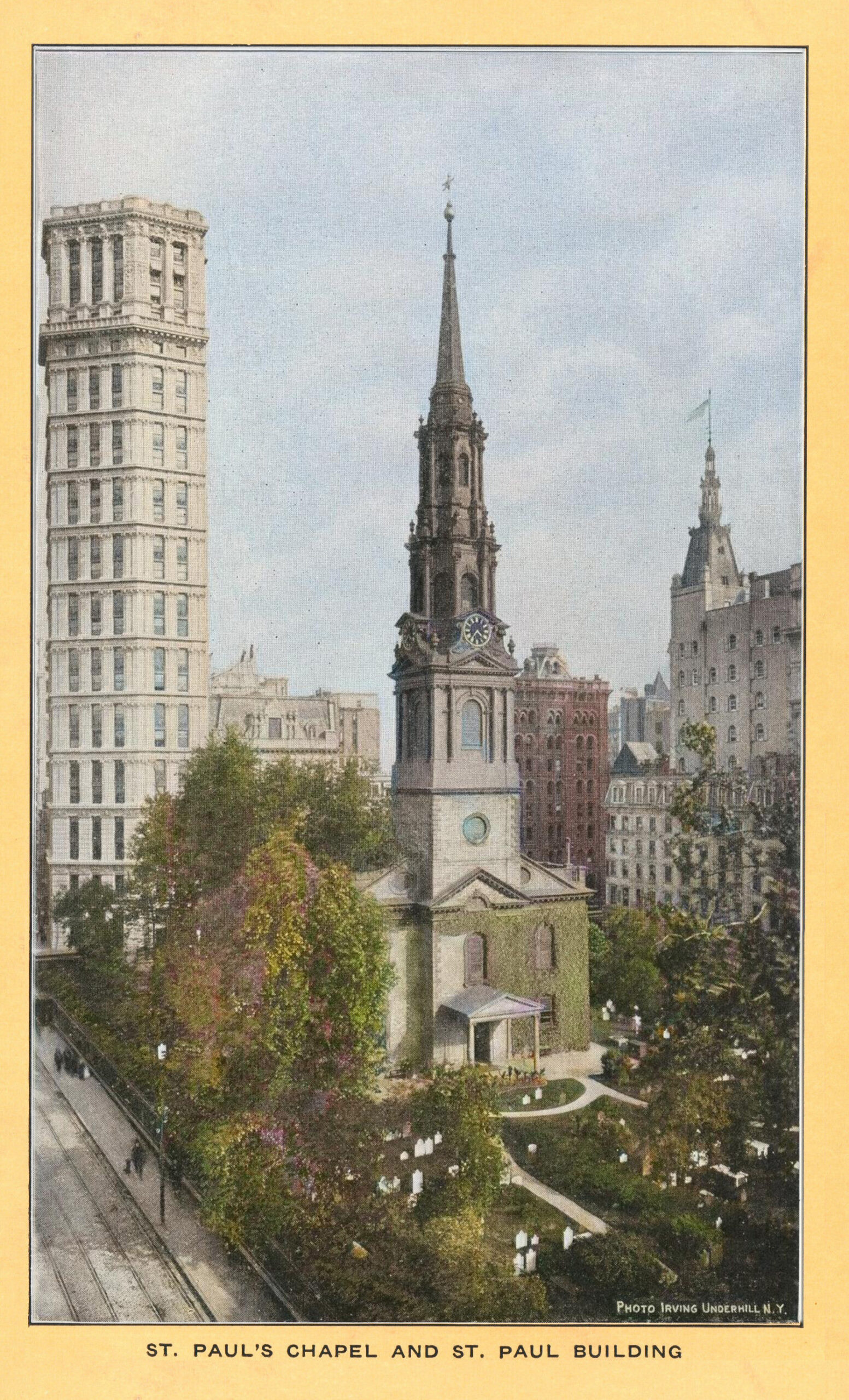
In these unhappy times, a look at a happy moment in Lovecraft’s life. Here are some views of the church chosen for Lovecraft’s wedding on the 3rd March 1924.

As Lovecraft had it…

St. Paul’s Chapel, Broadway and Vesey Streets, built in 1766, and like the Providence 1st Baptist design’d after St. Martin’s-in-the-Fields! [in London] GOD SAVE THE KING!

Neither Lovecraft or Sonia were religious, of course, but in those days a proper olde church it had to be — for a Lovecraft wedding. He appears to have chosen the place not simply for tradition, but also for its Colonial British architecture and family connections. It not only fitted…

most strongly Old Theobald’s traditional and mythological background

… but also echoed (in name only) the St. Paul’s church in Boston where his parents had married.

The cards and photos in this post are a little un-seasonal. March 1924 was famously very dry in New York, with very little early spring rain or snow, and the east coast down to Cheasapeake Bay was “warmer than normal” (Climatological Data for the United States by Sections, March 1924). Despite this and the city’s urban heat-island effect, early in March there would not have been the sort of spring/summer verdancy seen in these churchyard pictures. We might instead imagine a few hints of the very earliest new leaves on the trees, a sparse first flush of new grass after winter, and perhaps a few early un-opened daffodils.

We beat it to the Brooklyn borough hall, and got the [marriage licence] papers with all the coolness and savoir faire of old campaigners [… then ] Eager to put Colonial architecture to all of its possible uses … on Monday, March the Third, [I] seized by the hair of the head the President of the United — S. H. G. — and dragged her to Saint Paul’s Chapel, … where after considerable assorted genuflection, and with the aid of the honest curate, Father George Benson Cox, and of two less betitled ecclesiastical hangers-on [i.e. witnesses], I succeeded in affixing to her series of patronymics the not unpretentious one of Lovecraft.

Here we see the altar, albeit some decades later in time.

There were no friends or relations present…

Having brought no retinue of our own, we avail’d ourselves of the ecclesiastical force for purposes of witnessing — a force represented in this performance by one Joseph Gorman and one Joseph G. Armstrong, who I’ll bet is the old boy’s grandson although I didn’t ask him. With actors thus arrang’ d, the show went off without a hitch. Outside, the antient burying ground and the graceful Wren [designed] steeple; within, the glittering cross and traditional vestments of the priest — colourful legacies of OLD ENGLAND’S gentle legendry and ceremonial expression. The full service was read; and in the aesthetically histrionick spirit of one to whom elder custom, however intellectually empty, is sacred, I went through the various motions with a stately assurance which had the stamp of antiquarian appreciation if not of pious sanctity. Your Grandma, needless to say, did the same — and with an additional grace.

Of course, Lovecraftians now think of it as ‘a doomed marriage’. But perhaps it was not necessarily so. Had Sonia’s ill-advised independent NYC hat-shop been a success (and with the push of ‘the roaring 1920s’ economy behind it), and had her health then not have failed so badly, things might have turned out differently.

Notes on ‘Letters with Donald and Howard Wandrei’, part three

14 Friday Oct 2022

Posted by asdjfdlkf in Historical context, New discoveries, Picture postals

≈ Leave a comment

Notes on the book Letters with Donald and Howard Wandrei, part three.

We open with letters from early 1934.

p. 314. Lovecraft hears his friend Morton, the mineralogist and Paterson museum-keeper, giving a radio lecture on dinosaurs. Morton speaks on each 3rd Monday on “station WOOA”.

p. 326. Lovecraft has a kernel idea for a story involving “an oddly heiroglyphed grave” which was later surmounted and pinned down by a giant boulder.

p. 320. He suffered “measles at 19 and chicken-pox at 25.”

p. 332. Relevant to the writing of “Whisperer”. “I cannot do serious writing away from my books and familiar setting.” See my previous notes-post for this book, for reasons why it might have been something of an experiment for him. Being written piecemeal and while on his summer travels.

p. 335. He stays on the cheap “Rio Vista” in St. Augustine, Florida “on the bay front”. “Canned beans as a heavy staple” in order to economise, and “cutting my food bill down to a minimum”. He had stayed there before, for two weeks in May 1931, with the 67-year old Dudley Newton, a person “about whom we know nothing” according to S.T. Joshi’s biographies. This card gives a flavour of the “bay front”, and “120 Bay Street” is the address I found for the hotel on one Lovecraft letter. In the 1950s it had 71 rooms.

Lovecraft spent a week here in mid August, in the “quiet” hotel…

Am now in ancient St. Augustine — at the same quiet hotel I patronised in 1931. Staying a week — an utterly fascinating town!

Quiet it may have been, but it may also have had a somewhat strong sea smell. Here we see a bit further along the Bay St. sea-wall, in a 1950s slide which reveals what older postcards hide — the shore at low tide…

Despite postcards of the place rather struggling to find many examples of the picturesque, there is an impressive old shoreline fort and Lovecraft adored the rest of this sleepy “city founded in 1565” by Spaniards. Later, after a rather blood-soaked defence of the fort against the French, it was populated and made into a city by Spanish labourers from the lovely but poor island of Minorca, along with some Italians and Greeks. It was a city that Lovecraft felt to be the product of “an elder, sounder, & more leisurely civilisation”.

Who was the Dudley Newton with whom Lovecraft spent two weeks in 1931? He was not Dudley Newton (1845-1907) who was a local architect in Newport, Lovecraft’s favourite local resort. The dates don’t match, as Joshi has Newton as (1864–1954). Find a Grave has a “Dudley C. Newton”, died 1954 in Brooklyn, New York City. He was an amateur in the UAPA at the time Lovecraft joined, though according to an edition of The Fossils he does not appear to have produced his own amateur paper. My 2013 research suggested he was a senior millinery buyer and procurer of Parisian silk-flowers (for hats and bonnets), working on Fifth Avenue in New York City. Thus he could also have professionally known Lovecraft’s hat-making wife in the 1920s. In his retirement — one assumes the two weeks in St. Augustine in May 1931 may have aligned with this at age 67 — he appears to have devised and sold daily crossword puzzles to at least one newspaper.

p. 336. Lovecraft regrets that he keeps on narrowly missing seeing the movie Dr. Caligari, which was evidently circulating in Rhode Island. Later, in early 1937 shortly before his death, he manages to see it at last in a local film season. These screenings must have been some of the last cinema shows that he saw.

I attended a series of film programmes at fortnightly intervals under the auspices of the Museum of Modern Art, among which were The Cabinet of Dr. Caligari, one reel of The Golem, Hands, and a number of minor pieces from the pre-war cinema.

His opinions on these are not also recorded, just the fact that he had at last seen them on the screen. There is no “Museum of Modern Art” in Providence, so he presumably meant the New York MoMA institution, which had recently opened a Film Library and new Projection Room, and was evidently also offering touring shows to New England cities. This means there may be a programme listing in their online archives. Indeed there is, and here it is. “Film in Germany: Legend and Fantasy”…

We now know the full programme for some of Lovecraft’s last cinema viewings, though we still can’t tell which reel of The Golem he saw. Although it seems that, the reels having been packed up and shipped to Providence, Lovecraft’s local screenings were then staggered “fortnightly”. Probably late January and through into February 1937, since the New York “Programme One” premiere was on 9th-10th January 1937. My guess is that each local fortnightly screening was probably augmented in Providence by a short talk and slides — since we know that one of the Brown lecturers was a strong enthusiast for the new film-art at that time. He was also a local Lovecraft acquaintance. I would imagine that Brown was the venue, although it may have been RISD. Perhaps there was a later New York “Programme Two” in the spring that also travelled to Providence, but by then Lovecraft was gone.

p. 338. He was still taking the New York Times, along with the local Providence papers, or perhaps his aunt was paying for it and he also read her NYT. Possibly only a Saturday edition?

p. 355. “Jake’s Wickenden St. joint has reopened”, early September 1936. “I haven’t eaten there yet”. Recent research by Ken Faig Jr. suggests that he never did.

p. 357. “Good old [Arthur] Leeds — ever young despite the existence of grown children somewhere in the dim Chicago background!”

p. 359. Lovecraft senses, but never sees, other Weird Tales readers in Providence… “there must be some, since copies [of WT] eventually vanish from the [news-]stands”.


Back to the end of 1934, for the start of the Petaja letters.

p. 387. While in Paris, Galpin studied music under Vincent d’Indy.

p. 395. Lovecraft reveals some details of the intensive study of olde London he had once undertaken via maps and books. “I am virtually certain [i.e. in my mind] of the shabby and potentially mysterious character of the small streets in Southwark just back of the Bankside waterfront.” The alleys have since been swept away, but they survived into the era of photography and the A London Inheritance blog has indicative pictures of the lost Bankside alleys. They apparently feature heavily in the classic non-fiction book The Elizabethan Underworld.

p. 396. In a survey of “weird material […] Kipling and F. Marion Crawford both come definitely in, for their few weird tales are both typical and important.” There are a number of Kipling collections in that line, and Crawford had a Wandering Ghosts story collection as early as 1911.

p. 406. Lovecraft suggests some invented names for the lad to use, “Yabon, Nagoth, Zathu”.

p. 407. Lovecraft was also in correspondence with a “young man named John D. Adams”, a poet.

p. 428. April 1935. Lovecraft states he had read the book The Last Home of Mystery (1929) “some years ago”. This being… ‘Adventures in Nepal together with accounts of Ceylon, British India, the Native States, the Persian Gulf, the Overland Desert Mail and the Baghdad Railway. Illustrated with a Map and with many Photographs by the Author’. Apparently a bit of an old-school travel writing classic, and the author — a military intelligence man — appears to have many perceptive and informed observations on the local beliefs and lore. The copyright date is 22nd March 1929. So Lovecraft probably read the book circa April 1929 – 1931, by the sound of it. Too late to have influenced Dream-quest.

p. 429. Lovecraft found that the April 1935 issue of Weird Tales had a story by Bernal… “which embodies an idea I had meant to use”. This tale involves “the next development in radio” and “the man who was two men”.

p. 436. Telepathy is “not outside the realm of possibility”, and Lovecraft notes (without approving) the “very recent change of mind” of Freud in favour of telepathy.

p. 449. August 1935. Yes, “the plot of that Chaugnar story came from a suggestion of mine”. Frank Belknap Long has created the alien Chaugnar Faugn, and presumably “Horror from the Hills” (1931, Part One and Part Two) is then the story. A book survey of vampire tales states it has “a plot that staggers the imagination”, and we know it also incorporated Lovecraft’s “Roman dream” letter. And, by the sound of it, some “plot” suggestions from the master. Curiously there appears to be no YouTube or other accessible audio reading of this Weird Tales appearance. There was later a 1963 book version from Arkham House, which may be preventing audio versions? I’m uncertain if the book was expanded and revised, though one blurb does note “expanded for book publication”.


That’s not the end of the book of letters, so there’s still some more to come.

The Paterson Museum

23 Friday Sep 2022

Posted by asdjfdlkf in Picture postals

≈ Leave a comment

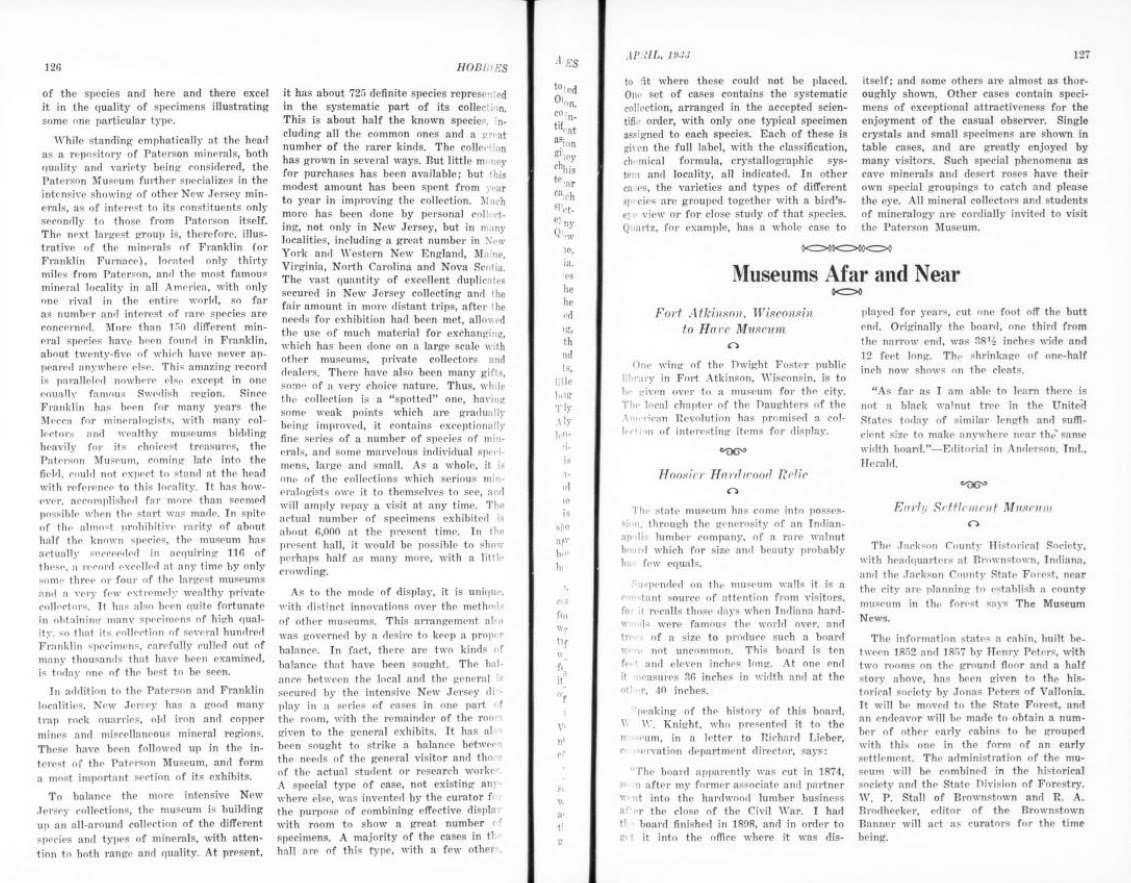
Lovecraft’s friend James F. Morton here describes his Paterson Museum, for the April 1933 issue of Hobbies: the Magazine for Collectors.

There’s nothing here about his collection of glow-in-the-dark minerals, known about from other sources. Though we do learn here, for the first time, that “cave minerals” had a special display. And we get a general feel for that the place was like in size and scope, after some five years under his care.

Friday ‘picture postals’ from Lovecraft: Purgatory and Paradise

02 Friday Sep 2022

Posted by asdjfdlkf in Historical context, Picture postals

≈ Leave a comment

In the last weeks of summer, a trip to the beach with Lovecraft.

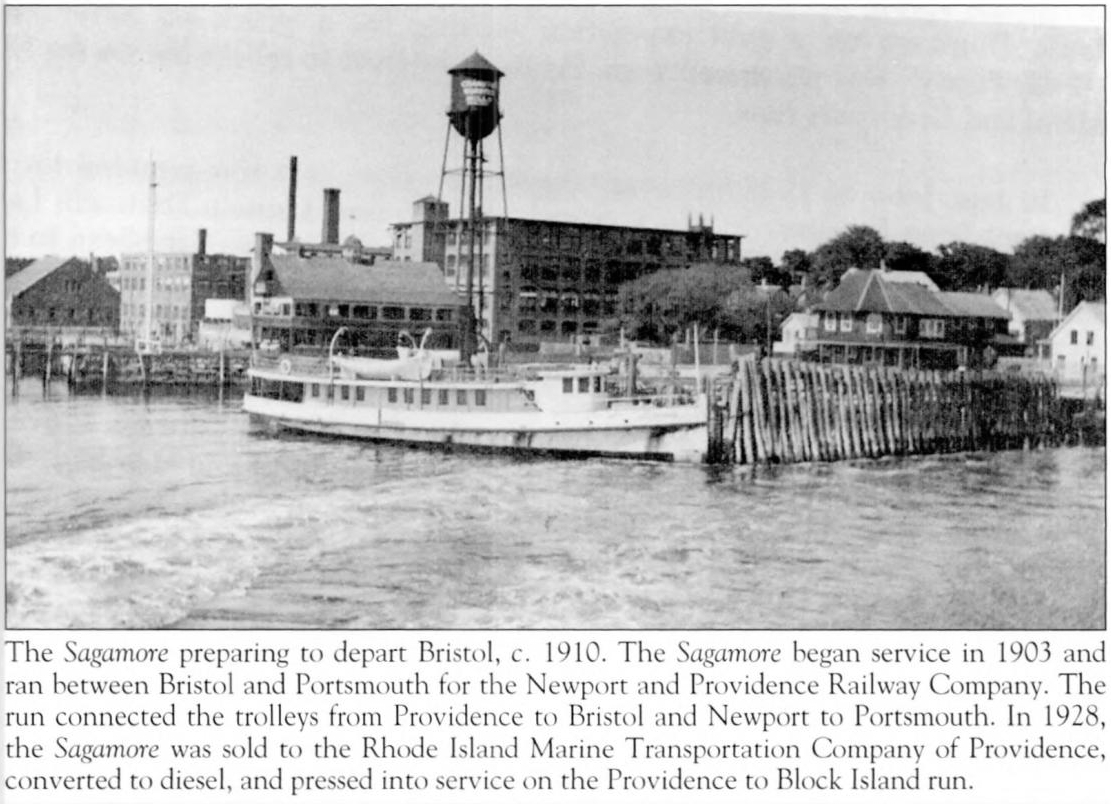
The old coastal town of Newport was one of H.P Lovecraft’s favourite places, and the place hosted him for one of the last local trips ever made in his life. It was near to Providence, but was still somewhat costly to reach in summer. It became more affordable to him during the Great Depression, and we know from the Cole letters that he often took the cheap and juddering older boat “Sagamore” from the Providence waterfront to Newport, sometimes in the company of cattle on the lower deck (Galpin letters, p. 62). Lovecraft tells us she had been “re-modelled” for the Providence – Newport – Block Island run which she started in 1928. On the lower and presumably widened decks of this formerly sleek little boat Lovecraft encountered “freight and cattle”. We know it was juddering because Lovecraft tells us he could not write on board, due to the vibration.

In the depths of the Great Depression this offered a fare as low as 15-cents for a day’s round-trip, and on one occasion he went for three days in a row. This was the route of the “Newport boat” which features in the famous “The Call of Cthulhu”. This could have been, at the time of “Cthulhu”, the “New Shoreham” passenger boat. As seen below, along with its Providence dockside.

The “Newport boat” landing and departure point, Providence.

Though in 1932 he mentioned to Cole that the upmarket 75-cent “Mount Hope” boat was competing with the far cheaper “Sagamore” (the cattle-carrying boat). With at least one guest, for instance Helen Sully in July 1933, he and his guest would take the better of the two Newport boats. So the Sully trip was very likely on the “Mount Hope”, which was warmer. The cheaper boat came back later and was thus colder on the way back, and there was also the risk of encountering cattle on deck. As can be seen here, the “Mount Hope” was a far more substantial passenger proposition than the small “Sagamore”…

Possibly there were even three services at the time of “Cthulhu”, since the “Mount Hope” seems to have made the run as early as the mid 1900s and was still being photographed on the same run in 1934. So the “Newport boat” at the time “Cthulhu” was written could have been either “Mount Hope” or the “New Shoreham”.

Anyway, enough of untangling the boats. Let’s get to the beach. Emerging from hibernation in spring, Lovecraft would take one or other Newport boat and then might hike out from the town “into the Bishop Berkeley country … some four miles beyond Newport beach on the road to Middletown”, through green fields of what he termed “sportive lambkins”. He enjoyed the coastline, beaches and rocks that lay behind and away from the town and the tourists.

Here we see James A. Suydam’s establishing view of this especially favoured place at the back of Newport, the “Paradise Rocks”. The “Hanging Rock” end of these gives a wide firm cleft for sitting and also views to nearby places named by locals “Paradise” and “Purgatory”. The end rock reminds one of the “sizeable table-like rock” in “The Dunwich Horror”.

A detail from a further painting shows the rock’s relation to the wide beaches and ocean, complete with one of Lovecraft’s “sportive lambkins”…

I once had a blog post on these two places, but sadly it was one of the few to perish when the blog blew up. However, I find that I can now recover the sketch-view from that post. This apparently shows “Paradise” (below the artist) and “Purgatory” (a deep cleft, down in the high headland seen across the beach/salt-grass).

Lovecraft visited many times, but also had at least three extended visits with his rock-appreciating geologist friend Morton. There was a Lovecraft-Morton visit in late June 1930, and again in the hot late August of 1932 when they explored the rocky cliffs and knoll and…

discussed the cosmos with Dean Berkeley’s shade

This being a reference to the British philosopher Bishop George Berkeley, a thinker who had especially enjoyed Newport’s “Hanging Rock” two hundred years earlier in circa 1728-32. Berkeley believed, among other things that “reality isn’t separate from perception” and he was a deep thinker on language who was later compared to Wittgenstein. The “Hanging Rock” being where, as Lovecraft put it…

Berkeley used to sit reading, writing, or meditating

In Selected Letters II Lovecraft gives a correspondent precise directions on how to find the place, once out of the town. One then has to assume that the area was not much signposted, and there would be no-one from whom to ask directions.

Here a detail of the “lip” at the “head” of the rocks, where one might perilously picnic or perhaps write competitive poems (Lovecraft recalls such a contest here, with the ocean-loving Wandrei)…

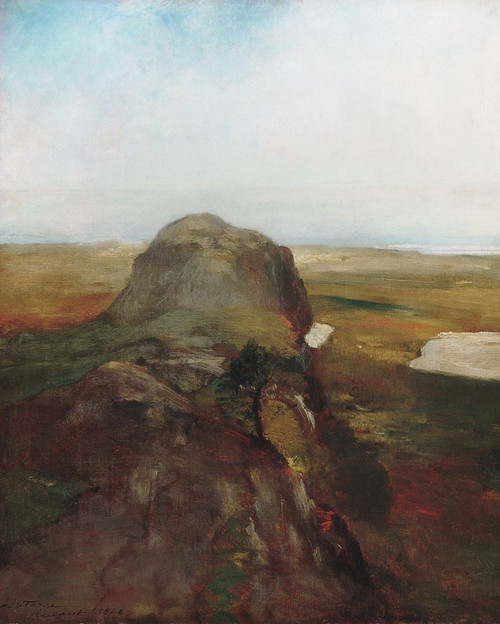
A rough study in oils by the local macabre and stained-glass artist John La Farge (1835–1910) also usefully indicates the highest-point elevation, of the sort on which Lovecraft might have “discussed the cosmos”…

we looked down from our exalted perch — a perch which 200 years ago was a favourite of Dean (later Bishop) Berkeley as he composed his famous Alciphron … We had splendidly hot weather all along — thermometer around 90˚.

Notes on the Wandrei letters – part one

26 Friday Aug 2022

Posted by asdjfdlkf in Historical context, Picture postals

≈ 2 Comments

These are my notes of interesting points found in the first third of the book Letters with Donald and Howard Wandrei (2019).

The year is 1927. All quoted letters are from Lovecraft unless otherwise stated. This part of the book also gives letters from Wandrei.


p. 26: Among critics of the time, “Their idea of fantasy is the sophisticated snickering of James Branch Cabell”.

p. 29. He gives a short list of the “Utopian things” that he read when young. One of these is named as “Wells’ “The Time Machine””. This is interesting as, according to Letters to Family, The Time Machine was only read by Lovecraft in November 1924. We know now that this 1924 edition was a library copy, borrowed for Lovecraft by Long, and thus did not come from the Wandrei collection of early science fiction. So, did Lovecraft actually read this seminal work when young, forget it, and then re-encounter it afresh much later in 1924? It sound like it.

p. 29. Also on the list of “Utopian things” read when young is “Parry’s “The Scarlet Empire””. This was a satirical novel published 1906. A young socialist tries to commit suicide at Coney Island, but is rescued from the water by Atlantean socialists who secretly dwell offshore. He is quickly shocked into awareness that their socialist city requires a ‘dictatorship of the proletariat’, severely limiting free speech and also persecuting love as ‘reactionary individualism’. A love interest occurs. Escape from tyranny, and destruction of the underwater city by submarine torpedo. The latter point recalling the fate of the reef off Innsmouth.

p. 32. “The Black Cat used to have some excellent fragments of the macabre”. This national news-stand story magazine was the predecessor of Weird Tales, though it seems Lovecraft did not read it all the way up to the crossover date. A footnote give a line from the letters to Barlow. He “began to notice it” about 1904 [approx age 14] and then would “buy that reg’lar like”. So the period to look for such tales from The Black Cat, would be 1904 onward. The cessation date of his reading is is unknown.

p. 54. “My love of the weird dates from fairy-tale days, my curve of taste running [first] through Grimm…”

p. 63. “To my mind, the only really beautiful life which the decaying world can hope to know in the years to come is that of the small, aloof nations with primitive simplicity and strong nationalist self-consciousness; insular centres of ancient, intensively individual & tenaciously vital cultural impulses like Iceland or Ireland. These places are still alive, enjoying unbroken communion with the creative forces behind them…”

p. 65. Among a wider world ‘if only I had the funds’ travel itinerary, he notes various places in northern Europe which he would especially like to visit. “Old England [of course, but also] Nuremberg [in Bavaria], Ratsibon [old name for Regensburg, in eastern Bavaria and with a Slavic culture], Mount Saint Michel, Chartres [both big ancient religious sites in northern France].” Why Bavaria? His recently written Dexter Ward has Baron Ferenczy’s castle, of course, though the location there is “dark wooded mountains” near Klausenburg (a nod to Stoker’s Dracula). But that’s Transylvania. The likely Bavarian interest surely comes rather from the Voss book The Monk and the Hangman’s Daughter which Lovecraft found, though “not weird”, … “makes the wild Bavarian hills and deep woods and hellish lakes quiver with a malign and poignant vitality. … The man who dreamed this scene knew Bavaria from the bottom up.”

p. 67. In 1926 he had acquired the book The Haunted Homes and Family Traditions of Great Britain by John H. Ingram.

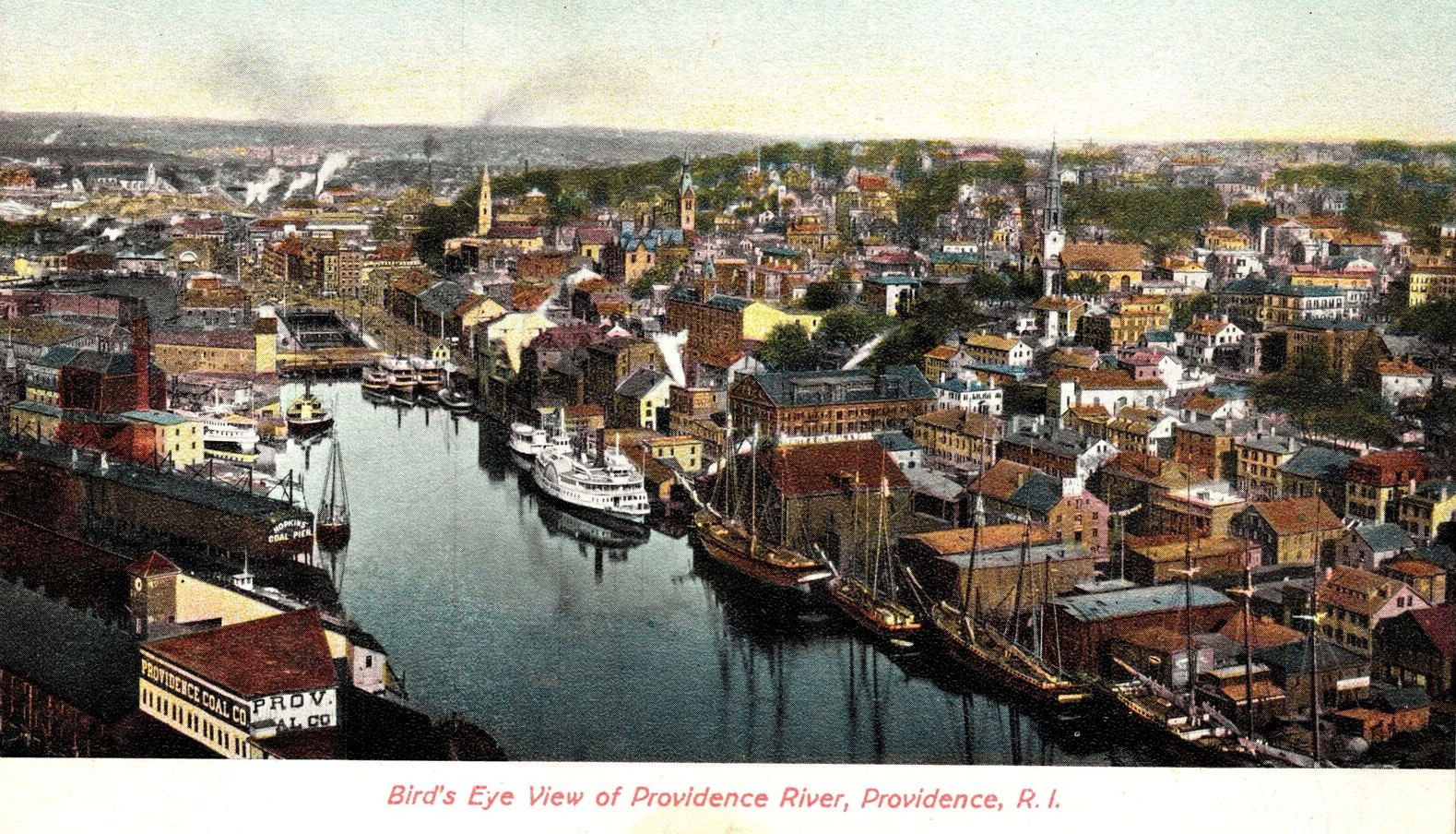
p. 77-78. “But still the little ancient lanes lead off down the precipice to the west; spectral in their many-peaked archaism, & dipping to a riot of iridescent decay where the wicked old [Providence] waterfront recalls its proud East India days […] sometimes I venture down into this maelstrom of tottering houses, broken transoms, tumbling steps, twisted balustrades, swarthy faces and nameless odours, winding from South Main to South Water, searching out the docks where the bay and sound steamers [i.e. the ‘Newport boat’ from “Call of Cthulhu” etc] still touch […] the dreaming wharves where Providence Indiamen [i.e. large sailing-ships] used to ride at anchor. Just this week there is a genuine old-time sailing ship in port — a rare occurrence now — and I love the sight of its antique masts above the centuried warehouse roofs.” See also page 98.

Heavy cargo, coal and oil docks on the left. Passenger docks and ‘non-messy’ freight on the right. Here we only see half the waterfront, since it ran on until it reached Fox Point which was where the New York boats docked.

p. 100. Charles “Fort is a close personal friend of Weird Tales author Edmond Hamilton, to whom he has suggested several story plots appearing in the magazine.”

p. 126. There is a marvellous extended description of his first visions of the ‘dream New York’. In Prospect Park at dusk… “the bronze lions crouch cryptic beside the marble quays of templed lakelets”. These were western-type lions, not Asian ones. He also gave Wandrei an extended two-page itinerary of things and place to see on a first visit to New York City, including Harlem. “Also walk across the High Bridge, which Poe loved”.

p. 131. He lists the used book shops then in Providence. “You will part with many a shilling at Eddy’s, The Old Corner, Gregory’s, Tyson’s, and so on.” Wandrei eventually spent $50 at such shops, then a large sum, and had to hitch-hike home. This develops into quite a hobo travelogue for Lovecraft from Wandrei, and there is a fine passage describing Wandrei’s entrance into Chicago on a powerful motorbike. Wearing goggles and mistaken for plain-clothes police, they were waved through all the city’s grids and jams.

Wandrei appears to have something of a spending problem at this point, as he later purchases two Clark Ashton Smith paintings, which apparently cleaned him out for the next year.

p. 132. At the Metropolitan Museum, Lovecraft recalled he “revelled in the new Wing K — the Roman garden with the statues. A certain austere head of a tight-lipped old Republican Roman is as much a favourite of mine as that effeminately pretty Antinous-type Hellenic head in the corridor is a favourite of Loveman’s.” Wandrei was then in New York with Loveman, and this seems a fairly clear ‘tip off’ to the lad about Loveman’s amorous inclinations.

The Met has pictures of “the Roman garden with the statues”, made in 1925…

p. 141. Confirmation by one who had visited, that Dwyer did indeed live on the lapping edge of a newly-created reservoir [re: “Colour out of Space”]. Wandrei described to Lovecraft… “a little farmhouse near the edge of the Ashokan reservoir which gives New York City its water.”

p. 147. I’ve just read [Wells’] “War of the Worlds” for the first time, in Amazing Stories. … the best thing of H.G.’s which I’ve ever seen”. This is 9th August 1927, and would be Lovecraft’s first encounter with the Wellsian idea of the ‘creeping red weed’.

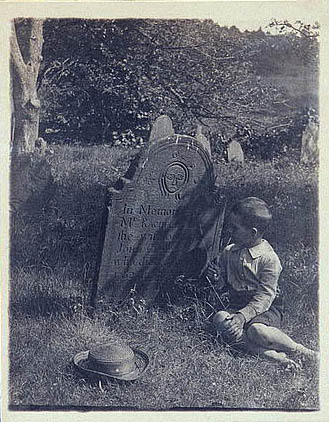
p. 146, 150-51. Possible relevant to Lovecraft’s “Plan of Foxfield — for possible fictional use”, though never used. Lovecraft plans to visit “the ancient Deerfield region” with an architecture unlike that found elsewhere. He visited circa 19th-23rd August 1927, when he called it “The summit of my earthly ambition — I’ve gone broke on postcards”. Cook added a note that HPL had spent the then-handsome sum of $5 on Deerfield postcards. See: Will Murray’s “Where Was Foxfield?” in Lovecraft Studies No. 33 (1995). I’m uncertain if this suggests a link with Deerfield.

Deerfield Burying Ground, with olde style carved face on gravestone.

p. 156. Lovecraft suffered a night in the primitive YMCA at crumbling Newburyport, at the end of August 1927. This confirmed all of Wandrei’s prejudices about YMCAs, and sounds like a precursor to the overnight room in Innsmouth.

pp. 162 and 167. Lovecraft returns to Jake’s on the Providence waterfront, and discovered there was a “Jake”…

Talman enlightened me concerning the identity on “Jake”. It seems there is a real person by this name — Adam Jacques — who actually pronounces his patronymick Jakes. This is the big boss — and you may be able to recall him as the somewhat thick-set man with the moustache. … Domingo, however, is the life of the place.

Jake’s appeared in the Providence Journal, 10th September 1927. Lovecraft sent a cutting. The letter was 11th September 1927, but the letter and cutting are not in the Brown repository. But apparently the newspaper archives for this date have survived.

Incidentally, I read that Lovecraft later had some criticism of Donald Wandrei, to others. But that was surely later than 1927. In 1927 he’s obviously very pleased to have newly discovered the “new Galpin” and to have successfully introduced him to the Circle.

‘Picture Postals’ from Lovecraft: To The Beach!

29 Friday Jul 2022

Posted by asdjfdlkf in Housekeeping, Picture postals

≈ Leave a comment

I’ll be having a bit of a rest during August, starting now. Blog posts will still happen here sporadically, as and when juicy news pops up. For instance, there will likely be news of the release of the 2022 Lovecraft Annual contents-list, Lovecraft’s Birthday releases, NecronomiCon Providence reports, etc. But my daily posting schedule will be in abeyance until the end of August. Thanks for your patience. There are, of course, a great many back-posts to browse and read while you’re waiting for a new post.

This week’s ‘Picture Postals’, update

23 Saturday Jul 2022

Posted by asdjfdlkf in Picture postals

≈ Leave a comment

An update on this week’s ‘Picture Postals’. I now discover that Stupid Blog Software™ has re-sized the picture, and refuses not the scale down and re-name the original. So here is a .ZIP with the providence-prospect-1877.jpg at the full 4,500 x 1,800 pixels at 300 dpi.

That’s one nice benefit of having a rental server, being able to offer .ZIP files.

‘Picture Postals’ from Lovecraft: Prospect Terrace

22 Friday Jul 2022

Posted by asdjfdlkf in Picture postals

≈ 1 Comment

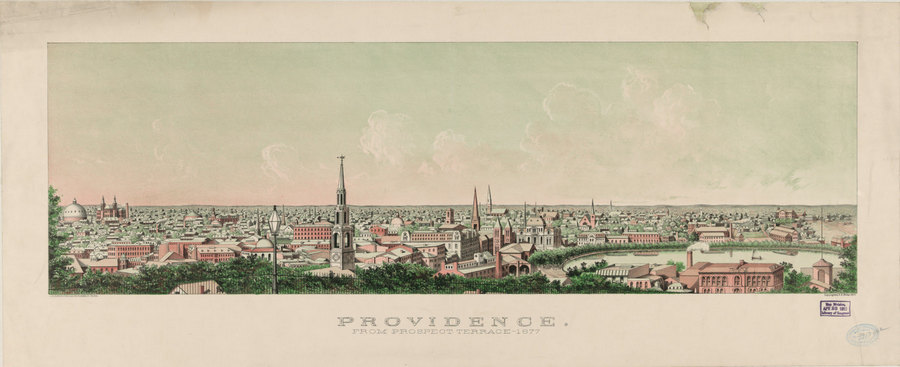
This week, ‘Picture Postals’ celebrates NecronomiCon returning to Providence. With an 1877 view from Prospect Terrace, Providence. Later photographs suggest this was much as Lovecraft knew and loved it 20 years later circa 1897.

In Photoshop I’ve given the heavy colour-cast a thorough work-over, with a focus on restoring the sunset glow on one side. Also repaired various flaws, and shrunk it to a manageable 4,500 x 1,800 pixels at 300 dpi. Even so there’s lots of luscious detail to zoom in on. You may need to save it locally, to get the full zoom.

The starting point for my fix and re-colouring…

Creative Commons Attribution, for my new version of the picture. Use it how you like.


Update: Stupid Blog Software™ has re-sized the picture, and refuses not the scale down the original. Here is a .zip with the providence-prospect-1877.jpg.

← Older posts
Newer posts →


Please become my patron at www.patreon.com/davehaden to help this blog survive and thrive.

Or donate via PayPal — any amount is welcome! Donations total at Easter 2025, since 2015: $390.

Archives

  • February 2026
  • January 2026
  • December 2025
  • November 2025
  • October 2025
  • September 2025
  • August 2025
  • July 2025
  • June 2025
  • May 2025
  • April 2025
  • March 2025
  • February 2025
  • January 2025
  • December 2024
  • November 2024
  • October 2024
  • September 2024
  • August 2024
  • July 2024
  • June 2024
  • May 2024
  • April 2024
  • March 2024
  • February 2024
  • January 2024
  • December 2023
  • November 2023
  • October 2023
  • September 2023
  • August 2023
  • July 2023
  • June 2023
  • May 2023
  • April 2023
  • March 2023
  • February 2023
  • January 2023
  • December 2022
  • November 2022
  • October 2022
  • September 2022
  • August 2022
  • July 2022
  • June 2022
  • May 2022
  • April 2022
  • March 2022
  • February 2022
  • January 2022
  • December 2021
  • November 2021
  • October 2021
  • September 2021
  • August 2021
  • July 2021
  • June 2021
  • May 2021
  • April 2021
  • March 2021
  • February 2021
  • January 2021
  • December 2020
  • November 2020
  • October 2020
  • September 2020
  • August 2020
  • July 2020
  • June 2020
  • May 2020
  • April 2020
  • March 2020
  • February 2020
  • January 2020
  • December 2019
  • November 2019
  • October 2019
  • September 2019
  • August 2019
  • July 2019
  • June 2019
  • May 2019
  • April 2019
  • March 2019
  • February 2019
  • January 2019
  • December 2018
  • November 2018
  • October 2018
  • September 2018
  • August 2018
  • August 2015
  • July 2015
  • April 2015
  • March 2015
  • February 2015
  • January 2015
  • December 2014
  • November 2014
  • October 2014
  • September 2014
  • August 2014
  • July 2014
  • June 2014
  • May 2014
  • March 2014
  • February 2014
  • January 2014
  • December 2013
  • November 2013
  • October 2013
  • September 2013
  • August 2013
  • July 2013
  • June 2013
  • May 2013
  • April 2013
  • March 2013
  • February 2013
  • January 2013
  • December 2012
  • November 2012
  • October 2012
  • September 2012
  • August 2012
  • July 2012
  • June 2012
  • May 2012
  • April 2012
  • March 2012
  • February 2012
  • January 2012
  • December 2011
  • November 2011
  • October 2011
  • September 2011
  • August 2011
  • July 2011
  • June 2011
  • May 2011
  • April 2011
  • March 2011
  • February 2011
  • January 2011
  • December 2010
  • November 2010
  • October 2010
  • September 2010
  • August 2010
  • July 2010

Categories

  • 3D (14)
  • AI (70)
  • Astronomy (70)
  • Censorship (14)
  • de Camp (7)
  • Doyle (7)
  • Films & trailers (101)
  • Fonts (9)
  • Guest posts (2)
  • Historical context (1,095)
  • Housekeeping (91)
  • HPLinks (74)
  • Kipling (11)
  • Kittee Tuesday (92)
  • Lovecraft as character (58)
  • Lovecraftian arts (1,626)
  • Lovecraftian places (19)
  • Maps (70)
  • NecronomiCon 2013 (40)
  • NecronomiCon 2015 (22)
  • New books (966)
  • New discoveries (165)
  • Night in Providence (17)
  • Odd scratchings (984)
  • Picture postals (276)
  • Podcasts etc. (431)
  • REH (184)
  • Scholarly works (1,469)
  • Summer School (31)
  • Unnamable (87)

Get this blog in your newsreader:
 
RSS Feed — Posts
RSS Feed — Comments

H.P. Lovecraft's Poster Collection - 17 retro travel posters for $18. Print ready, and available to buy — the proceeds help to support the work of Tentaclii.

Proudly powered by WordPress Theme: Chateau by Ignacio Ricci.