• About
  • Directory
  • Free stuff
  • Lovecraft for beginners
  • My Books
  • Open Lovecraft
  • Reviews
  • Travel Posters
  • SALTES

Tentaclii

~ News & scholarship on H.P. Lovecraft

Tentaclii

Category Archives: Picture postals

Friday ‘Picture Postals’ from Lovecraft: the Ladd Observatory

11 Friday Sep 2020

Posted by asdjfdlkf in Astronomy, Picture postals

≈ Leave a comment

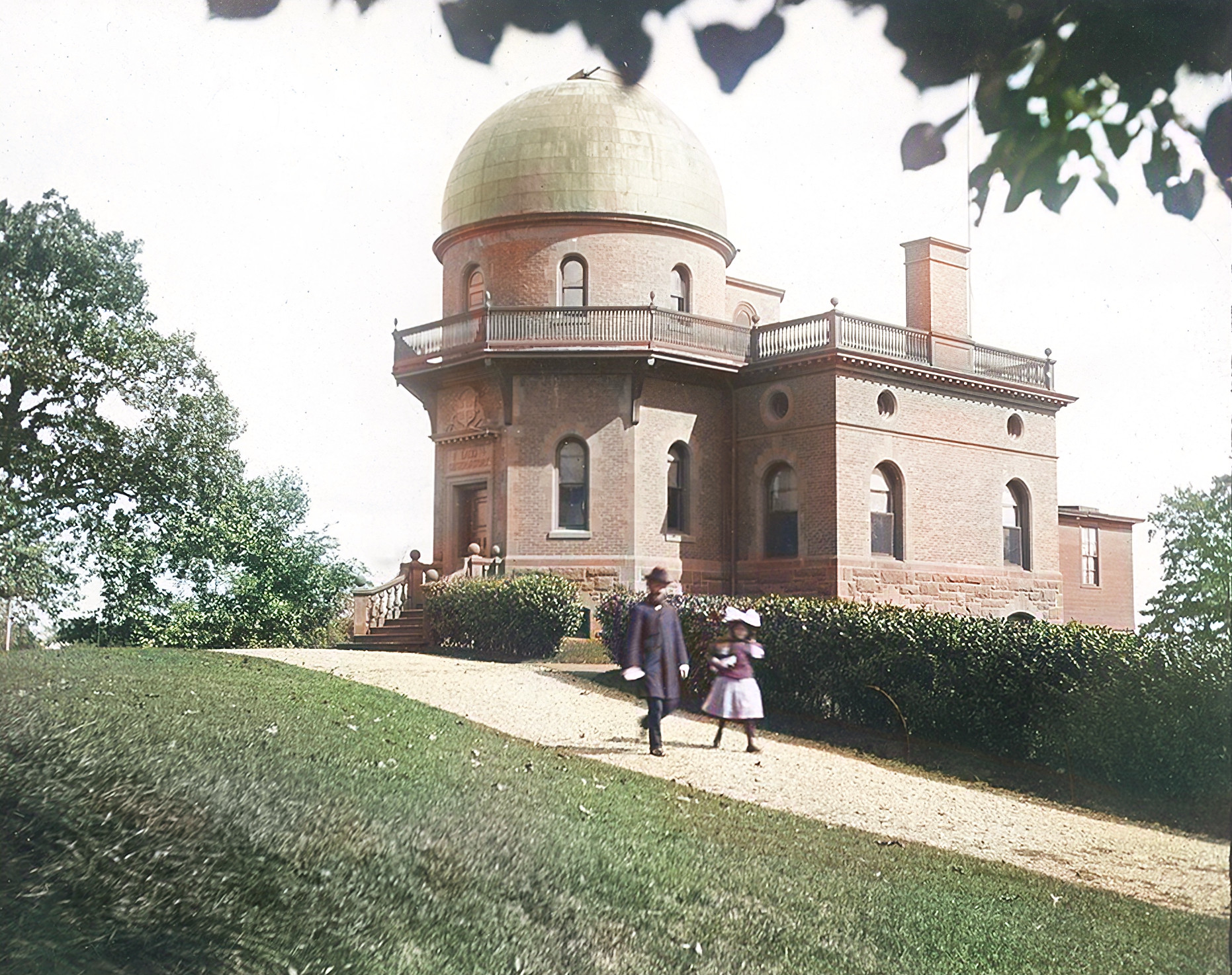
Here we see an especially cosmic haunt of the the young Lovecraft, the Ladd Observatory at Brown. Albeit in the bright morning and not star-surrounded and in silhouette at night.

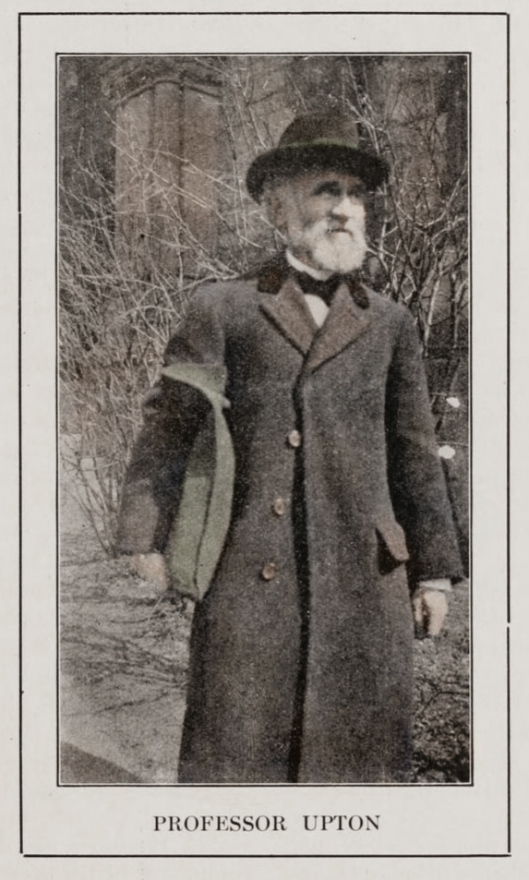
It’s quite possible that we see here the young Professor Upton. Most likely also one of his daughters (either Eleanor or Margaret), come to bring him home for a hot breakfast after a chilly and arduous night of observing.

“The late Prof. Upton of Brown, a friend of the family, gave me the freedom of the college observatory, (Ladd Observatory) & I came & went there at will on my bicycle.” — H.P. Lovecraft.

Below we see Prof. Upton in his Brown obituary picture of 1914, pictured in his old age — perhaps made circa 1909-1913.

‘Picture postals’ from Lovecraft: coffee at night in Providence

04 Friday Sep 2020

Posted by asdjfdlkf in Historical context, Night in Providence, Picture postals

≈ 2 Comments

This was in the lobby of the Butler Exchange in Providence. Lovecraft rhetorically derided the “ugly nondescript” architecture of such “Victorian pests as Butler Exchange” in Providence, the Butler being a large commercial ‘offices to let’ building that had opened in 1873. It had six floors including a floor of shops, and seems to have been inhabited for some fifty years by a multitude of small upmarket trades that included music teachers, portrait painters, and milliners. Lovecraft had his way on the city architecture, for once, and the carbuncular building was demolished in 1925.

Here we see the Exchange’s ‘hole on the wall’ coffee vendor, said to be in the entrance Lobby and possibly tucked into a defunct elevator shaft. Judging by the ‘News Company’ sign above, it was perhaps servicing newsmen who were working through the night to ready the dawn news? The demolition of the Exchange was in 1925, thus the date of this picture is likely to be circa 1920-24.

I can find no evidence that Lovecraft patronised this particular place on his pre- New York night-walks, either alone or with Eddy. But, given its very central location and likely all-night hours and public pay-phone, this would have been of obvious interest to him. Especially after a chill all-night walk or on leaving the train station after a cold journey at a very late hour. Even if he never visited, the picture is still very evocative of small ‘hole on the wall’ coffee vendors in Providence, at night in the early 1920s.

The Exchange building also evidently had a large art show on at least one occasion, and one of these in particular may have been a daytime draw for Lovecraft-al-Hazred…

H. Cyrus Farnum [RSID, Providence Art Club] … painted brilliant outdoor scenes of Africa which were exhibited at the Butler Exchange in Providence. He died at home in 1925. — North Providence

Cyrus Farnum had a large studio in the Butler Exchange, and this was presumably the location of the exhibition. As a leading member of the Providence Art Club, Lovecraft’s aunts would almost certainly have attended his show, since they were fellow Club members. Given the subject matter from Algiers and Biskra in North Africa, one imagines that Lovecraft would have been keen to accompany them — if he was not by then in New York City. I hazard a guess at c. 1920-24 for the show, as a retirement retrospective, but it might even have been staged in the pre-war period. He had certainly been in Algiers in 1905, given the date on one such picture, and he was exhibiting his best Algiers pictures during the war. Without access to local newspaper archives, or a completist database of all known pre-1945 art exhibitions (is there such a thing?), a date can’t be pinned on this show at the Butler Exchange. It would certainly be interesting to know if it was a pre-Christmas 1920 show, as the show would then be a possible influence on Lovecraft’s “The Nameless City” (written January 1921).

Friday ‘picture postals’ from Lovecraft: the night-view from Prospect Terrace

28 Friday Aug 2020

Posted by asdjfdlkf in Night in Providence, Picture postals

≈ Leave a comment

A night-view from Prospect Terrace, Providence, 1930s, as published in the city’s local newspaper.

The twilight is now getting too dim for writing—this [letter] being indited on Prospect Terrace, a small park not far from 10 Barnes [address of Lovecraft’s home], on the crest of the steep hill overlooking the spires & domes of the lower town out-spread to the west 200 feet [below]. The view from here is especially alluring & mystery-suggesting at sunset, & I not infrequently bring my work hither at such—& other—times.”   — Lovecraft letter to Toldridge, 12th August 1932.

There’s a long dot, just to the left of the tower, that I haven’t cleaned away. It could be an airship of the 1930s.

On the 1928 tower, and its effects at night, see the Christmas 2018 Friday ‘picture postals’ from Lovecraft: the Industrial Trust Building.

Friday ‘picture postals’ from Lovecraft: the India Wharf rail yards

21 Friday Aug 2020

Posted by asdjfdlkf in Historical context, Picture postals

≈ Leave a comment

In late December 1923 Lovecraft explored the India Wharf rail yards in Providence, ending up somewhere on the waterside between Fox Point and the rail bridge that crossed into East Providence.

We edged through ghastly channels between black silent freight cars on the India wharf at the southern tip of Providence’s east peninsula, a region I had never penetrated, though I had for twenty years or more wonder’d about it. It was an eldritch wiggle, like that of Alciphron in the tortuous crypts of Egypt, and at last we came out where pale phosphorescence effused from century’d rotting piles, and the distant harbour-lights bobb’d and twinkled away to the south, the far south, the south of dreams and templed isles, and curious ports, and pagodas of gold with savor of spice and incense around them. (Letters to Maurice W. Moe, page 510)

The context was that Morton was going home on the New York boat. In this case Lovecraft even tells us the name, the frigate Concord, seen here in Providence…

Both Morton and Loveman appear to have preferred to travel back from Providence this way. Though it appears to have taken Loveman a few tries to find the right passenger line and time of day to avoid the boorish crowd he had endured on his first such trip.

Lovecraft had first walked Morton up a long and insalubrious street that led to the New York docks, a street where as he put it…

where murther lurks in the alleys, and one stumbles over corpses in the gutters … a confused blur of pallid lamps and Hogarth vistas.

The latter must mean glimpses down alleys and entrances toward the riverside, as they walked up to Fox Point.

Once the luggage was stowed aboard, Morton found he had quite some time to wait until departure. Thus the pair appear to have slipped away down the adjacent freight lines. Presumably, over the Christmas break, the trains were backed up and not moving. There are two options for the exploration route. Either the pair threaded through the rail yards and a maze of freight trucks a relatively short way, to find the first good clear view over water to the south and the open sea. Or they walked the rails around to the industrial Wilkesbarre Pier and looked south from there, which seems far more unlikely.

Thus I’d say they were likely standing about here, in the chill and deepening dusk of 27th December 1923…

It’s interesting to think that an encounter with the black freight cars, arranged akin to “the tortuous crypts of Egypt”, could have informed the mood of his Houdini story “Under The Pyramids” in February 1924.

After seeing Morton off on the Concord, Lovecraft wrote that he walked back into town and took in a silent “cinema”. What might have been playing at that point in time? Salome and Lon Chaney’s While Paris Sleeps were both released at the start of 1923. There was no new Chaplin comedy feature in the second half of 1923, as Chaplin had made his first swerve into trying to be “serious” and it was a box-office disaster. The rest of the end-of-1923 fare seems very unappealing stuff. The Hunchback of Notre Dame (early September 1923) might still have been in cinemas, but Lovecraft had probably already seen it by then. Yet there was the German UFA silent feature The Street. This sinister cinema was released at the end of November 1923, and UFA was a big studio with USA distributors. Lovecraft had no German, but for a silent movie that wasn’t a problem. In The Street…

“The city is an expressionistic nightmare, a dangerous and chaotic place. The unfortunate man encounters thieves, prostitutes, and other predators. But the real threat [is that] The street itself is alive and watching.”

One can then imagine Lovecraft, as he fell asleep in the cinema as he often did, softly chuckling to himself… “Ha, I did it first!”

The Street, 1923.

Friday ‘picture postals’ from Lovecraft: almost No. 66

14 Friday Aug 2020

Posted by asdjfdlkf in Historical context, Picture postals

≈ Leave a comment

I’ve found another view of Lovecraft’s lane and a bit of his home at No. 66. It’s tucked into the side of a 1906 bird’s eye view of the Brown Campus, possibly made from a balloon.

Tucked into the corner we just about get a glimpse of No. 66, set back from the road on its unpaved lane.

Here we see Lovecraft at the top of the steps leading up to his front door, these steps possibly appearing as a smudge on the postcard.

Judging by the eBay photo, the card was slightly clipped at both edges by the seller. So, since it was only a mere $5 with international postage… I bagged it. I’ll hope to have a bigger scanner-scan of that corner, in due course.

Friday ‘picture postals’ from Lovecraft: the dockside

07 Friday Aug 2020

Posted by asdjfdlkf in Historical context, Picture postals

≈ 2 Comments

Providence, as if seen from a night-gaunt hovering above 66 College St. Available as an 8000px .TIF at the LOC.

This 1895 supplement the Providence Sunday newspaper at first appears to be a standard and rather dull city engraving of the period, until one zooms right in and sees the quality of the ink and wash work. Here we see a detail of the Providence river and dockside, the side usually shunned by postcard-makers…

In letters of the 1930s Lovecraft recalled the rigged sailing-ships of Providence, seen and admired in his youth but now departed.

In the heavy fog of late November 1923, his Providence friend Eddy introduced him to the sinister courtyards and back-alley labyrinths which ran back from the dockside seen above…

a squalid colonial labyrinth in which I moved as an utter stranger, each moment wondering whether I were indeed in my native town or in some leprous, distorted witch-Salem … there was a fog, & out of it & into it again mov’d dark monstrous diseas’d shapes … narrow exotick streets and alleys … grotesque lines of gambrel roofs with drunken eaves and idiotick tottering chimneys … streets, lines, rows; bent and broken, twisted and mysterious, wan and wither’d … claws of gargoyles obscurely beckoning to witch-sabbaths of cannibal horror in shadow’d alleys that are black at noon … and toward the southeast, a stark silhouette of hoary, unhallowed black chimneys and bleak ridgepoles against a mist that is white and blank and saline — the venerable, the immemorial sea”. (Lovecraft, heavily abridged from a letter to Morton, 5th December 1923).

Zooming further in we see a lone rower on the river…

As a sturdy lad, Lovecraft was for a short time an avid rower in a small boat, a period from which memories probably linger in the story “Dagon”. Lovecraft was (so far as we know) only boating around the corner on the Seekonk, rather than pulling past the sailing-ships and coalers as seen here. Still, the sight of a little rower is evocative of a freer time…

“I used to row considerably on the Seekonk … Often I would land on one or both of the Twin Islands — for islands (associated with remote secrets, pirate treasure, and all that) always fascinated me.” — Lovecraft letter to Rimel, April 1934.

‘Winds of Kitty Hawk’ and ‘Ah! Wilderness’

31 Friday Jul 2020

Posted by asdjfdlkf in Films & trailers, Picture postals

≈ Leave a comment

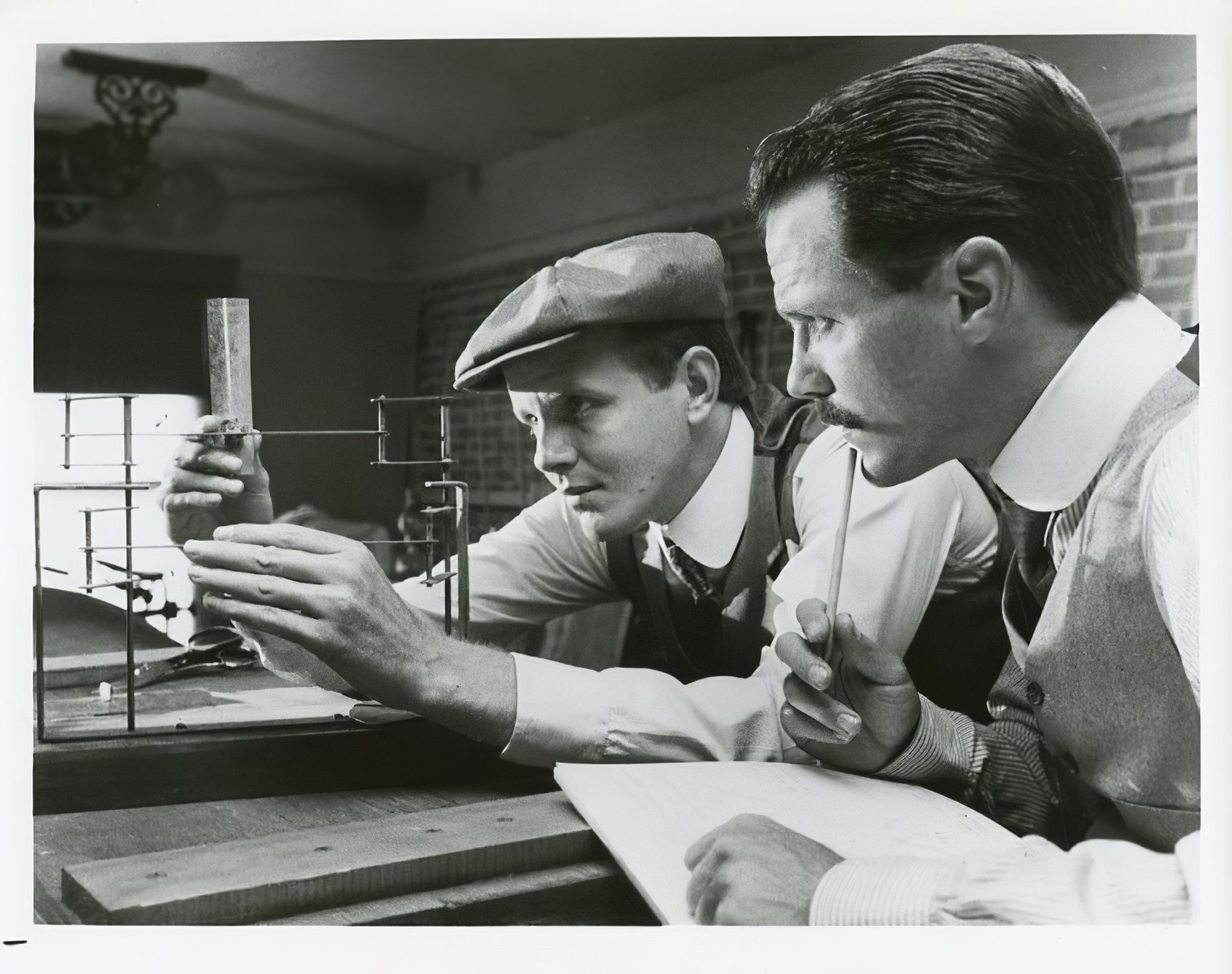
Here’s a bonus post in my regular “Picture Postals” slot, and also a movie suggestion for your weekend enjoyment and edification. This vintage NBC publicity press-picture was for the major TV movie Winds of Kitty Hawk (1978, colour). To my mind it very nicely evokes the entrepreneurial ‘back-shed science’ of the era in which Lovecraft grew up. After three years, and with no backers, the brothers succeeded. They had their first manned flight at Kitty Hawk just before Christmas 1903, at which point Lovecraft was then aged 13¼.

Surprisingly I find the movie to be the only serious feature-length drama of the Wright Brothers and their marvellous flying machine. In 2014 Tom Hanks was reported to be tinkering with the idea of a heading up a TV mini-series on the brothers, but evidently it never flew. You might have thought there would a half-dozen big-budget cinema movies by now, and several lesser bio-pics from the 1940s and 50s… but no. It’s another one of those great achievements in innovation history that big-budget cinema movie producers have been curiously uninterested in. There was another TV movie Orville and Wilbur (1972), part funded by the BBC, but it appears to have been lost (as with so much else the BBC made).

But we do have the one decent surviving movie for the Wright Brothers. Made for TV, but a pretty good movie due to locations, costumes, a deftly-handled low-key script, and recreation flying machines that fly. It’s pre-PC, almost free of the usual time-waster love-story sub-plot, doesn’t distort the facts too much, and was nominated for several Emmy awards (Outstanding Film Editing, Outstanding Sound, Outstanding Cinematography). It’s now streaming in the USA on Amazon, though here in the UK you have to hang around on eBay or Amazon waiting for low-priced DVD to be offered. I’ve now seen it, and I thoroughly enjoyed it.

The other big movie which evokes the same period, and indeed one that Lovecraft saw and adored for its vivid recreation of the era and settings of his boyhood, was the curiously titled Ah, Wilderness! (1935). Despite the misleading title this is not a ‘city dog lost in wild Alaska’ Jack London tale, but rather a Eugene O’Neill bittersweet comedy…

Pitting Lionel Barrymore against a young up-and-comer named Mickey Rooney gives Eugene O’Neill’s only comedy the loving luster it deserves. Horseless carriages, straw boaters, nickle beer: Ah, Wilderness! is a portrait of an America long gone — but forever remembered.

Lovecraft told Bloch that he had seen Ah, Wilderness sometime in early January 1936, and had…

revelled in it. Yuggoth, but it made me homesick for 1906! [it] gives all sorts of typical 1906 glimpses, including an old street-car, a primitive steam automobile, &c. It was photographed in Grafton, Mass. … where the passing years have left little visible toll.

He wrote to Moe that the movie recalled certain sensibilities and values that had since been lost to the world. While watching it…

At times I could well believe that the past had come back, & that the last 3 decades were a bad dream. [the world it depicted] having many a value which might well have been preserved had social evolution been less violently accelerated by the war.

Ah, Wilderness! is set on the 4th of July 1906, and in setting is meant to be a shore-town about 40 miles SW of Providence. This warm and human comedy is very well regarded, and is also now streaming in the USA. Together the two movies would probably make a pretty good double-bill, for those interested in the sensibilities of the ‘Young America’ of 1903-06 that helped form the young Lovecraft.

‘Picture Postals’ from Lovecraft: the elephant at the Park

31 Friday Jul 2020

Posted by asdjfdlkf in Historical context, Picture postals

≈ Leave a comment

Continuing the vague ‘zoo’ theme (we had zebras two weeks ago), this week’s ‘picture postal’ from Lovecraft is of an elephant.

Lovecraft would often jokingly refer to the size of his own nose in letters, and compare it to that of the resident pachyderm at Roger Williams Park in Providence…

Note the proboscidian effect,” [meaning his own large nose, in his photograph of him made by Robert Barlow …] “my only local rival in that field being the elephant at Roger Williams Park.

The choice of word faintly indicates the tentacular, and it was used again as such in the story “Out of the Aeons”, said of the nameless creature glimpsed through the mummy’s eye…

Even now I cannot begin to suggest it with any words at my command. I might call it gigantic — tentacled — proboscidian — octopus-eyed …

For most of the city’s children the elephant inspired amazement and curiosity rather than horror. They had clubbed together to raise the funds to obtain and keep him for the city. His name was “Baby Roger”, and he appears to have arrived at the park as a baby elephant when Lovecraft was aged three. We can plausibly imagine that the infant Lovecraft was taken to see him several times, and the elephant’s trunk may well have been his first real encounter with the ‘living tentacular’.

‘Picture Postals’ from Lovecraft: Henry J. Peck

24 Friday Jul 2020

Posted by asdjfdlkf in Historical context, Picture postals

≈ 1 Comment

In December 1928 Lovecraft wrote to his schoolteacher friend and correspondent Moe…


   “I have come upon an altogether unsuspected country lane which winds up the ancient hill by the falls of the Moshafsuck … not a quarter of a mile from this very home [Barnes St.], yet which I never knew till this September. … line’d on one side by abandon’d gambrel-roof’d houses of the vintage of 1740 or 1750 … there is obtainable a glamourous view of Smith’s Hill — with the dome of the marble State House … which reminds one of the citadel of some fascinating Renaissance hill-town … it so overwhelm’d me with aestetick extasy when I first glimps’d it, that I was impelled to exclaim out loud, & whip forth my tatter’d note to make a crude sketch. … the [Providence] art club lately hous’d an exhibit which proves I am not alone in viewing Old Providence with an enraptur’d eye. The exhibit, of which I enclose a catalogue, was of drawings and etchings by one Henry J. Peck; and reveal’d the archaick liveliness of the ancient town [he] beholds the same cryptick overtones of brooding elder magick that I behold … huddles of ancient roofs, vistas of grass-grown colonial lanes & Georgian flights of railed steps, glimpses of tarry ghosts along the Indies-dreaming waterfront … the drawing reproduced in the catalogue is #30 of the exhibit — the antient inn-yard of the Franklin Tavern (circa 1770) on College Hill. … such arch’d yardways, when unlighted within, suggest the most spectral suggestions conceivable at night.”


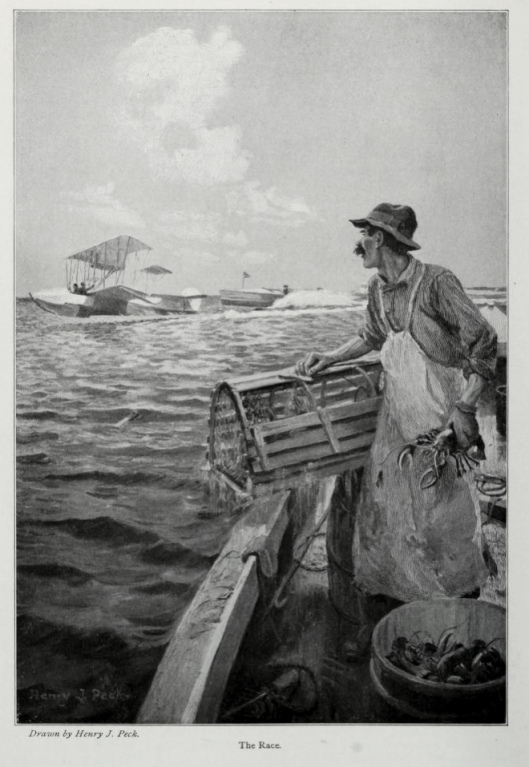
Who was Peck, and where is this admired work now? Henry Jarvis Peck (1880-1964) was usually referred to by his contemporaries and editors as Henry J. Peck. He grew up and came of age in Warren, Rhode Island, attending the Rhode Island School of Design (RISD). He studied first with Eric Pape in Boston, then George L. Noyes, then from age 21 for three years with Howard Pyle.

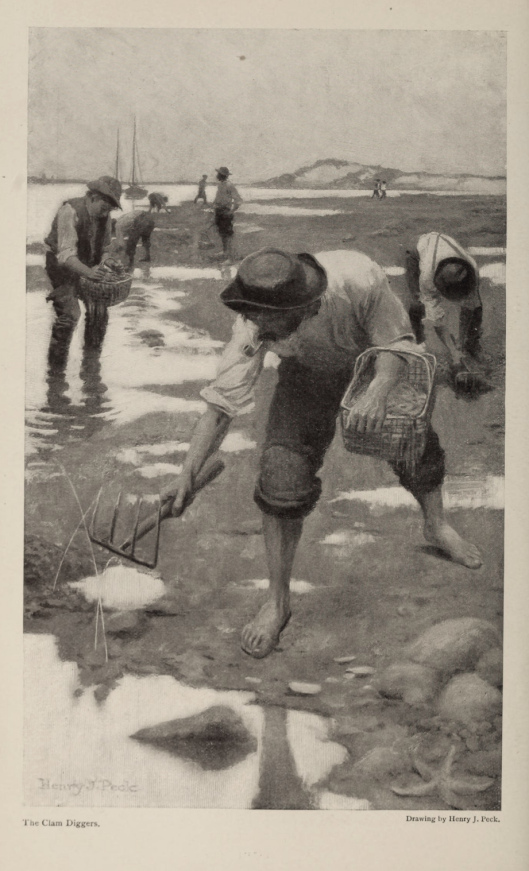
A writer as well as an illustrative artist for books and magazines, his combined articles appeared for several decades in the more upmarket magazines of America. In the summer he lived in Warren with a studio at Rodney Street, but as the snow settled he went to overwinter in New York City. Warren, you’ll recall, was a favoured haunt of H.P. Lovecraft and the scene of some remarkable ice-cream eating contests.

A favourite creative approach seems to have been to charmingly contrast the traditional and the modern, with a New England twist.
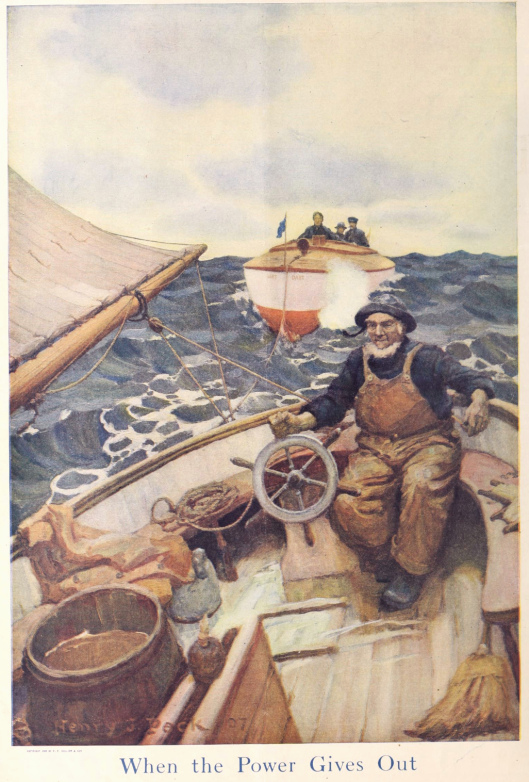
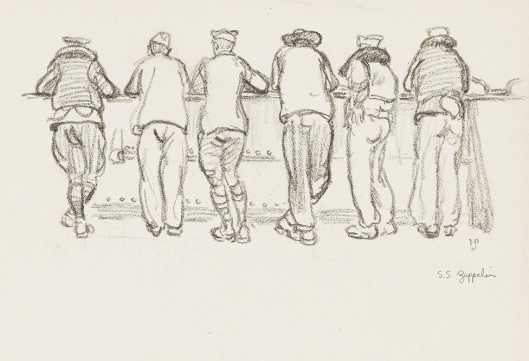
He appears to have been working in his prime from around 1906-1929. Some surviving sketch material suggests he may have served as a rapid-sketch war-artist with the Navy. Here we see officers on deck.
By the mid 1920s some of his work for Scouting journals was quite cartoonish. He also painted a string of folk-art-y radio-ham magazine covers, with the same easy and warm approach.

He also produced more refined work in this cartoonish line, for the American Country Life magazine, as seen here in December 1928. One wonders if this was a one-off swan-song, or if there was a whole series of this material.
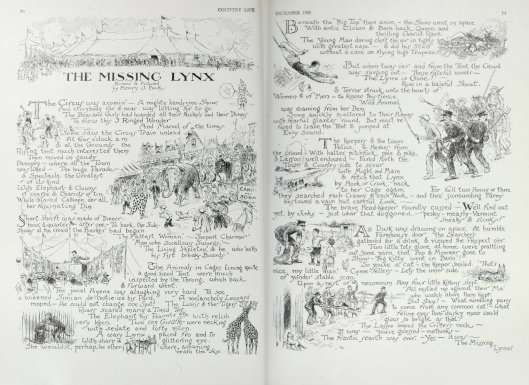
The online record suggests that Providence saw his only gallery show, and all that now remains are pictures in private hands. Lovecraft spoke to the artist at the launch of the show, and urged him to publish a book of the Providence work. But it was not to be. All that appears to survive is a catalogue for Glimpses of Providence, with a single picture, which is noted in the Moe letters. This is elsewhere noted as…

a small catalogue for an exhibition of drawings, “Glimpses of Providence and Vicinity,” by Henry J. Peck

The new Industrial Trust Building of 1928, looming over the old rooftops.

Lovecraft sent copies of the catalogue to Moe and Wandrei, and possibly to other correspondents. A label on a picture-back suggests Peck may once have had a studio in Providence in the 1920s, on Benefit Street, possibly while seeking out scenes and making the drawings for the 1928 show. But it seems he did not encounter Lovecraft before the big pre-Christmas 1928 show, and no contact was made afterwards.
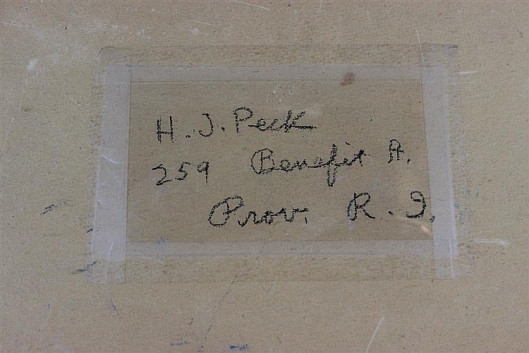
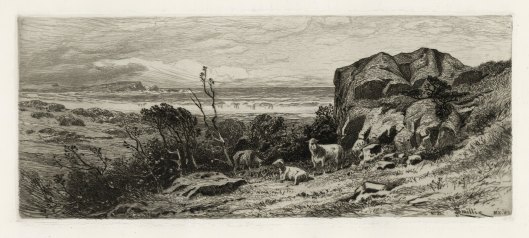
Where is Peck’s body of work now, as indicated by the catalogue? Work which might be so useful now to illustrate “Lovecraft’s old Providence” of the 1920s, beyond the main well-known buildings and sights? Mostly sold and dispersed, by the look of it. One hopes that the finer etchings at least are ‘safely lost’, quietly folded away for posterity in some neglected archive. But no such online record page seems to exist for such a holding, and a search of the RISD archives database also suggests nothing. But one such recently came up for the auction, going for a pitiful $30, and the auctioneers kindly left a large scan online.
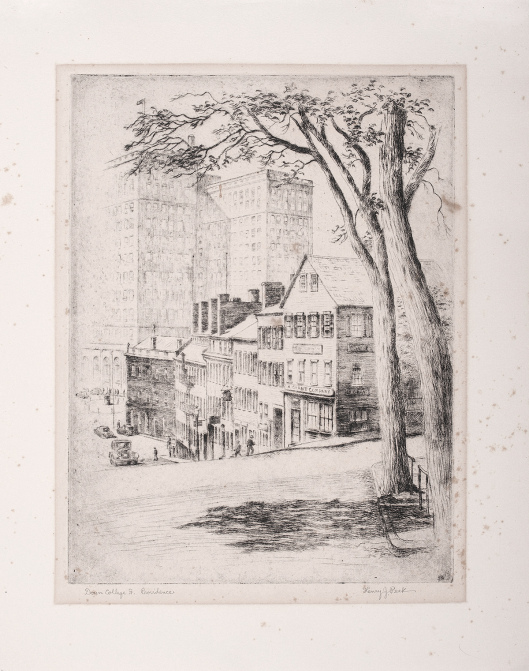
“Down College Street” (1928). A familiar-seeming man climbs the hill with a book or bundle of letters.

Toward the end of his life Peck did produce a book, a history of his home town of Warren in the form of 200th Anniversary of Warren, Rhode Island. Historical Sketch and Program 1747-1947.

Protected: ‘Picture Postals’ from Lovecraft: On the riding of zebra

17 Friday Jul 2020

Posted by asdjfdlkf in Historical context, Picture postals

≈ Enter your password to view comments.

This content is password-protected. To view it, please enter the password below.

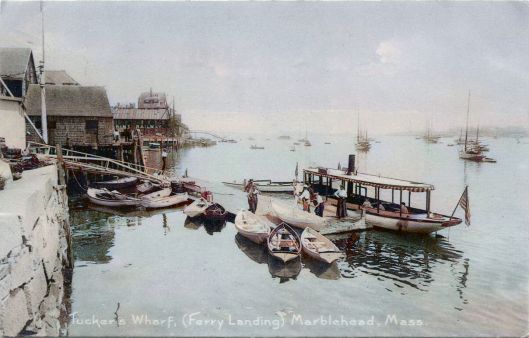
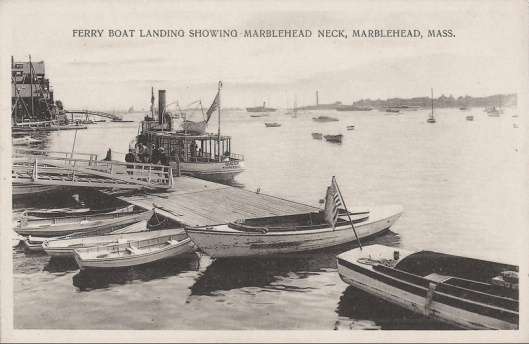
‘Picture postals’ from Lovecraft: the Neck and Marblehead.

10 Friday Jul 2020

Posted by asdjfdlkf in Picture postals

≈ Leave a comment

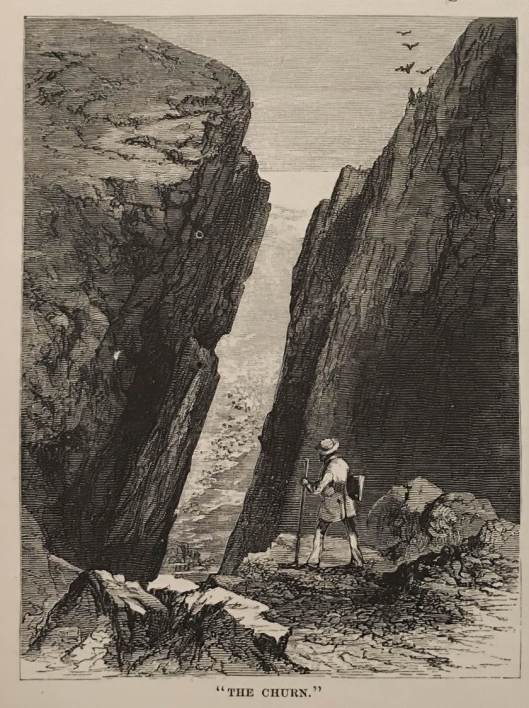
“… took the ferry across to the Neck, where Wandrei communed with his beloved and newly-discover’d sea from the rugged cliffs.” — July 1927 in a letter (letters to Moe p. 154).

In the Edwardian and 1920s periods. A boat of larger capacity and less sea-sickness inducing rocking was evidently needed by the 1920s.

Once across and walking off the ferry, the maps and lanes suggests the natural option would be to make one’s way up to the lighthouse and sea-cliffs at the far end. As I’ve shown elsewhere there’s a fair likelihood that a young lad who lived facing the wide ocean at the far end inspired the writing of “The Strange High House in the Mist”, via his fan-letter to Weird Tales.

Also, somewhere in the deeps about here rolls Lovecraft’s Waterman pen. According to the Moe letters he lost it on the Neck in summer 1923…

We crossed in the ferry to Marblead Neck, (where b.t.w I had lost my 1906 Waterman the Thursday before)” (letters to Moe, p. 116)

He later recalled it was lost “amidst the sands”, so presumably he was on the small rocky beach at the far end of the Neck. On hearing of the loss, Moe sent him a fine “self-filling” Conklin pen.

‘The Churn’, Marblehead Neck.

‘Picture postals’ from Lovecraft: the Hope Street Reservoir

03 Friday Jul 2020

Posted by asdjfdlkf in Historical context, New discoveries, Picture postals

≈ 1 Comment

H.P. Lovecraft lived at 10 Barnes St., Providence, from 1926 to May 1933. Since the mid 1890s, Barnes Street had a large 75 million gallon reservoir looming up at the back of it. Even if Lovecraft had become habituated to the sight and vicinity of this reservoir, he cannot have been unaware of it when writing “The Colour out of Space” in March 1927. You’ll recall the story involves a planned reservoir, and potential contamination of the urban water-supply. The story was written about a year after he had moved to 10 Barnes St.
Hope St. reservoir and pumping station.

Was the reservoir still full at that time? Probably partly full, but possibly no longer being pumped with fresh water — and thus emitting a certain invisible miasma over the neighbouring streets by early spring 1927. Because according to a Providence magazine of early 1928 the reservoir was then being decommissioned and its slow drainage was well underway… it “is not yet dry, but it will soon be; the city may make use of the site of the big pool for school purposes”. It may have been used as a school sports area, but other reports indicate it remained undeveloped at Lovecraft’s death. The pumping station/house was decommissioned in July 1928.

Lovecraft lived a little off the left of this picture-map, which shows the reservoir and Barnes Street. Looking at another map, it appears that Lovecraft’s high school directly faced the reservoir. He must surely have been familiar with its existence, even if he never walked up there and peered down into its fishy depths.

It would take work at the local archives to discover more, and the exact dates at which the slow drainage started. I assume it takes a year or so to slowly drain something like that, as rapid drainage could cause landslips and catastrophic spillage etc. But from the dates we do have it appears we can be fairly sure that Lovecraft would have taken note of the city’s plans to drain the reservoir, and possibly the start of the drainage, at about the time of the writing of “The Colour out of Space”. If the two were connected or not is now lost in the mists of time.


Update:

Thanks to Tom Douglass, local historian, who writes…

“I believe you are right about the connection you draw between the two, and perhaps more directly than you stated. … When Scituate’s water treatment facility came online in 1926, the Hope pumping station was decommissioned.”

So it’s interesting that the two events – draining Hope and filling Scituate – should be so closely connected. Lovecraft later recalled in a letter that the filling of Scituate was the key inspiration.

← Older posts
Newer posts →


Please become my patron at www.patreon.com/davehaden to help this blog survive and thrive.

Or donate via PayPal — any amount is welcome! Donations total at Easter 2025, since 2015: $390.

Archives

  • February 2026
  • January 2026
  • December 2025
  • November 2025
  • October 2025
  • September 2025
  • August 2025
  • July 2025
  • June 2025
  • May 2025
  • April 2025
  • March 2025
  • February 2025
  • January 2025
  • December 2024
  • November 2024
  • October 2024
  • September 2024
  • August 2024
  • July 2024
  • June 2024
  • May 2024
  • April 2024
  • March 2024
  • February 2024
  • January 2024
  • December 2023
  • November 2023
  • October 2023
  • September 2023
  • August 2023
  • July 2023
  • June 2023
  • May 2023
  • April 2023
  • March 2023
  • February 2023
  • January 2023
  • December 2022
  • November 2022
  • October 2022
  • September 2022
  • August 2022
  • July 2022
  • June 2022
  • May 2022
  • April 2022
  • March 2022
  • February 2022
  • January 2022
  • December 2021
  • November 2021
  • October 2021
  • September 2021
  • August 2021
  • July 2021
  • June 2021
  • May 2021
  • April 2021
  • March 2021
  • February 2021
  • January 2021
  • December 2020
  • November 2020
  • October 2020
  • September 2020
  • August 2020
  • July 2020
  • June 2020
  • May 2020
  • April 2020
  • March 2020
  • February 2020
  • January 2020
  • December 2019
  • November 2019
  • October 2019
  • September 2019
  • August 2019
  • July 2019
  • June 2019
  • May 2019
  • April 2019
  • March 2019
  • February 2019
  • January 2019
  • December 2018
  • November 2018
  • October 2018
  • September 2018
  • August 2018
  • August 2015
  • July 2015
  • April 2015
  • March 2015
  • February 2015
  • January 2015
  • December 2014
  • November 2014
  • October 2014
  • September 2014
  • August 2014
  • July 2014
  • June 2014
  • May 2014
  • March 2014
  • February 2014
  • January 2014
  • December 2013
  • November 2013
  • October 2013
  • September 2013
  • August 2013
  • July 2013
  • June 2013
  • May 2013
  • April 2013
  • March 2013
  • February 2013
  • January 2013
  • December 2012
  • November 2012
  • October 2012
  • September 2012
  • August 2012
  • July 2012
  • June 2012
  • May 2012
  • April 2012
  • March 2012
  • February 2012
  • January 2012
  • December 2011
  • November 2011
  • October 2011
  • September 2011
  • August 2011
  • July 2011
  • June 2011
  • May 2011
  • April 2011
  • March 2011
  • February 2011
  • January 2011
  • December 2010
  • November 2010
  • October 2010
  • September 2010
  • August 2010
  • July 2010

Categories

  • 3D (14)
  • AI (70)
  • Astronomy (70)
  • Censorship (14)
  • de Camp (7)
  • Doyle (7)
  • Films & trailers (101)
  • Fonts (9)
  • Guest posts (2)
  • Historical context (1,095)
  • Housekeeping (91)
  • HPLinks (74)
  • Kipling (11)
  • Kittee Tuesday (92)
  • Lovecraft as character (58)
  • Lovecraftian arts (1,626)
  • Lovecraftian places (19)
  • Maps (70)
  • NecronomiCon 2013 (40)
  • NecronomiCon 2015 (22)
  • New books (966)
  • New discoveries (165)
  • Night in Providence (17)
  • Odd scratchings (984)
  • Picture postals (276)
  • Podcasts etc. (431)
  • REH (184)
  • Scholarly works (1,469)
  • Summer School (31)
  • Unnamable (87)

Get this blog in your newsreader:
 
RSS Feed — Posts
RSS Feed — Comments

H.P. Lovecraft's Poster Collection - 17 retro travel posters for $18. Print ready, and available to buy — the proceeds help to support the work of Tentaclii.

Proudly powered by WordPress Theme: Chateau by Ignacio Ricci.