• About
  • Directory
  • Free stuff
  • Lovecraft for beginners
  • My Books
  • Open Lovecraft
  • Reviews
  • Travel Posters
  • SALTES

Tentaclii

~ News & scholarship on H.P. Lovecraft

Tentaclii

Category Archives: Picture postals

Friday ‘Picture Postals’ from Lovecraft: The Art Club

27 Friday Nov 2020

Posted by asdjfdlkf in Historical context, Picture postals

≈ Leave a comment

This week’s postcard is of the Art Club on Thomas Street, Providence.

Here we see the road-fronting section of the Club known as the “Brick Club House” building. The publication date is 1914, but I would guess the date of the picture is perhaps a few years after purchase of this house by the Club in 1906. Due to it being brick-built my colorising of it has imagined the building unpainted, with perhaps blue windows and shutters. It had been altered “sufficiently” for the purposes of a 100+ strong Club, but it was only leased and it was apparently under threat of being swept away by a planned railroad tunnel. Thus it lacks the love and polish it was given in the mid 1920s and later. Yet even here we can see the new large front door with its “resounding knocker”. Some years later the building’s “countless wooden shutters”, also seen here, were removed and served to panel a new Reading Room set to one side of the Entrance. By circa 1909 the Club had a Library and subscribed to about 30 art journals.

Here we see the Club in the snow circa 1909, perhaps a year or two after the above picture. Two sets of shutters have already been removed…

Inside, a floor had also been removed, thus forming the tall exhibition gallery that rose to the skylight…

In “the season”, there was an art show hung here every two weeks. Lovecraft once recalled that…

my eldest aunt is still more expert in this [artistic] direction, having had canvases hung in exhibition at the Providence Art Club

There were also evening ‘dinners’ for the men and ‘afternoons’ for the women, at which speakers were sometimes invited. Occasionally there were events to which members could invite guest non-members.

In 1919 the “Dodge” house, glimpsed on the far-left of the first picture, was purchased by the Club, and further money had been raised to provide an extensive exterior makeover. Part of the intended change was to sympathetically brick over the old cobbled lane of circa 1786, with a restored Georgian arch and walkway. This horse-way had led back to the old stables and coach house at the rear of the property.

This arch is marked on the map-plan as 1920, but it apparently took until 1924 to complete. Lovecraft might have seen the ‘new-look’ Club before he left for New York City, but equally he might have been delighted to return a few years later to find the Art Club looking distinctly more Georgian and restored. Indeed, the Club was one of the very first places he went when he returned home…

Then followed a resumption of real life as I had dropped it two years ago — the life of a settled American gentleman in his ancestral environment. We went out to an exhibition of paintings at the Art Club, (the colonial house in hilly Thomas Street, in front of which I snap-shotted Mortonius last fall — I mean the fall of ’23) (circular enclosed [presumably a flyer for the Art Club]) and had dinner downtown at Shepard’s (neo-) Colonial Restaurant. In the evening a cinema show at the good old Strand in Washington Street completed a memorable and well-rounded day.” (Selected Letters II).

Seen on the left of the first picture of the Art Club was the spot that Lovecraft sometimes met and conversed with the cat “Old Man”. The arch under which “Old Man” liked to sit is not itself a Georgian original, though was loving restored to that style by the Club President George Frederick Hall. The cobbled lane he arched and partly re-cobbled was of that age, as one can see from the above map-plan.

Here we see this arch and the cat “Old Man”, as finely drawn by Jason C. Eckhardt for The H. P. Lovecraft Cat Book (2019). Here is Lovecraft recalling “Old Man”…

He was a great fellow. He belonged to a market at the foot of Thomas Street — the hill street mentioned in [The Call of] “Cthulhu” as the abode of the young artist — & could usually (in later life) be found asleep on the sill of a low window almost touching the ground. Occasionally he would stroll up the hill as far as the Art Club, seating himself at the entrance [to the alleyway]. At night, when the electric lights made the street bright, the space within the archway would remain pitch-black. So that it looked like the mouth of an illimitable abyss, or the gateway of some nameless dimension. And there, as if stationed as a guardian of the unfathomed mysteries beyond, would crouch the sphinxlike, jet-black, yellow-eyed, & incredibly ancient form of Old Man. […] I came to regard him as an indispensable acquaintance, and would often go considerably out of my way to pass his habitual territory, on the chance that I might find him visible. Good Old Man! In fancy I pictured him as an hierophant of the mysteries behind the black archway, and wondered if he would ever invite me through it some midnight … Wondered, too, if I could ever could back to earth alive after accepting such an invitation.

Lovecraft likely recalled his own lost cat of the same colour, Trigger-ban, who had run away when Lovecraft had lost his childhood home. Had this missing cat lived on, my guess is he would have been more or less be of the same age as “Old Man”. Lovecraft also likely knew that the line of the underground railroad tunnel ran along the back of the Art Club, going under the hill to emerge near the Seekonk River. The Art Club had been in danger of being swept away when the line was being planned. But in the end, the line of the new tunnel was usefully nudged a little on the map, so it ran at the back of the property. To one who was aware of such tunnels it might, poetically and in dreams, have provided an additional dark route into mystery. After the death of “Old Man” Lovecraft continued to meet and go with him in dreams…

Lovecraft dreamed of him even more than before — he would “gaze with aged yellow eyes that spoke secrets older than Aegyptus or Atlantis.” (S.T. Joshi, I Am Providence, quoting Lovecraft).

Friday ‘picture postals’ from Lovecraft: the John Hay Library

20 Friday Nov 2020

Posted by asdjfdlkf in Picture postals

≈ Leave a comment

This week, just a plain postcard view of the John Hay Library of Brown University. Here we see it as was when it began receiving Lovecraft’s letters and papers. If I recall rightly these were first gifted by young Barlow in the late 1930s, shortly after Lovecraft’s death, and they were somewhat reluctantly received. Most postcard views from the Library’s first decades are from one side, but this photographer obviously had permission to go onto the Brown campus lawns to set up his tripod and make this face-on b&w picture (here enlarged and colourised). The design of the back of the card suggests the late 1930s. Possibly it was an official card, though in that case one would expect the back to state this. But perhaps the stamp-surround is actually Greek for “Brown”?
A complete historical survey of “H.P. Lovecraft and the Brown campus, staff and students” remains to be written (feel free), but we know that H.P. Lovecraft occasionally strode through these grounds, perhaps mostly to guide visiting guests such as Barlow and Morton toward eminent collections such as the Annmary Brown Memorial, the Harris Collection of poetry, and (very probably, for Morton) the Geology Dept. I seem to recall that in his later years he occasionally heard public lectures on the campus and paid at least one late visit to the astronomy club there and was impressed by how the science had progressed. It’s also not impossible that the shady grounds were simply a place to stroll with his aunt during the quiet heat of the July-August holidays, when students and faculty were away. After all, his home was just around the corner, and directly behind the Library building.

Thus it seems possible to imagine that, as he neared home after a walk in the grounds, he would admire the Library’s flashes of austere sun-struck frontage as seen through the summer leaves. Did he also ever imagine that his own letters and works would one day form the Library’s most popular and well-known collection? Almost certainly not. At summer 1936 even his poetry was overlooked by the Library’s enormous Harris collection, which apparently claimed to contain representative samples of all American poets of any note. As a sometime pulp writer all he might have vaguely hoped for in the mid 1930s was that, when the economic good-times returned, one of his young fans might at last hand-crank out a good-enough book collection of his tales. And that this hand-bound limited-edition might then somehow pass the sniff-test at the Library accessions desk, perhaps being accepted because it shone a sidelight on a curious and by-then forgotten corner of Brown’s campus history.

Friday ‘picture postals’ from Lovecraft: steamer across the Mississippi

13 Friday Nov 2020

Posted by asdjfdlkf in Historical context, Picture postals

≈ 1 Comment

This week I follow Lovecraft way out… across the Mississippi river. Dealing again with steamboats, this post is thus a follow-on to last week’s post on Lovecraft’s steamboat trips to Newport, RI. Yes, he actually once made it to the Mississippi, but he also encountered and was delighted by a rail journey along…

… the sinuous windings of the yellow Tennessee River. … After a couple of days in Chattanooga I rode across southern Tennessee to Memphis, where I saw the mighty Mississippi for the first time in my life. This ride involved some of the most magnificent sights of the whole trip — for most of it lay in or beside what is whimsically called the ‘Grand Canyon of the Tennessee River’ — the magnificent bluffs forming part of the Cumberland Mountain system [as they coil above] golden-tinted waters.

Once settled into the old quarter of New Orleans he crossed over “Old Father Mississippi” via the Algiers ferry…

for the first time treading soil west of the Mississippi….

Did he also see the big old river steamers? It’s quite possible, as it was summer 1932 and they were working on the river to be seen and photographed until at least 1936. As seen here in 1936…

He was also riding south on steam trains. In summer 1932 Lovecraft was still living in the last few years of the great age of steam power. At home in Providence, he would the next year move into a new home heated by steam.


His visit to Lookout Mountain, also while in Tennessee, had however been via a nippy electrified mountain rail-car…

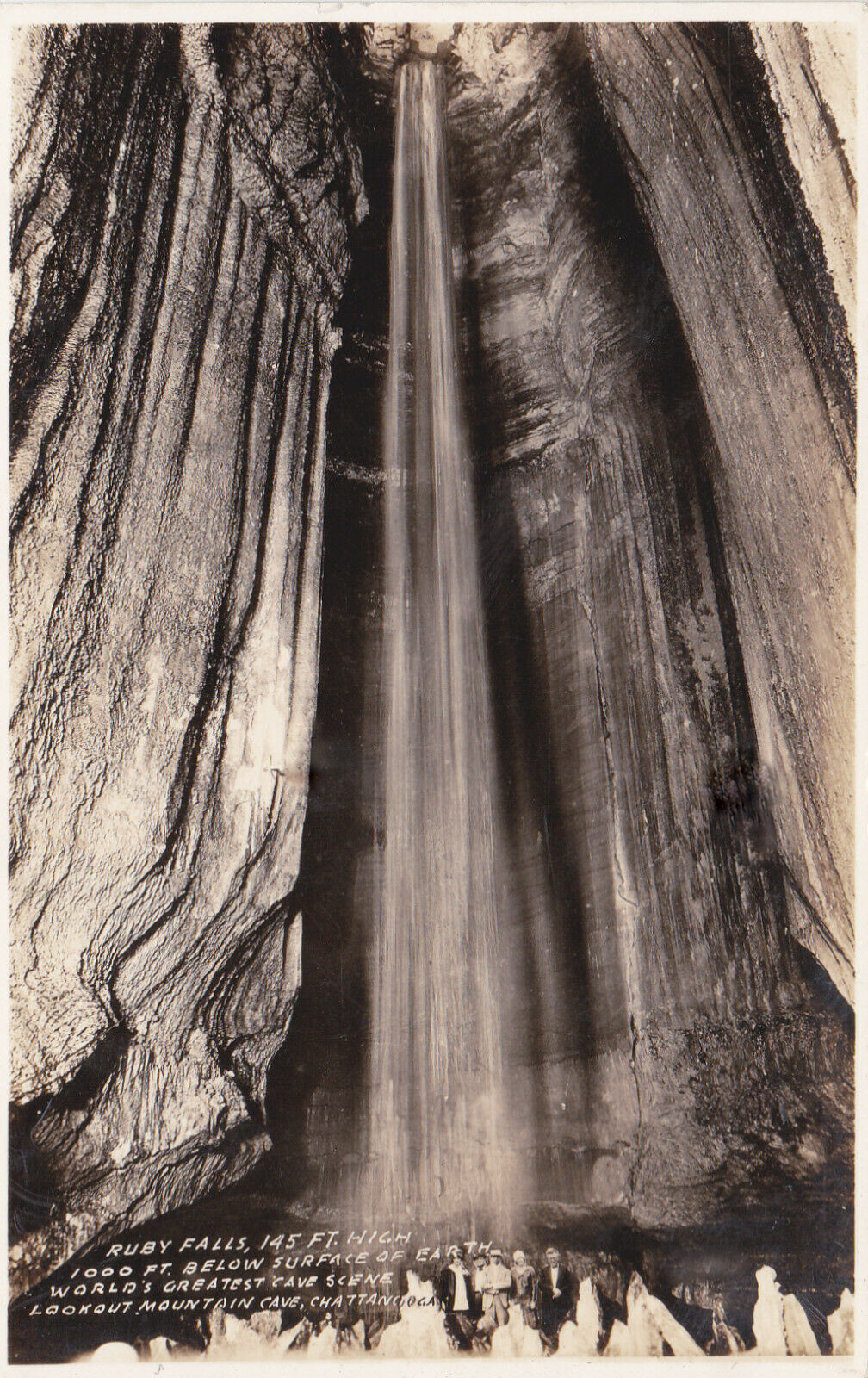
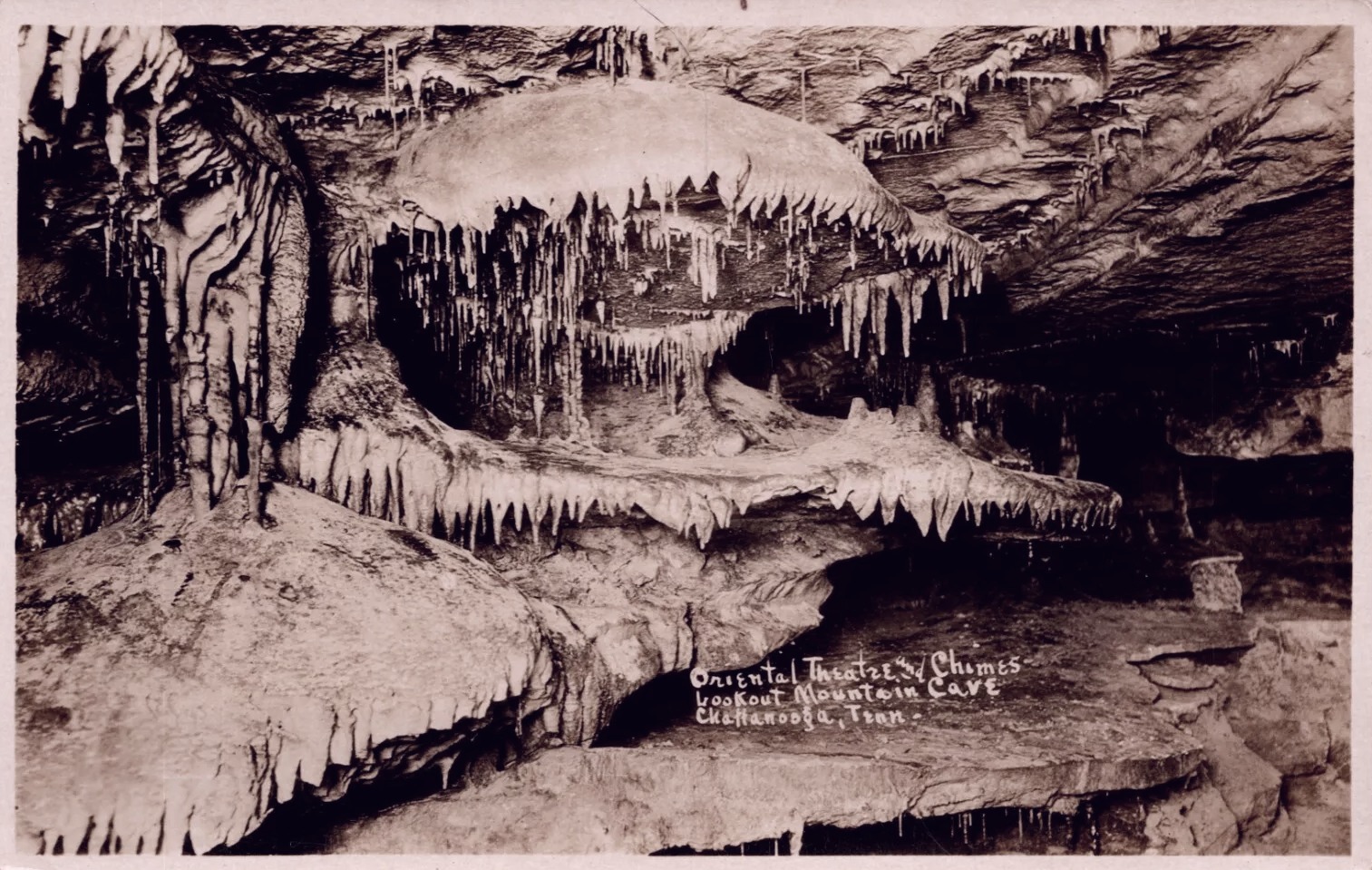
This precipitous car hauled him aloft Lookout Mountain and then he descended via a deep elevator shaft to explore another large and spectacular cave system. His first such descent having been in summer 1928 at the Endless Caverns.

I went up Lookout Mountain and revelled in the view and afterward descended into the spectral caverns inside the mountain — where in a vast vaulted chamber a 145-foot waterfall thunders endlessly in eternal night. This chamber and waterfall were discovered only ten years ago — at the end of sealed galleries whose geological formations prove them never to have been entered by mankind before.

I went all over Lookout Mountain [Tennessee], & explored the magnificent network of limestone caverns inside it — culminating in the vast & new-discovered [1923] chamber called “Solomon’s Temple” where a 145-foot waterfall bursts forth from the side — near the roof — & dashes down to a pool whose outlet no man knows.

Lovecraft postcard for sale

08 Sunday Nov 2020

Posted by asdjfdlkf in Historical context, Picture postals

≈ 1 Comment

For sale, a Lovecraft postcard, a pictorial addendum to a letter, in which he mentions his river journey down the river at Silver Springs. It sounds like it was sent to Clark Ashton Smith.

“Later – June 9 [1934]. Young Ar E’ch-Bei has held this epistle up several days, wishing to [solicit?] one enclosure. Meanwhile the envelope of your drawings has come, and he is in ecstasies over them. He keeps them always within reach and takes them out to gaze at every few minutes — and has made copies of many of them as best he can. I hope you can fix him up regarding the mythological matters. He wants all the available data on Tsathoggua — have you still the bits from ‘The Mound’ that I sent you when casting up that tale in 1930?

I went yesterday to Silver Springs, where the bottom of a lake is riddled with picturesque views seen from a glass-bottomed boat. Also sailed 10 miles down a tropical river which looked very much like the Amazon or Congo. The scenes for the cinema of ‘Tarzan’ were made here. I must send you a folder of the place — one of the most distinctive and fascinating spots I have ever seen. Evr Yrs for the Eternal Infra-red Flame.”


My June 2020 Picture Postals: On Silver River considered the same trip, with pictures.

Friday ‘picture postals’ from Lovecraft: the Newport boat

06 Friday Nov 2020

Posted by asdjfdlkf in Historical context, Picture postals

≈ 2 Comments

This week, another look at an aspect of the Providence dockside. H.P. Lovecraft wrote…

All my spare cash goes into trips to ancient towns like Newport” … In Rhode Island there is only one city really American, and that is Newport”.

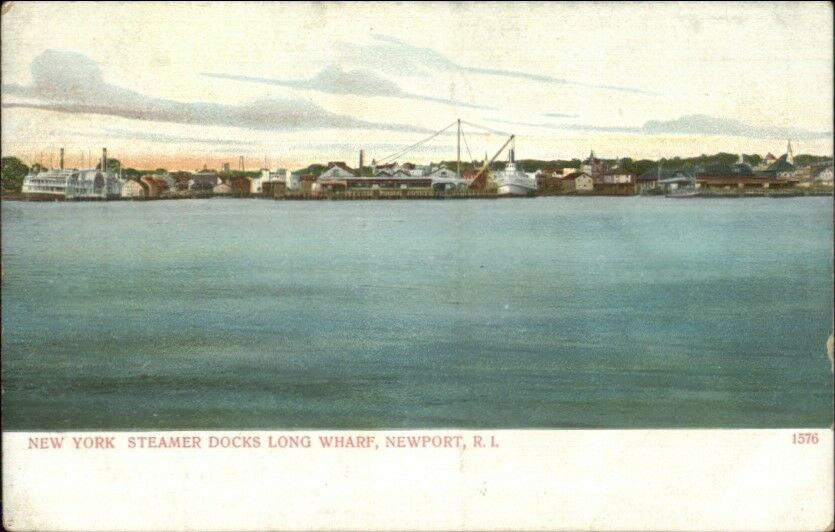
How did he get there? He travelled by sea, and this was his departure point…

The “Newport boat” landing and departure point, Providence.

This picture shows a setting briefly evoked in one of the world’s most famous horror stories…

“Locally, interest was intensified by the obscurity of the cause of death. The professor had been stricken whilst returning from the Newport boat [while he was walking up] a short cut from the waterfront…” (“The Call of Cthulhu”)

Lovecraft himself often “took a boat trip to Newport” from Providence, at the very time he was writing “Cthulhu”. The voyage would have been a day-trip, and thus he would have been at the Providence dockside early. For instance he was writing a letter before dawn in August 1926, and in it he wrote…

Well — it’ll be dawn soon, so that I can tell whether or not I’m going to Newport.

As the Great Depression deepened, he was sometimes able to afford more Newport trips each summer. At one point, what was usually 50 cents in high season became just 15 cents. In August 1932 he remarked on the voyage itself and its duration…

For the past three days I have been taking advantage of the incredibly low steamboat rates (15 cents round trip), and making diurnal [daily] voyages to ancient Newport. It is an admirable relaxation — a two-hour sail past green shores…

Though he regretted that he could not write his letters on the steamship, because…

the vibration will play the devil with my penmanship.

The throbbing steamship that Lovecraft endured was the Sagamore, a “remodelled” Bristol liner that now sometimes served as a local freight and cattle-boat, rather than the more salubrious liner which also plied the same route.

This would be the dawn sight of the Newport dockside, as Lovecraft approached from the sea…

And here is the same dockside seen in the distance, beyond some rather more picturesque fishing jetties…

After bringing in the Providence crowd, the steamship would then cast off for Block Island, returning later to pick up at Newport and return to Providence.

Once ashore in Newport, Lovecraft “wander’d through the living past” of the old town or “hiked into the Bishop Berkeley [British philosopher] country … some four miles beyond Newport beach on the road to Middletown”, through green fields of “sportive lambkins”. Often he sat writing for hours on “the great oceanward cliffs”, and once surveyed “the assembled U.S. Navy” in the bay — the place being also “quite a military town”.

Sometimes he ventured down into the holds of an ancient and venerable sailing ship that had been docked for the benefit of the Navy cadets.

Also, he haunted the oldest graveyards in his… “vain search in Newport for the grave of Michael, the elder James’s father [in his family-tree], who died in 1686”.

A lane in Newport, and Trinity church.

Lovecraft managed to see the town before the circa Fall/Winter 1927 “civic improvements” were made, which in a letter he called “detestable” because they would imperil…

the quaint narrowness of the main street, and the incomparable colour & atmosphere of the ancient wharves

He would also have known the Old Stone Tower, which appears to have had a small park around it where he might have sat and read.

‘Picture postals’ from Lovecraft: the Handicraft Club

30 Friday Oct 2020

Posted by asdjfdlkf in Historical context, Picture postals

≈ 1 Comment

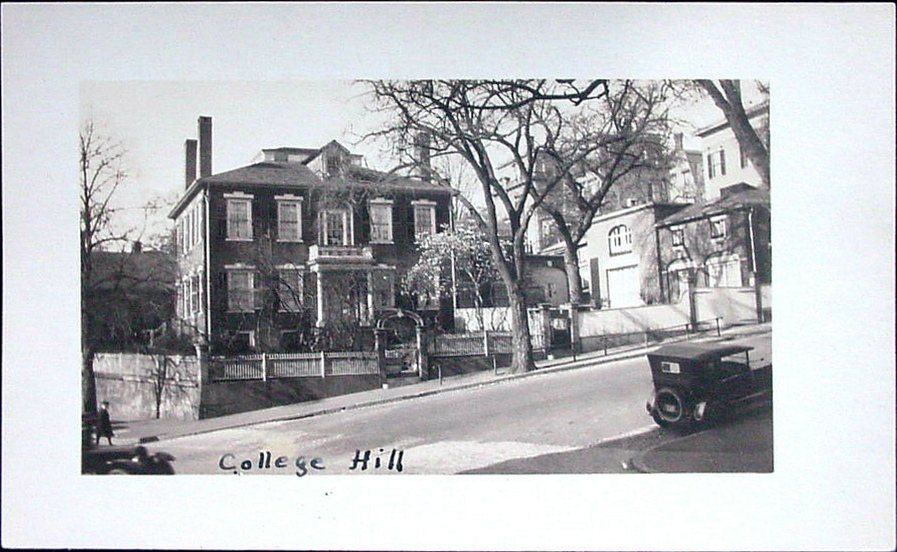
This week, yet another aspect of College Street as Lovecraft and his aunts would have known it. At the corner of Benefit and College Streets stood the headquarters of the Handicraft Club.

The artistically grown trees were apparently magnolias, and these later grew up substantially and when in leaf they obscure several later photographs of the frontage.

The Club was established there in 1905, and a rigorous approach soon attracted a healthy membership of skilled crafts workers. The place was extensive and there was a showroom and an annual exhibition of new crafts work.

It was here that one of Lovecraft’s aunts lived in 1927…

… half-way up [College Street] my aunt boarded in 1927 at the Handicraft Club in the old Truman Beckwith house. You doubtless recall that brick edifice and its old-fashion’d terraced garden.” (letter to Morton, Selected Letters IV)

S.T. Joshi writes of this period in I Am Providence…

We do not know much of what Lovecraft was doing during the first few months of his return to Providence [from New York City]. In April, May, and June [1927] he reported seeing several parts of the city he had never seen before, at least once in the company of Annie Gamwell, who at this time was residing at the Truman Beckwith house at College and Benefit Streets.

We do however know just a little of why his aunt might have been there. In 1925 the House had been purchased to serve as a “permanent home” (Handicrafts Of New England, page 321) as well as a clubhouse, and we can probably assume this was why Annie Gamwell could live there — if only for perhaps a single summer season of board and lodging. It seems plausible to assume that Lovecraft took the opportunity of his aunt’s residency to thoroughly appreciate the fine architecture. The Library of Congress has a detailed plan-book of the entire house, evoking all the details of the craftsmanship that Lovecraft would have thus admired. Though a photograph perhaps better evokes the interior that his aunt would have enjoyed at that time…


Atheist though he was, a few years later the mellowing Lovecraft was able to amiably enjoy an old traditional custom. Christmas 1933 found him listening to carols sung in the Handicraft Club courtyard…

Fixed up the sitting-room hearth with greens and surprised my aunt — and borrowed a cat for the occasion. Heard carol-singing in the early evening in the quaint cobblestoned courtyard of the Georgian Beckwith mansion (where my aunt was in 1927) halfway down the antient hill.” (letter to Morton, Selected Letters IV)

a turkey dinner at the boarding-house across the back garden & a stroll half-way down the hill to hear the carol-singing at the old Truman Beckwith mansion. I took the midnight coach & arrived in Manhattan the next morning —” (letter to Toldridge, Selected Letters IV)

Friday ‘picture postals’ from Lovecraft: more Providence at night

23 Friday Oct 2020

Posted by asdjfdlkf in Night in Providence, Picture postals

≈ Leave a comment

This week, more night views of Providence, this time as the young Lovecraft would have known it on night-walks. These two are early 1914 views made by the Providence artist Whitman Bailey (1884-1954). Lovecraft then aged in his early 20s.

Prospect Terrace was, of course, one of Lovecraft’s favourite places in his city. Neither picture is in my Whitman Bailey ebook collection, available here.

‘Picture postals’ from Lovecraft: Westerly!

16 Friday Oct 2020

Posted by asdjfdlkf in Picture postals

≈ Leave a comment

This week, a postcard to accompany the recent Voluminous podcast reading of “I Am Home”. The letter being Lovecraft’s ecstatic recounting of his returning to Providence by rail, from what he had come to think of as the ‘pest-zone’ of New York City. As the train sped through Westerly he finally felt he was coming home…

Then at last a still subtler magick fill’d the air — nobler roofs and steeples, with the train rushing airily above them on its lofty viaduct — Westerly — in His Majesty’s Providence of RHODE-ISLAND & PROVIDENCE-PLANTATIONS! GOD SAVE THE KING!!

Interestingly there was a “Wolf’s Den” at or near Westerly (often mis-named as “Westerely”), though he may never have visited it.

The best is can get is …

We’ll have to investigate Chauncey. Westerly coaches pass through Hope Valley (so do the New York Greyhounds), but the fare is probably rather formidable.” — letter to Morton, January 1933.

But perhaps he never made it there. Poverty led him to write to Morton in June 1930 that…

I fear desperately that I can’t quite make the Westerly jaunt.

There seems no other evidence he visited. Perhaps Westerly remained always a tantalising stop on the train line to Providence, at which he never alighted? A local place that, like Block Island, he should have visited but didn’t?

‘Picture Postals’ from Lovecraft: Robinson Hall, the first Brown Library

09 Friday Oct 2020

Posted by asdjfdlkf in Picture postals

≈ Leave a comment

Until he was aged about age 9 or 10 this would have been “the University library” (1878) that the boy Lovecraft knew of, as he mentally mapped the topography of College Hill and the wider city. The Library, being rather small for the growing university, was replaced by the current larger one in which Lovecraft’s letters are now housed.

The old Library then became simply “Robinson Hall”. The Economics Dept. relocated there in 1912 and, since Lovecraft was economically illiterate, it seems unlikely he knew it further other than by sight. The decorative exterior ironwork was lost due to decades of neglect, and when the ivy became unfashionable in the 1980s it was also removed. Like many desirable spaces in universities, by the early 1990s it was being used not by teachers and creatives but by the university admin staff. The building hung on until about 2017, when local press reports state it was demolished and replaced by an unremarkable modern admin block. One can’t help thinking what a wonderful ‘H.P. Lovecraft Museum and Archives’ it might have made, from the 1970s onward, serving as a significant tourist and visitor attraction for the city.

It was here that a strange final act of Lovecraft’s Providence life was staged. A large crowd gathered outside one Sunday in the fall/autumn of 1959, to see the surreal sight of H.P. Lovecraft’s entire house slowly moving through the streets of his city…

Truly, I never saw such fixed attention in a large crowd. I remember one elderly lady in tweeds who seated herself on a granite curb on the edge of the lawn at Robinson Hall to watch the show and enjoy a cigarette or two: she never once looked away from the slowly advancing house as she smoked.

Lovecraft in Esquire, 1947

02 Friday Oct 2020

Posted by asdjfdlkf in Historical context, New discoveries, Picture postals

≈ 3 Comments

The post-war chill of January 1946 was made a little colder for readers of Esquire magazine by an article on the 1938 New England floods, illustrated with with a very gloomy picture specially commissioned for the article.

Not quite a “Friday ‘picture postal'”, but a flooded Providence is as as-good-as. This image unwittingly visually trailed a short profile and supposed memoir of one H.P. Lovecraft, then a figure of quite some mystery. This item was to be found later on in the issue, and was penned by John Wilstach.

S.T. Joshi bluntly calls this memoir “fictitious” in his monumental Lovecraft Bibliography. It’s easy to agree, and for this reason I won’t muddy the waters by republishing it here. The editor of Esquire magazine even appears to implicitly warn his readers of being too credulous, in his trailer-blurb for the article…

In the article itself Wilstach claims to recall that he was drinking with the poet Hart Crane one day in New York in the twenties, and Hart happened to have the crumpled manuscript of Lovecraft’s “He” in his pocket. Crane thought highly of the tale and asked Wilstach to accompany him then and there on a visit to Lovecraft’s decrepit room in Red Hook, as he allegedly felt tender and protective toward the ‘old gent’. Given what we now know of Crane’s antipathy toward Lovecraft, and his apparent ignorance of the tale (only published September 1926, after Lovecraft had left New York), this seems highly unlikely.

But possibly the Esquire article needed jazzing up for acceptance. As such it’s not impossible that Wilstach substituted the famous Crane for a lesser writer he had actually known and who had known Lovecraft. His biographical blurb puts him in about the right place for that…

John Hudnall Wilstach (b. 1891) was a short-story writer and novelist specializing in circus and carnival life, crime, and science fiction.

Given his apparent circus specialism, one wonders if a possible candidate for the ‘real’ Crane might then have been Arthur Leeds. Leeds had a circus background, and might once have asked Wilstach to look over Lovecraft’s new ‘New York’ tales with a view to finding a market in ‘the slicks’ in which Wilstach sometimes published. That would be one hypothesis which could fit, but more would have to be known about Wilstach in 1920s New York to say more.

It can however be more firmly suggested that Wilstach had most of his personal material for the Esquire article from Paul Cook. Comments on the Esquire article, on the front page of the NAPA amateur journal the Literary Newsette for 2nd February 1946, seem to confirm this…

Wilstach obviously “… obtained most of the facts from W. Paul Cook, for whom he seems to have a strong admiration.

Wilstach’s article also claims he once made a post-New York winter visit to Lovecraft’s home in Providence, though he gives no address or date and not a single telling detail. There are however a couple of interesting points in his article, arising from his likely Cook connection. In the second half of the article there is an un-credited quote, which the editor has surprisingly let slip through un-credited. Presumably this quote is from Cook, given Cook’s known concern over people making the Poe comparison…

A friend once suggested that he stimulate dreams by means of drugs. Lovecraft exclaimed that if drugs would give him any worse dreams than he experienced without them, he would go mad. His dreams were his own. It is unfair to call him equal to Poe, greater than Poe, or lacking in certain Poe qualities. Better, consider him as standing alone.

That sounds like Cook, although if the quote was hooked from print I can’t discover. Evidently Wilstach had talked with Cook, since he relates the ‘Lovecraft wouldn’t disturb a sleeping cat in his lap’ anecdote, and states it was “told me by Cook”. A later June 1946 Esquire letter by Wilstach, defending his claims of a mid-1940s “Lovecraft cult” against a questioning March 1946 letter by Weird Tales founder Henneberger, shows that Wilstach had access to Cook’s mid-1940s little magazine Ghost. In this same letter he also talks of “my friend Cook”.

Given this reasonably firm Cook connection, one point in Wilstach’s article does ring true…

The [Lovecraft] family had been prominent in Providence. It was Lovecraft’s ambition to buy back the old home and restore the family’s position. He was almost in tears when he found a number of his grandfather’s books in a bookshop. He bought all he could.

Given that we know Lovecraft went on long book-hunting trips in Providence with Cook, both at the store of ‘Uncle Eddy’ and at other book-sellers, this last seems quite likely to be a fragment of memoir had via Cook. One then wonders if finding “his grandfather’s books in a bookshop” can be confirmed by a mention somewhere in Lovecraft’s letters? It does seem the sort of thing he would have told at least one correspondent about, though I don’t recall encountering it.

The Esquire article succeeded in bringing Weird Tales founder Henneberger to print, on the letters page of the June 1946 issue. This item is not in the Lovecraft Bibliography. He makes a pithy rebuttal without specifics, but more interestingly flashes a light on the very moment of Lovecraft’s initial reception in the Weird Tales office.

This itself is somewhat questionable in light of what we now know. Henneberger recalls that it was he who discovered Lovecraft, via Home Brew and the story “Randolph Carter”. But we know it was Cook’s The Vagrant that had published “Randolph Carter” in May 1920, not Home Brew. While Henneberger was doubtless keeping a close and wary eye on Home Brew (a possible competitor), it’s less certain he had also been tracking The Vagrant since summer 1920. However, its quite likely that in late 1922 he had made enquiries among the amateur journalists about suitable writers for his new Weird Tales, and been sent a bundle of The Vagrant.

He has it that he “contacted Lovecraft through this magazine” via editor Houtain, and personally invited a submission from Lovecraft. He was sent “The Rats in the Walls” and after reading it he showed it to his editor who was incredulous. We know it was published in Weird Tales, but not until March 1924, and we also know that this was not the “first” story to see print. That was “Dagon”, in the Halloween 1923 issue.

We also know that “Rats” could not have been among the initial handwritten manuscripts Lovecraft sent to Weird Tales in May 1923, since the tale was only written in late summer 1923. “Rats” was eventually submitted to Weird Tales, but it only arrived in the office circa 10th November 1923 (Selected Letters I, page 259). “Rats” had been typed by Eddy for Lovecraft, presumably with a couple of carbons, and submitted in good form to Argosy, which was one of the well-paying ‘slicks’. Evidently a carbon had also been mailed to Arthur Leeds, since Lovecraft states Leeds had written back to say he felt the tale was just too horrible for Argosy to accept… and so it proved. The rejected “Rats” was then quickly sent on to Weird Tales, to join the pile of other Lovecraft tales awaiting consideration.

One way of explaining Henneberger’s memories is then to say that he had indeed been tracking Home Brew and that, via Houtain its editor, he had indeed acquired Lovecraft’s address and passed it on to his editor at Weird Tales. This is not incompatible with the known fact that Lovecraft’s friends were drawing the new Weird Tales to his attention and urging him to submit some stories. We know that Lovecraft had eventually after much persuasion sent in stories in passable hand-written manuscript form in May 1923 (“Dagon”, “Carter”, “Ulthar”, “Arthur Jermyn”, The Hound”). But Henneberger’s 1947 letter implies that Lovecraft only really came to his attention when the Weird Tales editor queried how startlingly good the Eddy-typed “The Rats in The Walls” was, when it was read in mid November 1923. Clearly this Lovecraft was a cut above his Home Brew “Herbert West” and “Lurking Fear” serial-shockers, and his sent-in tales “Carter” and “The Hound” obviously gave only a hint of what he could really do. This seminal moment in time would then be what Henneberger was recalling in his 1947 letter. He did indeed ‘discover’ Lovecraft via Home Brew, at least in terms of getting an address out of Houtain. But he perhaps wasn’t quite aware of what a great writer he had got hold of, until his startled editor landed “Rats” on his desk for a second opinion. What he then pulled off his shelves to comfort his editor would not have been the serial-shockers of Home Brew, but was more likely something like some back-issues of Cook’s amateur publication. Containing as it did items such as the 1920 printing of “Randolph Carter”, and more importantly Cook’s 1919 essay “Howard P. Lovecraft’s Fiction” which had introduced “Dagon” to the world. In this respect it’s perhaps notable that “Dagon” was the first Lovecraft story printed in Weird Tales (October 1923). Evidently there was a copy of this in good form, somewhere in the Weird Tales offices. The presence of this last item in print would be ‘a given’, had Lovecraft in May 1923 sent his “Dagon” to Weird Tales not in the handwriting which obscured the other tales in his bundle, but rather in Cook’s 1919 printed form.

Such was the past, as Henneberger recalled it after some 25 years. What of the future? He has certainly been proven correct in his prescient forecast that Lovecraft…

will be read as enthusiastically in 2023 as he was in 1923

A useful reminder that Halloween 2023 will be the 100th anniversary of Lovecraft’s fiction first appearing in Weird Tales.

Friday ‘Picture Postals’ from Lovecraft: College St. demolition, 1935

25 Friday Sep 2020

Posted by asdjfdlkf in Historical context, Picture postals

≈ 2 Comments

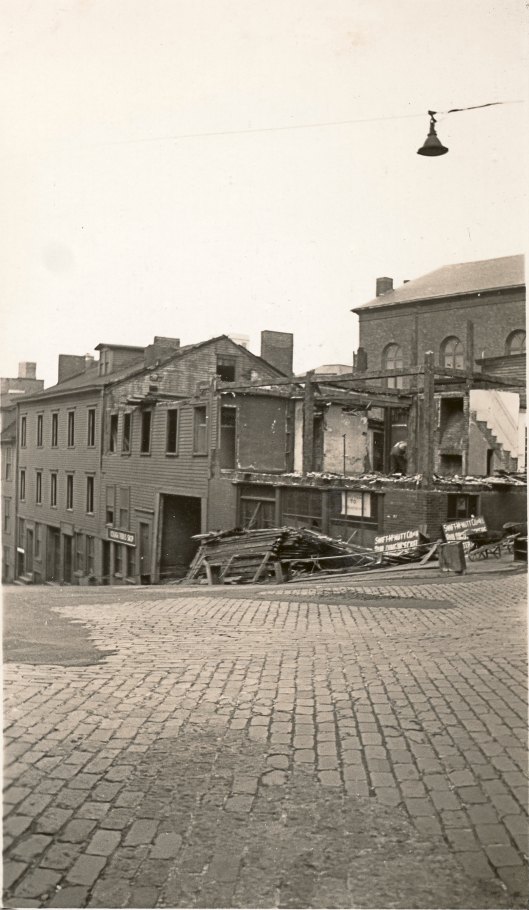
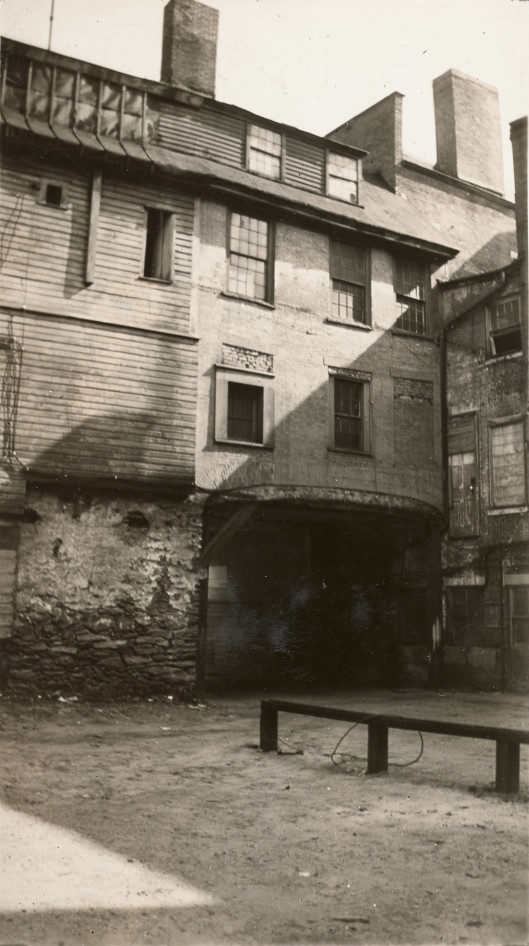
This Friday ‘Picture Postal’ follows last week’s, which had the same location but looked toward the city. In 1935 old buildings on lower College Street, Providence R.I, were demolished. Here we see 32-34 College Street in the process of demolition.

The wheels of modernity were spinning up and the motor car was the future. Horse-yards, and the antiquarians and artists who might haunt them, were increasingly surplus to requirements. We can imagine that Lovecraft, who lived further up the street at No. 66, objected to the demolitions. As he had at the demolition of the Old Brick Row, and other regretful changes to the city’s fabric. Though I can find no evidence that he did so for the bottom of College Street. Given the state of some of the backs (24-28 seen above), and the need for grand schemes in the Great Depression, it might have been difficult to publicly call for their preservation. Such is the way of it. Someone in authority makes a quiet decision somewhere and a street or area starts to be neglected. 15 or 20 years later the place is in such a state that it ‘has’ to be demolished, and it’s by then difficult to argue in favour of preservation.

Here we see local artist Stacey Tolman’s drawing of one of the yard entrances in the former ‘Rosemary Lane’, or one very much like it, and another from the other side showing the last days of usage for horses.

Here we see the back courtyard of No. 32 (top) and No. 33 (bottom), with the motor car replacing the horse in the yard at No. 33.

Tolman had earlier painted this yard at No. 33 in happier days, with its calm bright scene poised between industriousness and a faint threat.

Today, cynical modern eyes might instantly see men gambling and idle slum-boys playing hoop, or might raise a lip at the ‘chocolate-box’ sheen common to the Rhode Island art of the period. But the men are looking over plans for a worthy new horse-carriage for the somewhat Lovecraft-like man standing by them. Sturdy working apprentices stand ready to fit an iron rim to a hand-crafted wheel. An industrious wife has hung out lines of washing and one can just see her fresh green herb-pots on the same platform. This is a picture of a living place at work, but threatened by time. A point Tolman has emphasised by having the fateful clock tower of the Courthouse peering over the rooftops, steadily striking out the hours.

Did Lovecraft know the courtyard? He comments on the matter in a letter of April 1925. His aunts had both sent him a sketch of the courtyard, presumably printed in the local paper. He was astounded that he had never actually seen this inner court… “in all the thousands of times I have passed up & down College Hill.” However, being thus aware of it, we can be fairly sure that he visited it at least once on his return to Providence.

The demolitions appear to have inspired Lovecraft’s ever-fertile imagination. Late in his life, in a bitter winter, he ventured out from No. 66 to visit with a local girl admirer. Her memoir later recalled…

“Did we know, he asked, his sombre eyes intent on our faces, that recently, when early buildings on Benefit Street and College Street were razed to make way for new ones, deep tunnel-like pits, seemingly bottomless and of undetermined usefulness, were discovered in the ancient cellars?” — memoir of a visit by Lovecraft in 1934, by Dorothy C. Walter.

It was, of course, a test to see how imaginative she really was. As Lovecraft wrote a few years later…

The bulk of the human race lives very little in the imaginative realm; hence can seldom grasp the goals, motives, & aspirations of anyone with whom subtle perspectives, symbolic associations, & obscure mental correlations form important emotional factors.


The end result of the demolitions, looking up the lower part of College Hill…

Friday ‘Picture Postals’ from Lovecraft: down College Street

18 Friday Sep 2020

Posted by asdjfdlkf in Historical context, Picture postals

≈ 1 Comment

More vintage pictures of Lovecraft’s College Street, more or less as Lovecraft would have seen it was he briskly walked down the hill from his home at No. 66 and approached the lower part of College Street. He possibly used the right-hand side as seen here, as the convention of the Hill was apparently that the left sidewalk was the one used by Brown students. Using the right sidewalk would also presumably avoid any possibility that one would be jostled by unsavoury nautical-looking types outside the Courthouse. The Court buildings are seen on the left of the picture. Even if he habitually chose to turn left or right here, on his way to the commercial district, he would still have seen the view depicted.

Note the slightly sinister well-like manhole at the intersection, with a tight circle of bricks around it. How it might have glistened in the moonlight, and led to thoughts of what might lie beneath…

“Did we know, he asked, his sombre eyes intent on our faces, that recently, when early buildings on Benefit Street and College Street were razed to make way for new ones, deep tunnel-like pits, seemingly bottomless and of undetermined usefulness, were discovered in the ancient cellars?” — memoir of a visit by Lovecraft in 1934, by Dorothy C. Walter.

You can also just about see one of two courtyard entrances a little further down. This wasn’t the same “one of those old-fashioned courtyard archways (formerly common everywhere) for which Providence is so noted” on the slope of Thomas Street, which there led into the courtyard in which Lovecraft met the cat ‘Old Man’ at night. But I have photos of these College Street back-courtyards which evoke similar courtyard spaces. Of which more next week.

When Lovecraft was about level with one of the back-courtyard entrances he would be poetically poised between its antique allure on the one hand (if the doors were open), and on the other hand a forward view which now soared up into a towering modernity…

It appears that he actually didn’t mind this view too much, despite his yearning for the pre-modern. Long before he moved in to No. 66 he wrote about how he found himself walking up this particular street one evening when it was growing dark, which he had apparently never done before at that time of day. And it suddenly occurred to him to stop and turn and look back, since it would give a dusk view of Providence that he had never seen before. The Industrial Trust building (the tower seen here) was recently built by that time, and he found himself rather enchanted by the view he saw — differing grids and planes of distant lights rising up toward the stars.

← Older posts
Newer posts →


Please become my patron at www.patreon.com/davehaden to help this blog survive and thrive.

Or donate via PayPal — any amount is welcome! Donations total at Easter 2025, since 2015: $390.

Archives

  • February 2026
  • January 2026
  • December 2025
  • November 2025
  • October 2025
  • September 2025
  • August 2025
  • July 2025
  • June 2025
  • May 2025
  • April 2025
  • March 2025
  • February 2025
  • January 2025
  • December 2024
  • November 2024
  • October 2024
  • September 2024
  • August 2024
  • July 2024
  • June 2024
  • May 2024
  • April 2024
  • March 2024
  • February 2024
  • January 2024
  • December 2023
  • November 2023
  • October 2023
  • September 2023
  • August 2023
  • July 2023
  • June 2023
  • May 2023
  • April 2023
  • March 2023
  • February 2023
  • January 2023
  • December 2022
  • November 2022
  • October 2022
  • September 2022
  • August 2022
  • July 2022
  • June 2022
  • May 2022
  • April 2022
  • March 2022
  • February 2022
  • January 2022
  • December 2021
  • November 2021
  • October 2021
  • September 2021
  • August 2021
  • July 2021
  • June 2021
  • May 2021
  • April 2021
  • March 2021
  • February 2021
  • January 2021
  • December 2020
  • November 2020
  • October 2020
  • September 2020
  • August 2020
  • July 2020
  • June 2020
  • May 2020
  • April 2020
  • March 2020
  • February 2020
  • January 2020
  • December 2019
  • November 2019
  • October 2019
  • September 2019
  • August 2019
  • July 2019
  • June 2019
  • May 2019
  • April 2019
  • March 2019
  • February 2019
  • January 2019
  • December 2018
  • November 2018
  • October 2018
  • September 2018
  • August 2018
  • August 2015
  • July 2015
  • April 2015
  • March 2015
  • February 2015
  • January 2015
  • December 2014
  • November 2014
  • October 2014
  • September 2014
  • August 2014
  • July 2014
  • June 2014
  • May 2014
  • March 2014
  • February 2014
  • January 2014
  • December 2013
  • November 2013
  • October 2013
  • September 2013
  • August 2013
  • July 2013
  • June 2013
  • May 2013
  • April 2013
  • March 2013
  • February 2013
  • January 2013
  • December 2012
  • November 2012
  • October 2012
  • September 2012
  • August 2012
  • July 2012
  • June 2012
  • May 2012
  • April 2012
  • March 2012
  • February 2012
  • January 2012
  • December 2011
  • November 2011
  • October 2011
  • September 2011
  • August 2011
  • July 2011
  • June 2011
  • May 2011
  • April 2011
  • March 2011
  • February 2011
  • January 2011
  • December 2010
  • November 2010
  • October 2010
  • September 2010
  • August 2010
  • July 2010

Categories

  • 3D (14)
  • AI (70)
  • Astronomy (70)
  • Censorship (14)
  • de Camp (7)
  • Doyle (7)
  • Films & trailers (101)
  • Fonts (9)
  • Guest posts (2)
  • Historical context (1,095)
  • Housekeeping (91)
  • HPLinks (74)
  • Kipling (11)
  • Kittee Tuesday (92)
  • Lovecraft as character (58)
  • Lovecraftian arts (1,626)
  • Lovecraftian places (19)
  • Maps (70)
  • NecronomiCon 2013 (40)
  • NecronomiCon 2015 (22)
  • New books (966)
  • New discoveries (165)
  • Night in Providence (17)
  • Odd scratchings (984)
  • Picture postals (276)
  • Podcasts etc. (431)
  • REH (184)
  • Scholarly works (1,469)
  • Summer School (31)
  • Unnamable (87)

Get this blog in your newsreader:
 
RSS Feed — Posts
RSS Feed — Comments

H.P. Lovecraft's Poster Collection - 17 retro travel posters for $18. Print ready, and available to buy — the proceeds help to support the work of Tentaclii.

Proudly powered by WordPress Theme: Chateau by Ignacio Ricci.