• About
  • Directory
  • Free stuff
  • Lovecraft for beginners
  • My Books
  • Open Lovecraft
  • Reviews
  • Travel Posters
  • SALTES

Tentaclii

~ News & scholarship on H.P. Lovecraft

Tentaclii

Category Archives: Picture postals

‘Picture postals’ from Lovecraft: Night in Providence, 1933.

04 Friday Jun 2021

Posted by asdjfdlkf in Historical context, Night in Providence, Picture postals

≈ Leave a comment

This week, my upscale and colourising of a picture of downtown Providence, as Lovecraft would have known it at dusk on an evening in 1933. This is after the building of the Industrial Trust building. A building whose “blazing” and “winking” tower lights Lovecraft fairly soon came to rather enjoy having on his horizon, though he felt it marred the view from one particular childhood spot.

‘Picture postals’ from Lovecraft: Nicholas Roerich

28 Friday May 2021

Posted by asdjfdlkf in Historical context, Picture postals

≈ 1 Comment

This week, H.P. Lovecraft’s favourite non-magazine artist, Nicholas Roerich (1874-1947). As seen in The New York Times Magazine, 1st September 1929, as the article “Gods and Men in Storied India” (the northern Punjab). This is the only version online and is just about readable if you squint, but the rest of the article is not available.

From the same year, free as a PDF on Archive.org, his own book Altai-Himalaya: a travel diary, by Nicholas Roerich; with twenty reproductions from paintings, evoking and recording horseback journeys from 1924 to 1928 through the immense spaces and places of Asia, with the Altai Mountains being visited in 1926. This is the high bio-region where four nations now meet, China, Russia, Kazakhstan and Mongolia. It seen just before modernity and collectivisation, and the start of deforestation and the environmental damage wrought by socialism.

One wonders if Lovecraft read the book. But there is no Roerich book listed in Lovecraft’s Library. It seems like the sort of book that the budding ethnographer Barlow would have valued and taken away. Of course, it could also have been read from the Public Library. Roerich was then very famous, and there was no reason the Providence Public Library would not have stocked it.

If Lovecraft had picked up Roerich’s 1929 book a little late, in the early 1930s, and read as far as the 1926 “Altai” chapter then he would have been reading history. Wikipedia’s page on the Altai curiously skips the 1930s, but according to the reliable The Former Soviet Union’s Diverse Peoples: A Reference Sourcebook and other sources, under communism the Altai people were sent to small reserves in the south of the region, and by 1930 vast numbers of Slavs had been shipped in as part of a deliberate population-replacement strategy. In 1933 the Altai alphabet was banned, and the Altai religion was deemed an anti-Soviet conspiracy. The Altai who still remained outside the reserves were forced to settle and collectivise. During the war Stalin’s paranoia deemed them “pro-Japanese”. The post-war Soviet ‘Virgin Lands campaign’ brought gigantic collectivised farms to the region — 50 million acres of it went under the plough to grow the wheat needed to buy revolution and terror around the world. The Altai people were reduced to barely 20% of the population. Just a few years after his death in 1947, here and elsewhere in the high places of Asia, Roerich’s mid-1920s Shangri-la was gone.

Roerich’s 1920s ‘travel for painting’ diary book is fronted with a fine portrait of the man Lovecraft may have briefly talked with or seen on some of his many visits to Roerich’s New York City gallery. He would have been in his mid 50s by that time, then deemed ‘old’ by the male life-expectancy of the time.

…good old Nick Roerich, whose joint at Riverside Drive and 103rd Street is one of my shrines in the pest zone [New York City]” — Lovecraft letter to James F. Morton, March 1937.

Note that Roerich’s long expedition to Asia appears to have left New York City in March 1925, so after that date during the ‘New York City period’ Lovecraft would not have met or glimpsed Roerich in his Gallery. It’s quite possible the departure was covered by the cinema newsreels, though, and Lovecraft may have seen him on the screen.

Also new on Archive.org. “Nicholas Roerich and Science”, an article extracted from Art and Archaeology, May 1930. This presents an overview of the explorations and papers by Roerich that Lovecraft might have known by 1929, if only through personal discussion or press reports.

‘Picture postals’ from Lovecraft: the Radiator Co. building

21 Friday May 2021

Posted by asdjfdlkf in Historical context, Picture postals

≈ Leave a comment

Following on from last week’s ‘Picture Postals’ post, more sinister doorways. On 24th-25th October 1924 H.P. Lovecraft went on a long walk with Kirk to further explore New York City. As part of this they visited the new American Radiator Company building, a distinctive and free blend of new modern deco and old-world gothic that must have been very stimulating to Lovecraft’s sensibilities.

the new black & gold Dunsanian skyscraper design’d by the Pawtucket architect” (Letters to Family)

“Radiator Building” (1923-34) etching by Hugh Ferris.

The pair “for the first time explored the interior”, and specifically they visited the building’s basement.

A crack formed and enlarged, and the whole door gave way […] whence reached a sucking force not of earth or heaven, which, coiling sentiently about the paralysed detective, dragged him through the aperture and down unmeasured spaces filled with whispers and wails” (“The Horror at Red Hook”)

After exiting the ornate elevator visitors found the basement was styled like a complex crypt. This was, according to an architecture journal of the time…

reached by stairs leading down a series of platforms … The lowest level will contain the boiler-room[s and air conditioning chambers running at 300,000 cubic feet per hour] [with] a stone floor and wainscot and a decorated vaulted ceiling

Modern interior pictures of the building are for some reason almost unknown online, while there are thousands of pictures of the now-famous deco exterior in black brick and gold trim. But above and below are some interior pictures from The American Architect and Architecture Review, 19th November 1924. They have been rescued from Archive.org microfilm so far as is possible, and they indicate the spaces and atmosphere as Lovecraft would have seen them.

The ‘crypt’ gates.

He and Kirk walked down and found, as Lovecraft described it…

The basement is a dream of picturesqueness and spectral charm — crypt under crypt of massive vaulted masonry … terrible arches on Cyclopean columns, black things & haunted niches here & there, & endless stone steps leading down… down… down… to hellish catacombs where sticky, brackish water drips. It is like the vaulted space behind the entrances to some ancient amphitheatre in Rome or Constantinople — that, or some ghoulish tomb-nightmare not to be imagined save in visions of nameless drugs out of unfathomable Ind.” (Lovecraft, Letters to Family)

This visit was before the writing of “The Horror at Red Hook” (written early August 1925) so might have somewhat inspired the final scenes of that tale which is set in… “those nighted crypts, those titan arcades”.

‘Picture postals’ from Lovecraft: ye olde doorways

14 Friday May 2021

Posted by asdjfdlkf in Picture postals

≈ Leave a comment

Lovecraft’s near-obsession with discovering colonial doorways during his travels was not at all unusual for his era, and the appreciation was shared by many others. As tourism grew the interest also became understood, if perhaps not shared, by many more who lived in old colonial sections. The interest was normal and part of New England’s set of established antiquarian interests in material culture, along with covered-bridges, sailing ships, old lanterns, almanacs and so on.

Today we, and especially those outside the East Coast of America, might tend to think vaguely of the neatly painted-up and slightly chintzy re-creations of such doorways — and thus rather wonder at the attraction.

At best, people might picture the quieter doors of the type that could be seen in abundance on Lovecraft’s College Hill (as here) and which had never needed to be gentrified.

But as one can seen below, in 1920s pictures, some of the oldest original doors could be hoary and sinister with age… and thus most suited to a horror writer.

Lookout Court, Marblehead.

The Short House, Newbury.

‘Picture postals’ from Lovecraft: The Arcade

07 Friday May 2021

Posted by asdjfdlkf in Picture postals

≈ Leave a comment

Lovecraft talks a number of times of “the Arcade”, in Letters to Family Vol. 1. In 1926 he notes the demolition of the “old Butler mansion” next to the Arcade and worries about demolition of the Arcade (1827-28) itself. Indeed, Letters to Family reveals he was quite literally having nightmares about it (page 559). This is the building he’s talking about. It had two frontages. Here is the quieter-looking one on Weybosset St:

Curiously, no anti-pigeon measures on the building. Presumably the city offered a bounty to lads who were a crack shot with an air-rifle, in those days, rather than tolerate the buildings and sidewalks becoming fouled. Lovecraft was one such in his youth, and he had owned a fine collection of firearms and was a crack shot. A curious and not altogether unsuitable professional avenue might even have opened up for him, had his eyesight not been discombobulated by his intense astronomical observing — that of the city’s rat-and-pigeon sniper.

The Interior:

There was also a busier entrance on the busy Westminster Street, with a ponderously peaked pediment that gives it a less appealing look:

During the Second World War it was threatened again, when offices were planned for the site. But it survived, and is now the oldest surviving ‘proto-mall’ in America.

It was not for everyday shopping, and thus had no need to accommodate heaving crowds. It appears to have been a place which favoured, and around which clustered, photographers, commercial artists and picture-framers. Along with makers of hats, clothing accessories, jewellery, pens, perfume, etc. Also things like watch-repair and cameras. It was at a photographic studio here that Lovecraft had one of his first post-baby portraits made…

This is the first picture of me taken after the shearing of my infantile curls … I remember perfectly when the view was taken — one afternoon in a studio in the “Arcade”…

Friday ‘picture postals’ from Lovecraft: Keith’s Theatre

30 Friday Apr 2021

Posted by asdjfdlkf in Picture postals

≈ Leave a comment

This week, a little more on the Providence theatres of Lovecraft’s youth. In the form of an evocative 1905 programme cover showing the frontage…

Keith’s Theatre (it used the British spelling) was where Lovecraft later recalled having seen Houdini…

it happens that I saw him at the old Keith’s Theatre here nearly a quarter of a century ago

Though for some unknown reason he elsewhere stated he had never seen an entire Houdini stage show. It seems unlikely he was late for the show, since he would not have been admitted after the show had begun. Possibly he left before the finale, for some reason? It’s difficult to imagine that he fell asleep and missed part of the show that way. We might then consider the faint but amusing possibility that he was the audience member invited up onto the stage, to step inside the magician’s ‘vanishing’ cabinet — and thus in that way he missed part of the show. But in that case we would surely have read about it in the Letters, so the amusing notion can only be a possible plot point for someone’s future Mythos story.

In the 1930s Lovecraft recalled memories from his youth that seem to associate him with further this place. In 1900, aged five, hearing the…

quartette at Keith’s Continuous Vaudeville — ‘When the Harvest Moon is Shining on the River’

At this time one “Charles Lovenberg” was the Providence manager, which may have amused the boy Lovecraft due to the similarity to his own name. Lovenberg “saved the publicity about Providence vaudeville from area newspapers” in extensive scrapbooks, along with the theatre’s own publications. These books and papers survive and are now part of the archival Keith Albee Collection located in Iowa City.

The Christmas line-up at Keith’s, 1907.

Lovecraft also recalled how the theatre’s management used the (presumably very dull)…

new Biograph travel films to chase the [vaudeville] audiences out of Keith’s at six-o’clock

These were short documentary cinema films made by the American Mutoscope & Biograph company, as it was named until 1909.

The interiors of the Keith’s theatres were palatial, if the rest of the chain is anything to judge by. The Providence venue apparently became the Victory in 1924, being renovated and renamed while Lovecraft was in New York City.

Incidentally, here is a possibly useful tip for Archive.org searchers. There is no partial search, and thus “Keith” will not find “Keith’s”.

Picture postals from Lovecraft: Shepard’s in Providence

23 Friday Apr 2021

Posted by asdjfdlkf in Historical context, Picture postals

≈ Leave a comment

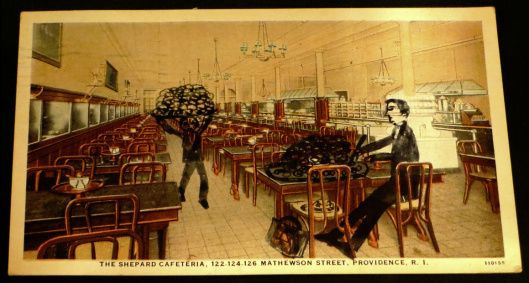
Another picture from Lovecraft’s momentous homecoming-day from New York City, which I presume I am soon to encounter again on starting the second volume of Letters to Family. I had already looked at the Art Club and the Strand cinema. Now there’s a newly found picture of the interior of “Shepard’s (neo-) Colonial Restaurant”, also mentioned as a place visited in celebration. Not great, as postcards go, but there are two pictures and it gives an indication. I suspect the blank space may have once held a miniature paper year-calendar. The picture on the right is faintly marked “Club Parlor”.

We went out to an exhibition of paintings at the Art Club, (the colonial house in hilly Thomas Street, in front of which I snap-shotted Mortonius last fall [1923] and had dinner downtown at Shepard’s (neo-) Colonial Restaurant. In the evening a cinema show at the good old Strand in Washington Street completed a memorable and well-rounded day. (Selected Letters II)

Presumably one of his aunts was a member, and could invite family guests. Not the same as his favourite and more affordable Shepard Cafeteria in Providence. Here we see a boy waiter (his face made somewhat animalistic by the chairs seen through the pen-work) bearing a second tray of do-nuts to feed Lovecraft as he dines at the Shepard Cafeteria.

Different version…

‘Picture Postals’ from Lovecraft: more on Silver Springs

16 Friday Apr 2021

Posted by asdjfdlkf in Historical context, Picture postals

≈ Leave a comment

This week, a return to Silver Springs, Florida, which I casually looked at on the blog last summer and again when a postcard popped up for auction.

I’ve now found pictures of the 1934 leaflet interior, the very year Lovecraft visited, and it details what Lovecraft could have seen and heard there…

Local weird lore from Aunt Silla, the ‘legend’ of the place.

He may also have seen Ross Allen’s Reptile Institute which was established at Silver Springs in 1929, and opened to the public in 1930. Thus Lovecraft could, if he had the cash, have seen displays of alligator wrestling, ‘milking’ of the toxic snake-venom, and sundry reptiles in captivity.

“Big George”, ‘largest alligator in captivity’, and Ross Allen.

Allen had established a large collection of “South and Central America” reptiles, with dozens of alligators, hundreds of snakes, monkeys, deer, birds, turtles, lizards, exotic animals. He performed wrestling demonstrations with live alligators and giant anacondas in the pool there. He used the profits for medical research for human health… “Allen pioneered many forms of snake anti-venom, including a dried variety” and he was a pioneer in this.

It’s interesting to then consider that Lovecraft might also have seen the Allen collection and show, but I suspect he was not able to afford both the entrance ticket and the boat trip(s). He doesn’t mention Allen or the Institute, and only tells correspondents about the river and its jungle environment. From how he describes the river, one might assume he was told that to see the animals in their natural habitat was the better option than paying to enter the Allen Institute. The river itself showed him… “alligators, turtles, snakes and strange birds” all along its length, and be found the sights “indescribably weird”. He does remark on “the snake-house at Silver Springs”, but does not appear to have gone into it or known more about it. It seems he knew about it only because he had a close-up with a “huge cotton-mouthed moccasin” snake. A local man had climbed aboard the tour-boat so as to take this catch to the “snake-house” downriver. Lovecraft was very glad that the captor kept a “firm grasp” on the snake’s neck all the way back. Lovecraft would not have termed it “the snake-house” if he had known it was actually a much more substantial venture and had a proper name and famous keeper.

Surprisingly, there is no mention of Silver Springs in the new Letters to Family volumes. At least according to the Index, there being nothing under either “Silver Springs” or “Lovecraft: travels of…”. Indeed the whole of 1934 is almost a blank.

But the volume of Baldwin, Rimel, Frome letters, newly acquired here, does have a few items. Evidently Lovecraft thought the Silver Springs boat-trip had been rather brisk, even at “ten miles in a launch”, since he later remarked that he had enjoyed a trip up the similar “Black Water Creek” in Florida in summer 1935 all the more because of “the more leisurely observing conditions” compared to Silver Springs. This raises the question of if Lovecraft took the slower (he uses the term “sailing”) “glass bottom” boat cruise, or the “Speedboat Jungle Cruise” as indicated on the leaflet above… “Silver River and back in 45 minutes” over a total of ten miles. Evidently there were these two types of trip available, and the speedboat trip appears to have been the longer but faster one. Actually, Lovecraft talks in his letters as if he did both, and the leaflet does pitch the speedboat ride as an add-on to the ride on the glass-bottom boat. True, he was strapped for cash at the time… but the Barlow family may have been paying.

No postcards are to be found of the “Black Water Creek” as it appears to have been a local place… “a marvellous tropical river near the Barlow place”. Last summer I tentatively suggested it might have once run south of the Barlow homestead, given the proximity of a farm of the same name, and a likely channel still visible on the (now far better drained) terrain.

‘Picture postals’ from Lovecraft: springtime at Lincoln Woods

09 Friday Apr 2021

Posted by asdjfdlkf in Historical context, Picture postals

≈ Leave a comment

An early springtime theme for the ‘Picture Postals’ this week. Views from the Lincoln Woods that Lovecraft so enjoyed on warm days, taking his reading and writing bag to the large rock by the lake. You can see the rock in the distance here…

the Quinsnicket or Lincoln Woods region which I have haunted all my life.” — letter from Lovecraft to Clark Ashton Smith, 1933.

Here are more vintage pictures, newly colorised…

A closer view of the rock, across the lake.

A rock massing that might have evoked a feeling of ‘cyclopean ruins’.

And finally, here is ‘the Butterfly House’, also part of the park. Not a house for butterflies, but named for the curious iridescent wings shape made by the cut blocks on the facing at the side of the house. They are clearly visible here. This house is not the same as the nearby…

picturesque ivied ruins of an ancient mill which I knew in youth.

Related posts and additional pictures:

Lovecraft, outdoorsman.

Lincoln Woods.

Lincoln Woods explored as Lovecraft knew the place. This reveals that the Druid Circle stones as known today are not the same as they were in the 1920s. They were damaged by the “blasting and road work” of the 1930s New Deal work-parties.

‘Picture postals’ from Lovecraft: family carriages and fine views

02 Friday Apr 2021

Posted by asdjfdlkf in Historical context, Picture postals

≈ 1 Comment

This week, more on the transport theme. Letters to Family briefly reveals that, as a young boy, Lovecraft and his grandfather used to drive out in a horse and carriage/gig named “Tom”. Evidently they would enjoy getting purposely lost in the country east of Providence…

… we wandered interestingly in the young dusk, and became picturesquely lost — as when Grandpa and I used to get lost driving “Tom” in East Providence — on some unknown height…

The implication here is that, being lost, he and Grandpa would then need to find elevated viewing points to drive up to or halt by, presumably partly to-reorient themselves but also to enjoy unexpected views.

(The above quote is not indexed: in the Index to Letters to Family add “p. 145” to Phillips, Whipple and to Lovecraft, H.P. … and Whipple Phillips).

Not Lovecraft and his grandfather, but evocative of riding “Tom” into a field to enjoy a sunset vista.

These were the days before any substantial automobile ownership, and it would have been very safe and quiet on the roads and lanes. Most likely the field and track gates were only latched, not padlocked as they might be now. The only danger and noise was likely from the occasional fierce farm-dog, but dog training was far better in those days and they were also trained not to spook horses.

What was “Tom”? Possibly Lovecraft’s “Tom” was a large four-seater family ‘city carriage’ with the sides down or off for the better weather, but the type of East Providence backroads and lanes travelled probably meant this was not practical. The roads, especially back-roads on which one might become lost, would not have been as good as today. True, the turnpikes (toll-roads) had been abandoned in Rhode Island by the 1880s, and a decade or two later one could go where one liked. But the patchwork of local upkeep is said to have left much to be desired, being good in places, but poor and uneven a mile further on, then good again. Rhode Island’s famous scientific ‘road surfacing’ experiment was not until 1907. This saw the laying of 14 ‘experimental sections’ to discover which was the best-wearing and most dust-free option. They were, surprisingly, the first such state in the nation to actually do such rigorous tests and the results came in 1909. A simple mix of “tar with natural stone macadam” beat all the fancy expensive mixes that contractors recommended. But the state’s new roads were not laid until after 1909. Thus the pre-tarmac roads encountered by Lovecraft and his grandpa circa 1895-1900 would have been quite varied, especially if one was trying to take a semi-random route in outlying rural districts.
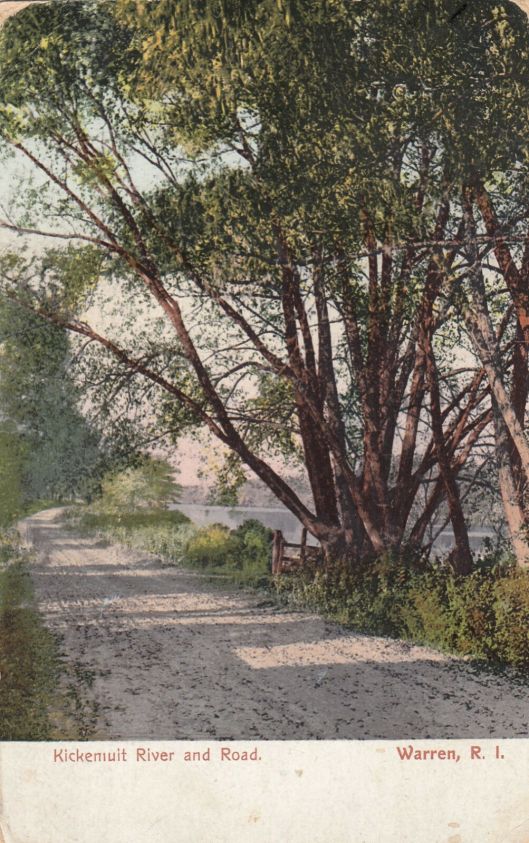
The unpaved road to Warren, in the far south of East Providence.

This means that a city-type carriage was probably not practical. Could there have been another lighter buggy-style carriage? Well we know the family kept several “carriages”, before financial problems meant…

the horses and carriages were sold too, so that I had a gorgeous, glorious, titanic, and unbelievable new playhouse — the whole great stable with its immense carriage room, its neat-looking ‘office’, and its vast upstairs, with the colossal (almost scareful) expanse of the grain loft…

Lovecraft somewhat hazily recalled this loss/gain as being “ca. 1895”, but S.T. Joshi dates the departure of the carriages and live-in coachman-groom a little later…

“when the coachmen left (probably around 1900)” (I Am Providence).

Whatever the dating we can thus be sure there were once several horse-drawn vehicles, hence the large size of the stable. The trips with his grandfather could then equally have been in a lighter runabout gig of the sort seen above. Possibly the formative vista-seeking trips were enjoyed when Lovecraft aged four or five, but if Joshi’s “1900” dating is a better informed guess they may have been a little later, perhaps at age seven or eight.

Anyway the dating of the stable probably does not matter for the dating of the trips. Since I assume that a sixty-something businessman like Grandpa Whipple would have still required hired horse transport to get around, even if he could no longer afford to have it located in the home stable. Experts on the Whipple finances may know more, but my guess is that he retained local access to at least a horse and buggy, even if it had to be hired in from nearby. He also likely retained the local ‘pull’ to borrow one from a friendly neighbour on a fine evening, even if finances were tight.

As quick-eyed photographers know, being on a bicycle (ideally tirelessly electric, or in this case a horse-buggy) enables one to discover exponentially more photographic possibilities than when plodding along on foot. If getting psychogeographically lost on purpose to find “picturesque” sights, Grandpa’s random turnings and likely exploration of spectrally embowered by-ways must have had much the same effect, offering many more ‘picture views’ than for the walker. I assume that the views were not simply for mundane re-orientation after becoming lost, and would have been enjoyed for their own sake.

But I also suspect the apparently random nature of the trips were about more than stacking up the probabilities of finding a really good near-sunset view. Recall, for instance, that his grandfather also gave the boy other forms of training at this time, such as finding his way through what Lovecraft called “a certain chains of dark rooms” to cure his fear of the dark. On a New York walk he recalled that he had also enjoyed becoming purposely lost in the local Cat Swamp as a boy…

Remembering that I had no map & knew nothing of the country, [I went] trusting with chance with a very agreeable sense of adventure into the unknown; just as I used to enjoy getting “lost” on walks around Cat Swamp, East Providence, or somewhere, with you [his aunt], Gramp, or my mother in the early and middle ‘nineties.” Letters to Family, page 421.

These things were also a form of navigation training. Thus getting lost with “Tom” could also have been another form of training, with purposeful random turnings aiming to teach the boy some skills of ‘natural navigation’ (the sort of things now found in best-selling books such as The Natural Navigator). But, if finding the way home at dusk, then also navigation by key stars and the moon. The adult Lovecraft often displayed an aristocrat’s hazy sense of time re: being less than prompt for meetings, but he seems to have had a countryman’s navigational skills. He was able to quickly find his way in situations when his clueless companions had their heads spinning. One suspects that this innate skill was honed early, firstly with his grandfather and later independently on his bicycle.

His grandfather had, once, been a rural man likely to value such skills. There was still at the back of the family horse-stable “the orchard”, which the boy Lovecraft would regularly raid for summer fruit. And there was also a field beside the house which pastured the family cow…

… the family cow — a beloved possession reminiscent of the prehistoric Greene days ere my grandfather became an urban dweller.” (Lovecraft, letter to Kleiner)
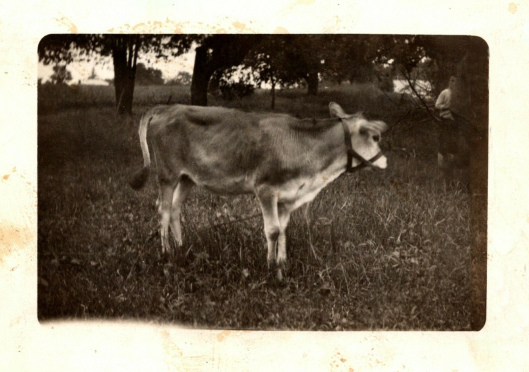
Again, not actually the boy Lovecraft and the family cow, but somewhat evocative of the likely scene.

It was, he later recalled…

an open field with a stone wall where great elms grew [and] a cow pastured under the gardener’s care. Here, when I was five, they built me a playhouse…
‘Picture postals’ from Lovecraft: Museum of Natural History, Roger Williams Park

26 Friday Mar 2021

Posted by asdjfdlkf in Astronomy, Historical context, Picture postals

≈ 1 Comment

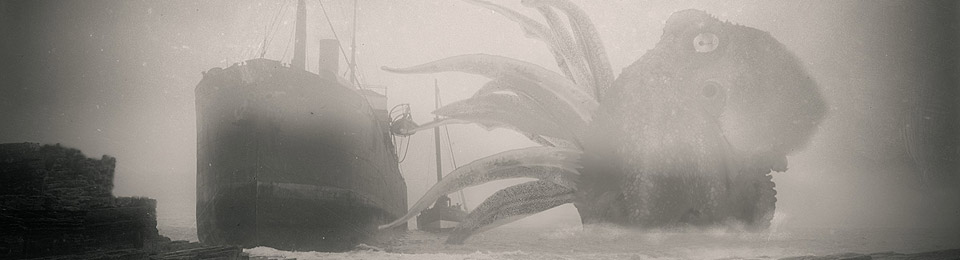
Newly coloured, a huge picture of The Museum of Natural History, Roger Williams Park, Providence. 1906, Lovecraft was then aged 16 and deeply investigating astronomy — so much so that the following year Prof. Upton of Brown personally introduced the young Lovecraft to Percival Lowell.

Only when record-pictures are this size and glass-plate clarity can one see certain details. The lizard-creature atop the building, for instance…

Or the wry humour in placing an “I Speak Your Weight” machine next to a short bench which looks about wide enough to accommodate one very fat person.

On the opposite side of the entrance-steps is what appears to be a huge lump of concrete, but I would guess was more likely a very fossil-rich accretion full of fossils… and thus designed to attract the sort of children interested in fossil-hunting. Another small but interesting detail is the British-English use of the wording “rubbish” on what today would be a ‘trash’ bin.

Lovecraft may have become overly familiar with the Museum’s exhibits by 1906, but it appears to have had local and visiting exhibitions and these could have been a continuing draw. He surely returned to it in the Autumn of 1916, when the famous astronomer Prof. Percival Lowell (he of the ‘Martian canals’ theory) exhibited there…

a remarkable collection of astronomical photographs … in the form of glass transparencies, exhibited in a darkened room, and illuminated from behind, so that they stand out with vivid clearness

There were 150 of these and they formed a “blockbuster” show, attracting over 1,300 visitors on the first day in Providence…

Currier of Brown University was at the museum all afternoon answering questions with regard to the 150 transparencies

I was uncertain of the 1916 date for this show, before, but Popular Astronomy for 1916 confirms it. The journal reprinted a newspaper report from Providence…

Lovecraft claimed lack of belief of Lowell’s ‘canal’ theories (“I never had, have not, & never will have the slightest belief in Lowell’s speculations” he wrote in 1916), though his surviving articles show more ambivalence. But he surely cannot have been sniffy enough about the theories to have missed this major local show of the Lowell Collection, in his favourite local park and running from circa 9th-23rd October 1916. Many of the pictures by Lowell and his highly skilled assistants were not again equalled in topographical detail until the 1960s. Also, Lovecraft would have been aware that by 1915 Lowell had theorized and had begun the search for “Planet X” (Pluto)…

in a manner not wholly dissimilar to that advised by Lovecraft himself in his letter to the Scientific American of July 1906. (S.T. Joshi, Primal Sources)

Rather amazingly the Lowell Collection of planetary photographs does not seem to have been digitized for modern public use. Perhaps there is a worry that they might still be mis-used re: the ‘Martian canals’? Nor are there even any pictures of what the Lowell exhibition looked like to the visitor of 1916.

Lowell died unexpectedly in November 1916, and Lovecraft penned a short poetic ‘elegy’ so turgid that it could even be intended to be read as some sort of sardonic snub in a coded 18th century manner. It ends by imagining Lowell ascending to the heavens and becoming a star, adding… “a new brilliance to the Southern Cross!” Could this be Lovecraft’s snippy allusion to the criss-cross of Lowell’s ‘canals’ theory, and also that Lowell had things ‘upside down’? Because the simple four-star Southern Cross is only visible ‘down under’ in places such as Australia. Apparently all Australians know that an observer can draw ‘imaginary lines’ out from the cross, to find the direction south at night.

‘Picture postals’ from Lovecraft: in a typical motor-coach of the early-mid 1930s

19 Friday Mar 2021

Posted by asdjfdlkf in Historical context, Picture postals

≈ Leave a comment

H.P. Lovecraft was a veteran traveller by motor-coach in the 1920s and 30s. Here we have a view as if from the back seat in a typical lower-cost local type of motor-coach of the mid 1930s, as photographed at that time (I’ve enlarged and colorised it).

By the mid 1930s there were, of course, expensive lines of streamlined coaches on the cross-country routes. Some even with reclining sleeper-seats and their own refreshments bar in a cubicle at the back with a white-uniformed server in the hatch. But Lovecraft was… “always seeking the cheapest possible route” on his many travels and so, unless an utter bargain of a long-distance ticket was on offer, he chose the lowest priced options. He would also have encountered many passenger transfer coaches, waiting at railway stations.

With clean glass, a good seat behind the driver (as was his wont) and the right weather, one might…

“traverse the long miles [through New England] by motor-coach, eagerly drinking in the green rolling hills, the fragrant, blossoming orchards, and the white steepled towns” (Dexter Ward).

He also appears to have been keen on the “fragrant” bit — a flow of rural air through the motor-coach — having come to detest the “prepayment suffocation chambers” that were the stuffy and smelly New York City equivalents. Possibly a draught was one of the advantages of being seated behind or beside the driver, who likely had a side-window open in summer. It would also have meant he was not forced to converse with a random fellow passenger, but might (if the driver was not the gruff and silent sort) obtain from the driver occasional names of the sights being passed. It would also enable him to easily signal the driver to stop and left him off, easy enough in those days of relatively little motor traffic. This happened at Salem, for instance…

The coach ride was delightful, giving frequent glimpses of ancient houses in a fashion to stimulate the antiquarian soul. Suddenly, at a graceful and shady village corner which the coach was about to turn, I beheld the tall chimneys and ivy’d walls of a splendid brick house of later Colonial design, and espy’d a sign which proclaim’d it open for publick inspection. Captivated by the sight, I signall’d the driver and alighted … I loudly sounded the knocker and awaited developments. Nothing develop’d. I then knock’d at the side door, but with equal futility. Then I noted a door half open in a miserable ‘ell’ at the back of the house; and believing the place tenanted, made a third trial there. My summons was answer’d simultaneously by two of the most pitiful and decrepit-looking persons imaginable — hideous old women more sinister than the witches of 1692, and certainly not under 80. For a moment I believ’d them to be Salem witches in truth; for the peculiarly sardonick face of one of them, with furtive eyes, sneering lips, and a conspicuously undershot lower law, intensify’d the impression produc’d by their incredible age and gauntness …” (1st May 1923).

Lovecraft may also have liked the hand-made and slightly rustic feel in some of lower-cost motor-coaches found in rural and coastal tourist districts, with (as can be seen here) stitched leather seat-top covers, woven wicker chair-frames and polished wooden arm-rests. This was a hand-crafted modernity, put together by artisanal craftsmen in small workshops.

Once in a new town or resort he also hopped aboard such coaches with his fellow tourists. Tourism was then a relatively ‘new thing’ for many towns, and even in the Great Depression there could be enough of this new breed of antiquarian sightseer to make such things viable. In this “rubbernecking” way he made his quick initial tour and assessment of a new place…

“[a] sort of preliminary touring, the standardised service of the various motor-coach sightseeing companies, and of the street-railway corporation, is strongly recommended as the cheapest and most comprehensive method [of first encountering a place].”

His sense of direction was excellent, even in the labyrinth of New York City, and he would also minutely study maps of a place before visiting. So, even while being spun around on a “rubberneck bus”, he could keep his bearings in a new place.

← Older posts
Newer posts →


Please become my patron at www.patreon.com/davehaden to help this blog survive and thrive.

Or donate via PayPal — any amount is welcome! Donations total at Easter 2025, since 2015: $390.

Archives

  • February 2026
  • January 2026
  • December 2025
  • November 2025
  • October 2025
  • September 2025
  • August 2025
  • July 2025
  • June 2025
  • May 2025
  • April 2025
  • March 2025
  • February 2025
  • January 2025
  • December 2024
  • November 2024
  • October 2024
  • September 2024
  • August 2024
  • July 2024
  • June 2024
  • May 2024
  • April 2024
  • March 2024
  • February 2024
  • January 2024
  • December 2023
  • November 2023
  • October 2023
  • September 2023
  • August 2023
  • July 2023
  • June 2023
  • May 2023
  • April 2023
  • March 2023
  • February 2023
  • January 2023
  • December 2022
  • November 2022
  • October 2022
  • September 2022
  • August 2022
  • July 2022
  • June 2022
  • May 2022
  • April 2022
  • March 2022
  • February 2022
  • January 2022
  • December 2021
  • November 2021
  • October 2021
  • September 2021
  • August 2021
  • July 2021
  • June 2021
  • May 2021
  • April 2021
  • March 2021
  • February 2021
  • January 2021
  • December 2020
  • November 2020
  • October 2020
  • September 2020
  • August 2020
  • July 2020
  • June 2020
  • May 2020
  • April 2020
  • March 2020
  • February 2020
  • January 2020
  • December 2019
  • November 2019
  • October 2019
  • September 2019
  • August 2019
  • July 2019
  • June 2019
  • May 2019
  • April 2019
  • March 2019
  • February 2019
  • January 2019
  • December 2018
  • November 2018
  • October 2018
  • September 2018
  • August 2018
  • August 2015
  • July 2015
  • April 2015
  • March 2015
  • February 2015
  • January 2015
  • December 2014
  • November 2014
  • October 2014
  • September 2014
  • August 2014
  • July 2014
  • June 2014
  • May 2014
  • March 2014
  • February 2014
  • January 2014
  • December 2013
  • November 2013
  • October 2013
  • September 2013
  • August 2013
  • July 2013
  • June 2013
  • May 2013
  • April 2013
  • March 2013
  • February 2013
  • January 2013
  • December 2012
  • November 2012
  • October 2012
  • September 2012
  • August 2012
  • July 2012
  • June 2012
  • May 2012
  • April 2012
  • March 2012
  • February 2012
  • January 2012
  • December 2011
  • November 2011
  • October 2011
  • September 2011
  • August 2011
  • July 2011
  • June 2011
  • May 2011
  • April 2011
  • March 2011
  • February 2011
  • January 2011
  • December 2010
  • November 2010
  • October 2010
  • September 2010
  • August 2010
  • July 2010

Categories

  • 3D (14)
  • AI (70)
  • Astronomy (70)
  • Censorship (14)
  • de Camp (7)
  • Doyle (7)
  • Films & trailers (101)
  • Fonts (9)
  • Guest posts (2)
  • Historical context (1,095)
  • Housekeeping (91)
  • HPLinks (74)
  • Kipling (11)
  • Kittee Tuesday (92)
  • Lovecraft as character (58)
  • Lovecraftian arts (1,626)
  • Lovecraftian places (19)
  • Maps (70)
  • NecronomiCon 2013 (40)
  • NecronomiCon 2015 (22)
  • New books (966)
  • New discoveries (165)
  • Night in Providence (17)
  • Odd scratchings (984)
  • Picture postals (276)
  • Podcasts etc. (431)
  • REH (184)
  • Scholarly works (1,469)
  • Summer School (31)
  • Unnamable (87)

Get this blog in your newsreader:
 
RSS Feed — Posts
RSS Feed — Comments

H.P. Lovecraft's Poster Collection - 17 retro travel posters for $18. Print ready, and available to buy — the proceeds help to support the work of Tentaclii.

Proudly powered by WordPress Theme: Chateau by Ignacio Ricci.