Up for auction…
“one of 50 unbound copies of H.P. Lovecraft’s first book, The Shunned House, which had a very complicated publishing history resulting in the novel being known as the author’s “stillborn” first book”

07 Thursday Nov 2013
Posted in Odd scratchings
Up for auction…
“one of 50 unbound copies of H.P. Lovecraft’s first book, The Shunned House, which had a very complicated publishing history resulting in the novel being known as the author’s “stillborn” first book”
07 Thursday Nov 2013
Posted in Odd scratchings
This is what I’d like to think Lovecraft’s ancestral seat might have looked like, had he ever found it in the county of Cornwall (a remote and wild corner of England)…

07 Monday Oct 2013
Posted in Odd scratchings
How does Lovecraftian madness read in cultures that have differing conceptions of mind?
The Lao, like many communities in Southeast Asia, have only recently become familiar with Western notions of psychology and sanity. This leads to an interesting discussion of how Lovecraft’s recurring themes of the cosmic threats to sanity and an ordered, consistent sense of the cosmos may be an utterly alien topic of terror. One can almost imagine a Lao reader going “Ha ha ha. Oh. You lost the American version of your mind? That’s it?”
27 Friday Sep 2013
Posted in Odd scratchings
“Let’s build that cool science-fiction idea, and make it work”, says a new MIT course MAS S95: Science Fiction to Science Fabrication…
“With a focus on the creation of functional prototypes, this class combines the analysis of classic and modern science fiction texts and films with physical fabrication or code-based interpretations of the technologies they depict.”
I nominate Tillinghast’s resonance wave machine (in “From Beyond”), perhaps in a cyber-goggles form that would enable one to safely see into and selectively merge the unseen wavelengths of light…
“Do you know what that is?” he whispered, “That is ultra-violet.” He chuckled oddly at my surprise. “You thought ultra-violet was invisible, and so it is – but you can see that and many other invisible things now.”
21 Saturday Sep 2013
Posted in Lovecraftian arts, Odd scratchings
Amazingly, there are still Lovecraft monsters that haven’t been worked up into game monsters by the table-top gamers. I can add another one, from the previously unpublished Wilbraham letter (ms. to Lillian D. Clark, 1st July 1928) that I was able to access for my latest book of essays…
“…lean brown marsh-things (invisible to mortal eyes) who wave & brandish them [constellations of fire-flies] in the gloaming when the unseen nether world awakes.”
Interesting also, that here we may have the genesis of the invisible monster which he was to place centre-stage in “The Dunwich Horror”. He wrote the story immediately after the Wilbraham visit.
19 Thursday Sep 2013
Posted in Historical context, Odd scratchings
More of Lovecraft’s favorite books, Richard Green Parker’s Aids to English Composition and Progressive exercises in English composition. The latter he sent to at least one promising revision client (Zealia Bishop).

19 Thursday Sep 2013
Posted in Odd scratchings
The Private Papers of Henry Ryecroft (1903), by George Gissing. Apparently one of H.P. Lovecraft’s favorite books, and one on which he based his personal philosophy of life. Sonia stated that she received a copy of it early in their courtship, with instructions to read it to better understand him.

Curiously the book isn’t listed in Lovecraft’s Library. My guess on that would be that S.T. Joshi had to weigh Sonia’s solo revelation about the book, against Lovecraft’s apparent utter silence on Gissing in all his other walks of life and voluminous correspondence. And the similar silence of his bibliophile friends on the book. But if you’d like to take a look, the book is available here: Dutton U.S. first edition online digital facsimile and as .mobi for Kindle.
19 Thursday Sep 2013
Posted in Odd scratchings
Hot on the heels of the Junior Burials at Brown I’ve found another Rhode Island tradition of weird parading. Lovecraft and George Kirk took a ten-mile trolley ride from Providence to Chepachet on 4th July 1926 to see the first of the modern ‘Parade of Ancients and Horribles’. This parade was the U.S. Sesquicentennial (150th) anniversary revival of an annual satirical Parade of Ancients and Horribles, an event which had first been recorded in New England in 1851. The visit was mentioned in Kirk’s diary…
This essay has been replaced by the essay in my new book of revised, expanded, and footnoted versions of my recent Tentaclii essays, Lovecraft in Historical Context: fifth collection.
18 Wednesday Sep 2013
Posted in Historical context, Odd scratchings
It’s interesting to learn that there was once a weird end-of-term tradition among junior Brown University students in Providence. In early July each year they would parade in a boisterous throng from the University to the Seekonk River by flaming torchlight, in order to “bury Whately”. This appears to have been done from 1833-8, then again from 1853-9 — when the tradition ended due to the advent of the Civil War.
Whately is of course rather a similar name to Whateley, the famous name from Lovecraft’s story “The Dunwich Horror”. Wilbur Whateley ends up horribly dead in the “reading-room” of a university library, you’ll remember. He evaporates, and so cannot be buried.
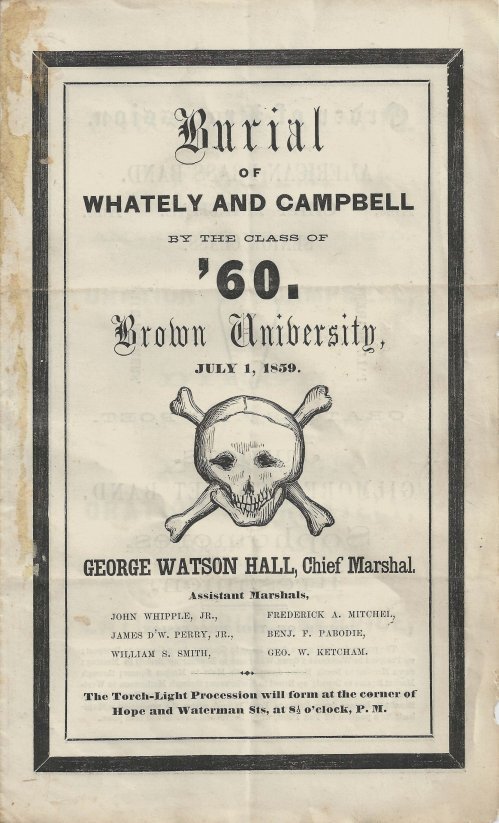
“…[the] earliest known program [for the “Junior Burials”] being for the year 1853. On these occasions there was a procession through the city streets with a brass band, banners and burning torches, as the rhetoric textbooks of Richard Whately, George Campbell, and William Spalding were conveyed in a coffin to Ferry Wharf [Fox Point, Providence, at the confluence of the Seekonk and Providence Rivers]. There the students embarked in boats to an offshore spot where the funeral ceremonies were conducted, complete with orations on the textbook authors, a poem and an ode, and the books were thrown overboard [sealed in a coffin].” (Encyclopedia Brunoniana)
According to Encyclopedia Brunoniana the tradition was taken up again in the 1870s, without the books of Whately but with more ghoulish costumes — and this time a burning of the books rather than a burial-at-sea…
“They were later revived as a “cremation,” and the textbook authors singled out [as] Elias Loomis on analytical geometry and Thomas B. Shaw’s Manual of English. The later processions did not head for the boats, but paraded across Red Bridge (and, once across, opened the draw bridge with the approval of the appropriate authorities) and burned the offending books. The cremation held in 1875 was described in rhyme in a local newspaper under the heading, “Brown Boys ‘On the Rampage’”:
“Thursday, by early candle light,
appeared a strange and grotesque sight,
upon the College Campus green,
a sight as queer as e’er was seen.
It was the Brown boys, out in force,
to celebrate in usual course,
their Class Day eve, with mock display,
and mimic funeral pageantry.
The Juniors, in outlandish guise,
bedecked themselves to strike surprise
to all who saw them thus arrayed,
on their accustomed street parade.
Some wrapped in winding sheets were ‘most
too noisy for a sober ghost,
and some wore horns, in travesty
of his Satanic majesty,
The latter seemed, upon the whole,
familiar with the title role,
and many, as the train went by,
inclined to Darwin’s theory.
From street to street the cavalcade,
with blatant hand, its progress made;
red robes, a skull and cross-bones bare,
looked hideous in the torches’ glare.
Beyond the [River] Seekonk’s further shore,
the strange procession marched, and bore
an English text-book, with Greek fire,
burned on a mock funeral pyre.
This frolic o’er, each Junior sped
at midnight to his little bed,
ending in peace this revel queer,
which comes, thank God, but once a year.”
The tradition had its last year in Providence in 1884, when the books documenting the university marking-system were buried (the Brown lecturers had started to complain that the students were becoming embarrassingly likely to burn textbooks written by Brown staff).
What of Whately? Richard Whately (1787-1863) was not actually a Professor at Brown University, but was rather the British free-market intellectual and nominal churchman who was the author of the hugely influential Elements of Rhetoric (1828) and Elements of Logic (1826), and also the editor of Bacon’s Essays with annotations (1857). Lovecraft’s use of the name Wilbur for Wilbur Whateley is a red herring if one looks for it in the real Richard Whately — since it is an obvious nod to Wilbraham, the topographical inspiration for “The Dunwich Horror”.
Could Lovecraft, so ardent a student of his city’s history and of ghoulish burials, have known of the Whately burial tradition? Possibly, although there is no evidence in the surviving letters that I know of. Nor is it in the city histories. A city prefers to forget many things about itself.
16 Monday Sep 2013
Posted in Odd scratchings
Michael Johnson muses on the Summer of Lovecraft coverage and its mainstream media idiocies. Joseph Laycock muses on the weird prank which topped off that summer, in “Claiming the Land for Azathoth: Lovecraftian pranks and the post-modern sacred”.

13 Friday Sep 2013
Posted in Odd scratchings
New blog: Lovecraftian Science, currently with posts on astrology and Lovecraft, and Carl Sagan and Lovecraft.
07 Saturday Sep 2013
Posted in Odd scratchings
I’m pleased to say that I’ve finally bagged an affordable UK-shipping copy of Lovecraft Remembered, which arrived this morning…