New on AbeBooks, albeit at a chunky price, Songs of Four Decades.


18 Thursday Aug 2022
Posted in Odd scratchings
New on AbeBooks, albeit at a chunky price, Songs of Four Decades.
15 Monday Aug 2022
Posted in Odd scratchings
“Artworks dropped into the Mediterranean, to eliminate illegal fishing, are allowing ecosystems to regrow”.
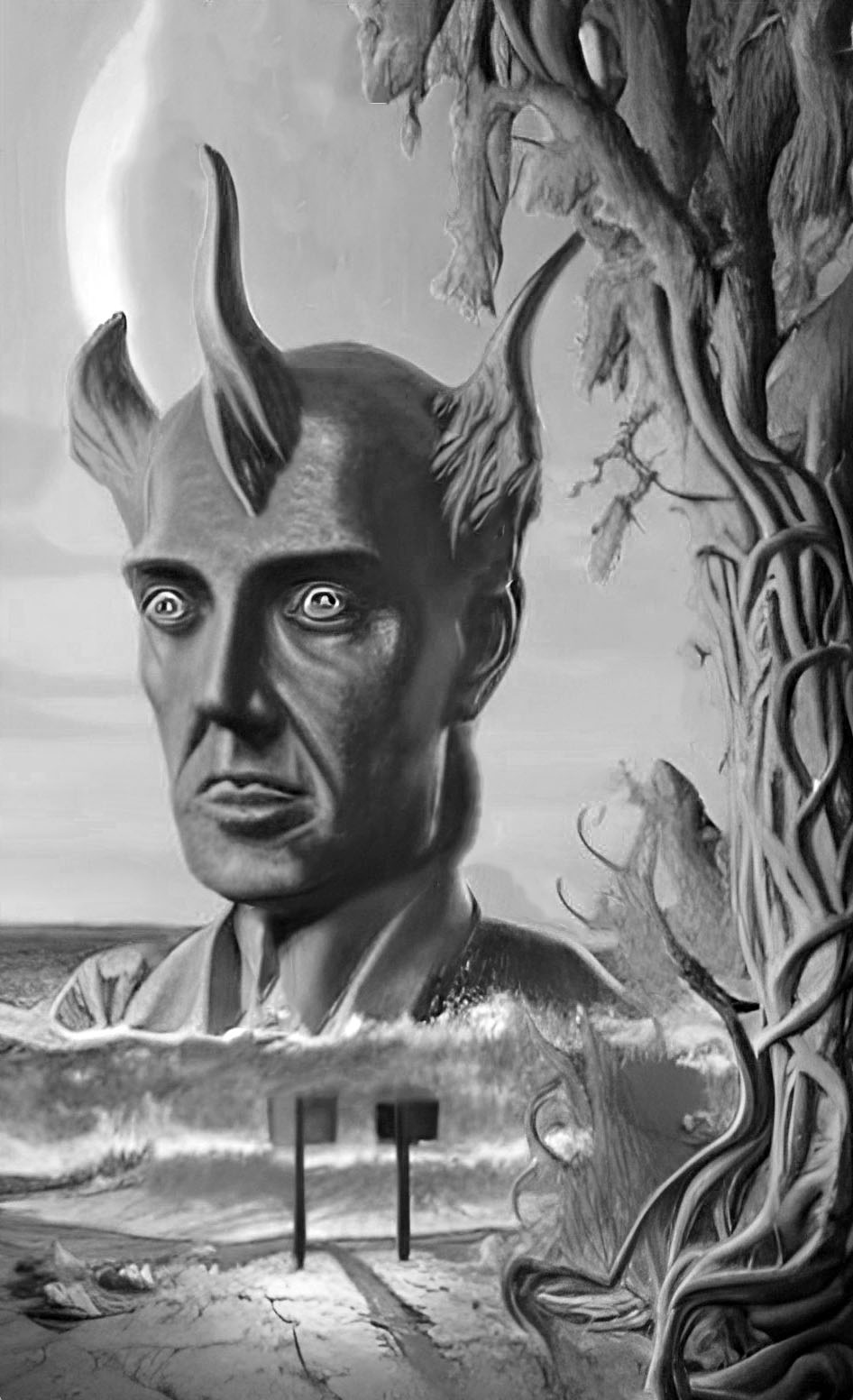
Now there’s an idea for the location of a ‘monument to Lovecraft’. A representation of the man as the pinnacle of a new man-made underwater eco-reef, perpetually facing the dark and rolling ocean abyss. And only visit-able by the most intrepid sailors and divers. Perhaps on the coastal shelf that falls off the back end of Newport, one of his favourite places. There appears to be a suitable reef or underwater ridge just west of Cormorant Rock.

31 Sunday Jul 2022
Posted in Housekeeping, Odd scratchings
Time for a July round-up post. It’s been a slow month, and not because of summer heat. Which barely lasted two days for me, on one of which I didn’t even need the air-conditioner turned on. I’m not sure which was worse, the brief 95-degree heat or the hysteria. As a boy who lived through ten weeks of non-stop scorching summer in 1976, I was not impressed by the nation’s wimpy behaviour. Now Tentaclii Towers once again languishes in what has overall been a rather cool summer, only it’s now rather damper than previously. I can feel the early autumn approaching already, and it won’t be surprising if I soon start to spot strange fungi around the Towers.
This month in ‘Picture Postals’ I looked at Columbia Heights, and specifically the “faery” view of the city towers from 110 Columbia Heights which so enchanted Lovecraft when he first arrived in New York City. I found several pictures which should help other researchers to go on to discover 1920s views from more or less the same photogenic spot. It features the Brooklyn Bridge, so a good picture-researcher with access to U.S. and New York archives could probably get an impressive dusk view from 1922 and almost the same spot. Staying in New York City, another ‘Postals’ post identified the mysterious “Chatham” that Lovecraft fondly recalled as one of three “quaint familiar landmarks” of his 1922 visit to the city. So far as I know I’m the first Lovecraftian to identify this. I then found several fine and evocative period photos of the place. Moving back to Providence I also restored and showed a panorama view of Lovecraft’s cherished Prospect Terrace, a view that I’d never seen before.
I completed my mammoth re-read of all five volumes of the Selected Letters, this time making notes. My post “Notes on the Selected Letters of H.P. Lovecraft, Volume V.” appeared in July. Remarkable finds in this post: later in his life Lovecraft thought there was life on Mars; he did read The Black Cat as a youth (“I used to buy that reg’lar-like”); at the end of this life he finally saw a movie he really liked, A Midsummer Night’s Dream (1935); and I found a photo of the “well-known ‘bohemian’ restaurant called Julius’s” where Lovecraft once stayed for two weeks. It became known, after the war, as one of the most famous gay bars in history. I’m now reading and making notes on the 2021 Lovecraft Annual, which will become a review before the 2022 edition appears.
A mention on Don Herron’s blog, of two Derleth “Lovecraft as character” tales, led me to take a look them. Not so impressive as tales, as it turns out, but in the research I also stumbled on mention of a Ray Bradbury depiction of Lovecraft as a character in The Martian Chronicles. This was actually his Martian story “The Exiles” (1950 version, Fantasy & Science Fiction, Winter/Spring 1950), which though a Mars story did not get into The Martian Chronicles. This led me to the further discovery that there are another two books-worth of Martian stories by Bradbury, beyond those selected for The Martian Chronicles.
For Lovecraftian researchers, I made the one-stop “SALTES, a custom search-engine for Lovecraftian researchers” based on Google Search. Though it still needs to be complemented by a further search on Tentaclii, since Google Search has still not yet properly indexed my blog at the new URL.
There were recordings from Howard Days 2022, and the Glenn Lord Symposium 2022, freely placed online in July. The latter had an especially illuminating discussion of the first phase of topics under discussion in the R.E. Howard / Lovecraft letters. I still can’t afford the HPL-Howard volumes of letters. They’re on the list, but several Ken Faig books and the Letters to E. Hoffmann Price and Richard F. Searight must come first.
Various useful reviews were noted and linked in blog and journals. The latest Spectral Realms poetry journal was listed on Hippocampus, and on inspection the contents list was found to include one non-fiction article on Barlow. The semi-annual Lovecraftian ‘zine The Blasphemous Tome released a new issue after a long gap.
In podcasts the new Voluminous (“Elizabeth and the New York Boys”) very usefully reminded me of emotional context for the writing of “The Shunned House”, and thus for my musing about the depiction of the final and otherwise rather incongruous “elbow” in the tale. This context confirms my earlier supposition that the glutinous “elbow” might well be read as a censorship-avoiding stand-in for some other less mentionable body part.
In open archival materials, I was kindly informed that HPL ‘zine (1972-74) is now free and public on Fanac.org, and I had a quick look through and pulled out or noted biographical materials for Tentaclii. I’ll have to get around to reading it more fully at some point, and I suspect that the Hoffmann Price item differs from that published elsewhere. Yes, it’s Price doing Lovecraft’s astrological chart, but the chart’s interpretation contains perceptive biographical insights on Lovecraft by one who knew him. New on Archive.org are Who’s Who in Horror and Fantasy Fiction (1978) and The Pulps: fifty years of American pop culture (1976).
The original Finlay art for the memorable dust-jacket of H.P. Lovecraft’s The Outsider (1939) came up for sale, and I snagged the preview scan.
In the comic and toon arts, Lovecraft’s The Dream-Quest of Unknown Kadath is now a current ongoing comic-book series, in the stores now as a #1. I’ve little idea what it’s like, but the covers and character-designs certainly intrigue. In royalty-free 3D I noted a “Patrick base mesh”, new on ArtStation and likely to be a very useful starting point for crafting a H.P. Lovecraft 3D toon figure. Also a new free very low-poly 3D figure for Poser, likely to interest noir / crime-pulp and Lovecraftian RPG artists and comics creators.
In the AI arts, I tinkered with a creative writing AI titled ‘Story Machines’, and as an experiment used it to expand a real H.P. Lovecraft dream paragraph. This became, via the AI, a new and much longer story fragment.
Nothing much in books this month, but in the musical arts S.T. Joshi released his Songs from Lovecraft and Others, as a book of sheet music with audio download-code.
Conventions started to become active again, with the RPG focused CarcosaCon 2023 booking and the Armitage Symposium once again arriving in Providence via NecronomiCon 2022. I suspect all such things will be smaller than before, partly due to reluctance to travel because of [insert: disease-of-the-week] and travel restrictions, and partly simply because most people can no longer afford to travel far.
For those interested in early British TV sci-fi (an acquired taste, I know) I also updated by Doctor Who view/watch list for the Tom Baker and Davison years, having now completed the viewings. The Davison stuff tails off badly, and apparently the several Doctors after that were dire. So very appropriately I’ve now gone back in time from Baker… and made a new list for the Hartnell (first Doctor) / Troughton / Pertwee years. Which I’ll view and updated with comments over the coming months. I was also pleased to find there’s a new 2022 second-edition of a complete viewer’s guide book to a rival TV channel’s ‘Doctor Who beater’ series, Jaunt: A Viewer’s Guide to The Tomorrow People, which suggests a follow-on British sci-fi series that I might also revisit.
The next Digital Art Live magazine is to be themed “Battle”, so please let me know ASAP if you’re an R.E. Howard artist or other artist who uses digital tools to make multi-character historical battle scenes. Ideally from a pre-gunpowder era, though I won’t say no to Solomon Kane in-battle art with flintlocks and the like.
That’s it for July 2022. Things will be even slower in August, as Tentaclii is now off the daily-posting schedule for a while. As always, please do seriously consider becoming my patron on Patreon or perhaps boosting your monthly patronage by another $ or two. Every dollar encourages, and I still have hopes of reaching $100 a month in total. Also welcome are simple PayPal donations, or just an inbound Web link to Tentaclii on your blog or a mention in your journal or podcast. You can also buy one of my various books.
24 Sunday Jul 2022
Posted in Odd scratchings, Scholarly works
New on Archive.org and possibly of interest to some. Who’s Who in Horror and Fantasy Fiction (1978), which seems useful for getting biographies of authors who are now neglected or forgotten. And The Pulps : fifty years of American pop culture (1976). This latter appears from the contents-page to be a sampler rather than a history.

20 Wednesday Jul 2022
Posted in Odd scratchings
NecronomiCon Providence 2022 Tickets, for 18th-21st August 2022. Gold and Silver Key passes sold out, but with one month to go until the event the “general passes and single-day passes” are available.
Note also the bit that says… “Special event tickets will be on sale starting ~20 July.”
19 Tuesday Jul 2022
Posted in Odd scratchings, Scholarly works
The silly-season for news is here, and things are getting a bit slack while scholars are at the beach. So here’s an off-topic post that may still interest some Tentaclii readers, though I recognise that 1970s British TV sci-fi is an acquired taste. My mega-re-watch of the best of Doctor Who is ongoing, and as such I was interested to learn of a book-length guide to one of its competitor TV series called The Tomorrow People. I fondly but rather vaguely recall this from my youth, though haven’t seen it in many decades.
The book guide for the series is titled Jaunt: A Viewer’s Guide to The Tomorrow People. First issued in 2013, and now in July 2022 just re-issued in a new “revised and expanded edition” including detailed coverage of the original comic-strip adventures that were run in Look-In.
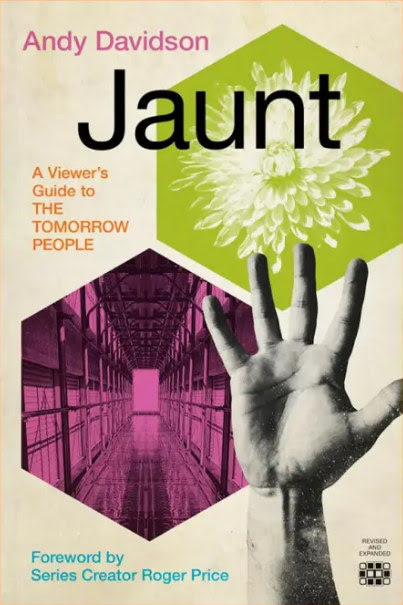
The cover is a faux emulation of a 1970s second-hand Penguin paperback.
I was also interested to hear of… “the return of the Tomorrow People in a lavish 1990s international co-production”, a TV reboot news of which had completely passed me by. There’s also said to be a modern third series, but it sounds both politically correct and radically changed, being set in a dystopian… “world far removed” from “the original series’ vision”.
10 Sunday Jul 2022
Posted in Odd scratchings
Just a reminder that Lovecraft’s 132nd Birthday is coming up in just over five weeks, on 20th August 2022. There’s still time to prepare a ‘birthday gift’, lecture, gig or event of some sort. If you need a theme or a ‘hook’ then note that 2022 is the 100th anniversary of Lovecraft’s first visit to New York City. It’s also been 100 years since “Hypnos”.
09 Saturday Jul 2022
Posted in Odd scratchings
The two Doctor Who technicolor movies have been restored to 4k “in a brand new restoration”, and are getting UK cinema screenings as well as a Blu-ray. The double-bill Blu-ray for Dr. Who and the Daleks (1965) and Daleks’ Invasion of Earth 2150 A.D. (1966) is out now.
Both of the widescreen cinema movies feature movie-star Peter Cushing as The Doctor (he never played the character on TV). They are not at all ‘canon’, in that they played very fast and loose with rather pointlessly ‘re-imagining’ key things in the series, much to the chagrin of the millions of fans of the weekly TV episodes. Still, the movies are likely to be enjoyable vintage British sci-fi for those otherwise unaware of Doctor Who.
The new releases are well timed for me, but even so I think I’ll skip them. Since — having now finished up a ‘lockdowns’ Baker and Davison “best of” re-watch of Doctor Who — I’m now embarking on a “best of” watch from the very first episodes. Namely those with Hartnell through to Troughton as The Doctor, and then into the Pertwee years up to his regeneration into Tom Baker. Which will brings things full-circle. Thus I have plenty of the real-thing to be going on with, without adding the rather jarring mid-1960s movies on top. There should be enough here to last me well into the next lockdown (which is increasingly likely, now that Boris has gone).
For what it’s worth, here’s my current selected watch-list for the vintage TV Doctor, in order. I’ll update the episodes with comments, when seen…
Hartnell:
* An Unearthly Child. WATCH. Excellent, surprisingly good for 1963. I was expecting something very creaky and blurry, and I was wrong.
* The Daleks. WATCH. The first Daleks. A little padded out for length (six episodes), but very watchable.
* The Edge of Destruction. SKIP. A bizarre attempt at a weird Pinter-esque stage drama in two parts. Everyone acts out of character and it doesn’t work.
* The Dalek Invasion of Earth. WATCH. A slow start for a six-parter, but it gets better and better. Excellent.
* The Rescue. SKIP. A weak two part story, slotted in at the last minute to quickly introduce a newly-cast companion (who sticks around for a few serials). Just read up on the plot.
* The Space Museum. WATCH? An interesting environment and amusing enemies, but definitely not vital. Introduces the idea of the ‘time conundrum’, and also a device which is used in the next story.
* The Chase. WATCH. A long six-parter. Good in parts, and it definitely gets better as go into the second half. Two long-time companions depart at the end, so it has to be seen.
* The Time Meddler. MUST WATCH. Excellent. Usually the medieval stories don’t quite work. This one is superb, and mixes past and future. Aka ‘The Meddling Monk’. New male companion.
(In a skipped serial the girl companion found in ‘The Rescue’ departs with a local hunk in the ancient city of Troy, and then over the next few serials the Doctor begins to rapidly go though numerous girl companions)
* The Daleks’ Master Plan. OPTIONAL. An epic 12-parter resembling 1930s early Space Opera, running five hours though substantially reconstructed around the original audio. Starts well, and continues from the missing/lost one-off episode ‘Mission to the Unknown’. Sags heavily into scattergun plotting in the middle of the five hours, and then descends into farce for a Christmas Special set in the era of the silent movies. Improves toward the end. Could be skipped, but has many good parts. You may want to find a skip/watch list just for this epic.
* The Massacre. PARTIAL. Only audio still exists. Read the plot, and then watch the end part (16:50 onward) of the reconstructed fourth episode for a rare introspective speech by Hartnell and also the arrival of a new companion.
* The Ark. WATCH. Very good, and thankfully still complete and intact. First full outing for the new girl companion Dodo, a British orphan from 1966 picked up at the end of serial (‘Massacre’).
* The War Machines. WATCH. Not great, partly because of the ridiculous machines. Held together by good acting and a UK setting. More new companions, this time long-term.
Troughton:
* Tenth Planet. WATCH. Only partly survives, reconstructed. A great idea, poorly executed and trapped in a predictable and a gratingly ‘shouty’ military scenario.
* The Power of the Daleks. WATCH. A six-parter that only partly survives, reconstructed. Good fun throughout, though has a rather cursory ending.
* The Moonbase. MUST WATCH. Excellent, though it only partly survives and is reconstructed. A strong setting and enemy.
* The Evil of the Daleks. WATCH. Animated, reconstructed. To understand what’s going on at the start, you need to read the plot summary for the previous ‘The Faceless Ones’ serial. This also explains why assistants Ben and Polly are no longer around. ‘Evil’ is a seven-parter that starts well, sags-and-pads in the middle, and then has excellent 2 x concluding series-finale episodes.
* The Tomb of the Cybermen. WATCH. New series starts. A little creaky in places, but a good setting and very watchable. New assistant, Victoria.
* The Abominable Snowmen. WATCH. Sadly most of this is reconstructed from stills, but it’s still excellent. Would be a classic, if only it was intact.
* The Web of Fear. MUST WATCH. A classic six-parter, and almost all intact. First UNIT, first Lethbridge-Stewart. Continues from ‘The Abominable Snowmen’.
(Victoria Screamer departs in the lost ‘Fury from the Deep’, then in the mostly-lost ‘The Wheel in Space’ the new and quieter assistant Zoe is picked up on a space station).
* The Dominators. WATCH. New series starts. Excellent, and complete. Not a classic but still very enjoyable, if you overlook the very silly Quark robots (bizarrely the BBC thought they could merchandise them as toys??). First use of the Sonic Screwdriver.
* The Mind Robber. SKIP. One of those Prisoner-era “take a set of nonsensical psychological tests, in another dimension, none of which matter” serials. A mid-series filler, padded out to five episodes.
* The Invasion. OPTIONAL. Eight episodes, set on Earth with UNIT. Two missing episodes are animated. Lots of action, but it’s all rather predictable and over-long.
* The Seeds of Death. WATCH. Creaky and sags a bit, here and there, since what should be a four-parter is being padded to six parts.
* The War Games. OPTIONAL. A massive ten-parter, in which there’s a whole lot of repetition of the tired old ‘doctor captured as spy’ sub-plot. Has its moments, but is often tedious.
Pertwee:
* Spearhead from Space. MUST WATCH. Excellent. This is what ‘The Invasion’ should have been, short (four episodes) and sweet. Pertwee’s first full outing, fun and with a fine calm new assistant.
* The Silurians. OPTIONAL. The Doctor’s car, Bessie, is introduced to the series. Slow, spread over seven episodes, and marred by bad alien costumes. But quite watchable, and with an interesting Derbyshire Peak setting.
* Inferno. OPTIONAL. A bit of a hodge-podge, and an unwelcome return to the “shouty” tone of the Troughton years. Seven episodes that drags and sags in the middle, as lazy scriptwriters slump into the stock and very tedious “doctor mistaken for a spy, condemned to death” sub-plot. Some fans think ‘Inferno’ (1970) is a Pertwee high-point, but I didn’t.
* Terror of the Autons. WATCH. A very watchable four-parter, brisk and entertaining but not vital to see.
* The Daemons. WATCH. A bit strained here and there, and the five episodes means not enough room for development of interesting secondary characters (the white witch, the technician). But it just about hangs together.
* The Sea Devils. WATCH. Fun, and even gripping in places. As with ‘The Silurians’, the alien costumes are rather bad. The series obviously ‘has it in’ for complacent mandarins from Whitehall, but the lads of the British Navy get prime-time recruitment footage.
* The Three Doctors. WATCH. Excellent.
* Frontier in Space. WATCH. Quite watchable, with some fine make-up and costuming. But leaves the war story on an unresolved cliffhanger and goes off into what is effectively another story in the following ‘Planet of the Daleks’. Apparently the outcome of the war situation has yet to be explained in any other Who-universe content. So be prepared for an unsatisfactory ending. Read the “Production” section on the episode’s Wikipedia page, to find out what the ending should have been.
* The Green Death. WATCH. Excellent. One you might want to re-watch.
* The Time Warrior. WATCH. Start of the final Pertwee season. Meets Sarah Jane, so a ‘must watch’. The quality of the acting and delivery holds it together and make it fun, despite the wobbly sets. Might be better to call the Pertwee run quits here, while you’re ahead.
* Invasion of the Dinosaurs. OPTIONAL. A sorry sort of send-off for Pertwee.
* Planet of the Spiders. OPTIONAL. Not great, but it leads you into the regeneration and the new Doctor, Tom Baker.
Many of the early episodes were destroyed or lost by the BBC, and thus some stories from the Hartnell / Troughton years will have a partial reconstruction via animation / audio / script.
07 Thursday Jul 2022
Posted in Lovecraftian arts, Odd scratchings
Dates for the CarcosaCon 2023. I don’t normally cover conventions, but I’ll make an exception for a big one dedicated to Chaosium’s Lovecraftian games and held in a castle in Poland. 23th-26th March 2023 at Czocha Castle, including “original lectures” and of course games galore and not just on tabletops.

01 Friday Jul 2022
Posted in Odd scratchings
Possibly of interest to those in East Anglia in the UK, Mythos magazine from Norwich. Currently calling for material, and I’d imagine anything with a local flavour would have more attention than otherwise.

18 Saturday Jun 2022
Posted in New books, Odd scratchings, Podcasts etc.
Now online at Brown, a scan of the poem “New England Fallen” (1912). It’s not in the second edition of The Ancient Track, though the far longer and different poem of the same name is there. The text of this (presumably newly-found) shorter and more personal version is to be found in good form in the 2021 The Lovecraft Annual, given there without commentary.
No sign of the scans of the Belknap Long letters at the Brown online repository, as yet.
Over on YouTube, a new reading of Lovecraft’s poem from a few years later, “The Garden” (1917).
09 Thursday Jun 2022
Over the summer I’m reading through Lovecraft’s Selected Letters. Here are my notes for Selected Letters II. With just one more post on Vol. II tomorrow, re: new discoveries about Lovecraft’s room at 169 Clinton Street on the edge of Red Hook.
* Page 221. Lovecraft’s family Bible, purchased 1889 by his parents, had in it a clumsy… “imitative engraving of Belshazzar’s Feast” by the Northumberland-born visionary artist John Martin (1789-1854). Lovecraft later recognized the picture “upon seeing a proper plate of the subject for the first time.”

* Page 222. 10th January 1928. Beirce’s translation of The Monk & the Hangman’s Daughter as a possible precursor to, or primer for, some of the feel of “The Dunwich Horror” (written August 1928)…
it is scarce two weeks since I read, for the first time … I shall not soon forget the general picture afforded of the wild Bavarian mountains, the sombre, ancient life of the salt mines, & the whispered, fearsome lore of the crag-fringed tarns & black hanging woods….
Around the spring of 1928 (page 331) Lovecraft also heard a public lecture — presumably at Brown — on modern Greek folklore… “I heard a highly illuminating lecture on the subject a year ago by Sir Rennell Rodd, a lifelong student of neo-Hellenic folklore.” This may also have fed into his fateful trip to Wilbraham and the birth of “The Dunwich Horror”. Rodd’s 1890s book on the topic is online, and he had presumably added to his knowledge since then.
* Page 296. By early 1929 he was weekly taking “the N.Y. Sunday Times and the sanely balanced and disillusioned news-weekly Time.” But a few years later he intimates to Long that he has limited his intake of national and international current affairs.
* Page 298. “I’d say that good art means the ability of any one man to pin down in some permanent and intelligible medium a sort of idea of what he sees in Nature, that nobody else sees. In other words, to make the other fellow grasp, through skilled selective care in interpretive reproduction or symbolism, some inkling of what only the artist himself could possibly see in the actual objective scene itself. … The picture can, if it be good art, give you something in the real scene which you couldn’t have gathered for yourself — which only the particular artist who painted the picture could ever have gathered preserved for other people to see. … We derive from this process a feeling of magnification in the cosmos — of having approached the universal a trifle more closely, and banished a little of our inevitable insignificance. Instead of being merely one person, we have become two persons — and as we assimilate more and more of art we become, in effect, more and more people all in one; till at length we have the sensation of a sort of identification with our whole civilisation.”
* Page 323. He reads The Silversmiths of Little Rest, by William Davis Miller. Because it related to his family-tree and “the Casey side av me” believed by his family research to be originally “the English Caseys of Gloucester”, England. The 50-page 18-plate book was produced in a limited edition of 150, seemingly for antiquarians in New England. Little Rest was a place, rather than a description of the work-habits of the smiths. “Full biographical and occupational information (markings, inscriptions) on the following key Little Rest (i.e., Kingston, RI) silversmiths: Samuel Casey, John Waite, Joseph Perkins, Nathaniel Helme, Gideon Casey and William Waite.”
* Page 324. March 1929. He alludes to something Talman is writing or has recently written. “By the way — it’s a good idea of yours to square us criminal Caseys with society by making an Howard Phillips a reg’lar deteckatiff” [regular detective]. Which hints that Talman had recently penned or planned to pen a crime-detective story featuring a “Howard Phillips”. I don’t yet have the volume of Talman letters, and I imagine I may find there some detail about this apparent ‘Lovecraft as character’ story. By January 1929 Talman had moved to Red Hook, and I would guess he was enamoured of “The Horror at Red Hook” with Detective Malone, and thus probably wanted to write something similar himself — perhaps a clever sequel featuring Lovecraft himself. But I shall have to wait for the book of Talman letters to find out if there are more details on this.
* Page 329-30. April 1929. He observes that the… “Famous ‘London Terrace’ in West 23d St. [New York City] — where a friend of mine has lived all his life — is to come down shortly to make room for a wretched apartment skyscraper.” Who was this friend? He may be footnoted in the Toldridge letters, but I don’t yet have that volume. But something can be gleaned from the building data. Historians now refer to the row as a… “development from the 1840s known as London Terrace, built to look like typical London [British] apartments at that time”. A local report of 1929 gives an alternative name, mourning the loss of… “a row of private dwellings of considerable age and great local interest, identified as London Row or London Terrace”. The book The City in Slang (1995) gives a folk-name and the location… “One of the earliest so-named Millionaires’ Rows in New York was a block on West 23rd Street, a development formally called London Terrace, between Ninth and Tenth Avenues.” So these data may help someone to pinpoint Lovecraft’s mysterious friend, who still lived there in 1929 and was likely either i) affluent and elderly or ii) a young lad of an affluent family.
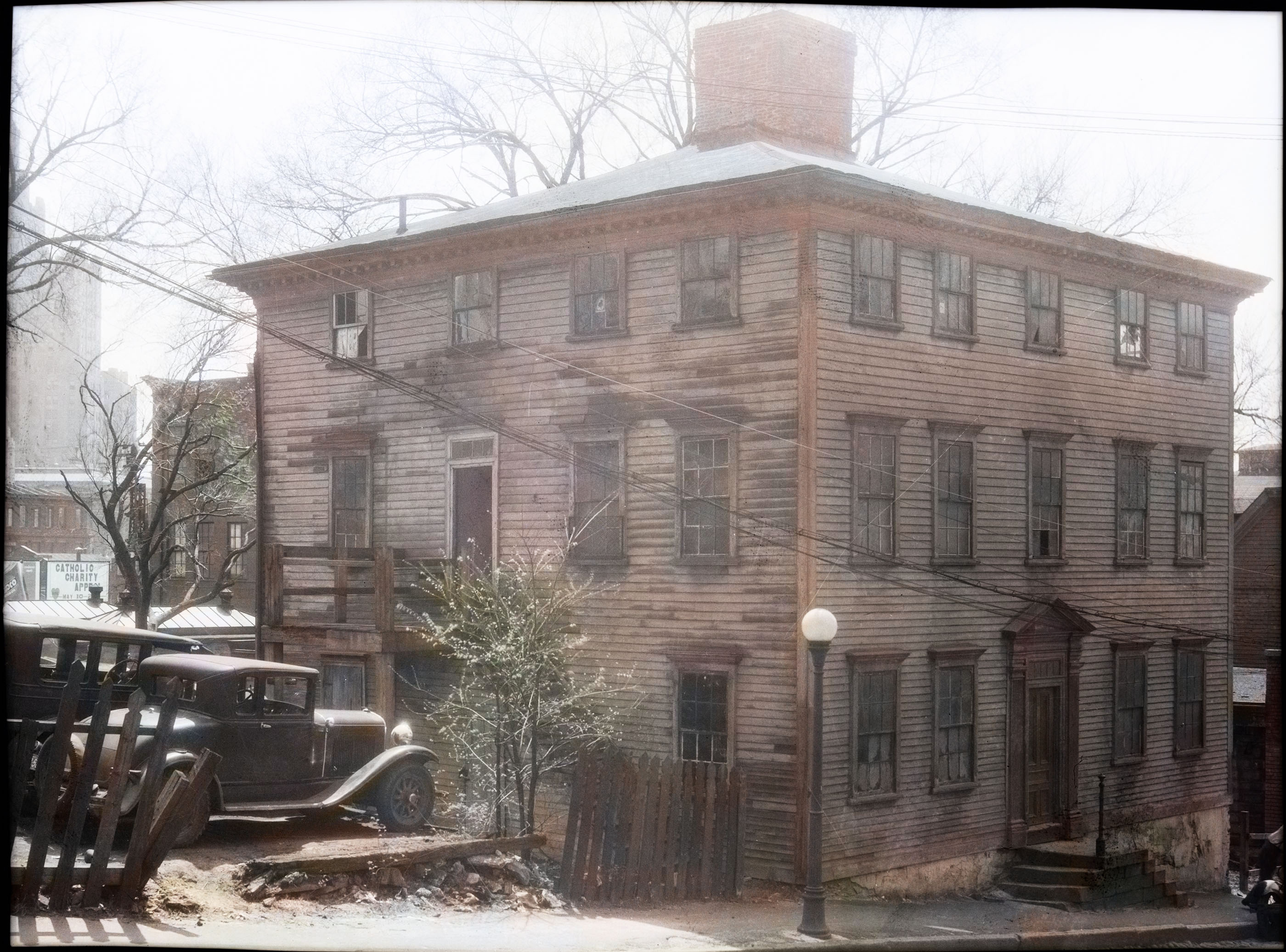
* Page 353. Lovecraft tells Mrs Toldridge… “I pass in sight of the ancient Carter house every time I walk down town — & the neighbourhood is still much as he knew it in 1770 & thereabouts. Across the street an old brick schoolhouse built in 1769 is still serving its original purpose, whilst at the foot of the hill the old Quaker Meeting House ( 1745) still broods beside its deserted wagonsheds. … John Carter, Providence’s colonial printer, & publisher of the Providence Gazette & Country-Journal before, during, & after the revolution. His old shop & office, the Sign of Shakespeare’s Head, in Gaol-Lane, is still standing in good condition notwithstanding the sinking of the neighbourhood to slumdom. It is a large square house on a steep hill, with fanlighted doorway & the double flight of railed steps so typical of colonial Providence.”
The John Carter house is at “21 Meeting Street”, an address which unlocks the Library of Congress. Here is the house as Lovecraft would have known it circa 1933-35. The Industrial Trust building can be seen behind on the left. Modern photos show a currently ‘restored’ colour that can range from neon-red to coconut-shell brown, so I’m not sure how to colour it. Here it’s sort of ‘faded creosote’, in keeping with its decrepit slum state.