• About
  • Directory
  • Free stuff
  • Lovecraft for beginners
  • My Books
  • Open Lovecraft
  • Reviews
  • Travel Posters
  • SALTES

Tentaclii

~ News & scholarship on H.P. Lovecraft

Tentaclii

Category Archives: New discoveries

A new Lovecraft poem?

20 Saturday Oct 2018

Posted by asdjfdlkf in Historical context, Lovecraftian arts, New discoveries, Picture postals

≈ 1 Comment

I think I may have found another new poem by Lovecraft. Not a macabre one this time, but rather a bit of early juvenilia. It’s the “Fore-worde” to his Hope Street High School yearbook for summer 1907, The Blue & White.

This “Fore-worde” is a poem of suspiciously archaic language, and also has a characteristic Lovecraft touch in the coining of the neo-archaism “strange-froughte”. Who else but Lovecraft would write such a poem in the style of an ancient wit, or insert such a phrase?

Neither the title or first line of the poem is in the latest edition of The Ancient Track. Nor is it in the Ancient Track‘s “Chronology”.

If the poem is a very early one by Lovecraft then it’s also interesting for implying that the author was on “ye humbell Boarde of Editours” in early summer 1907, which then leads one to wonder if he influenced the design on the cover. In which the tentacular flame seems to evoke (if you look at it right) a rather Lovecraftian version of a jinn to accompany the surrounding Aladdin’s lamps. If one knows that Lovecraft wore glasses at this time, the central ‘face’ could almost be a self-portrait.

Obtaining a full copy of the Yearbook would show if Lovecraft was on the “Boarde of Editours” for 1907. If he wasn’t, then the poem would be less likely to have been written by him.

He also appears as “H.P.L.” in the text of a humorous playlet in the Yearbook, titled a “Merry Drama of Hope”. At the plangent end of which he might be trying, in vain, to interest a passing fresher in the concept of meteoritic flight-paths…


Act IV, Scene 1.

The Corridor after school (snatches of conversation heard.)

[…]

“H. P. L. (Sophomorite:) “Well, the only definite theory advanced as to the cause of the meteoric path being hyperbolic or elliptic, is —”

Giddy Freshite (giggling hysterically:) “— And then he said —”

    (Corridor gradually becomes vacant)


Lovecraft was a freshman (fresher) at Hope Street High in 1904-05, but left in November 1905 and did not return until September 1906. He formally left on 10th June 1908, without a High School diploma — as he had only taken a few full classes in his final year.

According to a comment by Chris Perridas there may be a photo of Lovecraft in the next yearbook, 1908. But Chris had not been able to see either 1907 or 1908, and they’re still not scanned and online. Possibly it’s a photo that’s already well-known, though there’s nothing from 1908 here.

The small page-scans above are from a long-lost eBay listing, the data for which was snagged and kept online (just about) by a Web traffic-funnelling autobot.


An early Lovecraft appearance in fiction: “The Black Druid”

09 Sunday Sep 2018

Posted by asdjfdlkf in Historical context, Lovecraft as character, Lovecraftian arts, New discoveries, Scholarly works

≈ Leave a comment

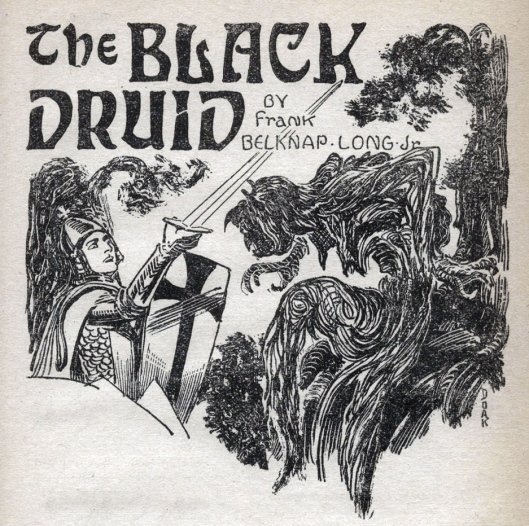
An early appearance of H.P. Lovecraft in fiction is to be found in “The Black Druid” by Frank Belknap Long, published in Weird Tales for July 1930. The Editor, Farnsworth Wright, knowingly bills the story on the contents page as: “A short tale that compresses a world of cosmic horror in its few pages”, trusting the regular reader to make the connection between “cosmic horror” and Lovecraft.

The picture illustrates the Lovecraft character in his ‘dream form’.

The story is interesting to scholars of Lovecraft’s life for being a knowing bit of fun-poking fictional commentary on Lovecraft, by someone who knew him on a near-everyday basis during the New York years. Lovecraft is only lightly veiled as “Stephen Benefield” and the character has similar concerns, physical attributes and locales. The story also fictionalises Lovecraft’s wife Sonia. Possibly the Bene in the name Benefield was even a comment on Lovecraft’s frugal diet, hinting at beans.

Archive.org’s OCR of the text is middling, but I’ve made the story readable as a PDF and have given it some annotations and a little introduction — along the way solving a very minor scholarly mystery about an entry in Lovecraft’s Commonplace Book.

Download PDF.

Weird Editing at ‘The Unique Magazine’

31 Friday Aug 2018

Posted by asdjfdlkf in Historical context, New discoveries, Podcasts etc.

≈ Leave a comment

PulpFest 2017 recordings don’t appear to have made it onto YouTube, but there’s a 50-minute panel discussion of Weird Editing at “The Unique Magazine” recorded at PulpFest 2015, on the editorial policies and practices at Weird Tales. The sound quality is listenable, given that it’s a convention panel recording and that those are usually notoriously bad (despite all the microphones present on the tables). But ideally you’ll still want good headphones and the volume turned up.

About ten minutes in there’s a rather curious five-minute monologue by someone who manages not to say very much about anything, but don’t be put off — after that the rest of the discussion is precise and very well informed.

Where exactly was this ‘weird editing’ going on? Chicago. I thought I’d do a brief survey of the actual addresses there, and along the way I discovered a highly likely reason why the editor Farnsworth Wright so inexplicably rejected Lovecraft’s “Cool Air”.

854 North Clark Street:

This address was noted by The Editor magazine in 1923 and O’Brien’s Best Short Stories in 1924. The address was also that of the Newberry Theater in Chicago. The new book Secret Origins of Weird Tales book gives the magazine’s 1923-24 years a detailed business history, if you want the full story of their time here.

450 East Ohio Street:

The later address of the Weird Tales editorial office in Chicago was then the Dunham Building, 450 East Ohio Street, seemingly from some point in 1926.

Interestingly this was the building of the Dunham company, “Manufacturers of Sub-Atmospheric Steam Heating Systems” and Air Conditioning. So this move to new offices may play into Lovecraft’s story “Cool Air” (written March 1926). Though perhaps only partly, in terms of the addition to the story of the technology involved, as there was an obvious precursor story in Arthur Leeds’s tale “The Man Who Shunned The Light” (1915). I suspect this story was used at one New York coffee-and-buns meeting, as a starting point for discussion on how the impoverished Leeds might improve it into a newly saleable story (see my book Lovecraft in Historical Context #4 for all the details and the story itself).

So far as I can tell, I’m the first scholar to notice the trade of the main occupants of the Dunham Building, and to connect that with “Cool Air” and the magazine’s move to a new office in 1926.

This then seems to neatly explain the decision of Farnsworth Wright to reject “Cool Air”…

Farnsworth Wright incredibly and inexplicably rejected “Cool Air”, even though it is just the sort of safe, macabre tale he would have liked” — S.T. Joshi, I Am Providence.

He may have rejected it not only because it was too close to Leeds’s 1915 story (published in Black Cat a decade earlier), but also for fear that his building’s owners would get to hear of it. And that they would then think that Wright had asked for the story from Lovecraft, in order to poke some macabre fun at them and their trade. In which case, they might even have given Weird Tales notice to quit. One can understand how Wright might have wanted to play it safe and reject the story.

840 North Michigan Avenue:

After a few years the editorial office moved to the new ‘Michigan-Chestnut’ building at 840 North Michigan Avenue, Chicago. The building was formally opened in 1929, according to the city’s architecture books.

This was a 20,000 sq.ft. corner lot, with shops at street level and elegant offices and studios above. The upper floors were said to be designed with two floors of light and high-ceiling studios that were intended to accommodate the area’s burgeoning artists’ scene. Though there doesn’t appear to be much exterior evidence of such studios on this later picture.

Judging by this plan, the studios were at the back, away from the clangour of the street noise…

Built 1927-28, by the time the building formally opened in 1929 the artists had been priced out of the booming district. As is often the case with such art studio complexes, the studios were instead occupied as offices by more professional creative services such as architects and magazine production. (Stamper, Chicago’s North Michigan Avenue: Planning and Development, 1900-1930). The ‘Michigan-Chestnut’ building was the home of the editorial offices of Weird Tales magazine until 1938.

Finally, a 1930s or 40s postcard of North Michigan Av. at night, looking like a very suitable home for Weird Tales…

Today, 840 North Michigan takes the form of an early-1990s historical folly-store, and is a far cry from Weird Tales darkness… unless you count a Hitler-saluting teddy-bear as sinister…


Further reading:

* Robert Weinberg’s The Weird Tales Story (1977) was a short 144-page fannish survey of the magazine’s history to 1974. It was stitching together fragments and hazy memories about the early days in the 1920s, and apparently it got a lot wrong on the early history.

* Weird Tales: The Magazine That Never Dies (1988) was a story anthology, but also had an introduction that surveys the entire history of the magazine to 1988, with notes on where further information might be found.

* Scott Connor’s “Weird Tales and the Great Depression” in The Robert E. Howard Reader (2010).

* The Thing’s Incredible: The Secret Origins of Weird Tales (2018) is a proper in-depth business history of the magazine, but only of the turbulent 1923-24 period.

Don’t bother with the litcrit The Unique Legacy of Weird Tales (2015) if you’re looking for business history.

A macabre Providence artist

27 Monday Aug 2018

Posted by asdjfdlkf in Historical context, Lovecraftian arts, New discoveries, Odd scratchings

≈ Leave a comment

John La Farge (1835–1910, lived in Providence, Rhode Island). Bed-ridden early in his career and in need of the cash, La Farge produced fairly loose watercolour designs which were engraved by Henry Marsh (American, 1826–1912) and published as story illustrations in the Riverside Magazine for Young People. He later regained his health and turned to the more respectable, and probably more profitable, trade of stained-glass windows.

Lovecraft knew of him, since he mentions him by name in a letter to Moe, 24th November 1923. Lovecraft had written “The Rats in the Walls” a few months earlier, August–September 1923. An interesting co-incidence, given the picture seen above, I’d suggest. There was apparently also a ‘Bishop Hatto’ story by Sabine Baring-Gould.

The Spirit of Revision: Lovecraft’s letters to Zealia Brown Reed Bishop

09 Sunday Aug 2015

Posted by asdjfdlkf in Historical context, New books, New discoveries, Scholarly works

≈ Leave a comment

Forthcoming in mid/late August, a new H.P. Lovecraft Historical Society book The Spirit of Revision: Lovecraft’s letters to Zealia Brown Reed Bishop. Nice to see that it’s both illustrated and rather affordable. The letters are new and previously unpublished…

“In 2014 a collection of [36, 1927 to 1936] letters from H.P. Lovecraft to Zealia Brown Reed Bishop was discovered in an old trunk in a basement.”

These new discoveries have been woven into the “eighteen previously known letters”, and the whole has been annotated.

bishopletters

bishoplettersback

[ Hat-tip: Ken Faig ]

“Tharr she blows!”

18 Saturday Jul 2015

Posted by asdjfdlkf in Historical context, New discoveries

≈ Leave a comment

Lovecraft’s copy of the famous novel Moby Dick has been found, thanks to Dan Boudreau of the American Antiquarian Society. The Society has found the book in its collections. One wonders what else of his may have been sent their way, by Barlow or Lovecraft’s aunt.

The inscription shows that I was right to think that Lovecraft may have had a copy from his bookseller friend Kirk in the Spring of 1925. Lovecraft read the 1892 Dana Estes & Co. edition in its 1919 reprinting by the Page Company, which added four rather uninspiring illustrations by A. Burnham Shute (taken from Arthur Stedman’s United States Book Company edition). Unfortunately there appears to be no online facsimile scan of this edition.

nzmnJoU

qSUVkJc

MlUuJZB

Galpin letter from eBay

23 Monday Mar 2015

Posted by asdjfdlkf in New discoveries

≈ Leave a comment

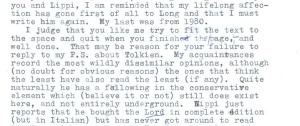
From eBay, an interesting Galpin letter to book dealer Roy A. Squires from Italy, 24th May 1981. Sold by epagana for $50, sadly.

The seller’s blurb: “Galpin approached Squires seeking assistance in disposing of his letters and documents from HPL, Frank Belknap Long and others of the HPL Circle. As reflected in the letter, Galpin had every confidence in Squires discretion, expertise and professionalism. The “Stanley” mentioned in the letter is John Stanley – the former head of Special Collections at the John Hay Library that houses the Howard Phillips Lovecraft collection. The “Hime” mentioned is Southern California bookseller, Mark Hime; and “Long” is Frank Belknap Long who needs no introduction.

The scan is not quite the full letter, with the top and bottom appearing cropped, but it’s interesting nonetheless. Several items of biographical interest:

* He’s concerned about the ethics of selling Hart Crane letters, in terms of revealing Hart’s “private life” — presumably an allusion to homosexuality.

* He had been told that letters from Loveman were “worthless”, at least in terms of a cash sale, regardless of what content they revealed about HPL or Crane.

* He talks of “your own bulky file” in terms of making “silent omission of any documents that would risk compromising either you — or me”. Not sure what he means here. Possibly he’s talking of a bundle of letter photocopies supplied to him by Squires, and was alluding to his pre-war 1930s discussions on fascism with HPL and others? The bundle can’t have been Squires doing Derleth a favour and passing Galpin the transcripts from Selected Letters of H.P. Lovecraft vol. V (1934–1937), as that book had already been published in 1976.

* His ongoing friendship with Long, by letters. He remembers that he always liked Long the most, of the HPL circle.

* His aside on the impact of The Lord of the Rings on Italian crypto-fascists in the 1970s and early 1980s, among whom it apparently generated a “following”. This seems to imply that Galpin still moved in fascist literary circles in Italy in the 1980s, or at least had some insight into their tastes.

1

2

3

“Strange and spacious realms”

18 Thursday Dec 2014

Posted by asdjfdlkf in Historical context, Lovecraftian arts, New discoveries, Scholarly works

≈ Leave a comment

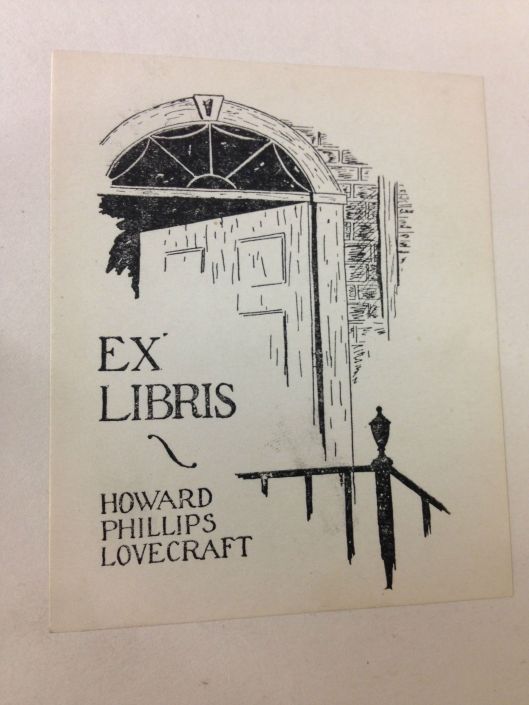
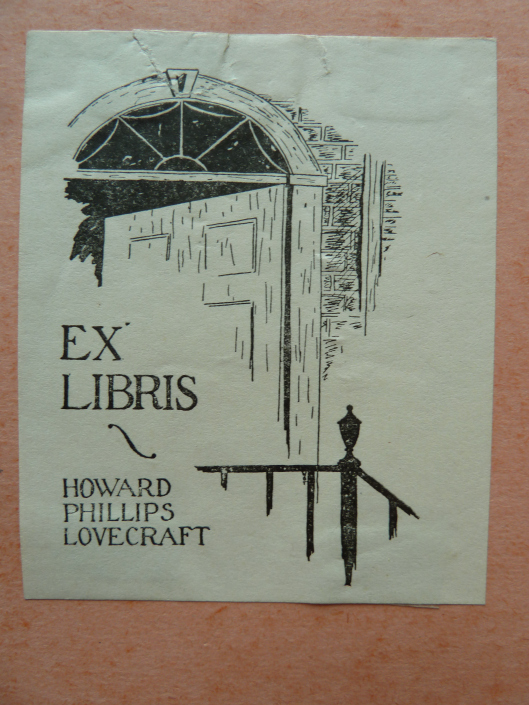
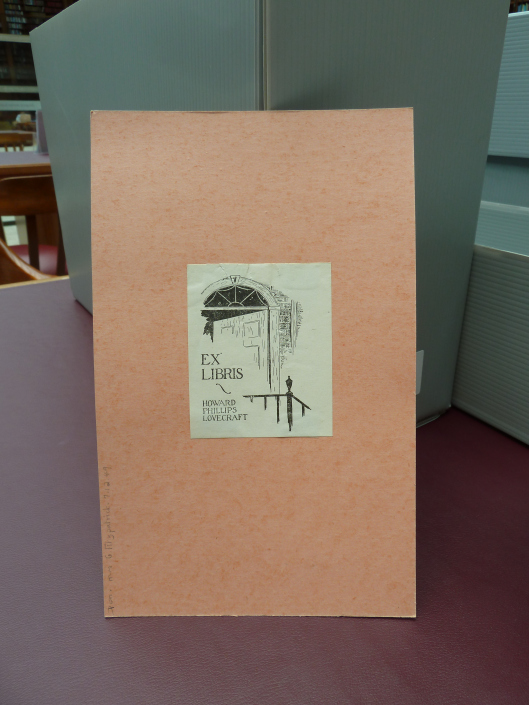
It appears I was correct about George Fitzpatrick, an Australian Lovecraft correspondent (see my Historical Context #4 and also Lovecraft Annual 2013). Drs. Brendan Whyte & Martin Woods of the National Library of Australia looked into the Fitzpatrick bookplate collection, seeking the Lovecraft bookplate. They found it…

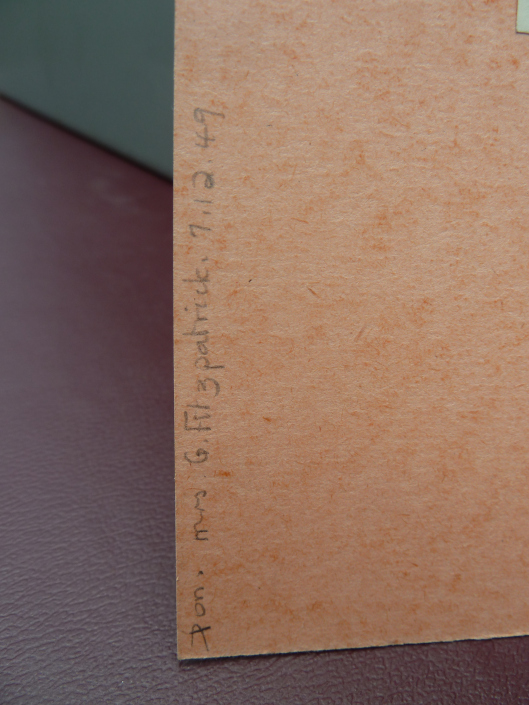
“I instructed him to see if the HPL bookplate was in the Fitzpatrick collection, and indeed it is. Attached are photos of it and the card to which Fitzpatrick attached it. The verso of the card, presumably typed (rather poorly) by Fitzpatrick from notes sent by Lovecraft, reads:

GENESIS.

The georgian doorway with a suggestion of a tall flight of outside steps, serves a three-fold symbolic purpose. 1. The doorway quality of all books, whereby they serve to admit the reader to strange and spacious realms. 2. It typifies the urban scene in which he has spent his life, the quaint hill streets of Old Providence scarcely changed in a century and a half, 3- symbolises his personal antiquarian tastes.

ARTIST. Wilfred Blanch Tolman.”

A note in pencil on the side states: “Don[or]. Mrs G. Fitzpatrick. 7.12.[19]49”

I would agree that the typed card must be Fitzpatrick’s summary of a Lovecraft letter which had accompanied the bookplate to Australia, and which had been discarded. The words “The doorway quality of all books, whereby they serve to admit the reader to strange and spacious realms.” certainly sound like they could be Lovecraft’s own.

070

069

072

073

One wonders if this was the limit of the correspondence, or if there were later letters between the two men?

A certain audacity

06 Saturday Sep 2014

Posted by asdjfdlkf in Historical context, New discoveries

≈ Leave a comment

The Brodsky frontispieces in the 1919 collection of Baudelaire that Lovecraft owned, and from which he took the opening quote which heads the story “Hypnos” (1922)…

   “Apropos of sleep, that sinister adventure of all our nights, we may say that men go to bed daily with an audacity that would be incomprehensible if we did not know that it is the result of ignorance of the danger.” — Baudelaire.

BaudelaireBrodzky1919-hypnos

The Scotch Bakery on Court and Schermerhorn

27 Sunday Jul 2014

Posted by asdjfdlkf in Historical context, New discoveries

≈ 2 Comments

Rheinhart Kleiner opened his memoir of Lovecraft, “Bards and Bibliophiles”, in…

a little coffee shop at the corner of Court and Schermerhorn Streets, Brooklyn” (Lovecraft Remembered, p.188)

I may have found a picture of this cafe, titled “Schermerhorn Street looking north to Court Street, 1928” From Brooklypix…

Brooklyn_Scotch_Bakery_court_schermerhorn_1928

Looking at the other available views of Schermerhorn/Court, it seems there were no other corner cafes there in the 1920s. The “Scotch Bakery and Lunch Room” can be seen on the right of the picture, and there is also a sculptural sign for it on the right-hand lamp post.

At the corner cafe Lovecraft and the gang would sup a 1 a.m. coffee and peruse the early morning editions of the New York newspapers, often before setting out for a long night walk. …


This essay has been replaced by the essay in my new book of revised, expanded, and footnoted versions of my recent Tentaclii essays, Lovecraft in Historical Context: fifth collection.

cover_front_600px

Albert Chapin (1869-1946)

15 Tuesday Jul 2014

Posted by asdjfdlkf in Historical context, New discoveries

≈ 1 Comment

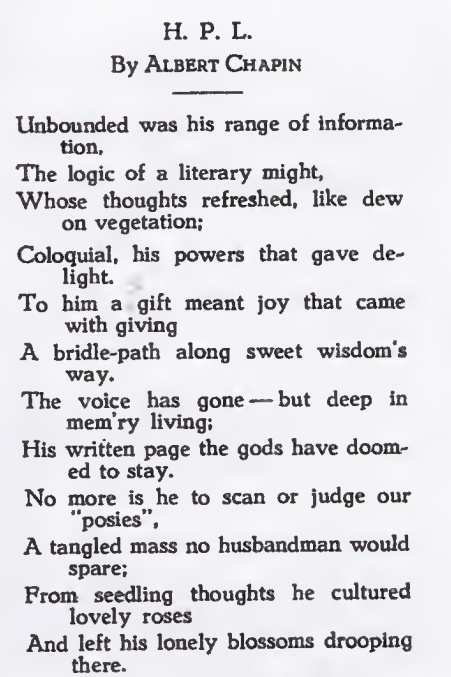
A poetic tribute to Lovecraft, in Inklings No.7, May 1938, from one who obviously knew him…

chapin_inklings_no7_may1938

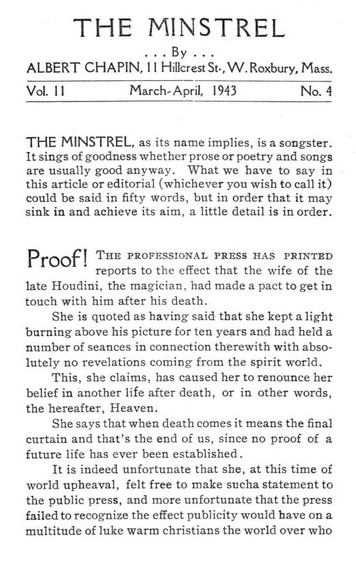
Albert Chapin (1869-1946) was described as one of the “New England [amateur] journalists” in an article on a convention in 1941. The “History of Early Amateur Journalism in Massachusetts” implies that he published a journal called “the Minstrel, Albert Chapin, West Roxbury” toward the end of the 1890s and/or early 1900s.

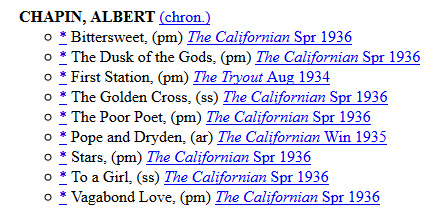
Chapin had a variety of work published in The Californian in the mid 1930s…

chapin_poems

It appears he began the Minstrel title again in the late 1930s and continued it into the 1940s, also from “11 Hillcrest Street, West Roxbury, Mass.”, which is six miles SW of Boston …

mistrel1943

It seems there are several mid 1930s letters from Chapin to Lovecraft in the John Hay Library collection at Brown University, and even a photograph of Chapin, so it seems he and Lovecraft corresponded although probably only briefly. Lovecraft quoted four lines from a Chapin poem in his own late essay “What Belongs in Verse” (1935), which further suggests that their correspondence was around 1935. My guess that Chapin was at that time an old amateur ‘coming back to the fold’ in the mid 1930s after decades of quiescence.

“A mighty woodcutter”: Bernard Austin Dwyer and his possible influence on Lovecraft

13 Sunday Jul 2014

Posted by asdjfdlkf in Historical context, New discoveries

≈ 5 Comments

This essay has been replaced by the greatly expanded essay in my new book of revised, expanded, and footnoted versions of my recent Tentaclii essays, Lovecraft in Historical Context: fifth collection.

cover_front_600px

← Older posts
Newer posts →


Please become my patron at www.patreon.com/davehaden to help this blog survive and thrive.

Or donate via PayPal — any amount is welcome! Donations total at Easter 2025, since 2015: $390.

Archives

  • February 2026
  • January 2026
  • December 2025
  • November 2025
  • October 2025
  • September 2025
  • August 2025
  • July 2025
  • June 2025
  • May 2025
  • April 2025
  • March 2025
  • February 2025
  • January 2025
  • December 2024
  • November 2024
  • October 2024
  • September 2024
  • August 2024
  • July 2024
  • June 2024
  • May 2024
  • April 2024
  • March 2024
  • February 2024
  • January 2024
  • December 2023
  • November 2023
  • October 2023
  • September 2023
  • August 2023
  • July 2023
  • June 2023
  • May 2023
  • April 2023
  • March 2023
  • February 2023
  • January 2023
  • December 2022
  • November 2022
  • October 2022
  • September 2022
  • August 2022
  • July 2022
  • June 2022
  • May 2022
  • April 2022
  • March 2022
  • February 2022
  • January 2022
  • December 2021
  • November 2021
  • October 2021
  • September 2021
  • August 2021
  • July 2021
  • June 2021
  • May 2021
  • April 2021
  • March 2021
  • February 2021
  • January 2021
  • December 2020
  • November 2020
  • October 2020
  • September 2020
  • August 2020
  • July 2020
  • June 2020
  • May 2020
  • April 2020
  • March 2020
  • February 2020
  • January 2020
  • December 2019
  • November 2019
  • October 2019
  • September 2019
  • August 2019
  • July 2019
  • June 2019
  • May 2019
  • April 2019
  • March 2019
  • February 2019
  • January 2019
  • December 2018
  • November 2018
  • October 2018
  • September 2018
  • August 2018
  • August 2015
  • July 2015
  • April 2015
  • March 2015
  • February 2015
  • January 2015
  • December 2014
  • November 2014
  • October 2014
  • September 2014
  • August 2014
  • July 2014
  • June 2014
  • May 2014
  • March 2014
  • February 2014
  • January 2014
  • December 2013
  • November 2013
  • October 2013
  • September 2013
  • August 2013
  • July 2013
  • June 2013
  • May 2013
  • April 2013
  • March 2013
  • February 2013
  • January 2013
  • December 2012
  • November 2012
  • October 2012
  • September 2012
  • August 2012
  • July 2012
  • June 2012
  • May 2012
  • April 2012
  • March 2012
  • February 2012
  • January 2012
  • December 2011
  • November 2011
  • October 2011
  • September 2011
  • August 2011
  • July 2011
  • June 2011
  • May 2011
  • April 2011
  • March 2011
  • February 2011
  • January 2011
  • December 2010
  • November 2010
  • October 2010
  • September 2010
  • August 2010
  • July 2010

Categories

  • 3D (14)
  • AI (70)
  • Astronomy (70)
  • Censorship (14)
  • de Camp (7)
  • Doyle (7)
  • Films & trailers (101)
  • Fonts (9)
  • Guest posts (2)
  • Historical context (1,095)
  • Housekeeping (91)
  • HPLinks (74)
  • Kipling (11)
  • Kittee Tuesday (92)
  • Lovecraft as character (58)
  • Lovecraftian arts (1,626)
  • Lovecraftian places (19)
  • Maps (70)
  • NecronomiCon 2013 (40)
  • NecronomiCon 2015 (22)
  • New books (966)
  • New discoveries (165)
  • Night in Providence (17)
  • Odd scratchings (984)
  • Picture postals (276)
  • Podcasts etc. (431)
  • REH (184)
  • Scholarly works (1,469)
  • Summer School (31)
  • Unnamable (87)

Get this blog in your newsreader:
 
RSS Feed — Posts
RSS Feed — Comments

H.P. Lovecraft's Poster Collection - 17 retro travel posters for $18. Print ready, and available to buy — the proceeds help to support the work of Tentaclii.

Proudly powered by WordPress Theme: Chateau by Ignacio Ricci.