• About
  • Directory
  • Free stuff
  • Lovecraft for beginners
  • My Books
  • Open Lovecraft
  • Reviews
  • Travel Posters
  • SALTES

Tentaclii

~ News & scholarship on H.P. Lovecraft

Tentaclii

Category Archives: New discoveries

Angelo Patri

02 Wednesday Feb 2022

Posted by asdjfdlkf in Historical context, New discoveries

≈ Leave a comment

New on Archive.org is a run of the journal Atlantica. August 1931 has a profile and photo of Angelo Patri, who I’d be willing to bet was a friend of Everett McNeil of the Lovecraft Circle. It’s good to be able to put a face to the name of the man I encountered while writing my book on McNeil.

Patri certainly championed McNeil in reviews and articles, and (though we’ll probably never know now) I suspect they were friends in New York by around the time of the appearance of McNeil’s Tonty novel.

‘Picture postals’ from Lovecraft: Uncle Eddy

21 Friday Jan 2022

Posted by asdjfdlkf in Historical context, New discoveries, Picture postals

≈ 2 Comments

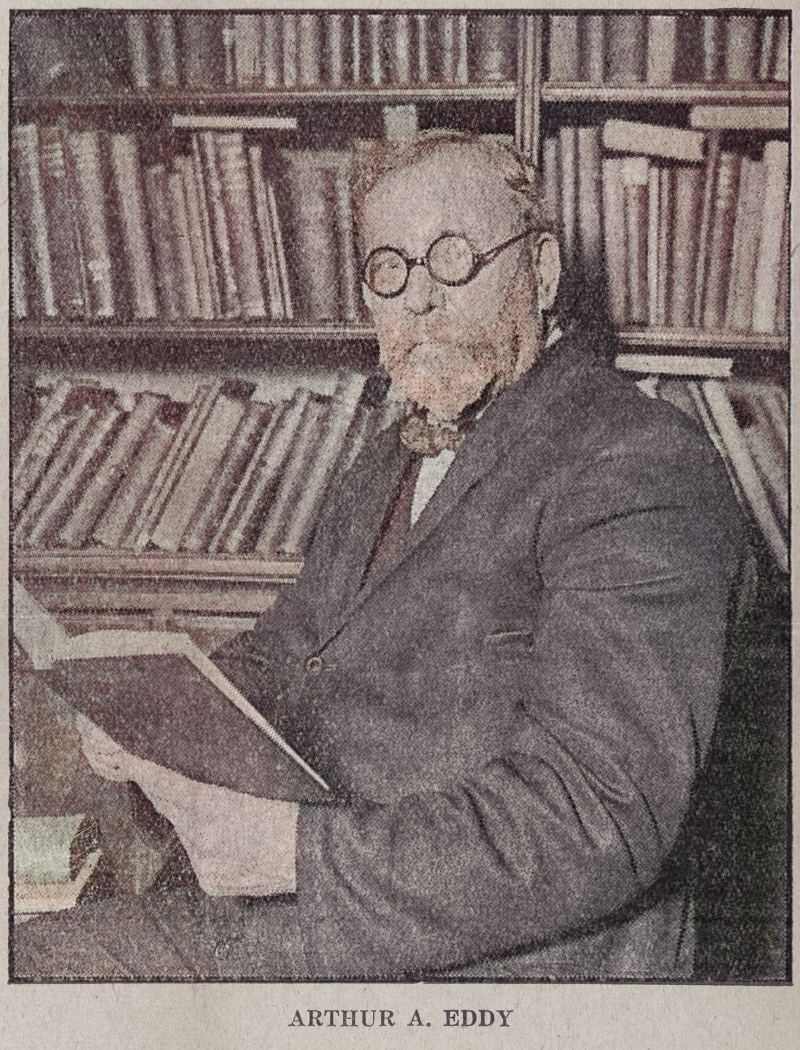
This was H.P. Lovecraft’s Providence bookseller, the uncle of his sometime-friend and fellow-writer Eddy. Here I’ve de-screened from newsprint and colorised as best I can. Until someone comes up with a magic ‘AI newsprint de-screener’ this is as good as it gets, even from a big 600dpi scan.

This comes from the now-found ‘Uncle Eddy’ cutting I referred to some posts back. Evidently the ‘RIAMCO listing’ is actually for the Brown University holdings of Lovecraft, which are now online as hi-res scans along with their enclosures and cuttings. Good to know. Thus we now have a very good picture of Lovecraft’s favourite Providence book-dealer, albeit in dotty newsprint.

It’s from the Providence News-Tribune, 22nd July 1931. Lovecraft and the visiting Morton happened to pop in to the Eddy bookshop shortly after it had been published, and thus were presumably able to rush around and find some local news-stores that had not sent back their ‘returns’ copies of the paper. Copies were duly purchased and the clippings sent to correspondents who knew and had patronised Eddy.

What appears to be a Frankenstein-like scar on the right of his face seems to be his glasses-chain.

What do we learn from the article?

1) His shop was “probably the largest of its kind in the city” at 1931. A massive 200,000 volumes (and, as we know from Lovecraft, more in his attic store at home). Thus Lovecraft’s joking in a letter to the effect that ‘Cook had cleaned Eddy out’ on a spending spree, must refer to the weird and supernatural items only.

2) He looks as though he might be in his early 60s in 1931, although several scratches suggest the press used a picture dated earlier. Possibly came of age circa 1887-90? He had not yet retired at the point of publication. Indeed, he had taken on and recently sold the Bargain Book Shop on Empire Street, which suggest he was still very much in business and had money to invest in new stock.

3) Modern poetry was then “much in demand”, which would be unthinkable today when contemporary poets can only sell to other poets. “Modern” here may not necessarily mean modernist poetry, as this is Providence in 1931.

4) The article hints at his willingness to sell the sort of “paperback” items that would bring fulminating religious ministers into the store to berate him. He would stand up to them. Possibly the books were the Haldeman-Julius ‘Blue Books’ line.

5) He started the business as a side-line, though to what is not stated.

The final part of the article covers the city’s Dana bookstore, and another shop run by Livsey and Knight. This section has other detail on the state of the book trade in Providence during the early years of the Great Depression.

‘Picture Postals’ from Lovecraft: Volcanoes on the Moon

14 Friday Jan 2022

Posted by asdjfdlkf in Astronomy, Historical context, New discoveries, Picture postals

≈ 8 Comments

In an early letter to Galpin, dated 21st August 1918, H.P. Lovecraft recalled…

I began to study astronomy late in 1902 — age 12. My interest came through two sources — discovery of an old book of my grandmother’s in the attic, and a previous interest in physical geography. Within a year I was thinking of virtually nothing but astronomy, yet my keenest interest did not lie outside the solar system. I think I really ignored the abysses of space in my interest in the habitability of the various planets of the solar system. My observations (for I purchased a telescope early in 1903) were confined mostly to the moon and the planet Venus. You will ask, why the latter, since its markings are doubtful even in the largest instruments? I answer — this very MYSTERY was what attracted me. In boyish egotism I fancied I might light upon something with my poor little 2¼-inch telescope which had eluded the users of the 40-inch Yerkes telescope!! And to tell the truth, I think the moon interested me more than anything else — the very nearest object. I used to sit night after night absorbing the minutest details of the lunar surface, till today I can tell you of every peak and crater as though they were the topographical features of my own neighbourhood. I was highly angry at Nature for withholding from my gaze the other side of our satellite!

This tells us a number of things. It implies he was then aware of the Yerkes telescope. He must have been, even at a young age — since it was the Hubble Telescope of its day. It had been grandly exhibited a decade before at the 1893 World’s Fair in Chicago, before being moved with much publicity to its domed home above Lake Geneva, Wisconsin. Doubtless the Providence Public Library could have furnished pictures of such large telescopes for the boy Lovecraft, circa 1902-03, if he had not already seen the Yerkes in newspaper and magazine pictures.

But the quote is rather more interesting because it illustrates his initial and formative stance toward the “habitability … of the solar system”. By which he meant alien life, rather than future habitation by human colonists.

In this respect he obviously had hopes of making a discovery about the apparently cloudy and moist planet of Venus. This was then considered a somewhat likely habitation for alien life and was set to emerge as the Venus of pulp imagination, or the ‘Old Venus’ as some science-fiction historians now usefully call it. Undeniable evidence of its thick atmosphere had been obtained from Earth in 1882, it was warm and roughly Earth-sized and there were also what appeared to be markings on the planet’s surface. The prospect of life there was thus deemed quite possible. One even wonders if Lovecraft’s observations of Venus were partly non-visual, seeking to use his $15 spectrograph to detect something new and telling about the composition of the atmosphere? But, as he says in his letter to Galpin, others had the better equipment either way. Yet for all their immense telescopes and professional equipment, the professionals had still not settled the question of Venus by the time the adult Lovecraft returned to Providence from New York City. For instance here is The New York Times — then a sober paper of record — reporting in April 1927 on new methods of photographing Venus and detecting life…

But, as he recalls for Galpin, the moon was his chief interest. The moon was not, as we might now think, entirely without interest as a prospect for alien life. I have already glanced at the early theories about a pocket of atmosphere on the moon, and the theory’s implications for primitive life and the moon’s dark-side. The basic idea back then was that the moon’s immense natural ‘bump’ meant that a shallow atmosphere could just about persist on the dark-side, and some icy crater-lakes would form there. This theory appears to have been especially favoured by the Germans, and persisted there into the 1930s.

Now a little digging reveals that the young Lovecraft could also have been influenced by a moon book of the time, which had its own ideas about life. This was the illustrated book The moon, considered as a planet, a world, and a satellite, by Nasmyth and a co-writer. It was a key book, and the young Lovecraft had it in the 1903 un-revised fourth edition. The preface to this smaller and popular edition is dated May 1903 and The Bookseller lists it as available for purchase in early September 1903. Thus Lovecraft could not have had the book along with his new telescope (had either “early in 1903”, or in July 1903 according to Lovecraftian researchers). He would have had this worthy and useful book some months later either way, and perhaps it was even given as a Christmas present.
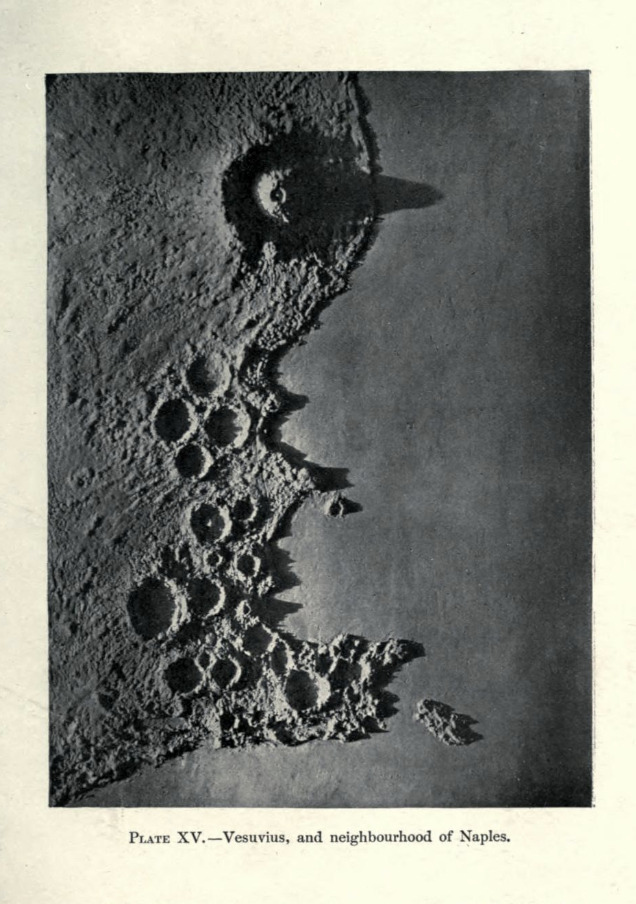
Such are the dates and the edition. What of the book’s ideas and influence? The book strongly supported and elaborately sustained a volcanic theory for the formation of the moon’s pockmarked surface. Volcanism then having obvious implications for things like subsurface heat. Because it implied magma chambers, networks of lava tubes, surface flow channels and so on. And at vast size too, since — as the book states — the moon’s large craters are immense and would dwarf those on earth.

Did Lovecraft subscribe to the theory? Yes. Lovecraft’s c. 1903 short note evaluating the likelihood of a competing theory of water-bearing “Lunar Canals” shows that he early accepted lunar volcanism. Also that he understood the volcanic activity to be relatively feeble by 1903…

“The lunar canals cover much less territory than the martian counterparts, this is doubtless, owing to the smallness of the moon compared with Mars, and therefore its feebler volcanic activity.” (“My Opinion as to The Lunar Canals”, c. 1903, my emphasis)

Was volcanism a crank theory? No. The volcanic theory of active crater formation reigned as a general scientific consensus until c. 1930, by which time some sustained doubts had become readily available in English. Yet its first serious challenge only came in 1949, long after Lovecraft’s death. Even then most scientists held to the consensus, until it was abruptly punctured by examination of actual rocks from the moon in 1965. Thus for most of his life, very likely for all of it, Lovecraft would have understood the moon’s surface to be actively volcanic in origin and nature.

This belief has certain implications. Do we glimpse here the spur for his intense moon observations? Quite possibly. If the boy Lovecraft could spot and observe an actual rare volcanic eruption in progress, and show the world the presence of a crater where before there had been none… he would have made his name as an astronomer.

What of the book’s opinion of life on this apparently volcanic moon? Nasmyth and his co-writer ruled out the possibility of “any high organism” on the moon’s surface due to the obvious lack of an atmosphere. Yet the book did tantalisingly suggest several possibilities for basic life:

i) Some form of ‘protogerm’ lying dormant, having sailed on the winds of space and landed…

Is it not conceivable that the protogerms of life pervade the whole universe, and have been located upon every planetary body therein? Sir William Thomson’s suggestion that life came to the earth upon a seed-bearing meteor was weak, in so far that it shifted the locus of life-generation from one planetary body to another. Is it not more philosophical [and assuming of a Creator] to suppose that the protogerms of life have been sown broadcast over all space, and that they have fallen here upon a planet under conditions favourable to their development, and have sprung into vitality when the fit circumstances have arrived, and there upon a planet that is, and that may be for ever, unfitted for their vivification.

ii) Some hardy form of vegetation able to survive intense cycles of heat and cold…

We may suppose it just within the verge of possibility that some low forms of vegetation might exist upon the moon with a paucity of air and moisture such as would be beyond even our most severe powers of detection.

After briefly considering these possibilities the book soberly concludes the moon is “barren” and that…

The arguments against the possibility of the moon being thus fitted for human creatures, or, indeed, for any high organism, were decisive enough to require little enforcing.

The words “barren” and “fitted” were well-chosen, since they leave open the question of the previously-suggested dormant and/or lower organisms. The book also leaves entirely un-examined the possibility of habitats in the sub-surface, in which the space-borne “protogerms” might have encountered a relatively warm (if apparently wholly dry and somehow non-gaseous) volcanic interior with its stable lava tubes.

Such lacuna would have been tantalising to the imaginative reader. I then suggest that here we may have some possible roots for Lovecraft’s later works, in terms of ideas such as:

i) a form of life that sails the star-winds and survives through space for cosmic time periods, before sifting down onto a clement planet to ‘vivify’;

ii) a hardy form of life, brought from the depths of space and (by implication) perhaps able to lie dormant for aeons in subterranean caverns. Only periodically brought to the surface by massive volcanism. A process akin, then, to the volcanic rising of R’lyeh in “The Call of Cthulhu”.

iii) the book’s volcanic ‘fountain’ diagrams and the idea of ‘protogerms’ arrived from space might both seem to evoke “The Colour out of Space” in its water-well.

I don’t say these were direct inspirations, later dredged from memory and made to serve Lovecraft’s mature fiction. But they would have been formative in shaping the broad contours of Lovecraft’s earliest cosmic imagining.

Incidentally, his yearning to see the dark side of the moon may even hint at a boyish theory about life existing there. In the absence of the lost boyhood story that he set there we can’t know much more about that. Yet knowing that he held to the volcanism theory suggests one obvious path the story could have taken — the discovery of volcanically melted crater-lakes on the dark side (his boy explorers had apparently needed their carbide lamps, implying they had stepped over the dividing-line) under a thin atmosphere.

What of ‘moon life’ claims made by others? Here I give readers a quick flavour of Prof. Pickering’s ‘snow’ ideas, related to his lunar ‘canals’ idea, via a glimpse of a full-page article in The Sphere for Christmas 1901…
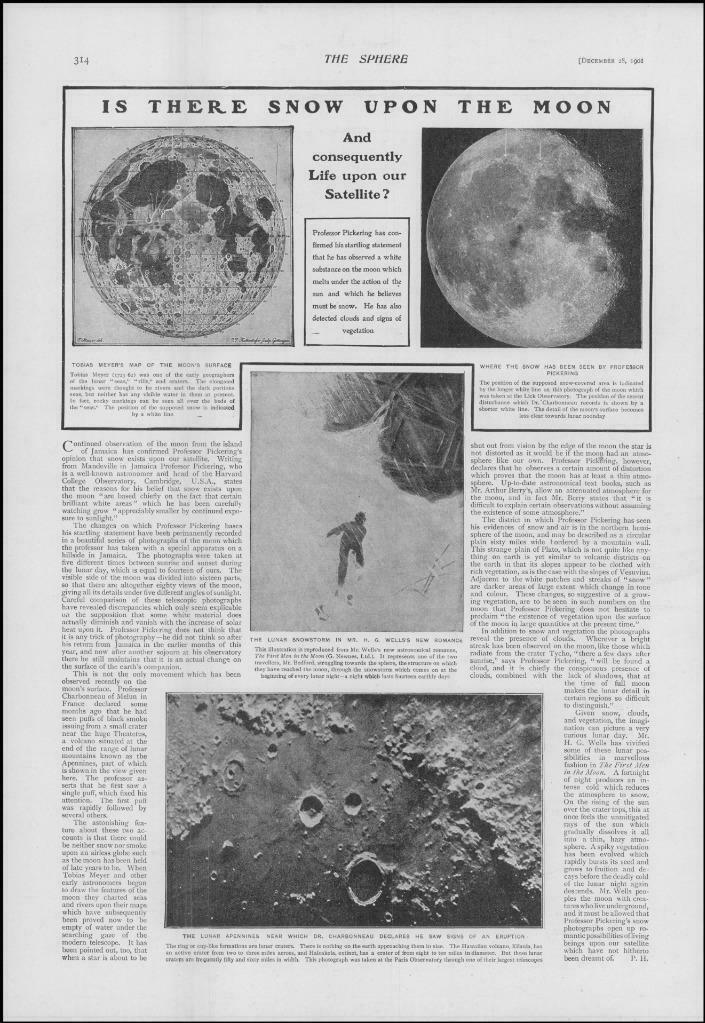
One can see how it would be easy to dismiss such things. Claims of observations of active primitive plant growth along snowy “canals” (or “streaks of vegetation” on the surface as Lovecraft described them) were indeed dismissed early by Lovecraft in his “My Opinion as to The Lunar Canals” (1903?). However much the glittering mountains might look like snow in photographs, water was not detectable from earth. Without water to sustain life, such things as ‘canals’ and ‘vegetation’ could not be. If the “Lunar Canals” text is correctly dated, then I would suggest it was written in late 1903 and under the direct and countering influence of the 1903 reprint of Nasmyth’s moon book.

See the Lovecraft Annual 2019 for a fine essay detailing Lovecraft’s reactions to Professor Pickering’s claims for the ‘lunar canals’ and more.

Yet ‘life on the moon’ was not then an either/or choice. One might sensibly discount questionable ideas such as immense banks of “snow” or “canals” and “vegetation”, while not entirely giving up hope for moon habitats of some sort. For instance, five years after his “My Opinion as to The Lunar Canals” we find Lovecraft even more certain of the apparent evidence for “active volcanism” on the moon, in his essay “Is There Life on the Moon?” (1906). But he has evidently become, after several years of personal observing, far more open to the idea of an active moon. He now aligns himself with some of Pickering’s ideas and the German ‘bulge’ idea, by musing on a “thin” atmosphere and surface frost forming on ridges…

Today [certain moon changes are] generally accepted as the work of active volcanism. Now no volcano can operate without atmosphere, but there could easily be a thin gaseous envelope undetected from the earth. The “lunar rays”, i.e. long, brilliant streaks radiating outward from some of the craters, have always been a puzzle to astronomers. Numerous theories have been promulgated concerning their origin, some saying that they are cracks in the moon’s surface while others maintain them to be streaks of lava, ejected in the remote past from the craters which they surround. But the latest and most startling theory is that they are deep furrows filled with snow. This seems incredible at first sight, considering that there are no clouds on the moon; but when we reflect that little more than hoar frost would be required to produce the glittering appearance, the theory becomes more acceptable. For this theory, the world is indebted to Prof. William H. Pickering of Harvard, the greatest living selenographer [i.e. Moon geographer].

Lovecraft could not believe in Pickering’s vegetative “canals” back in 1903, and he still could not do so. Nor could be believe in a widespread Christmas-y “snow” on the moon. But by 1906 he can at least believe in thin lines of “hoar frost” along the crater rays, while also making a nod to active volcanism operating with a thin atmosphere. These claims then set the reader up, in the same “Is There Life…” essay, for Lovecraft’s far bolder observation that in…

a deep, winding chasm [on the moon] called “Schroeter’s valley” can be seen the only active and ocular proof of seismic conditions. There an assiduous observer can detect peculiar clouds of moving whiteness, which the up-to-date selenographer interprets as nothing more or less than smoke from an active crater! These clouds are often so dense as to obscure neighbouring objects.”

He did not discover this likely spot on the moon, with its apparent implications for a sub-surface habitat for life. Nor was he the observer of the shoggoth-like “clouds”, as his article might vaguely seem to imply. Because it was almost certainly the August 1905 article “Life On the Moon” in Munsey’s Magazine that alerted him to this vast chasm and its “clouds”. I have dug the article out of Hathi (regrettably missing its first page on the scan, presumably torn out for its opening moon illustration). The text reveals that the Schroeter’s valley “clouds” observer was actually Pickering, and the author was generally highly supportive of Pickering’s ideas. This was probably the sort of popular article that had made Lovecraft receptive to some, though not all, of Pickering’s ideas.

Did Lovecraft read the article? It seems highly likely to be the source for his very similar Schroeter’s valley “clouds” observation, and we know he was reading Munsey’s Magazine from at least 1903…

In the only extant issue of [his] Rhode Island Journal of Science & Astronomy (September 27, 1903) makes reference to an article by E. G. Dodge entitled “Can Men Visit the Moon?” in the October issue of Munsey’s Magazine, which if nothing else indicates that Lovecraft was reading the journal at least as early as this. (Joshi, I Am Providence)

So there are now two moon articles known from Munsey’s Magazine, “Can Men Visit the Moon?” (1903) and “Life On the Moon” (1905). It’s quite possible that he read others there that have yet to be discovered.

As it happens it seems that we now know that the Moon was indeed volcanic and had a thin periodic dark-side atmosphere, but that the last such events were some two billion years ago. That ancient process likely created today’s large flat dark ‘mares’ or ‘seas’ as lava flows, and also rather usefully left us billions of tonnes of ice at the poles.


After 25 years away, Lovecraft’s imagination would return to the moon. Though not to encounter fungi-litten volcanic caves, or insect-philosophers crawling over the dark side under a feeble atmosphere, or even cloudy proto-shoggoths oozing from “a deep, winding chasm”. Instead in his Dream-quest tale he deemed the moon’s surface — at least as dreamed of in the Dreamlands — to be the poignantly still and desolate haunt of the cats of Ulthar. With strange and unspecified attractions to be found on the dark side.


‘Picture postals’ from Lovecraft: the almanacs

07 Friday Jan 2022

Posted by asdjfdlkf in Astronomy, Historical context, New discoveries, Picture postals

≈ 1 Comment

As we move into the New Year, it seems apt to take a look at the annual almanacs which H.P. Lovecraft cherished. Not quite postcards, of course, but still pictorial.

He inherited, and then further developed, a substantial collection of such old country almanacs. He writes in a letter that this family collection, when first passed down to him…

went back solidly only to 1877, with scattering copies back to 1815

Trying to complete this set eventually became a keen occasional hobby, though he had some luck there. He was allowed to root among the home storage attic of his sometime-friend Eddy’s book-selling uncle, and he descended the ladder with many a rare old copy. Which Uncle Eddy then sold him at a very affordable price. This haul appears to have spurred his ambitions, and he wrote…

I am now trying to complete my family file of the Old Farmer’s Almanack

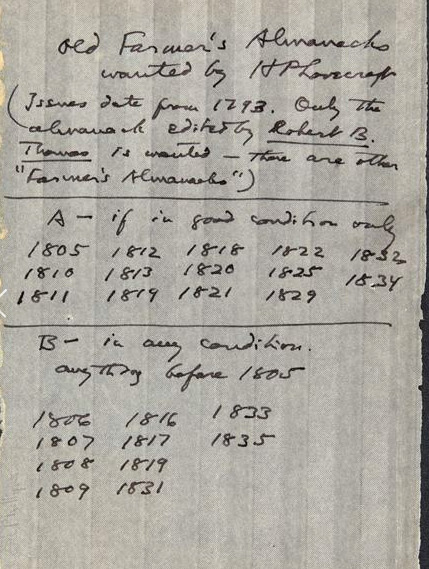
Here we see Lovecraft’s collecting ‘wants list’, as he tried to complete the set…

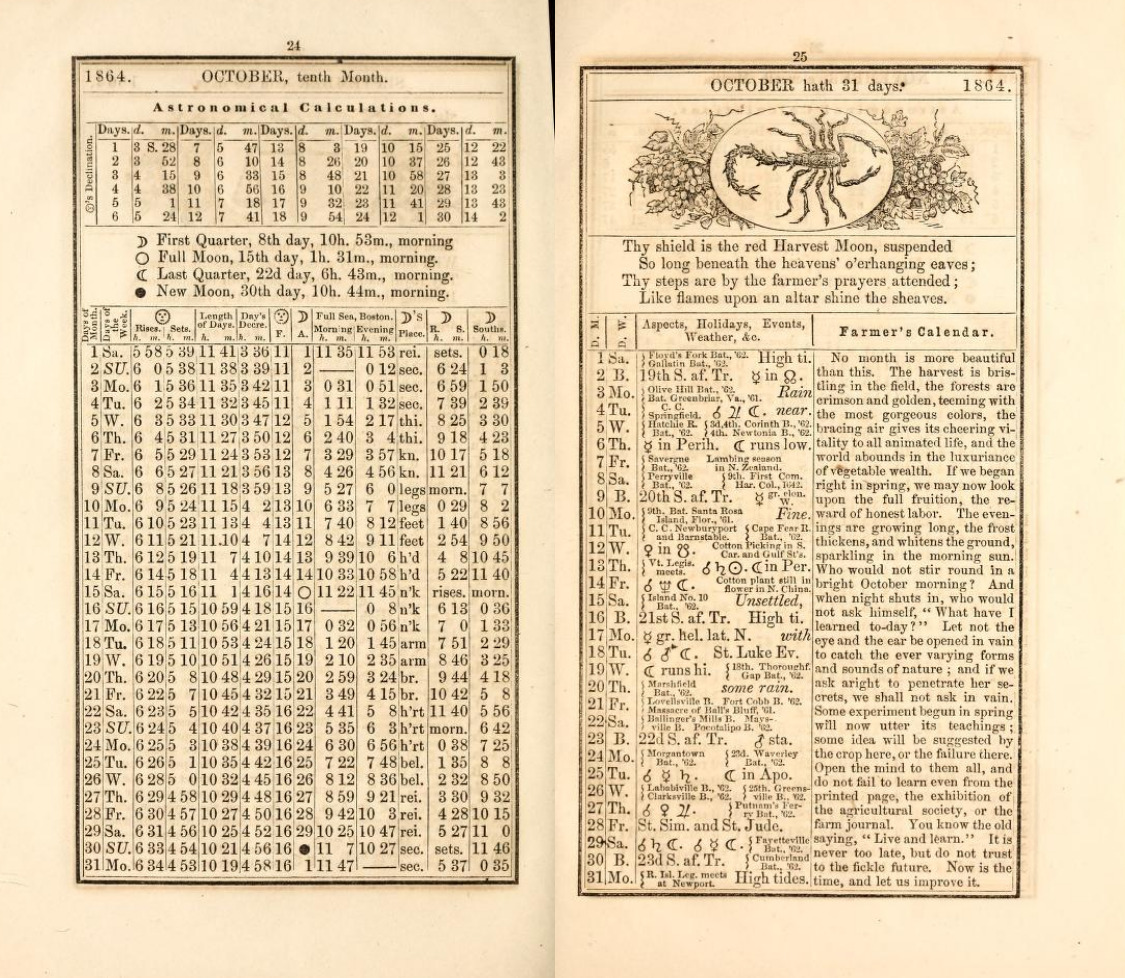
What, exactly, was this publication? Archive.org now has a small selection of scans of this Old Farmer’s Almanack, and thus we can get a better idea of what Lovecraft found between the pages. To be specific, he inherited and collected old copies of the Old Farmer’s Almanack edited by Robert B. Thomas. (It can’t be linked, as the URL is malformed, but if you paste this into the Archive.org search-box you should get it: creator:”Thomas, Robert Bailey, 1766-1846″ )

There were other publications of the same or similar title, but Old Farmer’s Almanack was Lovecraft’s mainstay. Which is not say he wasn’t delighted to discover that other similar almanacs were still publishing, out in the countryside…

It sure did give me a kick to find Dudley Leavitt’s Farmer’s Almanack [Leavitt’s Farmer’s Almanack, improved] still going after all these years. The last previous copy I had seen was of the Civil War period. But of course my main standby is Robt. B. Thomas’s [Almanack]

Thomas’s Old Farmer’s Almanack had begun publication in 1793. As we can see from the above list, Lovecraft was especially keen to get hold of anything before 1805 and in any condition. Many of these used the old long-S in the text…

I can dream a whole cycle of colonial life from merely gazing on a tattered old book or almanack with the long S.

This dream had first occurred very early in his life, and at age five the family Almanack had made a lasting impression…

my earliest memories — a picture, a library table, an 1895 Farmer’s Almanack, a small music-box

Evidently then this annual was taken and consulted in his home at that time. Also cherished and kept, since we know he was able to read the entire set…

[As a boy] I read them all through from 1815 to the present, & came early to think of every turn & season of the year in terms of the crops, the zodiac, the moon, the ploughing & [harvest] reaping, the face of the landscape, & all the other primeval guideposts which have been familiar to mankind since the first accidental discovery of agriculture in the Tigris-Euphrates Valley.

Nor did he overlook the rustic pictures…

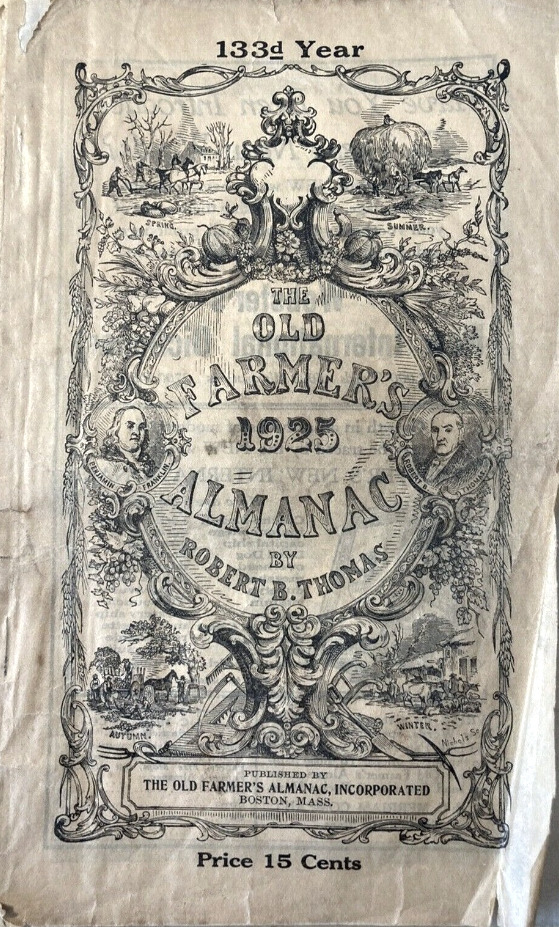
I am always fond of seasonal pictures, & dote on the little ovals on the cover of the ancient Farmer’s Almanack — spring , summer, autumn, & winter

On his travels he later found places where the homely traditions and moon and star-lore of the Farmer’s Almanack were still followed, such places as Vermont…

That Arcadian world which we see faintly reflected in the Farmer’s Almanack is here a vital & vivid actuality [in rural Vermont]

The publication was indeed a useful one. For instance it enabled Lovecraft to anticipate with ease the year’s lesser heavenly events…

Sun crosses the equinox next Wednesday at 7:24 p.m. according to the Old Farmer’s Almanack — which we have had in our family, I fancy, ever since its founding in 1793.

Having sent some introductory astronomy books, Lovecraft also sent young Rimel a copy of the latest Old Farmer’s Almanac for the coming year of 1935. In a later letter to Rimel of 28th January 1935, Lovecraft explicitly recommends the publication for astronomy use. The Almanac being…

capable of assisting the study of astronomy quite a bit.

The weather predictions found in its pages were perhaps of less use. Or at least, they had become so by the late 1970s. In 1981 Weatherwise magazine made a tally of sixty forecasts across five years. They found the month-by-month Almanack forecast to be little better than chance by then. How accurate the monthly weather forecasts might have been in the 1895-1935 period and in Providence remains to be determined. It might be quite interesting to tally that, with perhaps a leeway of two days. But to do so one would likely need to go back to the original journal / newspaper summaries of the month’s actual weather, rather than trust any recently ‘rectified’ computer-created data for those decades.

The Almanacks also contained a wealth of rather more reliable factual information. Such as the dates of the year’s key elections, court days, festival and saint’s days, tides, recurring natural events (usual time of lambing, bringing in cows for the winter etc), anniversary dates for sundry historical events, lists of Presidents, the standard weights and measures, distances, nutritional values of various crops and fodder, together with small amusements such as riddles and poetry. Short articles could also be present. Most importantly for Lovecraft’s huge flow of parcels and letters, the little booklets also appear to have given the latest postal regulations in a concise form.

In format they were rather like Lovecraft’s stories, then. A whole lot of sound facts garnished with a few slivers of delicious speculation (meaning the weather forecasts, rather than monsters and cults). Indeed, one might see something of the ‘carnivalesque’ at work in such publications. The use of a small inversion, that by its amusing ridiculousness serves to bolster the belief in the facticity of the rest of the structure.

The latest annual Almanack was also ever-present in Lovecraft’s own study, as he wrote to Galpin in 1933…

You may be assur’d, that my colonial study mantel has swinging from it the undying Farmer’s Almanack of Robert B. Thomas (now in its 141st year) which has swung beside the kindred mantels of all my New-England forbears for near a century & a half: that almanack without which my grandfather wou’d never permit himself to be, & of which a family file extending unbrokenly back to 1836 & scatteringly to 1805 still reposes in the lower drawer of my library table [evidently Lovecraft had by this time added 1876-1836 to the “family file”] … which was likewise my grandfather’s library table. A real civilisation, Sir, can never depart far from the state of a people’s rootedness in the soil, & their adherence to the landskip & phaenomena & methods which from a primitive antiquity shap’d them to their particular set of manners & institutions & perspectives.

This mantel-hanging had been a long-standing practice. For instance it was noted by his earliest visitor, when Lovecraft was emerging from his hermit phase. Rheinhart Kleiner recalled of his curious visit to the darkened room that…

An almanac hung against the wall directly over his desk, and I think he said it was the Farmers’ Almanac.

Lovecraft even kept up the tradition during the hectic New York years, writing in late 1924…

the Old Farmer’s Almanack … of which I am monstrous eager to get the 1925 issue

In that era the Almanacks were very often personalised and annotated quite heavily by their users, and a rural man’s personal collection grew to form a sort of natural diary and personal time-series for useful farm data. In 1900 40% of the American people still worked on the land, so such things were vital.

So far as I’m aware we have none of Lovecraft’s own copies today, so we don’t know if he also marked and noted them in various ways. Or if he had inherited copies that had been so marked by his relatives.

He also hints at being aware of and valuing another such publication. For instance, when he remarked on the discovery of the planet Pluto he wrote…

the discovery of the new trans-Neptunian planet …. I have always wished I could live to see such a thing come to light — & here it is! …. One wonders what it is like, & what dim-litten fungi may sprout coldly on its frozen surface! I think I shall suggest its being named Yuggoth! …. I shall await its ephemerides & elements with interest. Probably it will receive a symbol & be treated of in the Nautical Almanack — I wonder whether it will get into the popular almanacks as well?

In his early newspaper columns on astronomy he also appears to refer to this same publication…

The motions of these satellites, their eclipses, occultations, and transits, form a pleasing picture of celestial activity to the diligent astronomer; and are predicted with great accuracy in the National Almanack. [I assume here a mis-transcription by the newspaper editor of “National” for “Nautical”, or perhaps a correction to its shorthand name in the district].

Indeed, both Almanacks feature in Lovecraft’s “Principal Astronomical Work” list, among the vital accessories needed for a study of the night-sky…

Accessories:

Lunar Map by Wright.
Year Book — Farmer’s Almanack.
Planispheres — Whitaker & Barrett-Serviss.
Atlas by Upton — Library.
Opera glasses — Prism Binoculars.
Am. Exh. & Want Almanac. [meaning the American Ephemeris & Nautical Almanac, as “Exh.” is “Eph.” and “Want” should be “Naut”]

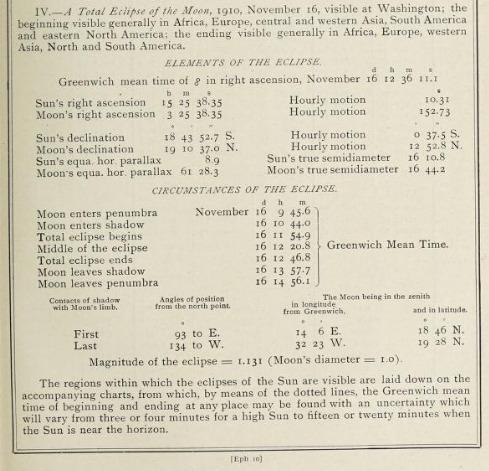
This Nautical Almanac is also on Archive.org, so we can peep inside a copy of that from 1910. Forthcoming eclipses were noted over several pages. Here, for instance we see all the details needed to observe a total eclipse of the Moon in November 1910, the beginning visible from “eastern North America”. I think we have a hint here about what Lovecraft was likely to have been doing in the late evening of 16th November 1910…

Archive.org also has The Old Farmer and his Almanack, a 1920 book which surveyed the topic with erudition. Lovecraft was heartily pleased to discover and read it shortly after publication.

Almanacks occur only once (and very trivially) in Lovecraft’s poetry. The one use in his fiction is more intriguing. In “The Picture in the House” (December 1920) a book is noted…

a Pilgrim’s Progress of like period, illustrated with grotesque woodcuts and printed by the almanack-maker Isaiah Thomas

The sharp-eyed will have spotted that Lovecraft might have meant to imply that this “Thomas” could have been the ancestor of the Robert B. Thomas of Old Farmer’s Almanack fame. That might be how some savvy bookmen took it at the time, but it is not so. For Lovecraft would have known that there was a real “almanack-maker Isaiah Thomas” and that he was no relation. Robert B. Thomas himself tells us this fact, in recalling his early years of trying to get a start in publishing almanacks…

I wanted practical knowledge of the calculations of an Almanack. In September, I journeyed into Vermont to see the then-famous Dr. S. Sternes, who for many years calculated Isaiah Thomas’s Almanack, but failed to see him. … In the fall, I called on Isaiah Thomas of Worcester (no relation) to purchase 100 of his Almanacks in sheets, but he refused to let me have them. I was mortified and came home with a determination to have an Almanack of my own.

Thus my feeling is that Lovecraft knew of these snubs and also, probably while reading his The Old Farmer and his Almanack (1920), had learned that Isaiah Thomas had sustained a sideline in publishing booklets containing the worst sorts of “astrology, palmistry, and physiognomy”. Thus, later that same year Lovecraft gave curmudgeonly old Isaiah Thomas a small poke in his fiction, by implying that Isaiah had marred a classic book with “grotesque” pictures — so “grotesque” that the resulting book ended up resting next to Pigafetta’s account of the Congo and its cannibals.


Update: The Nautical Almanac. Hathi now have the full run of the Nautical Almanac online.

“A Descendant of the Vikings”

19 Sunday Dec 2021

Posted by asdjfdlkf in Historical context, New discoveries

≈ Leave a comment

I’ve been pleased to discover a new and previously unknown story by Lovecraft’s friend and fellow writer Everett McNeil. I wrote the book on McNeil and his career in fiction and movie writing, and I never found a hint of “A Descendant of the Vikings” (written circa 1906, as it was announced then, and published 12th December 1907 in The Youth’s Companion).

It’s a boy’s hunting tale in one large broadsheet page, in which Norwegian boy Thor hunts a killer grizzly bear for a 200 dollar reward.

McNeil had grown up in Dunkirk, a small Wisconsin town of 2,000 New Englanders and Norwegians — so he would have known many lads like this.


Also new on Archive.org, the trade-journal The Writer for October 1924 announced that McNeil was one of the Triple-X prize winners. Winning a $100 prize for another unknown story titled “The Lost Dutchman”. The $5,000-total open contest appears to have been to launch the successful Triple-X men’s action-adventure fiction magazine from Fawcett.

I’d suspect this tale related to The Lost Dutchman mine, and that on publication it became the snappier titled “The Lost Gold of Mad Wolf Gulch”. It appeared as a two-parter published in Triple-X magazine for January 1925 and February 1925. I had known about this one from listings, and it sounds like a western with a mining element. He was also keen on real wolf attacks (his mother had often told her real-life tale of experiencing attack). So I wouldn’t be surprised if a starving wolf pack made an appearance in “The Lost Gold of Mad Wolf Gulch”. Assuming Fawcett paid the prize on publication, McNeil might have had the cheque cashed by March 1925, easing his worrisome financial situation a bit in time for springtime 1925. So the prize payment adds another small bit of data to the story of the Kalem Club during the years that Lovecraft was in New York.

Triple-X proved a useful market for McNeil, and he landed the following there. Thus showing ‘the gang’ that ‘the old fuddy-duddy’ could still hold his own in a substantial new action-adventure magazine…

* “Battle of the Stings”.
* “The Vale of Vengeance”.
* “The Lost Gold of Mad Wolf Gulch”.
* “California’s First Gold” (appears to have been his vivid six-page history of the earliest gold strike, later included in a 1928 schools reader).
* “The Duping of Scarnose” (posthumous).

“Our Empire’s Story, told in Pictures”

20 Wednesday Oct 2021

Posted by asdjfdlkf in Historical context, New discoveries

≈ 1 Comment

The new Arthur Harris letters (found in the new revised/expanded edition of the Lovecraft-Kleiner letters) reveal the exact details of the British historical survey books which Lovecraft so enjoyed circa the mid-1930s. He found four of this set at 10 cents each, while browsing for bargains before Christmas 1934 in the Providence branch of the Woolworth Store.

He reveals to Harris that the set was edited by one C.W. Airne, and published from Manchester by Sankey, Hudson & Co. They were thus not, as I had assumed by the description that Lovecraft gave to another correspondent, the wonderful Everyday Life / Everyday Things series by the Quennells.

With the editor’s name in hand one can thus discover that Airne edited the following series, with the overall title of “Our Empire’s Story, told in Pictures”:

1. The Story of Prehistoric & Roman Britain Told in Pictures.

2. The Story of Saxon and Norman Britain Told in Pictures.

3. Medieval Britain, Told in Pictures.

4. Tudor & Stuart, Hanoverian & Modern Britain, Told in Pictures.

5. Our Empire’s Story, Told in Pictures.

About 64 – 66 pages in each, containing “450 to 600 captioned illustrations”. Undated internally.

At Christmas 1934 Lovecraft only lacked the last in the series — “the Empire outside Britain” as he termed it — in his personal library. He tells Harris that he was striving to obtain that missing title for his set. Harris found the same set in his British Woolworth, on Lovecraft’s recommendation.

An Abe listing reveals there were also two later titles in the same series, one seemingly published during the war and thus after Lovecraft’s death:

6. Britain’s Story (to 1930’s).

7. Britain’s Story Revised (to 1943) (possibly issued 1944?).

Amazon appears to reveal a 1953 post-war addition:

8. Our Empire’s Story Told in Pictures (1953, revised)

Possibly 7. was a revised and expanded version of 6. And 8. was a post-war revision of 5.

Listed in the copy of Lovecraft’s Library I have, under “Airne” there is only Our Empire’s Story, told in Pictures, as if a single 64-page booklet. The series titles are not then sub-listed. Either Lovecraft had lent out the others in the series by 1937, or the initial cataloguer gave only the series title to save time and assumed a professional bookseller would figure out what the item was.

Variant covers on Abe and eBay show one edition with striking colour covers, possibly for the British gift market.

Though I suspect that the 10-cent Woolworths copies may well have been cheaper run-ons with lesser covers. Although it should be said that other seemingly-early-and-cheap variant covers can be found.

There is no publication-history of the series that I can find, only one blog post that hunts for racism… but the highlighted item is a page on the history of Rhodesia which fails to say anything bad about Cecil Rhodes (founder of Rhodesia).

Only one of the series is currently on Archive.org (linked above) and it seems to be quite an early edition of the first book in the series. (Update, April 2023: two more added, see links above).

I see that Airne’s similar 66-page photographic Castles of Britain is also on Archive.org, and this would have delighted Lovecraft had he seen it. Though it very regrettably omits the central Midlands. I recall from my work on Mary Howitt that the central Midlands were effectively erased (for some unknown reason) from her publisher-led project Ruined Abbeys and Castles of Great Britain (1862), and the effect may have cascaded though later books. Certainly it seems strange that the Gawain scholars so thoroughly overlooked Alton for over a century.

Airne also produced at least one other in the ‘In Pictures’ series, Animals of the World Told in Pictures.

Picture Postals: “On Cykranosh”

17 Friday Sep 2021

Posted by asdjfdlkf in New discoveries, Picture postals

≈ Leave a comment

“On Cykranosh” (July 1934). Not actually a postcard from Lovecraft this week, but rather an example of the sort of sci-fi postcard-print that Robert Barlow might have sent to his friend in the mid 1930s.

Barlow built this up over a real-world ’empty’ photo (possibly of Florida tree-tops, presumably by Barlow). In the Mythos ‘Cykranosh’ = the planet Saturn, which Mythos encyclopedias inform is the home-planet origin of Smith’s Tsathoggua. Encyclopedia items for “Cykranosh” have failed to also notice Lovecraft’s space-leaping Cats of Saturn, but it must also be their home. In Dream-Quest these alien cats are deemed “large and peculiar”, and have an affinity with the cosmic darkness on the Dark Side of the Moon. But the creature here is more of eel-like, a flying alien ‘eel-gannet’, and thus probably not meant to be one of the Cats of Saturn.

The scan of the card is from the small Barlow collection at Brown University. Looking through this again I find an update to my recent ravine post. Lovecraft’s own sketch map of Providence confirms my research. Two paths around the edges of York Pond, to a narrow ravine then running far back from the shoreline, and into a long oval which appears to indicate a narrow flooded area that was likely the “frog-haunted ponds” he later recalled. My feeling is the arrow may be, following mapping conventions, an indication of a steep incline. Rather than the western starting point of the ravine as he knew it. Note the importance he assigns to it here.

Protected: Picture Postals from Lovecraft: Dunwich in Providence

27 Friday Aug 2021

Posted by asdjfdlkf in Historical context, New discoveries, Picture postals

≈ Enter your password to view comments.

This content is password-protected. To view it, please enter the password below.

Further down Willoughby Street

16 Monday Aug 2021

Posted by asdjfdlkf in Historical context, New discoveries

≈ Leave a comment

In the second volume of his Letters to Family, H.P. Lovecraft reveals more about the location of his favourite cafe haunt “John’s” in Brooklyn in the mid 1920s. Readers of Tentaclii will recall I took a look for this location in my April 2021 post “Lunch in New York: Spaghetti in Breuckelen”. After that post I had a blog comment from ‘SJM’ pointing out a John’s in the Brooklyn tax-photos at…

185 Willoughby Street, corner Navy Street

… but I left the comment unapproved as I was fairly sure it was not the John’s. 185 Willoughby was a cafe and small corner-store relatively far up Willoughby Street and not especially close to Fulton. There are two photos of 185, one obviously showing changes after a few years.

The latter is from 1940s.nyc and feels like it’s perhaps a few years on after remodelling and gentrification associated with the new high-rise that has gone up in the background.

But a problem arises in this apparent identification… because on page 937 of Letters to Family Lovecraft states…

All three now set out for dinner — at the old Bristol Dining Room in Willoughby Street near Fulton, next door to the now defunct John’s, which was my Brooklyn headquarters for spaghetti in the old days. (July 1931)

Next door.

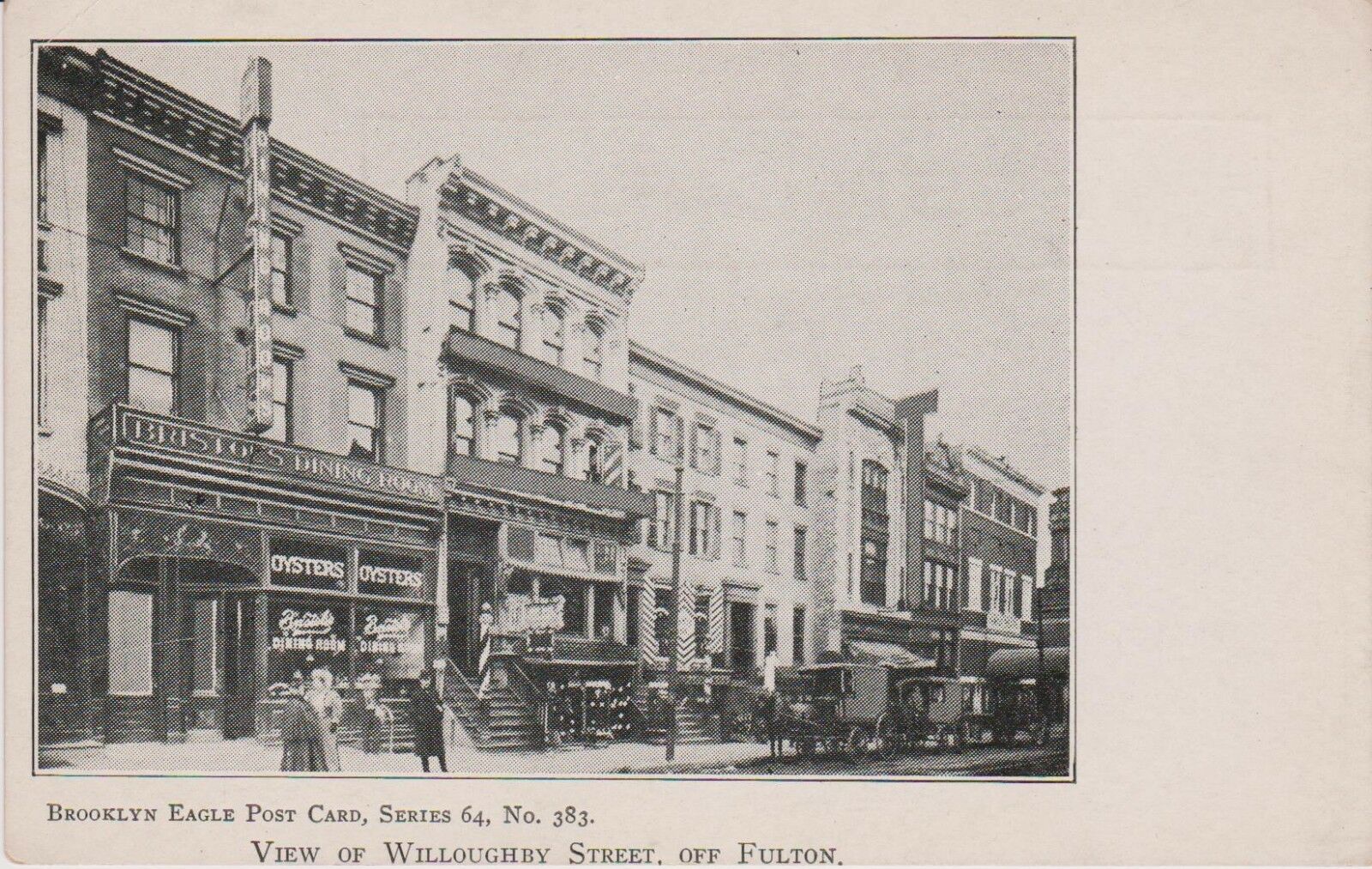
“Bristol” was the long-established Bristol’s Dining Room, with Mr. J. E. Bristol proprietor. He had a small chain of eight such in New York City by 1920. Can it be found? Well, there is this postcard picture, which appears in a book dedicated to such from the 1905-07 period in Brooklyn…

Here is the old Bristol’s Dining Room seen in all its oyster-purveying glory. As one can see, there is no architectural or street-furniture comparison to be found between the suggested site at 185 Willoughby and the postcard of Bristol’s Dining Room. If, as Lovecraft states, his old John’s was next to the Bristol’s Dining Room then it would either have been in the next-door barbers’ shop (barbering pole, outside) seen up steps on the right of the postcard, or is off to the immediate left and out of range of the camera.

Nor is there, on the 185 Willoughby or its adjacent 1940s.nyc pictures, any glimpse of a possible Bristol’s Dining Room next door. The clincher is that in summer 1931 Lovecraft talks of the “defunct John’s”. Therefore it would not be seen on a late 1930s / early 1940s tax picture. Most likely another nearby cafe took the name in the 1930s, perhaps hoping to profit a little on the name-recognition.

What then was the exact address of the Bristol’s Dining Room in Brooklyn in the mid 1920s? Could it have moved since 1900? Was there more than one in Brooklyn by that time? Those are possibilities. But regrettably the address cannot be discovered on the Web in public records or books, though those with access to pay-walled genealogy records might find it. Nor is there any 1920s branch advertising-map or suchlike to be found.

Can the architecture seen on the card be found on a virtual trot down Willoughby Street? Not on 1940s.nyc, so far as I can see.

So, it’s still a mystery.

Arthur Leeds on movie special effects, 1922

24 Saturday Jul 2021

Posted by asdjfdlkf in Historical context, New discoveries

≈ Leave a comment

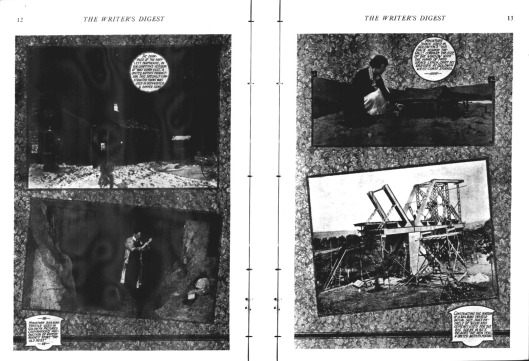
An article on special effects in movies, by Lovecraft’s friend and Kalem member Arthur Leeds. In the Writer’s Digest for July 1922, recently uploaded to Archive.org.

He had a number of practical and market-survey articles in Writer’s Digest from summer 1921 and into 1922, plus an interview-based article on George Allen England.

Notes on Letters to Family, Vol. II – part two

12 Monday Jul 2021

Posted by asdjfdlkf in Historical context, New discoveries

≈ Leave a comment

More notes on my reading of the second volume of H.P. Lovecraft’s Letters to Family, here mostly relating to 1926-1928.

There is an interesting description, re: a possible inspiration for “The Colour Out of Space”, of a ground curiously mineralised and as-if “powdered with star-dust” (page 604). He finds this in September 1926 scattered around the 1707 birthplace of the early astronomer David Rittenhouse (1732-1796), a homestead that had been encountered by chance as Lovecraft was lost while exploring the Wissahickon Valley. “Colour” was written some six months later.

Lovecraft saw the grand historical-adventure movie Ben Hur (page 602). Later he remarks on his break from cinema-going, between Aug-Sept 1927 and May 1928.

He recalls the Old Corner Bookshop (page 612). Presumably Dana’s Old Corner Bookstore in Providence, as he had sold some of his mother’s books to them and later regretted parting with one such when he saw it on display in the window.

He remarks that, like himself, his friend Loveman also had many young proteges… “He had with him one of his numberless prodigy-proteges, a quiet blond youth whose accomplishments seem to be, so far, appreciative rather than creative” (page 632).

In April 1928 Loveman had noticed that the old rooming house, 169 Clinton St. on the edge of Red Hook, appeared abandoned and with some windows smashed. However, in May 1928 Lovecraft and Loveman went to bid it a final goodbye… only to find it revived (a fresh coat of paint and “marks of rehabilitation”) and thus presumably under new ownership (pages 634 and 661).

By April 1928 the Kalem meetings had “almost dissolved” (i.e. dwindled to just a few attendees) but were strongly revived while Lovecraft was again living in New York City.

On discovering that some museums would make a good affordable plaster-casts for private display, he remarks… “it was my original design in youth to have a private museum of Greek & Roman casts”.

He discovers an old Antarctic adventure novel he has not yet read, titled Revi-lona: a Romance of Love in A Marvelous Land (1879) by a journalist of the time. An explorer finds love with sex-starved women in a tropical shangri-la amid the ice. Apparently very floridly written and yet ultimately conveying the rather cynical and anti-utopian sentiments of an American newspaperman. The implication is that Lovecraft has read most such novels, but that this is a new find for him. Not on Archive.org under that title.

“The Spence book on Atlantis that I read so hurriedly just before departing for my trip” (page 637). There is no footnote for this book, and both “Spence” and “Atlantis” are curiously missing from the index. Lewis Spence wrote five books about Atlantis, and the most likely in spring 1928 was the relatively new The History of Atlantis (1927), though it might have been the earlier The Problem of Atlantis (1924) or Atlantis in America (1925).

Lovecraft read at least one non-fiction book by Lewis Mumford on architecture. This was prior to Mumford’s efflorescence of ideas on tools, technologies and civilisation.

He knew, read and kept the magazine published by the Hospital Trust in Providence. This produced the fine Netropian journal, with many local history articles and local drawings from the 1920s. Copies apparently languish in paper at Brown and the Rhode Island School of Design, un-scanned.

He mentions reading and being impressed by a volume of poetry by Gessler, friend of his best friend Belknap Long, titled Kanaka Moon (1927). Not on Archive.org.

He found Morton’s full library very impressive when he saw it fully assembled and shelved at Paterson, and thought it better even than that of Cook. “I’ve never seen so fine a private Library” (pages 657 and 658).

Lovecraft finds he has a family-tree line named “Fish” (page 663), and this is some years before the writing of “Innsmouth”.

There was a time when $5 would buy you a custom original plot-synopsis by H.P. Lovecraft. In the spring of 1928 he was writing many such plots for one “Reed”, at the jobbing rate of a dollar per page (page 668). We later learn this client to be a “Mrs Reed” (page 676), now of course known to be his revision client Zealia Brown Reed.

Lovecraft revised the first chapter of McNeil’s historical-adventure novel The Shores of Adventure (1929). In which the boy hero earns and acquires his father’s super-sword.

In summer 1928 he notes “a resumption of the Providence Line of New York boats”, meaning passenger services from Providence — New York City.

Lovecraft discovered an old unchanged working colonial farmstead, “in full sight of the distant towers of Manhattan” and with its inhabitants oblivious to modernity of New York City (page 678).

Notes on Letters to Family, Vol. II – part one

29 Tuesday Jun 2021

Posted by asdjfdlkf in Historical context, New discoveries

≈ Leave a comment

I’ve begun reading the second volume of the new Letters to Family. Here are my notes on Lovecraft’s letters home, until the point when he returns home to Providence and Barnes St.


There is an evocative passage on “vast unknown islands” in the Arctic (page 560) in which Lovecraft seems to anticipate some future unwritten tale. Not impossible, at least historically, when you look at the topography and know that sea-level used to be much lower in the last Ice Age…

He laments that intellectually stunted people then made up “almost a majority” of the population of the USA, and he presumably was basing this on some test-based research of the period. A little later he also implies that knows whereof he speaks, when he says he has given up his former “loafing about slum cafeterias” on the edge of Red Hook.

He appears to have read the memoirs of the illustrator and leading printmaker Joseph Pennell, presumably The Adventures of an Illustrator (1925). This would have given him an insight into the artistic/publishing life of London from the 1880s to the early 1900s, and then the illustration side of magazine publishing in the New York ‘slicks’. By 1921 Pennell was living in Brooklyn, and its not impossible that in 1925 their circles overlapped at the edges.

He had begun reading some of the ghost stories of M.R. James and was impressed, referring to James a new “idol of idols”.

Evidently there was a large and capacious family scrap book, “Grandma’s red scrap book”, which had been kept into the mid 1920s and was still being added to. One wonders what became of it.

Vaudeville at Fay’s Theatre in Lovecraft’s youth could include lectures. He saw there a lecture by Dr. Cook, the polar explorer. Presumably this included a show of ‘magic lantern’ slides.

He saw the movie The Tower of Lies (1925) with Lon Chaney. Now a lost movie.

He gives the dates of his severe boyhood illness of 1903, “late April and early May”.

Loveman’s poetry was both “polished” and (later) proofread by Lovecraft (pages 551-2).

The location of Peter’s restaurant was “on Joralemon St near the corner of Clinton” in NYC.

Lovecraft’s Providence barber was named Fernando King at 72 Westminster Street. His partner in trade was Eduoard Fontaine. I see that the Nightingale Papers archive holds a local press “clipping and program for party held in King’s honor, 1926”. In New York Lovecraft’s final haircut is at “the barbers at State and Court”.

Lovecraft read the Henry James story “The Turn of the Screw” for the first time in February 1926, while working on his survey Supernatural Literature.

He makes a brief reference to the influenza of 1918, as a “scourge” (page 558). He later says that its symptomatic “effects are so far reaching” (page 576) suggesting he was still well aware of the unusual and devastating symptoms.

The plans for the giant Hope Reservoir were known to Lovecraft by February 1926. He talks about the plans, and what might replace it. We know from the Providence magazine that it was still not quite drained by early 1928, having begun draining in 1926. On return to Providence, he would live very near to it.

He saw the movie The Torrent, featuring Greta Garbo. This climaxes when “a huge storm hits the town, causing houses to flood, ceilings to cave in, and the dam to break bringing a torrent of rushing water”. A while later he saw an “impressive” costume-drama movie of the Jamestown Flood of 1889. Given that the giant, creaking and possibly dangerous (while the water level was being slowly lowered) Hope St. reservoir was almost directly behind his new home in Barnes St., these viewings seem well-timed.

He remarks that, at February 1926, he had never seen a decent display of the aurora (‘northern lights’).

He shops at the Clinton Delicatessen, presumably in Clinton St. Above it is the Taormina restaurant he and Sonia patronised in the 1925, but which had raised prices dramatically by 1926.

He recalls the Empire Book Shop in Providence, which he used to patronise, in Empire St. Another source gives the prop. as “H. D. Dana”, known later as a leading book dealer in Providence. By 1923 “new” at Weybosset St…

In the move to New York he lost the beautiful star-atlas booklet that accompanied the book Geography of the Heavens. The Library of Congress has it online now.

He talks of Eliphas Levi as “the best source of magical lore”, as translated by Waite (page 570). In March 1926 he is reading Constant’s History of Magick (page 585) but this again indicates Eliphas Levi — since Levi was Constant’s pseudonym. This must therefore have been the book The History Of Magic but Lovecraft’s epistolary whimsy has given the title an 18th century touch by using the spelling “Magick”.

He talks of enjoying “the subsidiary features” of movie-going, suggesting that he also sat through the cartoons, short travelogues, news-reels etc.

He states in the past he had read some “Hindoo” (Hindu) fables from India.

He disparages Freud and especially on dreams…”… his theory of dreams is perhaps the weakest link in his whole chain. Many of his hypotheses can be punctured quite readily…” (page 578)

Lovecraft reassures his aunt that, in his fragile mental state, he is not raving at immigrants in the streets… “don’t fancy that my nervous reaction against alien N.Y. types takes the form of conversation likely to offend any individual” and “don’t think I fail to appreciate the genius and good qualities of the entire assemblage” (by which he seems to mean ‘other groups, when considered in the round’). He also comments on the lack of leakage from the Kalems and his circle… “our group is not noted for faux pas‘s or inconsiderate repetition of opinion.”

He sees a re-run of the John Ford blockbuster movie “The Iron Horse” (1924) about the transcontinental railroad. Another movie that seems to foreshadow his return (by rail) to Providence.

Long patronises The Womrath Library, a library cum bookstore in New York, and sub-lends Lovecraft at least one book from it.

The family storage stables in Providence, at least at that point in time, are owned by a “Mrs Glazer”.

A favourite Italian joint in Providence was the Belvedere, “at the S.E. corner of Washington and Aborn”, and Lovecraft states he intends to make it a regular haunt when he returns.

He chanced to see the melodrama movie Stella Maris with Sonia, and recalled seeing the first half of the earlier Mary Pickford version in Providence in 1918. In 1918 he had to leave the cinema early due to health problems. This suggests the reason why he only saw half the Providence Houdini show.

He saw a foreign movie of Cyrando de Bergerac, possibly a French print of the Italian movie version of the time.

He saw the movie Don Juan, and enjoyed it all the more because the then-new Vitaphone technology sync’d the music perfectly.

He was impressed with the John Metcalfe (1891–1965) story “The Bad Lands”, in The Smoking Leg, and other stories (1925). This has not been collected in an anthology of ‘Lovecraft faves’ by Lovecraftians, presumably due to copyright. But note that the 1926 U.S. first edition should put it in the public domain in the USA in 2022. The story is now online, extracted from the British magazine publication of 1920. On reading, one immediately finds it a likely partial source of inspiration for “The Colour out of Space”, minus the colour and reservoir and meteor.

← Older posts
Newer posts →


Please become my patron at www.patreon.com/davehaden to help this blog survive and thrive.

Or donate via PayPal — any amount is welcome! Donations total at Easter 2025, since 2015: $390.

Archives

  • February 2026
  • January 2026
  • December 2025
  • November 2025
  • October 2025
  • September 2025
  • August 2025
  • July 2025
  • June 2025
  • May 2025
  • April 2025
  • March 2025
  • February 2025
  • January 2025
  • December 2024
  • November 2024
  • October 2024
  • September 2024
  • August 2024
  • July 2024
  • June 2024
  • May 2024
  • April 2024
  • March 2024
  • February 2024
  • January 2024
  • December 2023
  • November 2023
  • October 2023
  • September 2023
  • August 2023
  • July 2023
  • June 2023
  • May 2023
  • April 2023
  • March 2023
  • February 2023
  • January 2023
  • December 2022
  • November 2022
  • October 2022
  • September 2022
  • August 2022
  • July 2022
  • June 2022
  • May 2022
  • April 2022
  • March 2022
  • February 2022
  • January 2022
  • December 2021
  • November 2021
  • October 2021
  • September 2021
  • August 2021
  • July 2021
  • June 2021
  • May 2021
  • April 2021
  • March 2021
  • February 2021
  • January 2021
  • December 2020
  • November 2020
  • October 2020
  • September 2020
  • August 2020
  • July 2020
  • June 2020
  • May 2020
  • April 2020
  • March 2020
  • February 2020
  • January 2020
  • December 2019
  • November 2019
  • October 2019
  • September 2019
  • August 2019
  • July 2019
  • June 2019
  • May 2019
  • April 2019
  • March 2019
  • February 2019
  • January 2019
  • December 2018
  • November 2018
  • October 2018
  • September 2018
  • August 2018
  • August 2015
  • July 2015
  • April 2015
  • March 2015
  • February 2015
  • January 2015
  • December 2014
  • November 2014
  • October 2014
  • September 2014
  • August 2014
  • July 2014
  • June 2014
  • May 2014
  • March 2014
  • February 2014
  • January 2014
  • December 2013
  • November 2013
  • October 2013
  • September 2013
  • August 2013
  • July 2013
  • June 2013
  • May 2013
  • April 2013
  • March 2013
  • February 2013
  • January 2013
  • December 2012
  • November 2012
  • October 2012
  • September 2012
  • August 2012
  • July 2012
  • June 2012
  • May 2012
  • April 2012
  • March 2012
  • February 2012
  • January 2012
  • December 2011
  • November 2011
  • October 2011
  • September 2011
  • August 2011
  • July 2011
  • June 2011
  • May 2011
  • April 2011
  • March 2011
  • February 2011
  • January 2011
  • December 2010
  • November 2010
  • October 2010
  • September 2010
  • August 2010
  • July 2010

Categories

  • 3D (14)
  • AI (70)
  • Astronomy (70)
  • Censorship (14)
  • de Camp (7)
  • Doyle (7)
  • Films & trailers (101)
  • Fonts (9)
  • Guest posts (2)
  • Historical context (1,095)
  • Housekeeping (91)
  • HPLinks (72)
  • Kipling (11)
  • Kittee Tuesday (92)
  • Lovecraft as character (58)
  • Lovecraftian arts (1,624)
  • Lovecraftian places (19)
  • Maps (70)
  • NecronomiCon 2013 (40)
  • NecronomiCon 2015 (22)
  • New books (966)
  • New discoveries (165)
  • Night in Providence (17)
  • Odd scratchings (984)
  • Picture postals (276)
  • Podcasts etc. (430)
  • REH (184)
  • Scholarly works (1,467)
  • Summer School (31)
  • Unnamable (87)

Get this blog in your newsreader:
 
RSS Feed — Posts
RSS Feed — Comments

H.P. Lovecraft's Poster Collection - 17 retro travel posters for $18. Print ready, and available to buy — the proceeds help to support the work of Tentaclii.

Proudly powered by WordPress Theme: Chateau by Ignacio Ricci.