
[ Hat-tip: R.E.H.: two-gun raconteur ]

27 Tuesday Mar 2012
Posted in Historical context, New discoveries
[ Hat-tip: R.E.H.: two-gun raconteur ]
02 Thursday Feb 2012
Posted in Historical context, New discoveries
This is a quick and brief historical summary note in response to a Facebook query by David Milano, who is set to visit New Orleans and has an interest in Lovecraft’s time spent in the city:
H.P. Lovecraft paid a brief one-week visit to New Orleans in June 1932. He was there ‘taken under the wing’ of local resident and fellow Weird Tales writer E. Hoffman Price, who wrote a memoir of the visit (“The Man Who Was Lovecraft” in Something about Cats, and other pieces, Arkham House, 1949). At some point during these several meetings with Price, Lovecraft was apparently given the city tour — although Price missed out the city’s brothels due to Lovecraft’s conservative sensibilities — “I skipped concubines entirely” wrote Price. Lovecraft stayed at “a third class hotel on Charles Street” according to Price. Price’s apartment was at 305 Royal Street, and they had several epic discussion sessions there. Apparently the older French Quarter was a special hit with Lovecraft’s antiquarian architectural sensibility, and this area was also where Price’s apartment was located. Lovecraft later collaborated with Price on “Through the Gates of the Silver Key”, which opens in a New Orleans setting…
“For here, in the New Orleans home of this continent’s greatest mystic, mathematician, and orientalist, there was being settled at last the estate of a scarcely less great mystic, scholar, author, and dreamer who had vanished from the face of the earth four years before.”
Of course, a more substantial use of the locale came earlier. In “the wooded swamps south of New Orleans”, which was one of the key settings in the famous story “The Call of Cthulhu”. The story features an Inspector of Police for the city of New Orleans, who investigates idol worship in the swamps. In real life by 1925 these swamps were apparently threatened by 560 miles of drainage canals, a system which was at that time were increasing and would be increase again under the 1930s work schemes. One of the side effects of draining and logging the swamps would be to cut one of the main arteries by which illegal hard drugs were then entering the USA — the area was reported by police to be one of two main conduits in the 1920s for morphine/opium and cocaine entering the USA. Today, though much depleted by drainage and the heavy logging of the 1930s, some of the swamps are preserved, such as the Barataria Swamp and the Jean Lafitte National Historical Park Preserve south of New Orleans.
Key Lovecraft locations in New Orleans thus seem to be: 305 Royal Street and the French Quarter; the hotels on Charles Street; and places such as the Barataria Swamp and the Jean Lafitte Preserve.
Incidentally, a gruesome Mary Pickford movie Sparrows was released in May 1926, and is set in the swamps of New Orleans. The movie was possibly seen by Lovecraft in New York, since he wrote “The Call of Cthulhu” in the summer of 1926 and he may have visited the movie in order to give him a good visual idea of the swamps? Pickford was a major star of the time, and the movie saw a wide release.
“Sparrows‘ elaborate sets and magnificent cinematography create a nightmare world that later inspired the classic film Night of the Hunter.”
“Sparrows is horrifically good — a bad dream that wakens to a happy ending, a fairy tale told with brilliant style, a comedy, a Grand Guignol, an expressionist thriller” — Eileen Whitfield.
“The “look” of the film reflects the German expressionist style and should delight Lemony Snicket fans and anyone who gets off on creepy-strange beauty.” — Amazon review.
“Art director Harry Oliver transformed 3 acres (12,000 m2) of the [studio] back lot between Willoughby Avenue and Alta Vista Street into a stylized Gothic swamp. The ground was scraped bare in places, 600 trees were carted in, and pits dug and filled with a mixture of burned cork, sawdust and muddy water.”

The Library of Congress apparently has a beautifully restored 2006 print of the movie, but this has yet to be released on DVD. The currently available DVD is not the restored version, it seems.
06 Tuesday Sep 2011
Posted in Historical context, New discoveries
From my new book, a photo of the Local History & Genealogy room in the New York Public Library, a room where Lovecraft spent many evenings reading a reference-only book on the history of Providence.

Above: Local History and Genealogy room (No. 328) of the New York Public Library. Picture: Handbook of The New York Public Library, 1916. Public Domain.
Possibly this is the sort of “small genealogical reading-room” that Lovecraft had in mind when writing “The Dunwich Horror” just a few years later in 1928…
“The building was full of a frightful stench which Dr Armitage knew too well, and the three men rushed across the hall to the small genealogical reading-room whence the low whining came. For a second nobody dared to turn on the light, then Armitage summoned up his courage and snapped the switch. One of the three — it is not certain which — shrieked aloud at what sprawled before them among disordered tables and overturned chairs. […] The thing that lay half-bent on its side in a foetid pool of greenish-yellow ichor and tarry stickiness was almost nine feet tall, and the dog had torn off all the clothing and some of the skin. It was not quite dead, but twitched silently and spasmodically while its chest heaved in monstrous unison with the mad piping of the expectant whippoorwills outside. Bits of shoe-leather and fragments of apparel were scattered about the room…” — “The Dunwich Horror”.
One wonders if the nature of this creature’s depiction was perhaps even Lovecraft’s literary revenge on some particularly annoying phlegmy and wheezing old cougher, such as he might have once had to endure in the room at the New York Public Library?
Here’s another picture, unused in the book, which depicts another typical scene from the New York Public Library in the early years of the 20th century…

Picture: New York Public Library Flickr Commons stream.
This is what the exterior/entrance looked like, as painted by Tavik Frantisek Simon in 1927…

01 Thursday Sep 2011
Posted in Historical context, New books, New discoveries, Scholarly works
My new book is here! Walking With Cthulhu : H.P. Lovecraft as psychogeographer, New York City 1924-26. 55,000 words, 198 pages. Illustrated.
Another good haul of new discoveries! Including two new possible sources for Cthulhu. All heavily referenced and footnoted.
Buy a new paperback copy here! Kindle user? It’s also on the USA Kindle Store and the U.K. Kindle Store.
CONTENTS:
Timeline of Key Dates.
Introduction: A Walk in New York.
SURFACE: Walking the Streets of the City:
1. H.P. Lovecraft and the psychogeographers.
2. H.P. Lovecraft’s night walks in New York: psychogeographic techniques
3. The nature of the New York streets.
4. A note on H.P. Lovecraft and immigrants.
5. H.P. Lovecraft’s New York coffee houses and ice-cream parlours.
UNDERGROUND: On the Monstrous, Occult, and Hidden:
6. H.P. Lovecraft and the subway.
7. It emerged from the subways!
8. On mystical and occult New York.
9. On H.P. Lovecraft and Franz Boas
10. New York as R’lyeh, sunken city of Cthulhu.
“Nyarlathotep” annotated.
Bibliography.
Index.
12 Friday Aug 2011
Posted in Historical context, New discoveries
I’ve already written a note on Lovecraft and the Double-R Coffee House. Here are some more notes on the other coffee houses and cafes Lovecraft is known to have frequented…
* Cairo Gardens, Brooklyn.
Owned, probably in the late 1930s and 40s, by Joseph Oppedisano….
“He was a former teacher at Albany High School and Ravena-Coeymans High School. He later owned his own restaurant, Cairo Gardens, in Cairo, N.Y. and was also an area [local] musician in his own band called The Manhattans.” — from his obituary in the Albany Times Union from 8th-10th October 2004.
* Tiffany’s, Brooklyn.
Lovecraft calls this “my regular” in the 1925 letters. Apparently (perhaps later) it was the occasional hangout of young roughs, since a Lovecraft letter of 1927 states that the police had arrested some youngsters for possessing guns at the cafe. Although, one wonders if perhaps they were just attempting to extort ‘protection’ money from the owner?
Tiffany’s obviously also sold food, since Lovecraft states in a letter that he “dined” there with friends. Elsewhere in his letters he calls it the “Tiffany Cafeteria”.
Some might think that the movies Breakfast At Tiffany’s has something to do with the place, but the Tiffany’s in the movie is a jewellery store not a cafe.
* Tontini’s, Brooklyn.
Nothing known. Seems to occur only in Kirk’s letters. Could this actually be Kirk’s mis-spelling of the name of the ‘legendary’ Totonno’s on Coney Island, which was originally… “on Neptune Ave off Coney Island Ave in Brooklyn”?…
“Since 1924, Totonno’s pizzeria has been a beacon on the block, remarkable for its longevity and for the deliciousness of its food.” — New York Times, March 2009.
* Unknown. Spanish restaurant on Fulton Street, sometimes visited on Sundays for lunch.
Lovecraft and the gang would also frequent the ice-cream parlors. These were apparently very sparkly, and a woman in the 1920s was once described as… “glittering like an ice-cream parlor”.
Daniel Fuchs’s Brooklyn story “Low Company” (1937) gives us a vivid portrait of two burglars in a closed ice-cream parlor, a decade after Lovecraft was in New York…

Lovecraft and the gang also paid at least one visit to Coney Island, which had plenty of ice-cream parlors.
Amazingly, the famous anarchist Emma Goldman once opened an ice cream parlor in Brownsville, Brooklyn. It went bust within three months.
12 Friday Aug 2011
Posted in Historical context, New discoveries
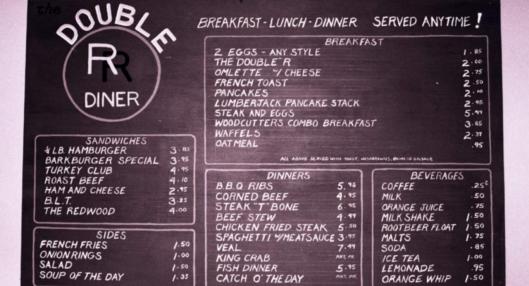
The Double-R Coffee House was a fairly regular hangout of Lovecraft and the Kalem Club in New York City. This is what the interior looked like when it opened…
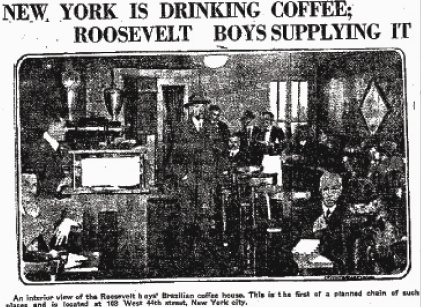
This is a little potted history of it…
“Members of the family of the late Colonel Roosevelt began to promote a Brazil coffee-house enterprise in New York in 1919. It was first called Cafe Paulista, but it is now known as the Double R coffee house, or Club of South America, with a Brazil branch in the 40’s [this is Lovecraft’s 112 West Fortyfourth Street haunt] and an Argentine branch on Lexington Avenue. Coffee is made and served in Brazilian style; that is, full city roast, pulverized grind, filtration made; service, black or with hot milk. Sandwiches, cakes, and crullers are also to be had.” — William Harrison Ukers, All About Coffee (1922).
“Upon entering the long narrow shop, a patron saw portraits’ of Voltaire and Shakespeare on opposite sides of the room. The walls were decorated with green and gold wallpaper containing a Brazilian bamboo plant design. The room contained 30 small oak tables and matching chairs with a large oak counter in the center where freshly ground coffee was made.” — The Rough Writer, Volume 9, Issue 3
It seems to have lasted about ten years under the first owners, and seems to have been set up to take advantage of Prohibition. It sold coffee, postum (a sort of decaf coffee substitute before decaf), pastries and cakes, sandwiches, and offered “a daily Brazilian dish”. It seems the manager was Brazilian.
There were “Expansion plans of Double-R Coffee House” (New York Times, 1923) which presumably meant the new Lexington Av. branch, but the venue was sold in 1928 (Tea and Coffee Trade Journal, 1928) to a Mr. and Mrs. Zivko Magdich — at which time the New York Times described it as a…
“gathering place for aspiring playwrights, actors, artists and musicians.”
The letters of George Kirk are a little more explicit on its artistic nature. It seems that, at least part of the week, the Double-R Coffee House served as a discreet queer meeting place…
“If you had been longer in NYC you’d know that there are many boys and many girls both male and female. My dear Double-R is claimed to be a hangout for these half and halfers.” — George Kirk, Letter of 17th Feb 1925.
Lovecraft wrote a poem to the place…
Here may free souls forget the grind
Of busy hour and bustling crowd
And sparkling brightly mind to mind
Display their inmost dreams aloud
— extract from “On the Double-R Coffee House” (1st February 1925)
It was also rather smoky, since Lovecraft writes in the same poem…
Mids’t them I sit with smoke-try’d eyes
— “On the Double-R Coffee House” (1st February 1925)
He also talks in one of his letters of the… “nicotined atmosphere”.
The full poem is to be found in The Ancient Track: The Complete Poetical Works of H.P. Lovecraft. It somewhat contradicts his very sour view of the artists of Greenwich Village in the short story “He”, although the fact that the coffee shop was a queer meeting place may throw new light on the line in Lovecraft’s New York story “He” (1925)…
“… uncommunicative artists whose practices do not invite publicity or the light of day.”
The Greenwich Village quill of 1921 very briefly mentions the Double R, so it seems that it was ‘on the map’ of the Greenwich Village crowd at that time.

The Double R apparently had a post-closure ‘media ghost’, since it seems to have been recreated as a setting in the TV series Twin Peaks. I’ve never seen the series, so I don’t know how faithful it might have been to the original. Presumably it was a covert Lovecraft reference by the makers.
11 Thursday Aug 2011
Posted in Historical context, New discoveries
A hat-tip to Christophe Thill, who has pointed out the existence of an interesting octopoid bas-relief from Equador, South America. It seems that this has been written about before as a possible source for the figurine in “The Call of Cthulhu”. Nothing shows up on Google Books or Amazon Look Inside, so possibly there is an essay on this in Lovecraft Studies, Crypt of Cthulhu etc. But those are very expensive now, and I don’t have access to them. So here’s my quick re-tracking down of some of the key facts and images…

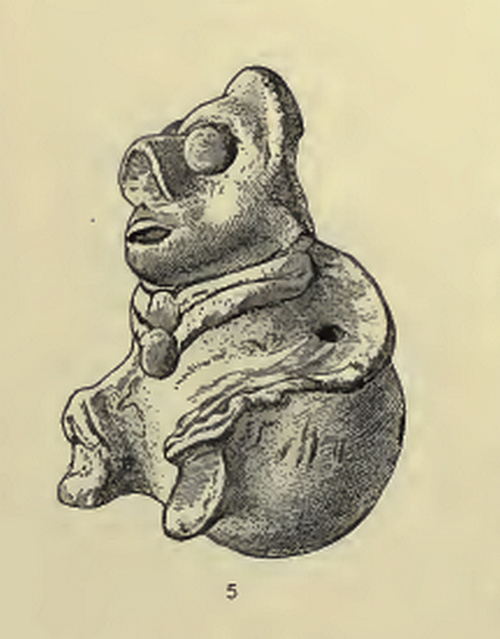
Both from The Antiquities of Manabi, Equador (1907) (Incidentally, an excellent example of why scanned books should not be discarded after mass scanning — the picture quality is rubbish).

The same picture given again in G. Eliot Smith’s book Evolution of the Dragon (1919). It has eight “arms” like an octopus, even though the arms are very straight rather than curvy.
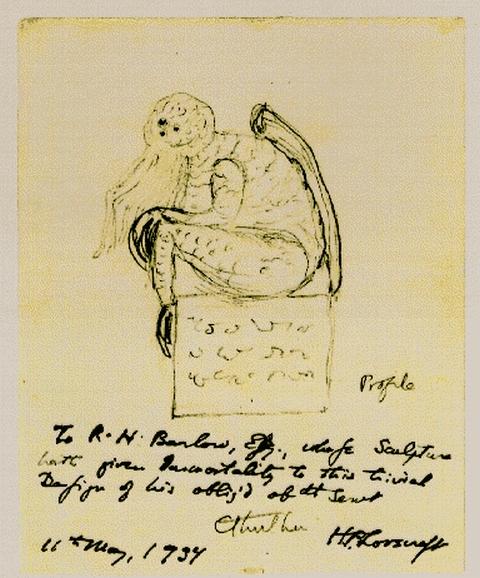
Lovecraft’s own pen-sketch of the Cthulhu figurine in the story.
Frank Belknap Long’s major mythos story “The Horror from the Hills” was written 1929, and first appeared as a two-parter in Weird Tales, Jan & Feb 1931. It is set in a New York museum, and Long mentions ‘The Manabi monoliths’. Although Lovecraft apparently gave written permission for one of his dreams [given in, among others, a letter to B.A. Dwyer of Nov. 1927] to be used in the story, as far as I can tell the story was not one of Lovecraft’s revision works. The late date and the seemingly tangential Lovecraft involvement thus suggests that there’s no actual proof that the Lovecraft circle may have known about the South American Manabi sculptures before 1927/9. Possibly some of Manabi works were on show in museums Long visited to research the story.
Yet… the Evolution of the Dragon was called a “highly acute and sensitive” (The Nation, 1919) work in the reviews of the time, and was even reviewed in Nature (1919), so it would seem strange if Lovecraft had not badgered the Providence library to obtain a copy. Or later tried to obtain a copy when he haunted the used bookshops and libraries of New York. Christophe Thill says that… “A picture of it [the Manabi octopoid] was published in Nature in 1924″, so it was obviously commented on. It is certainly very suggestive in the respect of the 1919 date that the famous entry in the Commonplace Book (entry No. 25, circa 1919, from a dream) describes not a squatting figure but a bas-relief like the one shown in Evolution of the Dragon…
“25. Man visits museum of antiquities — asks that it accept a bas-relief he has just made—old and learned curator laughs and says he cannot accept anything so modern. Man says that ‘dreams are older than brooding Egypt or the contemplative Sphinx or garden-girdled Babylonia’ and that he had fashioned the sculpture in his dreams. Curator bids him shew his product, and when he does so curator shews horror. Asks who the man may be. He tells modern name. “No — before that” says curator. Man does not remember except in dreams. Then curator offers high price, but man fears he means to destroy sculpture. Asks fabulous price — curator will consult directors. Add good development and describe nature of bas-relief.”
He is unlikely to have seen the squatting Manabi figure in the 1907 monograph, and it was not given in the book Evolution of the Dragon. So where might he have had it from? There are of course a great many similarly squatting and pedestal-seated Ancient Egyptian figures, and this seems an obvious source for an Egyptomaniac like Lovecraft. For instance, there are some human figures in that pose, many squatting baboon sculptures from Ancient Egypt from all periods, and the Egyptian sculptures of Bes mostly have the typical pose of squat with hands resting on knees. Lovecraft would have seen these illustrated in books on Egypt, and then by the time of writing “Cthulhu” would have seen plenty of actual examples in the New York museums…

Note the beard of Bes, which almost suggests octopus-like tentacles.


One might also point to the gargoyles of New York as another possible inspiration for the squatting figure of the Cthulhu statuette, especially the wings…
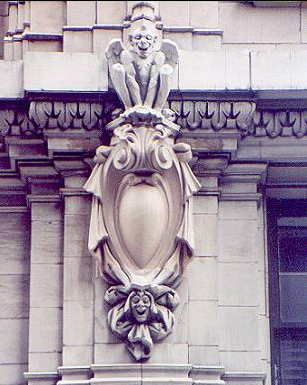
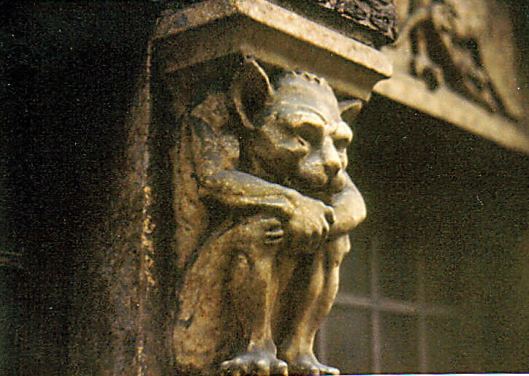
I know almost nothing of the roots of Masonic beliefs, but it may be that some scholar has reliably traced gargoyles back to guilds of masons whose traditions recalled those of Egyptian sculpture at the time of Rome? Whatever the truth of that, Lovecraft would certainly have made the Egyptian connection in his mind when he saw them on the buildings.
“The huge variety of nymphs, grotesques, demons, gargoyles, and other mysterious creatures carved into the facades of New York buildings is pretty astounding.” Ephemeral New York blog, 12th January 2011.
07 Sunday Aug 2011
Posted in Historical context, New discoveries
In 1924 Lovecraft wrote…
‘Take a werewolf story, for instance — who ever wrote a story from the point of view of the wolf, and sympathising strongly with the devil to whom he has sold himself?’ — H.P. Lovecraft in the letters columns of Weird Tales, March 1924. Quoted in Darrell Schweitzer, Discovering Classic Fantasy Fiction, p.126.
In this respect it’s interesting that a decadent writer called Robert Buchanan published a long decadent poem as a book, The Devil’s Case (1896). In it Buchanan sympathises with the Devil, portraying him both as a magician and a scientist/skeptic. Regrettably for the modern reader it comes with an offputtingly teduous late-Victorian preamble and it has much ‘poeticky’ language, but there are many very effective and vivid passages. Arkham House reprinted one of his long poems, but sadly not this one.
Here is Buchanan’s Devil in The Devil’s Case, recalling his time as a scientist/architect in Ancient Egypt. This would seem to have obvious relevance to “Nyarlathotep” (1920)…
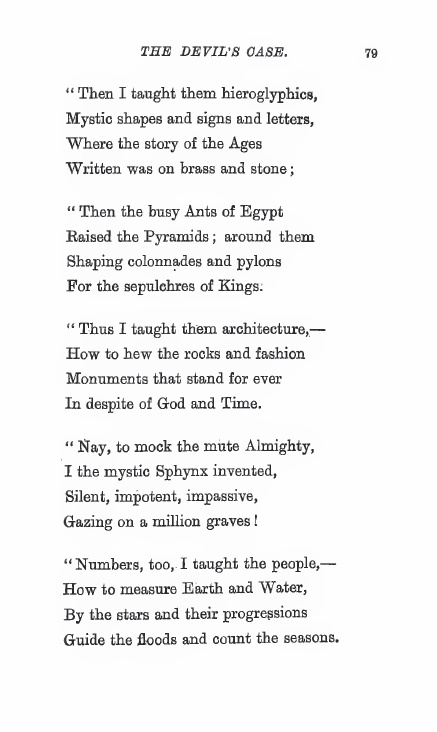
Given Lovecraft’s dislike of 19th century literature it’s perhaps understandable that Lovecraft does not appear to have even known about some of the Victorian fantasy novelists such as William Morris (or possibly he assumed from summaries that they were more like children’s fairy tales, or just felt them not to be weird or horrific enough for mention in Supernatural Literature). But Lovecraft was apparently fairly informed on the Decadents and poetry. Indeed he went through a Decadent “phase” up until about 1922/23. So it seems strange he appears never to have mentioned Robert Buchanan. Archibald Stodart-Walker’s book Robert Buchanan, the poet of modern revolt: an introduction to his poetry had appeared in 1901. Also Harriet Jay’s Robert Buchanan: some account of his life, his life’s work, and his literary friendships had appeared from Unwin in 1903, and Henry Murray’s Robert Buchanan: a critical appreciation, and other essays in 1901 — so it wasn’t as if the author had been forgotten in the 1910s. Much of Buchanan’s early work was conventional, but his The Book of Orm (1870) and especially its section of poems titled “The Devil’s Mystics” might have been on Lovecraft’s list had he read about it. Certainly Orm was described in Chapter 12 of Lafcadio Hearn’s Appreciations of Poetry (1916)…
Buchanan’s Orm is represented to be an ancient Celt, who has visions and dreams about the mystery of the universe, and who puts these visions and dreams, which are Buchanan’s, into old-fashioned verse.
a very remarkable beauty, a Celtic beauty of weirdness [of “The Ballad of Judas Iscariot”]
But Lafcadio Hearn’s essay appears to resolutely steer matters toward the ponderous ‘Christian meanings’, and he very oddly neglects to even mention that Buchanan ever published The Devil’s Case. If this book chapter was all that Lovecraft ever read about or by Buchanan (Hearn gives a large chunk of Judas Iscariot), then it may well have been enough to strike the name off Lovecraft’s list of works to investigate. Still, there does appear to be at least one very striking point of correspondence between the “The Devil’s Case” and “Nyarlathotep” (see above), and also some rather Lovecraftian language in places such as…
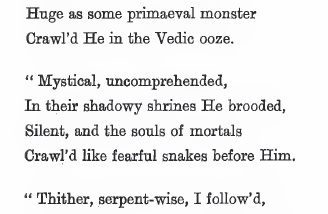
05 Friday Aug 2011
Posted in Historical context, New discoveries
A quick tracking-down of the site of Lovecraft’s famous ice-cream eating contests, which I had pictured as being in urban New York. But seemingly not…
“21, Federal Street [Warren, Rhode Island]. “Bosworth Mansion” or “Maxfields” c.1840: 2 story gable roof Greek Revival house possibly designed by architect Russell Warren for Judge Alfred Bosworth; known for years as “Maxfields” a popular local ice-cream parlor.”
“After digesting Warren’s quiet lanes and doorways we went across the tracks to Aunt Julia’s, where we tanked up on twelve different kinds of ice cream — all they’re serving at this time of year.” — Selected Letters: 1932-1934.
This was owned by Julia A. Maxfield’s whose father was apparently Louis Warren Taft, and was of an old Rhode Island family. It seems from the mention of “Aunt Julia” that she was related to a member of the Lovecraft Circle. It seems, though, that the “Bosworth Mansion” was not the actual site of the parlour. The parlour was apparently in a nearby building, presumably in the grounds and maybe looking more like a wooden Summer House?…

From: Ruth Marris Macaulay, John Chaney. Warren. Arcadia, 1997.
Or possibly it was a veranda-like extension at the back of the house, which Wandrei’s (then nearly 20 years-old) memories seem to imply. Although I think I would rather trust the memories of the local historians and local people that the parlour was actually some distance from the main house.
Possibly Julia A. Maxfield didn’t actually work there either, but employed her relatives to do so, since there is mention of a Charles Redfern Maxfield Snr. being the manager of an ice-cream parlour in Warren in the 1920s.
Thanks to Chris Perridas for snagging this from an auction-house blurb on the parlour…
From the 1944 Arkham House book Marginalia by H.P. Lovecraft, there is a section titled “The Dweller in Darkness” by Donald Wandrei. In that piece he explains the history and story behind the first 1927 trip to Maxfields:—
We took a bus for Warren, Rhode Island, where they promised a great treat. At Warren we walked to an establishment called Maxfield’s in a rambling old Colonial house. Its specialty was ice-cream, and it developed that our pilgrimage was solely for the purpose of consuming ice-cream.
There were thirty-two varieties on the menu. “Are they all available?” asked Lovecraft.
“No,” said the waiter, “only twenty-eight today, Sir.”
“Ah, the decay of modern commercial institutions,” said Lovecraft dolefully. “Thirty-two varieties are advertised but only twenty-eight are prepared for the famished pilgrims.”
We each ordered a double portion of a different flavor, and by dividing each other’s choice, we enjoyed three flavors with each serving. The trams came on and on — chocolate, vanilla, peach, black raspberry, pistachio, black walnut, coffee, huckleberry, strawberry, orange, plum, mint, burnt almond, and exotic types whose names I do not recall. The ice-cream was superior; there was no doubt of its being of the finest quality. But on the twenty-first variety I was beyond capacity. I watched with awe while the remaining flavors arrived in the same huge portions, and Lovecraft and Morton ate on with undiminshed zest, interspersing the astonishing meal with a wealth of literary allusions on the origins of ice-cream, its preparation in Italy, its appeal to famous men, the distinctions between meringues, ice-creams, and ices. I managed to sip each flavor for the record of twenty-eight, but I was a weak runner-up to the champions. I would estimate that Lovecraft and Morton consumed between two and three quarts of ice-cream apiece on that gastronomic triumph.
The occasion was so memorable that we wrote a short note of appreciation of the twenty-eight varieties and our enjoyment, signed it, and left it at the table. A year later when we visited Warren, we were surprised to find our tribute decorating a wall. Lovecraft was both amused and delighted but all he said was, “What a disapointment that the other four varieties were not available.”
30 Saturday Jul 2011
Posted in Historical context, New discoveries, Summer School
Assignment Nine, Vacation Necronomicon School: “From Beyond”.
Your brief writing assignment is to relate some aspect of today’s reading to another Lovecraft story “From Beyond”
Looking into Lovecraft’s toilet
The early story “From Beyond” (1920) is generally regarded as one of Lovecraft’s most flushable stories, and indeed it was not published until it saw light in The Fantasy Fan (June 1934, Vol. 1, No. 10). This essay suggests linkages between some of the story’s motifs, the house Lovecraft then occupied, and the villain Tillinghast.
First, who might Tillinghast be likely to have been based on? There was a “Tillinghast Supply Machine Company, Boston” in 1919. (Abstract of the Certificates of Corporations, Massachusetts Office of the Secretary of State, 1920). Although incorporated in Boston, the company was prominently based in Providence, and supplied plumbing materials and fittings at both retail and wholesale…
L.H. Tillinghast Supply Co., 162 to 168 Dorrance Street, Providence.
‘A Complete Stock of Everything pertaining to Plumbing. For thirty-seven years we have been manufacturers of and dealers in high grade plumbers’ supplies.’ — Year-book of the Rhode Island Chapter, American Institute of Architects, 1911.
Dorrance Street was the main road that led to the Providence railway station, and Lovecraft must have known it well. L.H. Tillinghast advertised in The Providence Directory of 1920, and Lovecraft may have seen their adverts for new toilets and sinks in the newspapers. Their president, at the time Lovecraft wrote his story, was the deliciously-named Lodorick Hoxie Tillinghast, a prominent Providence businessman and local worthy.

One wonders if Tillinghast was then a leading company installing domestic flushing toilet (then also called a “water closet” or “lavatory”) in Providence, as the city suburbs and towns of New England switched from chamber pots and outside privies to inside toilets? Certainly, Dorrance Street was obviously a major commercial street and not some poky little back street, and the long-established nature of the firm seems to suggest it had a wide range and reach. Tillinghast is of course a common local name, but one even wonders if the Tillinghast name may have been imprinted on Lovecraft’s toilet bowl at 598 Angell Street, or on some associated element?
At that time, toilets were perhaps not quite as advanced as the modern ones, and were a lot noisier and possibly more smelly…
‘an antique water closet, essentially an indoor outhouse. They were decorative, like furniture, until the owner lifted the lid or inhaled the bouquet.’ — Citro, Curious New England, 2004.
I think there is some very interesting evidence in the text of the story “From Beyond” to suggest a strong linkage between it and the everyday experience of visiting the toilet. I think I can show that “From Beyond” could be a potent fusion of high philosophy and the low odours arising from the experience of the indoor toilet — and thus from the cultural and personal cloud of anxieties that then surrounded that dreadfully liminal domestic space.
First let me remind readers of Lovecraft’s domestic circumstances in 1920. Since 1904 Lovecraft had shared a rented residence at 598 Angell Street, Providence. Donald Tyson describes this as…
‘a five-room apartment that made up the first floor of a somewhat smaller house [than the family had been used to previously]’ — The Dream World of H. P. Lovecraft, 2010.
This sounds rather cramped, although S.T. Joshi suggests that the boy Lovecraft also had access to (officially or unofficially) the attic — which incidentally is where the action in “From Beyond” takes place…
I looked about the immense attic room with the sloping south wall, dimly lit by rays which the every-day eye cannot see. The far corners were all shadows, and the whole place took on a hazy unreality which obscured its nature and invited the imagination to symbolism and phantasm.
This vision-space is later referred to as an “incredible temple” and “temple-like”, which brings to mind the colloquial description of the domestic toilet as a ‘throne’.
Given the shared nature of the house was it possible that Lovecraft was sharing a toilet with more people than just his female relatives? Sadly, no-one appears to have yet looked into the matter of Lovecraft’s toilet.
There had certainly been anxieties expressed on the subject of shared toilets in New England…
‘Modesty is hardly possible when from four to ten people of varying ages and both sexes live in from two to four rooms, some of them very small. Insufficient water-closet facilities also conduce to a low standard of morals.’ — The New England magazine, Volume 19, 1899.
Also, Chris Perridas has usefully uncovered a letter indicating the dreadful nature of the boys’ toilets in 1912, at the school Lovecraft attended…
‘At the Hope Street School the urinals are offensive, both in odor and appearance, and a positive menace to health. The toilet room is situated opposite the lunch room, and the caterer has spoken frequently of the noisome odors that permeate the basement. Teachers notice the odors as they pass the staircase on the floor above. Even pupils complain.’ — letter of 1912 from Charles E. Dennis, quoted by Chris Perridas in Dec 2010.
All this has obvious relevance to ‘body horror’, the nature of what is ‘beyond’ the u-bend, the emergence of slime into water, etc. But what might the evidence be in the story itself? In “From Beyond” the hero is taken to the attic laboratory (a word so curiously similar to lavatory, and in which he sees a toilet-bowl -like vision of… “a void, and nothing more”), where he enacts some of the key aspects of visiting the toilet to excrete. For instance, the machine which the hero sits near is “detestable” and connected with “chemicals”, rather like a toilet…
‘detestable electrical machine, glowing with a sickly, sinister, violet luminosity. It was connected with a powerful chemical battery’
The key evidence from the story is the descriptions of his sensations while engaged with the machine. These can easily be read as those of sitting on the toilet, passing wind, the holding of one’s breath, and then excreting, all the while feeling a cold draft around one’s uncovered nether regions…
Then, from the farthermost regions of remoteness, the sound softly glided into existence. It was infinitely faint, subtly vibrant, and unmistakably musical, but held a quality of surpassing wildness which made its impact feel like a delicate torture of my whole body. I felt sensations like those one feels when accidentally scratching ground glass. Simultaneously there developed something like a cold draught […] As I waited breathlessly I perceived that both sound and wind were increasing; the effect being to give me an odd notion of myself as tied to a pair of rails
This “pair of rails” could easily be interpreted as the two slats of a toilet seat, on which one waits for things that will glide “into existence” via “a delicate torture” of the body. In this respect then, the description of the horrors as “jellyish monstrosities” and “the things that float and flop” and as…
animate things brushing past me and occasionally walking or drifting through my supposedly solid body
My pets are not pretty, for they come out of places where aesthetic standards are — very different.
floating about with some malignant purpose
… are all very suggestive of seeing excretions in the toilet bowl.
Then there is the way in which the story’s attic space has the power to be communicative, in dreadful and damaging ways, with the rest of the house. This parallels the way in which a toilet inexorably conveys its sounds of splashing and flushing to the rest of a small apartment…
the wires picked up sympathetic vibrations. It must have been frightful — I could hear the screams up here in spite of all I was seeing and hearing from another direction […] it was rather awful to find those empty heaps of clothes around the house.
Here we can note the association of “vibrations” (as in the clanking and flushing of an old-fashioned toilet) with the later discover of empty (and possibly soiled) female clothing. Lovecraft, who had long been living with his female relatives, one possibly not sane, could have suffered similar experiences as an adolescent.
At the end of the story, the hero shoots the machine, revealing its fragile nature, for it seems a single bullet can smash it into a great many pieces, rather as if it were a ceramic toilet bowl…
the noxious machine which now lay hopelessly shattered on the laboratory floor
The villain Tillinghast again echoes the toilet in his wish to escape from the ‘daily motion’ undertaken on the domestic toilet, and the consequent ‘peering into the bottom’ of the pan, when he says that they will together…
without bodily motion peer to the bottom of creation
He might even be interpreted elsewhere as referring to the dreadful social “disintegration” that could be caused if one farted in a genteel sitting room, when Tillinghast warns…
Stirring, dear sir? I told you it was dangerous to move.
Finally, there is also an interesting historical association with the toilet and ‘reading in solitude’, although I can see no smear of it in the bowl of the story. But it is interesting to note that it used to be common to place entertaining ‘reading matter’ in the lavatory to pass the time while waiting for a bowel movement…
‘Reading during the ritual of the toilet […] has a long but mostly unrecorded history.’ — Holbrook Jackson, The Anatomy of Bibliomania, 2001.
This is indeed an ancient association, for the 12th century Life of Saint Gregory describes the toilet as…
a retiring place where tablets can be read without interruption.
Then there is the newspaper, which in ‘cut up’ form was once commonly used in toilets in place of the modern toilet paper, and thus was another means of reading even when books were not present in a toilet. Chapbooks were also commonly used as toilet paper in Colonial times in America (see Spufford, Small Books and Pleasant Histories, Cambridge University Press 1981, pp. 48-49).
Further reading:
Arthur Jean Cox (1964), “Lovecrap”, The Lovecraftsman, No.3 (Spring 1964). (On scatalogical references in Lovecraft)
Benidickson, Jamie (2007). The Culture of Flushing: a social and legal history of sewage. UBC Press, 2007.
Dawson, Jim (1998). Who Cut the Cheese? : A Cultural History of the Fart. Ten Speed Press, 1998.
Hodding Carter, W. (2007). Flushed : How the Plumber Saved Civilization. Atria, 2007.
Noren, Laura (2010). Toilet : Public Restrooms and the Politics of Sharing. NYU Press, 2010.
Horn, L. Julie (2000). The Porcelain God : A Social History of the Toilet. Citadel, 2000.
Ogle, Maureen (1996). All the Modern Conveniences : American household plumbing, 1840-1890. Johns Hopkins University Press, 1996.
Wright, Lawrence (2005). Clean and Decent: The Fascinating History of the Bathroom and the Water-Closet. Penguin, 2005.
Thornton Williams, Marilyn (1991). Washing ‘The Great Unwashed’: Public Baths in Urban America, 1840-1920. Ohio State University Press, 1991 [Available online. Has much to say on the ‘germ theory’ that Lovecraft would have been raised with]
28 Thursday Jul 2011
Posted in Historical context, New discoveries, Summer School
Assignment Eight, Vacation Necronomicon School: “Restless Nights” (Hypnos).
Your assignment today […] Knowing Lovecraft’s history [of childhood nightmares] it seems natural that he would make nightmares a recurrent theme in his work. Both of today’s selections […] concern the territory of sleep and dreams. Pick either reading assignment, then examine Lovecraft’s use of dreams as a theme, starting from the story you choose..
Loveman as a source for “Hypnos”
Hypnos was the Greek god of sleep, portrayed in the 19th century as a youth sleeping together with his older brother Thanatos (who is Death, but specifically the ‘good death’ of a quiet parting). Both were the sons of the goddess Nyx (Night). In literature, Forrest Reid’s Demophon (1927) gives a vivid updating of Hesiod’s original classical depiction of Hypnos…
Through the soundless twilight he could see into a cavern, where on a great throne of ebony, strewn with black feathers, Hypnos lay asleep. His pale limbs were relaxed, and on each side of him were empty dream shapes…
The cave is sometimes described (as by Ovid, Metamorphoses Book XI, ‘The House of Sleep’) as surrounded by opium poppies. Hypnos originally appears to have been described as winged, and as having black feathers, although later classical statuary of him seems conventionally human apart from cherub-like wings. This statuary is presumably why Reid can call him ‘pale’. His brother Death was originally white, although remnants of red feathers have recently been detected on one of his statues (classical statues were sometimes heavily decorated and painted, although that may be a far later and decadent tradition, and what we have now are mostly just the plain and pale marble with occasional flakes of paint).
Lovecraft’s extensive early reading on dreams and dream-lore, as well as on Greek and Roman mythology, no doubt meant that he was familiar with the name Hypnos from an early age. Perhaps Lovecraft was also aware of the portrayal of Hypnos in the visual arts. John William Waterhouse’s painting “Sleep and his Half-brother Death” (1874) is perhaps the most famous 19th century example of the portrayal of Hypnos and Thanatos, here shown as distinctly feather-less youths …

For now, just note the poppies in the hand of Hypnos. These feature as a potent grace-note at the end of Lovecraft’s story “Hypnos” and I will discuss them further later.
Lovecraft’s choice of Hypnos for the story now seems rather apt and timely, in relation to his own personal life…
Hypnos dwelled in the underworld with his mother. — Scott Littleton. Gods, Goddesses, and Mythology: Volume 1, p.709)
His home was in a cave […] Here it was always dark and misty — Michael Grant, Who’s Who in Classical Mythology, p.278.
At the time of writing the story Lovecraft was about to emerge from his dark reclusive hermitry of depression and the misty coast of Providence, and also from the shadow of his mother who had died less than a year before “Hypnos” was written. Also like Lovecraft, Hypnos was deemed to have “hundreds of sons” (both Lovecraft and Loveman would have many chastely surrogate ‘grandsons’, such as the gay Robert H. Barlow in Lovecraft’s case) involved in the inculcation of dreams — most prominent among these for Hypnos were the trio: Phantasos (animator of inanimate things in dreams); Morpheus (bringer of dreams, and animator of images of people in dreams); and Phobetor (bringer of nightmares, and animator of animals in dreams).
“Hypnos” was written around March 1922, just as Lovecraft was being enticed into his first-ever visit to the city of New York in April 1922. For the first time he would actually meet Samuel Loveman, his closest friend (by correspondence). The original dedication of “Hypnos” was to Samuel Loveman, although this dedication did not appear in either the May 1923 publication of the story in National Amateur, or in its appearance in the bumper 1924 May-June-July issue of Weird Tales.
Lovecraft then took the manuscript of “Hypnos” with him to New York in April 1922, met Loveman face-to-face for the first time, and read his new story to Loveman — who then told Lovecraft it was the best piece he had ever written. Lovecraft said the same about Loveman’s then-unpublished and uncompleted poem The Hermaphrodite. The two men shared an apartment during the stay, and Lovecraft’s letters state that these intimate works were read aloud, but not in the company of others. The Hermaphrodite would eventually be first published in 1926 in a limited run of 350 copies. As published, this has a section titled “Talent” which has a line in it strongly reflecting the theme of “Hypnos”…
I, who have neither hell nor paradise,
Breathe speech and beauty into hearts of stone.
One wonders if this was inserted after hearing Lovecraft read his “Hypnos”, a story about a sculptor who seems to breathe life into his own sculpture?
The story “Hypnos” would have appealed to Loveman on several levels, beyond the simple dedication. Loveman was a gay man who must have been acutely sensitive to art and literature with homoerotic undertows, and who was also deeply learned in the history of Ancient Greece and its poetry and myths. “Hypnos” is undeniably a story that depicts a deep and intimate and exclusive homosocial bond between two men, in which the beloved is (in the end) deemed to be ‘impossible’ in the eyes of English society even while society gazes upon his beauty — a conundrum not unlike the wider civilisational uses made of Ancient Greece while its attitudes to and practice of homosexuality were simultaneously denied. At the level of detail, the story also seems very open to speculation about the extent to which its several distinct touches of homoeroticism are ‘knowing’ or not.
One wonders if it was from Loveman that Lovecraft learned of the love of Hypnos for Endymion, a shepherd boy, since the story is clearly patterned on this version of the myth. Gay pioneer Karl-Heinrich Ulrichs had in 1879 pointed out that the Greek poet Licymnius of Chios…
‘suggests that it was the god Hypnos (Sleep) who loved [the shepherd boy] Endymion and lulled him to sleep with his eyes open so that the god might forever gaze into them.’ — GTBTQ Encylopaedia, “Endymion” (originally from Research on the Riddle of Man-Manly Love (1879) by Karl-Heinrich Ulrichs, and again in A Problem in Greek Ethics (1883) by John Addington Symonds.
‘But Hypnos much delighted
In the bright beams which shot from his eyes,
And lulled the youth [Endymion] to sleep with unclosed lids.’ — Licymnius, Athenaeus (1854), giving Licymnius, translated by C.D. Yonge who gives the poem together with a frank discussion of Greek homosexuality.
Clearly this source would then play into the fact that Lovecraft and Loveman were then about to ‘have sight’ of each other. In respect of Licymnius’s line “the bright beams which shot from his eyes” it is then very interesting that Lovecraft draws a special and foreshadowing attention to what he calls the “burning eyes” of Hypnos…
“wildly luminous black eyes”
“the black, liquid, and deep-sunken eyes open in terror”
In the later part of the story Lovecraft even has a beam of light shooting into the eyes of Hypnos…
“a shaft of horrible red-gold light — a shaft which bore with it no glow to disperse the darkness, but which streamed only upon the recumbent head of the troubled sleeper […] “I followed the memory-face’s mad stare along that cursed shaft of light to its source”
The red-gold nature of this light might be a further indication of Lovecraft’s knowledge of the Hypnos-Endymion myth, since…
‘This [Hypnos-Endymion] myth led to the association of sunset with Endymion, who was seen as the setting sun’ — Christopher Dewdney, Acquainted With the Night : excursions through the world after dark (2005).
‘the name ‘Endymion’ refers specially to the dying or setting sun’ — Hélène Adeline Guerber, Myths of Greece and Rome, 1938.
The setting sun does, of course, have a… “red-gold light” and cannot “disperse the darkness”. Once one knows this version of the myth and the origins of the name, then this part of the story would seem to be clearly inspired by the myth of Hypnos looking directly into eyes of Endymion, the beautiful boy who is symbolic of ‘the sunset’.
There is also the story’s notable but brief motif of poppies, also red like the sunset, which appears at the climax of the story…
‘young with the youth that is outside time, and with beauteous bearded face, curved, smiling lips, Olympian brow, and dense locks waving and poppy-crowned.’
… but poppies are also implicitly present throughout the story in the form of the drugs taken, since opiate drugs are derived from poppies. Poppies are found in connection with Hypnos at The Metropolitan Museum of Art, New York, in which there is apparently on display a certain carved sculpture of Hypnos, one of several there. Possibly Loveman may even have taken Lovecraft to see it, on that first visit to New York shortly after the writing of “Hypnos”. The carving features Hypnos holding a poppy over Endymion…
‘Hypnos, a bearded winged figure of ugly countenance, however, has been substituted for Night and holds a poppy over the sleeping Endymion. One [also] finds him on the other Endymion sarcophagus in the Metropolitan Museum…’ Millard Meissn, De Artibus Opuscula XL: essays in honor of Erwin Panofsky (1961).
One would love to know if the “ugly countenance” might bear any resemblance to Lovecraft himself, and if Loveman might have remarked on this resemblance in a letter? Sadly there only appears to be a picture of the other, more conventional, carving available online. Possibly the presence of the carving is just a co-incidence.
However that may be, all the other evidence in the text seems to indicate that Lovecraft’s attention had somehow been drawn to Licymnius’s queer version of the love of Hypnos and Endymion, rather than to some general non-queer account of Hypnos, and that he knew the subtler details of it. Given that Loveman was such a classical scholar and also a gay man, one has to assume that this somewhat obscure classical knowledge came from Loveman, and at some time shortly before Lovecraft’s visit to New York and their first actual meeting. If so, then Lovecraft may have been aware of the personal implication of such a revealing, and one then has to wonder if the story “Hypnos” was not partly his gently deflating and coded reply to Loveman’s timid and covert romantic overture? Loveman was then aged 34, and Lovecraft was 31.
Incidentally, Gavin Hallaghan writes that Lovecraft was a fan of at least one story by Ralph Adams Cram, an author who had written a “sometimes homoerotically-themed” 1895 horror story collection titled Spirits Black and White, the title referring to the brothers Hypnos and Death. Cram apparently was part of the Frederick Holland Day circle of homoerotic creative artists and writers, before he found Catholicism. But it appears that Lovecraft was not able to obtain a copy of the by-then very rare book.
Further reading:
Comte, Edward Le (1944). Endymion in England: the literary history of a Greek myth. King’s Crown Press, 1944.
Gross, Kenneth (1993). The Dream of the Moving Statue. Cornell University Press, 1993.
Hersey, George L. (2008). Falling in Love with Statues: Artificial Humans from Pygmalion to the Present. University of Chicago Press, 2008.
McInnis, John. (1990). “Father Images in Lovecraft’s ‘Hypnos'” Fantasy Commentator, 7.1, (Fall 1990), Vol.VII, No.1, pp.41-48. [Lovecraft Centennial Issue]
Stafford, E.J. (1993). “Aspects of Sleep in Hellenistic Culture”. Bulletin of the Institute of Classical Studies, 38, pp.105–120.
Stoichita, Victor I (2008). The Pygmalion Effect: From Ovid to Hitchcock. University of Chicago Press, 2008.
Whitbread, Thomas B. (2005). “Samuel Loveman : Poet of Eros and Thanatos”, The Fossil, July 2005.
22 Friday Jul 2011
Posted in Historical context, New discoveries, Scholarly works
My new 8,000 word essay on the historical context of one of science fiction’s most famous stories, ‘Some Notes On the Origins of Lovecraft’s “The Colour Out of Space”‘ will be available in my forthcoming paperpack Lovecraft in Historical Context: further essays and notes.