• About
  • Directory
  • Free stuff
  • Lovecraft for beginners
  • My Books
  • Open Lovecraft
  • Reviews
  • Travel Posters
  • SALTES

Tentaclii

~ News & scholarship on H.P. Lovecraft

Tentaclii

Category Archives: New discoveries

Myrta Alice Little

19 Monday Aug 2013

Posted by asdjfdlkf in Historical context, New discoveries

≈ 3 Comments

I’ve found a school yearbook photo and description for Myrta Alice Little, a friend and correspondent of H.P. Lovecraft at the start of the 1920s. She was born c.1888 in the ancestral home at east Hampstead, New Hampshire, a rural area about 5 miles NW of Haverhill. She went to college about sixty miles up the coast from Haverhill, at Colby College in Waterville, Maine. Here is her photo and description from the School Annual 1908 Colby College, Waterville, Maine.

20445

She took a B.A. there. She then went to Radcliffe College (1912) to take a Masters degree, and also took courses at Brown University and Clark University.

Her entry in An H.P. Lovecraft Encyclopedia states that she was a former college lecturer by the time Lovecraft knew her in the Spring and Summer of 1921. Her biography in Career Women of America (1941) states she had taught in two high schools before becoming Head of English at Alfred University in New York from 1912-14. She then taught at the State Normal school in Providence 1914-15, before moving to Wheaton Seminary College, Mass. 1915-16. She then moved to Sacramento, California 1917-19, where she was Education Secretary of the YMCA (possibly this was war work, catering to the young specialist workers who were moved from the east coast to the west to make war materials?). In 1919 she started writing conventional short stories. She then returned to Hampstead, New Hampshire c.1920 and joined the amateur journalism movement, seeking to develop as a mainstream commercial story writer. She usually published in newspapers as “Myrta A. Little”, and about a dozen such conventional homely little stories can be found online in old newspapers by searching Google under that name. One of these, “A Queen Did It”, was anthologised in New England Short Stories.

Judging by her photo and description in the yearbook, she was obviously very tall and rather beautiful, and very intelligent with it. Lovecraft called her “learned and brilliant” in his report “The Haverhill Convention”. She was a keen book collector, and had joined the Brothers of the Book as early as 1913. Only one Lovecraft letter to her survives, given in Lovecraft Studies #26.

Could she have become Mrs Lovecraft? Who knows? She certainly met Lovecraft at a vulnerable moment, very shortly after his mother died, and she seems to have been looking for a husband. But she appears to have briefly been a Catholic in the mid 1910s, then a Seventh-day Baptist shortly thereafter, and a religious streak may have mitigated her other charms in Lovecraft’s eyes. In May 1922, the summer after she met Lovecraft, she married the Rev. Arthur R. Davies who appears to have been a Methodist preacher. After her marriage she contributed to magazines such as the Christian Herald.

Lovecraft and ley-lines

01 Thursday Aug 2013

Posted by asdjfdlkf in Historical context, New discoveries

≈ Leave a comment

There’s an interesting early use of the idea of ‘ley lines’ in supernatural fiction, in Lovecraft’s “The Lurking Fear” (written November 1922)…

“Now, in the light of that low moon which cast long weird shadows, it struck me forcibly that the various points and lines of the mound system had a peculiar relation to the summit of Tempest Mountain. That summit was undeniably a centre from which the lines or rows of points radiated indefinitely and irregularly…”

The idea of “the light of that low moon which cast long weird shadows” is also indicative that Lovecraft had some basic knowledge about British archaeological methods. Before modern archaeological tools, detecting ancient earthworks such as small ploughed-out tumuli through fieldwork was something best done in a low-angled light casting long shadows.

So either Lovecraft independently lit upon this wrong-headed but seminal ‘earth mysteries’ concept, or else he must have had it from a review of Alfred Watkins’s book Early British Trackways, Moats, Mounds, Camps and Sites. This book had appeared in early 1922, some nine months before “The Lurking Fear”. It attempted to show that ancient British trackways, evidenced millennia later only by their associated ancient barrow mounds and standing stones, hill-forts and the like, were often constructed onto dead-straight lines. Watkins further suggested that these straight lines radiated from certain key points in the British landscape.

It seems likely that a review of Watkins in the scientific journal Nature (5th August 1922, 110, pp.176-177) would have been Lovecraft’s source for the idea. There Early British Trackways was briefly reviewed without skepticism. The Nature review charitably overlooked the bumbling place-name blunders which had caused howls from British reviewers at The Spectator and The Times Literary Supplement. This oversight at Nature was perhaps due to editorial recall of one Sir Norman Lockyer (founder and first editor of Nature until 1920) and his groundbreaking idea in Stonehenge and Other British Stone Monuments Astronomically Considered (1906, 1909) about the astronomical alignment of early British sacred sites. Findings which implied that a sacred nature might indeed be inferred for straight lines and lines-of-sight in early British cultures, and over a very long period. Lockyer’s work was the start of the broadly-sound (although loon-haunted) research on archeoastronomy. This earliest archeoastronomy was something which Lovecraft may also have become aware of in passing, since he was an astronomer who was also interested in ancient British topography and archaeology. Possibly the Theosophist journals may also have picked up early on Lockyer and Watkins, providing another route by which Lovecraft could have learned of the new ideas before late 1922.

To anyone familiar with the close-packed and topsy-turvy nature of the hilly topography of Watkins’s own English Midlands and Welsh Marches, the ‘ley lines’ idea might have seemed as loopy as the traditionally rambling English road. Yet Watkins found a hearing in some quarters because the Ancient Romans had actually done it, incontrovertibly paving much of Britain with their dead-straight roads. Some of which were indeed founded on or alongside earlier ancient British trackways. Yet most reputable archaeologists were skeptical, and the idea simmered and drifted to the fringes where it became entangled with occultism and UFOs. In the late 1960s and early 1970s ‘leys’ were assiduously researched by mushroom-munching hippies during the British counterculture’s rural retreat from the heroin-blighted cities, but the notion was brought to a juddering halt by the abundant computer power of the late 1970s and early 80s. Long-distance leys were shown to be the result of statistical chance, plus dodgy place-name derivation and the indiscriminate lumping together of disparately-aged points — rather than the result of druids with pointy sticks standing on hilltops.

druids“We’re out of a job, lads! Right, straight down the pub and let’s get at that mistletoe wine…”

Photos of Morton, Miniter, Cook, Houtain, Cole

26 Friday Jul 2013

Posted by asdjfdlkf in Historical context, New discoveries

≈ Leave a comment

Some of Lovecraft’s friends, Paul Cook; Edith Dowe Miniter; a young James Ferdinand Morton Jr.; George J. Houtain. Mrs Miniter I’ve seen before, although this is perhaps a better scan than some faded ones online. From the book Ex-presidents of the National Amateur Press Association : sketches published by Paul Cook from Athol, 1919. Which also has potted biographies: did you know Cook wrote much fiction, under a pseudonym? That he was a story writer is not a fact not found in the Lovecraft Encyclopedia entry for Cook. Although it seems a limited-edition book of his stories has been collected as Willis T. Crossman’s Vermont: Stories (2005).

cook

houtain

miniter

morton

cole

And Edward H. Cole of Boston, who Lovecraft visited frequently in the 1920s and 30s.

Shipping now: a new book on a key Kalem member

25 Thursday Jul 2013

Posted by asdjfdlkf in Historical context, New books, New discoveries, Scholarly works

≈ Leave a comment

Available and shipping now, my new book Good Old Mac: Henry Everett McNeil, 1862—1929.

frontcover-sm

“It does seem hard to imagine the gang without good old Mac somewhere in the background as a high spot of its general setting — for he was one of the founders [of the Kalem Club]; and his naive, individual note formed one of the most characteristic contributions to the entire symphony. At any rate, he will have a kind of modest and affectionate immortality in our reminiscent folklore — as well as in the memory of the thousands of boys who have read his tales.” — H.P. Lovecraft.

The ‘ground zero’ of modern horror was in the notorious slum of Hell’s Kitchen, New York, in the 1920s. There H.P. Lovecraft and his Kalem circle met regularly, in the room of the apparently simple old bachelor who had brought them together. This curious boy-man was Henry Everett McNeil, and “good old Mac” was Lovecraft’s close friend. In his walking tours of New York’s secret slums, McNeil opened new doors in Lovecraft’s macabre imagination and may have been the model for “He”. A year later he fatefully told Lovecraft about a new magazine…

“McNeil tipped me off to that Weird Stories thing [Weird Tales], which he says is published out of Chi[cago], but I ain’t saw it yet. I’ll tip it a wink the next time I lamp [see] a news stand.” — Lovecraft letter to Morton, 29th March 1923, in Letters to James F. Morton, 2011.

This new book is the first scholarly account of McNeil and his career. An in-depth biographical essay of 13,000 words uncovers for the first time: his origins and war record; the details of McNeil’s work as a scriptwriter for the earliest western genre movies; his work with screen cowboy Tom Mix; his work as a staff movie writer for Vitagraph — and then for Edison’s movie studio with fellow Kalem Club member Arthur Leeds; and his turbulent book publishing career. The book also tries to answer the riddle of why McNeil was apparently so poor, when he was a best-selling children’s author and a reviewer of books for The New York Times.

The footnoted essay is followed by a selection from McNeil’s works: a long macabre revenge story not published since 1900; two horror tales of wolf attacks; a Revolutionary War ghost story; the tale of a grey-haired bachelor who falls for a girl of sixteen; two of his best fantasy stories, and his own account of how he writes for his audience. The volume also contains his original movie ‘photoplay’ story for the feature-film Geoffrey Manning, and McNeil’s seminal 1911 article on how to write for the silent cinema. There is a complete annotated checklist of his known work, including the movies. Also a survey of McNeil’s various fictional appearances in weird fiction.

This new illustrated book will interest Lovecraft scholars, children’s book collectors, and silent-era movie historians alike. It contains the first known photograph of McNeil, a fine publicity picture in which he is seen seated in his room with his books around him.

Order it now!

Photograph of the Sentinel Elm at Athol

16 Tuesday Jul 2013

Posted by asdjfdlkf in Historical context, New discoveries

≈ 2 Comments

There has been much debate about the inspiration for the name of “Sentinel Hill” in Lovecraft’s “The Dunwich Horror”. W. Paul Cook declared (Joshi, Annotated Lovecraft, p.114) that the name was the only topographical inspiration Lovecraft took away with him from his Summer 1928 visit to Cook at Athol…

“During most of the years of my acquaintance with Lovecraft I was living in a north central Massachusetts town [Athol] which was the most absolutely devoid of historical, architectural, scenic, archeological [or other inspirations… except the Sentinel]”

I found this mention in the the book Athol, Massachusetts, past and present (1899), which explains Cook’s reference…

“To the west, across the intervening valley, is “West Hill,” one of the locations of the early settlers, with its “Sentinel Elm,” a landmark seen from every direction.”

I also found a postcard photograph of the same Sentinel Elm at Athol. It looks distinctly weather-beaten and not that ancient judging by the size of the trunk. It had presumably vanished by the time of the earliest Lovecraftian geographers, who could only find a nearby Sentinel Elm Farm. The card is currently for auction…

old-sentinel-elm-athol-ma-postcard

The Elm presumably gave its name to Athol’s first newspaper, Freedom’s Sentinel.

Here it is in colour…

The Sentinel Elm Athol, MA

And here in a Lovecraftian sunset…

The Sentinel Elm at Sunset Athol, MA

The same page of the book Athol, Massachusetts, past and present that talks of the “Sentinel Elm” has a small and rather nice ink sketch of “Round Top Mt” — there is a “Round Mountain” that provides local colour at the start of “The Dunwich Horror”…

roundtop-athol-mass

Although the Wilbraham Mountains are also rounded, which was where Lovecraft went directly he left the uninspiring topography of Athol in Summer 1928, to go to nearby East Wilbraham to stay with Mrs Miniter and Miss Beebe.

wilb_mtn_glendaleWilbraham Mountains seen from Glendale Cemetery.

Blue Pencil Club 1916

23 Sunday Jun 2013

Posted by asdjfdlkf in Historical context, New discoveries

≈ 1 Comment

blue-pencil-1916

Many of the Lovecraft’s amateur press friends come together in Brooklyn in February 1916, for an annual dinner. Brooklyn NY Daily Eagle.

Goodenough’s farmhouse in colour

23 Sunday Jun 2013

Posted by asdjfdlkf in Historical context, New discoveries

≈ 3 Comments

A colour painting of the farmhouse of Arthur H. Goodenough, the elderly amateur press man and friend of Lovecraft living near Brattleboro…

From the auctioneer: “D. POWERS: PASTEL PAINTING OF A COLONIAL HOME IN BRATTLEBORO VT (GOODENOUGH FARM)”

lot153

lot153-2

From the same auctioneer: “BERT G. AKLEY, OIL ON ARTISTS BOARD OF AN INDIAN MAIDEN PADDLING A BIRCH BARK CANOE BY MOONLIGHT 1917”. This is by the rustic naif artist-recluse Bert Gilman Akley (1871-1946) who Lovecraft visited at his farm and who gave his name to Akeley in “The Whisperer in Darkness”. Although a local article suggests…

“For Akeley’s home, however, Lovecraft seems to have drawn from his experience visiting another isolated Vermonter, the poet Arthur Henry Goodenough.”

Phillips Gamwell (1898-1916), two photographs

17 Monday Jun 2013

Posted by asdjfdlkf in Historical context, New discoveries

≈ 4 Comments

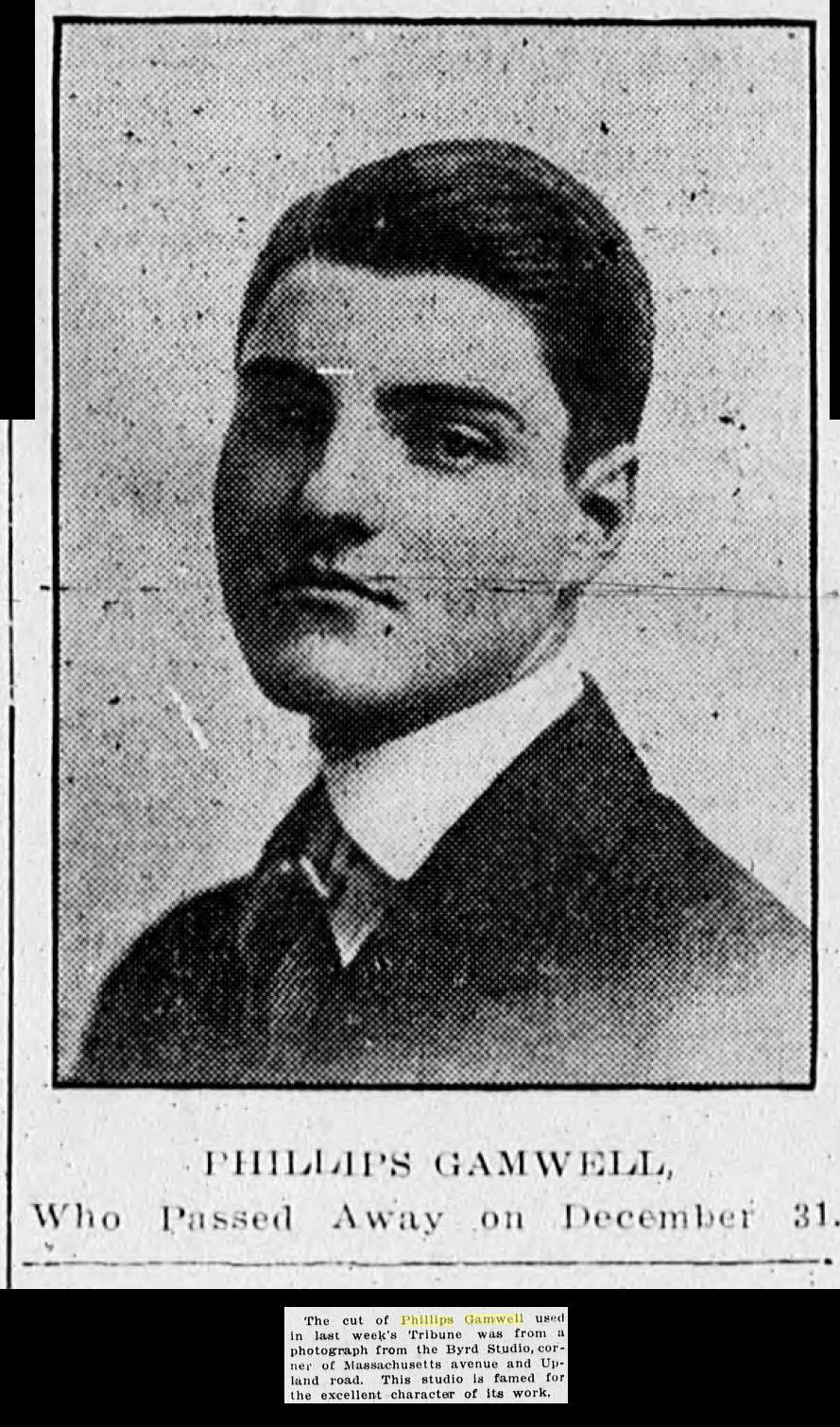
I’ve found another two appearances of Lovecraft’s elegy for his adored cousin Phillips Gamwell, who died young. Lovecraftian sources have the poem appearing in the Providence Evening News on 5th January 1917. But here it is in The Cambridge Chronicle, 6th January 1917, possibly with new biographical details in the introduction…

gamwell1

gamwell2

The same poem appeared again in The Cambridge Tribune on 13th January 1917, under the simple title “Phillips Gamwell”, this time with a fine photograph of cousin Phillips…

phillips_gamwell

… and the following week there was also an addendum on the photographer.

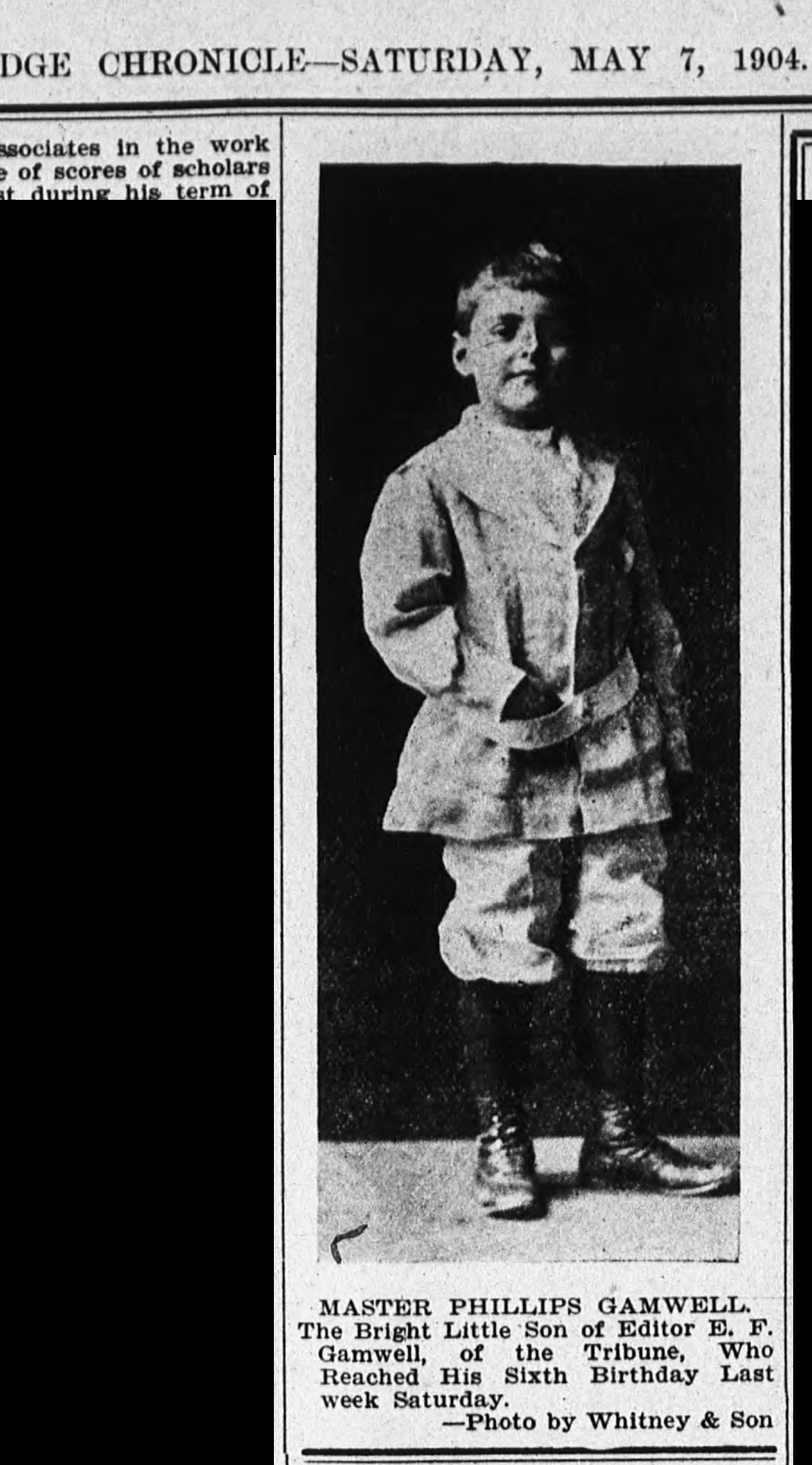
We’re also informed by The Cambridge Tribune of 2nd January 1904 that Phillips Gamwell was visiting Providence. Lovecraft then age 13, Phillips aged around 6. Here is Phillips Gamwell aged six in 1904 in The Cambridge Chronicle…

phillips_gamwell_1904

Resembles the young Lovecraft, wouldn’t you say?

Deacon Edward Taylor house

05 Wednesday Jun 2013

Posted by asdjfdlkf in Historical context, New discoveries

≈ 1 Comment

The building next to the Fleur de Lys Studios in Providence? Lovecraft’s uncle Franklin C. Clark appears to have owned it between 1873-1884. It’s the Deacon Edward Taylor house at 9 Thomas Street.

deaconprovidence

Uncle Edwin feels the chill

05 Wednesday Jun 2013

Posted by asdjfdlkf in Historical context, New discoveries

≈ 2 Comments

Here’s the ad of a refrigerator company agent in Providence in 1910. Note that the name is that of Lovecraft’s uncle Edwin Everett Phillips (1864-1918). This is from just before he lost a load of money for Lovecraft and his mother in 1911…

lovecraftuncle1910

In 1911, is this him being the Secretary and a Director in the new Providence Rotary Club?

rotary

rotary2

1911officers

The Boston Rotary Club (in 1912 apparently on rocky foundations, according to an open letter from the Chairman in 1912), sponsored the first Providence Rotary Club in 1911. The Providence club was set up alongside the established Rhode Island Rotary Club. One wonders if the new Providence Rotary got off to a shaky start, and/or if the Boston Rotary Club had to call in its sponsorship? A history of the Providence Rotary Club and its later merger with the incumbent club is given in The Rotarian, Oct 1917.

One wonders if Providence Rotary Club, being a commercial venture, was the same commercial venture which lost Lovecraft and his mother a lot of money? In 1932 Lovecraft remembered in a letter that…

“an uncle lost a lot of dough for my mother and me in 1911” (Selected Letters III, p.267)

Uncle Edwin (if indeed it was he) appears to have vanished as both Secretary and Director of the Providence Rotary Club by 1912/13, as evidenced by this picture and list of the officers. One wonders of his disappearance might suggest some financial calamity, one which necessitated his resignation?

provrotary1912

More on the Men’s Club in Providence

05 Wednesday Jun 2013

Posted by asdjfdlkf in Historical context, New discoveries

≈ 1 Comment

I found some further illuminating details which touch on the youthful Lovecraft’s involvement with the Universalist Men’s Club in Providence. Here is an article from 1922 (Cambridge Chronicle newspaper, 4th March 1922) in the fourth paragraph of which a visitor from the Providence men’s club visits the Cambridge equivalent, and reminds the laymen members there of their founding aims (the press report not actually going into detail on these, sadly)…

comrades

Following up the group’s name, it seems “The Order of Universalist Comrades” would be the title of such Clubs, at least by the early 1920s. I have found another reference to a branch of the “Universalist Comrades” in The Lewiston Daily Sun (17th Feb 1922). Yet The Universalist Register (available online to 1918) contains no mention of any Comrades. It seems likely that the name was changed after Lovecraft’s likely years with the organisation (his involvement perhaps sometime between 1906-1914), with the name change perhaps around 1921 or 1922? It strikes me that, in the radical political times after 1919, renaming the Men’s Club as “The Order of Universalist Comrades” might have been meant to appeal to naive youth looking for clubs of either the right or the far-left. But the Comrades seem to have vanished as an organisation during the years of the Great Depression…

“[Fred Colwell Carr, 1873-1936] was a native of Rhode Island and most of his life was passed in Providence” “He was national secretary of the now defunct organization, the Universalist Comrades.” “For the past eighteen years he has been secretary of the Universalist Convention of Rhode Island.” (The Christian Leader aka The Universalist Leader, Volume 39, Issue 4, 1936, p. 125) My emphasis.

This Carr name is interesting, and he must be the same Carr who spoke at the Cambridge meeting in 1922 (see the press cutting above). Carr may thus give us the name of someone connected to the Providence Men’s Club in Lovecraft’s time, when Carr would have been in his 40s and a possible leader of the Men’s Club. His name leads to me a list of its officers in Providence in 1922…

“The Universalist Comrades: President, Mr. E. S. Burlingham, 11 Progress Ave., Providence; Vice-President, Mr. Anson Wheelock, Woonsocket; Treasurer; Mr. Daniel E. Peckham, 30 Gurney St., East Providence; Secretary, Mr. Fred C. Carr, …” (Universalist Biennial Reports and Directory, 1922)

But there the trail goes dead. Sadly his 1936 obituaries are inaccessible online, due to copyright. They might have told us if he led the Men’s Club in Providence before the First World War, and something of the nature of the youth work then done in Providence. He also shows up in the record as Frederick Colwell “Freddie” Carr (1873-1936).

A few additions for Anna Helen Crofts (1889-1975)

02 Sunday Jun 2013

Posted by asdjfdlkf in Historical context, New discoveries

≈ Leave a comment

The collaborative story “Poetry and the Gods”, by Anna Helen Crofts and H.P. Lovecraft, appeared The United Amateur in September 1920. An H.P. Lovecraft Encyclopedia states nothing is known about Croft other than her address at 343 West Main St., North Adams, Mass. and that she “appeared sporadically in the amateur press”. However Crofts was traced through the Adams city directories in The Fossil #341, July 2009, in Kenneth W. Faig, Jr.’s “The strange story of “Poetry and the Gods” by Anna Helen Crofts and Henry Paget-Lowe”. Other details were also found. An obituary and further details were later unearthed and published in The Fossil #344, April 2010. Donovan K. Loucks in 2010 photographed her house and grave which shows her as Anna Helen Crofts McCuen (1889-1975), who married Joseph B. McCuen (1879-1963).

Given the biographical materials so far discovered on Crofts, Lovecraft presumably collaborated on “Poetry and the Gods” in the summer before Crofts took up a new salaried job in teaching. I have dug up the press notice of her appointment and salary, in the North Adams Transcript of 9th June 1920, with her appointment presumably being for the September 1920 term…

notice1920

This appears to have been her first substantial teaching post, judging from the dates in the obituary. I have also found that Crofts published several articles in Vocational guidance magazine (organ of the National Vocational Guidance Association). One of her articles was titled “Guidance versus Knights of the Road” (1932).

More interestingly I have also found some of the titles of her other fiction or poetry, as listed in The FictionMags Index…

   “Le Silent”, (short story), The Tryout Feb 1918.
   “To Autumn”, (poem), The Vagrant Jun 1918.
   “War Literature”, (article), The Tryout Apr 1919.

I’ve encountered no mention of her story “Le Silent” online, but the title makes it sound as if it might have been of interest to Lovecraft. Faig wonders why Lovecraft collaborated with her, and suggests i) her election as an officer of the United amateur movement in July 1920 and ii) the striking blank verse extracts she borrowed (uncredited) from Elizabeth J. Coatsworth to adorn “Poetry and the Gods”. Lovecraft had two poems (“A Winter Wish” and “Laeta: A Lament”) in the same Feb 1918 Tryout issue, and so (if The FictionMags Index is correct, and they haven’t mis-labelled a poem as a story), he would have seen her earlier work. Perhaps “Le Silent” is why he collaborated with her? The story “Le Silent” doesn’t appear to be online, nor is it collected anywhere that I can find details for.

The article by Faig in The Fossil #341 reports one other story by her, but it is not “Le Silent”…

   “S.T. Joshi credits Miss Crofts with at least one further story in the amateur press, “Life” (United Amateur, June 1921)”.

I cannot find online details of that story either, and neither “Life” nor “Le Silent” appears to be available online or collected. Nor can I find any trace of them being described or dismissed by Lovecraftians.

I can add just a little more to the work on Crofts published in The Fossil, in the form of this school art worksheet by her, in The School Arts Magazine, Vol.20, Sept 1920 to June 1921…

paperpr

← Older posts
Newer posts →


Please become my patron at www.patreon.com/davehaden to help this blog survive and thrive.

Or donate via PayPal — any amount is welcome! Donations total at Easter 2025, since 2015: $390.

Archives

  • February 2026
  • January 2026
  • December 2025
  • November 2025
  • October 2025
  • September 2025
  • August 2025
  • July 2025
  • June 2025
  • May 2025
  • April 2025
  • March 2025
  • February 2025
  • January 2025
  • December 2024
  • November 2024
  • October 2024
  • September 2024
  • August 2024
  • July 2024
  • June 2024
  • May 2024
  • April 2024
  • March 2024
  • February 2024
  • January 2024
  • December 2023
  • November 2023
  • October 2023
  • September 2023
  • August 2023
  • July 2023
  • June 2023
  • May 2023
  • April 2023
  • March 2023
  • February 2023
  • January 2023
  • December 2022
  • November 2022
  • October 2022
  • September 2022
  • August 2022
  • July 2022
  • June 2022
  • May 2022
  • April 2022
  • March 2022
  • February 2022
  • January 2022
  • December 2021
  • November 2021
  • October 2021
  • September 2021
  • August 2021
  • July 2021
  • June 2021
  • May 2021
  • April 2021
  • March 2021
  • February 2021
  • January 2021
  • December 2020
  • November 2020
  • October 2020
  • September 2020
  • August 2020
  • July 2020
  • June 2020
  • May 2020
  • April 2020
  • March 2020
  • February 2020
  • January 2020
  • December 2019
  • November 2019
  • October 2019
  • September 2019
  • August 2019
  • July 2019
  • June 2019
  • May 2019
  • April 2019
  • March 2019
  • February 2019
  • January 2019
  • December 2018
  • November 2018
  • October 2018
  • September 2018
  • August 2018
  • August 2015
  • July 2015
  • April 2015
  • March 2015
  • February 2015
  • January 2015
  • December 2014
  • November 2014
  • October 2014
  • September 2014
  • August 2014
  • July 2014
  • June 2014
  • May 2014
  • March 2014
  • February 2014
  • January 2014
  • December 2013
  • November 2013
  • October 2013
  • September 2013
  • August 2013
  • July 2013
  • June 2013
  • May 2013
  • April 2013
  • March 2013
  • February 2013
  • January 2013
  • December 2012
  • November 2012
  • October 2012
  • September 2012
  • August 2012
  • July 2012
  • June 2012
  • May 2012
  • April 2012
  • March 2012
  • February 2012
  • January 2012
  • December 2011
  • November 2011
  • October 2011
  • September 2011
  • August 2011
  • July 2011
  • June 2011
  • May 2011
  • April 2011
  • March 2011
  • February 2011
  • January 2011
  • December 2010
  • November 2010
  • October 2010
  • September 2010
  • August 2010
  • July 2010

Categories

  • 3D (14)
  • AI (70)
  • Astronomy (70)
  • Censorship (14)
  • de Camp (7)
  • Doyle (7)
  • Films & trailers (101)
  • Fonts (9)
  • Guest posts (2)
  • Historical context (1,095)
  • Housekeeping (91)
  • HPLinks (73)
  • Kipling (11)
  • Kittee Tuesday (92)
  • Lovecraft as character (58)
  • Lovecraftian arts (1,625)
  • Lovecraftian places (19)
  • Maps (70)
  • NecronomiCon 2013 (40)
  • NecronomiCon 2015 (22)
  • New books (966)
  • New discoveries (165)
  • Night in Providence (17)
  • Odd scratchings (984)
  • Picture postals (276)
  • Podcasts etc. (430)
  • REH (184)
  • Scholarly works (1,468)
  • Summer School (31)
  • Unnamable (87)

Get this blog in your newsreader:
 
RSS Feed — Posts
RSS Feed — Comments

H.P. Lovecraft's Poster Collection - 17 retro travel posters for $18. Print ready, and available to buy — the proceeds help to support the work of Tentaclii.

Proudly powered by WordPress Theme: Chateau by Ignacio Ricci.