• About
  • Directory
  • Free stuff
  • Lovecraft for beginners
  • My Books
  • Open Lovecraft
  • Reviews
  • Travel Posters
  • SALTES

Tentaclii

~ News & scholarship on H.P. Lovecraft

Tentaclii

Category Archives: Lovecraftian arts

NecronomiCon Providence 2019 – new poster

30 Thursday May 2019

Posted by asdjfdlkf in Lovecraftian arts

≈ 1 Comment

Another new poster for the NecronomiCon Providence H.P. Lovecraft convention, in August 2019. The artist is not credited on the page, though there’s some lettering too small to read on the right of the picture. (Update: thanks to ‘The Joey Zone’ for telling that the artist is named Brandon Kawashima).

At the Biltmore Hotel…

DeviantArt Delights

29 Wednesday May 2019

Posted by asdjfdlkf in Lovecraftian arts

≈ Leave a comment

Some new Lovecraftian work on DeviantArt, since last I looked through the ‘Newest’ results.

CA-Yogsothoth-F-BKM-PROG234567 by BKMcDevitt

Project: OSIRIS by SkoldArt

H. P. Lovecraft Statue by HaoZhiWei

Howard Lovecraft bust sculpture v.4 by tot-art

Howard Lovecraft by Malospal

The Silent Singer by FatherStone

Misc Longharbor concept art by nashotobi

RPG SvenskaKulter by IanBaggley (cover for a Swedish Lovecraftian RPG)

Deathning by Emerbend

Mr Nibblesworth by Dont-Trust-Dolls

Bestiary of the Cthulhu Mythos – interior previews

29 Wednesday May 2019

Posted by asdjfdlkf in Lovecraftian arts, New books

≈ 1 Comment

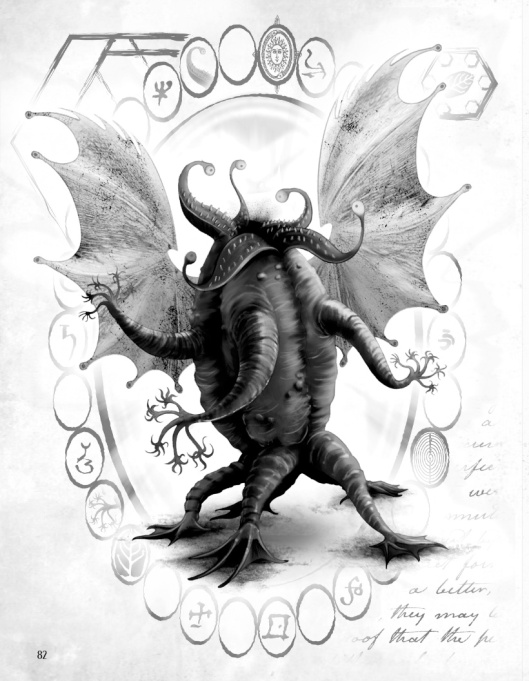
New interor preview pages from Kenneth Hite’s forthcoming for-gamers book Hideous Creatures: A Bestiary of the Cthulhu Mythos.

As I noted here back in October 2018 the book draws on Derleth and others, and despite its table-trembling size it’s not a completist illustrated encyclopaedia.

Xavier de Palau

29 Wednesday May 2019

Posted by asdjfdlkf in Lovecraftian arts

≈ Leave a comment

Xavier de Palau : tales of emerging music. This Italian musician is doing interesting work, with cosmic-focussed projects such as generatively converting the influence of space bodies (e.g. moonlight, the spectra of Mars) to music. One of his projects, Oradura, was inspired by Lovecraft.

Lovecraft’s Music

28 Tuesday May 2019

Posted by asdjfdlkf in Historical context, Lovecraftian arts

≈ Leave a comment

* As a young child H.P. Lovecraft… “sat rapt with childish adoration at the strains of Beethoven”.

* In his early boyhood he greatly enjoyed… “in youth listening to the [bandstand] concerts of Reeves’ American Band at Roger Williams Park with my grandfather.” and “I was forever whistling & humming in defiance of convention & good breeding.” He also enjoyed hearing Beethoven.

* After two years of lessons in classical violin playing… “I played a solo from Mozart before an audience of considerable size” in 1899, age 9. S. T. Joshi (also a music expert, compared to most ordinary folks) has carefully evaluated the possibilities for the pieced played. Joshi concludes… “it may be that Lovecraft played one movement (probably the slow movement or the minuet, since even the allegros of the early sonatas are demanding to a very inexperienced player) of the sonata in C, K. 6, in D, K. 7, or in B-flat, K. 8. Lovecraft’s description of a “solo from Mozart” implies only part of a work rather than a complete work.” But Lovecraft was pushed too fast and too far, and thus reacted strongly against the possibility of further lessons. All classical music seems to have been thrown overboard, along with his violin.

* By middle-childhood he was instead excelling at a more boyish instrument. He… “was also a star zobo soloist … the “zobo” — a brass horn with a membrane at one end, which would transform humming to a delightfully brassy impressiveness!”

* The popular tunes of his boyhood stayed with him, and… “even now I relish the old-time inanities when they are revived on the radio” (1934). He refers here to ‘tin-pan alley’ songs, old barber-shop tunes, and jaunty marching ditties. S.T. Joshi notes that in 1933 letter Lovecraft could still rattle off the names of “the hit songs of 1906″… ““When the Whip-Poor-Will Sings, Marguerite,” “When the Mocking-Bird Is Singing in the Wildwood,” “I’ll Be Waiting in the Gloaming, Genevieve,” “In the Golden Autumn Time, My Sweet Elaine””. These being the songs he had belted out as a boy of about age 12, in the company of his ‘Blackstone Military Band’ — made up of young friends playing their buzzing zobos and the like.

* He had a phonograph and discs as a boy of about 16-18… “memories of the days of a decade ago [c. 1907], when my phonograph was in constant use. I remember one record — a song called “Starlight”, which was truly Western in its cadences: “Good Nity, my Starrrrlight, hearrrt of my hearrt” … etc. etc.” Presumably he means Western as in ‘the wild west’.

* He appears to have also attained and retained some small facility with a musical keyboard, probably first acquired in childhood. For instance, at the main Baptist Church in Providence… “Lovecraft ascended to the organ loft and attempted to play ‘Yes, We Have No Bananas'”, a jaunty and highly popular tune. Which implies he could handle a keyboard. He would also sing tunes when called upon, in circumstances requiring parlour piano singing, with one letter vividly recording such a time in the Little household. There were probably also various social calls with his aunts where a song was a requirement.

* He was a tenor singer… “I once owned an Edison machine of the primitive type, with recorder and blanks; and I made many vocal records in imitation of the renowned vocalists of the wax cylinder. My colleagues would smile to hear some of the plaintive tenor solos which I perpetrated in the days of my youth!!”

* As for recorded and stage music, he wrote… “I am a frank barbarian, with Victor Herbert as about the upper limit of my real appreciation.” Victor Herbert (1859-1924) was the USA’s first accomplished composer for musical theatre. Mostly known now for a few enduring songs such as “Ah! Sweet Mystery of Life” (1910). Some of his operetta work is interesting re: Lovecraft, such as his… “wonderful and terrifying children’s operatic dreamscape”, Babes in Toyland (1903, music only). Though regrettably Babes has never been filmed in any form resembling the 1903 stage original (“Alan and Jane are abandoned in the Forest of No Return. In the Spider’s Den, they are protected by the Moth Queen. [In Toyland] the Master Toymaker is an evil genius who creates toys that kill and maim.”). After the First World War, Herbert swung behind the nation’s changing tastes and wrote straight musical comedies with simpler songs and tunes. I imagine Lovecraft liked both phases of Herbert’s work, but his use of the phrase “upper limit” might appear to indicate that he had enjoyed Herbert’s rather more complex operettas of the pre-war period. Yet he mentions Babes in Toyland as a youthful memory, in a letter to Morton of 1932.

* Lovecraft valued patriotic British songs, and for him… “”Tipperary” or “Rule Britannia” has infinitely more emotional appeal than [classical music]”. He refers here to the famous “It’s a Long Way to Tipperary / Pack Up Your Troubles…” song.

* He heard and enjoyed singing in the context of a seasonal townscape, for instance attending Christmas carol-singing… “at the old Truman Beckwith mansion” on College Hill in Providence.

* He apparently approved of Chopin, or at least he expressed murmurs of approval when the enthusiastic music student Gaplin played him some on a gramophone. He also saw light opera on the stage (or, as ‘light’ as opera gets) in the form of Katinka (1915). I imagine that was probably attended in the company of his aunts. There were doubtless many other such visits, to other local popular shows.

* Although he had at first disliked it passing, during his early boyhood, when older Lovecraft was genuinely stirred by the sweeping music of Wagner. He had an excellent opportunity to hear Wagner in New York City when he saw Fritz Lang’s Siegfried in 1925. Though this was seen in a cinema specially-equipped for the lush Wagnerian sound, Lovecraft felt he wasn’t able to appreciate the music fully due to his lack of training in understanding its subtleties and meanings. “The conventional grand opera goes over okay with Grandpa [i.e. Lovecraft], & Dick Wagner (whose Ride of the Valkyries I was privileg’d to hear) is just about my idea of emotion as derivable from sound.”

* He would, of course, have heard a great deal of incidental stage and feature film music over the years. The most memorable of which was likely pointing up some aspect of the macabre, mysterious or fantastical as it flickered across the silver screen.

* He would hum and whistle on walks, which was once a very common and accepted practice. He wrote… “It is impossible for me to whistle out of tune, or to miss notes by sharping or battening them. Whatever I do hum, I hum with the mathematical precision of a well-tuned piano. Rhythm, also.” And, writing to Kleiner… “today I hum & whistle the stuff you despise so much as played on your relative’s phonograph”. The once-common practice of outright singing while walking appears to have totally passed away in the Anglosphere by the 1920s, at least for lone walkers. Even humming and whistling is not ‘done’ today, and strikes us as eccentric and a sign of likely madness. But humming and whistling would have been acceptable in the 1920s, and probably even welcomed on the sleepy back-roads of New England. It would have rather politely served to alert people of his imminent arrival, while coming toward them along a track or lane.

* He also valued simple music that was integral to landscapes, such as… “sleepy churches whose chimes weave music and magic on Sunday mornings”, and faint music heard from ineffably far-off in an intriguingly indistinct and un-placeable form.

As S.T. Joshi has pointed out, Lovecraft never seems to have become familiar with the music of his beloved 18th century.


Thus, an imaginary “Lovecraft’s Music” 12-track album might look something like:

1. Strange “Zobo” noises, the sliding and zip of bicycle tyres on asphalt, merging into a New England parkland ambiance with the oompah playing of a distant bandstand, then a merry-go-round whirrs up to manic intensity, before a tumble of scraping violins chases away all the outdoor sounds.

2. Fade to indoors ambience. Faint scratchings. A single violin starts, initially halting and hesitant, and sometimes “rats clawing in the walls”-like. Yet it becomes ever more proficient and leads up into the fine if not very professional Mozart solo. This is played in a manner that expresses something of the boy Lovecraft’s loneliness. There is no applause from an audience.

3. Climbing old wooden stairs, a creaking door opens. Something from Babes in Toyland is heard, perhaps the “Toymaker’s Workshop” with its medley of weird workshop noises, suggesting Lovecraft’s time spent in the attic and the whirring of his mind as it comes alive.

4. The uncertainty of the previous track becomes the certainty of a jaunty boyish marching song, this then turning into a wartime “It’s a Long Way to Tipperary”, which in turn merges into a stirring “Rule Britannia”.

5. Fade into distant carol-singing, the noises of College Hill, the mew of cats, but increasingly echo-y as if in dark tunnels. The echo of the Boston subway, the ding and rumble of trolley-cars. The rumbling becomes more and more ominous and is mixed with anxious “Nyarlathotep”-like crowd-shouts from the disturbed Boston of 1919, then…

6. Siegfried music, and on into the “Ride of the Valkyries”.

7-10. A blended selection from the film music Lovecraft would have heard in the 1920s and 30s.

11. A modern electro-ambient / low-key plaintive interpretation of Victor Herbert’s “Ah! Sweet Mystery of Life” (1910), evoking his fallow years. Delightfully mewing kitties pad softly into and around the music.

12. … fading to a Virginia Astley (From Gardens Where We Feel Secure) -like soundscape of New England summer lanes, the sound of a man humming precisely a lively marching tune as he crunches down a path, against the call of distant bells and ever more indistinct far-off sounds as the man walks into the distance. Sounds of night coming on, a cosmic whisper of stars, distant whip-poor-wills call, and then the distant meowrrr-ing of a grimalkin Ulthar-cat is heard.

‘Une nuit avec Lovecraft’ reviewed

24 Friday May 2019

Posted by asdjfdlkf in Lovecraftian arts, New books

≈ Leave a comment

The French edition of Rodolphe & Marcele’s One Night with Lovecraft graphic novel, newly reviewed in French. As I’ve previously noted here, this fine graphic novel is free online in French, and in English translation on LibGen.

Herbert West: Reanimator – a two-hour reading

22 Wednesday May 2019

Posted by asdjfdlkf in Lovecraftian arts, Podcasts etc.

≈ Leave a comment

This week’s The SFFaudio Podcast #526 is a full two-hour unabridged audiobook reading of “Herbert West: Reanimator” by H.P. Lovecraft, read by Jim Moon. Apparently it’s a re-run of a Hypnogoria podcast that I can’t immediately find and may no longer be available. “Herbert West” was of course the serial ‘shocker’ that Lovecraft wrote for Home Brew.

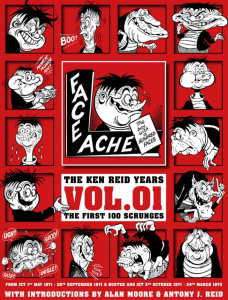
Looking for the Hypnogoria original of this audio reading, I was pleased to discover Hypnogoria: Microgoria #65 – Shiver and Shake and the Creepy Creations of Ken Reid. 33 minutes of podcast surveying a British master of fun cartoon monster-creation.

Ken Reid has a series of handsome book re-issues, Creepy Creations Vol 1., Faceache Vol 1: The First Hundred Scrunges, and Ken Reid’s World Wide Weirdies Vol. 1. His work will be fondly remembered by those of a certain generation.

I wonder if anyone still has that old cardboard “dial-a-monster” picture-frame from that time, which one could get through the mail and I for one had a copy of (long lost, now). It was an early generative work, as millions of unique combinations were possible, there being circular dials which would swing a variety of eyes, hair, chins, noses etc into the picture-frame portrait. They were designed so they would all more or less seamlessly blend together.

New book: A Place of Darkness

22 Wednesday May 2019

Posted by asdjfdlkf in Historical context, Lovecraftian arts, New books, Podcasts etc., Scholarly works

≈ Leave a comment

An interesting sounding new book of cultural history from Kendall R. Phillips, A Place of Darkness: The Rhetoric of Horror in Early American Cinema (Spring 2018). It steps beyond the movie industry’s early history and surveys the wider currents which each distinct cultural milieu both drew on and drew around itself…

“He shows how early cinema [1890s onward] linked monsters, ghosts, witches, and magicians with Old World superstitions and beliefs, in contrast to an American way of thinking that was pragmatic, reasonable, scientific, and progressive. Throughout the teens and twenties [1910s and 20s], Phillips finds, supernatural elements were almost always explained away as some hysterical mistake, humorous prank, or nefarious plot. The Great Depression of the 1930s, however, constituted a substantial upheaval in the system of American certainty and opened a space for the reemergence of Old World gothic within American popular discourse in the form of the horror genre [the famous Universal monster movies, 1931 onwards], which has terrified and thrilled fans ever since.”

It’s being well reviewed. Sublime Horror has a sturdy review, and also a free one-hour podcast interview with the author.

Book And Magazine Collector on Lovecraft

21 Tuesday May 2019

Posted by asdjfdlkf in Historical context, Lovecraftian arts, Odd scratchings

≈ Leave a comment

New on Archive.org, Book And Magazine Collector #193 (2004) with a good short potted introduction to Lovecraft’s genuine rarities and his basic publication history. Also the (then) not-so-rare. Oh, to have had Selected Letters Vol. 1 for just £15!

New book: Mud and Starlight: The Alan Moore Interviews

21 Tuesday May 2019

Posted by asdjfdlkf in Lovecraftian arts, New books

≈ Leave a comment

Newly published, albeit with a pug-ugly cover, Mud and Starlight: The Alan Moore Interviews 2008—2016. 372 pages of rare interviews, many apparently no longer available (defunct blogs) or difficult to obtain (obscure fanzines).

The Amazon UK “Look Inside” won’t let me see the contents page, but Amazon USA will…

The White Tree

20 Monday May 2019

Posted by asdjfdlkf in Lovecraftian arts, Podcasts etc.

≈ Leave a comment

It’s interesting to see that the H.P. Lovecraft Historical Society / Dark Adventure Radio Theatre are branching out into new HPL-alike audio adventures. Their The White Tree runs 72 minutes with their usual full-cast and full-FX approach, and the story sees…

The police inspector who once probed the mysteries of the Cthulhu cult on a case that leads him once again into the foreboding bayous of Louisana.

It’s © 2016 and on release seems to have been CD-only with a prop-pack. But I’ve now noticed it because it’s been released to Audible for download, dated “26th March 2019”.

New book: Songs of Giants

20 Monday May 2019

Posted by asdjfdlkf in Lovecraftian arts, New books, REH

≈ Leave a comment

Nearly published, Songs of Giants is a sumptuously illustrated…

“collection of some of the very best poetry written by three giants of pulp literature; Robert E. Howard, Edgar Rice Burroughs and H. P. Lovecraft.”

Available here and set to ship in June 2019.

← Older posts
Newer posts →


Please become my patron at www.patreon.com/davehaden to help this blog survive and thrive.

Or donate via PayPal — any amount is welcome! Donations total at Easter 2025, since 2015: $390.

Archives

  • March 2026
  • February 2026
  • January 2026
  • December 2025
  • November 2025
  • October 2025
  • September 2025
  • August 2025
  • July 2025
  • June 2025
  • May 2025
  • April 2025
  • March 2025
  • February 2025
  • January 2025
  • December 2024
  • November 2024
  • October 2024
  • September 2024
  • August 2024
  • July 2024
  • June 2024
  • May 2024
  • April 2024
  • March 2024
  • February 2024
  • January 2024
  • December 2023
  • November 2023
  • October 2023
  • September 2023
  • August 2023
  • July 2023
  • June 2023
  • May 2023
  • April 2023
  • March 2023
  • February 2023
  • January 2023
  • December 2022
  • November 2022
  • October 2022
  • September 2022
  • August 2022
  • July 2022
  • June 2022
  • May 2022
  • April 2022
  • March 2022
  • February 2022
  • January 2022
  • December 2021
  • November 2021
  • October 2021
  • September 2021
  • August 2021
  • July 2021
  • June 2021
  • May 2021
  • April 2021
  • March 2021
  • February 2021
  • January 2021
  • December 2020
  • November 2020
  • October 2020
  • September 2020
  • August 2020
  • July 2020
  • June 2020
  • May 2020
  • April 2020
  • March 2020
  • February 2020
  • January 2020
  • December 2019
  • November 2019
  • October 2019
  • September 2019
  • August 2019
  • July 2019
  • June 2019
  • May 2019
  • April 2019
  • March 2019
  • February 2019
  • January 2019
  • December 2018
  • November 2018
  • October 2018
  • September 2018
  • August 2018
  • August 2015
  • July 2015
  • April 2015
  • March 2015
  • February 2015
  • January 2015
  • December 2014
  • November 2014
  • October 2014
  • September 2014
  • August 2014
  • July 2014
  • June 2014
  • May 2014
  • March 2014
  • February 2014
  • January 2014
  • December 2013
  • November 2013
  • October 2013
  • September 2013
  • August 2013
  • July 2013
  • June 2013
  • May 2013
  • April 2013
  • March 2013
  • February 2013
  • January 2013
  • December 2012
  • November 2012
  • October 2012
  • September 2012
  • August 2012
  • July 2012
  • June 2012
  • May 2012
  • April 2012
  • March 2012
  • February 2012
  • January 2012
  • December 2011
  • November 2011
  • October 2011
  • September 2011
  • August 2011
  • July 2011
  • June 2011
  • May 2011
  • April 2011
  • March 2011
  • February 2011
  • January 2011
  • December 2010
  • November 2010
  • October 2010
  • September 2010
  • August 2010
  • July 2010

Categories

  • 3D (14)
  • AI (70)
  • Astronomy (70)
  • Censorship (14)
  • de Camp (7)
  • Doyle (7)
  • Films & trailers (101)
  • Fonts (9)
  • Guest posts (2)
  • Historical context (1,095)
  • Housekeeping (91)
  • HPLinks (75)
  • Kipling (11)
  • Kittee Tuesday (92)
  • Lovecraft as character (58)
  • Lovecraftian arts (1,627)
  • Lovecraftian places (19)
  • Maps (70)
  • NecronomiCon 2013 (40)
  • NecronomiCon 2015 (22)
  • New books (966)
  • New discoveries (165)
  • Night in Providence (17)
  • Odd scratchings (984)
  • Picture postals (276)
  • Podcasts etc. (431)
  • REH (184)
  • Scholarly works (1,469)
  • Summer School (31)
  • Unnamable (87)

Get this blog in your newsreader:
 
RSS Feed — Posts
RSS Feed — Comments

H.P. Lovecraft's Poster Collection - 17 retro travel posters for $18. Print ready, and available to buy — the proceeds help to support the work of Tentaclii.

Proudly powered by WordPress Theme: Chateau by Ignacio Ricci.