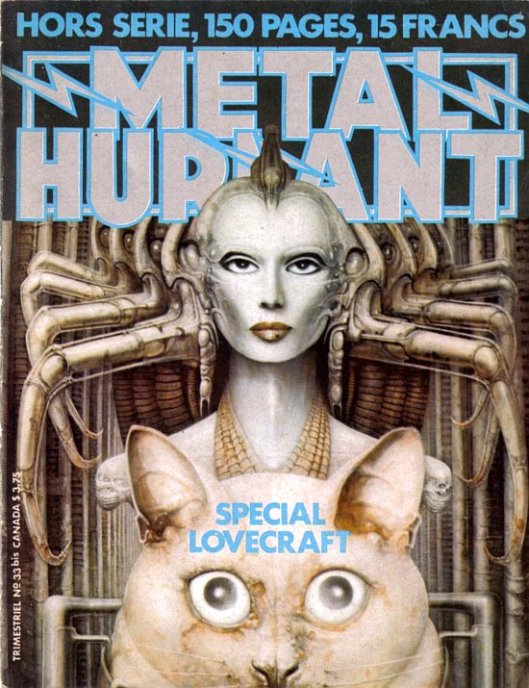
Celebrating H.P. Lovecraft’s keen interest in cats.
One of the best science-fiction stories of 1955/56… “The Game of Rat and Dragon”, from Galaxy for September 1955.
09 Tuesday Jun 2020
Posted in Lovecraftian arts
Celebrating H.P. Lovecraft’s keen interest in cats.
One of the best science-fiction stories of 1955/56… “The Game of Rat and Dragon”, from Galaxy for September 1955.
08 Monday Jun 2020
Posted in Lovecraftian arts
Graham Plowman has released a new soundtrack to an “unmade film” adaptation of H.P. Lovecraft’s At the Mountains of Madness.
Available now as free samples and as an $8 download.
07 Sunday Jun 2020
Posted in Lovecraftian arts
Just released, an interesting labour-of-love videogame from a former BioWare developer. Old Gods Rising is a single-player Windows game…
Old Gods Rising is a first-person adventure mystery. Duvall describes it as “what would have happened if H.P. Lovecraft had been running the Firewatch team.
In which you wander around an eerily deserted university campus and grounds. As you do, these days. I’ve no idea what Firewatch is but Old Gods sounds like it’s in the mould of the British game of a few years ago called Everyone’s Gone to the Rapture, but here with a scholarly and Lovecraftian layer. Old Gods is said to take about four hours for hardened three-games-a-week puzzler gamers, or perhaps three evenings for those who only play three games a year.
As with all large new PC games, it may be advisable to wait for a few bugfix patches before playing.
06 Saturday Jun 2020
I’ve found another early appearance of ‘Lovecraft as character’. It was mentioned in the Bloch letters, and takes the form of a three-page spoof story/sketch. Robert Bloch’s humorous “The Ultimate Ultimatum” appeared in Fantasy Magazine for August 1935. This purported to be an account, over three pages, of a very large convention of writers and fans. Supposedly having taken place recently in a large crypt, the ‘event’ clearly anticipated the form of ‘the large science-fiction convention’ as it later emerged — none had actually happened at that point, though regional ‘conventions’ were a thing in amateur journalism.
The relevant issue of Fantasy Magazine is not online, and nor is the item itself, but here is a taster dug out of a later magazine article on Bloch…
It was a big convention. Lovecraft was there. So was Clark Ashton Smith, August Derleth, and Otto Binder. Ray Palmer was present, and Stanley Weinbaum. Also there was I, thrilled and proud at attending this gathering of masterminds.
In his letter to Bloch, Lovecraft commented on Bloch’s “The Shambler from the Stars” story in which he had also featured as a character. He added… “the spoof also is extremely clever — I can recognise myself except for the pipe”.
An endnote for the letter adds a little more text from “The Ultimate Ultimatum”…
Howard Cthulhu Lovecraft … sat in the corner, puffing furiously at a skull-shaped pipe.
So far as I can tell the spoof has never been collected, and the Fantasy Magazine for August 1935 has its only appearance. It’s unknown if there were illustrations, but probably there weren’t. It might make for an interesting 1960s Mad magazine -style comics adaptation, today, by a good caricaturist.
30 Saturday May 2020
Posted in Lovecraftian arts
Looking for a Saturday-night movie, tonight? The movie Cast a Deadly Spell (1991) has reportedly arrived on Amazon Prime in the USA, and this week Film School Rejects has a short appreciation (warning: plot spoilers!) of this ambitious and successful attempt to create a fun mix of H.P. Lovecraft and 1940s gumshoe film noir…
Cast a Deadly Spell is pure fun, first and foremost. That said, the movie is also a prime example of how great storytelling and imagination are two of the most magical ingredients in any film. This movie has those qualities in abundance, and it deserves to be appreciated by a wider audience.
When it first appeared, Darrell Schweitzer noted in a fanzine that the original title was to have been H.P. Lovecraft: Private Eye. The central character is indeed named Lovecraft, and the actor has a mild facial resemblance, but otherwise he’s a typical 1940s Private Investigator. Schweitzer also compared the movie to Disney’s equally retro The Rocketeer (1991), but with more overt humour and (I would add) the budget put into FX and hand-made monster-puppets rather than big shiny stunt-planes and jet-packs.
It even has the coveted Stamp Of Approval from S.T. Joshi, who knows his gumshoe detectives as well as his Lovecraft…
it ingeniously combines the Mythos with hard-boiled detection in its portrayal of a tough private eye, H. Phil Lovecraft … While not directly based on a specific Lovecraft story, it captures the essence of the Cthulhu Mythos surprisingly well.
In I Am Providence Joshi singled it out as a “striking performance” … “highly effective”. Although he calls it a “two hour” film, so it’s possible he saw a naughty convention screening of a print made before the editor trimmed it back for cable TV running times? Just my guess. The stated running-time is actually one hour and 36 minutes. I don’t seen any mention of some 14 minutes or so of out-takes being available elsewhere, on YouTube or the laser-disc version.
It appears that Cast a Deadly Spell was a cable-only U.S.-only show for many decades, with an old VHS tape being just-about obtainable and a laser-disc being almost unobtainable… but no DVD was allowed lest it interfere with cable showings. However, my UK version of Amazon now offers a £10 Spanish import DVD with multi-language including English. In terms of current streaming, nothing is visible on the UK Prime — at least to a UK Amazon user who shuns Prime. Such are the stupidities of the region-system. The UK is a big profitable market, with buyers who would spring instantly for a £3.99 streaming version. Yet instead we have to risk an import DVD, or dodge among the dodgy torrents, or peer at a 480px VHS-rip on YouTube.
Fangoria magazine #106 (1991) had a long article on the movie and many spoiler-pictures of the various monsters, as part of their ‘Lovecraft special’ issue. This same issue also has a long article from Will Murray in which he surveys Lovecraft adaptations to 1990…
Note that an early 1990s scan of Fangoria magazine is probably not ‘safe for work’ in 2020.
Beware also that there was a Cast a Deadly Spell sequel in 1994 with a different star and different cast, less charm and humour, and the Lovecraftian lore was cut. But those were the years of the virulent ‘satanic panic’ hysteria, so we’re probably lucky that either movie was made and then reached a mass mainstream American audience.
28 Thursday May 2020
Posted in Lovecraftian arts, New books
Here’s the cover for The Colour Out of Space edition (Penguin Science Fiction) due in August 2020, ready for what would have been the ‘I got my student-grant!’ season. At first glance it seems a prime example of how marketeers think that slow cerebral science-fiction can’t be sold to the masses — except by misleadingly implying ‘there’s steamy sex inside!’ Eager readers hoping for ‘hot romps in the hay-loft’ may be disappointed.
Penguin may claim it’s actually a mutant seed-grain, if you sort-of squint hard at it. But that’s obviously not how potential readers are intended to see it on the shelves of the bookstore. Still, I suppose we and the designer should be grateful — at least there’s no Stephen King quote spoiling the cover. And the penguin trademark is actually kind of Lovecraftian, if you recall the giant-penguins in At The Mountains of Madness.
23 Saturday May 2020
Posted in Lovecraftian arts, Odd scratchings
Have a VR headset handy? Let’s Virtually “Wander” in Lovecraft’s Providence and Beyond…
“Please send a message to me on Facebook at WillHartCthulhuWho1 or contact me here on my blog, if you’d like to meet in Virtual Reality in “Wander,” to see some of the many Lovecraftian sites that can be visited this way, or in “vTime XR,” for a virtual four-person Lovecraftian meeting.”
17 Sunday May 2020
Posted in Lovecraftian arts
Herbert West Reanimator may have been dashed off as a ‘quickie grue’ series for Lovecraft, written to help a friend fill a new magazine of cheap titillation. But within the tale may lie “philosophical and theological themes”. Or such is the claim of the creatives behind the new graphic novel, Reanimator Incorporated. This re-tells West by pointing up these themes, making the tale an “exploration of existence itself”. The creatives have also shifted the setting to the future, with the serum becoming a “AI-driven atomic assembler unit”. Part one of the six-part series is out now.
16 Saturday May 2020
Posted in Historical context, Lovecraftian arts
George Laswell’s artbook Corners and characters of Rhode Island (1924) is now in the public domain and online at Archive.org as a good scan. Possibly also at Hathi, although for the last few months Hathi has been so slow and un-responsive as to be totally un-usable.
My thanks to Ken Faig Jr. who in the latest Lovecraft Annual points out that Sonia recalled that Lovecraft knew and admired Laswell’s pen sketches — since they had first appeared weekly in his local newspaper. A paper on which Laswell was the Staff Artist. Oh, for the days when a local newspaper had a Staff Artist who worked in crisp pen and ink…
That must have been circa 1921-1924, and thus we see Providence as it was after the First World War but before Lovecraft left for New York City. The main focus is on the worthy and seemingly timeless historic buildings, many of which Lovecraft mentions in his letters and stories. While posterity might have preferred a selection of the less-noticed elements of Providence — such as the bookstores, the hidden courtyards and their cats, the Seekonk shoreline and its dark ravine-pools — the book’s extensive survey of the city’s key buildings does make it a handy ‘look up tool’ for visualising a building as described in Lovecraft’s work or letters.
But there are two or three glimpses of the less genteel life of the city, of the sort that Lovecraft could have encountered on waterfront night-walks in the early 1920s. Such as the dredging fleet which over-wintered at Fox Point, and this portrait of the wooden waterfront with its cheap cafes that (so the text says) often went up in flames and burned out sections of the waterfront.
Burned out
I can imagine Lovecraft and Eddy breezing into one of these coffee cabins at the crack of dawn, in the early 1920s, after a long night-walk.
14 Thursday May 2020
Posted in Lovecraftian arts
Currently crowdfunding in Spain, Os gatos de Ulthar. So far as I can make out it’s intended, if funded, to be a small print celebration of the 100th anniversary of publication of “The Cats of Ulthar” in 1920 (written June, published November 1920). In the form of an illustrated adaptation, fold-out posters, bookmarks and similar.
12 Tuesday May 2020
Posted in Kittee Tuesday, Lovecraftian arts
Here is my reasonably faithful large assemblage of the cover art for the 1971 Ballantine U.S. paperback edition of The Dream-Quest of Unknown Kadath, in the Ballantine Adult Fantasy series. The spine could only be had as a low-res scan, which is why that bit is fuzzier than the rest.
The book went through three paperback printings from Ballantine before 1975, as the USA’s baby boomers came of age and discovered Lovecraft and fantasy in general. By 1983 the Del Rey edition had galloped like a frisky zebra through 28 reprintings. Given such apparent popularity at that time, it’s a pity so few young writer cut their little kitty teeth on Lovecraft’s Dreamlands. Gary Myers’s fine The House of the Worm (1975) collection being the stand-out exception. As C.W. Thomas wrote, back in 2010 at Innsmouth Free Press…
It saddens me a little that the Dreamlands never caught on as a setting for other writers. This seems odd, considering how much of what Lovecraft wrote became the springboard for new authors. … My challenge to writers is simply to write a tale of Ulthar or lost Kadath. Forget the retread tales of Deep Ones, the diaries about guys who look for Cthulhu. Try a little magic, instead. I will gladly join you in the land of Mnar, where men built “Thraa, Ilarnek, and Kadatheron on the winding river Ai.”
The Ballantine cover art for the 1971 Dream-Quest was by Gervasio Gallardo (Gervasio Gallardo Villasenor, of Barcelona, Spain). He had a solo 95-page artbook in 1976, The Fantastic World of Gervasio Gallardo, and a feature in Novum in the early 1970s, “Gervasio Gallardo, Spain: a master of free and applied art”.
An example of his other 1970s work can be seen below. This picture was made at a time before the crude political usurpation of the Marian ‘crown of stars’ by the mundane European Union, and the symbolism here is rather in his blending of the Catholic Mary ‘star of the sea’ with the classical Venus. Though such a comparison was likely to have gimlet-eyed Jesuits leaping out at the artist from dark corners of Barcelona’s Gothic Quarter, it was and is a perfectly valid elision to make and rests on good historical foundations — it was not a made-up New Age hippy confabulation of the mid 1970s. The devout Christian C.S. Lewis had also felt free to make a similar elision at the end of one of his science-fiction novels, as a way of of introducing the Marian in a form palatable to his readers.
Born in 1934, the artist Gervasio Gallardo came-of-age in the Catholic Francoist post-war Barcelona of the mid 1950s. He left Spain for work at a German studio in 1959, moving later to an agency in Paris and then to USA in 1963. He was prolific in the early and mid 1970s, producing many covers for the Ballantine Adult Fantasy series and other authors. Thereafter he went back to Barcelona and set up his own studio, and then appears to have worked mostly as a commercial artist, with clients among European perfumiers and the makers of fine Spanish liqueurs and brandies. Not a bad line of regular work to be in, as the boom years of the mid-1980s approached.
The Fantastic World of Gervasio Gallardo at Archive.org.
11 Monday May 2020
Posted in Lovecraftian arts, New books
Une annee sans Cthulhu (A Year Without Cthulhu), a new colourful curiosity from France.
It’s a 176-page graphic novel murder-mystery, melding 1980s teenage schoolroom angst with Lovecraftian role-playing games. It’s in French.
Equally curious and gaming related is the new RPG booklet 100 Rumours to Hear in Lovecraft Country. Specifically being…
Rumours to hear in or about the towns of Arkham and Kingsport. … These rumours can be used as potential adventure hooks or background colour. They are aimed at the 1920s-30s setting but, with tweaking, some could be adapted to other settings.