• About
  • Directory
  • Free stuff
  • Lovecraft for beginners
  • My Books
  • Open Lovecraft
  • Reviews
  • Travel Posters
  • SALTES

Tentaclii

~ News & scholarship on H.P. Lovecraft

Tentaclii

Category Archives: Lovecraftian arts

Gou Tanabe’s “The Haunter of the Dark”

16 Tuesday Mar 2021

Posted by asdjfdlkf in Lovecraftian arts

≈ Leave a comment

Gou Tanabe’s 160-page comics adaptation of Lovecraft’s “The Haunter of the Dark” has just reached the French market, having been published in serial form in Japan back in 2016.

Beware Amazon’s apparent link to a Kindle ebook, on the same page. This turns out to be a get-rich-quick shovel-ware edition of Lovecraft that has nothing to do with Tanabe, and is just the usual dodgy link being added by Amazon’s indiscriminate dumb-bots. You would have thought that a huge, rich, and AI-savvy corporation like Amazon would have cracked this mis-selling problem by now. But no.

‘Picture Postals’ from Lovecraft: Tentacles over Brooklyn

12 Friday Mar 2021

Posted by asdjfdlkf in Historical context, Lovecraftian arts, New discoveries, Picture postals

≈ 2 Comments

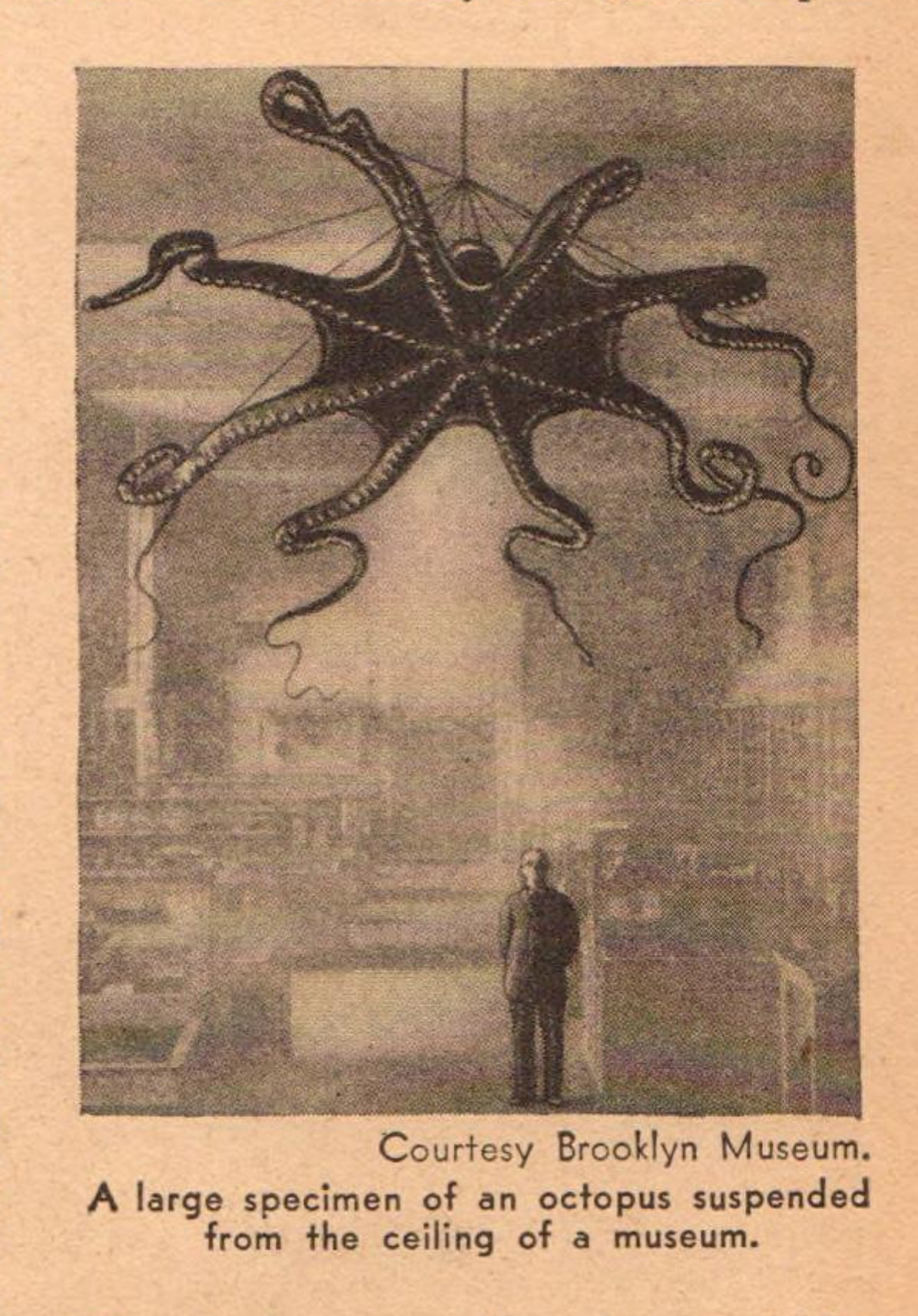
Tentacles in the Brooklyn Museum, 1931. Found while flipping through Science and Invention magazine for March 1931, newly on Archive.org. An initial search suggested there was also a giant squid, as the modern book Brooklyn Museum of Art: Building for the Future talks of their having once been natural history galleries and a specific section for… “Invertebrates housing not only display cases of specimens but also large models of a squid and an octopus suspended overhead”.

The first hall, moved wholesale to another hall and re-opened by 1928. This is as Lovecraft would have known it until c. 1927.

The first question was, did H.P. Lovecraft know the Museum from 1922 onward? Yes, of course he did. He saw it as a tourist first, and then ‘did it’ systematically and thoroughly later in 1922. Its galleries and the adjacent Japanese Gardens became a regular haunt when he was in New York. Another question was, was it always the “Brooklyn Museum” or did it have another or formal name? Indeed it did, being also known as the Brooklyn Institute. Pictures? Yes, here is a rare eye-level card showing it about a decade earlier. Most of the other cards are later, gaudily coloured and vigorously airbrushed.

Were there other attractions there? Well, a big attraction was the cost. Entry was free on most days, and the place was also open in the evening on Thursdays. By circa 1930 he probably knew the place well, but he was also well aware of the new items being accessioned. He did the Museum solo in May 1930, seeing the new ‘Colonial furniture and interiors’ wing which newly offered complete rooms arranged for Lovecraft’s lingering delight. In 1933 he “…did the Brooklyn Museum with Sonny” — Lovecraft letter to Morton, 12th January 1933, when they focussed on the “Dutch” section. I would suspect that this may also have been new.

But what of the tentacles, and the “Cthulhu” period? Regrettably there appears to be a lack of vintage postcards from the Museum, showing the interior, still less the Invertebrates section. Still there is one negative of a record-picture of the Hall of Invertebrates in 1928. Below I have newly enlarged and colorised it. The picture makes the room appear smaller than it was. The cabinets are man-high, not at child-level as they might be today.

1928, after removal from the second floor, east wing, to the first floor, west wing.

The hanging giant octopus was there before “Call of Cthulhu” was written, as confirmed by the book Guide to the Nature Treasures of New York City (1917). Also the giant squid…

Models of the octopus and squid occupy the last wall case at this end of the hall and should be compared with the giant octopus and squid suspended from the center ceiling and the marine painting above.

Thus it would be plausible to suggest that this (and the squid) could have played into Lovecraft’s conception of Cthulhu… “The cephalopod head was bent forward, so that the ends of the facial feelers brushed the backs…”.

1920 saw the addition of a ‘Pacific case’, a fine diorama with glass models. Possibly these were in the closed wooden cases seen at the back of the 1928 photo above. As such the picture below exemplifies the sort of detailed and accurate ‘undersea’ scene available in this Hall.

Here is the full description of what Lovecraft would have seen there circa 1922. This also notes the microscope views and many glass re-creations…

“… invertebrates and plants in the eastern galleries [on the “second floor” until 1927, the on the “first floor, west wing” after that]… the Hall of Invertebrates of the Brooklyn Museum (Room 7 on plan) is next entered, where the sponges and corals, worms, mollusks, crustaceans and other types of animals lacking a backbone (invertebrates) are exhibited.

Among this invertebrates are the sponges and corals, from all parts of the world, are systematically arranged in wall cases on the west, north and south sides of the hall, and in various floor cases special groupings have been made of sponges and corals of particular beauty or interest or of unusual size.

Other invertebrates are specimens of the Protozoa, or one-celled animals, the simplest forms of animal life, are shown in the first floor case on the left (north) side of the hall, by the aid of micro-scopes, and also by enlarged glass models. The sponges are the simplest forms of animals whose bodies consist of more than one cell, for the cells, although arranged in two layers, act each independently. Varieties of lime sponges, glass or silicious sponges and horny sponges are shown, as well as fresh-water, deep-sea and boring sponges, and sponge spicules under the microscope.

Models of coral, showing the anatomy of the polyps and their relation to one another, are seen in the second floor case on the left, which contains also models of the freshwater polyp hydra and other related forms. In the adjacent wall cases, specimens of mushroom, staghorn and brain coral and other forms are shown. A very large specimen of brain coral from the Bahamas and a specimen of staghorn coral, one of the largest pieces of branching coral ever collected, are exhibited in floor cases in the center of the hall.

Among the mural paintings in this hall of the Brooklyn Museum, representing some of the more striking invertebrates as they appear in life, is one depicting a coral reef in a tropical sea, and on the south wall in the center of the hall a large window group shows a coral reef close at hand and the animals that frequent it. Other mural paintings show an octopus at home, the formation of a mangrove swamp and other typical shore scenes of the Atlantic coast. Proceeding down the left side of the hall, the starfish and sea urchin families occupy the next case, and the development and anatomy of starfishes and sea urchins are illustrated by drawings, dissections, models and specimens of various ages. Abnormal specimens and specimens showing regeneration of rays in a starfish also are shown. The various types of sea urchins occupy the eastern side of the case. The worms in the next cases include the serpulid worm of the sea, the horsehair worm and a model enlarged and dissected; the branchiopods, related to both worms and mollusks, are shown here.

Crustaceans, in the next case of invertebrates, are represented by some one hundred species, including the crayfish with an enlarged model of dissection to show the anatomy, and a section of mud from a river bank showing a crayfish group at home, together with crabs, lobsters, shrimps, barnacles, horseshoe crabs and others. In the wall case at this point, the giant spider crab and the locust lobster of Japan, the largest species of living crustaceans, are shown.

The systematic series of shells, which includes characteristic examples of the principal divisions of mollusks and gives a general impression and synopsis of this group of animals at the Brooklyn Museum, is arranged in two floor cases on the right (southern) side of the hall at this (western) end. The largest specimens are in the upper part of the case, and the extensive study collections are arranged systematically in drawers below. Fine specimens of the nautilus and argonaut, representing the higher mollusks, may be seen, also the paper nautilus of Japan; a particularly interesting specimen is the naked mollusk from Naples, which appears to have no shell because the shell is internal.

An exhibit of land snails and of shells from Lake Tanganyika occupies a position in the systematic series of shells and shows specimens of the eggs of marine mollusks. The ship-boring bivalve teredo and its work in destroying ship bottoms are exhibited in the case next on the east; sections of wood show the damage done and method of work, and photographs show the anatomy of the animal. Other boring mollusks are exhibited here also, and in the upper part of the case are habitat groups of the edible snails of southern Europe. An exhibit of pearl shells from the pearl fisheries …

The marine animals of the coast of Long Island and New England, from high tide to a depth of 7,200 feet, form an interesting exhibit in the last floor case on this side. Among the specimens may be mentioned the oyster drill, showing the drilled shells, egg cocoons and stages of growth of the animal, and mounted specimens of the pipefish, sand flea and other shore creatures. Models of the octopus and squid occupy the last wall case at this end of the hall and should be compared with the giant octopus and squid suspended from the center ceiling and the marine painting above.

Passing into the Insect Hall (Room 8 on plan) …”

Ah, the Insect Hall. What monstrous wonders might he have seen through microscopes in there…?

The young Robert Bloch

11 Thursday Mar 2021

Posted by asdjfdlkf in Historical context, Lovecraftian arts

≈ Leave a comment

The young Robert Bloch at the typewriter keyboard, circa his Lovecraft correspondence period.

FHTAGN!

10 Wednesday Mar 2021

Posted by asdjfdlkf in Lovecraftian arts, New books

≈ Leave a comment

The German Lovecraft Society is now able to provide Germans with the full FHTAGN as a book, this being…

a pen & paper set of [RPG] rules under an Open Game License, with which commercial and non-commercial projects can be implemented by third parties without the need for a separate license or consent. The volume is 172 pages and contains all the rules that Game Masters and players need for exciting hours in the cosmic horror universe of H.P. Lovecraft.

Apparently based on Delta Green.

Recently on DeviantArt: Lovecraft the man

08 Monday Mar 2021

Posted by asdjfdlkf in Lovecraftian arts

≈ Leave a comment

A few personal picks from the many recent ‘Lovecraft the man’ pictures, as posted on DeviantArt…

H.P. Lovecraft by Dvazart.

2020 by perimido. I guess the skeleton penguins are ‘Mountains of Madness’.

Ach-Pe-El by gjsx51.

H.P.Lovecraft – caricature by miguelzuppo.

HPL’s bathroom by Zeephra. As a physical sewn tapestry. Based on a pixelart version.

Inktober, 2020: H.P. Lovecraft by Snipetracker. Specifically, Lovecraft and Sonia while he was writing “Under the Pyramids”. You’ll recall that the story interrupted their Honeymoon.

H.P. Lovecat by JulianDemiurgo.

H.P. Lovecraft by Nick-OG.

“… only in the patriarchs did that rigid face with horror-bulging eyes strike any chord of memory.”

07 Sunday Mar 2021

Posted by asdjfdlkf in Lovecraftian arts

≈ Leave a comment

Grandpa Whipple and others, rejuvunated through the miracles of technology.

Likely to be using the new Deep Nostalgia service at MyHeritage.

Party like it’s 1984…

05 Friday Mar 2021

Posted by asdjfdlkf in Lovecraftian arts

≈ 2 Comments

A while back Archive.org put up the legendary science-fiction comics editor Josep Toutain’s first run of his Spanish-language 1984 title (#1 – 30). It’s still there.

The magazine actually ran on to #64. Now Archive.org also has Toutain’s 1984 #30 – #64 in PDF, newly arrived. Plus five Annuals (1980-84) and even two ‘specials’ in the year 1984 that appear to have been showcasing aspiring young comics artists.

The magazine was titled 1984 until the actual year of 1984 swung around… and of course this made an anachronism of the masthead. It was then continued, necessarily re-titled, as Zona 84 (#1 – #96, three annuals, four beginners anthologies, and what appear to have been four poster-magazines — the latter being a format that was hot at that time).

It’s not to be confused with the various licenced editions of the Spanish 1984 which appeared in other languages. In the USA this means Warren’s 1984 (later titled 1994) magazine, which offered a toned-down American competitor to the English edition of Heavy Metal and Marvel’s native Epic magazine. I never saw the Warren 1984 (1994) here in the UK, and it probably never even reached our comics shops, perhaps due to the import censorship and moral panics of the period — and thus never survived to be found later in the comics boxes of second-hand bookshops.

There was also the partial reprint of the Spanish title as a French-language magazine Ere Comprimee (#1 – #42). This seems to have been a high-quality competitor to Metal Hurlant (the French source of Heavy Metal) in France and Belgium, but heavier on the nudity and cartoon violence.

The Warren titles and Ere Comprimee did not just do straight translated reprints of the Spanish issues. They appear to have selected the strips they wanted, adding alongside them local artists and new unique editorial material. I would imagine the words also saw some buffing and shifting in the translations.

Which reminds me that we still need an auto-translate comics reader software for French and Spanish comics. The best we have is Project Naptha (May 2020), a browser addon at the Chrome store. It now works on the Opera browser as well, but can still only do ‘English to other languages’. We need a PDF/CBR reader than can attempt basic auto-translation of comics-lettering from French and Spanish to English. Ideally inline and replacing, as Project Naptha has shown is possible.

I seem to recall reading somewhere that other publishers in Europe also produced their own clones of the Spanish 1984, using translated material from the Spanish magazine. Possibly there are titles from Germany and Italy I’m not aware of.

Such titles also appear to have inspired Cheval Noir (1989-1994), an American Heavy Metal-like title in which Dark Horse reprinted the best continental European comics in English. It offered a mix of standalone shorts, and ongoing strips, in black and white. Probably other long-forgotten magazines were also around in this ‘free’ period between the censorship of the 1950s/60s and the prudish political correctness of the later 1990s. While the stories in these various titles veer toward excuses for titillating 1970s-style nudity and gory battle, the comic art and sci-fi inventiveness is fabulous.

The German Lovecraft

03 Wednesday Mar 2021

Posted by asdjfdlkf in Historical context, Lovecraftian arts

≈ Leave a comment

A glimpse of what H.P. Lovecraft ‘looked like’ to German readers, via the covers of the Insel books issued 1969-73.

Druillet’s Lovecraft

23 Tuesday Feb 2021

Posted by asdjfdlkf in Historical context, Lovecraftian arts

≈ 1 Comment

Now at last I understand why the French so closely associate the Metal Hurlant artist Druillet with Lovecraft. It wasn’t just the Metal Hurlant work etc. His art was used for the covers of their seminal paperback series, and a great many of the French must have first encountered their Lovecraft that way. I’d never seen these before, still less all in one place, and I guess they must be so collectable and/or cherished that they’re rarely seen for sale. Anyway, here’s the set of covers, in the largest versions of each that I could find.

The last appears to be an anomaly in terms of the design. I’m guessing that the “et Derleth” on the cover might mean it’s “The Colour out of Space” fronting some of Derleth’s posthumous collaborations?

Lovecraftian Cooking Simulator

22 Monday Feb 2021

Posted by asdjfdlkf in Lovecraftian arts

≈ Leave a comment

Obvious, when you think about it. There’s a new Lovecraftian Cooking Simulator. Make Lovecraftian horror-themed dishes, try to avoid summoning monsters … get a secret Easter egg. The small mini-game prototype seems to have been rustled up very quickly as part of a game jam, but I like the idea.

A real Lovecraftian Cooking Simulator would involve Lovecraft having to live frugally on $x per day, long periods of semi-starvation (“reducing”, as he politely called it), grocery trips to the local What Cheer in search of bargains and discounted dented cans, midnight meals in seedy dock-front cafes, secretly putting aside titbits for stray cats, immense ice-cream and coffee binges, connoisseurship of various forms of spicy cooked cheese, assiduous avoidance of fish-bars and fish-markets, and a lifelong shunning of booze. There’s quite a set of game mechanics in that lot, I’d suggest, especially if the goal is to fuel Lovecraft enough to produce a masterpiece… while also not allowing either him or his kitties to die, and preventing him from concocting a meal with the wrong sort of deadly left-over ingredients and thus summoning hallucinatory monsters. Possibly occasional visitors from New York would arrive, bearing exotic and unusual foods they had discovered, which could lead to dream-visions of far desert ruins and weird mountain-top water-gardens.

Possibly it could become partly a storytelling board-game, with picture-cards, rather than a fiddly RPG with stats. It could even have some small tabletop figures…

Spectral Realms #14

21 Sunday Feb 2021

Posted by asdjfdlkf in Lovecraftian arts, New books, Scholarly works

≈ Leave a comment

Shipping very soon, if not already, the weird poetry journal Spectral Realms No. 14. A number of the contributors…

contribute poems about or inspired by H. P. Lovecraft

Although it’s difficult to tell how many, from reading the blurb. There are also two substantial survey reviews of six poets.

Cthulhupunk

18 Thursday Feb 2021

Posted by asdjfdlkf in Lovecraftian arts, New books, Podcasts etc.

≈ Leave a comment

From Germany, a new “Cthulhupunk” (i.e. ‘steampunk Lovecraft’) story anthology Necrosteam with illustrations for each tale.

GM Factory is also hard at work turning public-domain stories into free German-language audiobooks, from H.P. Lovecraft, R.E. Howard, and C.A. Smith.

Also from Germany, a trailer for a promised new screen adaptation of “The Haunter of the Dark”.

← Older posts
Newer posts →


Please become my patron at www.patreon.com/davehaden to help this blog survive and thrive.

Or donate via PayPal — any amount is welcome! Donations total at Easter 2025, since 2015: $390.

Archives

  • March 2026
  • February 2026
  • January 2026
  • December 2025
  • November 2025
  • October 2025
  • September 2025
  • August 2025
  • July 2025
  • June 2025
  • May 2025
  • April 2025
  • March 2025
  • February 2025
  • January 2025
  • December 2024
  • November 2024
  • October 2024
  • September 2024
  • August 2024
  • July 2024
  • June 2024
  • May 2024
  • April 2024
  • March 2024
  • February 2024
  • January 2024
  • December 2023
  • November 2023
  • October 2023
  • September 2023
  • August 2023
  • July 2023
  • June 2023
  • May 2023
  • April 2023
  • March 2023
  • February 2023
  • January 2023
  • December 2022
  • November 2022
  • October 2022
  • September 2022
  • August 2022
  • July 2022
  • June 2022
  • May 2022
  • April 2022
  • March 2022
  • February 2022
  • January 2022
  • December 2021
  • November 2021
  • October 2021
  • September 2021
  • August 2021
  • July 2021
  • June 2021
  • May 2021
  • April 2021
  • March 2021
  • February 2021
  • January 2021
  • December 2020
  • November 2020
  • October 2020
  • September 2020
  • August 2020
  • July 2020
  • June 2020
  • May 2020
  • April 2020
  • March 2020
  • February 2020
  • January 2020
  • December 2019
  • November 2019
  • October 2019
  • September 2019
  • August 2019
  • July 2019
  • June 2019
  • May 2019
  • April 2019
  • March 2019
  • February 2019
  • January 2019
  • December 2018
  • November 2018
  • October 2018
  • September 2018
  • August 2018
  • August 2015
  • July 2015
  • April 2015
  • March 2015
  • February 2015
  • January 2015
  • December 2014
  • November 2014
  • October 2014
  • September 2014
  • August 2014
  • July 2014
  • June 2014
  • May 2014
  • March 2014
  • February 2014
  • January 2014
  • December 2013
  • November 2013
  • October 2013
  • September 2013
  • August 2013
  • July 2013
  • June 2013
  • May 2013
  • April 2013
  • March 2013
  • February 2013
  • January 2013
  • December 2012
  • November 2012
  • October 2012
  • September 2012
  • August 2012
  • July 2012
  • June 2012
  • May 2012
  • April 2012
  • March 2012
  • February 2012
  • January 2012
  • December 2011
  • November 2011
  • October 2011
  • September 2011
  • August 2011
  • July 2011
  • June 2011
  • May 2011
  • April 2011
  • March 2011
  • February 2011
  • January 2011
  • December 2010
  • November 2010
  • October 2010
  • September 2010
  • August 2010
  • July 2010

Categories

  • 3D (14)
  • AI (70)
  • Astronomy (70)
  • Censorship (14)
  • de Camp (7)
  • Doyle (7)
  • Films & trailers (101)
  • Fonts (9)
  • Guest posts (2)
  • Historical context (1,096)
  • Housekeeping (91)
  • HPLinks (77)
  • Kipling (11)
  • Kittee Tuesday (92)
  • Lovecraft as character (58)
  • Lovecraftian arts (1,628)
  • Lovecraftian places (19)
  • Maps (70)
  • NecronomiCon 2013 (40)
  • NecronomiCon 2015 (22)
  • New books (966)
  • New discoveries (165)
  • Night in Providence (17)
  • Odd scratchings (984)
  • Picture postals (276)
  • Podcasts etc. (431)
  • REH (184)
  • Scholarly works (1,470)
  • Summer School (31)
  • Unnamable (87)

Get this blog in your newsreader:
 
RSS Feed — Posts
RSS Feed — Comments

H.P. Lovecraft's Poster Collection - 17 retro travel posters for $18. Print ready, and available to buy — the proceeds help to support the work of Tentaclii.

Proudly powered by WordPress Theme: Chateau by Ignacio Ricci.