• About
  • Directory
  • Free stuff
  • Lovecraft for beginners
  • My Books
  • Open Lovecraft
  • Reviews
  • Travel Posters
  • SALTES

Tentaclii

~ News & scholarship on H.P. Lovecraft

Tentaclii

Category Archives: HPLinks

HPLinks #57 – 16mm Lovecraft’s pals doc revived, graphic novel about Lovecraft’s cat, new article by Lovecraft’s uncle, and more…

30 Tuesday Sep 2025

Posted by asdjfdlkf in HPLinks, Lovecraft as character, Lovecraftian arts, Podcasts etc., Scholarly works

≈ Leave a comment

HPLinks #57.

* Here in the UK, Edinburgh Napier University newly posts some details of what sounds like an important H.P. Lovecraft Documentary Project which is well underway and about to launch a crowdfunder…

Restoration of archival 16mm footage shot by Sean Martin in 1989/90 about writer H.P. Lovecraft, featuring unique footage of Lovecraft’s then surviving friends and colleagues. Work-in-progress cut was screened at the Lovecraft Centenary Conference at Brown University in 1990. Project received ENU research funding in 2024 to digitise footage. This has now been completed (90 mins of material digitised), and a crowdfunder is being launched in autumn 2025 to raise monies needed to digitise the remaining footage. Industry contacts are in place to assist with restoration and additional postproduction.

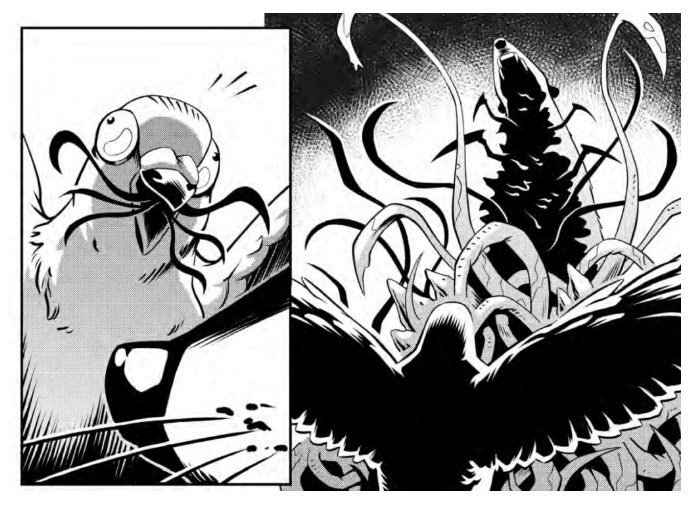
* Another ‘Lovecraft as character’ graphic novel, from Argentina, which Deep Cuts usefully reviews this week…

… a story about a boy [Lovecraft] and his cat. It is not a historical work that delves into the nuances of the cultural forces that went into such names, [but rather for those who] want a heartwarming fantasy about Lovecraft and his beloved pet, which has gained a kind of literary immortality.

I found a review from Harartia magazine in Argentina, which concluded the book was… “essential reading for both lovers of horror literature and for those who seek stories that, in their apparent simplicity, hide a moving depth.”

Sounds good. I certainly hadn’t spotted it here, and the news is very welcome. It was published in Argentinia by Jano Comics in 2023, and runs to 103 pages. There’s no sign of it on Amazon or eBay. The closest I can get to a possible store source is AleComics in Buenos Aires, which appears to be selling it locally by mail-order.

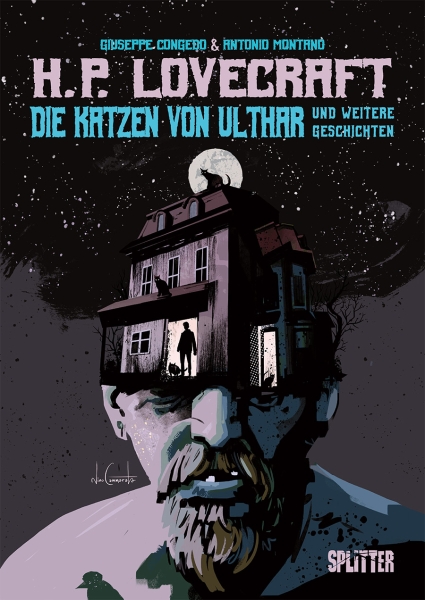
* Talking of cats, Grognardia this week considers “The Cats of Ulthar” and points out that… “in its conception of a higher, more mysterious order” of justice, it “stands in marked contrast to the cosmic indifference of Lovecraft’s later, more famous works”. In this sense it shares, I’d add, something with his “The Street”.

* I found a real-life ‘horror story’ from Lovecraft’s uncle Franklin Chase Clark (d. 1915), writing in 1876. Friend’s Review reprinted his survey article in the Sanitarian, on a horrible pig parasite which also infects and quickly kills humans. Eeek!

* The latest Strange Studies of Strange Stories podcast tackles the two ‘most Lovecraftian’ tales of Borges, “There Are More Things” and “The Book of Sand”. It seems the podcast’s Patreons also get a bonus interview with Andrew Leman of the HPLHS.

* A new book chapter on “The Visual Realization of Fantastic Worlds in Book Cover Design”. Now free and open-access, as part of the book Fantasy Aesthetics: Visualizing Myth and Middle Ages, 1880-2020 (2024). This is No. 4 of a German publisher’s The Middle Ages and Popular Culture series, but the text is in English.

* Just published (according to Amazon’s date and reviews, though shipping seems uncertain), the popular culture history book Weirdumentary: Ancient Aliens, Fallacious Prophecies, and Mysterious Monsters from 1970s Documentaries. This comprehensively surveys movies and TV series / specials… “positioned as documentaries, that began with Chariots of the Gods (1970) and ended with The Man Who Saw Tomorrow (1981)”.

* The Hippocampus Press website now has “December” as the shipping date for the forthcoming A Sense of Proportion: The Letters of H.P. Lovecraft and Frank Belknap Long.

* In the related world of R.E. Howard, another fine free audiobook reading from Gates of Imagination, Robert E. Howard’s substantial Solomon Kane tale “The Moon of Skulls”, first published in Weird Tales over two issues in summer 1930. A few years ago Jeffro’s Space Gaming blog was reading through Kane and found that with this tale Kane became… “even more heroic, more imposing, more inspiring, and more awesome than his preceding tales could indicate.” The new reading of “The Moon of Skulls” runs over two hours. There may be frequent ads if you just listen on YouTube, thus an .MP3 download will be far more enjoyable.

* Open Letters Review reviews a new graphic adaptation of “The Tower of the Elephant” by Robert E. Howard. One of my favorite Conan tales, and here paired with art by Valentin Secher. Not really a graphic novel, by the looks of the samples. More of a sumptiously illustrated tale that might work well if paired with an English audiobook reading. At least, it would if you’re someone who doesn’t already have their own very clear visualisation of this classic ‘young Conan the thief’ tale.

The review states the 2022… “Bragelonne original was nearly 11-by-15 inches” and that the new small Titan printing in English is very inferior by comparison. Bragelonne has a page which reveals the French title was Conan illustre : La Tour de l’Elephant, and a title search reveals that Amazon FR and Amazon UK have the same two copies left in stock. Personally, the art really doesn’t fit how I’ve always visualised the tale (too brightly lit, too cliched) or Conan (too old, too steroid-pumped), so the book is not for me. But some collectors may want a big French copy of the book, before they sell out.

* I’m pleased to hear about the second issue of the revived Heavy Metal comics magazine, and the vibes coming from a few trusted HM connoisseurs feel good. My look at the contents-list reveals a new strip by HM veteran Enki Bilal, and even a revival of “The Bus” strip. A reasonable $30 gets you a one year digital subscription to the new quarterly, though sadly it’s a “subscription starts with the current issue” sub. Those only now discovering the HM revival may well want a “start me with issue one” sub, which doesn’t appear to be on offer.

* From Poland, a 2025 B.A. dissertation abstract for “Digital character sheets in RPGs, exemplified by the Call of Cthulhu system”. Not available in full-text. Examines…

… character sheets in role-playing games (RPGs). It also presents the design and implementation of the web application SheetKeep which serves as a virtual character sheet. […] Discusses the history and theory of such, and then] formulates the application’s design requirements. The outcome of this analysis is an application that enables users to create and manage character sheets for the Call of Cthulhu system within their own campaigns.

* And finally, a free HMS Challenger Botanic illustrations LoRA for use as a ‘style plugin’ with Illustrious. Based on scans of Ernst Haeckel’s book, presumably. Lovecraft’s uncle lyrically explains the historical context…

What beauties, what wonders, then, are found miles beneath the sea? The great steamship, the Challenger, sent out for a four years’ cruise by the English Government, has now returned. It has brought back with it the story so long concealed in these darksome and almost fathomless depths; the story of that great and strange and hitherto unknown country stretching for 140,000,000 square miles beneath the dark blue waves.” (Lovecraft’s uncle, Franklin Chase Clark, 1878).

Lovecraft knew and was strongly influenced by Haeckel’s anthropology and philosophy, but if he knew Haeckel as an artist of bizzare marine biology is unknown. The LoRA’s demo images are poor, but I was able to easily generate satisfactory ‘pages’ such as this…


— End-quotes —

“As for sea-food — it is simply intensely repulsive to me. […] From earliest infancy every sort of fish, mollusc, or crustacean has been like an emetic to me.” — Lovecraft on his disgust at the smell of fish out of water, to R.E. Howard, November 1932.

“Miami did not produce much of an impression [but I] sailed out over a neighbouring coral reef in a glass-bottomed boat which allowed one to see the picturesque tropical marine fauna & flora of the ocean floor.” — Lovecraft to Toldridge, July 1931.

The Miami boat… “gave splendid views of the exotic tropical flora and fauna of the ocean floor — grasses, sponges, corals, fishes, sea-urchins, crinoids, etc. A diver went down and brought up a bucket full of sea-urchins for distribution among the passengers, but I restored mine to its native element because I had no means of preserving it.” — Lovecraft to Derleth, June 1931.

“Once I was taken under the ocean in a gigantic submarine vessel with searchlights, and glimpsed some living horrors of awesome magnitude. I saw also the ruins of incredible sunken cities, and the wealth of crinoid, brachiopod, coral, and ichthyic life which everywhere abounded.” — Lovecraft, “The Shadow Out of Time”, written 1934-35.

“[… The madman said] “It is amphibious, you know — you saw the gills in the picture. It came to the earth from lead-grey Yuggoth, where the cities are under the warm deep sea. It can’t stand up in there — too tall — has to sit or crouch.” […] The madman was bidding him hear the splashing of a mythical monster in a tank beyond the door — and now, God help him, he did hear it! […] Phobic paralysis held him immobile and half-conscious, with wild images racing phantasmagorically through his helpless imagination. There was a splashing. There was a padding or shuffling, as of great wet paws on a solid surface. Something was approaching. …” — Lovecraft, “The Horror in the Museum” (written 1933).

HPLinks #56 – Lovecraft and plants, new translations, pulp and comics art, Bloch letter up for auction, and more…

24 Wednesday Sep 2025

Posted by asdjfdlkf in HPLinks, Lovecraftian arts, New books, Scholarly works

≈ Leave a comment

HPLinks #56.

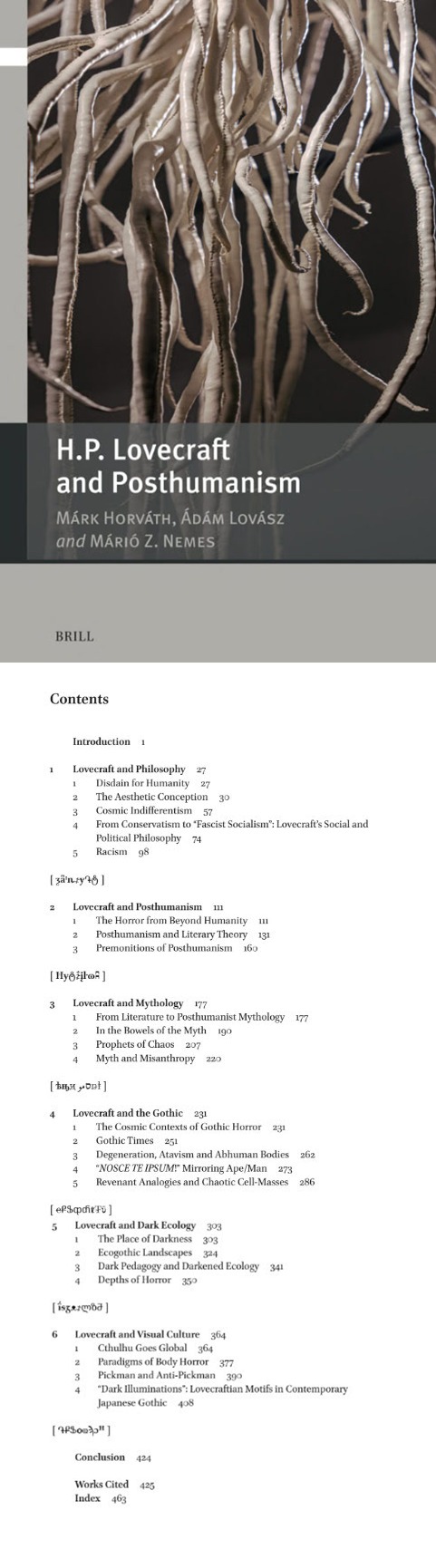
* A new book in German, Tierwerden und Pflanzendenken in der Literatur: Okologische Entgrenzungen von Franz Kafka und H.P. Lovecraft bis heute (2025). (‘Animal and Plants in Literature: ecological delimitations in Franz Kafka and H.P. Lovecraft’). Due for publication on 31st October 2025, and if you can read German the Kindle edition is currently free to preorder on Amazon. The table-of-contents shows the specific Lovecraft stories being discussed…

* Spanish readers now have the new book Barbarie y Primigenios, Tomo 3: La Correspondencia entre H.P. Lovecraft y Robert E. Howard (2025), being the final volume of the Lovecraft – R.E. Howard letters in Spanish translation.

* Italian website Nerdpool reviews the new Italian translation of the mammoth philosophical-political letter Lovecraft sent to Woodburn Harris. In Italian, but here’s a taste in English translation…

Before reading the book it is necessary to pay attention to the warning of the author, who invites the recipient not to read the [very long and dense] letter in one sitting […] 96 years later the author’s words are still sadly current. [The letter is followed by the] observations of the curator and translator, who offers us important biographical ideas to better understand the importance of the letter, [and he also suggests why it was] worthy of being translated and transformed into a book.

* Threads that Bind on “The Nihilistic Void of Lovecraft’s Cosmicism”, and possible personal solutions.

* Now posted for free at the author’s blog, the Phantasmagoria magazine issue 27 review of Robert E. Howard: The Life and Times of a Texas Author… “an incredible book, utterly readable, insightful and impressively thorough, one of the best biographies of a writer I have ever read”.

* New in open-access in the journal Word & Image, the article “Coloring the Mind: fantasy, imagination, and stereotype in early twentieth-century pulp fiction illustration” (2025). Only shows front-covers as illustrations.

* New to me, the book The Visionary Art of Franco-Belgian Comics, 1930s to 1960s (2025). An academic chapter book from Leuven University Press, but one that’s apparently well-illustrated with interior panels — due to being able to draw on a fabulous lifetime collection. Good to hear that… “This book will be made open access within three years of publication”.

* Feuilleton discusses the Lovecraftian art of Jean-Michel Nicollet, which appeared mostly on the covers of French paperbacks (all new to me), but he also had a short comic-strip in the 1978 Heavy Metal Lovecraft issue. Feuilleton offers a selected gallery.
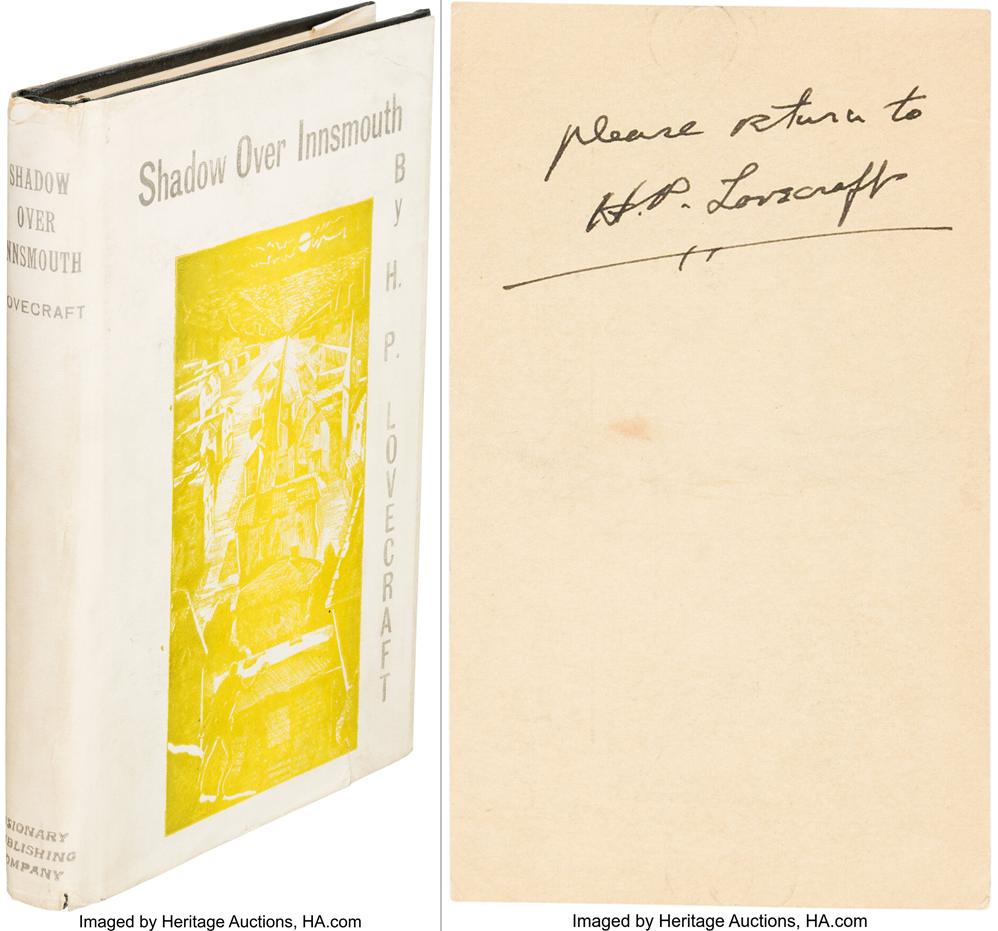
* In Greece, a new 2024 volume of Lovecraft… “translated by writer Thomas Mastakouris and illustrated by Ariadne Tzounakou”. Her ArtStation gallery has the cover without text, and also gives a good look at her style.

* New to me, a very slight appearance of ‘Lovecraft as a character’. In Subconscious Password (National Film Board of Canada, 2013), a short CG animation made with the 3D technology of the time. He briefly appears on a game-show, and attempts to explain how to pronounce Cthulhu, before being swallowed by a tentacle monster. Possibly the first CG animated Lovecraft?

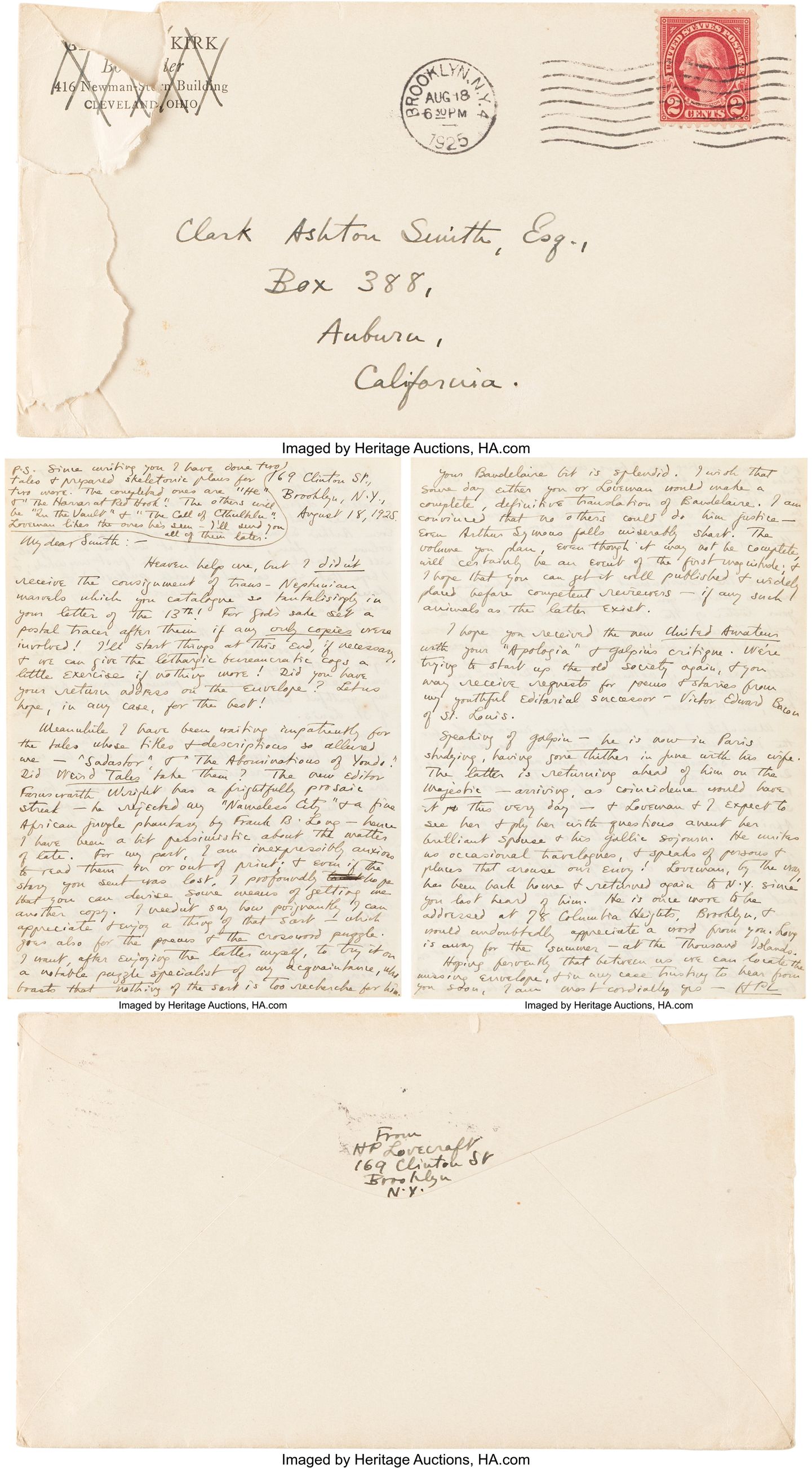
* And finally, currently up for auction is one of Lovecraft’s letters to Robert Bloch (published), with envelope. Good pictures. It’s Christmas Day 1933…

On envelope: “The more I look at KADATH the more he fascinates me. I have him propped up besides the fireplace amongst my Yultide decorations.” (“KADATH” was a drawing by Bloch, sent to Lovecraft)


— End-quotes —

[The young Lovecraft makes a little ‘model garden’] “This was my aesthetic masterpiece, for besides a little village of painted huts erected by myself and Chester and Harold Munroe, there was a landscape garden, all of mine own handiwork. I chopped down certain trees and preserved others, laid out paths and gardens, and set at the proper points shrubbery and ornamental urns taken from the old home. My paths were of gravel, bordered with stones, and here and there a bit of stone wall or an impressive cairn of my own making added to the picture. Between two trees I made a rustic bench, later duplicating it betwixt two other trees. A large grassy space I levelled and transformed into a Georgian lawn, with a sundial in the centre. Other parts were uneven, and I sought to catch certain sylvan or bower-like effects. The whole was drained by a system of channels terminating in a cesspool of my own excavation. Such was the paradise of my adolescent years, and amidst such scenes were many of my early works written. Though by nature indolent, I was never too tired to labour about my estate, attending to the vegetation in summer, and shovelling neat paths in niveous winter.” — Lovecraft to Galpin, September 1920.

“Vrest Orton’s house is an early 19th century farmstead; white & rambling, & with the small-paned windows […] The grounds are ample & lovely; with great elms, numerous peach trees now in pink blossom, a rambling brook, a sunken garden, & a series of grape-arbours, flower-beds, & climbing rose vines which will give an even greater exquisiteness to the scene later in the season. Activities are of a sort congruous with the setting — yesterday we changed the course of a tributary to the brook, built two stone footbridges, pruned the fruit trees, & trained the vines on a new homemade trellis.” — Lovecraft stays with Vrest Orton and repays the hospitality with some unpaid heavy-labour in the garden. Lovecraft to Miss Toldridge, April 1929.

Though there were very different gardens in his dreams…

“… alien & incredible scenes — crags & pinnacles lit by violet suns, fantastic piles of cyclopean masonry, vari-coloured fungous vegetation, half-shapeless forms lumbering across illimitable plains, bizarre tiers of waterfalls, topless stone cylinders scaled by rope ladders like ships’ ratlines, labyrinthine corridors & geometrically frescoed rooms, curious gardens with unrecognisable plants, robed amorphous beings speaking in non-vocal pipings …” — Lovecraft gives an impression of one of his recent dreams, in a letter to Barlow, May 1935.

HPLinks #55 – ‘atmospheric war’ and Lovecraft, Barlow’s Yoh-Vombis, Portland FilmFest programme, magic-lantern Cthulhu, and more…

17 Wednesday Sep 2025

Posted by asdjfdlkf in HPLinks, Lovecraftian arts, Scholarly works

≈ 1 Comment

HPLinks #55.

* An interesting new psychogeography Phd thesis, Atmospheric War and the Fantastic: Andre Breton, H.P. Lovecraft, and Richard S. Shaver (2025), from the University of California. Freely available online, and 165 pages. Examines how…

each writer conceives of the fantastic as an atmospheric phenomenon in culture. By characterizing the fantastic as an atmospheric phenomenon [the writers respond] to a broader process taking place in the twentieth century, whereby technological and scientific innovations increasingly made it possible to intervene into background conditions of life that were hitherto beyond the scope of human access or understanding [ By engaging with this ] process I call atmospheric war […] writers such as Lovecraft and Shaver carry forward Surrealism’s project to develop a collective myth that would make art the basis of a new, revolutionary life praxis.

* S.T. Joshi’s blog brings news of the new book The Man Who Collected Lovecraft: How R.H. Barlow Built His Vaults of Yoh-Vombis (2025). A bibliographic scholar and book sleuth assiduously traces how Barlow’s fabulous collection of the weird (kept in a special closet) was built, and then later dispersed and travelled across time…

The book has important implications regarding the dispersal of the books in Lovecraft’s library. A must for all Lovecraft and Barlow scholars and collectors!” (Joshi)
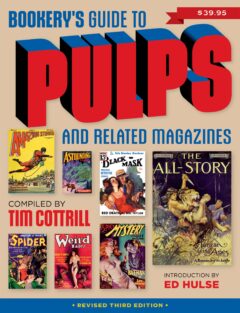
Available now as a Kindle ebook. Also as a paperback and one that’s surprisingly affordable, in these days of expensive ever-price-ratcheted print-on-demand paperbacks.
* Joshi also notes in his blog that… “David E. Schultz and I are also working on a volume of Derleth’s essays on weird, fantasy, and science fiction”. This will be a selection from Derleth’s huge output.

* Here in the UK for the past three years, The University of Oxford has been running a successful series of public talks by scholars on aspects of Tolkien’s work and life. Now they’re branching out, with “H.P. Lovecraft: The Madness and the Horror”, set for 16th October 2025. “Booking required” for this one, though, since I guess it’s one more likely to be disrupted by leftist students.

* Now online, the schedule for the H.P. Lovecraft Film Festival (Portland). To also include panel discussions on “Psychedelics and the Cthulhu Mythos”, and “Dreams, Madness, and Monsters: Translating Lovecraft to the Screen”.

* From France, the forthcoming book Pixels Hallucines: Lovecraft et les jeux videos (‘Hallucinating Pixels: Lovecraft and videogames’). Set for release on 6th November 2025, according to Amazon UK. The book appears to be a multi-author chapter collection.

* Grognardia, in the midst of making a Dreamlands RPG, has a new long thoughtful post on Lovecraft’s “The White Ship”.

* A stage performance of Lovecraft in London, H.P. Lovecraft’s “From Beyond” (20th and 21st October), followed at the same venue by a “magic lantern + live theremin” preformance of “The Call of Cthulhu” (27th – 28th October 2025)…

Fresh from a series of sold out Lovecraftian shadow-puppet shows, T.L. Wiswell turns her hand to the magic lantern, bringing “Call of Cthulhu” to life in a new and original format with Sam Enthoven’s live theremin [music] building the dread.

* For R.E. Howard readers and scholars, new on YouTube is a recording of “REH in 1935” from Howard Days 2025.

* Chaosium Con in Poland. This is the big one for Call of Cthulhu RPG gamers in the UK, Europe, Eastern Europe, Greece etc. 30th October – 2nd November 2025.

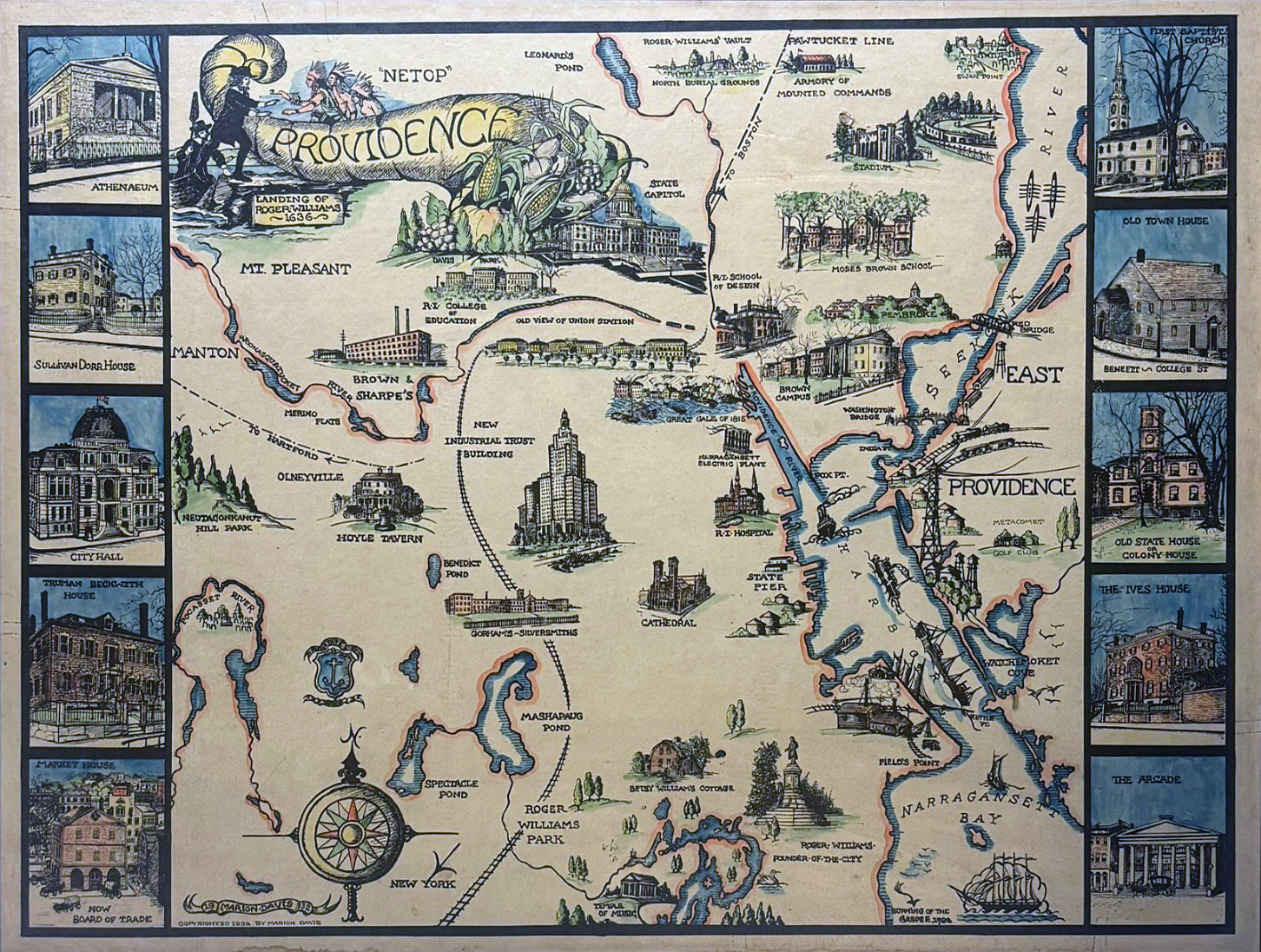
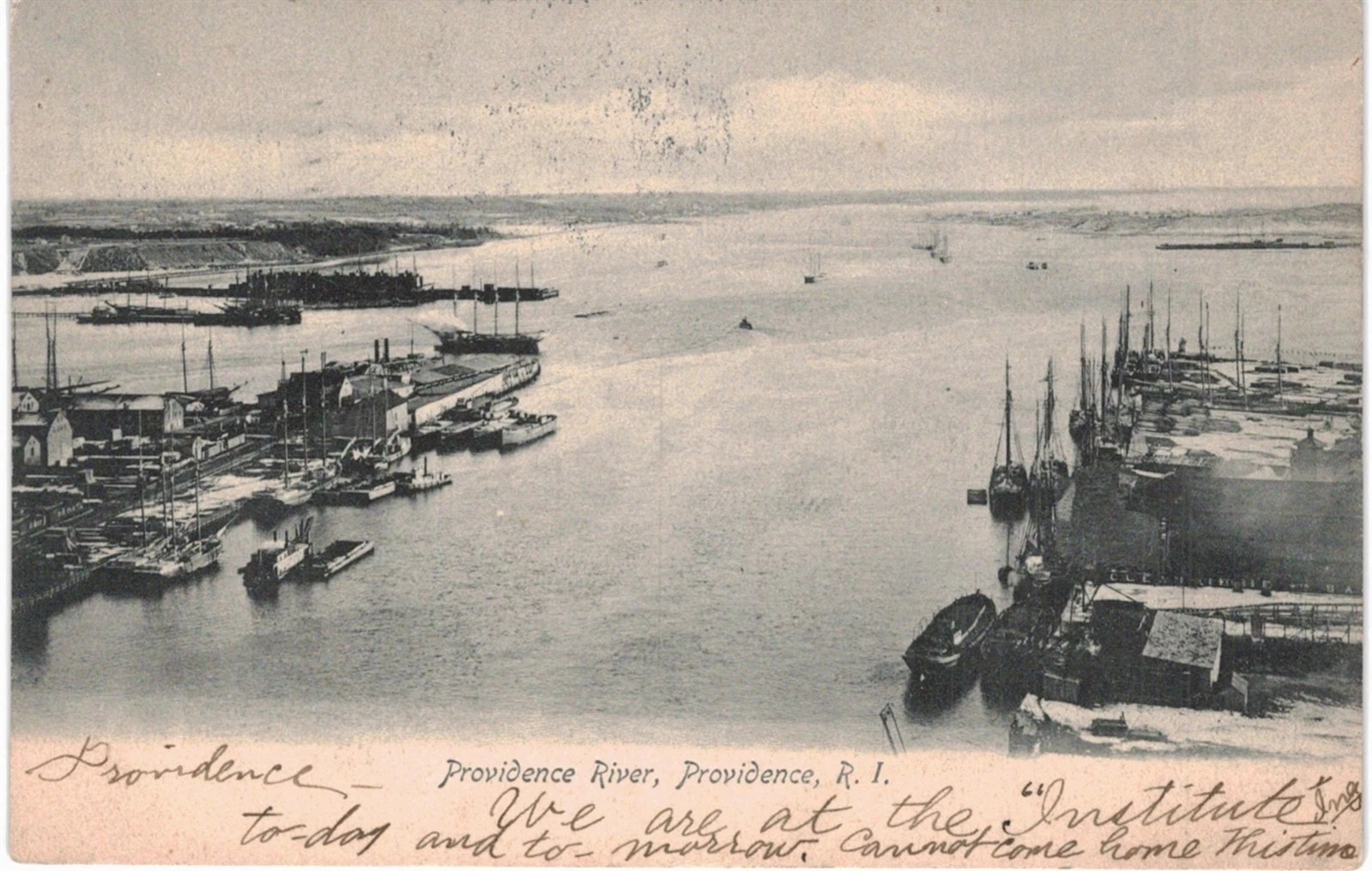
* A 1962 postcard of old Providence that Lovecraft would have been pleased to receive, had he lived to old age. Here seen in its wall-poster version…

* And finally, behold the genesis of… The Meowthos…


— End-quotes —

“[it became] a youthful mystery of my own […] You doubtless recall the closing passage of Poe’s “Premature Burial” — where, after an allusion to Carathis which baffled me till I had read Vathek, there occurs the tenebrous final simile: “but, like the Demons in whose company Afrasiab made his voyage down the Oxus, they must sleep, or they will devour us — they must be suffered to slumber, or we perish.” Now that image of Afrasiab sailing down the mysterious Oxus (a cryptic stream whose imaginative associations always fascinated me) on an accursed vessel full of sleeping daemons — ineffable nighted things — held for me a macabre terror of peculiar intensity; a terror all the acuter because I could not trace the allusion to any source. I wove all sorts of hideously fanciful images about that voyage, and made obscure references to it in many of my juvenile tales. At first, the name of Carathis was woven into the mystery, but that faded when I found it in Vathek. Afrasiab and his daemons remained the tough nut, and for a while I thought they must be derived from some version of the Arabian Night more ample than any I had seen. Only after years did I find out somehow that Afrasiab came from Firdousj’s great Persian epic […] But I have not yet succeeded in finding any translation of the Shah-Namah, hence am still ignorant of Afrasiab’s frightful adventure with the daemons.” — Lovecraft to Hoffman Price, March 1933.

Lovecraft read Vathek (1786) in July 1921, learning of “the demonic songs sung by Vathek’s necrophilic mother Carathis”.

“In the darkness there flashed before my mind fragments of my cherished treasury of daemoniac lore; sentences from Alhazred the mad Arab, paragraphs from the apocryphal nightmares of Damascius, and infamous lines from the delirious Image du Monde of Gauthier de Metz. I repeated queer extracts, and muttered of Afrasiab and the daemons that floated with him down the Oxus; later chanting over and over again a phrase from one of Lord Dunsany’s tales — “the unreverberate blackness of the abyss”.” — Lovecraft, “The Nameless City” (1922)

Fabled Samarcand of Silk Route fame was “on the Polytimetus, a branch of the Oxus”.

“Arabia …. Haroun al Raschid …. the Golden Road to Samarcand …. Vathek …. Palace of Eblis …. Sinbad …. the Roc …. the ghouls ….” — Lovecraft demonstrates his associative chain-of-imagination thinking to Morton, over several pages, January 1931.

Each distant mountain glows with faery grace,
    The flame-lit lakelet laps the level strand;
Lur’d by dim vistas beck’ning out of space,
    We take the Golden Road to Samarcand!

— Lovecraft, some lines of his poetry sent to Morton, November 1929.

“… that elusive, ecstatically mystical impression of exotick giganticism and Dunsanian strangeness and seethingly monstrous vitality which I picked up in 1922, before I knew [the city] too well […] Cyclopean phantom-pinnacles flowering in violet mist, surging vortices of alien life coursing from wonder-hidden springs in Samarcand and Carthage and Babylon and Aegyptus, breathless sunset vistas of weird architecture and unknown landscape glimpsed from bizarrely balustraded plazas and tiers of titan terraces” — Lovecraft recalling his first impressions of New York City, seen at sunset/dusk in 1922.

” [I nightly heard] … whining monotones on a strange bagpipe which made me dream ghoulish and incredible things of crypts under Bagdad and limitless corridors of Eblis beneath the moon-cursed ruins of Istakhar. I never saw this man, and my privilege to imagine him in any shape I chose lent glamour to his weird pneumatic cacophonies. […] In truth, I never saw with actual sight the majority of my fellow-lodgers [while living in Red Hook]. I only heard them loathesomely­ and sometimes glimpsed faces of sinister decadence in the hall. […] And what scraps of old papers with Arabic lettering did one find about the house! Some­ times, going out at sunset, I would vow to myself that gold minarets glistened against the flaming skyline where the church-towers were!” — Lovecraft, recalling his squalid rooming-house on the edge of Red Hook, New York City.

Lovecraft here as if taking the part of Afrasiab on his voyage down the Oxus, with his unseen fellow lodgers taking the part of the demons… “they must sleep, or they will devour us — they must be suffered to slumber, or we perish.”

HPLinks #54 – Poet of the Abyss, Crypt unearthed, Angell Street, Coq translated, The Spark Devil and more…

12 Friday Sep 2025

Posted by asdjfdlkf in HPLinks, Lovecraftian arts, New books, Podcasts etc., REH, Scholarly works

≈ Leave a comment

HPLinks #54.

* The latest The Vermilion reviews a new Italian book whose title translates as H.P Lovecraft: Poet of the abyss (2025). Not on Amazon UK, or even Amazon Italy.

The review is in English but seems to have been auto-translated from the Italian into English. Thus I’ve clarified it in this quote…

… an exhaustive manual [of Lovecraft], full of information of all kinds, suitable for readings of different intensity, and with a narrative that includes biographical details and curious anecdotes, together with an in-depth analysis of the entire work and exploring the literary, philosophical and esoteric connections of its production. The book does not neglect a critical and attentive look at the vast secondary literature …

* I seem to have missed noting a ‘zine release. Robert M. Price’s Crypt of Cthulhu #115 was published back in summer 2023, and I see it can still be had as a digital ebook. Mostly fiction, but there’s also an interview with Richard A. Lupoff, and an essay comparing “At the Mountains of Madness” with the 1933 novel which was later made as the ‘finding Shangri-la in the mountains’ movie Lost Horizon.

* The HPLHS has announced their new edition of The Gentleman from Angell Street, being the 1961 book of Eddy memories of their knowing Lovecraft in the Providence of the 1920s. The new $65 edition is described as a… “substantially expanded and embellished edition … more than doubling its size” to 174 pages. I should note that some of these supposed memories have been criticized as “fabrications” (Joshi and Schultz, Lovecraft Encyclopedia), and one hopes these will be footnoted as such. But the book’s page has nothing on that point. Indeed, we’re not even told if buyers will actually get any new information about Lovecraft. Nor do we see a contents-page. The new expanded edition is set to ship in September 2025, and is currently pre-ordering.

* New in the Spanish open-access scholarly journal Alambique, two reviews of the recent book Resena de Fantasia epica Espanola (1842-1903) (2024). The book…. “seeks to fill [a] historiographical gap by exploring the Spanish roots of epic fantasy through a theoretical analysis and an anthology of representative texts.” Review 1 and review 2. Freely available online, and both reviews are in Spanish.

* I see that Maurice Sand’s Conan-like epic fantasy novel Le Coq aux Cheveux D’or (1867) has been reprinted in paperback in France, by PRNG in 2024. The book…

… reads as one of the first heroic fantasy or even sword-and-sorcery works ever written in modern times. The ‘rooster’ of the title looks and acts in a similar way to Howard’s Conan. Its fictional world is also fully Howardian both for its themes and its style.” (from the journal article “A Century of High Fantasy in Latin Europe”).

The new paperback of Le Coq is in French, and scans of the original book are not on Hathi or Archive.org. However, there is now a free English translation PDF on Archive.org.

* The Sprague de Camp Fan blog has a new and lengthy survey of publications related to Robert E. Howard’s early schoolboy writings.

* VoegelinView reviews the new book John Cowper Powys and the Afterlife of Romanticism (2025) and asks why this English author is today “ignored by readers and academics alike?”. Well… he’s certainly not everyone’s cup of tea. I did try to read his A Glastonbury Romance once, having managed to actually find a copy in those pre-Internet days. But I recall he was just so boring that I gave up after a chapter or two, and for £1 passed the then-scarce book on to a colleague who was seeking a copy. The new review does interest though, since it reveals something new to me, that… “his last novels are ‘fantasies’ that can read like a kind of futuristic science-fiction”. SF Encyclopedia notes the relevant titles and some details of contents, remarking that his final works are… “fabulations, some of them unhinged”.

* A new podcast “History in Flames with Robert Bartlett”, a long interview with the author of a new book on the destruction of mediaeval manuscripts over the centuries. Possibly a useful backgrounder for Mythos writers and RPG makers?

* The latest Appendix N Book Club podcast discusses H.P. Lovecraft’s “The Dream-Quest of Unknown Kadath”.

* New on Archive.org, a scan of From The Sorcerer’s Scroll a long-ago ‘zine which had the article “The Lovecraftian Mythos in Dungeons & Dragons” (1978). Last month Grognardia had a post on this same seminal article. It appears to have been one of the very earliest attempts to translate what was then the “Lovecraftian Mythos” into role-playing games (actually it was Lovecraft + Derleth, but few could tell the difference back then).

* Grognardia is also developing a new RPG for Lovecraft’s Dreamlands, and now has a public comments and suggestions post on his blog, which welcomes ideas and suggestions.

* The HPLHS has a pre-order page for their The Spark Devil, this being a complete prop-heavy Call of Cthulhu RPG adventure set in Providence in 1935. It… “makes extensive use of real Providence history and locations to create the most authentic setting possible”. Set to ship in October 2025. Also includes audio-props, which play via this device-prop which is included in the boxed-set…

* I see another nice set for luxury tabletop gaming, seemingly this very week. New Call of Cthulhu collector editions… “for Pulp Cthulhu, The Grand Grimoire of Cthulhu Mythos Magic, and the epic Masks of Nyarlathotep [adventure, in two volumes]”.

* And finally, LongPage is a new dataset of 300 novels with applied… “multi-layered ‘planning traces’ including character archetypes, story arcs, world rules, and scene breakdowns.” It’s free, uses public-domain, and seems useful for training AIs to plot and plan (or even write) novels in a coherent manner. I guess RPG makers may also find a use for this.


— End-quotes —

— Lovecraft on Angell Street —

[On the death of his beloved grandfather in 1904, Lovecraft at age 13] … mother and I were forced to vacate the beautiful estate at 454 Angell Street [built by his grandfather in 1880–81, and then numbered 194] … My home had been my ideal of Paradise and my source of inspiration — but it was to be profaned and altered by other hands. Life from that day has held for me but one ambition — to regain the old place and re­establish its glory — a thing I fear I can never accomplish.”

“… my grandfather transferred all his interests to Providence (where his offices had always been) & erected one of the handsomest residences in the city — to me, the handsomest — my own beloved birthplace! [in Angell Street]. The spacious house, raised on a high green terrace, looks down upon grounds which are almost a park, with winding walks, arbours, trees, & a delightful fountain. Back of the stable is the orchard, whose fruits have delighted so many of my sad (?) childish hours. The place is sold now, & many of the things I have described in the present tense, ought to be described in the past tense. The house has been sold to one purchaser; the stable & orchard to another; & an ugly garage now smells to high heaven where once the crystal waters of the fountain played! Such degeneracy! Why could not the purchaser have kept his car elsewhere, & suffered the ancient fount to sparkle as of yore?”

“I never liked any other colour combination so well as black-and-gold. To my naive and undeveloped aesthetick sense that represents about the apex of dignified beauty — perhaps because that was the scheme in the front hall of my birthplace, 454 Angell Street. […] Ebony and gold is the aesthetick mixture [I like] — although old gold and rose is a great scheme, as the front parlour of my birthplace amply proved. There was an almost Oriental richness in that room, as in the palace of a caliph — I used to read the Arabian Nights there with an especial zest.”

HPLinks #53 – Penumbra, Lovecraft Annual, Dreamlands RPG, del Toro collection for sale, Beowulf vs. Conan, Conan vs Cthulhu, and more…

03 Wednesday Sep 2025

Posted by asdjfdlkf in AI, HPLinks, Lovecraftian arts, Scholarly works

≈ Leave a comment

HPLinks #53.

* S.T. Joshi’s annual journal has a new issue listed, Penumbra: A Journal of Weird Fiction and Criticism, No. 6 (Autumn 2025). Among others…

Mario Sanchez Gumiel contributes a profound analysis of the Spanish writer Pompeu Gener, whose work shows analogies with Lovecraft, Machen, and other leading weird writers. John C. Tibbetts supplies a broad overview of the weird work of English writer Saki (H.H. Munro)

* S.T. Joshi’s Blog also announces a new volume of his essays, Aspects of the Weird Tale (2025), featuring among others… “several new essays on Lovecraft [and] a long essay on the weird work of Sir Arthur Conan Doyle”. Available now as a budget Amazon ebook, and on receiving the 10% free sample I also see an essay on the rural/city divide in Dunsany, and that the Lovecraft essays are on Lovecraft’s Egyptian mummies, poetry about Lovecraft, Arthur S. Koki on Lovecraft, “Mountains” (unknown focus), Lovecraft and Weird Art, and Lovecraft in Audio.

* Also on Amazon, the latest Lovecraft Annual No. 19 (2025) is now listed there and appears to be shipping. No sign of its fellow annual journal The Dark Man: Journal of Robert E. Howard and Pulp Studies since 2023, so far as I can find.

* New in English in a Turkish open-access journal, the substantial “Translating Violence and Horror in Lovecraft’s Cthulhu Mythos: A Comparative Study of English & Turkish Versions” (2025).

* From Charles University in Prague, a dissertation in English offering a “Literary Comparison of Beowulf and R.E. Howard’s Conan the Barbarian” (2024). Freely available online.

* A stop-motion short advert, publicising a new Conan action-figure toy… “features the new Conan figure in battle with Lovecraft’s Cthulhu”. No link here, as Animation Magazine blocks all VPN users in an obnoxious manner.

* My Tolkien Gleanings newsletter is now available at a new URL. Tracking and linking news of Tolkien scholarship, though only occasionally noting items concerning The Silmarillion and the invented languages. Please update your bookmarks and RSS feeds etc.

* Free and available now, my distillation of Lovecraft for NovelForge AI, the $50 novel-writing software. The packages should work with the trial version of this Windows software, which so far as I know never expires.

* The Tolkien and Fantasy blog has a new post “Correcting the ‘Facts’ about A. Merritt’s Autobiographical Writings”. As you’ll recall, Merritt was admired by Lovecraft and idolized by the early readers of Weird Tales magazine.

* New on Archive.org, a run of the British edition of Astounding magazine. Looks like it’s 1943-1955, and perhaps not a complete run for those years.

* How high will it go? A copy of Lovecraft’s Selected Letters Vol. 1 (1911-1924) in fine condition, on eBay with six days to go.

* A new issue of Undefined Boundary: The Journal of Psychick Albion.

* London Uncanny: A Gothic Guide to the Capital in Weird History and Fiction (2025).

* New to me, the forthcoming table-trembler The Palgrave Handbook of the Zombie (January 2026). Setting a new record in jaw-dropping academic book pricing, at £550 ($740), albeit for a brain-eating 1,900 pages. One hopes that the editor has read the recent essay in the Lovecraft Annual, which very persuasively demonstrates that Lovecraft created the modern zombie and states that the master’s standing as “the font of the modern zombie is unchallengeable” (Lovecraft Annual 2020). Lovecraft is, however, not mentioned in the book’s blurb.

* The risk of Californian wildfires, and concerns about his old age, are reportedly leading movie-maker Guillermo del Toro to auction off part of his magnificent collection. The auction is being held soon via Heritage Auctions, and one hopes there will be a fabulous free PDF catalogue. TheoFantastique has the details and links. I’m uncertain if del Toro’s life-size H.P. Lovecraft sculpture will be under the hammer. Possibly not, I would guess.

* And talking of large amounts of vintage pop culture, free at CivitAI is a new generator of Scooby-Doo backgrounds for use with SDXL image-generation models. Spooky old-school 1970s Scooby Doo-style animation backdrops galore, freely re-usable… just add your own prompts.

* Grognardia’s blog reports that he’s been so taken by Lovecraft’s Dreamlands tales of late that he’s… “now devoting myself to the development of an Old School Essentials-derived Dreamlands RPG, Dream-Quest.” Not AI, I assume. I would love a well-made text-based Dreamlands adventure as a solo role-play that was run and managed by an AI. With the player untroubled by fussy-dusty stats and rules, which would nevertheless still be whirring away in the background. Nothing like that is currently available, so far as I know.

* And finally, Pickman’s Hidden Atelier is a new YouTube channel that will aim to review only Lovecraftian videogames. And fairly obscure ones, by the look of it — first up is a 1991 Sega Mega Drive title.


— End-quotes —

“I studied Old London intensively years ago, & could ramble guideless around it from Hampstead Heath to the Elephant & Castle!” — Lovecraft to Galpin, November 1933. (Mooted in a letter as the basis for an unwritten Lovecraft story starting in Old London and ending in Roman horrors elsewhere).

“In London there is a man who screams when the church bells ring. He lives all alone with his streaked cat in Gray’s Inn, and people call him harmlessly mad.” — Lovecraft, opening lines of “The Descendent” (fragment).

“The [post]card from antique Londinium [London] duly came, & filled me with envy at your opportunity to behold civilisation’s capital, if only for a single full day. If I were in Europe, I would devote not less than 2 or 3 weeks to London — & might not get outside of Britain at all. The British Museum card surely reveals one of my (or Klarkash-Ton’s or Sonny Belknap’s) extra-human monsters in disguise — indeed, I am positive that this entity reached Java as a relique of sunken Mu, or of the still more monstrous & fabulous R’lyeh! Thanks!” — Lovecraft to Galpin, August 1932.

The most likely Java deity image in the current British Museum collection, which would also make for a postcard, would be this fine drawing of an elephant-god sculpture…

“Coming early to London, I saw as a Child many of the celebrated Men of King William’s Reign, including the lamented Mr. Dryden, who sat much at the Tables of Will’s Coffee-House. With Mr. Addison and Dr. Swift I later became very well acquainted, and was an even more familiar Friend to Mr. Pope, whom I knew and respected till the Day of his Death.” — Lovecraft uses his own childhood attic encounter with the 18th century wits, in his “A Reminiscence of Dr. Samuel Johnson”.

“I share most emphatically your regret at the distance between 278 Grove & 598 Angell, & wish we both lived in Old London, within walking distance of Will’s & of each other’s homes.” — Lovecraft to Kleiner, December 1918. “Will’s” coffee-house was a key London gathering place of 18th century wits and poets.

HPLinks #52 – the Lovecraft Protocol, Hess letters, Lovecraft as blogger, Lovecraft and wolves, and more…

27 Wednesday Aug 2025

Posted by asdjfdlkf in HPLinks, Lovecraftian arts, Scholarly works

≈ 1 Comment

HPLinks #52.

* The latest issue of the Brazilian open-access fantastic fiction journal Abusoes is a special on ‘histories and theories of fantasy in the 21st century’. A number of their back issues are also fantasy or science-fiction specials, and there’s also large special issue dedicated to Lovecraft. Mostly in Portuguese.

* The Science Fiction Foundation has a call for contributions to a forthcoming “100 Years of Wonder” special issue of its journal, with a submission deadline of 5th April 2026…

2026 marks the centenary of Hugo Gernsback’s [magazine] Amazing Stories. To commemorate and critically explore what many regard as the birth of genre science fiction, the Autumn 2026 issue of ‘Foundation’ (No. 153) will present a series of articles that investigate and re-evaluate the history of the science fiction pulps.

* The journal Messengers from the Stars plans a 2026 special issue on cityscapes in fantasy & science fiction. Deadline: 1st September 2025.

* A preprint paper on PsyArXiv, “The Lovecraft Protocol: A Clinical Guide for First Contact with Functionally Plural Systems”. Now withdrawn, but archived at Reddit. Appears to have been an HPL Birthday spoof of psychology ‘personality assessment’ papers, that made it into Google Scholar.

* In the new $155 academic-theory book Theorizing Stephen King (2025), I see there’s a chapter titled “A Lovecraftian Critique of the Art of Stephen King”.

* New in the open-access megajournal Humanities, “Decadent Echoes: Arthur Machen, M. John Harrison, K.J. Bishop, and the Ends of Mystery”. Traces the influence of the fin-de-siecle Decadents through Machen to M. John Harrison’s Viriconium series and beyond.

* Deep Cuts look at the Clara Hess letters held at Brown University, in “The Letters of Clara Lovrien Hess”, and transcribes letters she sent to August Derleth. As I understand it Derleth also interviewed her about her memories of Lovecraft, probably in late 1948.

* New articles at Grognardia on “Lovecraft the Blogger” and “Lovecraft the Fantasist”…

Like [R.E.] Howard, Lovecraft peopled the Dreamlands with decadent civilizations, perilous sorceries, and monstrous foes. Like Tolkien, he gives us a secondary world with its own geography, history, and laws. The difference is perhaps one of emphasis. Howard’s heroes carve their fates with the sword, Tolkien’s with the burden of virtue, and Lovecraft’s with the dreamer’s restless desire to glimpse what lies just beyond the horizon.

* For Lovecraft’s birthday, DMR had the article “Lovecraft at 135: Yeah, He Won”. If one pinpoints 1925 as the beginning of Lovecraft’s strong influence on other creatives, then he’s now endured for a century…

By this time in August of 1925, HPL had turned the heads of Clark Ashton Smith, Robert E. Howard and many, many others. ‘Others’ like C.L. Moore and Manly Wade Wellman. ‘Others’ like Robert Bloch and Ray Bradbury. [… and now 100 years later] The ‘lens’ of most horror fiction is filtered through the paradigm Lovecraft refined and perfected [and he also lives] rent-free even in the minds of even his most ardent haters.

* This week Wormwoodiana surveys “Those Thick Omnibuses from the Thirties”, and recommends some core 1930s books which collected the best ‘weird’ stories between hardcovers.

* A new audiobook The Lost World by Arthur Conan Doyle, being a quality seven-hour reading of the classic Professor Challenger novel. From the same reader, there’s also “The Door to Saturn” by Clark Ashton Smith. Both free on YouTube. Avoid the YouTube ads by downloading with desktop freeware such as Mediahuman’s YouTube To MP3 software.

* I’m pleased to see that Fred Blosser has just published a new R.E. Howard reader’s guide, The Solomon Kane Companion: An Informal Guide to Robert E. Howard’s Dark Avenger. Billed as the “first-ever comprehensive guide” and available now.

Includes a “Kane chronology and a glossary of people and places” in the tales.

* Perhaps useful for some involved in fantasy illustration and RPG-making, a proper ‘savage wolf’ LoRA for SDXL-based image generator models. The free A Better Wolf… “fixes a lot of the wolf related issues in SDXL”.

* Bandcamp Daily has a new long article and survey “Exploring the Mystical Realms of Fantasy Synth”, which is shorthand for ‘synthesizer-based electronic music’…

Think of a fantasy setting or a specific corner of mythology, and there’s almost certainly a one-person synth project out there taking its lore and turning it into music.

* Robert Bloch’s short Mythos novel Strange Eons (1978) was re-issued by Valancourt Books in early August 2025. Now shipping. Bloch makes frequent use of Lovecraft-the-man via letters etc, to prop up the rather dialogue-heavy tale. There’s no audiobook, it seems.

* New on Archive.org, a good scan of Weird Tales for January 1946, including an indication that The Necronomicon had been dropped into the swirl of bookseller’s lists as early as 1945…

Also new on Archive.org, a Sprague de Camp snippet in Future Science Fiction, August 1954. His regular column lets drop a few details on his then-recent visit to Providence — giving the colours of Lovecraft’s homes and calling 10 Barnes a “monstrous” building.

* From Poland in Polish, the undergraduate dissertation “Shades of Cosmic Horror: An analysis of the cinematic expressions applied in adaptations of H.P. Lovecraft’s “The Colour Out of Space””. The author considered “all seven film adaptations” of “Colour”, and discussed the methods used to visually and scientifically convey the idea of a fictional colour. Not yet online.

* And finally, Lovecraft’s “The Shadow Over Innsmouth” adapted as a 1992 Japanese TV Movie (who knew?). Now subtitled in English and newly and freely available on Archive.org.


— End-quotes —

[In 1904, as a thirteen year-old] “… Latin now captivated my fancy, and I became a haughty Roman with scant use for the barbaric darkness of the modern world. The impress of this phase is still upon me, and I still thrill at the Roman name and the fasces and the figure of the Wolf of the Capitol.” — Lovecraft to Dwyer, March 1927.

“… nocturnal howling has an element of fearfulness for me. I always associate it with lean, dog-faced beings that walk sometimes on two legs and sometimes on four, and that lope abroad in the night’s small hours. Wolves and other animals are of course the ultimate basis of the hereditary folk-fear on which my impression is founded.” — Lovecraft to Dwyer, January 1928.

“To say that we actually believed in vampires or werewolves would be a carelessly inclusive statement. Rather must it be said that we were not prepared to deny the possibility of certain unfamiliar and unclassified modifications of vital force and attenuated matter; existing very in-frequently in three-dimensional space because of its more intimate connexion with other spatial units, yet close enough to the boundary of our own to furnish us occasional manifestations which we, for lack of a proper vantage-point, may never hope to understand.” — Lovecraft, “The Shunned House”.

“[I] fancied I glimpsed a kind of thin, yellowish, shimmering exhalation rising from the nitrous pattern toward the yawning fireplace, I spoke to my uncle about the matter. He smiled at this odd conceit, but it seemed that his smile was tinged with reminiscence. Later I heard that a similar notion entered into some of the wild ancient tales of the common folk — a notion likewise alluding to ghoulish, wolfish shapes taken by smoke from the great chimney” — Lovecraft, “The Shunned House”.

HPLinks #51 – birthday presents, NecronomiCon dates, an Italian Lovecraft festival, Lovecraft’s Calculator, periwigs and more…

20 Wednesday Aug 2025

Posted by asdjfdlkf in AI, HPLinks, Lovecraftian arts, Scholarly works

≈ Leave a comment

HPLinks #51.

* Eusebeia – a mystical Lovecraftian short film… 3DVF has it that… “the film evokes a universe worthy of Lovecraft”. Freely available on YouTube.

* Dates have been announced for the NecronomiCon Providence 2026, 13th-16th August 2026. No further details or trailer-poster, as yet.

* My Lovecraft LoRA for SDXL and ComfyUI, now freely available in time for Lovecraft’s Birthday. My next HPLinks will hopefully have more links to birthday goodies from others.

* The 2025 birthday has been used as a means of re-promoting the Italian essay collection Yog-Sothothery (October 2024), and the new promo usefully has a few details of what’s inside.

Seven essays in Italian in total, including…

    – a survey of places in New York City frequented by Lovecraft

    – an examination of the scientific details in “At The Mountains of Madness”

    – a study of mass-media ‘adaptations’ of Lovecraft and their distortion by leftist politics

Also announced is a spin-off from the book…

The Yog-Sothothery project is a multimedia project inspired by Lovecraft’s imagination, evoking the profound symbiosis between Providence author and and his dark myths. It will be articulated through events, audiovisual productions and interactive content that will be presented in the coming months in Rome and L’Aquila, on the occasion of two symbolic anniversaries. 100 years of “The Call of Cthulhu” (set in 1925), and 50 years of the publisher Chaosium. Among the promoters and supporters of the project include L’Aquila Reborn, Rome Creative Hub, People and Territories, Lightson, Mokona’s, Studio Comunico, Rome Film Academy.

* Live on YouTube later today, the R.E. Howard Foundation on “Robert E. Howard & H.P. Lovecraft: Opinionated Pen Pals”.

* Newly released, the book Lovecraft’s Calculator: Physics, Paradox, and a Scientific Guide to Cosmic Horror…

This book doesn’t describe cosmic horror. It proves it. Using real equations, peer-reviewed papers, and a narrator who has clearly been awake too long reading arXiv at 3 a.m., Lovecraft’s Calculator drags you down the spiral staircase of reality, one unsettling scientific fact at a time. You’ll explore vacuum decay, black holes, dark energy, Boltzmann brains, and the nauseating possibility that the universe itself is a malfunctioning simulation with no tech support.

There’s an affordable Kindle ebook edition. How much it actually references Lovecraft’s work and his 1900s-1930s scientific context is unknown.

* In the latest edition of the journal Zeitschrift fur Katalanistik, the Catalan article which translates as “Ofelia Dracs and the reception of H.P. Lovecraft in Catalan literature”. Freely available online.

* From Poland in English, and published in the latest issue of a Malaysian open-access journal, “Which hollow is Witches’ Hollow? : an empirical study on translating toponyms”…

It was decided that the proper name for the study should be Witches’ Hollow — a toponym from a short story that was first published in a collection of weird fiction tales, “The Watchers Out of Time”, by August Derleth. […] it takes place in the cult world of Cthulhu Mythos, inspired by Lovecraft’s works and notes he left, and stylized as Lovecraftian, but not authored by Lovecraft.

* On DeviantArt, Red-Vanguard has new illustrations for The Horror at Martin’s Beach, The Black Bratt of Dunwich, and The Dunwich Horror, in the sort of artistic style one imagines Lovecraft might have had is he had been published on the covers of the ‘slicks’ rather than inside the ‘pulps’. Red-Vanguard also has earlier works for “The Lurking Fear” and others.

* Grognardia blogs on Lovecraft’s awe…

What often goes unspoken is how beautiful the weird can be. The shimmering city of the Elder Things beneath the ice of Antarctica; the dream-haunted vistas of Kadath; the mind-transcending journey of Randolph Carter through the stars. These are not scenes of mere terror. They are awe-inspiring in the truest sense — sublime and strange, but also profoundly glorious.

* Another new blog essay from Grognardia is “Of Periwigs and Pallid Masks”, which co-incides nicely with my now completed and very enjoyable re-reading of Dexter Ward…

[What fascinated the Anglophile Lovecraft was that time when] Boston remained loyal to the [British] Crown, when the [American] frontier still loomed dark and unknown, and when superstition and science existed in uneasy proximity. […] To the best of my knowledge, Chaosium has never released a full supplement set in 17th- or 18th-century British North America. […] The early 18th century was a period when science, superstition, and theology all vied for dominance in the human mind. A figure like Emanuel Swedenborg, for example, could be taken seriously not only as a scientist and engineer but also as a visionary who conversed with spirits. That intellectual ambiguity suits the Mythos perfectly.

* And finally, ‘Oh noes, we iz expozed… burn th periwigs, guyz!’ New on YouTube, the documentary Inside America’s Insane Lovecraft-Obsessed Fraternity.


— End-quotes —

“I’ve never attempted long hair [i.e. in the decadent manner] because I always think of myself in a periwig rather than following the post-1775 fashion of wearing my own hair. The common thing in periwig days was to clip or even shave the head — so I worry along with close haircuts and imagine my wig hanging on a wig-block or the bedpost.” — Lovecraft to Virgil Finlay, October 1936.

[My] “dream-self has come to represent me so perfectly that in waking hours I sometimes feel odd for lack of my three-cornered hat, powdered periwig, satin small-clothes, silver sword, and buckled shoes.” — Lovecraft to Robert E. Howard, January 1933.

“… one June day in 1917 I was walking through Swan Point Cemetery with my aunt and saw a crumbling tombstone with a skull and crossbones dimly traced upon its slaty surface; the date, 1711, still plainly visible. It set me thinking. Here was a link with my favourite aera of periwigs — the body of a man who had worn a full-bottom’d wig and had perhaps read the original sheets of The Spectator. Here lay a man who had lived in Mr. Addison’s day, and who might easily have seen Mr. Dryden had he been in the right part of London at the right time! Why could I not talk with him, and enter more intimately into the life of my chosen age? What had left his body, that it could no longer converse with me? I looked long at that grave, and the night after I returned home I began my first story [of my adult life]” — Lovecraft to Galpin, April 1920.

[Lovecraft recalls being a boy who had discovered Alden’s] THE READER [… This old book] was so utterly and absolutely the very thing I had been looking for, that I attacked it with almost savage violence [for it] reflected in all its completeness the Georgian rhetorical tradition of Addison, Pope, and Johnson, which had survived unimpaired in America even after the Romantic Movement had begun to modify it in England. This, I felt by instinct, was the key to the speech and manners and mental world of that old periwigged, knee-breeched Providence whose ancient lanes still climbed the hill […] Little by little I hammered every rule and precept and example into my receptive system, till in a month or so I was beginning to write coherent verse in the ancient style” […] “At the same time I was reading the 17th and 18th century poetical translations of the classics and the old Queen Anne essayists as fast as I could, so that periwigged Georgianism was absorbing me as utterly as if I had been actually born in its midst.” — Lovecraft to Dwyer, March 1927.


HPLinks #50 – Lovecraft as theologian or prophet of the occult, Miskatonic diploma, Lovecraft and Lovelock, filming on Benefit Street, and more…

17 Sunday Aug 2025

Posted by asdjfdlkf in Films & trailers, HPLinks, Lovecraftian arts, Scholarly works

≈ Leave a comment

HPLinks #50.

* A new PhD thesis, sadly under embargo, Eldritch Theology: A comparative study of Lovecraft as theologian (2025). There is, however, a lengthy abstract.

* A new Masters dissertation, “Fear, Cosmic Horror and the Sublime in H.P. Lovecraft’s Fiction” (2025). Freely available online. Examines Lovecraft’s personal and societal… “fears and how they had an impact on his writing, how said fears created the genre of cosmic horror” and the relation to ‘the sublime’.

* A recent Masters dissertation, “H.P. Lovecraft: Prophet of the Elder Gods: Investigating his Influence over the 20th and 21st Century Occult and Religious Worlds” (2024). Not freely online, but it appears to provide a survey of the various… “researchers, occultists, and occult organizations that seek to venerate or utilize Lovecraftian entities in occult practice and worship.”

* An official announcement from the H.P. Lovecraft Film Festival, the HPLFF Returns to Providence 22nd-24th August 2025. More than 30 films, plus Q&As and talks.

* S.T. Joshi’s blog has updated, and he writes…

I am in receipt of an extraordinary project, The H.P. Lovecraft Experience, compiled by the H.P. Lovecraft Historical Society. In addition to a two-volume edition of Lovecraft’s complete fiction (which uses my corrected texts), there is a supplementary volume, A Reader’s Guide to Selected Works by H. P. Lovecraft — a most appealing and heavily illustrated work containing much information on […] key works. Every devotee of Lovecraft will want to secure this major undertaking.

GameSpot’s review of the same also spots among the collectables… “a diploma from Miskatonic University [and the University’s] Undergraduate Course Book, presented as a small booklet”.

* There’s an update on the New England Folklore Bestiary. They report expanding entries at a healthy rate, and a suitable illustrator has now joined the project.

* Feuilleton surveys Akihiro Yamada’s Lovecraftiana.

* In France, “Lovecraft honoured at the 7th Cinematographic Meeting of Charolais Brionnais”. This appears to be a local newspaper puff for a cinema sub-event at the Lovecraft event featured in my last HPLinks.

* In Hamburg, Germany, tickets are now on sale for a series of stage performances of “Dreams in the Witch House”.

* New on Archive.org, a 1987 small magazine translation of Lovecraft’s “Erich Zann” into Romanian.

* New on Archive.org, Sam Moskowitz on “The Prophetic Edgar Allan Poe”, from the Christmas 1958 edition of Satellite magazine…

… his greatest contribution to the advancement of the genre was the precept that every departure from norm must be logically explained scientifically. This made it easy for the reader to attain a willing suspension-of-disbelief and accept the unusual. The greatest names in the history of the field owe a profound debt to his method: “that everything must be scientifically logical”

* Also new on Archive.org, “Lovecraft meets Lovelock”. A thoughtful five-page section in the book Alien Ocean: Anthropological Voyages in Microbial Seas (2009)…

Mixing the horror of Lovecraft with the romantic rationalism of Lovelock produces a volatile concoction.

* Free RPG Day (who knew?) this year gave away Comets of Kingsport – A Quickstart Adventure, a scenario for the Arkham Horror Roleplaying Game. Having bagged his freebie, Rlyeh Reviews offers an experienced gamer’s in-depth review.

* Kay Talks Games celebrates “The Fantastic Narration of Wayne June”, though appreciating June’s voice-work on the Darkest Dungeon games rather than the Lovecraft tales.

* Have you spotted any stolen Steve Ditko original comic-art boards? There’s now a chunky $20,000 reward.

* And finally, “J.J. Abrams films Ghostwriter in Providence, RI”. Ghostwriter is apparently set to be a blockbuster “retro” (i.e. set in the 1980s) sci-fi/mystery movie… “about an author who finds that the mythical world he imagined is real”. Sounds familiar, and the filming locations on Benefit Street, Wickenden Street and Hope Street all strongly suggest a possible Lovecraft-the-man wrinkle in the movie.


— End-quotes —

“What depths of mental poverty and aesthetic paralysis yawn in the simple fact that hordes of people, each supposedly endowed with individual perceptive faculties and a responsive imagination, vary not a whit in their stolid, incurious reactions to the world’s wonders, and glimpse not a vision beyond the bare, material, geometrical outlines of the scene before them. One patient herd; one conglomerate mind; one universal coma! [… yet with free expression, such as that enabled by amateur journalism, we may taste a little of the … ] golden antiquity of freedom, beauty, intensity, and individuality. From one grey world the artist escapes to a colourful cosmos of hundreds of brilliant worlds — for does not an awakened imagination shatter all barriers and empower the mind to shape the impressions it receives?” — Lovecraft’s Presidential message to fellow amateur journalists, in the National Amateur of July 1923.

“I’m not the only one to see a really serious problem ahead for the sensitive aesthete who would keep alive amidst the ruins of the traditional civilisation. In fact, an attitude of alarm, pain, disgust, retreat, and defensive strategy is so general among virtually all modern men of creative interests, that I’m sometimes tempted to keep quiet for fear my personal feeling may be mistaken for affected imitativeness!” — Lovecraft to Morton, October 1929.

“I’ve learned from experience that this kind of negligence [in correspondence] is extremely common [such as Cook’s case, in 1930]. He was so utterly shot to pieces that he left Athol and all his responsibilities behind, giving no address and allowing his mail to pile up […] I’ve noticed that other nervous people — including some of the finest characters alive — react the same way under stress. When crowded and harassed to the limit […] they save their equilibrium through a temporary gesture of complete repudiation […] Then, when things calm down a bit, they belatedly drop notes and try to pick up the threads again. While this is irritating (& sometimes disastrous) enough to those who write them, one can’t afford to confuse such cases of desperation with pure callousness or malevolence.” — Lovecraft to Hyman Bradofsky, November 1936.

HPLinks #49 – Lovecraft Annual 2025, Lovecraftian mapping, bestiaries, “Ulthar” movie, “Outsider” in puppetry, and more…

07 Thursday Aug 2025

Posted by asdjfdlkf in HPLinks, Lovecraftian arts, Scholarly works

≈ Leave a comment

HPLinks #49.

* Hippocampus Press has details of the forthcoming Lovecraft Annual 2025. Among others, the journal will have articles on…

    – Lovecraft’s Boyhood Cat.
    – “Iä, Iä!”: Its Origin and Significance.
    – Lovecraft and Wales.
    – Lovecraft in the Netherlands.
    – Lovecraft in Mexico.

Looks good. Set for release in August 2025. Not yet listed on Amazon UK.

* The French journal Epistemocritique also produces a line of free ebooks. One of their latest books is Ecrire avec les cartes (2024). Along with chapters on maps and the fiction of Kipling, Stevenson and H.G. Wells, this book includes “Cartographies d’outre-tombe: la posterite cartographique de la Nouvelle-Angleterre imaginaire de Lovecraft” (‘Cartographies from beyond the grave: the cartographic posterity of the New England imaginary of Lovecraft’), which is well illustrated with maps. Freely available online.

I propose to examine how these [popular, post-Lovecraft] maps relate to Lovecraft’s [original] fiction, with particular reference to “The Shadow over Innsmouth”. I suggest that these maps can be grouped into three categories, according to the function they perform and their graphic style. This abundant popular cartographic production affects both our reading of Lovecraft, and our perception of real spaces.

Available in PDF, and easily auto-translated. Historians of science-fiction may also want note Epistemocritique’s first such free ebook, on Jules Verne and the popularisation of science.

* From the Proceedings of Grapholinguistics in the 21st Century (2022), “Fantastic Letters: Writing in a Fictional World”. Letter-forms devised for fantastic worlds. Freely available online.

* In the French journal Belphegor, “Le bestiaire medievaliste comme produit derive” (2024, ‘The medievalist bestiary as a [modern] derivative product’), in French. Freely available online, but easily auto-translated. This examines modern gaming ‘monster manuals’ — most familiar to Lovecraftians via Sandy Petersen’s Field Guide to the Lovecraftian Horrors, Creatures of the Dreamlands etc — but does so with a medievalist’s eye to the mediaeval prehistory of the form.

* Also in gaming, the HPLHS Store has what appears to be a new series of “Audio Props”, each tuned to a specific variety of Lovecraftian game.

* Lovecraft’s “The Outsider” adapted as a 2024 puppetry film. With finely-crafted puppets, complex sets and FX. Free on YouTube.

* S.T. Joshi latest blog post mentions a film version of Lovecraft’s “The Cats of Ulthar”, from Wales. He links to a trailer and a Kickstarter. Joshi seems to be right that many liberties have been taken with the tale. But that doesn’t seem to have stopped the Kickstarter from nearly reaching its goal with a week to go.

* A review of a stage production of “The Call of Cthulhu”, in Hamburg, Germany. The show has just closed its run, but if you’re in the city then you can catch the same troupe’s “Dreams in the Witch House”, on stage “in mid-August”.

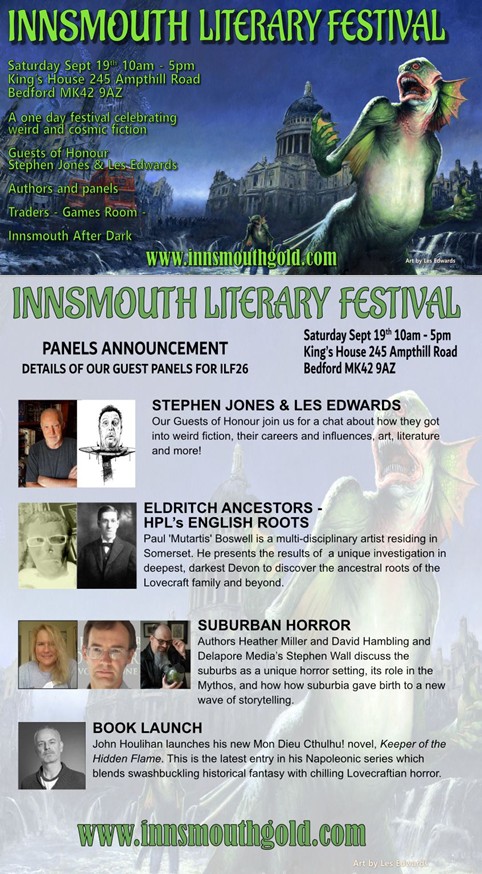
* A UK meetup for Mythos writers and also traders, the Innsmouth Literary Festival 25 is set for Saturday 27th September 2025, in the English town of Bedford. Located conveniently midway between Birmingham and London, and between Oxford and Cambridge, and with not one but two railway stations. Booking now.

* In the world of R.E. Howard, this week we have free on YouTube Editing Robert E. Howard’s Conan: A Conversation with Dr. Patrice Louinet. Also new and free on YouTube is a good reading of “Black Vulmea’s Vengeance” by Robert E. Howard. An excellent pirate adventure featuring an Irishman seeking his vengeance in the Caribbean. With a few tweaks, it could have been a ‘Conan the pirate’ tale.

* Tellers of Weird Tales feels the effects of Strange Rays & Weird Waves in Weird Tales of the mid 1920s.

* New on Archive.org, a run of the Deep Magic Ezine, 2002-2006. Includes short interviews with fantasy writers and artists.

* A pleasing and new-to-me view of a spot on the Brown University campus that Lovecraft likely visited, given his interest in Ancient Rome. An exact replica of an ancient statue of Caesar Augustus in Rome, installed on the Brown campus in 1906 and there until the early 1950s. Indeed, we can be fairly sure Lovecraft visited, in the company of his visiting geologist friend Morton. Since, after 1915 the adjacent Hall housed the Geology Department on the ground floor and in the basement. Morton would surely have prompted Lovecraft to visit the Dept. when visiting Providence.

* Talking of Brown University, the modern-day Providence campus and its library (home of most of the Lovecraft letters) are set to become a little safer to visit, after Brown reaches a $50m settlement over its campus antisemitism. Brown must now take… “significant, proactive, effective steps to combat antisemitism” including “proactive measures to protect Jewish students”, and it appears that progress is to be closely monitored.

* And finally, Lovecraft’s birthday is on the 20th of this month. ‘Presents’ have been a feature of past birthdays. As my present, I plan to release my recently-made “Lovecraft’s face/head” LoRA. This is intended as an add-on for use with SDXL models re: image-generating AI. Here’s a preview of ‘without and with’, when the generated figure is in the middle-distance and a facefix is automatically applied. Close-ups give a far better likeness (no facefix needed for close-ups), but this demo shows the LoRA can also work at a distance — which will be important for comic-books. It will also work with the head at an angle, and a prompt can change the expression (here seen in neutral)…


— End-quotes —

“My own nervous state in childhood once produced a tendency inclining toward chorea, although not quite attaining that level. My face was full of unconscious & involuntary motions now & then — & the more I was urged to stop them, the more frequent they became.” — Lovecraft to Richard F. Searight, March 1935.

“After 1904 [i.e. age 14] I had a long succession of 22-calibre rifles, and became a fair shot till my eyes played hell with my accuracy.” (Lovecraft to J. Vernon Shea, November 1933) / In Lovecraft’s “Polaris”… “my eyes were the keenest in the city, despite the long hours I gave each day to the study of the Pnakotic manuscripts”.

“I used to have to wear them [spectacles] all the time, and they kept my nose and ears in a state of perpetual irritation. Now I wear them only for steady middle-distance vision — as at the theatre, or at illustrated lectures.” — Lovecraft to Bloch, June 1933.

“It’s all as plain as the nose on your face …. or even that on my face, which is something else again.” — Lovecraft on his large nose, to Talman, February 1931.

“I do not claim to be 100% Teuton. My dark hair and eyes forbid me that honour. […] I am content to survey my ample height and pallid complexion […] your old Grandpa is pretty well satisfied to be a Nordick, chalk white from the Hercynian wood and the Polar mists” — Lovecraft joshing with Frank Belknap Long, December 1923.

HPLinks #48 – Lovecraft and music, new and old comics, D&D 5.5e Lovecraft, and more…

31 Thursday Jul 2025

Posted by asdjfdlkf in HPLinks, Lovecraftian arts, Podcasts etc.

≈ Leave a comment

HPLinks #48.

* The Great Dangerous Books podcast this week on H.P. Lovecraft & The Apocalypse. Discussing the… “philosophical implications of Lovecraft’s stories, particularly the themes of knowledge, reality, and the human condition.”

* In France, the 23rd Festival de Bourgogne (seems to be in Burgundy, France) is to offer a two-day “The World of Lovecraft” event in late August 2025…

Films by Marc Thomas Charley and Martine Chifflot will introduce the world of Lovecraft to mark his birthday on 20th August 2025. Three short biopics, and bio-fiction films in the evening. The 21st August meeting will then address the themes of witchcraft, documentaries, and Lovecraftian fiction. Two documentaries, three biopics, and audience discussions will take place before another evening screening, which will feature a documentary by Marc Charley, “The Curse of the Feathers,” a true case of witchcraft, followed by a new black-and-white version of Lovecraft’s “Dreams in The Witch House”. “Ritual” will be shown that evening. Followed by discussions with the audience, these screenings revive the spirit of the Festival’s film club by presenting inventive art-house films. A moment of sharing, discovery, and emotion for all in the Chauffailles cinema.

* In the latest Cryptology #3 (Spring 2025), Lovecraftian Will Murray has an article on the Charlton horror comics. I recall some of these titles fondly, when they were unusual items found in the dusty bargain-boxes of British comics shops.

Writer Will Murray does the first part of “A Requiem For Charlton Horror”, looking at their early horror titles with a selection of covers.

* Also in comics, Broken Frontier reports this week that Gou Tanabe’s Comics Adaptation of Lovecraft’s ‘The Shadow Out of Time’ “is to be translated and published by Dark Horse” in English. Set for January 2026.

* Feuilleton has “Lettering Lovecraft”, meaning hand-lettering.

* DiGRA 2025 now has its papers and abstracts online. This year’s major videogames think-fest will offer papers such as “Tentacle to the Metal: Ecosophy, Metamodernism, and Splatoon 3″, “The Fractured Imbunche: a Study of Chilean Horror Games”, and (abstract only) “Ecology of Killer Insects and Violent Nature in Grounded”.

* Also in the world of games, Form of Dread has a new and very detailed and technical review of Cthulhu by Torchlight. This new gamer book is meant to transform the core tabletop RPG game D&D 5.5e into a Lovecraftian world.

The single biggest highlight of Cthulhu by Torchlight are the subclasses, which are among the better-designed out of all those that I have seen made for 5e. [But the] bestiary [is disappointing], specifically the statblocks of the Mythos Deities. These are genuinely underwhelming, having few options to influence the battlefield and generally being ‘bruisers with one extra trick up their sleeve’.

Not to be confused with Cthulhu by Gaslight.

* A fledgling attempt to pin down some of the linguistic specifics of a R’lyehian language.

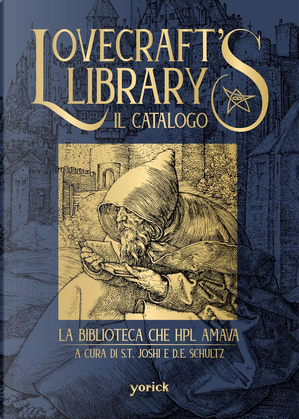
* Forthcoming, a French edition of Encyclopedie H.P. Lovecraft, being the encyclopaedia by Joshi & Schultz. Due in mid October 2025 from Bragalonne, according to Amazon UK. 500 pages and newly illustrated.

* A very niche new survey of a subset of Lovecraftian tales, the illustrated Powerpoint presentation “Cthulhu Returns to Camelot: New Works of Lovecraft-Inspired Arthurian Fiction” (May 2025). Available from academia.edu, and note that a Google Scholar search will get you an open PDF download without having to sign up to academia.edu.

* Seeming to me to be relevant to Lovecraft’s travels and campaigns to keep venerable old buildings, and his sense of resigned loss when they were demolished, is the new journal article “Spectres of gentrification: Towards a hauntological framework for exploring the impacts of gentrification” (2025)…

Using a case study of a gentrifying neighbourhood in New England, this article describes the utility of the hauntological framework in understanding ‘more than material’ impacts of gentrification. Drawing on extensive ethnographic research, alongside photovoice and walking interviews with long-time residents, this article describes how participants and residents are often haunted by the sense of individual and communal loss of their community’s future place in the neighbourhood. These ‘lost futures’ are often represented by the material changes, such as new buildings, and demographic changes, witnessed through the displacement of their neighbours, occurring in their neighbourhood.

* A new book chapter, “Empty horizons: Library music and the occult”, meaning stock ‘music library’ tracks which were licensed by production companies and broadcasters and used to accompany supernatural scenes. Part of the new book Anonymous Sounds: Library Music and Screen Cultures in the 1960s and 1970s (2025).

This essay focuses on a particular strain of library music that engages with the occult and the supernatural, produced at a time when there was a countercultural fascination with esoteric belief systems. New technologies such as the Moog and Arp synthesizers were able to create other-worldly sounds, the like of which had not been heard before

* And finally, in keeping with this HPLink’s focus on comics and music, “The Music from Beyond”. A Chamber of Darkness comic-book adaptation of Lovecraft’s “Zann”.


— End-quotes —

“Decidedly, Grandpa is an eye-man & not an ear-man! If any one thing killed my musical taste it was the violin-lessons I took betwixt the ages of 7 & 9. Back in ’97 I thought I liked music, but a year or two of classico-academic drill on a 3/4 size fiddle soured me completely. They wouldn’t let me scrape the tunes I wanted, but confined me to useful exercises & insipid folk-tunes out of a book. As a result, practicing became a hell, & the whole damn practicing became a hell, & the whole damn business drove me so close to nervous exhaustion that two physicians (I was little short of a neurotic semi-invalid as a kid) told my mother that a halt would have to be called. […] Today I can scarcely tell one end of a violin from another, & don’t recall a cursed thing about reading music” [i.e. from sheet music] — Lovecraft to Fritz Leiber, Jr., December 1936.

“Merely because the world is haphazard & imperfect, with certain satisfactory [aesthetic] adjustments attainable by only a part of the population, he jumps to the erroneous & irrelevant conclusion that nobody can attain such adjustments; that those who say they do merely pretend it, & that it is a waste of time to seek such a type of felicity. In other words, because some people can’t appreciate music, it is foolish for anybody to seek the pleasures of harmony.” — Lovecraft to Helen Sully, October 1933.

“I revel in absolutely frivolous light opera & musical comedy airs, I cannot bear serious Music with a capital M. However, I am not so narrow that I do not understand its aesthetic value, & I never laugh at it in the manner of Lord North and other celebrated anti-musical personages. So fond am I of light and catchy music, that I tried to write a comic opera when about ten years old!” — Lovecraft to Galpin, August 1918.

“Despite my vast ignorance [of music], there are musical compositions which tend to evoke from my imagination certain definitely visual concepts which could be expressed (had one the skill) either in poetry or painting.” — Lovecraft to Helen Sully, May 1934.

HPLinks #47 – vitalist Lovecraft, Lovecraft in the Po Delta, re-evaluating CAS, a new Lovecraft Atlas, and more…

24 Thursday Jul 2025

Posted by asdjfdlkf in AI, HPLinks, Lovecraftian arts, Maps, Podcasts etc., Scholarly works

≈ 2 Comments

HPLinks #47.

* More Lovecraft + philosophy. New from Hungary, “Lovecraft, antimodernism and new vitalisms” (2025)… “H.P. Lovecraft’s oeuvre is considered as a specific genre iteration of antimodernist themes, but also as a formative influence on the philosophy of speculative realism.” In Hungarian from the Dept. of Philosophy at Zagreb, and freely available for download.

* Overthink podcast Episode 134: Weirdness with Eric Schwitzgebel, interviewing Eric about his philosophy book Weirdness of the World (Princeton University Press, 2024). With a substantial discussion of the book Weird Realism: Lovecraft and Philosophy.

* Aetherium Arcana blog has a new short article on “Lovecraft and the Unconscious Structure of Empire”, followed by the new longer essay “Self-devouring Racism: Subversion and Collapse in Lovecraft’s Mythos”.

* New from Spain in English and open-access, “Development of Expert Systems by means of Large Language Models”. The authors feed Lovecraft’s fiction to a leading AI LLM, and have it try to find and map connections. Freely available online, those the images are rubbish quality and partly unreadable even in the source zip. This is as good as they get…

* Strange Aeons has a Catalog and Contacts link-list for the Italian Lovecraftians. Seems to have first appeared in 2023, and was last updated on 23rd July 2025.

* Also in Italy, Wu Ming 1 on Lovecraft, appearing at the Lunatico Festival. On 25th July 2025 he presents his new novel featuring Lovecraft-as-character, and then… “the geographer Francesco Visentin and Andrea Olivieri will dialogue with the author”. Followed by a presentation of…

The graphic-musical project [that depicts] the imaginary journey of H.P. Lovecraft in the Po Delta in 1926, between hallucinated visions, esoteric confraternities and monstrous water creatures. Designed by the Italian-English musician Jet Set Roger and the Serbian cartoonist Aleksandar Zograph, preseting a concert event that merges music and literature in a game of cross-media references with the Wu Ming novel.

* Decadent Serpent considers “The Reevaluations of Clark Ashton Smith”. Part of the discussion is of “The Quest of Iranon” by Lovecraft, compared to “Xeethra” by CAS.

* Black Gate has a long event-report with excellent photographs, “Post Oaks and Sand Roughs: A first trek to Howard Days” 2025.

* A useful new survey article of all the “Biographies of Robert E. Howard”, issued prior to the new and well-reviewed biography from the University of North Texas Press.

* Forthcoming in French, Atlas Lovecraft, a 180-page book that sounds like a cartographic atlas for Lovecaft. Due in October 2025 from reputable publisher Bragelonne.

A completely unprecedented atlas offering tangible geographic and cartographic representations of the emblematic places of Howard Phillips Lovecraft. An illustrated work in colour presenting plans of Providence, the State of Massachussetts, Arkham, Innsmouth, Kingsport, Dunwich and its region, a map of the Antarctic Expedition and a cartographic statement of mountain areas… [etc]

* And finally, a LoRA add-on for Flux, meant for generating images of whimsical toon Happy Shoggoths. Not on CivitAi, thankfully — since (as of today) the go-to site for creative AI is effectively banned here in the UK. I’m happy now that I nipped in just in time with my Windows 11 Superlite upgrade, and thus I now have the SD 1.5 turbo LoRAs, SDXL, Flux Kontext and Wan2.1 all downloaded and set up with workflows and ComfyUI to run them.


— End-quotes —

“I have always been fond of maps & geographical details (I’ve drawn a map of “Arkham’ to keep my local references straight), & my lifelong antiquarianism has caused me to lay zestful stress on historic backgrounds & traditional architectural minutiae.” — Lovecraft to Fritz Leiber, Jr., February 1936.

“I used to row [in a boat] considerably on the [River] Seekonk, which you’ll find on your city map … and also on general maps of R.I. Often I would land on one or both of the Twin Islands — for islands (associated with remote secrets, pirate treasure, and all that) always fascinated me.” — Lovecraft to Duane Rimel, April 1934.

[Lovecraft is delighted to find that he can circumnavigate the city of Charleston entirely via its many graveyards …] “the President of the Charleston Garden Club some time ago form’d the notion of mapping out an idyllic cross-town walk which might include as many as possible of these with a fair degree of continuity.” — Lovecraft, “An Account of Charleston”.

[Lovecraft rises to the very top of the highest building in New York City …] “The assembled clan’s first move was up — clean up to the top of N.Y.! It costs half a ducat [dollar] per rube [person], and is worth it. Loveman was dizzy, but your grandpa wasn’t — gawd knows how hard I worked when I was ten years old to conquer my native tendency to dizziness from altitudes! I walked on high railway trestles, and hell knows what not! But I digress. All Manhattan, Brooklyn, and Jersey City lay below, outspread like a map — in fact, I told Mortonius [Morton] that the city-planners had done an excellent job in making the place almost as good as the map in my Hammond Atlas at home.” — Lovecraft to Maurice Moe, May 1922.

HPLinks #46 – Lovecraft & Science conference report, CAS conference, Sonia update, Vondy letters, Tanabe and Stanley at work on new projects, and more…

17 Thursday Jul 2025

Posted by asdjfdlkf in HPLinks, Lovecraftian arts, Scholarly works

≈ Leave a comment

HPLinks #46.

* In the journal Transatlantica, a new and detailed 5,000-word summary and conference report from the recent major international conference on Lovecraft and the Sciences, held at the University of Poitiers from 4th-6th December 2024. In French, but here’s the Google Translate link.

* S.T. Joshi’s blog has updated. Among other things, he has news of a one-day conference “The Smith Circle: A Clark Ashton Smith Conference”. To be held in Smith’s hometown of Auburn, California, at the Auburn Carnegie Library on 18th January 2026. Booking now.

* My thanks to Ken Faig for tipping me off to Sean Donnelly’s long article on the Vondy-Spink correspondence file…

I sat down with the file of Vondy-Helm letters and hoped to find some clues. After all, they both knew Lovecraft and they were writing to each other during the last 14 years of Lovecraft’s life. There must be some reference to him in all those letters.

* The Papers of Sonia H. Davis blog (on Lovecraft’s wife) has an update on 2025 Sonia Scholarship.

* New from the Italians, Potrebbe anche non esserci piu un mondo (2025)…

Lovecraft’s longest single letter, delivered to the Italian reader in the form of a book. Here is Lovecraft as a man who is sober and calm, full of healthy common-sense, an acute and resigned critic of the modern age and anticipator of the future.

Possibly the letter to Woodburn Harris, then? Although the blurb has it that the letter was addressed to an unknown recipient.

* A 700-page script? No problem, for the Dark Adventure Radio Theatre. Purgatory Chasm is their new audio production with a difference, a choose-your-own-adventure in audio with multiple storylines and music. The setting is 1922, when a geologist discovers mysterious glyphs and artifacts in a New England cave.

* Another excellent new reading of R.E. Howard’s ‘El Borak’ tales, “The Lost Valley of Iskander”. Free on YouTube. Note that the reader’s Patreon patrons are able to suggest stories to be newly recorded in future.

* Gou Tanabe has reportedly started work on his manga adaptation of Dexter Ward. Given the length and complexity, I’d imagine it might be offered across two or more graphic-novel volumes? Although, given the glacial pace at which his work reaches an official English translation, I guess we may not see it in English for three or four years yet.

* Another more long-term project should be underway relatively soon. Richard Stanley’s movie version of The Dunwich Horror is still planning to start filming in Providence in early 2026. The movie aims to be the follow-up to his acclaimed Color Out of Space movie, set well after the events of Color and making Dunwich into “a futuristic version of Arkham”. It seems that Stanley hopes to film on the Brown campus and on College Hill, in his words… “to actually shoot the beast on College Hill and on the Brown campus”, fees and campus politics permitting. So presumably digital CG / AI / FX will give the present-day Providence a makeover, transforming it into a future-Arkham. Sounds good.

* HPL in the 18th century.

* Call of Cthulhu Ireland (Chaosium, 2025) is… “an update of the 2012 Miskatonic University Library Association (MULA) Monograph ‘Mysteries of Ireland'” for role-play gamers. 230+ pages, a 1920s setting, and also likely to be of interest to writers (as a spur to ideas and plotting within this setting). Currently nominated for the 2025 ENNIES Awards for new RPG books. Doesn’t appear to be on Amazon, and is possibly only on DriveThru RPG (which flung a ‘captcha’ road-block at me on trying to visit, and thus I didn’t visit and they don’t get a link here).

* And finally, order now to beat a 5% price-rise at print-on-demand publisher Lulu. All the store’s print book prices go up by 5% from 1st August 2025, due to inflationary back-end costs.


— End-quotes —

“… according to O’Hart’s Pedigrees [Irish Pedigrees (1892)] [in my family-tree] my Caseys are descended from Baudoin Ui Niall (O’Neill), 137th King of Ireland. Begorra …” — Lovecraft to Morton, March 1933.

“My mother and aunts knew the daughters of Joseph Banigan from childhood, and found them really worthy in every respect. The grandchildren were my earliest playmates, though it made me shudder in my British soul to know ‘Dicky Banigan’, ‘Robert McElroy’, ‘Edmund Sullivan’, etc!! [… The Banigan mansion is now] one of the ‘show places’ of the neighbourhood, and excited Klei[ner]’s vast admiration when he was here. It is a Gothic manor-house of brick and stone, such as its peasant builder may have seen and admired at a distance in his boyhood in Ould Oireland. The grounds are extensive and beautifully kept, with hedges, trees, and stables of pleasing architecture. It lies almost exactly half way betwixt the house where I was born, and that which I inhabit. Altogether, I fancy the Irish have helped rather than harmed the locality!” — Lovecraft to Galpin, September 1919.

“One of the great puzzles of Northern ethnology is the origin of the peculiar facial & cranial type associated with the Gaelic Celt of western Ireland & northern Scotland — the type with upturned nose, long upper lip, heavy eyebrow-ridges, &c. This type has no known analogue anywhere else in the world, & the ethnologist is at a loss to determine how it arose.” — Lovecraft to F. Lee Baldwin, August 1934.

“Most conservative anthropologists think it unlikely that — despite the vivid legends of diminutive Picts and elfin brownies in Scotland, tiny fairies and subterrene leprechauns in Ireland, sinister underground ‘little people’ in Wales, and Robin Goodfellow’s merry crew in England — any miniature race has ever actually inhabited the British Isles. We derive such tales entirely from the experience of our ancestors at a former stage of migration on the European continent.” — Lovecraft, “Some Backgrounds of Fairyland”.

← Older posts
Newer posts →


Please become my patron at www.patreon.com/davehaden to help this blog survive and thrive.

Or donate via PayPal — any amount is welcome! Donations total at Easter 2025, since 2015: $390.

Archives

  • January 2026
  • December 2025
  • November 2025
  • October 2025
  • September 2025
  • August 2025
  • July 2025
  • June 2025
  • May 2025
  • April 2025
  • March 2025
  • February 2025
  • January 2025
  • December 2024
  • November 2024
  • October 2024
  • September 2024
  • August 2024
  • July 2024
  • June 2024
  • May 2024
  • April 2024
  • March 2024
  • February 2024
  • January 2024
  • December 2023
  • November 2023
  • October 2023
  • September 2023
  • August 2023
  • July 2023
  • June 2023
  • May 2023
  • April 2023
  • March 2023
  • February 2023
  • January 2023
  • December 2022
  • November 2022
  • October 2022
  • September 2022
  • August 2022
  • July 2022
  • June 2022
  • May 2022
  • April 2022
  • March 2022
  • February 2022
  • January 2022
  • December 2021
  • November 2021
  • October 2021
  • September 2021
  • August 2021
  • July 2021
  • June 2021
  • May 2021
  • April 2021
  • March 2021
  • February 2021
  • January 2021
  • December 2020
  • November 2020
  • October 2020
  • September 2020
  • August 2020
  • July 2020
  • June 2020
  • May 2020
  • April 2020
  • March 2020
  • February 2020
  • January 2020
  • December 2019
  • November 2019
  • October 2019
  • September 2019
  • August 2019
  • July 2019
  • June 2019
  • May 2019
  • April 2019
  • March 2019
  • February 2019
  • January 2019
  • December 2018
  • November 2018
  • October 2018
  • September 2018
  • August 2018
  • August 2015
  • July 2015
  • April 2015
  • March 2015
  • February 2015
  • January 2015
  • December 2014
  • November 2014
  • October 2014
  • September 2014
  • August 2014
  • July 2014
  • June 2014
  • May 2014
  • March 2014
  • February 2014
  • January 2014
  • December 2013
  • November 2013
  • October 2013
  • September 2013
  • August 2013
  • July 2013
  • June 2013
  • May 2013
  • April 2013
  • March 2013
  • February 2013
  • January 2013
  • December 2012
  • November 2012
  • October 2012
  • September 2012
  • August 2012
  • July 2012
  • June 2012
  • May 2012
  • April 2012
  • March 2012
  • February 2012
  • January 2012
  • December 2011
  • November 2011
  • October 2011
  • September 2011
  • August 2011
  • July 2011
  • June 2011
  • May 2011
  • April 2011
  • March 2011
  • February 2011
  • January 2011
  • December 2010
  • November 2010
  • October 2010
  • September 2010
  • August 2010
  • July 2010

Categories

  • 3D (14)
  • AI (70)
  • Astronomy (70)
  • Censorship (14)
  • de Camp (7)
  • Doyle (7)
  • Films & trailers (101)
  • Fonts (9)
  • Guest posts (2)
  • Historical context (1,095)
  • Housekeeping (91)
  • HPLinks (68)
  • Kipling (11)
  • Kittee Tuesday (92)
  • Lovecraft as character (57)
  • Lovecraftian arts (1,623)
  • Lovecraftian places (19)
  • Maps (70)
  • NecronomiCon 2013 (40)
  • NecronomiCon 2015 (22)
  • New books (966)
  • New discoveries (165)
  • Night in Providence (17)
  • Odd scratchings (984)
  • Picture postals (276)
  • Podcasts etc. (430)
  • REH (181)
  • Scholarly works (1,464)
  • Summer School (31)
  • Unnamable (87)

Get this blog in your newsreader:
 
RSS Feed — Posts
RSS Feed — Comments

H.P. Lovecraft's Poster Collection - 17 retro travel posters for $18. Print ready, and available to buy — the proceeds help to support the work of Tentaclii.

Proudly powered by WordPress Theme: Chateau by Ignacio Ricci.