• About
  • Directory
  • Free stuff
  • Lovecraft for beginners
  • My Books
  • Open Lovecraft
  • Reviews
  • Travel Posters
  • SALTES

Tentaclii

~ News & scholarship on H.P. Lovecraft

Tentaclii

Category Archives: Historical context

Who was John Pucciatti?

29 Sunday May 2022

Posted by asdjfdlkf in Historical context

≈ 2 Comments

Yesterday I at last firmly located the elusive “John’s”, the favourite Brooklyn spaghetti hang-out of H.P. Lovecraft and his circle.

Here again is the ad, from a 1925 radical magazine. “John’s” at “7 Willoughby”.

Who was John Pucciati (1885-1967), who ran John Pucciatti’s Spaghetti House (popularly known as “John’s”)? He was a quite a character in 1910s and 20s New York, and is still remembered to this day. Difficult to research via Google, though. Because for some reason Google Search dumbly insists on removing the quote marks from “John Pucciatti” after the first page of results. But thankfully there’s eTools, which has no such dumbness built in.

The basic details are:

“Established in 1908 by John Pucciatti, an immigrant from Umbria, its menu offered an appetizer, main dish, dessert, and cup of coffee for under a dollar.”

He was an early Italian anarchist. Lovecraft knew a few of these…

There’s nothing about ‘anarchists’ to be afraid of! … they are very harmless folk. … Despite their bold talk they are timid & ineffectual creatures, most of whom would not hurt a fly if they could. I know many of them … [such as Morton, and likely also Loveman in a rather closeted way.] [They are to be distinguished from the Greenwich Village ‘radicals’ who adopt] a slovenly insincerity & cheap posing habit, which merely uses the guise of radicalism as an easy way of attracting attention.” — H.P. Lovecraft, July 1929.

Pucciatti was perhaps of a different order than Morton or the posers at New York parties. Maybe more syndicalist, depending on how much experience he had of the dramatic and very sudden industrialisation of Italy, before leaving for America. Though we can’t be sure, since he doesn’t appear to have left any writings. On him Radical Gotham: Anarchism in New York City can only offer that his restaurant was one of…

… a multitude of Italian cafes and restaurants offered cheap meals and distraction, serving as important social and political centers. Founded in 1908 by John Pucciatti, an immigrant from Umbria, John’s on East 12th Street was legendarily known as “the favorite meeting place of free thinkers of all nationalities”. Other popular anarchist hangouts included Albasi’s grocery on East 106th Street and the Vesuvio restaurant on 3rd Avenue near 116th Street in East Harlem, where for one dollar radicals could enjoy a cheap meal while debating politics and socializing.

Another book, Making Italian America, has the same and adds a little more from a recent biography of the socialist labour-organiser and editor Tresca…

In the United States, the sovversivi’s most popular hangout was John’s Spaghetti House on East Twelfth Street in New York City (now simply John’s), which was commonly advertised in Italian radical newspapers as ‘the favorite meeting place of free thinkers of all nationalities’. Established in 1908 by John Pucciatti, an immigrant from Umbria, its menu offered an appetizer, main dish, dessert, and cup of coffee for under a dollar. Carlo Tresca, Arturo Giovannitti, and other famous sovversivi regularly ate there, often holding special radical banquets at John’s private apartment upstairs.

At the time he started his main branch, aka ‘John’s of 12th Street’, the Wild West was still wild and Butch Cassidy and the Sundance Kid were rooming just around the block. Pucciatti had at least one local artist fresco the walls, paid in free meals. The place was classy, a formal white-tablecloth Italian restaurant with apron-ed waiters. But by the early 1920s the place seems to have slipped over from idealistic tub-thumping 1910s Italian anarchism to illegal tub-brewed booze… and thus the first wave of U.S. gangster-ism. The slide being quite evident from 1922. John’s became a popular watering hole for proto-mafia gangsters such as Lucky Luciano. Who was not so ‘lucky’ one night as he left the place, being gunned down outside. At this time it…

also operated as a well-known speakeasy [i.e. illegal booze purveyor] during prohibition. The ground floor continued as a restaurant, while wine and whiskey were made in the basement and served in espresso cups on the second floor.

Entrance to the upstairs was via a hidden staircase. Head hooch-brewer Mama John had a candle lit in the window when the fresh booze was ready to be served. Any sign of the cops in the area, and the candle went out. One article states that John’s on 12th Street was “ground zero” for the subsequent growth of the Italian Mafia in the U.S. This may explain his low-profile as a business during prohibition, keeping out of directories and not advertising except in journals likely to bring the right type of clientele.

After the war the main John’s catered to off-Broadway actors and the theatre crowd, and continued to be considered one of the top Italian eateries in America. As shown by a tourist Guide Book…

John’s at the corner of 2nd Ave , and 12th St. (the heart of the off-B’way theatre area) has been satisfying the palates of folks for 50 years. Under the guidance of Dan and Ann Pucciatti, the north Italian hostelry…

The 2009 book Restaurant Startup & Growth magazine tells us that his son…

Danny Pucciatti, took over day-to-day management of the [main] restaurant in the 1950s when his parents retired. Eventually he sold the establishment to current owners Mike Alpert and Nick Sitnycky in 1973.

It’s still there today, and still a leading place to eat good food.


But what of Brooklyn? Nothing seems to have passed into New York restaurateur lore about the 1925-30(?) Brooklyn branch, which is presumably why it has eluded Lovecraftians until now. The opening of this branch can however be dated by the 24-month block of adverts which John took out in Worker’s Monthly. In March and April 1925 his first adverts appeared, but the Brooklyn branch was not advertised. “Indian” here is perhaps a typesetter’s mistake, later corrected to “Italian”?

Then in May 1925 the Brooklyn branch appears on the ad, and the ads (inc. Brooklyn) continue on through February 1927 when they cease. I assume the 24-month block-booking was over. So the Brooklyn branch opened in spring 1925, and it was still in existence in early 1927. John’s first appears in Lovecraft’s 1925 Diary on 4th May, so that both fits and confirms. Possibly there was a grand 1st May ‘May Day’ opening day, something that would be most suitable for an anarchist. Lovecraft returned to John’s to eat on the 6th and 7th May, and frequently thereafter. In the letters a typical encounter with “John’s — the Italian joint around the corner in Willoughby St.” is…

stopping only at twilight, when I wended my homeward way, pausing at John’s Spaghetti place for my usual Sunday dinner of meat balls and spaghetti, vanilla ice cream, and coffee. Incidentally — not many doors away, on the other side of Willoughby St, I found a restaurant which specialises in home-baked beans.

This fits the facts, as the “home-made baked beans” shop was further up and on the other side as can be seen on 1940s.nyc. But John’s remained Lovecraft’s spaghetti “headquarters”, as he later phrased it. He was getting the best that 1920s New York could offer, made by cooks born in little hill-villages in the old country. Which must have been quite some spaghetti. He would afterwards find it difficult to get a comparable ‘New York flavoured’ spaghetti meal in Providence.

Back in New York, John’s had closed before summer 1931. On page 937 of Letters to Family Lovecraft states it was “defunct” by July 1931…

All three now set out for dinner — at the old Bristol Dining Room in Willoughby Street near Fulton, next door to the now defunct John’s, which was my Brooklyn headquarters for spaghetti in the old days.

Was John ever on the premises? Unless any Lovecraft letters can show otherwise, back in the mid 1920s it may well have been that John Pucciatti — the anarchist who looked like a Roman nobleman but who was actually from the “little medieval village of Bevagna, between Spoleto and Assisi” — wasn’t sitting down at a table to chat philosophy and art with Lovecraft. He appears to have lived and worked at his main branch. Still, he might have popped in now and again, when he wanted to escape from the big-name gangsters and the fumes of Mama John’s back-yard hooch-brewing.

Pictures for “John’s”, Brooklyn

29 Sunday May 2022

Posted by asdjfdlkf in Historical context

≈ Leave a comment

Here are pictures for “John’s”, located at Willoughby Street, Brooklyn, from May 1925. A regular and favourite New York City haunt of H.P. Lovecraft, from that date.

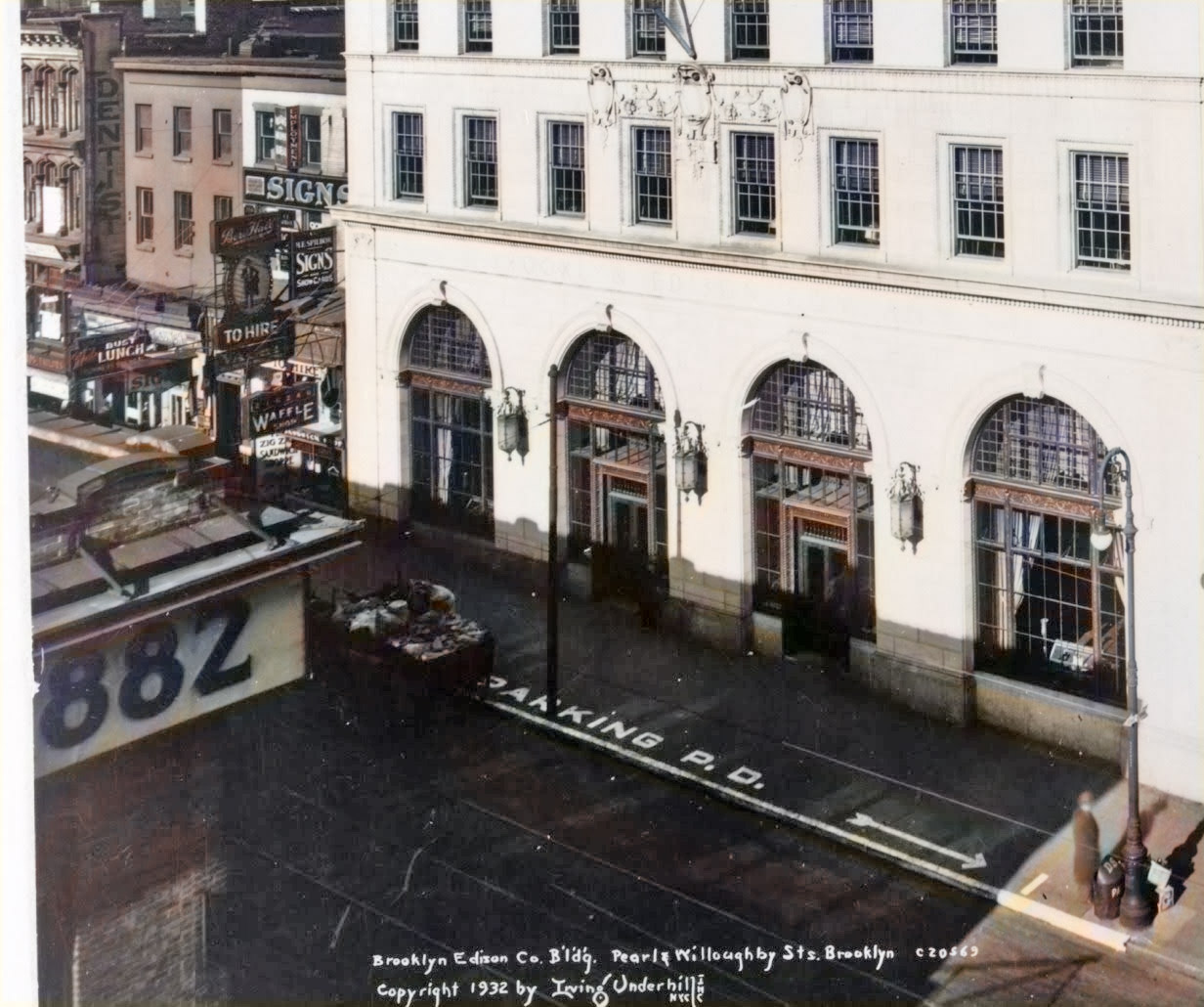
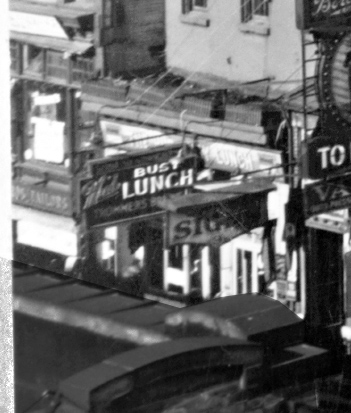
Here we see Willoughby at numbers 5 – 15 on part of a Library of Congress architect’s photograph made in 1932. It shows the Edison Company’s 1924 offices, with the shadows lifted by myself to reveal a shadow-hidden truck and also some of the detail on the adjacent stores. A corner of a closer building’s roof partly obscures the view.

No. 7 is on the right. Still offering “Lunch”.

No. 5 can be identified by its architecture as seen on other pictures, and is half-seen on the far left of the picture. Circa 1924 it held the office of Lovecraft’s New York writer friend La Touch Hancock. Then we simply count along the row. Numbers 11-13-15 were obviously subsumed by Edison into a single “No. 15”, a building which is still there today and has the same number. Some modern sources erroneously date the Edison Company offices here to “1960”, but that is the date of a building record-photo, not of the building’s 1923/24 erection.

This show us what the street looked like in Lovecraft’s time, with the Edison building there already by 1924-26. Here is the detail, and it suggests John’s was no longer John’s by 1932. I seem to recall that Lovecraft mentions somewhere in a letter that it had closed by the 1930s, but I can’t find that mention. By 1932 it certainly has a ‘cabin’ frontage added, and is the “Busy Lunch” with what might be a “Trommers” or “Drummers” Bar incorporated.

It feels like John had departed, and indeed he had. On page 937 of Letters to Family Lovecraft states of July 1931…

All three now set out for dinner — at the old Bristol Dining Room in Willoughby Street near Fulton, next door to the now defunct John’s, which was my Brooklyn headquarters for spaghetti in the old days.

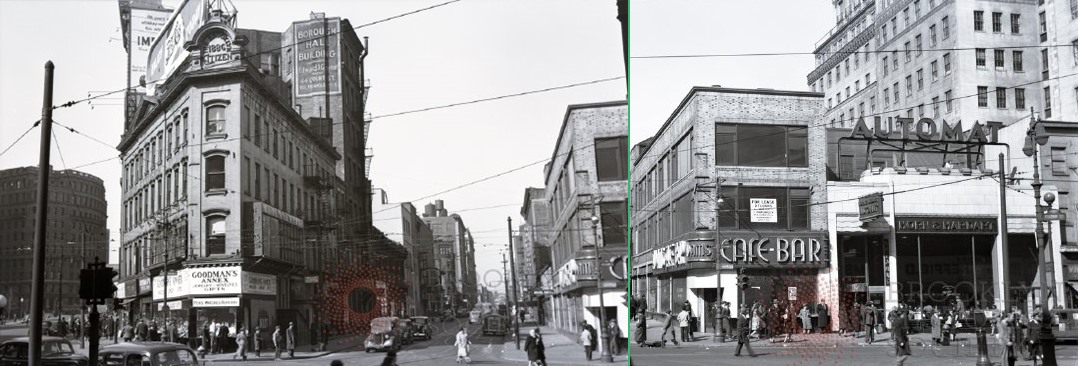
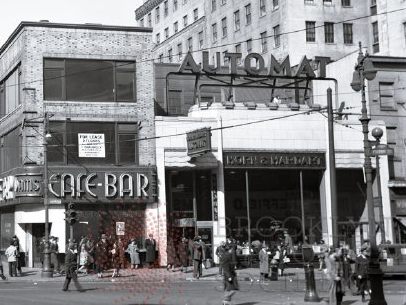
By the late 1930s it was a Wines and Liquor store, as partly seen on the right of a badly mis-placed 1940s.nyc picture. A Lovecraft-like man crosses the street to the art-deco “Automat” which had by then replaced 3-5 Willoughby Street.

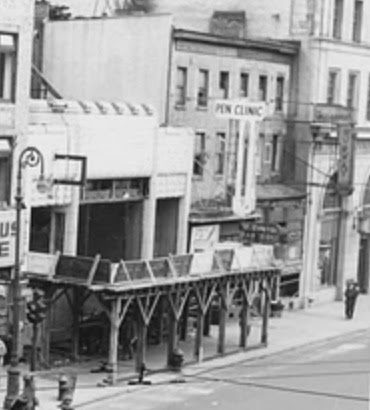
A further picture I have shows that No. 7 was still there in 1954, along with No. 1, and 3-5. The Automat at 3-5 was then being gutted and — appropriately enough — the former John’s appears to have become a “Pen Clinic” for ink pens. Lovecraft, always in pursuit of the perfect ink pen-flow, would surely have approved of what appears to have been the final fate of John’s.

1954, what looks like the final years for numbers 1 to 9.


With these pictures in hand I’d say that the modern layout places the site of No. 7 about at the very edge of the plaza, or maybe a little further out into the highway…

The plaza is small, cramped and over-cluttered… and thus the safest hassle-free place (the city is currently subject to a massive wave of street-crime) for any Lovecraftian tour-guide gathering and talk would appear to be in the far corner of Columbus Park. Which is seen here, after my having ‘virtually’ crossed the highway from No. 15 and its small plaza. I’ve here indicated the continuing line of the ‘lost’ Willoughby Street in a soft orange…


What did it look like in circa 1925-27? We can’t know, until more pictures are found. But we do have the Subway Construction pictures of 1916, presumably made on lovely large glass-plates so as to forestall any spurious compensation claims in litigious New York City. Good prints of these can now be had from the city’s Transit Museum. They show a place very different from the makeover it had by the late 1930s, so I guess ‘the unknown 20s’ are some way between the two sets of pictures.

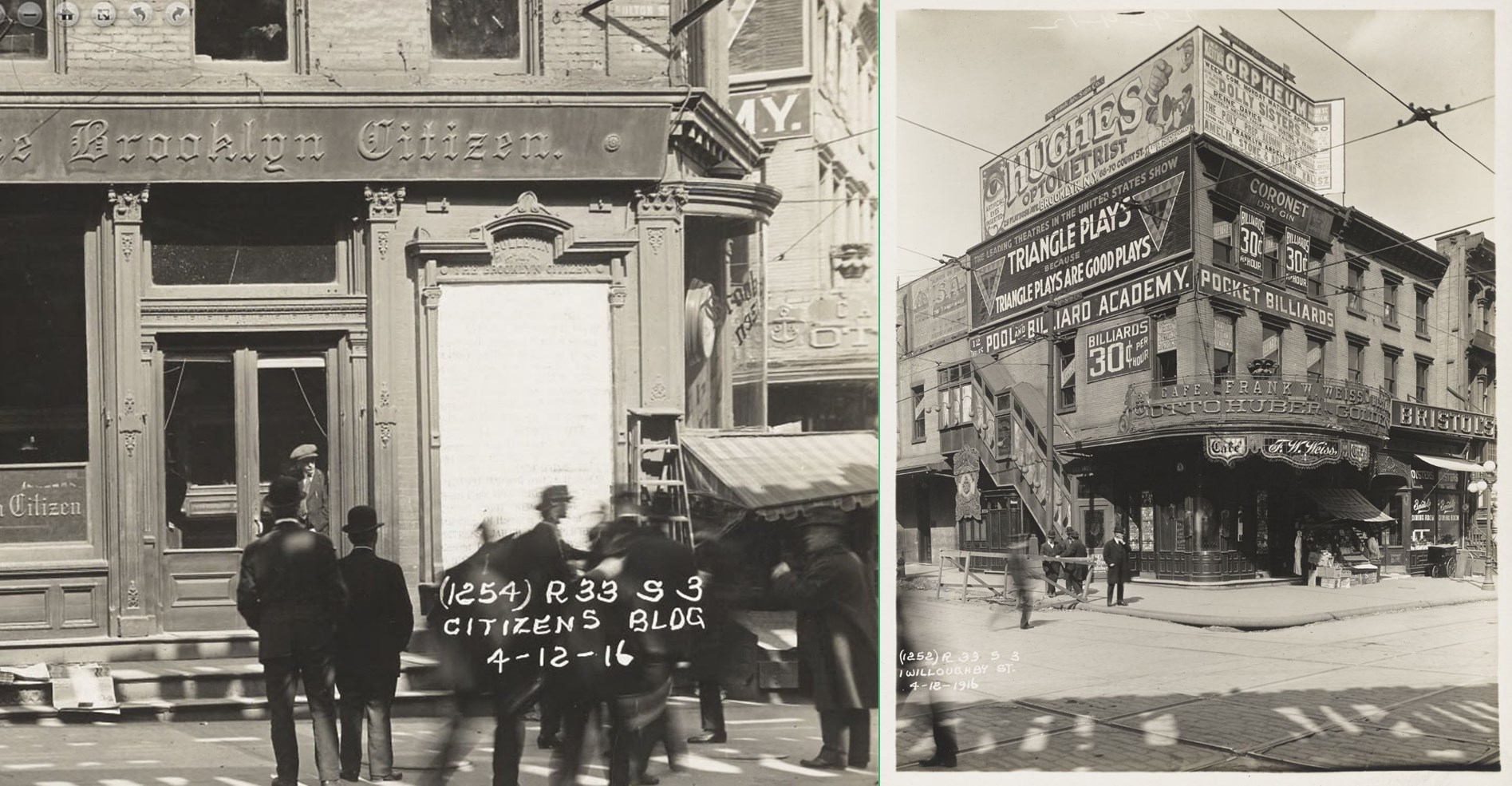
But we should be thankful we have three very good pictures of No. 7 as a Hungarian restaurant in 1916, with various vacant units around about. The place would have made a natural transition to an Italian eatery, with newer signs in a slightly more 1920s style and probably a spruce-up in Italian type colours, probably red and green and white rather than what might have been a Hungarian blue and white.

Here we half-see No. 7, but head on, while picturing No. 9. Also seen is a part of No. 11, which by Lovecraft’s time had been lost to the Edison Company’s 1924 offices.

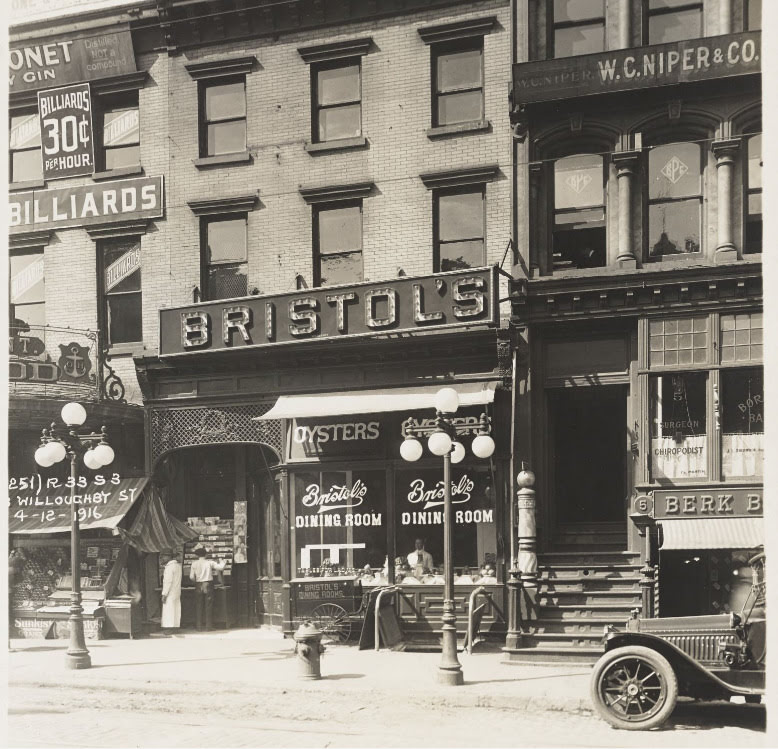
The full circa 1900 run from the original 3 – 15, including the Bristol Dining Room which Lovecraft patronised in the 1930s after John’s closed, can be seen here…

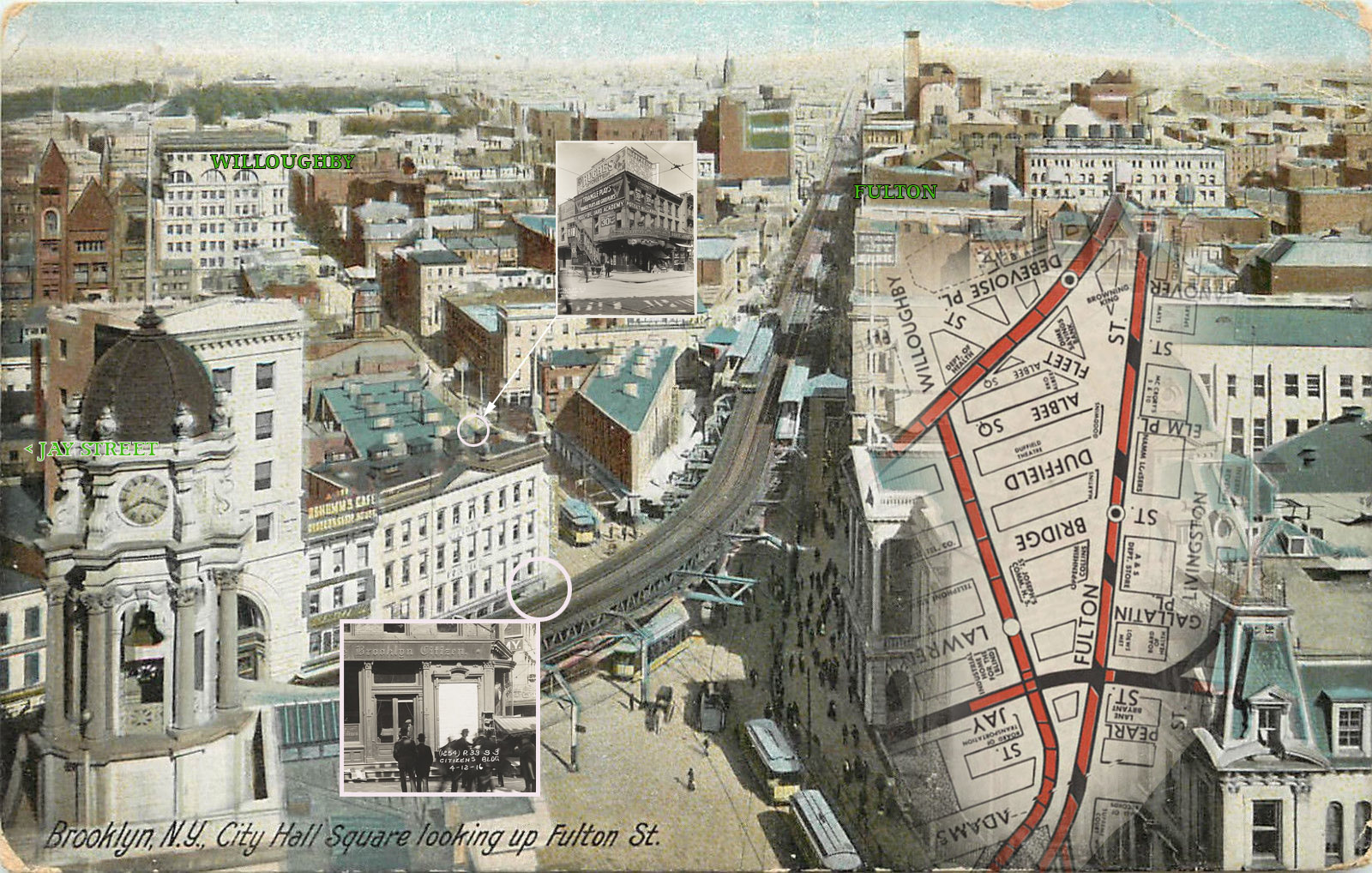
And finally, this wonderfully clear 1916 view of the entrance, looking down the foot of Willoughby toward the Citizen building (hardly to be seen) and the Elevated railway as it curved around and into Fulton. I’ll colourise this at some point, but automation doesn’t even remotely do it and I don’t have the time to do it justice at present.

It was still the same Hungarian place in 1918, when a further small picture shows the subway air ducts being dug.

Some of the (to our eyes) superb signs and sign-writing had no doubt gone by the mid 1920s, perhaps some of the lower vacant units would have become fruit-sellers and the like, and the whole corner would have had a distinctly more seedy and gangster-ish feel about it. Especially after John’s opened. On which, more in the next post.

Finding John’s

28 Saturday May 2022

Posted by asdjfdlkf in Historical context

≈ Leave a comment

Following on from yesterday’s Bickford’s, Brooklyn post, another try at finding the very elusive John’s, one of Lovecraft’s favourite eating and supping places in Brooklyn. Which I’ve searched for before…

the letters vaguely talk of the corner of Fulton and Willoughby Street, and the western end of Willoughby St and even “in Willoughby St”.

First, I found some new data about restaurants low on Willoughby, from court records…

FRITZ’S: “on or about the 24th day of March, 1902, the defendant conducted and now conducts a restaurant at No. 7 Willoughby street, Borough of Brooklyn”. In 1901… “7 Willoughby Street, known as Fritz’s restaurant”.

AUTOMAT: In 1936, “Horn and Harart Company … in the restaurant business … located at 3-5 Willoughby Street in the borough of Brooklyn, New York City” … “the defendant The Horn & Hardart Company owned, operated and controlled a certain restaurant commonly known as the Automat, located at No. 3 Willoughby Street in the Borough of Brooklyn”.

The Brooklyn Historical Society then gave me the location of this Automat, in an early-1940s picture and I usefully spotted that this aligned with an adjacent picture of The Brooklyn Gazette building. This gave me a very useful orientation point…

With thanks to the Brooklyn Historical Society. These are not on the 1940s.nyc site and are later on in the 1940s. Prints can be had.

Just to check, in the following picture we look at the same place but from the left-hand side. From the Fulton Street facing side of the Citizen building in 1916, we look across the end of the street and see an anchor sign peeping out from across the road. This can be tallied with a picture of “No. 1 Willoughby”, on which the very same sign is seen. These are New York Board of Transportation pictures, made before the subway construction in 1916. No. 1 would be the “Cafeteria” by the late 1930s, and then the slightly renamed “Cafe-Bar” by the early-mid 1940s.

These are also now in the public domain and held by the New York Transit Museum, if you want nice prints made. Again, they are not on 1940s.nyc.

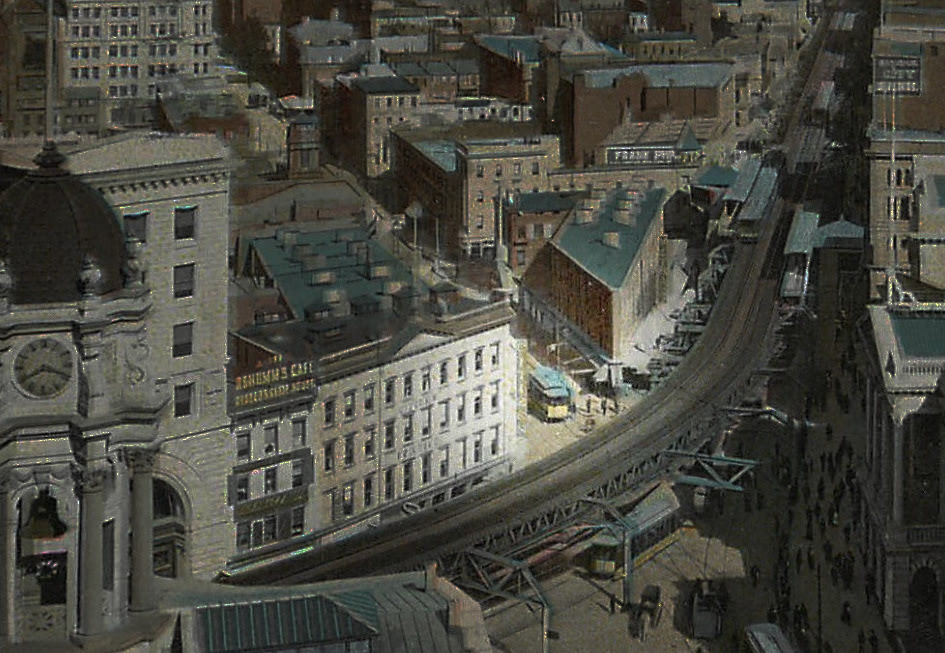
With those two composite views of the same site established, I needed a wider view from the period. Because a great deal has changed by today, and the approximate 1940s.nyc tax-photos map is quite misleading as well — as well as being not very useful on pictures at this particular location. Today Willoughby Street starts with a cursory new plaza containing only No. 15, this being the former Brooklyn Edison Co., built as electricity company offices in 1923/24 (site of the vaudeville/cinema Royal Theater at 11-16 Willoughby, corner of Pearl). Today the rest of the bottom of Willoughby Street, along with the Citizen newspaper building, has been wiped out by the huge multi-lane highway and the plazas either side.

Here’s the more useful orienting bird’s-eye 1910 postcard, and also a 1940s/50s map showing street layouts along with what are probably the subway lines. I think the Elevated railway down Fulton had been dismantled, by then?

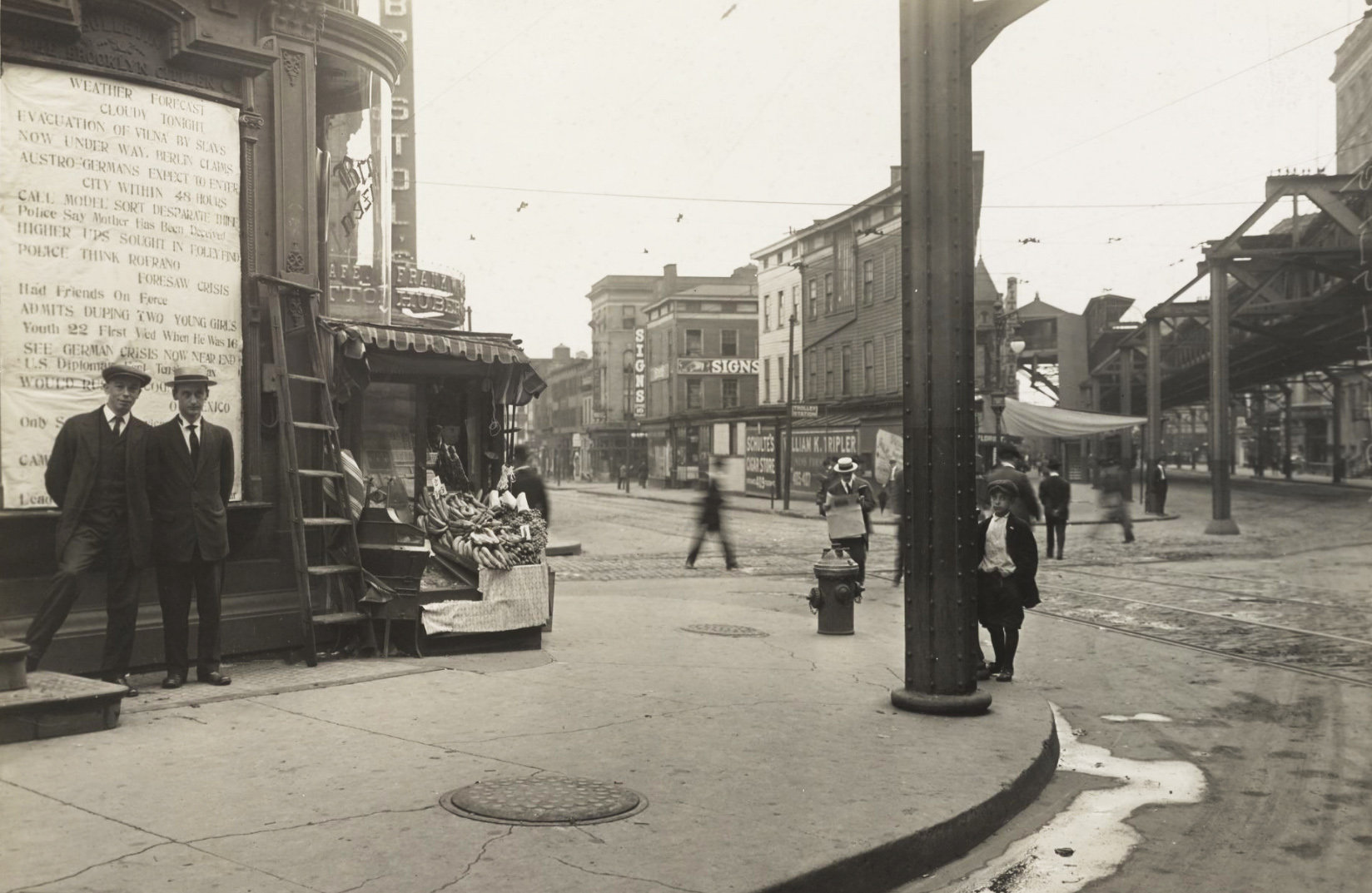
With the location established, I now move along and up the street on the same side, again using the excellent and free 1916 New York Board of Transportation pictures. Here you can see a tiny bit of No. 1 (note the anchor sign), and 3 and 5, in 1916. Note that the number 5 can be seen.

From January 1916 No. 5 was the new Headquarters of the Brooklyn Press Club. Doubtless the proximity to the Citizen newspaper helped there, and also nearby was the best private Directory and Guide-book library in the city. I have also discovered that upper floors of No. 5 later held the office of none other than Lovecraft’s New York friend La Touche Hancock, professional versifier and fellow British Empire loyalist. Here we see him advertising at this address in Student Writer, with such ads running from 1922-24 and also in at least one movie magazine…

By 1931 No. 5 was the “American Book Exchange”. Photographic evidence shows the “Automat” was not there in 1932, but a little later 3-5 was be completely re-made as the wholly new art-deco “Automat”. Thus the “Automat” only appeared after Lovecraft left New York City…

Here in the early 1940s we also see a little glimpse of No. 7, just peeping in at the right-hand edge of this early 1940s picture. It had survived Lovecraft, and appears to be looking much the same as the mid 1920s.

Hmmm. Hang on a minute. “Bristol’s” at No. 3? Sounds familiar. On page 937 of Letters to Family Lovecraft states of July 1931…

All three now set out for dinner — at the old Bristol Dining Room in Willoughby Street near Fulton, next door to the now defunct John’s, which was my Brooklyn headquarters for spaghetti in the old days.

Yup, same place. From Lovecraft’s own words, Bristol’s was “next door to the now defunct John’s”. So… John’s must be either 1, 5, or 7. Yes, I’ve found it was at 7…

Found at last. This ad for John’s is from 1925, at the required “7 Willoughby”. His branch opened in Brooklyn early May 1925, and the owner was the spaghetti-maestro John Pucciati. Who, as it turns out, was also a leading Italian anarchist in New York City, and by that time deep into running one of New York’s key illegal speakeasy joints. More on John tomorrow, and more of the relevant building pictures.

This picture is No. 7 in 1916, nine years before John took it over in May 1925. As we can see in this picture it was a bit pokey, it terms of getting a table with a view…

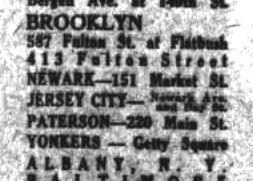
This lack of views raises a problem. How did Lovecraft sit in John’s and look out at the Brooklyn Citizen building? Which it’s likely he did. Because that was where and how he spotted his cheap suit from Monroe Clothes, across the street from John’s in an upper window. A 1922 copy of The New York Times (thanks Archive.org) brings this Monroe location a little closer than it was in my previous fruitless search for John’s. The NYT has the Monroe Clothes chain’s main Brooklyn branch at 413 Fulton Street, aka the Citizen newspaper building…

So, it appears that I was led astray by their earlier 1917 “Fulton and Hoyt” address for Munroe, which I looked for some years ago now. It now looks like they moved further up Fulton Street toward Borough Hall at sometime between 1918 and 1922. The company then failed in December 1925 – June 1926 after being “dragged into bankruptcy” by a vexatious creditor. When the official receiver was appointed for the Monroe Clothes bankruptcy in June 15th 1926, it was usefully listed at “409-21 Fulton Street”. This then is further confirmation that they were indeed at 413 Fulton Street by 1922. 413 was likely their main ground-floor entrance, and then they had sales and stock rooms above that stretched across No. 409-21. They were a purely “upstairs” men’s suits store, which is how they offered their famous cheap prices.

But how could Lovecraft have seen the Citizen building when eating at John’s at No. 7? I can only assume that No. 7 had some kind of extended rental across the upper roof-space, in order to have more tables and also more ‘tables with a view’. Which would look something like this…

So, the Citizen building would have been in view, if this was the arrangement. As I’ll explain tomorrow, John had some tight ‘mob’ connections by this time, and thus could have ‘swung’ such an extension across the upper floors, even had the other owners been reluctant. More on John tomorrow, along with fine photos of No. 7.

‘Picture postals’ from Lovecraft: Bickford’s, Brooklyn

27 Friday May 2022

Posted by asdjfdlkf in Historical context, New discoveries, Picture postals

≈ 1 Comment

This week, another try at finding H.P. Lovecraft’s New York City cafes and eateries. Today Bickford’s, tomorrow… John’s.

H.P. Lovecraft mentions that a favoured eatery in Brooklyn was “Bickford’s” near Borough Hall. The place was found early during his New York City sojourn. He had abandoned the Tiffany, whose wood-panelled decor he favoured, after he discovered that the clients just could not be ignored in favour of the decor…

the clientele was past enduring … young toughs and gangsters … I got all my stomach could stand after three or four months and thereafter switched to Bickford’s – near Borough Hall.” (Selected Letters II, page 259).

The early switch is confirmed by his 1925 Diary, which notes “Bickford’s”.

In the early 1920s Bickford’s was part of a small but growing chain, with the owner Samuel L. Bickford known for his work with and fund-raising for the Boys Club in Brooklyn. He had also run the New England Waldorf’s Lunch chain in the 1910s, and since these were one of Lovecraft’s favourites he could have been familiar with Bickford’s name in that way. In New York Mr. Bickford offered the unbeatable combination of good cheap food, fast service, and long hours. His chain was a success and in the 1920s branched out into even faster service with self-service automats, it seems, if the New York City branches listed in directories as ‘Bickford’s Lunch System’ are anything to go by. He ended up with a large successful chain.

The Chain Store Age trade magazine tells us that a Bickford’s branch wasn’t located at 425 Fulton Street until 1927. Thus the 58 Court Street branch must have been Lovecraft’s haunt in the Red Hook years, and it is indeed very “near Borough Hall” being just a few steps away down Court St. He calls this branch of Bickford’s a “one-arm”, meaning both cheap and that it had ‘side-arm’ tables just wide enough to hold your plate of food.

In its better days 58 Court Street had been the home to Mr. Edward Greaf, first-class dealer and importer of wines and also the Curator of Entomology at the Brooklyn Institute. But by the 1940s it was the Concord Cafeteria, with a Chop Suey hall above…

As can be seen here in the late 1930s. The former Bickford’s is now the Concord cafeteria and is partly seen on the left. The 25-cent Chop Suey restaurant is above…

Today Street View shows the site as a seedy “Dunkin’ Donuts” hole-in-the-wall next to a failed “General Nutrition” health-food store. However, most of the pleasing stonework and a classic Brooklyn metal fire-escape remain above, evoking a touch of the past.

The above 1940s picture is the nearest in time and place to the 1920s I can get. Not quite as Lovecraft would have known it some 15 years earlier, but I note that since 1917 Bickford’s branches all had the same classy architect and designer, one F. Russell Stuckert. Thus the Court Street branch would probably not be too different from the following frontage in design and logo and perhaps also the use of stained glass. Here we see his design work in the post-1927 frontage for the nearby 425 Fulton Street branch, located a little to the west of Borough Hall…

“Hot Turkey” on the menu. The frontage is deceptive as to the size, since inside it was vast and went back and back and back again — as I’ll explain in another post. The smartness of this 1927 branch, seen here in the late 1930s, may not quite reflect that of the earlier and more worn Court Street branch circa 1925.

David W. Dunlap wrote about the cultural aura of the Bickford’s chain in 2000 in The New York Times, then a reputable newspaper of record. He noted that in the 1950s Ginsberg’s Howl beat generation… “sank all night in submarine light of Bickford’s” (Howl, Ginsberg), and that the great Woody Allen later revered the chain… “I got no money. I’ll go sit in Bickford’s.” (Getting Even, 1971, his breakthrough book collection). Other New York creatives also mentioned it over the years. But Dunlap didn’t pick up on the fact that one H.P. Lovecraft had, as usual, got there first.

Notes on Selected Letters II – part one

23 Monday May 2022

Posted by asdjfdlkf in Astronomy, Historical context, Lovecraft as character, New discoveries

≈ 4 Comments

Over the summer I’m re-reading H.P. Lovecraft’s five volumes of Selected Letters and this time I’m making notes. Here is part one of my notes on Selected Letters Vol. II.


* Lovecraft mentions Chase’s Drug Store located at the central “bridge” area of Pawtuxet, stating that this store offered all the best available postcards of local scenes (page 58). The Providence Public Library has a picture of Chase’s frontage, with a chap appearing to carry away a packet of drugs that could equally be a set of postcards. I’ve here rectified and faintly colourised it (this kind of picture doesn’t take colour very well). The picture was made by Mr. Chase, so it is his store.

* Lovecraft states that he had his cuttings on Rhode Island and antiquarian matters well-sorted and assembled into scrapbooks by October 1926. These having been in mounded up in piles on his desk, when living in one room at Red Hook (page 77). His scrapbooks, antiquarian or otherwise, do not appear to have survived.

* In April 1926 he was back in Providence and exploring his own city. Though obviously inspired by Eddy’s recent introduction to the reality of an ‘unexplored Providence’, he appears to be alone in the following exploration. He was also presumably using the secrets he had learned about the layout of colonial Providence during the fateful visit to the Shepley Library. He thus begins to visit on foot parts of Providence he had not previously visited…

I discovered one of the most hellish slums ever imagined by mankind. it was a place whose existence I had not before realised — the end of Chalkstone Ave. near Randall Sq. and the railway — and its dark hilly courts approach the very ultimates of blasphemous horror.” (page 43)

It appears to be a dangerous area even today, just to warn any local Lovecraftians who might be thinking of photographing there. The 2022 news reports two shootings in Chalkstone Ave.

* In May 1926, Lovecraft was still exploring previously unexplored “seedy” by-ways, but this time perhaps less squalid ones. As he was in the company of his aunt…

Mrs. Gamwell and I took a walk thro’ a section of the town in which I had never set foot before — an antient and now seedy district east of the river and just south of the good residential area. Colonial houses abounded, and I was astonisht at some of the gorgeously antique effects obtainable here and there. […] It is call’d Dove Street, and has neither pavement nor sidewalk, but consists of irregular rows of simple Colonial cottages with rough stone doorsteps, and here and there a flagstone or two.” (page 54)

Dove Street is one of the parallel side streets that run alongside the main Hope Street at Fox Point, and head down toward the waterfront rail-yards at India Point. Dove Street still exists, though the map hints it may have been truncated in modern times. Today the Rhode Island Historical Society’s Mary Elizabeth Robinson Research Center is located about 160 yards to the north, which means that researchers might also fit a visit to nearby Dove Street in when visiting. The top part of Dove Street appears, from Street View, to be on its way to being gentrified.

* In February 1927 he writes of the Providence waterfront and names four “dark alleys” there…

the vivid, glamorous waterfront with its rotting wharves & colonial warehouses & archaic lines of gambrel roofs & dark alleys with romantic names (Doubloon, Sovereign, Guilder, Bullion, etc) & wondrous ship-chandleries & mysterious marine boarding houses in ancient, lamplit, cobblestoned courts”.

Today “Doubloon Street” etc. One of which might have partly inspired “The Call of Cthulhu” setting…

one of the queer dark courts on the precipitous hillside [of Providence] which formed a short cut from the [dock used by the Newport boat on the] waterfront to the deceased’s home in Williams Street.

* In October 1926 he travelled, seemingly by motor-coach, from Providence and…

the Eddy Street coach terminal over the antient Plainfield Pike […] and later on the region devastated to create the new Scituate reservoir” (page 81)

In March 1927, five months later, he wrote “The Colour Out of Space” with its soon-to-be reservoir setting.

* He cleaned his old telescope in October 1926…

I cleaned the brass of my telescope yesterday for the first time in twenty years. Gehenna, what a green mess! And I couldn’t get it very brilliant even in the end. That’s what neglect does!

So this tells us two things. That he still had his old telescope, but that he had not used it for a long time.

“Gehenna” is a word used in the King James Bible in the final parts of Isiah, and refers to a beautiful garden place, a garden-grove for refined dancing and singing that was near to Jerusalem. An insidious and intractable Moloch worship [i.e. ritual sacrifice of young children by burning alive] came to replace the dancing and song. Lovecraft thus alludes to the later form of the valley when, after being utterly despoiled by the Moloch worship and sacrifice, the later and more respectable kings of the city sought to blot out the memory of the despoliation with further despoliation of their own — they buried Gehenna under a giant tip used for the fire-ashes and waste and unwanted dead bodies of Jerusalem. Thus “Gehenna” became a byword for ashes and filth.

In April 1927 (page 126) Lovecraft gives the vaguest hint that he may have made some winter or early spring 1927 observations through the newly-cleaned telescope…

As in your case, the skies exert the utmost fascination upon me; nor is the weaving of wild dreams about their unplumbed deeps & suns & worlds in the least hampered by the precise astronomical data which my scientific side demands.

* By June 1927 (page 140) Lovecraft had noticed how at least one critic had made the connection of the more fanatical aspects of the Puritan era with “the horror-element in American literature”…

It is easy to see how the critic Paul Elmer More traces the horror-element in American literature to the remote New England countryside with its solitude-warped religious fanaticism.

* Eddy Jr. pops up again in July 1927 (page 156) when he is “hunted up” to join a gathering of visitors at Barnes Street of Morton, the Longs and others. The implication of the wording is that Lovecraft has not seen Eddy Jr. for a while, had not invited him to the gathering, and was not quite sure how to get in touch with him when someone (likely Morton) suggested Eddy Jr. should join them at Barnes Street.

* His birthplace and childhood home at 454 had an “ebony and gold” decorative scheme for the “front hall”, and then a rich “old gold and rose” for the “front parlour”, in which he used to read The Arabian Nights.

* A letter offers us some implied details of Long’s proposed “novelette”, which would have made characters out of Lovecraft and others in the New York City ‘gang’. He chides Long (page 172)…

As for your new novelette — look here, young man, you’d better be mighty careful how you treat your aged and dignified Grandpa as here! You mustn’t make me do anything cheerful or wholesome, and remember that only the direst of damnations can befit so inveterate a daemon of the cosmick abysses. And, young man, don’t forget that I am prodigiously lean. I am lean — LEAN, I tell you! Lean! And if you’re afraid that my leanness will make the horror get you instead, why just reduce [diet] like your Grandpa and escape as well! And be sure to depict me in my new Puritan frock coat. I think I shall adopt an umbrella also.

Evidently the proposed novel had by September 1927 become a “novelette” and was in the planning stage. Lovecraft by then expected it to be in the weird monster-horror vein and likely to feature mysterious demise or else “damnation” for the gang. Presumably it was to be set in the mid 1920s in New York City. That’s about all that can be gleaned here. His use of “LEAN” refers to Long’s humorously ribbing of Lovecraft about the early part of his New York sojourn, during which the master had grown distinctly plump under the influence of Sonia’s cooking and also her largesse in paying cake-shop and restaurant-bills.

* In late September 1927 Lovecraft lists his recent notable reading likely to be of interest to Ashton Smith (page 174)…

– Goat Song by Werfel. (a printed play)

– Atlantideer by Beniot.

– New Lands by Charles Fort (only “skimmed”)

– The World’s Desire by Rider Haggard and Long (a mis-transcription for Lang) (planning to read)

The latter was not a new book, and had first appeared in 1889. Lang was the famous late Victorian scholar and folklorist, compiler of numerous useful popular anthologies of fairy and Northern epic stories, and translator of ancient classical texts. Haggard was the florid and fantastical adventure writer, famous for She. Their novel apparently… “continues the story of Odysseus, who returns to Ithaca to find his home destroyed”. He then leaves for a new quest, seeking his former love Helen of Troy. Lovecraft likely did read the still-rather-readable novel, since it spurred entry #141 in his Commonplace Book. Incidentally, the novel’s Wikipedia page has obviously had a severe and politically rebarbative mauling by leftists.

New Lands was a 1923 book by the modern confabulator Charles Fort, in which he focused on apparent “astronomical anomalies” that fall or float down from the sky. Fort used the book to loosely… “pull together examples of falls of stones, gelatinous substances, anomalous earthquakes, fireballs … bright stars, luminescent gas, mirages, ball lightning”, in pursuit of his barmy notion of ‘sky islands’ — actual land floating all unseen in our upper atmosphere. This theme of sky-falls has obvious relevance to Lovecraft’s “The Colour Out of Space”, written March 1927. Since I assume that Fort’s book was “skimmed” before and not after the writing of the famous story. I’ve not seen any other suggestions that New Lands inspired “Colour”, or rebuttals of the notion. Thus this may be my new discovery — if the dates align.

“Atlantideer” is a mis-transcription for Atlantida. This 1919 novel appeared in English in 1920 and was serialised in Adventure. It appears to be a romantic Sahara desert ‘lost race’ adventure with strong similarity to Haggard’s famous She. Indeed so strong that there was a legal case over it.

Goat Song appears to be a romantic coming-of-age tragedy-adventure involving a Spartan boy-warrior and his beloved.

It’s interesting that The World’s Desire, Atlantida and Goat Song could all be construed as having strong female themes which would have allowed Lovecraft to ‘think through’ his relations with the departed Sonia.

* With the visiting Talman’s help he discovered apparent Welsh elements in his family ancestry. Although striking an amused pose, he appears rather peeved and not a little un-nerved by this (page 180). Several slightly later letters see him diving headlong into Ancient Roman history and imagining (and indeed dreaming) himself as a Roman. I intuited that this may have been in reaction to the Celtic discoveries, or as he phrased it “this shocking revelation of hybridism”. This discovery has obvious implications for the development of the later “Innsmouth” and its idea of tainted heredity. The Welsh discovery was not the only shock from his family tree. Later, as Ken Faig Jr. has recently discovered, Lovecraft found an American side of the family line who had been rather lowly fish dealers. Thus offering us another possible inspiration for “Innsmouth”.

Actually the Welsh link in his core line of descent, as I’ve pointed out, may not have been really Welsh by lineage and blood. It may have simply been by residence. Although admittedly his letters do report him discovering one seemingly true-blooded Welsh lady had married into the family. Sadly his Northumbrian / Welsh(?) family line never seem to have been followed by a modern genealogist, and indeed I’m not sure if the relevant data now exists.

* He notes with some pleasure the first appearance of his fiction in hardback, when “The Horror at Red Hook” was re-printed as the concluding story in “Not at Night”. This was actually titled You’ll Need a Night Light, the third of what had only just become the ‘Not at Night’ series. These books contained Weird Tales reprints, selected for the British market by the magazine’s London agent Charles Lovell and then passed to Selwyn & Blount’s anthologist Christine Campbell Thomson for final choice and arrangement.

Despite this being a “third edition” cover the publisher apparently went bust shortly after publication, and the book’s UK rights were promptly purchased by Hutchinson. Which led to a legal tangle with Weird Tales, as a later Lovecraft letter recounts.

* And finally, a line written while joshing with Long (page 202) sounds like an entry in the Commonplace Book, but wasn’t…

… certain queerly-dimensioned cities of windowless onxy towers on a planet circling around Antares

Year Book of the American Society of Bookplate Collectors and Designers

22 Sunday May 2022

Posted by asdjfdlkf in Historical context, Scholarly works

≈ Leave a comment

Of possible interest to Lovecraftian researchers, Year Book of the American Society of Bookplate Collectors and Designers, 1923-1931. Turning on a U.S. VPN gets me the full-view at Hathi.

‘Picture Postals’ from Lovecraft: Durfee Hill and the Dark Swamp

20 Friday May 2022

Posted by asdjfdlkf in Historical context, Maps

≈ 1 Comment

Following on from yesterday’s “Black Noon” post, this week’s ‘Picture Postals’ looks at Durfee Hill and the adjacent Dark Swamp. Lovecraft attempted to reach these places on expeditions with Morton or Eddy respectively.

Here is the best I can do with approximating the Dark Swamp location, via juggling an overlay of a modern road map and two approximately adjoining old USGS maps…

Dark Swamp was and still is just over a mile west of Durfee Hill and also just a touch south. Some old sources say it was in Exeter, others in Glocester [aka Gloucester]. No roads lead into it, it seems, even today. But it’s now specifically encompassed as part of the Durfee Hill Wildlife Management area. It appears from the map that, in 1923, the Swamp would have needed to be approached by a completely different road than the one running down to and over Durfee Hill. Even then, one might not find trails down to it, unless one was a hunter who knew the safe ways in and out.

A 1990s Rhode Island guide offers a rather useful tip for Lovecraftians looking to visit the wider Durfee wildlife reserve area in the autumn…

This is a hunting area so you [as a tourist] should not plan to visit in the fall.

Lovecraft and Eddy would have visited, had they reached the place, in October. Not only would the heavy rains of that year have made the place treacherous with bog-sumps and the like, but it seems that roving hunters could have presented a peril had the pair entered the dense darkness.

As for the adjacent Durfee Hill it was then considered the highest natural point in the state, commonly stated as being 805 feet in height at the summit. Lovecraft anticipated climbing it with Morton on a visit planned for late summer 1926…

Mortonius, of course, must have his Durfee Hill — for which stiffish jaunt I purpose to keep faithfully in training.

Possibly Morton was a ‘peak bagger’ (i.e. one who seeks to climb all the peaks in a district or state), but I have found new evidence that he may have wanted to visit in his role as a professional geologist…

The peak was rich in minerals, and had even once had a gold mine along a quartz-vein through the woods. Presumably the mine, later flooded, and its tailings yielded the source of the mineral samples being cited here.

However, despite Lovecraft and Morton being prepared, they never actually reached Durfee in September 1926. Morton, though a very experienced hiker, took a wrong turn and they unexpectedly ended up in Pascoag. One will recall that Pascoag is where Lovecraft had his “The Horror at Red Hook” open, a tale written at speed in 1925 in New York City.

NOT MANY WEEKS ago, on a street corner in the village of Pascoag, Rhode Island…

Lovecraft had been in Pascoag in September 1923 and, as I’ve shown elsewhere, he accurately described the fateful corner in “Red Hook”…

encountering the compact section, [Malone] had turned to his left into the main thoroughfare where several modest business blocks convey a touch of the urban.

But in September 1926 Lovecraft had a chance to more fully appreciate the place. Durfee’s loss was Pascoag’s gain, and he rhapsodised over “the early, half-forgotten, beautiful simple America” it presented, the America that Poe had known.

Their going astray may suggest to Lovecraftians that there was no opportunity to study large-scale USGS maps. Not even the well-provided Providence Public Library could, it would appear, furnish the expedition with the USGS sheets for a place so far out from Providence.

Interestingly the Durfee peak also has a part in Lovecraft’s famous “I am Providence” claim…

I am Providence, and Providence is myself — together, indissolubly as one, we stand thro’ the ages; a fixt monument set aeternally in the shadow of Durfee’s ice-clad peak!

Now… there’s an idea for the location of the homeless life-sized bronze statue of H.P. Lovecraft.

Given the ferocity of the New England winters his use of “ice-clad” was presumably no amusing hyperbole, but rather a matter of icy fact. Though curiously there never appears to have been a weather-station sited there. Nor any fire-tower that I can find, re: New England’s extensive post-1940s re-forestation.

The Cthulhu Prayer Society Newsletter, Vol. 1, No. 7 (November 2011) has a relatively recent account of Lovecraftians trying to reach the actual swamp, but the expedition had to concede defeat even with motor-transport, maps and compass. Their article is titled “The 1923 Quest for The Dark Swamp, Revisited: By Car and Foot in Chepachet & Glocester”. This article implies that Lovecraft hymned the view from Durfee thus…

Far as the Eye can see, behold outspread
The serried Hills that own no Traveler’s Tread;
Dome behind Dome, and on each flaming Side
The hanging Forests in their virgin Pride.

The poem is not so titled in The Ancient Track and thus may not have been about Durfee, though the lines might seem to imply it. I am however still a little uncertain if Lovecraft ever actually managed to climb this peak. He didn’t manage it in 1926 with Morton, nor it seems on the Dark Swamp expedition. Nor did he ever return with Morton / Eddy for a second try at either Durfee or the Dark Swamp, despite their having located some of the correct paths and turnings. I can find no other evidence that he ever got up to the summit. Many others also failed to do so, judging by the lack of vintage photographs, postcards or even accounts of reaching the summit. One would have thought that some enterprising young buck in the 1910s could have made an artfully-angled postcard of the state’s ‘highest point’, and sold a bundle. But no. Everyone knows it is there but, like the Dark Swamp, no-one ever seems to reach it.

In one letter, arguing with Morton about the new “Einstein theory”, Lovecraft even imagines Durfee…

… removed from the present planet and differently environed in the continuum of space-time.

Old Brick Row

19 Thursday May 2022

Posted by asdjfdlkf in Historical context

≈ Leave a comment

Currently on eBay, albeit at $37, a postcard of Lovecraft’s cherished ‘Old Brick Row’ with a good scan. Not being sold by me. But here I give it a light clean and fix.

Fix:

Source:

“Black Noon”

19 Thursday May 2022

Posted by asdjfdlkf in Historical context, Maps

≈ Leave a comment

“Letter to Weird Tales”, March 1924 (PDF). Lovecraft tells editor Baird of his new-found Providence pal Eddy, and their coming hike out in search of the mysterious Dark Swamp. Eddy had lingered in a corner-store in Chepachet and by chance overheard local lore about a vast ‘Dark Swamp’ west of Durfee Hill, which hunters said was always dark even at noon. And so…

Eddy began writing a story about it — provisionally entitled “Black Noon” — on the trolley ride home. Now we are both to see it … we are both to go into that swamp … and perhaps to come out of it. Probably the thing’ll turn out to be a clump of ill-nourished bushes, a few rain-puddles, and a couple of sparrows — but until our disillusion we are at liberty to think of the place as the immemorial lair of nightmare and unknown evil ruled by that subterraneous horror that sometimes cranes its neck out of the deepest potholes… It.

“Black Noon” was later partly written — although if from the original 1923 trolley-car draft/notes is unknown — by Eddy in 1967. He had earlier recalled something of the real Dark Swamp journey in his 1966 memoir (see Lovecraft Remembered). Eddy died before the “Black Noon” tale could be finished. It was however substantial enough to be published in…

* The Eddy collection Exit Into Eternity: Tales of the Bizarre and Supernatural, 1973, and 2000 reprint.

* The Robert M. Price edited miscellaneous anthology Acolytes of Cthulhu, 2001. Rights meant it had to be omitted from the later 2014 Titan reprint edition.

So far as I can discover, these are the only places it has been published. Derleth is said to have considered ‘finishing’ it as a tale, but didn’t.

Life on Mars

18 Wednesday May 2022

Posted by asdjfdlkf in Historical context

≈ Leave a comment

A fine short article from PulpFest today, “Pulp History: Brother, Can You Spare a Dime?” considers what the hero pulps and imaginative escapism meant emotionally to ordinary people during the hard times of the Great Depression in America. It makes the interesting point, not often encountered, that the first science-fiction fandom was in part a defiant grassroots expression of sheer hope by youngsters. Hope in the face of what must have seemed like an inescapable disaster that, so far as they knew, was set to go on and on and damage their entire lives. It’s good to think that Lovecraft played his part in keeping some of that hope alive, and helping the scene to grow into something more imaginative and sustainable than it might have been.

It’s often said that the flying cars never arrived, but the more thoughtful of those early writer-fans got what they wanted. Not least of whom was the influential Arthur C. Clarke, who interestingly was an early fan of Lovecraft’s cosmicism. Within a few decades there really were manned rockets leaving earth, and the initial exploration of the Solar System was underway. The escapism of the 1930s had reached escape velocity, you might say. Perhaps the steely-eyed missile-men of the Cold War would have got us part of the way there anyway. But without Lovecraft’s progeny we might not have had the post-war will toward sustained space exploration, nor enjoyed the ride half as much.

Anyway, PulpFest is set for early August 2022, which is less than three months away now. It’s to be in a place called “Mars, PA” which I had to look up. Bing Maps reveals it is not actually on Mars, but rather a small town to the north of Pittsburgh and about 250 miles west of New York City. Booking now.

William Dean Howells

18 Wednesday May 2022

Posted by asdjfdlkf in Historical context

≈ Leave a comment

Here’s an interesting bit of historical back-story, relating to the literary atmosphere into which the younger Lovecraft would have emerged. He might have felt “The Dead Hand of William Dean Howells”, as a new article at DMR puts it. In this and a follow-on post, DMR looks at this William Dean Howell…

the “Dean of American Letters [and] literary tastemaker for the entire nation […] and his twisted jihad against any fiction containing a hint of adventurous fun or overt heroism

His main influence appears to have been from roughly circa 1887 when the Haymarket anarchist bombings led him to become a strident leftist, until the tumultuous events of 1919 and the counter-reaction they caused among the public. Howell died a year later in 1920. It is suggested by DMR that his influence after 1888 helped to bifurcate narrative literature. As well as breeding an academic cadre of gloomy leftists… “who hate the very concept of the individually competent and heroic” and who also strive to paint history as an un-heroic parade of horrors.

The division of literature being suggested, as I would phrase it, is into…

accessible imaginative adventure tales + (increasingly) science and technology

vs.

a rather dull and class-ridden realism + (increasingly) leftist politics

Sounds plausible, though admittedly I’m no expert on the emergence and reception of the proto-pulps before about 1922. Nor of literary realism. And I’d imagine that historians of early pulp might well suggest other cultural and economic forces at work in the emergence of early pulp forms. Nevertheless it does appear from what I read that Howells would have been a potent part of the mix. I’d then surmise that, as with many things, having something frowned on or censored can give it a potent allure for rebellious youth. As with so many cultural zealots, it sounds to me like Howells and his ilk may have been effectively publicising and making more exciting the very thing he wanted to stamp out. This probably worked in an inter-generational way, rather than directly. In that a copy of Black Cat or Adventure was made more exciting because Grandma and the Sunday School teacher would confiscate it if found. Neither young Billy or the news-stand vendor would have been reading William Dean Howell directly. At the editorial level, Howell and his ilk would be causing self-censorship, true. But this would just mean that some of the crudity was refined out… and thus the thing they hated was more likely to be tolerated on the news-stands and to reach young Billy.

Incidentally, talking of derided tales of heroism, this month I interviewed someone who had a big hand in the underlying CG for Emmerich’s recent war-movie Midway. And so I took a look at the movie, along the way, ignoring its bad reviews. I’m glad I did. It’s great. What did those reviewers see? It doesn’t seem to have been the same movie I saw.

Anyway, ignore the slathering of bad reviews it had on release. I found Midway to be a very fine movie on the small screen + headphones, and a straightforward celebration of American heroism of a type I didn’t think was being made today. Don’t be put off by thinking that it might be as convoluted and stop-start as the first half of his latest and somewhat clunky disaster-epic Moonfall.

But back to Howells. Did Lovecraft ever pass an option on Howells? Just once and obliquely, when he noted in passing a house as having once been lived in by the…

correct old lady William Dean Howells of Boston

That appears, so far as I have access to the materials, to be the limit of Lovecraft’s opinion of the famous critic. To Lovecraft he was, it seems, to be considered a ‘fussing old maid’ of the prim and censorious Bostonian type.1 I even checked the Morton letters ebook, which can only be searched on a Kindle 3. No mention of Howells there either.

  1. See books such as Banned in Boston: The Watch and Ward Society’s Crusade Against Books and The New England Watch and Ward Society ↵

Providence in 1920

17 Tuesday May 2022

Posted by asdjfdlkf in Historical context, Maps

≈ Leave a comment

As automobiles became more common, the modern type of general outline map of a city became needed. Here’s an early one for Providence in 1920, which also now has its uses for orienting Lovecraftians. The dotted line in the harbour also indicates the sailing route of the ocean-going passenger ships from Fox Point.

← Older posts
Newer posts →


Please become my patron at www.patreon.com/davehaden to help this blog survive and thrive.

Or donate via PayPal — any amount is welcome! Donations total at Easter 2025, since 2015: $390.

Archives

  • March 2026
  • February 2026
  • January 2026
  • December 2025
  • November 2025
  • October 2025
  • September 2025
  • August 2025
  • July 2025
  • June 2025
  • May 2025
  • April 2025
  • March 2025
  • February 2025
  • January 2025
  • December 2024
  • November 2024
  • October 2024
  • September 2024
  • August 2024
  • July 2024
  • June 2024
  • May 2024
  • April 2024
  • March 2024
  • February 2024
  • January 2024
  • December 2023
  • November 2023
  • October 2023
  • September 2023
  • August 2023
  • July 2023
  • June 2023
  • May 2023
  • April 2023
  • March 2023
  • February 2023
  • January 2023
  • December 2022
  • November 2022
  • October 2022
  • September 2022
  • August 2022
  • July 2022
  • June 2022
  • May 2022
  • April 2022
  • March 2022
  • February 2022
  • January 2022
  • December 2021
  • November 2021
  • October 2021
  • September 2021
  • August 2021
  • July 2021
  • June 2021
  • May 2021
  • April 2021
  • March 2021
  • February 2021
  • January 2021
  • December 2020
  • November 2020
  • October 2020
  • September 2020
  • August 2020
  • July 2020
  • June 2020
  • May 2020
  • April 2020
  • March 2020
  • February 2020
  • January 2020
  • December 2019
  • November 2019
  • October 2019
  • September 2019
  • August 2019
  • July 2019
  • June 2019
  • May 2019
  • April 2019
  • March 2019
  • February 2019
  • January 2019
  • December 2018
  • November 2018
  • October 2018
  • September 2018
  • August 2018
  • August 2015
  • July 2015
  • April 2015
  • March 2015
  • February 2015
  • January 2015
  • December 2014
  • November 2014
  • October 2014
  • September 2014
  • August 2014
  • July 2014
  • June 2014
  • May 2014
  • March 2014
  • February 2014
  • January 2014
  • December 2013
  • November 2013
  • October 2013
  • September 2013
  • August 2013
  • July 2013
  • June 2013
  • May 2013
  • April 2013
  • March 2013
  • February 2013
  • January 2013
  • December 2012
  • November 2012
  • October 2012
  • September 2012
  • August 2012
  • July 2012
  • June 2012
  • May 2012
  • April 2012
  • March 2012
  • February 2012
  • January 2012
  • December 2011
  • November 2011
  • October 2011
  • September 2011
  • August 2011
  • July 2011
  • June 2011
  • May 2011
  • April 2011
  • March 2011
  • February 2011
  • January 2011
  • December 2010
  • November 2010
  • October 2010
  • September 2010
  • August 2010
  • July 2010

Categories

  • 3D (14)
  • AI (70)
  • Astronomy (70)
  • Censorship (14)
  • de Camp (7)
  • Doyle (7)
  • Films & trailers (101)
  • Fonts (9)
  • Guest posts (2)
  • Historical context (1,095)
  • Housekeeping (91)
  • HPLinks (76)
  • Kipling (11)
  • Kittee Tuesday (92)
  • Lovecraft as character (58)
  • Lovecraftian arts (1,628)
  • Lovecraftian places (19)
  • Maps (70)
  • NecronomiCon 2013 (40)
  • NecronomiCon 2015 (22)
  • New books (966)
  • New discoveries (165)
  • Night in Providence (17)
  • Odd scratchings (984)
  • Picture postals (276)
  • Podcasts etc. (431)
  • REH (184)
  • Scholarly works (1,469)
  • Summer School (31)
  • Unnamable (87)

Get this blog in your newsreader:
 
RSS Feed — Posts
RSS Feed — Comments

H.P. Lovecraft's Poster Collection - 17 retro travel posters for $18. Print ready, and available to buy — the proceeds help to support the work of Tentaclii.

Proudly powered by WordPress Theme: Chateau by Ignacio Ricci.