• About
  • Directory
  • Free stuff
  • Lovecraft for beginners
  • My Books
  • Open Lovecraft
  • Reviews
  • Travel Posters
  • SALTES

Tentaclii

~ News & scholarship on H.P. Lovecraft

Tentaclii

Category Archives: Historical context

Lovecraft in France

26 Friday Jul 2013

Posted by asdjfdlkf in Historical context

≈ 1 Comment

Robert Olmstead, in France, reports that he has started a detailed illustrated Web timeline of Lovecraft in France.

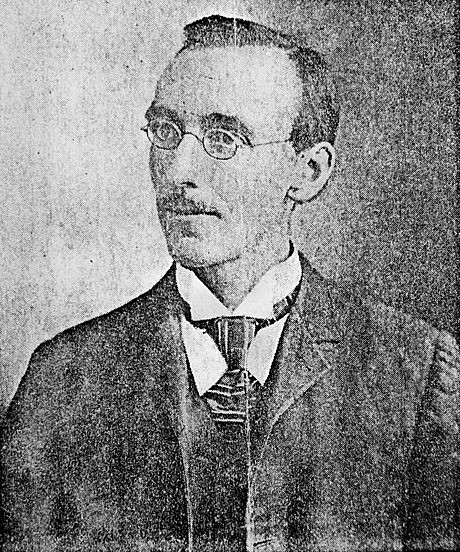
He also has a clipping of an article from the Providence Evening Bulletin of 1970 that made Providence aware of the serious French reception of Lovecraft in translation…

providence1970

The Levi Goodenough Farm 1783

26 Friday Jul 2013

Posted by asdjfdlkf in Historical context, Scholarly works

≈ 2 Comments

Added to the Open Lovecraft page, a mostly well-researched new (June 2013) local history article on the Arthur Goodenough farmhouse, “The Levi Goodenough Farm 1783” with lots of new pictures of the site. Although the short section discussing “The Whisperer in Darkness” is bizarre. The farmhouse was the home of Arthur H. Goodenough, the elderly amateur press man and friend of Lovecraft living near Brattleboro. His home was in part the inspiration for the setting of Lovecraft’s “The Whisperer in Darkness”. Interesting to learn that it’s set directly back into the hillside, like the house in “The Dunwich Horror”…

   “his house — a spacious, peak-roofed affair whose rear end was buried entirely in the rocky hillside” (“The Dunwich Horror”).


Mr. Arthur Goodenough, as a younger man.

Investors are currently being sought to help keep the historic site open for visitors.

Photos of Morton, Miniter, Cook, Houtain, Cole

26 Friday Jul 2013

Posted by asdjfdlkf in Historical context, New discoveries

≈ Leave a comment

Some of Lovecraft’s friends, Paul Cook; Edith Dowe Miniter; a young James Ferdinand Morton Jr.; George J. Houtain. Mrs Miniter I’ve seen before, although this is perhaps a better scan than some faded ones online. From the book Ex-presidents of the National Amateur Press Association : sketches published by Paul Cook from Athol, 1919. Which also has potted biographies: did you know Cook wrote much fiction, under a pseudonym? That he was a story writer is not a fact not found in the Lovecraft Encyclopedia entry for Cook. Although it seems a limited-edition book of his stories has been collected as Willis T. Crossman’s Vermont: Stories (2005).

cook

houtain

miniter

morton

cole

And Edward H. Cole of Boston, who Lovecraft visited frequently in the 1920s and 30s.

Shipping now: a new book on a key Kalem member

25 Thursday Jul 2013

Posted by asdjfdlkf in Historical context, New books, New discoveries, Scholarly works

≈ Leave a comment

Available and shipping now, my new book Good Old Mac: Henry Everett McNeil, 1862—1929.

frontcover-sm

“It does seem hard to imagine the gang without good old Mac somewhere in the background as a high spot of its general setting — for he was one of the founders [of the Kalem Club]; and his naive, individual note formed one of the most characteristic contributions to the entire symphony. At any rate, he will have a kind of modest and affectionate immortality in our reminiscent folklore — as well as in the memory of the thousands of boys who have read his tales.” — H.P. Lovecraft.

The ‘ground zero’ of modern horror was in the notorious slum of Hell’s Kitchen, New York, in the 1920s. There H.P. Lovecraft and his Kalem circle met regularly, in the room of the apparently simple old bachelor who had brought them together. This curious boy-man was Henry Everett McNeil, and “good old Mac” was Lovecraft’s close friend. In his walking tours of New York’s secret slums, McNeil opened new doors in Lovecraft’s macabre imagination and may have been the model for “He”. A year later he fatefully told Lovecraft about a new magazine…

“McNeil tipped me off to that Weird Stories thing [Weird Tales], which he says is published out of Chi[cago], but I ain’t saw it yet. I’ll tip it a wink the next time I lamp [see] a news stand.” — Lovecraft letter to Morton, 29th March 1923, in Letters to James F. Morton, 2011.

This new book is the first scholarly account of McNeil and his career. An in-depth biographical essay of 13,000 words uncovers for the first time: his origins and war record; the details of McNeil’s work as a scriptwriter for the earliest western genre movies; his work with screen cowboy Tom Mix; his work as a staff movie writer for Vitagraph — and then for Edison’s movie studio with fellow Kalem Club member Arthur Leeds; and his turbulent book publishing career. The book also tries to answer the riddle of why McNeil was apparently so poor, when he was a best-selling children’s author and a reviewer of books for The New York Times.

The footnoted essay is followed by a selection from McNeil’s works: a long macabre revenge story not published since 1900; two horror tales of wolf attacks; a Revolutionary War ghost story; the tale of a grey-haired bachelor who falls for a girl of sixteen; two of his best fantasy stories, and his own account of how he writes for his audience. The volume also contains his original movie ‘photoplay’ story for the feature-film Geoffrey Manning, and McNeil’s seminal 1911 article on how to write for the silent cinema. There is a complete annotated checklist of his known work, including the movies. Also a survey of McNeil’s various fictional appearances in weird fiction.

This new illustrated book will interest Lovecraft scholars, children’s book collectors, and silent-era movie historians alike. It contains the first known photograph of McNeil, a fine publicity picture in which he is seen seated in his room with his books around him.

Order it now!

Lovecraft and Moby Dick

22 Monday Jul 2013

Posted by asdjfdlkf in Historical context

≈ 4 Comments

Lovecraft did read Moby Dick, it seems, in the spring of 1925. I had assumed Lovecraft had never read the book, since it isn’t listed in S.T. Joshi’s Lovecraft’s Library (2nd ed.). But here is Lovecraft in a letter (Letters from New York, p.122) stating that he was about to read the book…

   [Lovecraft about to depart for Washington, 11th April 1925] “Kleiner and Loveman will wave tear-stain’d handkerchiefs after the tail-lights of the [train] coach that bears Kirk & me away. I shall probably wear my light overcoat, checking it at the Union Station in Washington, where I shall also check the book which is to beguile my hours of idleness — “Moby Dick, or the White Whale”, by Herman Melville”.

In “Suggestions for a Reading Guide” (intended as the final chapter of Lovecraft’s revisory work Well Bred Speech, 1936) he notes… “Of Herman Melville at least Moby Dick deserves a hearing.”

His almost-certain reading of Moby Dick seems fairly interestingly timed, given its ocean monster theme: four months later he wrote out the plot of “The Call of Cthulhu”.

Moby Dick was apparently deemed an obscure and rather neglected work until the Melville centenary in 1919 — and it wasn’t until 1920 that Melville’s own unexpurgated text of the work finally reached a modern audience and triggered “the Melville Revival”. This new text of the book was swiftly followed by the biography Herman Melville, mariner and mystic (1921) and Carl Van Doren’s chapter on Melville in The American Novel (1921). The following year saw publication of Melville’s letters. This scholarly interest led in time to a wider public interest, generated especially by the major Warner Brothers silent film of Moby in January 1926, titled The Sea Beast and starring John Barrymore. Predictably the movie makers managed to add a love interest, as seen in the lavish stills which illustrated Warner’s cash-in reprint of the novel of the book titled “Moby Dick Photoplay”. But this movie tie-in reprint cannot have been the edition Lovecraft took to Washington, since it was released 17th December 1925 according to Catalog of Copyright Entries.

The edition of Moby Dick that Lovecraft intended to read in Washington may instead have been borrowed stock from Kirk’s bookshop, and was presumably one of the early 1920s single-volume unexpurgated editions.

To Mary of the Movies

20 Saturday Jul 2013

Posted by asdjfdlkf in Historical context

≈ 1 Comment

Rheinhart Kleiner, with a New York address of 444 Evergreen Av, Brooklyn, in the mainstream Motion Picture magazine for May 1915…

kleiner1915

This is an appearance three months earlier than the commonly cited “Piper for September 1915″ for this poem. Lovecraft replied to “To Mary…” with “To Charlie of the Comics” (Providence Amateur, February 1916) which started a sort of poetic jousting between the two.

Marvel Tales #1

18 Thursday Jul 2013

Posted by asdjfdlkf in Historical context

≈ Leave a comment

Marvel Tales #1, printing Lovecraft’s “Celephais”.

marveltales1

Photograph of the Sentinel Elm at Athol

16 Tuesday Jul 2013

Posted by asdjfdlkf in Historical context, New discoveries

≈ 2 Comments

There has been much debate about the inspiration for the name of “Sentinel Hill” in Lovecraft’s “The Dunwich Horror”. W. Paul Cook declared (Joshi, Annotated Lovecraft, p.114) that the name was the only topographical inspiration Lovecraft took away with him from his Summer 1928 visit to Cook at Athol…

“During most of the years of my acquaintance with Lovecraft I was living in a north central Massachusetts town [Athol] which was the most absolutely devoid of historical, architectural, scenic, archeological [or other inspirations… except the Sentinel]”

I found this mention in the the book Athol, Massachusetts, past and present (1899), which explains Cook’s reference…

“To the west, across the intervening valley, is “West Hill,” one of the locations of the early settlers, with its “Sentinel Elm,” a landmark seen from every direction.”

I also found a postcard photograph of the same Sentinel Elm at Athol. It looks distinctly weather-beaten and not that ancient judging by the size of the trunk. It had presumably vanished by the time of the earliest Lovecraftian geographers, who could only find a nearby Sentinel Elm Farm. The card is currently for auction…

old-sentinel-elm-athol-ma-postcard

The Elm presumably gave its name to Athol’s first newspaper, Freedom’s Sentinel.

Here it is in colour…

The Sentinel Elm Athol, MA

And here in a Lovecraftian sunset…

The Sentinel Elm at Sunset Athol, MA

The same page of the book Athol, Massachusetts, past and present that talks of the “Sentinel Elm” has a small and rather nice ink sketch of “Round Top Mt” — there is a “Round Mountain” that provides local colour at the start of “The Dunwich Horror”…

roundtop-athol-mass

Although the Wilbraham Mountains are also rounded, which was where Lovecraft went directly he left the uninspiring topography of Athol in Summer 1928, to go to nearby East Wilbraham to stay with Mrs Miniter and Miss Beebe.

wilb_mtn_glendaleWilbraham Mountains seen from Glendale Cemetery.

Lovecraft and Bolton, Mass.

15 Monday Jul 2013

Posted by asdjfdlkf in Historical context

≈ 1 Comment

In several of his stories H.P. Lovecraft mentions Bolton, Massachusetts, a small town located about twelve miles west of Boston. Bolton was then remote, and had not yet become a commuter dormitory for Boston. Here are the instances of Lovecraft’s uses of Bolton:

bulletPoint “The manager of a circus at the neighbouring town of Bolton was questioned, but he swore that no beast had at any time escaped…” (“Herbert West—Reanimator”). This mention of a circus later prompted the game-story “Freakshow” in the Call of Cthulhu RPG game book Tales of the Miskatonic Valley (1991) in which… “investigators follow the trail of a B-grade circus and its new helpless but monstrous recruit”.

bulletPoint “In college, and during our early practice together in the factory town of Bolton, my attitude toward him had been largely one of fascinated…” (“Herbert West—Reanimator”).

bulletPoint “It was not easy to find a good opening for two doctors in company, but finally the influence of the university secured us a practice in Bolton — a factory town near Arkham, the seat of the college. The Bolton Worsted Mills are the largest in the Miskatonic Valley” (“Herbert West—Reanimator”).

bulletPoint “In Bolton the prevailing spirit of Puritanism had outlawed the sport of boxing — with the usual result. Surreptitious and ill-conducted bouts among the mill-workers were common” (“Herbert West—Reanimator”).

bulletPoint “Bolton had a surprisingly good police force for so small a town” (“Herbert West—Reanimator”).

bulletPoint “Familiarity had dulled them, and what they could not see was glimpsed by a timid woodmill salesman from Bolton who drove by one night in ignorance of the country legends.” (“The Colour out of Space”).

bulletPoint “My eldest cat, “Nigger-Man”, was seven years old and had come with me from my home in Bolton, Massachusetts” (“The Rats in the Walls”).

Yet there appears to be no known biographical connection of the small town with Lovecraft’s life. My perusal of the book History of Bolton 1738-1938 suggests that it was not a factory town, and also that it probably had no great claims on the attentions of an antiquarian tourist like Lovecraft. It did have many woodmills and a few rare minerals, the latter perhaps making it a place known to Morton of the Lovecraft circle. But previous scholars have been stumped…

bulletPoint “Lovecraft mentions the town of Bolton, Massachusetts, in several of his stories; the reason, if any, is something of a mystery” (Donald R. Burleson, 1983)

bulletPoint “What prompted Lovecraft’s use of Bolton remains unknown.” (Peter H. Cannon, 1989)

There appear to be three faint possibilities, other than the minerals:

1) The astronomer Samuel Stearns (1741-1810) was born at Bolton, Mass….

“He was a physician and astronomer of Worcester, New York City, and of Brattleboro [Vermont]. He was the author of Tour to London and Paris; Mystery of Animal Magnetism; The American Oracle; and The American Herbal or Materia Medica“.

Stearns issued an annual The North-American’s almanack, and Lovecraft was a collector of early almanacs. Stearns was a British patriot, like Lovecraft (and was framed for several crimes as a result, and forced to flee to Britain). He returned to America and died in Brattleboro, Vermont, a place which Lovecraft knew well. Stearns’s Tour to London and Paris is an account of visiting Paris in the 18th century (the book has little to say on London) and might have interested Lovecraft, although it was not found in Lovecraft’s library at his death.

2) The town of Bolton was the boyhood town of William Ellery Leonard (1876-1944), a poet and author who taught at the University of Wisconsin’s Dept. of English, and who… “struggled to stave off madness through art”. He wrote eloquently about the town of Bolton in his major psychological autobiography The Locomotive-God (written summer of 1926, published 1928). This book was, however, published well after the use of Bolton by Lovecraft (in “Herbert West” written 1921-22; “Rats” 1923; and “Colour” 1927).

Could Lovecraft and Leonard have corresponded before 1928? There is no evidence that they did. But, like Lovecraft, Leonard wrote antiquated classic poetry, and had a number of bizarre phobias and psychological ailments. Leonard is known to have written a praising review of Frank Belknap Long’s obscure first collection A Man from Genoa and Other Poems (1926), but other than that I can find no linkage between Leonard and the Lovecraft circle. (He did graduate from Harvard 1899, but that probably wouldn’t have given him a connection to Morton — who graduated there in 1892).

Is there a very slim chance that Leonard’s remarkable autobiography (1) might have been one of the inspirations for the character of the English literature professor Albert N. Wilmarth in “The Whisperer in Darkness” (1930)? For more on Leonard, see the just-published biography by Neale Reinitz, William Ellery Leonard: The Professor and the Locomotive-God, Fairleigh Dickinson University Press.

3) Five miles to the west of Bolton lies the enormous Wachusett Reservoir (1895-1908). A history of this reservoir is to be found in: Eamon McCarthy Earls, Wachusett: How Boston’s 19th Century Quest for Water Changed Four Towns and a Way of Life, Via Appia Press.

“one of the largest civil engineering feats in New England history” … “The $11 million project drew more than 4,000 immigrant workers from Italy, Hungary and Finland, and a group of African-Americans from Virginia” … “the unskilled workers settled here” … “Building the reservoir meant removing 3,816 bodies from a cemetery on the site in Clinton.”

This last fact may have meant that Bolton suggested itself as a setting for its early use by Lovecraft, in “Herbert West”, where the theme is of course grave-robbing and corpse stealing. But then, why not use Clinton itself?


Note 1: “Jim Stephens, in The Journey Home: Wisconsin Literature Through Four Centuries (1989, North Country Press), likens the events in The Locomotive-God to “the feeling of The Fall of the House of Usher brought to life.” — from James P. Roberts, Famous Wisconsin Authors.

The Lost Lane, NYC

09 Tuesday Jul 2013

Posted by asdjfdlkf in Historical context

≈ Leave a comment

Here’s a poor scan of the article in the New York Evening Post (29th August 1924) which sent Lovecraft to Greenwich Village to seek out the little lost alley… “just off Perry street, past Bleeker”. This setting appeared a year later as the “little black court off Perry Street”, in which the narrator emerges after his ordeal in the Lovecraft story “He” (written 11th August 1925).

littlesketches-nyep-29aug1924

Lovecraft on the Mississippi

04 Thursday Jul 2013

Posted by asdjfdlkf in Historical context

≈ Leave a comment

Snagged from an eBay auction just ended at $495… a Lovecraft postcard from New Orleans, on 6th June 1932, to Walter J. Coates of The Driftwind Press…

“Greetings! At the far end of one of my annual travel outbursts, & enjoying every minute of it! Shenandoah Valley…. Tennessee…. old Father Mississippi (seen by me for the first time)…. Vicksburg…. Natchez…. & now ancient New Orleans, paradise of the architect and antiquarian. Right in the same class with Charleston & Quebec! Here for over a week, then Mobile, Ala. Have a very faint hope of getting to Charleston. Regards — & hope that spring is getting around to the arctic regions at last! HPL”

lovepost1932card

neworleanscard

New book, Lovecraft in Historical Context: fourth collection – available now!

01 Monday Jul 2013

Posted by asdjfdlkf in Historical context, Lovecraftian arts, New books, Scholarly works, Summer School

≈ 6 Comments

Available now in paperback… my latest book collection of essays:
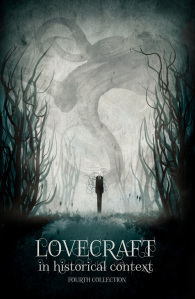
Lovecraft in Historical Context: fourth collection.

A book of essays is now an annual tradition with me, and this year’s volume weighs in at 304 pages, 76,000 words. Contains many expanded and footnoted versions of blog posts which first appeared here — for instance the essay “The terribly nice old ladies” zooms up to 12,000 words as I delve into the source landscape of “The Dunwich Horror”. Long-time Lovecraft researchers may be especially interested in 4,000 words of highly detailed scholarship which lays out the complete circus/theatrical and movie executive career of Arthur Leeds prior to the Kalem Club, accompanied by the first known photograph of him and a newly discovered Leeds short story that is an obvious inspiration for “Cool Air”.

Enjoy!

cont4cover

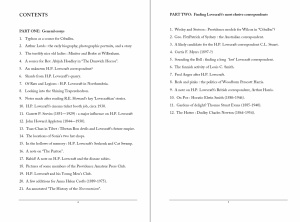
contents

PART ONE: General essays

1. Typhon as a source for Cthulhu.
2. Arthur Leeds : the early biography, photographic portraits, and a story.
3. The terribly nice old ladies : Miniter and Beebe at Wilbraham.
4. A source for Rev. Abijah Hoadley in “The Dunwich Horror”.
5. An unknown H.P. Lovecraft correspondent?
6. Shards from H.P. Lovecraft’s quarry.
7. Of Rats and Legions : H.P. Lovecraft in Northumbria.
8. Looking into the Shining Trapezohedron.
9. Notes made after reading R.E. Howard’s key ‘Lovecraftian’ stories.
10. H.P. Lovecraft’s cinema ticket booth job, circa 1930.
11. Garrett P. Serviss (1851—1929) : a major influence on H.P. Lovecraft.
12. John Howard Appleton (1844—1930).
13. Tsan-Chan in Tibet : Tibetan Bon devils and Lovecraft’s future empire.
14. The locations of Sonia’s two hat shops.
15. In the hollows of memory : H.P. Lovecraft’s Seekonk and Cat Swamp.
16. A note on “The Paxton”.
17. Rabid! A note on H.P. Lovecraft and the disease rabies.
18. Pictures of some members of the Providence Amateur Press Club.
19. H.P. Lovecraft and his Young Men’s Club.
20. A few additions for Anna Helen Crofts (1889-1975).
21. An annotated “The History of the Necronomicon”. — sample

PART TWO: Finding Lovecraft’s most elusive correspondents

1. Wesley and Stetson : Providence models for Wilcox in “Cthulhu”?
2. Geo. FitzPatrick of Sydney : the Australian correspondent.
3. A likely candidate for the H.P. Lovecraft correspondent C.L. Stuart.
4. Curtis F. Myers (1897-?)
5. Sounding the Bell : finding a long ‘lost’ Lovecraft correspondent.
6. The fannish activity of Louis C. Smith.
7. Fred Anger after H.P. Lovecraft.
8. Reds and pinks : the politics of Woodburn Prescott Harris.
9. A note on H.P. Lovecraft’s British correspondent, Arthur Harris.
10. On Poe : Horatio Elwin Smith (1886-1946).
11. Gardens of delight? Thomas Stuart Evans (1885-1940).
12. The Hatter : Dudley Charles Newton (1864-1954).

Thanks for the cover art to Cotton Valent and Apolonis Aphrodisia.

Buy the book in paperback!

← Older posts
Newer posts →


Please become my patron at www.patreon.com/davehaden to help this blog survive and thrive.

Or donate via PayPal — any amount is welcome! Donations total at Easter 2025, since 2015: $390.

Archives

  • March 2026
  • February 2026
  • January 2026
  • December 2025
  • November 2025
  • October 2025
  • September 2025
  • August 2025
  • July 2025
  • June 2025
  • May 2025
  • April 2025
  • March 2025
  • February 2025
  • January 2025
  • December 2024
  • November 2024
  • October 2024
  • September 2024
  • August 2024
  • July 2024
  • June 2024
  • May 2024
  • April 2024
  • March 2024
  • February 2024
  • January 2024
  • December 2023
  • November 2023
  • October 2023
  • September 2023
  • August 2023
  • July 2023
  • June 2023
  • May 2023
  • April 2023
  • March 2023
  • February 2023
  • January 2023
  • December 2022
  • November 2022
  • October 2022
  • September 2022
  • August 2022
  • July 2022
  • June 2022
  • May 2022
  • April 2022
  • March 2022
  • February 2022
  • January 2022
  • December 2021
  • November 2021
  • October 2021
  • September 2021
  • August 2021
  • July 2021
  • June 2021
  • May 2021
  • April 2021
  • March 2021
  • February 2021
  • January 2021
  • December 2020
  • November 2020
  • October 2020
  • September 2020
  • August 2020
  • July 2020
  • June 2020
  • May 2020
  • April 2020
  • March 2020
  • February 2020
  • January 2020
  • December 2019
  • November 2019
  • October 2019
  • September 2019
  • August 2019
  • July 2019
  • June 2019
  • May 2019
  • April 2019
  • March 2019
  • February 2019
  • January 2019
  • December 2018
  • November 2018
  • October 2018
  • September 2018
  • August 2018
  • August 2015
  • July 2015
  • April 2015
  • March 2015
  • February 2015
  • January 2015
  • December 2014
  • November 2014
  • October 2014
  • September 2014
  • August 2014
  • July 2014
  • June 2014
  • May 2014
  • March 2014
  • February 2014
  • January 2014
  • December 2013
  • November 2013
  • October 2013
  • September 2013
  • August 2013
  • July 2013
  • June 2013
  • May 2013
  • April 2013
  • March 2013
  • February 2013
  • January 2013
  • December 2012
  • November 2012
  • October 2012
  • September 2012
  • August 2012
  • July 2012
  • June 2012
  • May 2012
  • April 2012
  • March 2012
  • February 2012
  • January 2012
  • December 2011
  • November 2011
  • October 2011
  • September 2011
  • August 2011
  • July 2011
  • June 2011
  • May 2011
  • April 2011
  • March 2011
  • February 2011
  • January 2011
  • December 2010
  • November 2010
  • October 2010
  • September 2010
  • August 2010
  • July 2010

Categories

  • 3D (14)
  • AI (70)
  • Astronomy (70)
  • Censorship (14)
  • de Camp (7)
  • Doyle (7)
  • Films & trailers (101)
  • Fonts (9)
  • Guest posts (2)
  • Historical context (1,096)
  • Housekeeping (91)
  • HPLinks (77)
  • Kipling (11)
  • Kittee Tuesday (92)
  • Lovecraft as character (58)
  • Lovecraftian arts (1,628)
  • Lovecraftian places (19)
  • Maps (70)
  • NecronomiCon 2013 (40)
  • NecronomiCon 2015 (22)
  • New books (966)
  • New discoveries (165)
  • Night in Providence (17)
  • Odd scratchings (984)
  • Picture postals (276)
  • Podcasts etc. (431)
  • REH (184)
  • Scholarly works (1,470)
  • Summer School (31)
  • Unnamable (87)

Get this blog in your newsreader:
 
RSS Feed — Posts
RSS Feed — Comments

H.P. Lovecraft's Poster Collection - 17 retro travel posters for $18. Print ready, and available to buy — the proceeds help to support the work of Tentaclii.

Proudly powered by WordPress Theme: Chateau by Ignacio Ricci.