• About
  • Directory
  • Free stuff
  • Lovecraft for beginners
  • My Books
  • Open Lovecraft
  • Reviews
  • Travel Posters
  • SALTES

Tentaclii

~ News & scholarship on H.P. Lovecraft

Tentaclii

Category Archives: Historical context

Notes on Lovecraft’s Selected Letters III

22 Wednesday Jun 2022

Posted by asdjfdlkf in Astronomy, Historical context

≈ Leave a comment

Notes on Lovecraft’s Selected Letters Vol. III.

* “I am very fond of gardens – in fact they are among the most potent of all imaginative stimuli with me.” (page 29). Later he implies they formed his “earliest dreams”… I have actually found the garden of my earliest dreams – and in no other city than Richmond, home of my beloved Poe! Maymont!” (page 151). He also refers to an early, lost tale or long poem… “In childhood I used to haunt such places [florists’ shops] about February, when the strain of hated winter became unbearable. I liked to walk through the long greenhouses & imbibe the atmosphere of warm earth & plant-life, & see the vivid masses of green & floral colour. One of my early doggerel attempts was a description of an hypothetical glass-covered, furnace-heated world of groves & gardens …” (page 138). He had early read Erasmus “Darwin’s ‘Botanick Garden’ … my early reading” (page 419), a likely influence on such early writing.

* He was taking night-walks in Providence in the Autumn / Fall of 1929… “the Hunter’s Moon last week was exceptionally fine. I took several walks to get the benefit of the mystic moonbeams on particular bits of landscape & architecture-river reflections” (page 38). Later he explores the far south of the city on foot, and later still (Vol. IV) parts of the north of the city.

* On everyday Christianity vs. its often pagan material trappings: “We have mouthed lying tributes to meekness and brotherhood under Gothic roofs whose very pinnacled audacity bespeaks our detestation of lowliness and our love for power and strength and beauty.” (page 45).

* On his Zimbabwe poem “The Outpost”, set in Rhodesia, he gives a linkage with Ophir which is not in the poem… “smart Arab and Phoenician Kings reign’d within the walls of the great Zimbabwe … and work’d the illimitable mines of Ophir”. The poem’s protagonist “K’nath-Hothar the Great King … [born of] great King Zothar-Nin [who] was born in Sidon of pure Phoenician stock” (page 55).

* He reads “The Netopian, house organ of Providence’s most influential bank”, which has some antiquarian articles. (Page 56). This is not online, but Brown holds the 1920-31 run at its Rockefeller Library.

* Ashton Smith’s “The Tale of Satampra Zeiros” features Commorium, which Lovecraft deems buried under the ice of Lothar. “It is this crux of elder horror, I am certain, that the mad Arab Abdul Alhazred was thinking when he – even he – left something unrnention’d & signdfy’d by a row of stars in the surviving codex of his accursed & forbidden Necronomicon!” (page 87). Lovecraft later refers to… “the mildew’d palimpsets of Commoriom” (page 242).

* Lovecraft hints at a “Cthulhu” sequel, having elsewhere suggested the possibility of a sequel story set on Cthulhu’s “home planet”. The following seems the match with that idea… “I shall sooner or later get around to the interplanetary field myself … I doubt if I shall have any living race upon the orb whereto I shall – either spiritually or corporeally – precipitate my hero. But there will be Cyclopean ruins – god! what ruins! – & certain presences that haunt the nether vaults.” (page 88) “It would begin as a dream-phenomenon creeping on the victim in the form of recurrent nightmares, as a result of his concentration of mind on some dim transgalactic world. Eventually it would enmesh him totally — leaving his body to vegetate in a coma in some madhouse whilst his mind roamed desolate & unbodied for ever above the half-litten stones of an aeon-dead civilisation of alien Things on a world that was in decay before the solar system evolved from its primal nebula. I doubt if I’d handle it as, phantasy so much as a stark, macabre bit of quasi-realism.” (pages 95-96).

* “The cuttings you enclosed are of extreme interest – that about the “star jelly” being absorbingly & superlatively so. … It is really improbable that any matter in the condition we recognise as “organic” could manage to get from one orb to another under the strenuous conditions of meteoric flight, though these occasional reports certainly do have their puzzling aspects. I have used the idea once – in “The Colour Out of Space” – & may yet use it again in a different way.” (page 136).

* In 1930 “the covers as well as the contents of rags like Snappy Stories represent true pornography” (page 108).

* “I’d damn well like to come out with a book [of philosophy] some day, even though I might never win a place beside Schopenhauer, Nietzsche, or Bertrand Russell.” (page 110). On learning philosophy he suggests to Toldridge… “You ought most emphatically to read The Story of Philosophy by Dr. Will Durant” (page 146).

* The “Fungi from Yuggoth” sonnet “series” was actually a modest and immediate financial success at a difficult time, netting him “$52.50 to date” (page 129).

* The writing of “The Whisperer in Darkness” was interrupted… “I am still stall’d on p.26 of my new Vermont horror, since revision (which I can’t refuse if I expect to make my trip!) has overwhelm’d me.” (page 130).

* In June 1930 he gives the place of a recent meeting with Dwyer… “the genial and fantastic Bernard Dwyer, whom I visited in antient Dutch Wiltwyck, up the placid Hudson” (page 159).

* In October 1930 he really does believe in witches… “the traditional features of witch-practice and Sabbat-orgies were by no means mythical. … Something actual was going on under the surface … scholars now recognise that all through history a secret cult of degenerate orgiastic nature-worshippers, furtively recruited from the peasantry and sometimes from decadent characters of more select origin, has existed throughout northwestern Europe; practicing fixed rites of immemorial antiquity for malign objects, having a governing system and hierarchy as well·defined and elaborate as that of any established religion, and meeting secretly by night in deserted rustic places. … the first mediaeval opposers of witchcraft were not mere fanatics fighting a shadow. They were deluded in that they thought themselves to be fighting something supernatural, but they were most certainly right in believing that they were fighting a genuine menace. … The witch-cult itself is probably now extinct, but no one can say just when it perished.” (pages 179-181) He later borrows many books on the topic from Keonig… “H. C. Koenig who has for some time been lending me books on witchcraft from his remarkably extensive library.” (Vol IV).

* There is a joking incantation on page 185, not in The Ancient Track…

N’ggah-kthn-y’hhu! Cthua t’lh gup r’lhob-g’th’gg Igh thok! G’llh-ya, Tsathoggua! Y’kn’nh, Tsathoggua!

It hath come!
Homage, Lord Tsathoggua, Father of Night!
Glory, Elder One, First-Born of Outer Entity!
Hail, Thou Who wast Ancient beyond Memory
Ere the Stars Spawned Great Cthulhu !
Power, Hoary Crawler over Mu’s fungoid places!
Ia! Ia! G’noth-ykagga-ha!
Ia! Ia! Tsathoggua!!!

* He is chided by Morton on his disregard of mineralogy in science… “No, Sir, I am not insensible of the importance of mineralogy in science… The fact is, I am perhaps less anti-mineralogical than the rest of the herd; insomuch as I realise that the trouble is with myself rather than with mineralogy.” (pages 200-201). One wonders if this chiding contributed to the mineralogy aspects of “At The Mountains of Madness”?

* In 1930 he recalls a past era when normal magazines would take weird fiction… “it often amuses me to note how the sedate & established magazines used to take horror-tales & phantasies without hesitation. Those were free & unstandardised days; & the prevailing view of the cosmos was one of awe & wonder, amidst which a bit of weird fiction was not at all incongruous. But all is changed now.” (page 203).

* He itemises the personal libraries of the circle… “The really big libraries owned by our crowd – beside which mine sinks into insignificance – are those of James F. Morton (general belles-lettres, specialising in Elizabethan literature), Loveman, (poetry, rare bibliophilic items), Orton (modern first editions – for which I wouldn’t give a plugged nickel), Cook (weird material), Munn (popular weird material), & young Derleth (everything under the sun — weird & modern fiction predominating).” (page 211). Curious, since I thought that Loveman was the Elizabethan specialist? Nor does he mention political works as an aspect of Morton’s library.

* On the prospects of his once again writing like Dunsany, in 1930… “In my hands, the result tends to resemble “The Land of Lur” more than it resembles the products” of Dunsany. What was “The Land of Lur”? He refers to a story in the May 1930 Weird Tales.

* “I am as geographic-minded as a cat” (page 214).

* He is still thinking in terms of ether-waves in 1930, albeit poetically… “after the destruction, the ether waves resulting therefrom might roll still farther out into some other realm of entity, where they – or part of them-might curiously reintegrate.” (page 217). In science he is also thinking of a ‘circular time’ in a similar way… “a curved time corresponding to Einsteinian curved space, you might have the voyager make a complete circuit of the chronological dimension-reaching the ultimate future by going beyond the ultimate past, or vice versa” (page 218) In relativistic terms, in space… “Straight lines do not exist, nor does theoretical infinity. What seems infinite extension is simply part of an inevitable returning curve, so that the effect of proceeding directly away from any given point in space is to return at length to that same point from the opposite direction. What lies ultimately beyond the deepest gulf of infinity is the very spot on which we stand.” (page 388). See also “Through the Gates of the Silver Key” (1934), though note that the maths in that were from his collaborator Price.

* In late 1931 he hears a lecture on the “expanding universe” theory, re:… “all spiral nebulae – external galaxies – are retreating rapidly into outer space” (page 438). But then he has second thoughts in early 1932… “Probably the expansive effect now perceived is in part illusory & in part due to one phase of a general pulsation of alternate expansions & contractions.” (Vol. IV, page 6).

* “As for Irem, the City of Pillars … The mad Arab Abdul Alhazred is said to have dwelt therein for a time in the 8th century A.D., prior to the writing of the abhorred & unmentionable Necronomicon. … some timid reader has torn out the pages where the Episode of the Vault under the Mosque [i.e. a CAS story] comes to a climax – the deletion being curiously uniform in the copies at Harvard & at Miskatonic University. When I wrote to the University of Paris for information about the missing text, a polite sub-librarian, M. Lean de Vercheres, wrote me that be would make me a photostatic copy as soon as he could comply With the formalities attendant upon access to the dreaded volume. Unfortunately it was not long afterward that I learned of M. de Vercheres’ sudden insanity incarceration, & of his attempt to burn the hideous book which he had just secured & consulted. Thereafter my requests met with scant notice.”

* On what would today be called jet-set ‘globalists’… “We cannot judge cultures, and their deep instinctive attitudes toward one another, by the unctuous amenities of the few internationally-minded aristocrats, intellectuals, and aesthetes who form a cosmopolitan and friendly group because of the common pull of surface manners or special interests. Of course these exotic specimens get on well enough together…” (page 272)

* His… “dream-self has come to represent me so perfectly that in waking hours I sometimes feel odd for lack of my three-cornered hat, powdered periwig, satin small-clothes, silver sword, and buckled shoes.” (page 283). Although elsewhere he remarks that the bulk of his dreams involve his childhood.

* “I first read up on the Hellenistic [ancient Greek] period back in ’04 and ’05.” (page 288). He reckons just 2,400 years since the height of Periclean Athens. Which makes 2022 around 2,500 years.

* The young Lovecraft, at around age 12, always carried a real revolver with him (page 290). He also had a set of disguises and false beards. This was presumably to do with his boyhood detective work. He later had “an endless succession of guns and pistols” (Vol IV, page 158) and became a crack shot until his eyesight gave out.

* He alludes to the British scientist Sir Oliver Lodge without naming him, re: spiritualism… “the nostalgic & unmotivated ‘overbeliefs’ of elderly & childhood-crippled physicists” (page 295) and “the side-line tripe cooked up by bullhead-brained physicists on their mental vacations!” (page 302). Alongside Conan Doyle, Lodge was a leading public champion of spiritualist nonsense.

* He recalls that… “from the age of three my mother always took me walking in the fields & ravines, & along the high wooded riverbank, (the latter still unchanged, thanks to the Met. Park System.).” … “the old countryside is almost gone; though one farm still remains as a farm with a few acres of antient field & orchard & garden around the antient (1735) house, & forms the goal of many a walk of mine.” The “Met. Park System” means the park formed along the banks of the Seekonk. (Pages 317 and 318).

* Early 1931. “All winter, as I told you, I have been studying Quebec; & all this spring I have been studying the Dutch Hudson Valley” (page 327).

* Lovecraft and Middle-earth, 1931… “a cold winter twilight calls up all sorts of images of shadowy shapes marching imperiously in some Northerly middle region just beyond the Earth” (page 394)

* The out-of-Africa theory was not then know. “That the human race started on some plateau in central Asia is almost certain” he writes (page 412). This out-of-Asia theory would have been a supported scientific position as late as the 1950s. Only in the 1970s and 80s did the ‘out-of-Africa’ theory become the new consensus.

* On sister-marriage and consanguinity, pre-genetics, he writes… “science long ago exploded the myth that there is necessarily anything unhealthy about the offspring of close kin.” (page 424). I’m not sure where he was getting that from, but it might argue that he had radically departed from the accepted eugenic science of the time re: the dangers of in-breeding.

* Writing to young Shea, he foresees a future time of at least partial erotic liberation… “At present, the [active] following of an alternative course [to normal sexuality] involves so much commonness & ignominious furtiveness that it can hardly be recommended for a person of delicate sensibilities except in extreme cases. It remains to be seen what sort of middle course the future will work out.” (page 425).

* Loveman was riding out the worst of the Great Depression quite well, at least in summer 1931… “Loveman gets $60.00 per week as an expert cataloguer for the well-known N.Y. firm of Dauber & Pine”. (page 416)

* Lovecraft’s younger aunt spoke with a Boston accent. (page 420).

* A revision job… “this week I have received impressions from the book-revision job which slightly alter my picture of 18th century life in the Connecticut Valley”. I can’t immediately find which book this might have been. (Page 426). The letter was October 1931, so if the work was published as a book then it might have been anywhere from Christmas 1931 to around 1935.

* “Deeps of Gba-Ktan, beyond Devil’s Reef off the coast of Innsmouth.” (page 435). Appears not to have found its way into Mythos encyclopedias.

* And finally, an item that might have made an entry in his Commonplace Book, but didn’t. “Wind in hollow walls mistaken for spectral music. Actual case in Halsey Mansion around the corner from 10 Barnes St. … actually feared by the ignorant” (pages 444-445).

Map of the NYC subways and elevated system, 1924

20 Monday Jun 2022

Posted by asdjfdlkf in Historical context, Maps

≈ Leave a comment

Map of the NYC subways and elevated system, 1924. Useful for research orientation.

A little more data on Willoughby St.

19 Sunday Jun 2022

Posted by asdjfdlkf in Historical context

≈ Leave a comment

A little more data on Willoughby St., Brooklyn, which was looked at in depth in recent posts.

1) A 1914 ad for “Bristol’s”, which was next to “John’s” in Brooklyn.

Their office address was No. 3, but the Dining Rooms were classed as 3-5. Thus Lovecraft was aware of this double-frontage numbering when he said in a letter that John’s was “next door” to Bristol’s… at No. 7.

In 1914 Bristol’s was advertising itself as “always open”. J.E. Bristol is the owner.

2) By mid 1922 Harry E. Spilbor, Sign Writer, was listed as at No. 7 Willoughby, presumably in the sub-shop that was photographed when empty in 1916. By the mid 1930s the New York State Manufacturers directory puts him next door at No. 9. My guess is he started in the sub-shop at No. 7 at the start of the 1920s, and then later moved next-door when No. 7’s frontage was “boxed” (as seen on 1930s photos). He also writes sign cards for show-windows in stores.

The empty sub-shop in 1916.

3) Next door to “John’s” in 1923 at No. 9 was Mike’s Radio Shop (the Kranz Brothers), in either the upstairs or the sub-shop. Still in business in 1925 because they were recorded making a payment to the city, though no address is stated alongside. Barbers don’t tend to go out of business, so my guess would be the 1916 barber’s was still there in 1925 and the radio shop was in the sub-shop below it. This would be a good location for such a store because the big new Edison Electric office block was next door at the former 11-17 (subsumed circa 1923 as No. 15, still standing today).


So, that all fills in a little more mid-1920s detail on the immediate surroundings for Lovecraft’s favourite Italian eatery at John’s. The long-standing Bristol’s Dining Rooms at 3-5 with Lovecraft’s friend and fellow revisionist la Touche Hancock in an office above. Then John’s at No. 7, with Mr. Spilbor the sign-writer below in the sub-shop. Next door at No. 9 was probably a barber shop, with Mike’s Radios below.

Lovecraft and E.E. ‘Doc’ Smith

18 Saturday Jun 2022

Posted by asdjfdlkf in Historical context

≈ 1 Comment

My Patreon patron John Millar asks: “Did HPL read the work of the American science-fiction writer E.E. “Doc” Smith? Did he offer an opinion about it?”


Born in 1890, the early science-fiction pulp writer E.E. “Doc” Smith was the same age as Lovecraft. Like Lovecraft he was also a doughnut enthusiast. But in Smith’s case, he didn’t just dunk the ‘nuts in his four-sugar coffee. He made a career out of the food science of making doughnuts. On the side he also wrote implausible super-science ‘space operas’, complete with immense and ever-expanding spaceships. Tales which — some might now wryly observe — bear a certain resemblance to his light air-pumped doughnuts. But nevertheless, like Lovecraft’s work, his interstellar tales pioneered what later became a vast sub-genre.

A liking for doughnuts was not the only similarity in the youth of the two writers. Like the young Lovecraft, as a youth Smith took avidly to rifles and amateur chemistry sets. Hobbies that might have a kooky kid locked up and sedated in today’s America were then quite normal. Possibly there are other such comparisons to be drawn.

Like Lovecraft, Smith’s breakthrough in writing fiction came in the early 1920s. However, publishing was a different matter. Smith had far more trouble seeing his work published than Lovecraft who had the Weird Tales market. Only in April 1927 did the breakthrough The Skylark of Space begin to appear in the magazines. It had been completed years before. Other Skylark novels were published and then Spacehounds of IPC in 1931, Triplanetary in 1934. Thus Lovecraft might at least have noticed these and the Skylark series, though he was largely averse to actually reading the ‘scientifiction’ pulps. Smith only seems to have enjoyed book publication after the war. Also, Smith’s famous Lensman series only began to arrive after Lovecraft’s death.

In 1929 Lovecraft considered getting into the game himself, but he did not think much of the competition…

A good interplanetary or interstellar tale has yet to adorn the pages of [Weird Tales] … I shall sooner or later get around to the interplanetary field myself — & you may depend upon it that I shall not choose Edmond Hamilton, Ray Cummings, or Edgar Rice Burroughs as my model!”

So we know he was reading or had read some examples of the type, and was aware of the emerging sub-genre. Thus it’s not impossible that he at least noticed the emergence of Smith. However, in 1934’s essay “Notes on Interplanetary Fiction” Lovecraft does not mention Smith. The nearest equivalent cited, in terms of galactic scope, is Olaf Stapledon’s seminal classic Last and First Men (1930).

Confirmation of Smith’s non-reading by Lovecraft comes in his letter to Conover in 1936…

About The Skylark of Space — I’ve never read it, since a vast majority of the mature critics who have tell me it has no serious literary merit. From what I hear, it has some clever theories as background, but is essentially a juvenile action-adventure story [of the stock type, and] one can’t spare the time to read everything” (Letters to Robert Bloch and others, page 390).

Again, he recommends that the lad take Olaf Stapledon’s Last and First Men over Smith.

The approaches of the two writers to cosmicism have been compared in one essay, Rolf Maurer’s “Through a Lens Dark and Lightly: The Cosmicism of E.E. Smith and H.P. Lovecraft”, presented at the Armitage Symposium in 2017. But seemingly not then published in Lovecraftian Proceedings #3. Smith’s “irrepressibly optimistic, learn-as-you-go heroes” are contrasted by Maurer with “Lovecraft’s characters as learned-but-fragile pawns of higher powers”.

In his essay “The Epic of Space” (1947) Smith name-checked Lovecraft as a writer he enjoyed, and later in the same essay he implies influence when he states that “Lovecraft was the master craftsman” in atmosphere. Lovecraft’s sense of the vastness of time and space, and the sense of burning curiosity for knowledge may also have been influential, though that’s not stated in the essay. What Smith did not take from Lovecraft, if take he did, was the sense of the un-breakable rules of the cosmos. Galactic space-opera, by definition, must bend the rules.

‘Picture Postals’ from Lovecraft: Lovecraft at the Automat

17 Friday Jun 2022

Posted by asdjfdlkf in Historical context, Picture postals

≈ Leave a comment

This week on my Friday ‘Picture Postals’, back to Brooklyn and to another type of food “filling station” frequented by Lovecraft. Thanks to the wonders of the Interwebz we can actually go inside the very Automat that was fitted into the space of the former Bristol’s at 3-5 Willoughby Street.

You’ll recall that Lovecraft’s favourite restaurant of “John’s” was next door to this, at No. 7. This Automat wasn’t constructed until after Lovecraft left New York City. The available evidence suggests this Automat arrived in 1933 and lasted until about 1954. This is what it looked like inside and it was fairly typical of the type…

Its big plate-glass windows usefully show us what was on the other side of Willoughby and thus was opposite “John’s”, albeit about a decade later than the 1925-1930 period in which John’s existed at No. 7. The cigar store seen on the Transit Authority glass-plates of 1916 is still there, but by this date has rather incongruously added “Luncheons”. Perhaps there was a demand for places to eat lunch where one could also smoke a cigar? Across the road in the far distance we see the other entrance to the platform on the Elevated railway line…

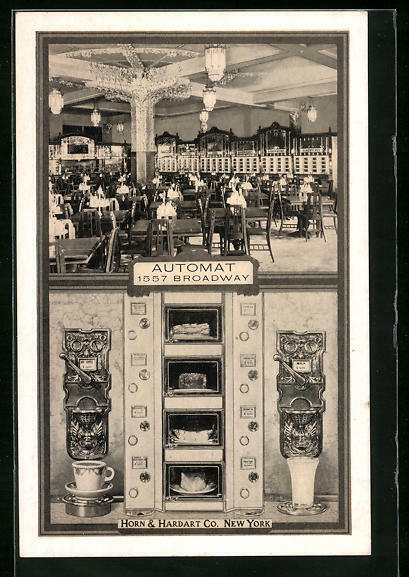
Lovecraft may not have used this automat, but he patronised plenty of the earlier mid-1920s automats while living in and visiting New York City. Also in the various large cities visited on his travels. This particular automat was part of a chain which had over 150 branches in New York and Philadelphia by the mid 1920s. Here is the card for their Broadway branch, which has the chain information on the back…

Evidently before the vogue for Art Deco they were rather more Gothic in feel. Thus, it would be wrong to imagine an Art Deco background for a meeting of Lovecraft and Loveman at an automat in 1925. A combination of glitzy fairground Wurlitzer and a wall of dispensers resembling a Gothic church organ seems to be ‘the look’.

‘Wurlitzer’ 1910s and 20s

‘Deco’ 1930s

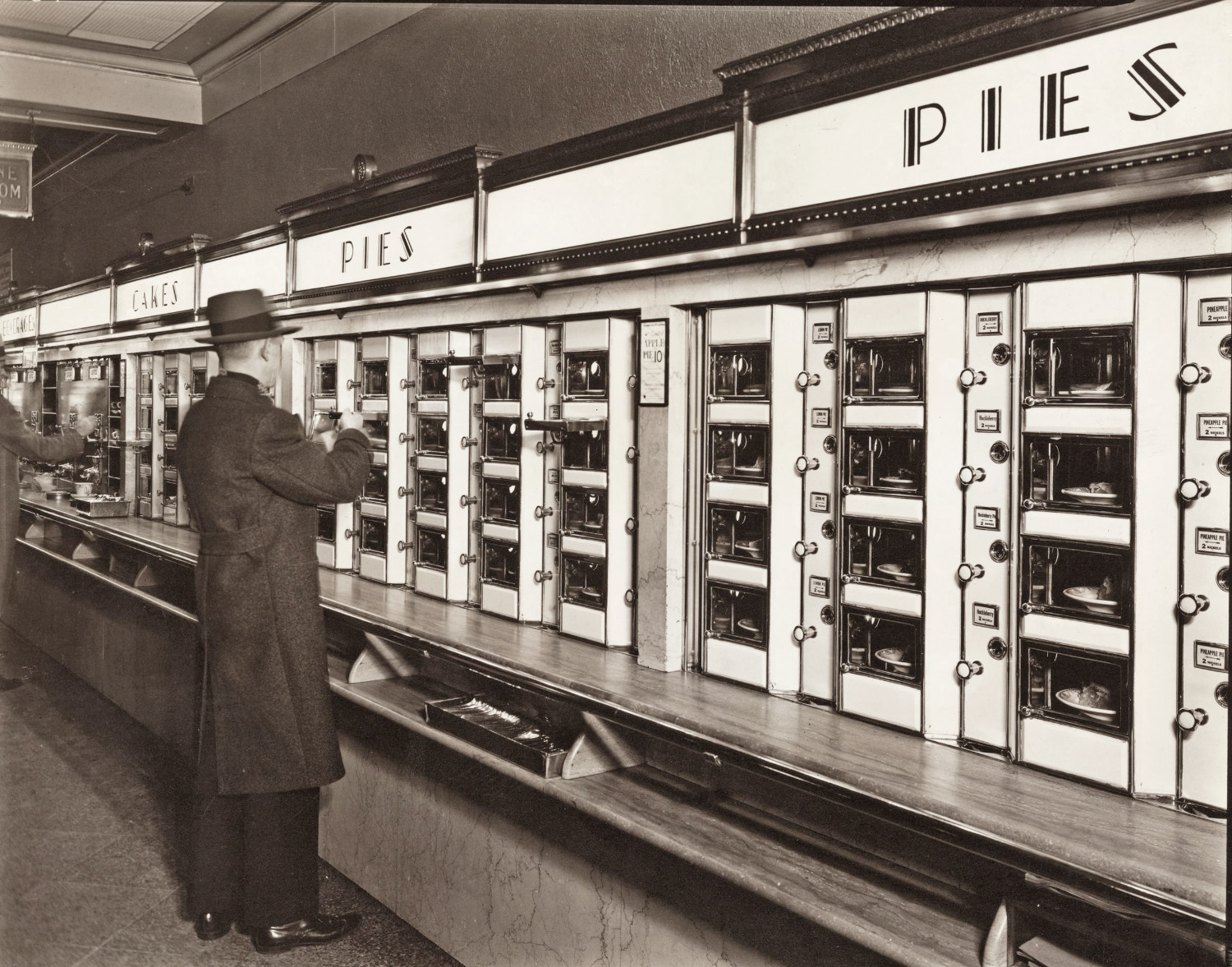
Frank Gruber’s pulp-writer’s memoir The Pulp Jungle explains how they worked…

The Automat restaurants, which are peculiar to the East [of the USA], are just what the name implies. You get a flock of nickels from the cashier, then go down the battery of little cubicles, inside of which repose the articles of food that appeal to you. Pie, sandwiches, whatnot. In 1934 a sandwich was ten cents. You put two nickels into a slot, turned a knob and you were then able to open the little door and take out the sandwich. There were a few things the inventors of the Automat were not able to lick, such as coffee. You put a nickel into a slot, held a cup under a nozzle and got a cupful of black coffee. Sugar and cream, however, had to be on the table.

Lovecraft’s 1925 Diary is peppered with instances of automat meals, especially when meeting Samuel Loveman. I was also pleased to find one of these Diary instances reveals he did visit the Botanic Garden in Brooklyn, a place which was the subject of a Tentaclii ‘Picture Postals’ post a few weeks ago…

April 16. Out early — Mc[Crory?] — meet JR, [at] Zoolog. Park — Botanic Garden — down to Boat — explore &c. — Automat.

For Lovecraft, unlike many others, an automat was also an opportunity for a cash-saving takeout. For ten cents extra at one of these places he could also pocket..

my breakfast supply of cheese and peanut butter sandwiches

Such just-in-time delivery was often useful in terms of preventing “rodent marauders” from visiting his room. In many cheap places Lovecraft stayed, there might really be rats in the walls. Many New York City automats were 24-hour places, so could be visited after a long night-walk through the city. Probably they were also 24-hour in Philadelphia and elsewhere.

Another automat favourite was the Hot Chocolate “potion”, as he called it. He found that it and cocoa were unavailable at regular restaurants.

In the above picture of the Willoughby Street interior you can also see the upper balcony on the left. Such places became a haunt of the earliest science-fiction fans, possibly attracted by the Art Deco futurist vibes. Charles Hornig recalls, of the time he was writing to Lovecraft, that…

We had a series of impromptu meetings, mostly on the balconies of automat restaurants, where we would spend hours discussing our favorite topic [science fiction], until we were thrown out by the management.

Old-Time New England, 1910-1981

15 Wednesday Jun 2022

Posted by asdjfdlkf in Historical context, Scholarly works

≈ Leave a comment

Back in March I noted that the journal Old-time New England was freely available to 1925.

Hathi now has a few more into 1926, though the issues from 1926/27 onward are in a pointless copyright lockdown.

You won’t find them at Archive.org via the title search-box, curiously. But Google sees them there, and reveals that Archive.org now has them (from microfilm) all the way to 1981, as Old-Time New England 1910-1981.

Lovecraft’s letters to Haldeman-Julius – part two

14 Tuesday Jun 2022

Posted by asdjfdlkf in Historical context, Podcasts etc.

≈ Leave a comment

This is part two of a post arising from the latest Voluminous podcast, in which some of Lovecraft’s public letters are read. Sent to a Haldeman-Julius publication in 1923, his letters followed the editor’s call for lists of ‘the top 10 greatest names of all time’. In my first post I looked at Lovecraft’s naming of Remy de Gourmont, and also the use of the perennial alarmist’s “inevitable decline of civilisation, starting now” notion, of the sort which can look so ridiculous 30 years later.

In this second post I look at the links with Haldeman-Julius as a publisher.

A 1925 ‘Houdini’ special-issue of the Monthly version, with interview.

Lovecraft was sending for Haldeman-Julius ‘blue books’ by mail-order in 1923. Since we know he early on obtained a copy of Schopenhauer’s “Art of Controversy” and many others that way. He soon acquired even more, because we know he packed a pocket-full for light-relief when he hiked the New Jersey Palisades with Sonia. That was shortly before their marriage. One might then wonder if some of these ‘blue books’ might have been of the type then referred to as ‘marital hygiene’ advice, which were to be found among the Haldeman-Julius line. Though perhaps he was not thinking quite that far ahead.

He tells Moe that he did not intend the 1923 letter — as read in the Voluminous podcast linked above — to be published…

I’ve been having a bit of fun with the Haldeman-Julius Weekly, which is the old socialistic Appeal to Reason partly turned sane under a new name. … [the editor printed] an 8-page letter of mine, not meant for the vulgar eye. Ho hum… not that it matters.

How had Lovecraft come into contact with Haldeman-Julius and the magazine? Via Morton would be my guess, or maybe David V. Bush suggesting it as being of possible interest as a market. As an anarchist pamphleteer Morton would have had an interest in the political angle of the enterprise, and Bush an interest in the ‘hygiene’ and sexology side. But perhaps the publisher just sent a free copy of Haldeman-Julius Weekly with Lovecraft’s order, on the sound principle that anyone brave enough to tackle Schopenhauer also deserved some lighter reading matter along with it. The title in question only sold a few hundred copies in 1923. Four years later it was re-issued with the snappier title “How to Argue Logically” and sold 30,000.

By 1925 Lovecraft can be found telling his aunt that he is buying up Blue Books in bulk, because he has heard that the 5-cent and 10-cent prices are to double. He reads them to pass the time on the longer New York City subway journeys. At one point he hears (again wrongly) that Haldeman-Julius has ceased publishing, then that he is about to cease. Somewhere near Grand Central Station he discovers a ‘Little Blue Book Store’, apparently stocked with nothing but the Blue Books. Possibly this store is the source of the false rumours, designed to boost panic bulk buying. Tentaclii readers who have paywall access can find the newspaper article on this store, titled “Pay as You Go Out, 5 Cents a Copy, in the New Cafeteria Bookshop” (New York Times, 24th February 1924). At that time Lovecraft picked up many of the line’s science booklets, and three weirder booklets featuring tales by Poe, Kipling and E.F. Benson’s ghost stories respectively. According to Joshi’s Lovecraft’s Library these three were the only Blue Books thought to be worth noting in his Library at his death, though he owned far more. In his mid 1920s letters he later comments that the New York store had closed down, and bemoans that he will have to go back to the ‘old method’ of ordering by mail from Kansas.

In 1928 he comments in passing on the Haldeman-Julius organisation’s ‘militant atheist’ stance…

I cannot sympathise with the violent anti-Christian agitators and “debunkers” of the Truth-Seeker and Haldeman-Julius Weekly type.

Many of Morton’s pamphlets were issued by “The Truth Seeker Co.” in New York, but I’m uncertain of its connections if any with the later Truth-Seeker magazine.

Lovecraft did not have a collection of these magazines, and his comment implies that the strident atheism of the 1920s and 30s was just as simultaneously boring and as dangerous as today (i.e.: Christians relentlessly depicted in movies and popular novels as sadists, bigots, perverts, sentimental milksops, hypocrites, dogmatic, anti-science etc). But Lovecraft did own the Blue Books in quantity by the early 1930s. He talks of a tall “stack” of them balanced up against one wall of his personal library. In 1933 he signs off a letter to Morton with… “Now to get my Haldeman-Julius booklets tied together to avoid shuffling”, which suggests he has a substantial collection of all the titles he might want from the publisher. The context of “avoid shuffling” was his house move to No. 66.

Yet in a letter to Shea of early 1934 he affects not to be familiar with their current catalogue and their newer titles… “I suppose there must be dozens of Haldeman-Julius booklets about the matter [active homosexuality] now”. He may just be trying to give a casual hint to the lad about where such helpful reading might be ordered. Or he may have no longer been receiving the annual catalogue. Probably the former, since… why would be not be on the mailing-list for this cheap and interesting catalogue?

“Hygiene” was then a euphemism for sex matters.

In 1936 he talks discreetly of the “Brobst H-J” stuff which Barlow had presumably borrowed during his long visit to Lovecraft in August 1936, and by then had with him at home in Fort Leavenworth. “H-J” being “Haldeman-Julius”. Lovecraft advises that this “stuff” should be returned directly to Brobst. The implication is that the Providence asylum nurse Brobst had his own large collection of the Blue Books, most likely especially relating to mental illness and eccentricity and suchlike. As a trained and qualified nurse Brobst would have been able to order the riskier psychology and sexology titles without having to fear postal or parental censorship.

Lovecraft’s letters to Haldeman-Julius – part one

13 Monday Jun 2022

Posted by asdjfdlkf in Historical context, Podcasts etc.

≈ 1 Comment

The latest Voluminous podcast reads some of Lovecraft’s public letters. Sent to Haldeman-Julius publications in 1923, the letters follow a call for lists of ‘the top 10 greatest names of all time’. Haldeman-Julius was the publisher of several magazines and the semi-notorious “Little Blue Books” pocket-paperback series. Operating from a large printing plant in remotest Kansas he became ‘the Henry Ford’ of cheap mail-order books, running a business that usefully and affordably punctured censorship throughout the 1920s and 30s.

An offline .MP3 download of the episode can be had via the Podbean listing.

Two things are immediately interesting in the letters.

The first is that it might seem that Lovecraft is pushing a Spenglerian view of imminent civilisational decline, but at that date he had not yet read Spengler. The famous 1918 The Decline of the West… “appeared in its English edition in 1926” in both the USA and UK. Obviously Lovecraft was well able to have his own ideas on the matter, but may have picked up enough from discussion and reviews to have an outline of Spengler’s gloomy ideas by early 1923. He writes to Galpin in 1932 that he read the first volume of Spengler in English… “some years ago with much attention & a great degree of acquiescence”. Joshi puts this reading at spring 1927, after having read a review of the book in 1926. But consider that Lovecraft also paid close attention to British ideas, and by 1923 the anti-colonial movement had taken up the cultural pessimism of many of the late Victorians — the idea that all Empires have natural cycles and that the British Empire could not last and would inevitably go the way of Rome. Hence, ‘better to quietly divest the Empire in an orderly way now, while we have the chance’, etc. Thus such arguments might be an alternative pre-Spenglerian source for such pessimistic ideas, paired with the general cultural pessimism of Schopenhauer, the French decadents, Nietzsche etc. At this point, recall, Lovecraft was still in the last part of his ‘decadent’ phase.

The second is of course the names on his ‘greatest of all time’ list. Most seem fairly sound choices for early 1923, and for what he admits is a rather sixth-form exercise not worth spending much time on. I won’t spoil the podcast’s letters by giving the names here, but they run thus…

Poet.
Philosopher.
Military general with cultural interests.
Military general and letter writer.
Poet and playwright.
Novelist.
Poet and story-writer.
Modern philosopher.
Modern philosopher.
Poet.

The last is the only really puzzling choice to English speakers today, since the French decadent / symbolist writer and editor Remy de Gourmont is almost unknown outside France. Lovecraft’s touchstone for Gourmont might be initially thought to have been the coy translation by Arthur Ransom (Swallows and Amazons) of A Night in the Luxembourg. But the dates don’t match. In September 1923, at the very end of his decadent phase, we know that Lovecraft read the book A Night in the Luxembourg (1919) (Selected Letters I, page 250). But this was after the letters he sent to Haldeman-Julius. What de Gourmont could he have read before that time?

Well, he had remarked to Galpin in June 1922 that… “Some day I guess I’ll give the immortal Remy the once-over — he sounds interesting.” Thus Galpin had read de Gourmont and told Lovecraft about it in glowing terms. The logical starter book for philosophic Paris-yearning Galpin to have been urging on Lovecraft would be the English translation of Philosophic Nights in Paris (1920). This had been issued in English by Luce, in Boston, a year after A Night in the Luxembourg and in a uniform edition with it. My guess would be that Lovecraft read Philosophic Nights in Paris late in 1922. He later quoted a line in English from the book, about beauty. Which admittedly is very slim evidence that he had read it, and especially since he undoubtedly owned the cheap Haldeman-Julius booklet The Epigrams of Remy de Gourmont (November 1923, translation of a 1919 book).

In early September 1923 Lovecraft tells Long that he’s been dibbling about with some random summer reading and that he has recently read the English-translation of A Night in the Luxembourg. This was after the letters he sent to Haldeman-Julius, and would thus not have influenced the ‘top 10’ list. He would have found this book equally well-suited to his own already-developed philosophy. Being a philosophical fantasy with play-like dialogue and “Epicurean interludes”, indeed “a crystalline Epicureanism” as translator Ransom explains. I would suggest that another part of the general appeal of de Gourmont may have been the idea that it was possible for an iconoclastic fantasy writer to strongly impact a nation’s intellectual thought. Lovecraft evidently saw this facially-disfigured hermit-writer as a Nietzsche-like kindred-spirit, a man apparently able to reduce a whole culture to rubble with a few strokes of his pen. Since Lovecraft-the-Nietzschian gleefully states, in the essay “Lord Dunsany and His Work” (December 1922), that through his writing… “Remy de Gourmont has brought a wholesale destruction of all values” to France. This is not hyperbole as de Gourmont does indeed appear to have had such a strong impact, being deemed the man who “spoke for his generation” while he was alive. But by the early 1920s the glittering game-players of French intellectual life had moved on.

Lovecraft barely mentions de Gourmont elsewhere, and I suspect the infatuation may have been short-lived. He didn’t read the man’s novel A Virgin Heart before he made a birthday present of it to Belknap Long in 1925. That must have been the 1921 New York edition. Admittedly, that he did not read it may not be proof of anything — it was a fat and apparently semi-erotic novel in translation. Even the most careful browsing of it might invite ribald joshing from Long that Lovecraft had ‘peeked at the naughty bits’ before giving the gift.

For those interested, a translated English sampler of de Gourmont’s fantastical fiction is From a Faraway Land (2019) by the indefatigable Brian Stableford. But I suspect that Lovecraft only knew the English translations of Philosophic Nights in Paris and A Night in the Luxembourg. The latter also gets a name-check in the European travelogue he ghost-wrote for Sonia… “I took care not to miss the splendid Luxembourg Gardens — reminiscent of Remy de Gourmont and countless other writers — which lie across the Boulevard St. Michel.”

What of influence? The first edition of Joshi’s Decline of the West does see a parallel between ideas in Luxembourg and “The Quest of Iranon” (February 1921), but no de Gourmont work was read by Lovecraft until after June 1922. One might also think of the Parisian setting of “The Music of Erich Zann”, but again that story was written in 1921.


Tomorrow, a look at the links with Haldeman-Julius.

‘Picture Postals’ from Lovecraft: Looking down Clinton Street

10 Friday Jun 2022

Posted by asdjfdlkf in Historical context, New discoveries, Picture postals

≈ 1 Comment

Following on from yesterday’s notes, the final post for Selected Letters II.

Page 259: Here Lovecraft is giving advice to young Talman, who by January 1929 had moved to Red Hook. Lovecraft recalls that when living at Clinton Street he had patronised… “the grocer on the corner of Atlantic” as he put it. Thus Clinton Street and Atlantic Avenue, very near his room. He seems to imply there was only one such possible corner with a grocer on it.

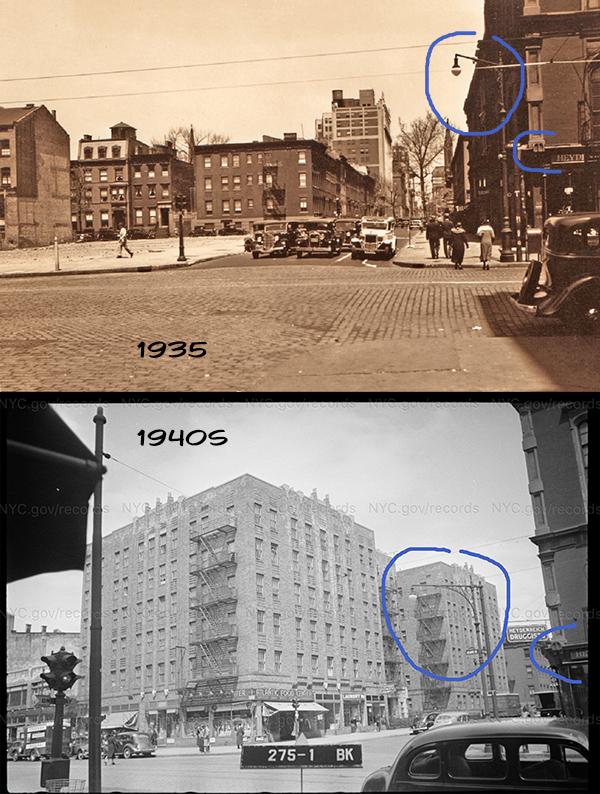
Now it can’t be the “Atlantic Food Centre” seen on 1940s.nyc, because that corner was gone by 1934 and the “Food Center” only appeared there after Lovecraft’s time. Before that it was the Fougera apartments. They had stores beneath the apartments, but the larger of these appears to have been a liquor store.

Although on 1940s.nyc the lower picture may be earlier, as the “Druggist” corner on the right of the picture was also demolished in 1942.

We know what the Fougera corner looked like in 1922, before demolition and the later “Atlantic Food Centre”, thanks to pictures in an article on The Fougera by New York historian Brownstoner. It does not look like a grocery store…

The picture of the demolished Fougera site does however give us a peep down the street to Lovecraft’s famous No. 169 Clinton address, albeit in 1935 and thus ten years after his time there…

Lovecraft says elsewhere that he patronised the Syrian “tailor in the same block”, and here we can indeed see a large sign for “Tailor”. Also a glimpse of the corner store on the right (“Heyd…” something). We know from Lovecraft’s “Red Hook” story that there were relic Norwegians in the area, so my guess on the name would be Scandinavian. There are plenty of Heyde and Heyder surnames in Norway. A later picture shows a drugstore/chemists there, and this earlier incarnation does have the visual feel of a chemists’ shop. Not a grocery then.


But what of Lovecraft’s grocer? It’s not the Fougera corner and it’s not the drugstore corner. So it should be one of two possibilities that are behind the above-seen cameraman.

Ok, the 1940s.nyc site now lets me ‘turn the camera around’ and give readers a look at those two possible grocery stores.

The bottom and slicker-looking one was built as a savings bank, which moved out in 1922. Google Street View has the building’s Clinton side as “191 Clinton” and the shorter Atlantic side of the same building is “160 Atlantic Avenue”. The same numbering applied in the 1920s. In 1922 American Art News announces…

Nicolas Macsoud [a painter of the Orient and miniaturist, 1884-1972] has returned to his studio, 191 Clinton Street, Brooklyn.

Although that may indicate the rooms above. The large apartments above the bank were home to several artists circa 1890s-1910s, and circa the 1900s-1910s the address pops up frequently on art show catalogues now on Archive.org. In 1921 it was still the address of the Brooklyn Society of Miniature Painters, though that may be because of the miniaturist Nicolas Macsoud. Nothing much is heard of art there after 1922. That may be due to the copyright cut-off. Or it could be that the artists departed with the bank in 1922, as the area went rapidly downhill.

But my feeling is that a lush marble-lined savings bank of 1922 would not suddenly become home to a cheap grocers the very next year. This reinforces my feeling that 160 Atlantic Avenue / 191 Clinton Street was not Lovecraft’s corner grocery, if it even was a grocery circa 1923-27. To me it feels, peering through the fuzz, like a fancy bread and cakes shop. Or perhaps a fruitier.

Update: I can now discount the store on this ‘bank’ corner of Atlantic Avenue – Clinton Street. A 1927 picture shows that a corner store was not yet there at that time.

That leaves one option. The top of the two pictures is the final possible corner, at 156 Atlantic Avenue. In this circa 1940 picture the address feels the cheaper of the two possible stores. It has what might be ‘delicatessen’ sign-writing on the windows. On the balance of probabilities, I’d say that Lovecraft’s Red Hook grocery store was at No. 156.

Today the area has obviously gentrified and 156 is the affluent hipster’s ‘Swallow Cafe’, though its facade still keeps the old name ‘Tripoli’ (the well-reviewed middle-eastern and “seafood specialities” restaurant that was there 1982-2010s). Pictures of the side of the building today show it goes quite far back, far enough to allow for a large grocery store in the 1920s, and this is confirmed by a similar early 1940s view of the place…

Mythos writers may then be interested to learn that No. 156 also goes down quite deep…

156 Atlantic Avenue: this particular building has three sub-basements, the lowest of which lines up with track level inside the [subway] tunnel. (The World’s Oldest Subway, 2015, page 22)

Thus Lovecraft’s Red Hook corner grocery had deep basements that went down and down until they reached the level of the city’s oldest subway. And was later home to a “seafood specialities” restaurant. Hmmm….

Notes on Selected Letters II – part two

09 Thursday Jun 2022

Posted by asdjfdlkf in Historical context, Lovecraft as character, Odd scratchings

≈ Leave a comment

Over the summer I’m reading through Lovecraft’s Selected Letters. Here are my notes for Selected Letters II. With just one more post on Vol. II tomorrow, re: new discoveries about Lovecraft’s room at 169 Clinton Street on the edge of Red Hook.


* Page 221. Lovecraft’s family Bible, purchased 1889 by his parents, had in it a clumsy… “imitative engraving of Belshazzar’s Feast” by the Northumberland-born visionary artist John Martin (1789-1854). Lovecraft later recognized the picture “upon seeing a proper plate of the subject for the first time.”

* Page 222. 10th January 1928. Beirce’s translation of The Monk & the Hangman’s Daughter as a possible precursor to, or primer for, some of the feel of “The Dunwich Horror” (written August 1928)…

it is scarce two weeks since I read, for the first time … I shall not soon forget the general picture afforded of the wild Bavarian mountains, the sombre, ancient life of the salt mines, & the whispered, fearsome lore of the crag-fringed tarns & black hanging woods….

Around the spring of 1928 (page 331) Lovecraft also heard a public lecture — presumably at Brown — on modern Greek folklore… “I heard a highly illuminating lecture on the subject a year ago by Sir Rennell Rodd, a lifelong student of neo-Hellenic folklore.” This may also have fed into his fateful trip to Wilbraham and the birth of “The Dunwich Horror”. Rodd’s 1890s book on the topic is online, and he had presumably added to his knowledge since then.

* Page 296. By early 1929 he was weekly taking “the N.Y. Sunday Times and the sanely balanced and disillusioned news-weekly Time.” But a few years later he intimates to Long that he has limited his intake of national and international current affairs.

* Page 298. “I’d say that good art means the ability of any one man to pin down in some permanent and intelligible medium a sort of idea of what he sees in Nature, that nobody else sees. In other words, to make the other fellow grasp, through skilled selective care in interpretive reproduction or symbolism, some inkling of what only the artist himself could possibly see in the actual objective scene itself. … The picture can, if it be good art, give you something in the real scene which you couldn’t have gathered for yourself — which only the particular artist who painted the picture could ever have gathered preserved for other people to see. … We derive from this process a feeling of magnification in the cosmos — of having approached the universal a trifle more closely, and banished a little of our inevitable insignificance. Instead of being merely one person, we have become two persons — and as we assimilate more and more of art we become, in effect, more and more people all in one; till at length we have the sensation of a sort of identification with our whole civilisation.”

* Page 323. He reads The Silversmiths of Little Rest, by William Davis Miller. Because it related to his family-tree and “the Casey side av me” believed by his family research to be originally “the English Caseys of Gloucester”, England. The 50-page 18-plate book was produced in a limited edition of 150, seemingly for antiquarians in New England. Little Rest was a place, rather than a description of the work-habits of the smiths. “Full biographical and occupational information (markings, inscriptions) on the following key Little Rest (i.e., Kingston, RI) silversmiths: Samuel Casey, John Waite, Joseph Perkins, Nathaniel Helme, Gideon Casey and William Waite.”

* Page 324. March 1929. He alludes to something Talman is writing or has recently written. “By the way — it’s a good idea of yours to square us criminal Caseys with society by making an Howard Phillips a reg’lar deteckatiff” [regular detective]. Which hints that Talman had recently penned or planned to pen a crime-detective story featuring a “Howard Phillips”. I don’t yet have the volume of Talman letters, and I imagine I may find there some detail about this apparent ‘Lovecraft as character’ story. By January 1929 Talman had moved to Red Hook, and I would guess he was enamoured of “The Horror at Red Hook” with Detective Malone, and thus probably wanted to write something similar himself — perhaps a clever sequel featuring Lovecraft himself. But I shall have to wait for the book of Talman letters to find out if there are more details on this.

* Page 329-30. April 1929. He observes that the… “Famous ‘London Terrace’ in West 23d St. [New York City] — where a friend of mine has lived all his life — is to come down shortly to make room for a wretched apartment skyscraper.” Who was this friend? He may be footnoted in the Toldridge letters, but I don’t yet have that volume. But something can be gleaned from the building data. Historians now refer to the row as a… “development from the 1840s known as London Terrace, built to look like typical London [British] apartments at that time”. A local report of 1929 gives an alternative name, mourning the loss of… “a row of private dwellings of considerable age and great local interest, identified as London Row or London Terrace”. The book The City in Slang (1995) gives a folk-name and the location… “One of the earliest so-named Millionaires’ Rows in New York was a block on West 23rd Street, a development formally called London Terrace, between Ninth and Tenth Avenues.” So these data may help someone to pinpoint Lovecraft’s mysterious friend, who still lived there in 1929 and was likely either i) affluent and elderly or ii) a young lad of an affluent family.

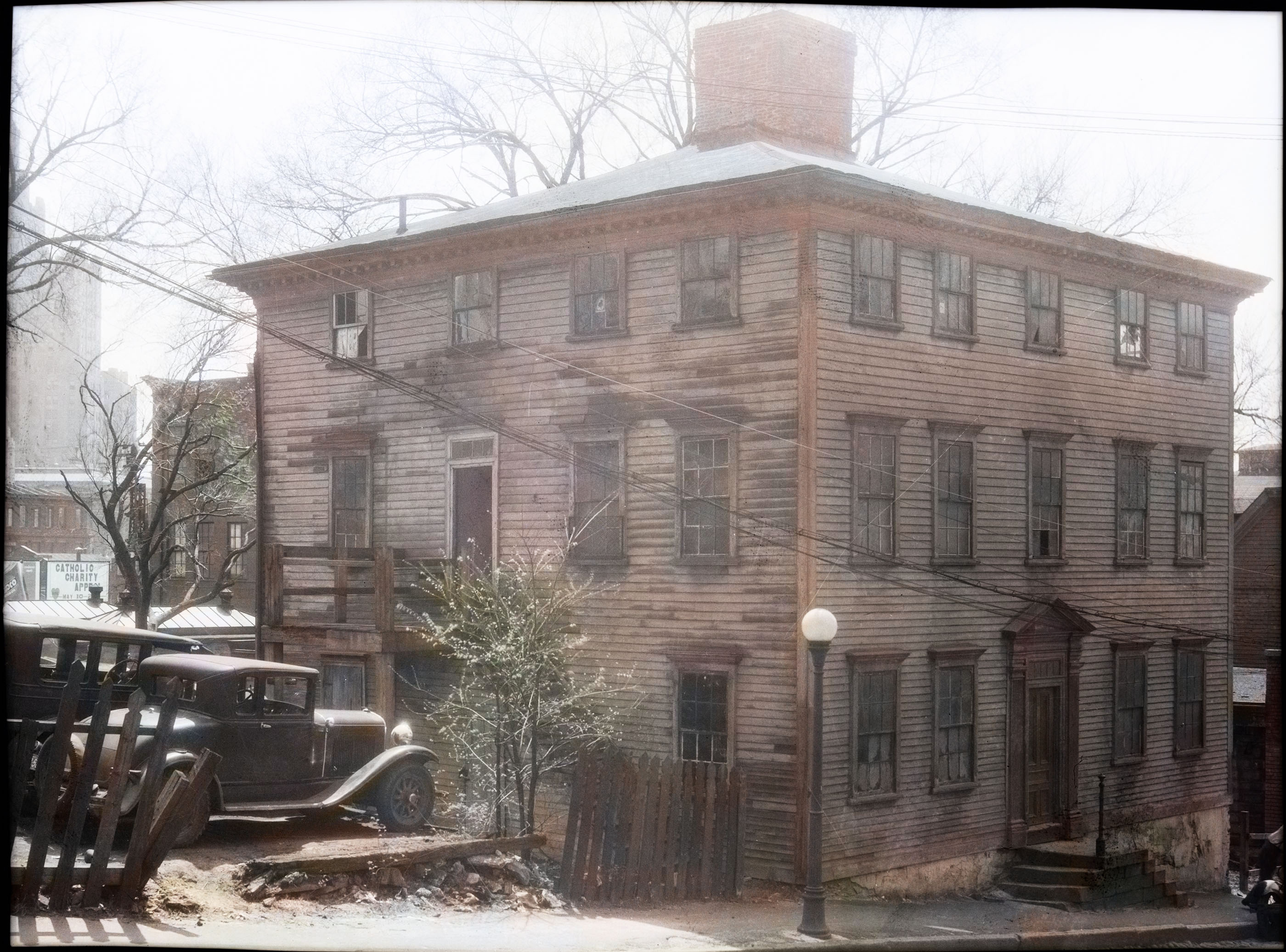
* Page 353. Lovecraft tells Mrs Toldridge… “I pass in sight of the ancient Carter house every time I walk down town — & the neighbourhood is still much as he knew it in 1770 & thereabouts. Across the street an old brick schoolhouse built in 1769 is still serving its original purpose, whilst at the foot of the hill the old Quaker Meeting House ( 1745) still broods beside its deserted wagon­sheds. … John Carter, Providence’s colonial printer, & publisher of the Providence Gazette & Country-Journal before, during, & after the revolution. His old shop & office, the Sign of Shakespeare’s Head, in Gaol-Lane, is still standing in good condition notwithstanding the sinking of the neighbourhood to slumdom. It is a large square house on a steep hill, with fanlighted doorway & the double flight of railed steps so typical of colonial Providence.”

The John Carter house is at “21 Meeting Street”, an address which unlocks the Library of Congress. Here is the house as Lovecraft would have known it circa 1933-35. The Industrial Trust building can be seen behind on the left. Modern photos show a currently ‘restored’ colour that can range from neon-red to coconut-shell brown, so I’m not sure how to colour it. Here it’s sort of ‘faded creosote’, in keeping with its decrepit slum state.

SFFaudio Podcast #684

05 Sunday Jun 2022

Posted by asdjfdlkf in Historical context, New discoveries, Podcasts etc.

≈ Leave a comment

As some people’s thoughts turn toward the usual beach-front summer vacation, the new SFFaudio Podcast #684 has an unabridged Gordon Gould reading for “The Strange High House In The Mist” by H.P. Lovecraft followed by discussion.

Lovecraft claimed the story was inspired by the “titan cliffs of Magnolia” (Mass.). Yet I find that the postcard and glass-plate makers have singularly failed to capture any “titan” cliffs, and the candidates of “Rafe’s Chasm” and “Mother Ann” seem to lack the necessary attributes.

Yet it appears he was not being ironic…

I ended up with the titan cliffs of Magnolia — memories of which prompted “The Strange High House in the Mist” — and found their charm undiminished. [He had seen them in 1923]. You can’t imagine their majesty unless you’ve seen them — primal rock and sea and sky …. and the bells of the buoys tolling free in the aether of faery!

In 1933 he recalls…

the striking sea-cliffs of Magnolia — with the yawning abyss of Rafe’s Chasm.

Well then… maybe they just never had the right photographer? Perhaps at low tide one could walk around below them on the beach, and that way they looked more impressive?

However, the search of Magnolia does yield me the required Father Neptune…

‘Picture Postals’ from Lovecraft: Fulton Street

03 Friday Jun 2022

Posted by asdjfdlkf in Historical context, Picture postals

≈ Leave a comment

This week on ‘picture postals’, a hunk o’ the actual place. Fulton Street, Brooklyn, to be exact. Or as good as, in the form of a .PNG cutout (i.e. on transparency) for Tentaclii readers.

This follows on from last week’s discovery of the location of Lovecraft’s fave restaurant at 7 Willoughby Street, just around the corner from Fulton.

Preview:

Download: fulton-st-cutout.png


Also, a couple of Willoughby Street ‘out-takes’ from my recent posts on John’s. These are ten years before Lovecraft’s New York sojourn, and are from the 1915-16 pictures made to forestall any damages litigation before the subway was dug.

Here we look along Willoughby Street, in 1915, from what is now No. 15 down to No. 1. The theatre (by then a cinema) is still on the corner at that point, but by Lovecraft’s time in the city would have become the Edison Electric Co. office building that still stands today as No. 15. The Elevated railway can be seen in the distance, as it swings around the Brooklyn Citizen newspaper building and heads down Fulton. The second barber pole seen here about marks the site of 7 Willoughby Street, later John’s, and part of its “Hungarian Restaurant” sign can be seen.

Here we look across the foot of Willoughby Street at that same point in time. The spot is seen on the bird’s-eye view.

The Brooklyn Citizen newspaper building is in the immediate foreground on the left, and their hoarding gives the news headlines. It looks like three newspaper hawkers are waiting for the early-morning newspaper bundles to land on the sidewalks. Behind the edge of the Citizen we can just see the signs that indicate the start of Willoughby Street, including Bristol’s restaurant at No. 3. The middle-distance of the picture shows roughly the stores that would have been opposite John’s. Note that the run of stores directly opposite are neatly boarded up, presumably in advance of the subway work, and (as seen on other pictures) their frontages tell people to use an entrance around on Fulton.

The Elevated railway on the right of the picture heads down into Fulton, but we see a passenger stop and the steep stairs up to the platform. Perhaps this was a frequent station for Lovecraft and friends, when John’s was the “spaghetti headquarters”… though of course the trains it served may have been headed the wrong way for some of the ‘gang’. The bird’s-eye postcard view, however, also reveals a station platform opposite and going the other way.

“Sunday morning elevated”, Lovecraft on the platform of the Elevated.

← Older posts
Newer posts →


Please become my patron at www.patreon.com/davehaden to help this blog survive and thrive.

Or donate via PayPal — any amount is welcome! Donations total at Easter 2025, since 2015: $390.

Archives

  • March 2026
  • February 2026
  • January 2026
  • December 2025
  • November 2025
  • October 2025
  • September 2025
  • August 2025
  • July 2025
  • June 2025
  • May 2025
  • April 2025
  • March 2025
  • February 2025
  • January 2025
  • December 2024
  • November 2024
  • October 2024
  • September 2024
  • August 2024
  • July 2024
  • June 2024
  • May 2024
  • April 2024
  • March 2024
  • February 2024
  • January 2024
  • December 2023
  • November 2023
  • October 2023
  • September 2023
  • August 2023
  • July 2023
  • June 2023
  • May 2023
  • April 2023
  • March 2023
  • February 2023
  • January 2023
  • December 2022
  • November 2022
  • October 2022
  • September 2022
  • August 2022
  • July 2022
  • June 2022
  • May 2022
  • April 2022
  • March 2022
  • February 2022
  • January 2022
  • December 2021
  • November 2021
  • October 2021
  • September 2021
  • August 2021
  • July 2021
  • June 2021
  • May 2021
  • April 2021
  • March 2021
  • February 2021
  • January 2021
  • December 2020
  • November 2020
  • October 2020
  • September 2020
  • August 2020
  • July 2020
  • June 2020
  • May 2020
  • April 2020
  • March 2020
  • February 2020
  • January 2020
  • December 2019
  • November 2019
  • October 2019
  • September 2019
  • August 2019
  • July 2019
  • June 2019
  • May 2019
  • April 2019
  • March 2019
  • February 2019
  • January 2019
  • December 2018
  • November 2018
  • October 2018
  • September 2018
  • August 2018
  • August 2015
  • July 2015
  • April 2015
  • March 2015
  • February 2015
  • January 2015
  • December 2014
  • November 2014
  • October 2014
  • September 2014
  • August 2014
  • July 2014
  • June 2014
  • May 2014
  • March 2014
  • February 2014
  • January 2014
  • December 2013
  • November 2013
  • October 2013
  • September 2013
  • August 2013
  • July 2013
  • June 2013
  • May 2013
  • April 2013
  • March 2013
  • February 2013
  • January 2013
  • December 2012
  • November 2012
  • October 2012
  • September 2012
  • August 2012
  • July 2012
  • June 2012
  • May 2012
  • April 2012
  • March 2012
  • February 2012
  • January 2012
  • December 2011
  • November 2011
  • October 2011
  • September 2011
  • August 2011
  • July 2011
  • June 2011
  • May 2011
  • April 2011
  • March 2011
  • February 2011
  • January 2011
  • December 2010
  • November 2010
  • October 2010
  • September 2010
  • August 2010
  • July 2010

Categories

  • 3D (14)
  • AI (70)
  • Astronomy (70)
  • Censorship (14)
  • de Camp (7)
  • Doyle (7)
  • Films & trailers (101)
  • Fonts (9)
  • Guest posts (2)
  • Historical context (1,095)
  • Housekeeping (91)
  • HPLinks (76)
  • Kipling (11)
  • Kittee Tuesday (92)
  • Lovecraft as character (58)
  • Lovecraftian arts (1,628)
  • Lovecraftian places (19)
  • Maps (70)
  • NecronomiCon 2013 (40)
  • NecronomiCon 2015 (22)
  • New books (966)
  • New discoveries (165)
  • Night in Providence (17)
  • Odd scratchings (984)
  • Picture postals (276)
  • Podcasts etc. (431)
  • REH (184)
  • Scholarly works (1,469)
  • Summer School (31)
  • Unnamable (87)

Get this blog in your newsreader:
 
RSS Feed — Posts
RSS Feed — Comments

H.P. Lovecraft's Poster Collection - 17 retro travel posters for $18. Print ready, and available to buy — the proceeds help to support the work of Tentaclii.

Proudly powered by WordPress Theme: Chateau by Ignacio Ricci.