• About
  • Directory
  • Free stuff
  • Lovecraft for beginners
  • My Books
  • Open Lovecraft
  • Reviews
  • Travel Posters
  • SALTES

Tentaclii

~ News & scholarship on H.P. Lovecraft

Tentaclii

Category Archives: Historical context

Robert E. Howard journal #17

25 Wednesday Jun 2014

Posted by asdjfdlkf in Historical context, REH, Scholarly works

≈ Leave a comment

New REH: Two-Gun Raconteur journal, #17. Apparently limited to 200 copies. Which seems odd, in the age of print-on-demand. Two essays that might interest Lovecraftians…

* “What the Thak?: Anthropological Oddities in Howard’s Works” by Jeffrey Shanks, illustrated by Clayton Hinkle.

* “Robert E. Howard and Past Lives: Reincarnation, Dreams and Race Memories” by Barbara Barrett, illustrated by Richard Pace.

More on the Isles of Shoals as an inspiration for Devil Reef

21 Saturday Jun 2014

Posted by asdjfdlkf in Historical context

≈ Leave a comment

More on the Isles of Shoals being a suitable inspiration for Lovecraft’s Devil Reef in “The Shadow over Innsmouth”. Firstly, they were suitably bleak, something that one might not know today — in the era of bright cheerful chocolate-box paintings of the islands made in high summer.

“the Isles of Shoals, eight bleak little rocks in the pounding Atlantic, ten miles off Portsmouth” (LIFE magazine, Sept 1940)

“the dark volcanic crags and melancholy beaches [of Herman Melville’s Enchanted Islands] can hardly seem more desolate than do the low bleached rocks of the Isles of Shoals to eyes that behold them for the first time.” (Atlantic Monthly, 1869)

“Swept by every wind that blows, and beaten by the bitter brine for unknown ages, well may the Isles of Shoals be barren, bleak, and bare.” (the local poet, Celia Thaxter)

“Were those the desired Isles of Shoals? Lois felt deep disappointment. Little bits of bare rock in the midst of the sea; nothing more. No trees, she was sure; as the light fell she could even see no green.” (Susan Warner, the novel Nobody, 1882)

“With a total area of barely six hundred acres, the Isles of Shoals are about the most desolate, barren and forbidding bit of real estate in all New England.” … “Yet barren, desolate, almost worthless as the islands were [until the hotels on Appledore and Star], with their only denizens rough, illiterate and somewhat degenerate fisherfolk, smugglers and worse” (Early Star Island History)

Lovecraft might just have read Hawthorne’s American Notebooks. Although the slim evidence for that, when you start digging into it, falls apart. There are 10,000 words of sporadic diary for Hawthorne’s stay on the Isles of Shoals. Hawthorne visited in the highest of high summer, to get his Tanglewood Tales book (a junior HPL favorite) underway in a suitably Mediterranean light. But his descriptions of the place get bleaker and bleaker as he remained there into the early Autumn (Fall) and saw the fogs and storms start rolling in. He finally got off quick before winter began, but in early September of his visit he wrote…

“We walked to the farthest point of the island, and I have never seen a more dismal place than it was on this sunless and east-windy day, being the farthest point out into the melancholy sea which was in no very agreeable mood, and roared sullenly against the wilderness of rocks. One mass of rock, more than twelve feet square, was thrown up out of the sea in a storm, not many years since, and now lies athwart-wise, never to be moved unless another omnipotent wave shall give it another toss.”

“It is quite impossible to give an idea of these rocky shores,—how confusedly they are tossed together, lying in all directions; what solid ledges, what great fragments thrown out from the rest. Often the rocks are broken, square and angular, so as to form a kind of staircase; though, for the most part, such as would require a giant stride to ascend them. Sometimes a black trap-rock runs through the bed of granite; sometimes the sea has eaten this away, leaving a long, irregular fissure. In some places, owing to the same cause perhaps, there is a great hollow place excavated into the ledge, and forming a harbor, into which the sea flows; and, while there is foam and fury at the entrance, it is comparatively calm within. Some parts of the crag are as much as fifty feet of perpendicular height, down which you look over a bare and smooth descent, at the base of which is a shaggy margin of seaweed. But it is vain to try to express this confusion. As much as anything else, it seems as if some of the massive materials of the world remained superfluous, after the Creator had finished, and were carelessly thrown down here, where the millionth part of them emerge from the sea, and in the course of thousands of years have become partially bestrewn with a little soil.”

“The old inhabitants lived in the centre or towards the south of the island, and avoided the north and east because the latter were so much bleaker in winter.”

(The description of the rocks here is also somewhat similar to the madly confused island rocks scene in “The Call of Cthulhu”)


I further wonder if the young Lovecraft, scanning his maps and alighting on the only really interesting islands off New England (apart from Matinicus, way up near Rockland), once spotted the tantalising similarity of the name to a name from antiquity…

“Hesiod calls the Western Islands [Atlantis] the Isles of Souls” and “Proclus says, on the authority of Marcellus, that there were seven Atlantic islands [in Atlantis]” (Legends and superstitions of the sea and of sailors, 1885, reprinted 1892).

“Souls” was a slight fabulation or misconstruing (the usual translation of Hesiod is “The Isles of the Blessed” or “Blest”, from makarôn nêsoi, μακάρων νῆσοι) from the East Coast navy man who wrote the book, but one can then imagine the young Lovecraft’s imagination flaring with the thought that the Isles of Shoals could be the mountaintops of the sunken Atlantis. And what lies miles below Lovecraft’s Devil Reef? A fabulous anti-Atlantis of immortals.

seabook

Difficult to believe that Lovecraft didn’t come across this in folklore sections of the New York used bookshops, or at the Providence Public Library (which had a good folklore section c.1900). Its highly coloured tone and breathless pace made it quite popular, despite a scathing review in the London Spectator, and it went to a second printing in 1892. Although it wasn’t listed as being in his library at his death.

“Lonely bleak islands off N.E. coast.”

18 Wednesday Jun 2014

Posted by asdjfdlkf in Historical context, Maps, New discoveries

≈ 2 Comments

“168  Lonely bleak islands off N.E. [New England] coast. Horrors they harbour—outpost of cosmic influences. (H.P. Lovecraft, story idea #168 in the “Commonplace Book”)

“There was a lone southward-sailing ship, and far out the eye could barely discern the misty suggestion of the half-fabulous Isles of Shoals [four miles off the coast from Portsmouth]. I had not seen the ocean before for six years—the glimpses one gets in harbours are nothing.” (H.P. Lovecraft, June 1922, Selected Letters I, p.185.)

“the low, black reef lay a full mile and a half out from Innsmouth Harbour.” … “Far out beyond the breakwater was the dim, dark line of Devil Reef, and as I glimpsed it I could not help thinking of all the hideous legends I had heard in the last twenty-four hours—legends which portrayed this ragged rock as a veritable gateway to realms of unfathomed horror and inconceivable abnormality.” (H.P. Lovecraft, “The Shadow Out of Innsmouth”)

Lovecraft had visited Portsmouth just one month before writing “The Shadow over Innsmouth”.

“They are supposed to have been so called, not because the ragged reefs run out beneath the water in all directions, ready to wreck and destroy, but because of the “shoaling,” or “schooling,” of fish about them, which, in the mackerel and herring seasons, is remarkable.” (Atlantic Monthly, 1869)

“the abundance of fish was certainly almost uncanny” … “Queer how fish are always thick off Innsmouth Harbour” (H.P. Lovecraft, “The Shadow out of Innsmouth”)

“As he [‘King’ Haley] turned over a stone one day [on his Haley Island, part of the ‘Isles of Shoals’] he found three bars of solid silver [and with that mysterious treasure built a sea-wall and a wharf]” (real-life story in “The Isles of Shoals”, Harper’s Weekly)

“always been a kind of mystery where the Marshes get the gold they refine … Others thought and still think he’d found an old pirate cache out on Devil Reef” (H.P. Lovecraft, “The Shadow out of Innsmouth”)

Of course Lovecraft probably never visited those particularly barren and low-lying Isles, only spied them from the coast and read of them. A visit entailed a full day-trip on a steamer from Portsmouth in the 1920s. The steamer landed passengers at the main Star Island, where the Oceanic Hotel was a church-run establishment and any cafes likely served quite expensive refreshments to a captive audience of trippers. So it’s more likely he just read up on them, then imagined that the most bleak of the Isles — such as the barren northern Duck Island and its ragged reefs and ledges — might be transplanted elsewhere, and brought closer in so that it would be clearly visible from a hideous old town.

duck-shoals

txu-pclmaps-topo-nh-portsmouth-1917Above: ‘The Isles of Shoals’ seen in relation to Portsmouth, 1917 topographic map. The map’s marking of “Town of Kittery” and “Town of Rye” across the islands indicates legal jurisdiction, not that the islands had towns on them. The hotel on Appledore island had burned down in 1914.

Curiously, given the supposedly ‘ever-rising sea levels’ that are supposed to soon inundate the nearby New York City, global warming has left completely untouched the coastline of these lowest of low-lying islands.

Old Newburyport

18 Wednesday Jun 2014

Posted by asdjfdlkf in Historical context, Maps

≈ 4 Comments

[Update: I later had an additional post on the Newburyport shoreline].

Old Newburyport, giving impressions of how H.P. Lovecraft might have seen it.

AViewofNbptfromHarbor1850_Sm
Newburyport harbour in the 1850s, painted by Richard Burke Jones with historically accurate details. Prints available.

nraland-c1920
The waterfront district circa 1920.

newburyport_waterfrontMore waterfront, from a lower elevation, view of the bridge.

newburyportpridgeBridge at Newburyport.

waternpostAs a working port.

colrun-newburyport
Coal conveyors, presumably to fuel up the steamships.

newburyportlightLight tower at Newburyport, coal conveyor to the steam ships.

1910_Newburyport_station_postcardTrain station. Lovecraft may have instead arrived by trolley in most instances (see David Goudsward, H.P. Lovecraft in the Merrimack Valley), but perhaps the train station and cross-country trolley terminus were the same place? He probably passed through on this line on his return south after visiting Portsmouth in the early 1930s. He also probably arrived here on the train from/to Boston at least once.

Looking Down State Street NewburyportCommercial centre.

neststCommercial centre.

newburyportmarket-620x413Commercial centre.

trolleymaketsquareTrolley car out of the market square.

Nbpt-JoppaLandingJoppa Landing (past the main commercial centre, Lovecraft missed the centre and went hurtling on into this area on the trolley, then walked back).

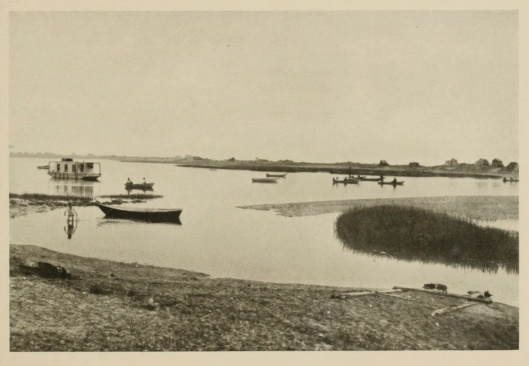
Clam shacks at Joppa Flats. The trolley car lines have been painted out, but you can see the trolley wire posts.

newburyport-clammersClam pickers on the flats.

Salt-haySalt-haying on the adjacent marshland. Seen in October from the train line that crossed the marshlands, when Lovecraft was returning south from a visit to Portsmouth, could these have looked like shoggoths-in-the-mist? 🙂

nbpt-haystacksSalt-haying on the adjacent marshland.

nra-lots-1972Newburyport waterfront partially cleared in the early 1970s, just before restoration.

nra-lots-1973Newburyport waterfront partially cleared in the early 1970s, just before restoration.

Many more excellent old photos at The Newburyport blog of Mary Baker Design.

Book Review: H. P. Lovecraft in the Merrimack Valley

17 Tuesday Jun 2014

Posted by asdjfdlkf in Historical context, Maps, New books

≈ 1 Comment

Book Review:

David Goudsward, H.P. Lovecraft in the Merrimack Valley, Hippocampus Press, summer 2013. $15 print-on-demand paperback, 192 pages. Foreword by Kenneth W. Faig. Jr., with an afterword by Chris Perridas. Illustrated, basic index. The book was read completely and carefully.

lovemerr


David Goudsward is obviously a prodigious walker, just as H.P. Lovecraft was. One has to marvel at the amount of physical legwork and boot leather that went to make this new book. Goudsward has walked and ridden every one of the various routes that Lovecraft threaded through the Merrimack Valley, and he has also wandered through what remains of the antiquated foot-ways of its eastern fishing towns. At the end of the book he even provides readers with a useful short gazetteer, listing places he has visited and which are currently open to the public. For those who can’t make such visits the book offers abundant and crisply reproduced black-and-white pictures. These pictures are either Goudsward’s own, or those he has ably sourced from local archives.

The book is well organised, and the text and pictures flow well together. But much tedious and time-consuming page-flipping might have been avoided by having the footnotes placed at the bottom of each page, instead of at the back of the book. It would also have been useful to have had at least one map of the area, but there are none. This seems a pity, when there are excellent old maps in the public domain at high resolution…
newburyport Above: Newburyport in 1888, topographic map. Full version.

Of course the more digitally adept reader might juggle a digital tablet with the book, and thus ‘follow along’ via the wonderful Google Maps and Google Street View (a free tool which now allows researchers to scout out Lovecraft’s locations from the comfort of their PC). Sadly the modern Haverhill — the setting for the first half of this book — doesn’t lend itself to such Googly goodness: Goudsward informs the reader that the centre of Haverhill was effectively destroyed by the urban-planning vandals of the 1960s and 70s.

haverhill1888Above: Haverhill in 1888, topographic map.

The book opens with a short but engaging foreword by the veteran Lovecraft researcher Kenneth W. Faig, Jr. Faig immediately grabs the Lovecraftian reader by the lapels, with a stirring call to undertake the daunting task of making a complete day-by-day summary time-line of Lovecraft’s life, in the same manner as has already been done for Abraham Lincoln. That might best be done alongside an online searchable edition of the complete corpus of surviving letters (with only fragments shown, as with Google Books, in order to prevent piracy). In the meantime, books such as H.P. Lovecraft in the Merrimack Valley can help to fill some of the gaps, in terms of an almost day-to-day documentation of Lovecraft in one particular place.

Goudsward more or less strides through the events chronologically, with only a few sharp switchbacks into town histories. He opens with a succinct but detailed account of the life of Lovecraft’s fellow amateur pressman Charles W. “Tryout” Smith (1852-1948) of Haverhill. In the book’s appendices “Tryout”, along with Myrta Alice Little, is treated to a fine and painstaking listing of all solo publications.

Then the reader is stepped through the story of Lovecraft’s initial 1921 stay-over meeting with a near neighbour of “Tryout”. This person was the very tall, very beautiful and very intelligent Myrta Alice Little (1888-1967). Lovecraft was perhaps not ‘on top form’ when he met her, being only a few weeks into mourning for his dead mother. Myrta fairly soon decided to marry a local Methodist preacher, and Lovecraft was rather left in the dust. I was surprised to discover that “Tryout” Smith also swiftly departed the Haverhill scene, albeit in a very different way — he became a total recluse at a place called Plaistow between 1922 and 1926, seemingly admitting no visitors at all. Not even Lovecraft.

But Lovecraft did retain a good reason to visit Haverhill, and to explore the area’s antiquities. From March 1922 he had cultivated a friendship with a bright thirteen year old boy named Edgar J. Davis (1908-1949) of Haverhill. Lovecraft befriended Edgar’s family and was allowed to stay over at his home. Together he and Edgar were allowed to go off on trips of local exploration. They eagerly visited the shadowy crumbling estuary-mouth seaport of Newburyport, later admitted by Lovecraft to be — in part — a model for the famous story “The Shadow over Innsmouth” (written Nov-Dec 1931). Here one of Goudsward’s claims about Newburyport made me pause. It was a small claim that the old Bayley Hat (Chase Shawmut) factory was the direct model for the Marsh Refinery of “Shadow Over Innsmouth” (p.47). I felt this claim needed more evidence. On the other hand, the place does look like a plausible candidate, seen here in an elevation sketch I found from circa 1903…

RTEmagicC_PHO-Mersen-Newburyport-Facility-1903.jpg

Like many of Lovecraft’s places, Innsmouth was very probably a bit of a literary collage. He probably borrowed elements from different places: a marshy shoreline from here; a familiar town grid plan from there; add a road by which to approach in an atmospheric manner; give it human pathos by using the crumbling elegant architecture and fishing shacks of Newburyport. Then top it off with a creepy reef way offshore; a horrible hotel; a mysterious refinery; and an old abandoned railroad, some of which were perhaps simply dreamed up from his abundant imagination to suit the needs of the plot.

Goudsward’s book also looks at Lovecraft’s later (post New York) trips to Newburyport and the region, in the company of W. Paul Cook. The bright young Edgar J. Davis had by that time grown up and gone off to Harvard to study law. In this section I again paused over just one of the claims made: that a coral reef Lovecraft saw on a Miami tourist trip was the direct inspiration for Innsmouth’s Devil Reef (p.70). Yet Lovecraft’s description of the jaunt (not given in the book) seems rather incongruously bright-and-sparkly for something so dark and brooding…

   “… sailed out [from Miami] over a neighbouring coral reef in a glass-bottomed boat which allowed one to see the picturesque tropical marine fauna & flora of the ocean floor.” (Selected Letters III, p.380)

The northern third of the nearby ‘Isles of Shoals’, four miles offshore from nearby Portsmouth and ten miles NW of Newburyport, might have been a more plausible suggestion for the idea of the Reef. Although that’s not to say that Lovecraft ever visited any of the bleaker of those islands. While a couple of the larger islands had become minor tourist traps (Hawthorne wrote the junior HPL fave Tanglewood Tales there), most of ‘The Isles of Shoals’ is a sprawl of lonely low islands and tidal ledges just above the sea, where “ragged reefs run out beneath the water in all directions” (Among the Isles of Shoals, 1873). Lovecraft had visited Portsmouth just one month before writing “The Shadow over Innsmouth”.

txu-pclmaps-topo-nh-portsmouth-1917Above: ‘The Isles of Shoals’ seen in relation to Portsmouth, 1917 topographic map.

I did wonder if more might have been said in the book about the historical as well as the geographical context. By historical context I mean the sweep and impact of large implacable forces, such as the shifts in the economy and the coming of modernity to the area in the 1920s. Goudsward does have some short town histories, and some paragraphs that try to say why Newburyport was decaying. But his bibliography lacks the sort of books that might have given him some useful big spotlights, with which to illuminate small details to do with Lovecraft. While pounding the same streets as Lovecraft did can obviously be very useful, an equal pounding on digital doors — of Google Books, HathiTrust, Archive.org, Library of Congress pre-1922 online newspapers, and suchlike — might have yielded Goudsward a few useful additions to his book. For instance, the drastic overfishing at Innsmouth and the town’s keen desire for vast new shoals of fish. Is something similar to be found in the history of the Merrimack River? At Google Books I swiftly found the interesting fact that…

   “Fish were a critical link in the Merrimack valley’s food chain”, and that these fish were vastly overfished and the river over-dammed by commercial interests in the early 1800s, and the fish life of the river consequently suffered a severe ecological collapse in what had once been one of the finest salmon rivers in America. (For full details on this story see the chapter “Depleted Waters” in Nature Incorporated: Industrialization and the Waters of New England, Cambridge University Press, 2004.)

There seems an obvious parallel here with the depiction of the fictional collapse of the Innsmouth fishing economy…

   “Most of the folks araound the taown took the hard times kind o’ sheep-like an’ resigned, but they was in bad shape because the fishin’ was peterin’ aout…” (Zadok in “Shadow over Innsmouth”)

   “That fishing paid less and less as the price of the commodity fell and large-scale corporations offered competition… [but by then Innsmouth had the fish being herded in…]” (“Shadow over Innsmouth”)

I also wondered about a rhetoric around population ‘degeneration’ at the time, apparently specific to the region. I wondered how early this developed in 1921—1931, the period under discussion in the book, as evidenced by the local and regional newspapers…

   “by the 1930s […] entire regions like north-eastern Connecticut and the Merrimack Valley of New Hampshire and Massachusetts appeared to be left behind by history, and the sight of abandoned factories was as common as that of deserted farms” […] “the rural hinterlands seemed to be largely populated with inbred, degenerated retards” [and newspapers pictured] “them as a bunch of mutated dwarfs, giants, and idiots.” (Bernd Steiner, “The Decline of a Region”, H.P. Lovecraft and the Literature of the Fantastic, 2007, p.33).

Finally, there is ‘Mystery Hill’. Goudsward has long been associated with the so-called megalithic site of ‘Mystery Hill’ in New England, and so I was rather dreading reading a gusher of an essay on the topic, but find that the essay is relegated to an appendix in the book. I am no expert on the New England megaliths controversy, other than to know to be highly sceptical of North America’s ubiquitous faux prehistory. But I was pleased to find what appears to be a restrained and rather careful look at the known evidence about Lovecraft having once visited this site. I only worried that I could find nary a whit nor a sniff of the name “Pattee’s Caves” (which Goudsward states was the old local name for ‘Mystery Hill’, before its mid 1930s purchase and transformation) in any of the big pre-1926 online archives. After sifting the dubious claims of Munn and others, Goudsward finally alights on an elegant and moderately plausible way to get Lovecraft up to ‘Mystery Hill’. I won’t spoil the surprise for readers, but it’s a fun ride getting there. Even if Goudsward is right on that point, then it still doesn’t prove that the highly dubious man-sized stone slab now in pride of place at ‘Mystery Hill’ was present and visible there in 1921. Nor that Lovecraft then recalled that same slab a few years later, and fictionally hoisted it atop Sentinel Hill in “The Dunwich Horror”.

Overall the book is an engaging read, and I recommend it to those who want the fine and thought-provoking details about the inspirations for Innsmouth and how Lovecraft came to know the Merrimack River area.


Contents:

Foreword, by Kenneth W. Faig, Jr.
Preface
Acknowledgements
H.P. Lovecraft in the Merrimack Valley
Transformations
First Visits: 1921
Whittierland and Newburyport
Intermezzo: 1924–1926
Innsmouth Ascendant: 1927–1931
Dreams and Eclipses: 1932–33
Shadows out of Haverhill: 1934–36
Coda
Appendices
The Haverhill Convention, by H.P. Lovecraft
First Impressions of Newburyport, by H.P. Lovecraft
Tryout’s Return to Haverhill
Plaistow, N.H., by C.W. Smith
The Return, by H.P. Lovecraft
The Published Works of Myrta Alice Little Davies
Howard Prescott Lovecraft, by C.W. Smith
The Publications of Charles W. Smith
H.P. Lovecraft, “The Dunwich Horror,” and Mystery Hill
Sites Open to the Public
Notes
Lovecraft: A Sense of Place and High Strangeness, by Chris Perridas
Bibliography
Index


Lovecraft’s star-chart

17 Tuesday Jun 2014

Posted by asdjfdlkf in Astronomy, Historical context

≈ 1 Comment

Lovecraft’s star-chart or ‘planisphere’: “The Barritt-Serviss Star and Planet Finder”, circa 1906.

lovecrafts-star-chart

6Mb PNG, complete, printable

planisphereexhibitcradle

storagecaseandextras

sizeindication

“Thirty years ago I bought a large planisphere from Barritt — the so-called “Barritt-Serviss Star and Planet Finder”, with a graduated ecliptic and thumb-tacks for planets. An accompanying booklet gave the right ascension of each planet at short intervals for about a decade ahead, so that one could simply stick a tack on the ecliptic at the right place and all be set. Time passed, the booklet became obsolete, and I didn’t know what had become of Barritt and his firm. For a while I used the Nautical Almanack…” (Selected Letters V, p.412)

He was still using this with binoculars for casual star-gazing (not serious observation work) in the early 1920s.

Phillips Genealogies (1885)

17 Tuesday Jun 2014

Posted by asdjfdlkf in Historical context, Scholarly works

≈ Leave a comment

The full text of the book Phillips Genealogies (1885). This is probably a key source from which Lovecraft constructed his family tree as he knew it: I read in the footnotes for the recent H.P. Lovecraft in the Merrimack Valley that this point has been suggested by Kenneth W. Faig Jr. Or I wonder if perhaps the book may have been used by Lovecraft’s maternal grandmother Robie (‘Rhoby’), who died in 1896 and who had apparently done much work on the family tree?

phillips

Lovecraft and Phaeton

16 Monday Jun 2014

Posted by asdjfdlkf in Historical context

≈ 3 Comments

A new post on the Lovecraftian Science blog, “Smith and Lovecraft’s Use of the Asteroid Belt in their Fiction”. Here’s the actual Lovecraft quote, not given by the LS blog…

It came to me that this was the language used by a captive mind I had known slightly in my dreams — a mind from a large asteroid on which had survived much of the archaic life and lore of the primal planet whereof it formed a fragment. At the same time I recalled that this level of the archives was devoted to volumes dealing with the non-terrestrial planets [meaning, the gas-giant planets in our outer solar system].” (H.P. Lovecraft, from “The Shadow out of Time”)

The name of the “primal planet” was Phaëton, in the ‘the Belt is the remains of an exploded planet’ hypothesis then current. This then perhaps gives a new twist to the understanding of Lovecraft’s poem “On Receiving a Picture of Swans” (1916)…

  With pensive grace the melancholy Swan
  Mourns o’er the tomb of luckless Phaëton;
  On grassy banks the weeping poplars wave,
  And guard with tender care the wat’ry grave.
  Would that I might, should I too proudly claim
  An Heav’nly parent, or a Godlike fame,
  When flown too high, and dash’d to depths below,
  Receive such tribute as a Cygnus’ woe!
  The faithful bird, that dumbly floats along,
  Sighs all the deeper for his want of song.

Cygnus (the Swan) is a key constellation in astronomy. Thus the poem might be understood as lightly bearing a secondary underlying meaning, that of an astronomical picture of the constellation of Cygnus seen rising over the asteroid belt. Apparently there is a huge “Veil Nebula” which “sprawls across southern Cygnus”, and one wonders if this might evoke weeping willow trees in leaf? Can any visual astronomers out there say if such a picture is possible in astronomy: Cygnus and the Veil Nebula rising above the Asteroid Belt?

Lovecraft also wrote a poem titled “Phaeton” in August 1918, but sadly I don’t have access to that.

“A sort of mad-eyed monstrosity behind the leader…”

13 Friday Jun 2014

Posted by asdjfdlkf in Historical context, Scholarly works

≈ Leave a comment

The Organization of American Historians is holding their 2016 conference in Providence. The conference theme is “Leadership in America”, so on that basis I guess there might be room to shoehorn Lovecraft in there? Which would be fitting, as the conference will be in Providence.

Perhaps a paper titled something like… ‘Corresponding Leaderships: H. P. Lovecraft as leader of the amateur journalism movement’. Looking not at the tedious minutiae of the posts he occupied and the twist and turns of his leaderships-by-correspondence, but at Lovecraft as an example of the sort of people who gained skills from leading an autonomous literary open movement that was — perhaps for the first time in world history — outside of religion or party/single-issue politics, free of pre-publication censorship, and which consciously tried to overcome boundaries (gender, income, education, and geography) between members.

Unknown Friends of H. P. Lovecraft: No.1, Chester Alwyn Mowry

11 Wednesday Jun 2014

Posted by asdjfdlkf in Historical context, New discoveries, Scholarly works

≈ 3 Comments

I’m very pleased that the legendary Lovecraft researcher Randy Everts has chosen Tentaclii to help publish an important new essay on Lovecraft in Providence. His essay reveals, for the first time, one of Lovecraft’s previously unknown local friends — Chester Alywn Mowry (1898-1945).

With his permission I have slightly tweaked the essay, formatted it with my usual book style, and added my footnotes plus a few extra pictures. My thanks to Randy for this great opportunity.

   “Yeh—keep it up [meaning, the use of new American slang and twang], & you’ll have even Mowry rolling his rrr … ’s in mid-western style yet!” (Letter from Lovecraft to James F. Morton of January 1928).

Download: Randy Everts, “Unknown Friends of H. P. Lovecraft: No.1, Chester Alwyn Mowry”. (PDF, formatted for 6″ x 9″ print, 8,000 words inc. footnotes).

The Supremacy of Life

11 Wednesday Jun 2014

Posted by asdjfdlkf in Historical context, New discoveries

≈ Leave a comment

Thanks to Randy Everts for telling me that an early Lovecraft revision is now scanned and online, “The Supremacy of Life” (1917)…

In one of the letters to [David V.] Bush dated 20th January 1918 HPL mentions the book he edited (re-wrote) for the Rev. W.S. Harrison of Starkville, Miss., a “long Miltonic epic in blank verse”

ex2

ex1

I wonder if the revision / ghost writing for this work may have prompted Lovecraft to muse upon the possibility of his lost “Life and Death” story (c. 1920). We know of one such instance: apparently working on a Bush revision had, in part, been a prompt for the dream that led to “Nyarlathotep”.

“The world knew by radio all that it ought to know…”

11 Wednesday Jun 2014

Posted by asdjfdlkf in Historical context, Lovecraftian arts, New books, Scholarly works

≈ 2 Comments

Just published, a new scholarly history of British horror radio broadcasting, Listen in Terror: British Horror Radio from the Advent of Broadcasting to the Digital Age

radiotimesillusPeter Till illustration from a 1975 edition of the BBC’s Radio Times schedules magazine.

← Older posts
Newer posts →


Please become my patron at www.patreon.com/davehaden to help this blog survive and thrive.

Or donate via PayPal — any amount is welcome! Donations total at Easter 2025, since 2015: $390.

Archives

  • March 2026
  • February 2026
  • January 2026
  • December 2025
  • November 2025
  • October 2025
  • September 2025
  • August 2025
  • July 2025
  • June 2025
  • May 2025
  • April 2025
  • March 2025
  • February 2025
  • January 2025
  • December 2024
  • November 2024
  • October 2024
  • September 2024
  • August 2024
  • July 2024
  • June 2024
  • May 2024
  • April 2024
  • March 2024
  • February 2024
  • January 2024
  • December 2023
  • November 2023
  • October 2023
  • September 2023
  • August 2023
  • July 2023
  • June 2023
  • May 2023
  • April 2023
  • March 2023
  • February 2023
  • January 2023
  • December 2022
  • November 2022
  • October 2022
  • September 2022
  • August 2022
  • July 2022
  • June 2022
  • May 2022
  • April 2022
  • March 2022
  • February 2022
  • January 2022
  • December 2021
  • November 2021
  • October 2021
  • September 2021
  • August 2021
  • July 2021
  • June 2021
  • May 2021
  • April 2021
  • March 2021
  • February 2021
  • January 2021
  • December 2020
  • November 2020
  • October 2020
  • September 2020
  • August 2020
  • July 2020
  • June 2020
  • May 2020
  • April 2020
  • March 2020
  • February 2020
  • January 2020
  • December 2019
  • November 2019
  • October 2019
  • September 2019
  • August 2019
  • July 2019
  • June 2019
  • May 2019
  • April 2019
  • March 2019
  • February 2019
  • January 2019
  • December 2018
  • November 2018
  • October 2018
  • September 2018
  • August 2018
  • August 2015
  • July 2015
  • April 2015
  • March 2015
  • February 2015
  • January 2015
  • December 2014
  • November 2014
  • October 2014
  • September 2014
  • August 2014
  • July 2014
  • June 2014
  • May 2014
  • March 2014
  • February 2014
  • January 2014
  • December 2013
  • November 2013
  • October 2013
  • September 2013
  • August 2013
  • July 2013
  • June 2013
  • May 2013
  • April 2013
  • March 2013
  • February 2013
  • January 2013
  • December 2012
  • November 2012
  • October 2012
  • September 2012
  • August 2012
  • July 2012
  • June 2012
  • May 2012
  • April 2012
  • March 2012
  • February 2012
  • January 2012
  • December 2011
  • November 2011
  • October 2011
  • September 2011
  • August 2011
  • July 2011
  • June 2011
  • May 2011
  • April 2011
  • March 2011
  • February 2011
  • January 2011
  • December 2010
  • November 2010
  • October 2010
  • September 2010
  • August 2010
  • July 2010

Categories

  • 3D (14)
  • AI (70)
  • Astronomy (70)
  • Censorship (14)
  • de Camp (7)
  • Doyle (7)
  • Films & trailers (101)
  • Fonts (9)
  • Guest posts (2)
  • Historical context (1,096)
  • Housekeeping (91)
  • HPLinks (77)
  • Kipling (11)
  • Kittee Tuesday (92)
  • Lovecraft as character (58)
  • Lovecraftian arts (1,628)
  • Lovecraftian places (19)
  • Maps (70)
  • NecronomiCon 2013 (40)
  • NecronomiCon 2015 (22)
  • New books (966)
  • New discoveries (165)
  • Night in Providence (17)
  • Odd scratchings (984)
  • Picture postals (276)
  • Podcasts etc. (431)
  • REH (184)
  • Scholarly works (1,470)
  • Summer School (31)
  • Unnamable (87)

Get this blog in your newsreader:
 
RSS Feed — Posts
RSS Feed — Comments

H.P. Lovecraft's Poster Collection - 17 retro travel posters for $18. Print ready, and available to buy — the proceeds help to support the work of Tentaclii.

Proudly powered by WordPress Theme: Chateau by Ignacio Ricci.