Protected: Lovecraft and The Cult of the Peacock Angel
12 Wednesday Jun 2019
Posted in Historical context, New discoveries, Odd scratchings
≈ Enter your password to view comments.

12 Wednesday Jun 2019
Posted in Historical context, New discoveries, Odd scratchings
≈ Enter your password to view comments.
09 Sunday Jun 2019
Posted in Historical context, Odd scratchings
Don Herron has posted a picture of “Galpinius and Mrs. Galpinius” I hadn’t seen before. Galpin looks distinctly more chunky than I had imagined him in the 1920s and 30s, but it’s Italy in 1967 in the picture.
08 Saturday Jun 2019
Posted in Historical context, New books
I’m pleased to see that Frank Belknap Long’s memoir of Lovecraft, Dreamer on the Nightside is now available as a Kindle ebook via Amazon. This is the new Wildside Press ebook edition, previously only available via a convoluted checkout on their website.

07 Friday Jun 2019
Posted in Historical context, Maps, Picture postals
Here we see the corner of Joralemon St and Clinton St., Brooklyn, then on the edge of Red Hook. H.P. Lovecraft lived just a short walk from this spot, in a “dismal hovel” at 169 Clinton St., also right on the edge of Red Hook. During his time here he…
often” ate at “Peter’s in Joralemon St.” (Selected Letters II)
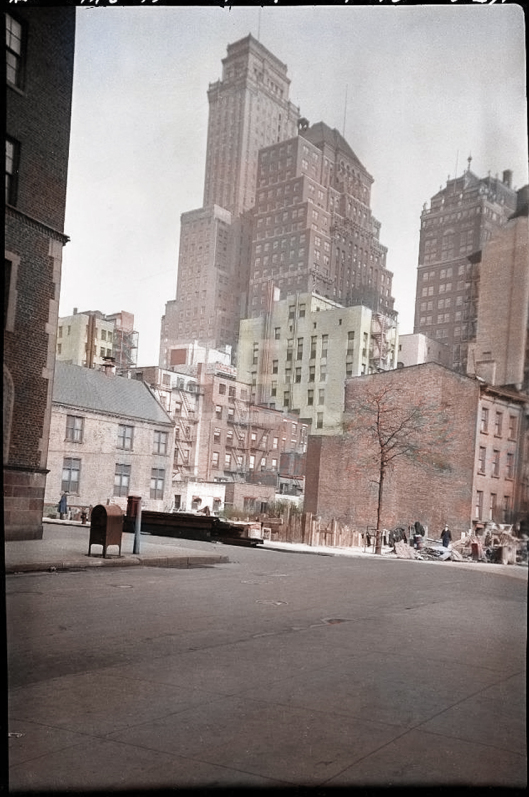
Thus he may have known the corner well, as he often walked down from his apartment and around the corner to eat in a Joralemon St. cafe. Joralemon St. goes both ways from the intersection, as you can see from the map below. Since the precise cafe location is currently unknown, then the direction in which he would have turned off Clinton St. is also unknown.
The photographer was Percy Loomis Sperr, and the date is 22nd February 1930. Which is only a few years after Lovecraft had left.
As for Lovecraft, the man seen walking into the right of the picture, or the man seen on the left contemplating the wasteground, both seem like close stand-ins for him (perhaps they’re Sperr’s bodyguards, which a cameraman with a valuable camera and tripod might need in Red Hook). Although by this date the master was safely back in Providence, and musing on the opening lines of “The Whisperer in Darkness”.
Here’s my useful map for future researchers in this part of Brooklyn. I used Photoshop to combine four such maps, which show building-level numbering and street layout. It’s centred on Lovecraft’s 169 Clinton St. Bear in mind that it’s from 1884, so is only to be used for initial orientation. Specific details for your chosen time period will need to be confirmed by consulting later maps.
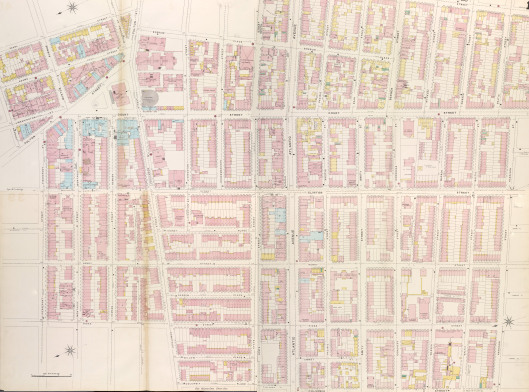
It seems that Clinton and Atlantic broadly formed the boundaries of what was then thought of as Red Hook. Which means Lovecraft was living right on its edge. Evidently it was not a salubrious edge. Lovecraft’s decrepit mouse-infested lodgings were noisy, smelly, and the apparently genteel Irish landlady quickly proved to be none too particular about who she took in as lodgers — an adjacent room harboured shifty youths who stole Lovecraft’s clothes and left him only what he was wearing.
Below Columbia St., seen along the very bottom of the map, the long waterfront of sailor-bars and wharfs and warehouses began and ran down for a few blocks before thrusting out into a series of ship-piers. Experts on the waterfront’s history say little online about the 1920s and 30s, but can say that until the public works of the mid to late 1930s there were still shantytowns, open scrubby land and undrained marshland along the waterfront. Eastern parts of Red Hook were also heavily dotted with “weedy undeveloped terrain” on 1924 aerial photography, and a Thomas Wolfe short story of 1936 (which concurs with Lovecraft’s description of Red Hook) would put this area at “Erie Basin”.
Searches of Google Books reveal that, back of this waterfront area, the built-up residential part of Red Hook seen on the above map mostly had a population of poor Italians from the south of Italy, split into dialect groups that had great difficulty comprehending each other. Red Hook also had some large, though possibly dwindling, Irish groups until the later 1930s. Further there were significant numbers of Syrians who were almost all Christians escaping persecution, according to the book An Ethnic and Racial History of New York City — although Lovecraft wasn’t to know that from listening to their “eldritch” music through the walls of his apartment. There were even a few old Norwegians and Finns (classed as “Swedish” in reports), left behind after earlier waves of immigration had left the area c. 1900-1910. Presumably many of these remainers were old sailors and this may especially interest some, in terms of Lovecraft having a Norwegian sailor be central to the plot of The Call of Cthulhu. Mixed in with Red Hook’s two majority populations of Italians and Irish were floating populations of active sailors on shore-leave from all over the world. There was a small permanent Caribbean population in Red Hook at 1920, perhaps families of sailors, and these may be the same as those noted in a 1927 report as being tiny colonies of Porto Ricans and black Brazilians. Mingling among the transient sailors were the many illegal arrivals, spurring occasional raids into Red Hook by the immigration authorities. In “Red Hook” Lovecraft thus appears to have got the demographics right, except that he substituted the Spanish (not yet in Red Hook, at that time) for the Irish. Presumably he made this change because his detective protagonist is Irish.
One academic has claimed in the New England Review that Lovecraft was right about there being Kurds in Brooklyn, the claim being based on the rather idle assumption that the modern Kurdish community has always been there. That is not the case. The current Kurdish community only arrived there in 1975 when the U.S. resettled 700 people. Brooklyn’s Kurdish Library was opened in 1989 and by the early 1990s there was a community of 2,000 (Encyclopaedia of New York City). Thus the modern community, centred on North Gowanus which is now Boerum Hill, cannot plausibly be ‘mapped back’ onto any Kurds Lovecraft might have encountered in Brooklyn in 1925. Indeed, Lovecraft correctly states in “Red Hook” that Gowanus was then home to a relic population of Norwegians. I can add that there had been a failed Sheikh Said rebellion of the Kurds in February-March 1925, and this might just have caused some richer Kurds to try to get to New York City. “The Horror at Red Hook” was written 1st-2nd-August 1925, and thus Lovecraft might had seen and felt a small but noticeable influx of exiled Kurds entering clandestinely into Brooklyn in May-June-July. But that is speculation, and I can find no confirmation of any newly-arrived Kurds in Brooklyn in 1925.
On the area S.T. Joshi remarks, in I Am Providence…
It [Red Hook] was then and still remains one of the most dismal slums in the entire metropolitan area. In the story Lovecraft describes it not inaccurately, although with a certain jaundiced tartness:
‘Red Hook is a maze of hybrid squalor near the ancient waterfront opposite Governor’s Island, with dirty highways climbing the hill from the wharves to that higher ground where the decayed lengths of Clinton and Court Streets lead off toward the Borough Hall. Its houses are mostly of brick, dating from the first quarter of the middle of the nineteenth century, and some of the obscurer alleys and byways have that alluring antique flavour which conventional reading leads us to call “Dickensian”.’
Lovecraft is, indeed, being a little charitable (at least as far as present-day conditions are concerned), for I do not know of any quaint alleys there now.
Photographs show large parts of Red Hook being erased by massive ‘housing projects’ (UK: ‘tower blocks’) in the late 1930s, so the alleys Lovecraft evoked may once have actually existed.

I’ve given the opening picture of Joralemon St. and Clinton St. a new light colorisation. Architectural record photographers such as Sperr tend to prefer very quiet times to make pictures, and we can thus assume that at other times this scene would have been alive with children, food-carts, vehicles, pedestrians, and other obstructions to making a record-picture. Here is a 1923 picture indicative of the sort of Italian/Irish New York street-corner life Lovecraft would have had to weave his way through to reach his cafe. Though one imagines that the affluent lady in the open chauffeur-driven car would have been a rare sight, in that part of New York…
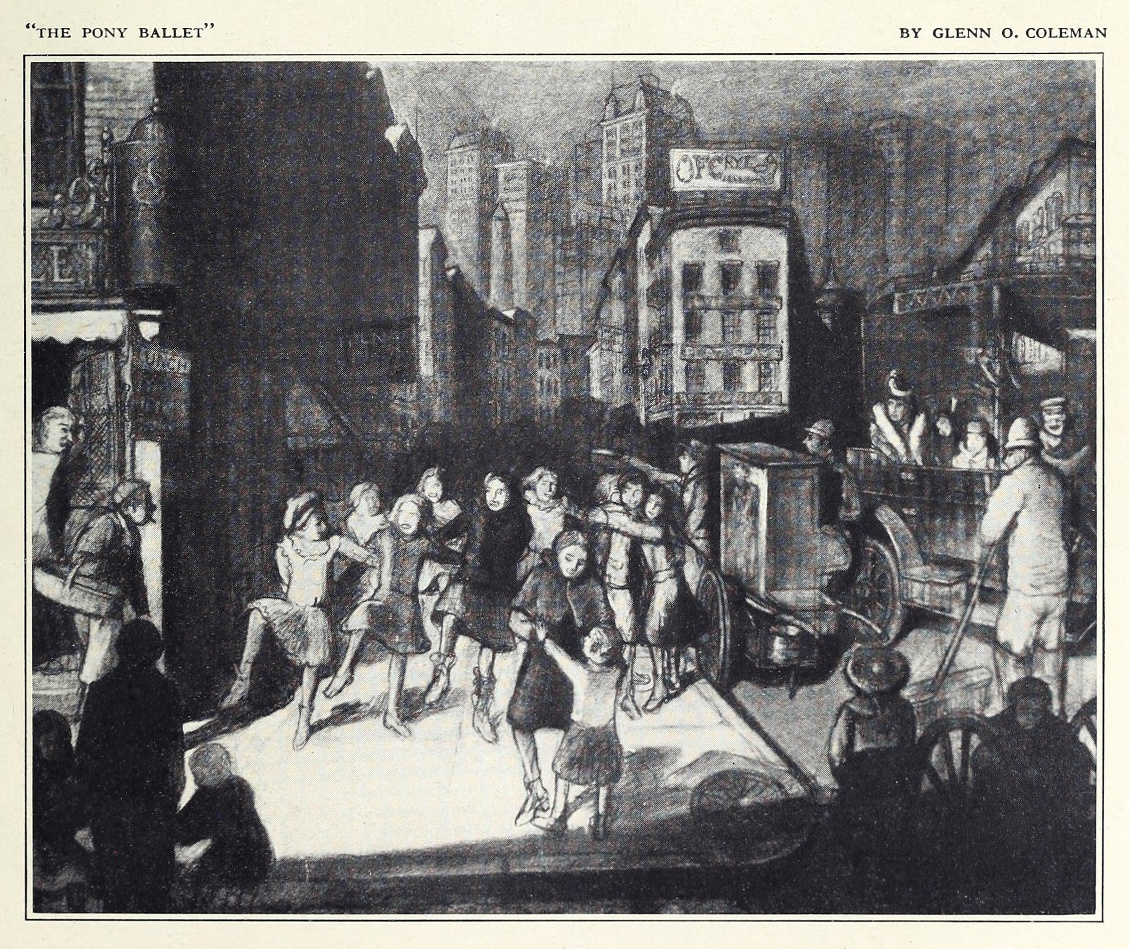
Picture: Glenn O. Coleman, “The Pony Ballet”. A pony ballet was a very high-kicking chorus-girl dance-line, presented on the stage by the younger dancers in a theatre troupe. It usually formed an interlude between acts at a variety theatre.
In terms of the appearance of the streets we should also take into account the extreme weather in New York City during Lovecraft’s time there, which would seasonally have radically changed the nature of the streets. Such as the worst snowstorm in living memory from 1st-3rd January 1925. Lovecraft had barely moved in to his “dismal hovel” at 169 Clinton Street, on 31st December according to the date I have, before the storm hit the city. Then a searing killer heatwave settled on the city in June of 1925. There was a similar but slightly less searing heatwave in July 1926, though by that time Lovecraft had left New York. Worse was to come, as can be seen from this EPA chart, but Lovecraft was able to enjoy these in far more comfort. Indeed, it might be said that without the 1929-37 heatwaves, he would not have lived as long as he did…

05 Wednesday Jun 2019
Posted in Historical context, Scholarly works
James Barton has a new investigation into Swamp Men and French Werewolves, in the Louisiana swamps that now form part of Lovecraft country.

Picture: Scary Louisiana swamp, from an old U.S. government publication on the trees of the swamps there.
04 Tuesday Jun 2019
Posted in Doyle, Historical context, REH
DMR has a developing series of short blog posts which introduce a set of “Forefathers of Sword and Sorcery”. The latest up for consideration, Arthur Conan Doyle. I must say I’d never even considered him as an influence on R.E. Howard, except in the vaguest way.
In addition to enjoying his Holmes stories, Doyle is also interesting to me for being another of the great names who have Birmingham and Staffordshire connections, alongside Wells, Tolkien, Borges and the Gawain-poet. For instance, I’ve reviewed Sherlock Holmes in the Midlands, which is the book you want if you’re interested in that topic or decide the take a literary touring holiday in Birmingham, Staffordshire and out into the neighbouring Welsh Marches.
Until reading DRM’s post I’d always thought of Doyle in terms of the always-re-readable Sherlock Holmes + some Edwardian horror stories. Even the fairy-world spiritualism of his dotage is of interest, because it tells one something about the pits of fraudulent charlatanry that opened up as religion faded, and how these could swallow up even highly intelligent people. This then reflects on the paths available to the early Wells, the young Tolkien, Kipling, Lovecraft and others, re: the cultural terrain they were navigating.
I must admit that I’ve never once encountered Doyle’s Professor Challenger adventure books, which DMR mentions, nor the various adventure and historical novels which the Doyle bibliography reveals. Professor Challenger is three novels, and two stories, apparently. Ho hum, yet another set of books to get around to… eventually! Ideally when a full-cast unabridged audiobook of such appears, and perhaps with Phil Dragash-like levels of avoidance of modern cynicism and hipster overtones in its vocal delivery.
03 Monday Jun 2019
Posted in Historical context, New books, Scholarly works
I’ve found an open access PhD thesis titled Prophets of Decline (2003), which has two chapters relevant to understanding the historical context for Lovecraft’s reception of Spengler in the America of the later 1920s…

Once returned to Providence…
Lovecraft began in the late 1920s to develop his notions of the decline of the West — notions that his reading of Oswald Spengler’s great work on the subject only helped to clarify and develop. (S.T. Joshi, I Am Providence).
From a Lovecraft letter of 1926…
Recently I saw a review of Spengler’s ‘Decline of the West’ — which will make splendid discussion-matter with Mortonius [James Morton]. Did you see it — in the New York Post?
This must be the front-page review by the anti-communist John Cournos, “Is Our Civilization Doomed? No Chance Of Survival — Says Spengler” The New York Post Literary Review supplement, 29th May 1926. (Now un-findable online, and it seems there’s no microfilm of this title at libraries before 1934?).
The Prophets of Decline thesis thus offers what are effectively two ‘free bonus’ appendices, in a digestible thirty pages, for readers of S.T. Joshi’s book on Lovecraft’s intellectual life The Decline of the West (now a very affordable and cleanly formatted ebook on Amazon). The chapters are quite dense and have some typos, but are admirably concise and focused. They outline Spengler’s initial reception in America, and then the changed perceptions there of Spengler in the 1930s — as the civil war within socialism raged and both communism and fascism twisted the ways he was portrayed and understood. Part of the problem on the right was that Spengler did not endorse Hitler. He had also supported those purged in 1934, and because of this was subject to a campaign of vilification by the Nazi Party.
As for the rest of the thesis it tells the larger story of the reception by journalists and intellectuals of the alarmist doom-mongers of 1896-1961, and as such provides useful background for better understanding the doom-mongers of the 1970s and 80s.
02 Sunday Jun 2019
Posted in Historical context
In the latest University Bookman, Stephen Schmalhofer takes a trip “From New York to Chartres with La Farge” and examines this macabre Providence artist’s later stained-glass work and his influence on other creatives of his time.
Adams came to understand that gothic architecture was not gloomy. “The necessity for light was the motive of the gothic architects,” he writes of Chartres. “They needed light and always more light, until they sacrificed safety and common-sense in trying to get it.” Cortissoz observes that La Farge’s art contained “little knots of form, meant to hold color in solution; cunningly wrought webs in which to imprison light” and his windows were “curtains of jewels hung between us and the light, pieces of some new kind of luminous poetry.”
I’d previously noted the early print illustration work of this Providence artist, in my post on “A macabre Providence artist”. There I observed that Lovecraft’s discovery of him had coincided with the writing of “The Rats in the Walls”.

01 Saturday Jun 2019
Posted in Astronomy, Historical context
A new photograph of the interior of the Ladd Observatory, a place which Lovecraft knew very well. The camera looks between rooms and across a corridor, and thus into the tiny Clock Vault room. The need for a sealed room, constant temperature, and thick insulation for this room might remind one of Lovecraft’s story “Cool Air”.

From the same blog, even more Lovecraftian is a 1930s picture of the chemical battery cells that powered the Observatory’s telegraph system…

01 Saturday Jun 2019
Posted in Historical context
Newly up for sale, a short letter / postcard from Lovecraft in his Dream-Quest of Unknown Kadath period. The description is from bookseller James Cummins, and states…
The first paragraph of this note was published in the Arkham House collected correspondence and in Joshi & Schultz [i.e. the Letters books]; the second paragraph has remained unpublished until now.

From this second “unpublished” paragraph we learn that writing a work of Kadath‘s length proved to be slow-going, and was not (as some might have assumed) the rapid and enjoyable dashing-off of a free-wheeling draft. We also see how Lovecraft preferred to work on one tale at a time, and felt he had to get Kadath out of the way in order to do something else. Lovecraft finishes by mentioning that he’s discovered a new artist of the weird, but doesn’t name him. Though there appears to be some miniscule writing inserted above, which might be the name?
I also like Lovecraft’s description of a story as a “hair-raiser deluxe!”
Perhaps just as interesting is what appears to be Lovecraft’s fingerprint in blood, which raises the possibility of chemical analysis of Lovecraft’s blood. I assume that advanced 21st century forensics could achieve something with it, even at this great distance in time. Though perhaps not as much as some would like — such as resurrection via a cloned baby Lovecraft, etc.
31 Friday May 2019
Posted in Astronomy, Guest posts, Historical context, Scholarly works
Horace Smith had kindly posted the following as a comment on this blog. But I think I’d rather present it as a Guest post, which does his work justice. So, here is his investigation…
John Edwards of the Ladd Observatory at Brown — Cockney or Cornishman?
By Horace Smith.
I’ve been researching H.P. Lovecraft’s early astronomical interests. Tentaclii had at one point briefly puzzled over Lovecraft’s calling the Ladd Observatory assistant, John Edwards, a Cockney in one letter and a Cornishman in another. If what I have found is right, he was neither by birth.
 Picture: the Ladd Observatory as it appeared in the mid to late 1930s. Newly shadow-lifted and colourised.
Of the three staff members of the Ladd Observatory, whom Lovecraft “pestered half-to-death” in his youth, the observatory assistant John Edwards provided the greatest practical aid to Lovecraft’s astronomical endeavours. Whether it was offering a diagonal eyepiece for his telescope, lantern slides for a lecture, or a lens for a camera, Edwards was there to help. But, aside from being an assistant at the Ladd Observatory, who was John Edwards? In different letters, Lovecraft alternatively referred to him as a cockney, a term traditionally applied to someone from East London, and a Cornishman from Cornwall. Could I pin down which, if either, was correct?
Tracing genealogical connections can be tricky, and not everything you read online can be trusted. I knew when I began only that Edwards had worked at the Ladd Observatory in the late 1890s and early 1900s, but I didn’t know his middle name, nor when he was born, nor where, except that England was a good bet for his birthplace. I turned to Ancestry.com and FamilySearch.org to progress further.
The federal census for 1910 gave me a middle initial, W, and a spouse, Mary A. It also provided a birth date of around 1858 and an immigration date of 1887. In 1915, Edwards accepted his former colleague Frederick Slocum’s offer of a position at Wesleyan University’s new Van Vleck Observatory in Middletown, Connecticut. When Edwards took up that position, the Wesleyan University Bulletin printed his full name: John William Edwards. Alas, his stay at Wesleyan was not long, for he died of heart disease three years later, on 24th April 1918.
 Picture: Wesleyan University Bulletin for May 1918.
The Hartford Courant newspaper for 28th April 1918, informed me that, after Edwards’s death, his body was taken to Attleboro, Massachusetts, for burial. Why Attleboro?
‘Find a Grave’ led me to a photograph of the tombstone of John and Mary in Attleboro. It carried their birth and death years (1858-1918 for John and 1856-1917 for Mary) and those of two of their children, Joseph (1882-1901) and May (1891-1891). The 1910 census had already told me that, by 1910, two of their three children had died, and the gravestone and census were thus consistent. The son still living in 1910 was Alban Edwards, born in Lonsdale, Rhode Island, in 1888. His First World War draft card showed that it was he who resided in Attleboro. Massachusetts death records confirmed that Mary Ann Edwards had died in North Attleboro in 1917, the year before her husband’s passing. Now the burial of John and his wife in Attleboro made sense. The gravestone also gave me Robinson as Mary’s maiden name.
With that information, could I trace the family back to England? I checked immigration records, finding one likely match: the arrival from Liverpool of a John Edwards with Mary A. Edwards and Joseph Edwards, all of the right ages, at the port of Boston aboard the Catalonia on the 1st of October 1887. They were lower steerage passengers, and John was labelled a labourer. I next came up with a marriage record for a John Edwards and a Mary Ann Robinson on 12th April 1879, at Christ Church in Preston, Lancashire, with the birth years of 1858 for John and 1857 for Mary. That seemed quite close and, if correct, gave me Peter Edwards as John’s father and an association with Lancashire. Was there additional evidence for a Lancashire connection? A John William Edwards was christened on 4th April 1858, at Saint John Church in Preston, Lancashire. John William Edwards was also listed as having been born in Preston sometime in the first quarter of 1858. If not a certainty, there is at least some likelihood that he was the future assistant at the Ladd Observatory.
Everything was hanging together, so far. But John Edwards is a common name. Could I find any evidence that contradicted the above? I did find one document that didn’t fit. The 1900 U.S. Census showed a John Edwards who was an astronomer’s assistant, who lived on Doyle Avenue, near the Ladd Observatory, who was the right age, and who arrived in the United States 12 years earlier in 1888 — not far off the late 1887 date found above. The census’s March, 1858, birth date is consistent with an early April christening. However, the 1900 census stated that John was single! Where were Mary and Alban? Was that just a mistake? Or did it indicate some sort of otherwise hidden family problem?
I checked the 1900 census for a Mary A. Edwards. Mary Edwards is a common name, but I couldn’t find a Mary Edwards that seemed to fit the bill in terms of age, birthplace, spouse, etc. Nor was there any mention of an Alban Edwards. To try to straighten things out, I turned to the Providence city directories. The 1901 and 1903 directories showed John living at two different Doyle Avenue addresses. They also showed that a Mrs. Mary A Edwards worked as a nurse and lived at 67 Manton Avenue in Providence, but later directories show that she was not the Mary Edwards for whom I was looking. Many women who were not heads of a household or employees do not appear to be listed within the directories, so the absence of Mary is not necessarily telling. For example, John W. Edward’s address in the 1910 city directory is consistent with his 1910 census address, However, the 1910 directory makes no mention of Mary, while the 1910 census indicates she was living with John at that address.
Fortunately, Rhode Island carried out state censuses in between the federal ones. I discovered a 1905 Rhode Island state census for a John W. Edwards, living on Doyle Avenue, of the right age — his birth date is given as 4th March 1858 — and working at the Ladd Observatory, with a mother and father born in England. Those last items are incorrectly indexed on the transcribed version of the census, but are clear in the original. However, in that census, Edwards is listed as married not single, with four in the household. There is also a census entry for Mary A. Edwards at the same address — her birth date is indexed as 18th April, 1856, but the original pencilled entry is hard to read. Mary was then a mother of three, only one of whom was still living, and with a household again containing four people.
My conclusion is that the weight of the evidence indicates that it is the 1900 census entry which is in error. Perhaps the circumstance of their son Joseph having died the following year somehow temporarily disrupted living arrangements? Or perhaps “the census-taker’s knock” awakened John after a night of observing and he just wanted to get back to bed as quickly as possible! If all this is indeed correct, we conclude that John Edwards was English, but neither a cockney nor a Cornishman.
31 Friday May 2019
Posted in Historical context, Picture postals
Here we see a fine example of an early silent cinema in Providence, The Star Theatre, with its staff and there is even a glimpse of an adjacent fortune-telling caravan.

Local trade journals state this cinema was established 1899, and the cinema history book Silent Film Sound (2007) states that in 1915 the Star in Providence advertised a “New York two dollar show” at “local prices” and that this advert also promised a full orchestral accompaniment for the big movie The Birth of a Nation (1915) — which we know Lovecraft saw in Providence. One wonders if the lads in the centre of the picture served as the orchestra members, and presumably the children worked part-time as ushers, ticket-booth girls, sweepers, bill-posters and the like. There then being little prohibition on child-labour. What appears to be a fortune-telling caravan at the side is also rather remarkable, and media archaeologists may note it as another example of the close association of early cinema with the superstitious and uncanny.
The picture is undated but might be the early years of the 1910s. At this time Lovecraft was in his early 20s and still an avid cinema-goer. Lovecraft said in 1919, in a letter to Galpin…
“I formerly attended the cinema quite frequently, but it is beginning to bore me.”
He would thus have been familiar with this sort of cinema in the 1910s, if not with the Star especially (so far as I know). But, given the information above, there is a possibility that it was here he saw The Birth of a Nation.
The silver screens were not always flickering with Chaplin-esque comedians and melodramatic waifs and thundering cavalry, as nearby Pawtucket had long had a Governor-sponsored programme of educational cinema, on which Lovecraft’s friend and associate Dench commented favourably in his book Motion Picture Education (1917). Interpreters presented a five-minute summary of the scenario and inter-titles, before each silent picture, for audience members who did not yet read English. This was at the grander baroque 1,500-seat Pawtucket Star Theater, which seems to have been involved from the start in the push for educative cinema in Rhode Island. It’s not to be confused with the Providence Star.
The Star’s “Nov 2nd” posters, seen in the picture, proclaim that a “Japanese Troupe” was the vaudeville act during that week. Their name is difficult to read but appears twice and must be Azuma, implying they were Kabuki dancers and performers. Incidentally, a Japanese star was one of Lovecraft’s two favourite actors on the silent screen, the young Sessue Hayakawa. This raises the slightly surreal vision of the staunch Anglophile editor of The Conservative sitting in his seat waiting for a Sessue Hayakawa movie to start, being first entertained by a lively Japanese Kabuki troupe in full costume…

He was after all “prodigiously keen” on such things, as he wrote in a letter…
My admiration of Japanese art — dating from the days when my infant eyes rested upon various screens, fans, & bits of pottery at the old home – has always been prodigiously keen, & this stationery embodies some of its most attractive characteristics. The combination of utter simplicity, perfect harmony, & civilised repose is quite irresistible – & forms something which could never be duplicated [by cultures] outside Japan. The Japanese carry the spirit of art into the smallest details of life more fully than any other people since the Greeks – & it will be an irreparable loss if their newer generations lose the old spirit in an effort to assimilate western traditions.
Here’s the original picture scan without colorisation…

The card’s “early divided back” apparently dates it to 1907-1915. It’s currently for sale on eBay at an exorbitant price and will probably be re-listed after failing to sell.
