• About
  • Directory
  • Free stuff
  • Lovecraft for beginners
  • My Books
  • Open Lovecraft
  • Reviews
  • Travel Posters
  • SALTES

Tentaclii

~ News & scholarship on H.P. Lovecraft

Tentaclii

Category Archives: Historical context

Irvin Binkin meets H.P. Lovecraft

30 Sunday Jun 2019

Posted by asdjfdlkf in Historical context, Odd scratchings

≈ Leave a comment

Uploaded to Archive.org in February 2019, The Alien Critic #5 (May 1973). It has the article “Irvin Binkin meets H.P. Lovecraft”, by Jack Chalker, in which Chalker meets and hears from Binkin. Reprinted from Chalker’s ‘zine Viewpoint #1 (February 1973).

… he’s decided that owning the world’s largest collection of Lovecraft is better than collecting the huge sums he could sell it for (he’s already turned down $30,000).

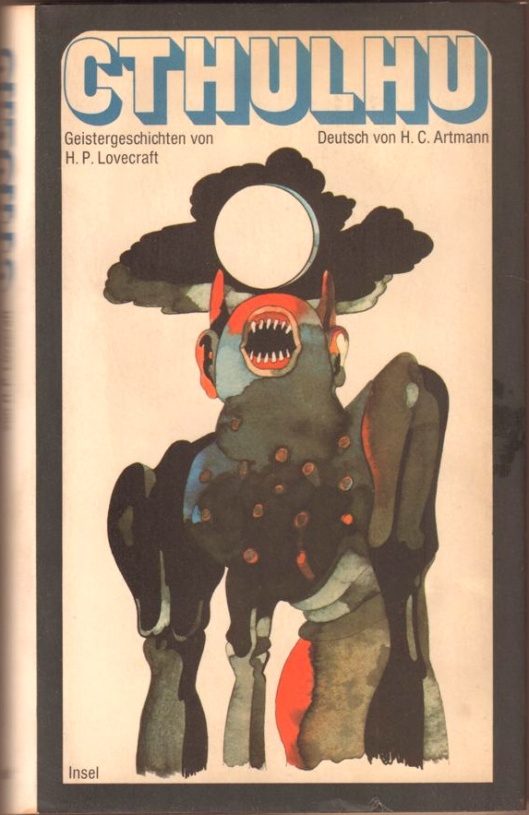
Ze German Cthulhu

29 Saturday Jun 2019

Posted by asdjfdlkf in Historical context, Lovecraftian arts

≈ 3 Comments

How Germany saw Cthulhu in 1968. Art by Heinz Edelmann. Is it meant to indicate the idol? Or perhaps “The Hound”?

Friday ‘picture postals’ from Lovecraft: The Copp’s Hill Burying Ground

28 Friday Jun 2019

Posted by asdjfdlkf in Historical context, Picture postals

≈ 1 Comment

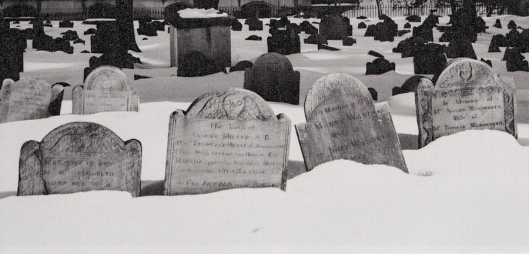
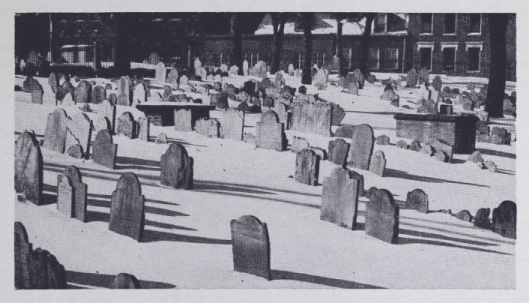
In early 1923 Lovecraft investigated the old North End of Boston and climbed up to the Copp’s Hill Burying Ground, est. 1659—1825…

At present this part of the town is an Italian quarter of the most squalid sort … Thence I proceeded up the steps to that fascinating necropolis the Copp’s Hill Burying Ground. This latter spot hath for me a singular fascination … Here are interr’d some of the most illustrious Colonial dead of the Province, including the Mathers, who are interesting to me from my possession of Cotton Mather’s “Magnalia Christi Americana”. But the chief charm of the scene is in the entire broad effect; the bleak hilltop with its horizon of leaden sky, harbour masts, and Colonial roofs. Over the sod was a thin coat of snow, thro’ which the slabs peer’d grimly whilst black leafless trees claw’d at a sinister lowering sky. … As I beheld the black slate slabs rising ghoulishly above the snow, & cast my glance about at the adjacent chimney-pots, it was difficult to realise that full two centuries have pass’d since the heyday of my particular aera. … In fancy I could conjure up the Boston of the late 17th century with its narrow, hilly, curving streets and quaint wooden and brick houses.

The above is a blend of two letters mentioning the same 1923 visit, one to Galpin and one to Kleiner. Lovecraft saw this old area just in time, as on a later visit in summer 1927 he was disappointed to find that large areas of the old town had been torn down and levelled.

A few years later Lovecraft would have Pickman paint a ghoulish scene here, in “Pickman’s Model”…

Gad, how that man could paint! There was a study called “Subway Accident”, in which a flock of the vile things were clambering up from some unknown catacomb through a crack in the floor of the Boylston Street subway and attacking a crowd of people on the platform. Another shewed a dance on Copp’s Hill among the tombs with the background of today. Then there were any number of cellar views, with monsters creeping in through holes and rifts in the masonry and grinning as they squatted behind barrels or furnaces and waited for their first victim to descend the stairs.


Above we see the side of the Copp’s Hill Burying Ground on the left of the pictures, with the street much as Lovecraft would have encountered it, perhaps photographed in the late 1910s and early 1920s. Even on a winter’s day Lovecraft encountered a small crowd of such urchins outside the Burying Ground, perhaps alerted by others who had seen him climbing through the squalid Italian quarter and up the hill — their juvenile trade was to spout some memorised historical doggerel to many visiting antiquarians and historians, and then demand coins for their ‘services’…

a horde of ragged little ciceroni who surrounded me & blocked my feet whilst spouting history in lifeless, mechanical voices. It was worth a handful of farthings to be rid of these small highwaymen, whose desire to instruct the traveller is not unmixt with a craving after sweetmeats.

It sounds like some of them may have been satisfied with candy from a bag Lovecraft had brought with him. He also always carried a small bag of cat-attracting catnip on such trips.

The Arthurian Lovecraft

24 Monday Jun 2019

Posted by asdjfdlkf in Historical context, Scholarly works

≈ Leave a comment

There was an “Armitage Handout on Lovecraftian Arthuriana” at the scholarly symposium at NecronomiCon 2017. Basically, a preliminary but useful list of King Arthur work which elides in some way with Lovecraft.

This has now been revised and updated as “Mergers of the Matter of Britain and Lovecraft’s Cthulhuan Mythos: A Preliminary Bibliography (Revised)” (May 2019), which is online and public.

Picture: Merlin, by a young Howard Pyle.

Friday ‘picture postals’ from Lovecraft: the Cloisters, NYC

21 Friday Jun 2019

Posted by asdjfdlkf in Historical context, New discoveries, Picture postals

≈ 1 Comment

H. P. Lovecraft once wrote to Galpin in 1934…

How are the “yarbs” [medieval-style herb garden] coming along? I enclose something about a similar enterprise. These old cloisters are very familiar to me — indeed, Belnape, Mortonius, & I visited them for the first time not long after our memorable Cleveland sessions of ’22..

Here he alludes to a remarkable architectural assemblage of medieval art in Manhattan. The “Barnard Cloister” had opened to the public in 1914, and was a poetic presentation in a large church-like structure with landscape setting. Attendants were garbed in the habits of medieval monks. This unusual architectural museum then expanded its content in 1926, when taken over by New York’s Met museum. In circa 1927/28 the Met then began to plan a new and larger museum a little further north along the hill, and their new building only finally formally opened in 1938 after Lovecraft’s death. The Met’s new Cloisters presented the collection with a coherent scholarly and curatorial rigour. The place is still open today and a major tourist attraction.

Period map showing subway station for the Cloisters.

The 1938 Cloisters in its landscape context, January 1961, beside the frozen river with ice-floes and with modern housing projects clustering around its forest park. The original Cloisters seems to have been just off the left of the picture, on the same ridge.

Lovecraft’s initial Autumn (Fall) 1922 visit would thus have been to the 1914 Cloisters. Free entry encouraged visits from the Lovecraft Circle despite the very long and tedious subway ride under Manhattan. Lovecraft’s first visit was with a day there with Sonia in 1922, but another was vividly recalled by Frank Belknap Long in his Lovecraft memoir, albeit a memoir written some fifty years later. Long has it that he, Morton and Lovecraft approached the Cloisters in the gloaming dusk, presumably hoping for a night-time candle-light tour perhaps around Halloween-time. It was only in winter that the museum closed at dusk. The group were rather startled to see old crones in black ‘hats’, using giant witch’s besom-brooms to sweep the darkling paths of the wooded grounds…

… we approached over a narrow, winding footpath we were instantly struck by the long and chilling shadows which the trees were casting in the deepening dusk. Then we saw — the witches. Three bent and fragile-looking women, unmistakably well advanced in years, were sweeping up the fallen leaves surrounding the Cloisters with long-handled brooms. There was a twilight glimmer at their backs, and they were wearing what at least from a distance looked like jet-black, conically tapering hats.

12th century doors, a working doorway at The Cloisters.

[Inside…] It was just as impressive as any similar shrine in Europe, with goblin tapestries and illuminated manuscripts vying in interior splendor with wood-carved figures, gilded or unadorned, dating back to the Middle Ages. For the most part the figures were angelic in aspect, but a few were chillingly demoniac with gargoyled features.

Archival material reveals that there were special candlelight evenings at the 1914 Cloisters, and one assumes that it one of these that spurred Lovecraft’s 1922 visit. Regrettably Long’s memoir can’t inform us on that point, as he recalled only the time of day, the forest, the ‘witches’, and the general nature of the exhibits. But evidently there were candle-light nights for the public, and here we see a photograph of one such at the 1914 Cloisters…

Here are some of the more grotesque carvings Lovecraft would have been especially pleased to spot on his visits, as the Cloisters became “very familiar” to him…

While an elevated roof-garden and children-friendly ‘unicorn tapestry’ galleries were added for the 1938 opening of the new building, Lovecraft may have seen early medieval wall murals such as this. Note the figures below the dragon…

There were also illuminated manuscripts at the 1914 Cloisters, because one of the ‘witch’ crones seen by Lovecraft turned out to be the keeper of the illuminated manuscripts. She and her companions wore the habits of the museum attendants. Their ‘black hats’ proved to be old stockings worn over the hair to keep out dust, twigs and insects, while sweeping dry leaves with the giant brooms.

Lovecraft’s 1925 Diary also records a later visit on the evening of June 27th, after he had spent the afternoon exploring Inwood near Long Beach. At this point in time the Met had taken over the 1914 Cloisters, but the new 1926 south wing was not yet open and the Rockefeller collection of religious figurative sculpture was not yet installed. Nor does it appear that the Met’s building work on the 1938 version of the Cloisters was underway by summer 1925.

The Met, having decided to build the new Cloisters, wanted to record the old Cloisters. One of the ways they chose to do this was a short and rather creaky cinema film, which was released in 1928 and is now on YouTube. In this we see something of the original Cloisters as Lovecraft would have known the place…

[youtube https://www.youtube.com/watch?v=8cH5T09cVd0?start=30&w=560&h=315]


Given his 1934 comment to Galpin that “These old cloisters are very familiar to me” we can assume other visits followed those of 1922 and 1925. Perhaps those with good access to Lovecraft’s letters can discover these dates, probably in the early 1930s, and also determine if Lovecraft later visited the (perhaps partly-built and partly-opened) ‘new’ Cloisters which formally opened in 1938. Though a few very scholarly sources say 1934, which may perhaps indicate a difference between a 1934 opening to the public and a 1938 ‘final official’ opening ceremony.


The Bernard Cloisters of New York were not the only cloisters Lovecraft experienced, as he also enjoyed those of Yale (forming from them some conception of the hushed quadrangles of the colleges of Oxford, in his beloved but never-visited England), and he also… “liked the cloistral hush of the Brown University campus, especially the inner quadrangle, where in the deserted twilight there seemed to brood the spirit of the dead generations.” (Lord of a Visible World). Yet, given the timings I’ve outlined above, it seems plausible to assume some influence of the 1914 Bernard Cloisters on elements of “The Lurking Fear” (written November 1922) and “The Rats in the Walls” (written August-September 1923).

This place and Lovecraft’s visits should remind us that Lovecraft was writing his most gothic work at the very tail end of the idea of the gloomy middle-ages. William Morris and Burne-Jones and others had of course done much to lift the idea of the medieval out of the mud, mostly in England, but it was not underpinned by the sort of heavy-duty scholarship needed to shift the idea of the medieval away from the old view of it. Even by the mid 1920s the consensus idea of the medieval in America was of a dark and rancid Church that hated industry and learning, and which shuffled the intelligent off into seclusion as shivering half-starved turnip-munching monks, mad sex-starved nuns, to be religious prisoners in dank dungeons, or (if they were lucky) they got to be ecclesiastic scholars who squabbled over religious trivialities such as the correct cut of a monk’s hair. There were no grand universities or thriving merchant towns, just dank castles lording it over lowly over-taxed peasants. There was no uniform set of traditions, sustained and nurtured across five centuries. There were no long distance trade or pilgrimage routes, no trade guilds, little law, no books and letters moving about Europe, and everyone was more or less stuck fast in their native clay speaking mutually incomprehensible dialects and languages. No-one could read and there was no cheap rush-lighting at night to read by anyway. There was no joyous art and music, yet at the same time people were emotionally incontinent, incapable of restraint. Dark Devilish heresy lurked behind every scraggly hedge, and an Inquisitor listened under every creaking bed. Kings and princes, if not completely mad religious zealots, were pompous, pig-ignorant and warlike.

That false view began to change with educative projects such as The Cloisters from 1914, and many other such efforts gathered steam in the USA by the mid 1920s, and thus we saw the first stirrings of a new and enlightened understanding of the medieval that the educated have today — though it can of course still be found in the gothic-horror vampire-and-werewolf end of popular culture. The counter-reaction may have gone too far, coming in the end to focus on and overly venerate the 12th and 13th centuries as a lost golden-age, but from that scholarly and literary over-correction came creative triumphs such as The Lord of the Rings and others which form the best works of high-fantasy.

Podcast: Subway fear

20 Thursday Jun 2019

Posted by asdjfdlkf in Historical context, Podcasts etc.

≈ Leave a comment

In the new Pessimists Archive podcast, each episode outlines a mass panic about new technologies or products — a panic that sooner or later proved to be unfounded.

Their The Subway episode seems relevant to Lovecraft and subways and similar tunnels. For instance in “Nyarlathotep” (1920) Lovecraft has… “Another [column of people] filed down a weed-choked subway entrance, howling with a laughter that was mad.”; Pickman paints a study called ‘Subway Accident’ featuring monsters climbing into the subway through a “crack in the floor” of the subway; and the climax of “At the Mountains of Madness” famously makes the comparison with a subway train. There was also Lovecraft’s general and growing dislike of subway travel when in New York, and then what appears to be his fear of using them by late 1925 / early 1926. One can also see broad comparisons between subways and the various other tunnel networks in his fiction.

For further reading, see my essays on “Lovecraft and the Subway” and the wider “It Emerged from the Subways! On the genesis of the monstrous under New York City”, in Walking With Cthulhu: H.P. Lovecraft as psychogeographer, New York City 1924-26.

Added to Open Lovecraft

17 Monday Jun 2019

Posted by asdjfdlkf in Historical context, Scholarly works

≈ Leave a comment

Newly added to my Open Lovecraft page, of public open access scholarship:

* G. Parkinson, “We Are Property: The ‘Great Invisibles’ Considered Alongside ‘Weird’ and Science Fiction in America, 1919–1943”, The Space Between: Literature and Culture, 1914-1945, Vol. 14, 2018. (Discusses the early reception of H.P. Lovecraft in France via VVV during 1942-43, and the possible influence on Andre Breton. Also the wider reception of U.S. pulp writers and Charles Fort in continental Europe).

* From The Vaults of Yoh-Vombis: An Important and Valuable Collection of Books by Clark Ashton Smith, Thompson Rare Books, Catalogue No. 50, Fall 2018. (Illustrated scholarly bookseller catalogue for a collection of CAS rarities).

* A.M. McGee, “Haitian Vodou and Voodoo: Imagined Religion and Popular Culture”, Studies in Religion, Vol. 41, 2012. (Opens with a very brief discussion of Lovecraft’s Call of Cthulhu and sees… “his work as a prototype for many later presentations of voodoo”. Appears to be unaware of Henry S. Whitehead’s influence on the pulp idea of voodoo).

Protected: The Plot Genie

16 Sunday Jun 2019

Posted by asdjfdlkf in Historical context, Odd scratchings

≈ Enter your password to view comments.

This content is password-protected. To view it, please enter the password below.

New CD: Sonnets of the Midnight Hours

15 Saturday Jun 2019

Posted by asdjfdlkf in Historical context, Odd scratchings, Podcasts etc.

≈ Leave a comment

News of the new Sonnets of the Midnight Hours, a Fedogan & Bremer audio CD. Graham Plowman provides the musical score, underpinning theatrical readings of a cycle of 47 poems from Donald Wandrei. Who H.P. Lovecraft held in very high regard, along with the artist brother Howard. The poems arise from circa-1927, with Wandrei under the influence of both Lovecraft and Clark Ashton Smith.

This is a type of fantastic that mixed both science and fantasy, and that was common with the Lovecraft circle. You don’t get this sort of imagery after the Campbellian science fiction take over in the late 1930s. … His sonnet cycle is what probably sent H. P. Lovecraft off to create the “Fungi from Yuggoth” cycle that started appearing in Weird Tales in September 1930. Robert E. Howard produced his “Sonnets out of Bedlam” probably influenced either by Wandrei or Lovecraft or both.

[Picture: Howard Wandrei’s cover band illustration (front) for a 1964 collection of his brother’s poems.]

For modern print, Sanctity and Sin: The Collected Poems And Prose Poems Of Donald Wandrei (2008) seems the book to get, and can still be had at an affordable price in paperback.

A Youth in Wayland Square

14 Friday Jun 2019

Posted by asdjfdlkf in Historical context, Odd scratchings

≈ Leave a comment

This weekend, the 39th Festival of Historic Houses of Providence, Rhode Island…

Sunday will appeal to horror fiction fans. The new guided walking tours will visit the birthplace and childhood neighborhood of writer H.P. Lovecraft. “We’ll also be doing a tour of Gladys Potter Park and tours of the Blackstone Conservation District to highlight the cultural landscape of the neighborhood: the origins, the history, how it’s evolved, what’s being done today to protect some of the great open spaces there,” adds Brent.

Booking.

Friday picture postals from Lovecraft: Fulton St. near Clinton St., Brooklyn.

14 Friday Jun 2019

Posted by asdjfdlkf in Historical context, New discoveries, Picture postals

≈ Leave a comment

Last week I looked at the corner of Joralemon St. and Clinton St., New York, which led me to look at the geography and demographics of Red Hook in the 1920s. Lovecraft got the demographics and mix of Red Hook right in his description of the place, except in one respect. Having an Irish protagonist in the story, he substituted “Spanish” for “Irish” in his opening description of the place and its people. According to my reading on Red Hook, there was to be a large Spanish-speaking population there, but that came later in time.

Following my look at Joralemon and Clinton St., here’s a ‘picture postal’ of another nearby scene which I’ve also newly colorised…
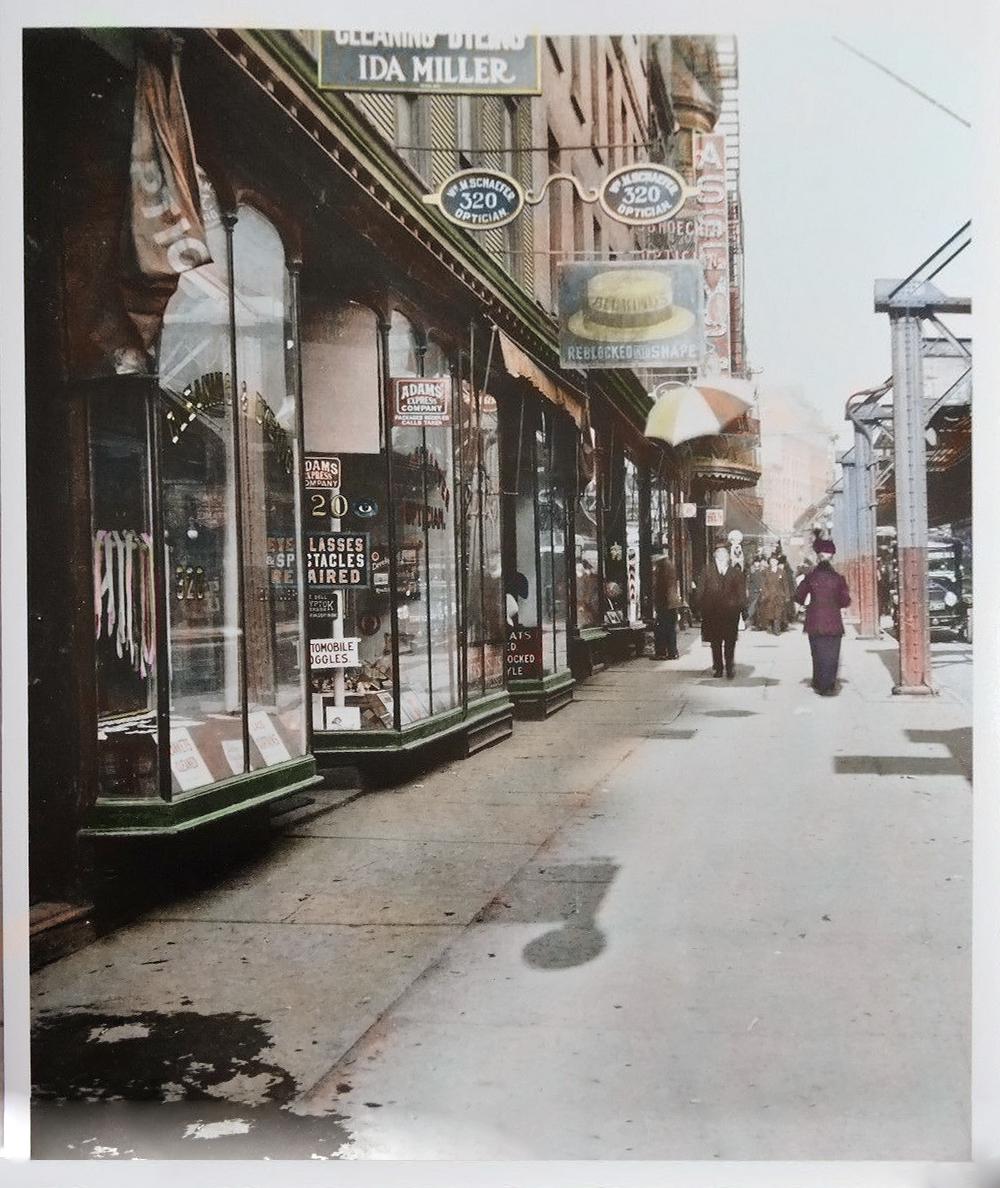
Again, we also see an evocative ‘H.P. Lovecraft stand-in’, this time as if walking toward the viewer. The man is not Lovecraft, but one could imagine he might be. We also see 320 and 322 Fulton Street on the left. This spot is thus close to Lovecraft’s dingy apartment on Clinton St., and the two points are marked on this extract from last week’s map…

The lady’s hat might date the picture some years earlier than the mid 1920s. One source says 1907, the other 1915. The scene here is one street over from the Montague Street technical and mercantile branch (1903) of the main Brooklyn Public Library, and I assume the Music Academy was still opposite this library (update, no it had burned down but there was an Art Club). This part of Fulton St. is obviously more salubrious than the adjacent Red Hook, despite the relative proximity to it. There’s a cleaners, an opticians, a hat-blocker, what seems to be an umbrella shop, a novelty shoe shop (according to Directories), the latter being next to “Asseys” (sp?). The “Asseys” sign and canopy might lead one to think it was a theatre or similar. But I can find no trace of such. Possibly it was a private club with large restaurant with dance-floor. Because there was a “Gentlemen’s Cafe and Grill Room” at 308 Fulton St. in 1910, with… “Accommodations for Balls, Banquets, Private Dining Parties and Lodges” and promising to provide the Royal Hungarian Orchestra. One has to wonder though, if this stretch of the street was quite so salubrious a place by 1925/26, given the way that the social status of New York neighbourhoods can rapidly shift over time. But one has to assume that the nearby Library continued to give the place a certain level and type of clientele, in the mid 1920s, which helped to maintain its standing.

The curious steel structure on the right of the picture is part of the famous and once much-loved elevated railway, “the El”. Lovecraft’s friend Rheinhart Kleiner celebrated Fulton Street and the El in this section of his Betjeman-esque poetic ditty “Brooklyn, My Brooklyn”…

   To hear the passing roar above
   Of elevated trains,
   That thrill me as they soar above
   Unnumbered marts and fanes.

   I’d miss the book so pleasingly
   Displayed on Fulton Street;
   The other wares that teasingly
   Remind of things to eat.

By book Kleiner presumably means a large bookshop shop-sign, hanging above the street and done in the shape of a book? In the photo above we see something similar in the shape of eye-glasses…

By fanes Kleiner indicates ‘temple or shrines’, and presumably the word is here used whimsically of the lunch eateries and soda palaces.

In one letter of 15th April 1929 Lovecraft talks of travelling into New York by rail on the… “elevated which I generally employ”, for a return visit. Here is a postcard and archive picture which shows the sort of elevated view he would have enjoyed along Fulton St. The second picture is a record-picture of the Elevated in the heart of Fulton St., Brooklyn, albeit from perhaps 20 years before Lovecraft’s time there.

Travelling in this manner is hugely enjoyable to the observant and keen-eyed type of person, provided one has a good window seat on the correct side of the carriage. One can thus become far more endeared to a place than otherwise, if one were only riding along in heavy traffic or trudging and dodging along at ground level on foot. Cities with elevated and double-decker transport are inherently more ‘likeable’ places.

Lovecraft’s good friend Frank Belknap Long also liked to browse an antiquarian shop on Fulton Street for curios, although (amazingly) it was Lovecraft who in 1922 had introduced Long to the second-hand bookshops of New York, not the other way around. Long went there at least once with Lovecraft…

[Roman coins and] baked-clay Roman lamps, and he [Lovecraft] once helped me pick out magnificent examples of both ‘coinage and lampage’ at an old-coin shop on Fulton Street.” (Dreamer on the Nightside)

Presumably this was the Brooklyn Fulton St., though it could have been its namesake over the river. That said, Long’s memory (of more than forty years prior) is not to be wholly relied on, and the store might even have been in some other street entirely. Scans of old coin-collector journals reveal the name of a well-respected curio and coin dealer dealer on Fulton St., but this name can lead me to no address or picture.

But the opening picture of this post is certainly of the Brooklyn Fulton St., the street in which Lovecraft successfully culminated his epic pursuit of a new suit at a cheap price after his clothes were stolen. That suit store was at 463 Fulton Street, Brooklyn, further up the street-numbering and around the bend from the spot pictured above. Lovecraft also patronised a restaurant off Fulton Street, this being sometimes visited by Lovecraft on Sundays for lunch. There were likely also some bookshops nearby, given the proximity of the technical and business Library, and more were coming — the bookshop of Isei Binkin at 252 Fulton Street may have been at that nearby address from 1932. This was the same Mr. Binkin of the amazing Grill/Binkin collection of Lovecraftania, which emerged in the early 1970s alongside Lovecraft’s reviving reputation.

Probably there are more mentions of ‘Fulton’ in print, but the two key books on Lovecraft in New York are not indexed to street-names. Once again I’m reminded that if one wanted to turbo-charge Lovecraft scholarship, a searchable database of all the letters would surely do that — even if it only supplied Google Books-like snippets in its search results. Surely such a thing would be fully crowd-funded within a day, if championed by Joshi and others?

But even without such a scholarly tool, I generally have the impression that the lower half of Fulton St. was ‘about’ something. It was about making the more aspiring people of this first great city of the modernity feel comfortable and easy, for a relatively-modest but fair price. Whether that was in affordable men’s accessories, cleaning and hat services, Sunday meals and soda/ice-cream palaces, or small items items such as spectacles, umbrellas, unusual shoes, cut-flowers, smoking pipes, and perhaps (later) books. In the upper half, as the streets rose into the 450s and 60s, the stores seemed to have become grander and there were several large and tall department stores.


I should note that there is another Fulton St. to be found just across the Brooklyn Bridge, passing through what is now the Financial District of New York. It was once connected to the Brooklyn Fulton St. by river ferries which had terminals at the foot of the famous Brooklyn Bridge. The ferry service seems to have been discontinued by the mid 1920s, thus severing the two streets. This means that when Lovecraft talks of visiting the Fulton St. Fish Market in a letter, he’s actually across the river and walking around the dockside at the foot of that other Fulton Street…

Some years ago Long and I attempted to explore the Fulton Fish Market section of New York — which is full of quaint scenes and buildings. I don’t know where I left the
lunch I had eaten an hour previously — for I was too dizzy to read the street signs! In the end I managed to stagger out of the stench without actually losing consciousness …” (letter of 1933, Selected Letters IV)

This brief mention implies that this daytime visit was hasty, yet according to Vrest Orton’s memoir of Lovecraft the area was a fairly frequent night-walk haunt of Lovecraft’s (see Lovecraft Remembered) in search of 18th century remains. Possibly the fish-smell was less so in the dead of night, when the boats were away and trawling and the disinfected warehouses awaiting their dawn-landed catch?

That Fulton St. appears to have subways rather than an “El” railway, and a subway entrance can be seen here in this 1933 picture…
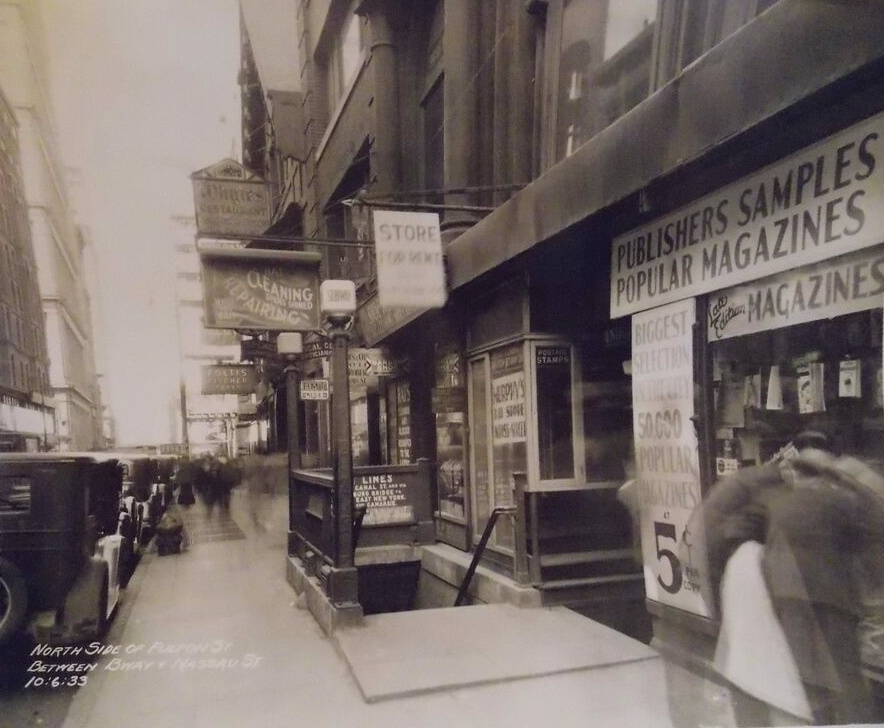
Since we know Lovecraft was also in this other street too, we might again imagine the picture’s scene shifted a few years in time. And that the men looking excitedly in the display-window resemble Lovecraft and Belknap Long — perhaps just hopped up from the subway to visit the “50,000 magazines store” — and seeing familiar names on the cover of a brand-new edition of Weird Tales.

The Borough Clothiers on Fulton St.

13 Thursday Jun 2019

Posted by asdjfdlkf in Historical context, New discoveries

≈ 2 Comments

Two new discoveries.

1) A photograph exists of the interior of the shop where Lovecraft culminated his epic hunt through New York, seeking a new affordable suit after his clothes were stolen. The date of the photograph is likely perfect, too.

A trade journal named The Clothier and Furnisher, seemingly in its 1925 volume, which has a long profile article on The Borough Clothiers store in Fulton Street, which was Lovecraft finally bagged his $25 suit. Hathi has a scan of three 1925/26 volumes, but these are on copyright lockdown for another few years and can’t be had even with a VPN.

Finally he seemed to come across just what he wanted—except that the coat only had two buttons. This was at the Borough Clothiers in Fulton Street in Brooklyn. Lovecraft was shrewd in dealing with the salesman: he said that he really wanted only a provisional suit until he could get a better one, therefore implying that he might buy another suit from the place later (not mentioning that it might be more than a year before he did so); the salesman, accordingly, consulted with a superior and showed him a more expensive suit but priced it at only $25. Lovecraft, putting the thing on, found that it “vastly delighted me,” but the absence of the third button gave him pause. He told the salesman to hold the suit while he checked more shops. The salesman told Lovecraft that it was unlikely he could get a better deal anywhere else, and after examinations of several more stores Lovecraft found that this was the case; he went back to Borough Clothiers and bought the suit for $25. (S.T. Joshi, I am Providence).

Perhaps someone with access to the archives of the New York libraries might be able to get a copy of the picture from the paper archives?

2) With some keyboard twiddling I managed to get the actual address from the Google Books copy, in a snippet:

the store operated under the name of The Borough Clothiers, at 463 Fulton Street, Brooklyn, is …

So far as I’m aware, this is the first time that scholars of Lovecraft’s life have known the actual address. A small point, yet it may lead to the emergence of a 1920s photo of the exterior as well as the interior.

← Older posts
Newer posts →


Please become my patron at www.patreon.com/davehaden to help this blog survive and thrive.

Or donate via PayPal — any amount is welcome! Donations total at Easter 2025, since 2015: $390.

Archives

  • March 2026
  • February 2026
  • January 2026
  • December 2025
  • November 2025
  • October 2025
  • September 2025
  • August 2025
  • July 2025
  • June 2025
  • May 2025
  • April 2025
  • March 2025
  • February 2025
  • January 2025
  • December 2024
  • November 2024
  • October 2024
  • September 2024
  • August 2024
  • July 2024
  • June 2024
  • May 2024
  • April 2024
  • March 2024
  • February 2024
  • January 2024
  • December 2023
  • November 2023
  • October 2023
  • September 2023
  • August 2023
  • July 2023
  • June 2023
  • May 2023
  • April 2023
  • March 2023
  • February 2023
  • January 2023
  • December 2022
  • November 2022
  • October 2022
  • September 2022
  • August 2022
  • July 2022
  • June 2022
  • May 2022
  • April 2022
  • March 2022
  • February 2022
  • January 2022
  • December 2021
  • November 2021
  • October 2021
  • September 2021
  • August 2021
  • July 2021
  • June 2021
  • May 2021
  • April 2021
  • March 2021
  • February 2021
  • January 2021
  • December 2020
  • November 2020
  • October 2020
  • September 2020
  • August 2020
  • July 2020
  • June 2020
  • May 2020
  • April 2020
  • March 2020
  • February 2020
  • January 2020
  • December 2019
  • November 2019
  • October 2019
  • September 2019
  • August 2019
  • July 2019
  • June 2019
  • May 2019
  • April 2019
  • March 2019
  • February 2019
  • January 2019
  • December 2018
  • November 2018
  • October 2018
  • September 2018
  • August 2018
  • August 2015
  • July 2015
  • April 2015
  • March 2015
  • February 2015
  • January 2015
  • December 2014
  • November 2014
  • October 2014
  • September 2014
  • August 2014
  • July 2014
  • June 2014
  • May 2014
  • March 2014
  • February 2014
  • January 2014
  • December 2013
  • November 2013
  • October 2013
  • September 2013
  • August 2013
  • July 2013
  • June 2013
  • May 2013
  • April 2013
  • March 2013
  • February 2013
  • January 2013
  • December 2012
  • November 2012
  • October 2012
  • September 2012
  • August 2012
  • July 2012
  • June 2012
  • May 2012
  • April 2012
  • March 2012
  • February 2012
  • January 2012
  • December 2011
  • November 2011
  • October 2011
  • September 2011
  • August 2011
  • July 2011
  • June 2011
  • May 2011
  • April 2011
  • March 2011
  • February 2011
  • January 2011
  • December 2010
  • November 2010
  • October 2010
  • September 2010
  • August 2010
  • July 2010

Categories

  • 3D (14)
  • AI (70)
  • Astronomy (70)
  • Censorship (14)
  • de Camp (7)
  • Doyle (7)
  • Films & trailers (101)
  • Fonts (9)
  • Guest posts (2)
  • Historical context (1,096)
  • Housekeeping (91)
  • HPLinks (77)
  • Kipling (11)
  • Kittee Tuesday (92)
  • Lovecraft as character (58)
  • Lovecraftian arts (1,628)
  • Lovecraftian places (19)
  • Maps (70)
  • NecronomiCon 2013 (40)
  • NecronomiCon 2015 (22)
  • New books (966)
  • New discoveries (165)
  • Night in Providence (17)
  • Odd scratchings (984)
  • Picture postals (276)
  • Podcasts etc. (431)
  • REH (184)
  • Scholarly works (1,470)
  • Summer School (31)
  • Unnamable (87)

Get this blog in your newsreader:
 
RSS Feed — Posts
RSS Feed — Comments

H.P. Lovecraft's Poster Collection - 17 retro travel posters for $18. Print ready, and available to buy — the proceeds help to support the work of Tentaclii.

Proudly powered by WordPress Theme: Chateau by Ignacio Ricci.