• About
  • Directory
  • Free stuff
  • Lovecraft for beginners
  • My Books
  • Open Lovecraft
  • Reviews
  • Travel Posters
  • SALTES

Tentaclii

~ News & scholarship on H.P. Lovecraft

Tentaclii

Category Archives: Historical context

The Fossil (July 2020)

03 Monday Aug 2020

Posted by asdjfdlkf in Historical context, Scholarly works

≈ Leave a comment

Thanks to Ken Faig Jr. for telling me that there’s a new July 2020 edition of The Fossil, journal of the Historians of Amateur Journalism. This is freely available online.

There are two items of Lovecraftian material in the issue. David Goudsward offers “A Postscript to Myrta Little” in which he explains some of the context for Lovecraft’s apparent love poem “To Phillis”. This article might have perhaps been a touch longer, and also briefly considered Lovecraft’s sonnet to Whitehead’s young friend & guest Allan Grayson.

The main article is the biographical “A Memory of Andrew Francis Lockhart”…

“an early acquaintance of H.P. Lovecraft who is mainly known in literary circles for having written the first article about the famous horror writer.”

Lockhart was an ardently anti-liquor man and was admired by Lovecraft for his tussles with local rum-runners, and well as for his poetic and amateur endeavours. Lockhart was the subject of Lovecraft’s poem “To Mr. Lockhart, on His Poetry”, aka “To A.F. Lockhard”, and is enshrined in the travel account “Little Journeys to the Homes of Prominent Amateurs: II. Andrew Francis Lockhart”. The latter is available as a reading on Librivox.

Lovecraft in Florida

01 Saturday Aug 2020

Posted by asdjfdlkf in Historical context, New books, Podcasts etc.

≈ Leave a comment

The paranormalist ‘X’ Zone Radio Show podcast interviews Lovecraftian David Goudsward…

his next publications will include H. P. Lovecraft in Florida (Bold Venture Press), Horror Guide to Southern New England (Post Mortem Press) and Sun, Sand, and Sea Serpents: A History of Florida Sea Monster Sightings.

New book: The Fortean Influence on Science Fiction

31 Friday Jul 2020

Posted by asdjfdlkf in Historical context, New books

≈ Leave a comment

The McFarland book list for Fall 2020 is now available. I got as far as spotting The Fortean Influence on Science Fiction, and had to give up on trying to use their painfully slow interactive-flipbook catalogue. It appears that there’s no alternative list. Lesson: if you want to reach media editors, make it fast, and also make it available in a portable/offline format such as PDF.

‘Picture Postals’ from Lovecraft: the elephant at the Park

31 Friday Jul 2020

Posted by asdjfdlkf in Historical context, Picture postals

≈ Leave a comment

Continuing the vague ‘zoo’ theme (we had zebras two weeks ago), this week’s ‘picture postal’ from Lovecraft is of an elephant.

Lovecraft would often jokingly refer to the size of his own nose in letters, and compare it to that of the resident pachyderm at Roger Williams Park in Providence…

Note the proboscidian effect,” [meaning his own large nose, in his photograph of him made by Robert Barlow …] “my only local rival in that field being the elephant at Roger Williams Park.

The choice of word faintly indicates the tentacular, and it was used again as such in the story “Out of the Aeons”, said of the nameless creature glimpsed through the mummy’s eye…

Even now I cannot begin to suggest it with any words at my command. I might call it gigantic — tentacled — proboscidian — octopus-eyed …

For most of the city’s children the elephant inspired amazement and curiosity rather than horror. They had clubbed together to raise the funds to obtain and keep him for the city. His name was “Baby Roger”, and he appears to have arrived at the park as a baby elephant when Lovecraft was aged three. We can plausibly imagine that the infant Lovecraft was taken to see him several times, and the elephant’s trunk may well have been his first real encounter with the ‘living tentacular’.

Lovecraft’s barn

30 Thursday Jul 2020

Posted by asdjfdlkf in Historical context

≈ Leave a comment

Back in May I briefly mused on Lovecraft’s barn, where in 1934 he stored crates of the old 18th century books that he had grown up with and inherited.

In the Moe letters I’ve now come across another mention of this barn. It was located “about a mile away” from Barnes Street in 1930, and it then contained Lovecraft’s carbons for his pre-“Dagon” period of writing. This places the location approximately under this marked area…

This at least narrows the field, for those with access to barn-level street maps from the period. The ‘mile’ might be a little further in, if Lovecraft factored ‘wiggle-room’ into his walking distances.

One possible clue is that his younger aunt lived “about a mile away” from Barnes Street, before the move to 66 College Street. Her pre-1933 vicinity might be the best place to start looking for a barn.

It may also help to know that “Old Providence Barns” were catalogued and photographed by John Hutchins Cady in 1948.

This barn is to be differentiated from the substantial 1881 horse-stable at Lovecraft’s boyhood home, which he told Moe was being demolished in August 1931 (Letters to Maurice W. Moe, page 311). Though it must have had a hay-loft to store the winter horse feed, and one letter states that this stable was later used to store the books of a friend-of-the-family. One imagines that dry book-storage, located within a mile of Brown University, might have been in demand during that period.

“Cosmic Horror” considered

26 Sunday Jul 2020

Posted by asdjfdlkf in Historical context, Scholarly works

≈ Leave a comment

Bobby Derie considers “Cosmic Horror” (1945) by Dorothy Tilden Spoerl, an early item of Lovecraft criticism.

‘Picture Postals’ from Lovecraft: Henry J. Peck

24 Friday Jul 2020

Posted by asdjfdlkf in Historical context, Picture postals

≈ 1 Comment

In December 1928 Lovecraft wrote to his schoolteacher friend and correspondent Moe…


   “I have come upon an altogether unsuspected country lane which winds up the ancient hill by the falls of the Moshafsuck … not a quarter of a mile from this very home [Barnes St.], yet which I never knew till this September. … line’d on one side by abandon’d gambrel-roof’d houses of the vintage of 1740 or 1750 … there is obtainable a glamourous view of Smith’s Hill — with the dome of the marble State House … which reminds one of the citadel of some fascinating Renaissance hill-town … it so overwhelm’d me with aestetick extasy when I first glimps’d it, that I was impelled to exclaim out loud, & whip forth my tatter’d note to make a crude sketch. … the [Providence] art club lately hous’d an exhibit which proves I am not alone in viewing Old Providence with an enraptur’d eye. The exhibit, of which I enclose a catalogue, was of drawings and etchings by one Henry J. Peck; and reveal’d the archaick liveliness of the ancient town [he] beholds the same cryptick overtones of brooding elder magick that I behold … huddles of ancient roofs, vistas of grass-grown colonial lanes & Georgian flights of railed steps, glimpses of tarry ghosts along the Indies-dreaming waterfront … the drawing reproduced in the catalogue is #30 of the exhibit — the antient inn-yard of the Franklin Tavern (circa 1770) on College Hill. … such arch’d yardways, when unlighted within, suggest the most spectral suggestions conceivable at night.”


Who was Peck, and where is this admired work now? Henry Jarvis Peck (1880-1964) was usually referred to by his contemporaries and editors as Henry J. Peck. He grew up and came of age in Warren, Rhode Island, attending the Rhode Island School of Design (RISD). He studied first with Eric Pape in Boston, then George L. Noyes, then from age 21 for three years with Howard Pyle.

A writer as well as an illustrative artist for books and magazines, his combined articles appeared for several decades in the more upmarket magazines of America. In the summer he lived in Warren with a studio at Rodney Street, but as the snow settled he went to overwinter in New York City. Warren, you’ll recall, was a favoured haunt of H.P. Lovecraft and the scene of some remarkable ice-cream eating contests.

A favourite creative approach seems to have been to charmingly contrast the traditional and the modern, with a New England twist.

He appears to have been working in his prime from around 1906-1929. Some surviving sketch material suggests he may have served as a rapid-sketch war-artist with the Navy. Here we see officers on deck.

By the mid 1920s some of his work for Scouting journals was quite cartoonish. He also painted a string of folk-art-y radio-ham magazine covers, with the same easy and warm approach.

He also produced more refined work in this cartoonish line, for the American Country Life magazine, as seen here in December 1928. One wonders if this was a one-off swan-song, or if there was a whole series of this material.

The online record suggests that Providence saw his only gallery show, and all that now remains are pictures in private hands. Lovecraft spoke to the artist at the launch of the show, and urged him to publish a book of the Providence work. But it was not to be. All that appears to survive is a catalogue for Glimpses of Providence, with a single picture, which is noted in the Moe letters. This is elsewhere noted as…

a small catalogue for an exhibition of drawings, “Glimpses of Providence and Vicinity,” by Henry J. Peck

The new Industrial Trust Building of 1928, looming over the old rooftops.

Lovecraft sent copies of the catalogue to Moe and Wandrei, and possibly to other correspondents. A label on a picture-back suggests Peck may once have had a studio in Providence in the 1920s, on Benefit Street, possibly while seeking out scenes and making the drawings for the 1928 show. But it seems he did not encounter Lovecraft before the big pre-Christmas 1928 show, and no contact was made afterwards.

Where is Peck’s body of work now, as indicated by the catalogue? Work which might be so useful now to illustrate “Lovecraft’s old Providence” of the 1920s, beyond the main well-known buildings and sights? Mostly sold and dispersed, by the look of it. One hopes that the finer etchings at least are ‘safely lost’, quietly folded away for posterity in some neglected archive. But no such online record page seems to exist for such a holding, and a search of the RISD archives database also suggests nothing. But one such recently came up for the auction, going for a pitiful $30, and the auctioneers kindly left a large scan online.

“Down College Street” (1928). A familiar-seeming man climbs the hill with a book or bundle of letters.

Toward the end of his life Peck did produce a book, a history of his home town of Warren in the form of 200th Anniversary of Warren, Rhode Island. Historical Sketch and Program 1747-1947.

The pageant of Benefit Street down through the years (1945)

21 Tuesday Jul 2020

Posted by asdjfdlkf in Astronomy, Historical context

≈ Leave a comment

Some years ago I linked to the book While Benefit Street was young (1943), and I noted that another book by the same author was not yet online. The other book has now appeared at Archive.org. The Pageant of Benefit Street down through the years (1945) was written by someone who had lived on the street as a child, being then a few years older than Lovecraft.

Lovecraft almost ended up living on that street in 1933, his choice then being between 66 College Street with his aunt or a lone room in the Seagrave Mansion on Benefit Street. An astronomy newspaper column by Lovecraft (Sept 1914) suggests a reason for the second possible choice…

Mr. Seagrave, who is connected with the astronomical department of Harvard University, and who is one of the foremost astronomers of the present time, formerly had an observatory on Benefit Street in this city.

… the implication being that there was still some connection between Seagrave and Lovecraft via astronomy. Frank Evens Seagrave (1860 – August 1934) was still alive at that point and aged 74. Although a letter from Lovecraft, considering his options, implies the old man had by then moved out…

the old Seagrave mansion where the noted astronomer F. E. Seagrave dwelt & had his private observatory until 1914

Given that Lovecraft had the offer of a room there, we might plausibly assume that Mr. Seagrave was letting rooms in his old place to suitably refined but impoverished old gents of Providence. And especially so if they had a connection with Brown or astronomy.

New book: Who’s Who In New Pulp

19 Sunday Jul 2020

Posted by asdjfdlkf in Historical context, New books

≈ Leave a comment

Rather usefully for some, there’s now a biographical-survey directory to Who’s Who In New Pulp, published by Airship 27 Productions at £4 in Kindle. The book includes artists, editors and publishers as well as writers. In its first edition it appears to be a working Who’s Who directory for the field, rather than a survey of the tales, themes and ideas. Probably also of interest to early-bird collectors.

The book has been compiled and edited by veteran comics writer Ron Fortier, now turned neo-pulpster. Ron also has a My Life in Comics (a Memoir) ebook available.


One of the pulp genres looking increasingly lively is the Weird Western, and historians are also taking an interest. Dark Worlds Quarterly also has a short but useful new historical survey of Weird Westerns and Lee Winters.

Probably the longest running series of Weird Westerns is the Lee Winters stories of Lon Thomas Williams. (1890-1978). Williams’ Deputy Marshall encounters all kinds of strange ghosts and less explained phenomena out in the desert.

In games I hear that there’s also a substantial action-RPG videogame with the same theme, Weird West. The isometric view and turn-based combat doesn’t make it look very appealing, but I guess I might have once thought the same about the superb Titan Quest. There’s a trailer, but no release date beyond “2021”.

Protected: ‘Picture Postals’ from Lovecraft: On the riding of zebra

17 Friday Jul 2020

Posted by asdjfdlkf in Historical context, Picture postals

≈ Enter your password to view comments.

This content is password-protected. To view it, please enter the password below.

Barlow’s correspondence with receiving libraries

16 Thursday Jul 2020

Posted by asdjfdlkf in Historical context, REH

≈ Leave a comment

Bobbie Derie delves into letters arising from Barlow’s deposits of letter-caches with receiving libraries, in the late 1930s. The focus is on the whereabouts of the Robert E. Howard letters, but the article also throws a little light on the possible disposition of some of Lovecraft’s rarer books after his death…

Later, Mrs. Gamwell [Lovecraft’s aunt] may want someone to look over Howard’s [Lovecraft’s] books for possible library donations, I believe there is not much for the Harris Collection, but other departments might find material.

So the assumption that it was all trucked down to the hill to the Dana bookstore may not be the whole story. Before that happened there may have been some ‘picking’ of certain choice volumes by Brown academics, as well as by his aunt and a few members of his circle.

Lovecraft’s Dictionary

14 Tuesday Jul 2020

Posted by asdjfdlkf in Historical context, Kittee Tuesday, Scholarly works

≈ Leave a comment

Lovecraft’s well-used dictionary was a red-bound one-volume edition of Stormonth or Stormonth’s Dictionary of the English Language (Harpers, New York, 1885 revised). Given its status as one of the most famous dictionaries, it’s regrettable that Lovecraft’s edition is only to be found scanned and online at Hathi — regrettable because Hathi is now so slow as to be effectively unusable, and because they don’t allow whole volumes to be downloaded. The best that Archive.org can offer is an 1874 British edition via the University of Oxford.

Spine of the $6 Harpers edition of 1885, as sold recently at auction.
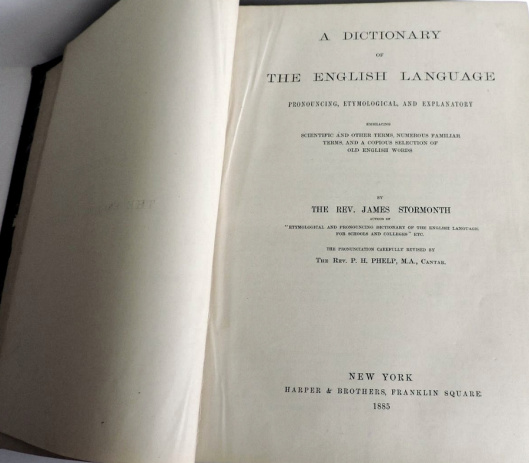
Lovecraft used the Rev. James Stormonth’s venerable dictionary to help him write early letters to Moe on the permissible rhyming of rrr words, circa 1914-1916. It appears that, at that point in time, he had been using the single-volume work since he had first needed a good dictionary. It was one of two dictionaries he asked his aunts to send to New York, when he married Sonia, the other being Webster’s Unabridged (Webster’s International, 1890). Evidently it was not bagged by burgling youths in Red Hook, and if they saw it then they likely baulked at its hefty 1,200+ pages and well-thumbed state. A later letter shows Lovecraft was still consulting and recommending Stormonth in 1929. As late as December 1936 he tells Fritz Leiber that the use of the word constrictious in Adept’s Gambit is doubtful because…

I can’t find it in either of the two dictionaries — a Stormonth & an 1890 Webster’s International — which I possess.

He remarks to Moe that he valued Stormonth because it was thoroughly British and his British father had used the same edition, partly to prevent him “becoming nasally Yankeeised” in America. Lovecraft also valued it because its “conservative authority” eschewed what Lovecraft called “Oxfordisms” (slangy ‘tricks of phrase, syntax, and metaphor’, emanating from the University of Oxford) and gave the proper London pronunciation of the mid Victorian period. The first edition was in 1871, so the well-bred speech of the 1860s might be assumed…

Amidst the sea of conflicting usage, the man of sense will pronounce as his father and grandfather pronounced before him. I use a Stormonth’s Dictionary which was my father’s — recommended to him by his father. And I shall use it till I die, Sir! A fig for your momentary fashions!
He was largely averse to the Victorians, especially their mawkish Dickensian sentiment and their larger forms of architecture. Yet admired the era’s spirit of idealism, and also its personal manners and refined pronunciation. In 1927 he wrote…

If I could create an ideal world, it would be an England with the fire of the Elizabethans, the correct taste of the Georgians, and the refinement and pure ideals of the Victorians.

Given his vast collection of old books, it seems a little curious to me that Lovecraft only ever had two dictionaries, even if they were thick enough to stun a rat and thus presumably very comprehensive. The Rev. Stormonth wrote several other useful dictionaries which Lovecraft might have used and enjoyed. For instance, one wonders if Lovecraft knew of his A manual of scientific terms, pronouncing, etymological, and explanatory, chiefly comprising terms in botany, natural history, anatomy, medicine, and veterinary science, with an appendix of specific names (1885), which appears to be a shelf-companion for the scientific reader to Stormonth’s Dictionary edition of the same year. This is now on Archive.org and one can see from the first few pages that it is not an ordinary dictionary, as the startled dipper encounters curiosities such as abrachia (‘absence of the arms’), acanthocephala (‘parasitic worms armed with spines’), achroma (deficiency in colour), actea (‘the elder tree, full of clusters, clustering … black snake root’), aduncate (‘bent in the form of a hook’), amadou (from the German, ‘dry leathery fungus found on old trees’). Even in the first few pages there are inspirations for weird horror stories a-plenty. But perhaps he didn’t need the additional volume, because its 300 pages were already included in the much larger 1885 edition? Until we get a workable online copy of the larger work, we can’t know.


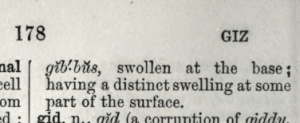
Stormonth’s dictionaries included ‘phonetic pronunciation’, meaning that the word is also given in a special phonetic alphabet meant to indicate ‘how you say it’. You can see an example above, drawn from A manual of scientific terms. Lovecraft appears to have been as conversant with the ‘phonetic pronunciation’ system as he was with poetic meter. But this system is not easily graspable by the tongue of the layman. Is there a simpler method to ‘hear’ the form, involving computers? Of course, you won’t find the ‘phonetic symbols’ on a standard keyboard. But what about a virtual keyboard? Yes, there’s one of those at ipa.typeit.org, so you can at least painstakingly get the complete ‘word’ from the page of a book to your Windows clipboard. But how then to have the computer ‘speak’ it? The indications are that such things are still in the realm of academic papers, surprisingly, but there is one basic option — for free at the 2017 tech-demo phoneme synthesis. Which, apart from the mechanical robo-voice in which the words are spoken, is a cool demo because it’s happening in your browser in javascript. As the maker of the site states, “It was odd that this tool did not exist”. I concur. Who, looking at a dictionary like Stormonth, would not want a digital version of it to embed one-click ‘click to pronounce’ speech-to-audio synthesis?

But possibly a more portable solution might be best — a free browser add-on that knows how to OCR (copy) the notation symbols from the screen, then offers options for correcting the inevitable copying errors from small complex text, and then knows how to pronounce the resulting ‘word’ using your chosen TTS audio voice. There is a browser tool that does this for the phonetic instances given on Wikipedia entries, but in that case they’re already neatly typed out. Such an addon might be extended to OCR not only the International Phonetic Alphabet (est. 1888), but also pre-1888 phonetic systems, and allow a choice of speaking voice. In which case, someone should please synthesise Terry Thomas, so that we can get an authentic sounding male British voice for the Victorian dictionaries.

Or erm… (oh, it’s Kittee Tuesday!) just for fun you could have it read by a cat. Now there’s an idea, a TTS voice that can read any text in a voice that sounds sort-of like it should be a cat ‘speaking’. Just add small purr-lings, and micro-meows, and some touches of LOLcat-ese…


← Older posts
Newer posts →


Please become my patron at www.patreon.com/davehaden to help this blog survive and thrive.

Or donate via PayPal — any amount is welcome! Donations total at Easter 2025, since 2015: $390.

Archives

  • March 2026
  • February 2026
  • January 2026
  • December 2025
  • November 2025
  • October 2025
  • September 2025
  • August 2025
  • July 2025
  • June 2025
  • May 2025
  • April 2025
  • March 2025
  • February 2025
  • January 2025
  • December 2024
  • November 2024
  • October 2024
  • September 2024
  • August 2024
  • July 2024
  • June 2024
  • May 2024
  • April 2024
  • March 2024
  • February 2024
  • January 2024
  • December 2023
  • November 2023
  • October 2023
  • September 2023
  • August 2023
  • July 2023
  • June 2023
  • May 2023
  • April 2023
  • March 2023
  • February 2023
  • January 2023
  • December 2022
  • November 2022
  • October 2022
  • September 2022
  • August 2022
  • July 2022
  • June 2022
  • May 2022
  • April 2022
  • March 2022
  • February 2022
  • January 2022
  • December 2021
  • November 2021
  • October 2021
  • September 2021
  • August 2021
  • July 2021
  • June 2021
  • May 2021
  • April 2021
  • March 2021
  • February 2021
  • January 2021
  • December 2020
  • November 2020
  • October 2020
  • September 2020
  • August 2020
  • July 2020
  • June 2020
  • May 2020
  • April 2020
  • March 2020
  • February 2020
  • January 2020
  • December 2019
  • November 2019
  • October 2019
  • September 2019
  • August 2019
  • July 2019
  • June 2019
  • May 2019
  • April 2019
  • March 2019
  • February 2019
  • January 2019
  • December 2018
  • November 2018
  • October 2018
  • September 2018
  • August 2018
  • August 2015
  • July 2015
  • April 2015
  • March 2015
  • February 2015
  • January 2015
  • December 2014
  • November 2014
  • October 2014
  • September 2014
  • August 2014
  • July 2014
  • June 2014
  • May 2014
  • March 2014
  • February 2014
  • January 2014
  • December 2013
  • November 2013
  • October 2013
  • September 2013
  • August 2013
  • July 2013
  • June 2013
  • May 2013
  • April 2013
  • March 2013
  • February 2013
  • January 2013
  • December 2012
  • November 2012
  • October 2012
  • September 2012
  • August 2012
  • July 2012
  • June 2012
  • May 2012
  • April 2012
  • March 2012
  • February 2012
  • January 2012
  • December 2011
  • November 2011
  • October 2011
  • September 2011
  • August 2011
  • July 2011
  • June 2011
  • May 2011
  • April 2011
  • March 2011
  • February 2011
  • January 2011
  • December 2010
  • November 2010
  • October 2010
  • September 2010
  • August 2010
  • July 2010

Categories

  • 3D (14)
  • AI (70)
  • Astronomy (70)
  • Censorship (14)
  • de Camp (7)
  • Doyle (7)
  • Films & trailers (101)
  • Fonts (9)
  • Guest posts (2)
  • Historical context (1,096)
  • Housekeeping (91)
  • HPLinks (77)
  • Kipling (11)
  • Kittee Tuesday (92)
  • Lovecraft as character (58)
  • Lovecraftian arts (1,628)
  • Lovecraftian places (19)
  • Maps (70)
  • NecronomiCon 2013 (40)
  • NecronomiCon 2015 (22)
  • New books (966)
  • New discoveries (165)
  • Night in Providence (17)
  • Odd scratchings (984)
  • Picture postals (276)
  • Podcasts etc. (431)
  • REH (184)
  • Scholarly works (1,470)
  • Summer School (31)
  • Unnamable (87)

Get this blog in your newsreader:
 
RSS Feed — Posts
RSS Feed — Comments

H.P. Lovecraft's Poster Collection - 17 retro travel posters for $18. Print ready, and available to buy — the proceeds help to support the work of Tentaclii.

Proudly powered by WordPress Theme: Chateau by Ignacio Ricci.