• About
  • Directory
  • Free stuff
  • Lovecraft for beginners
  • My Books
  • Open Lovecraft
  • Reviews
  • Travel Posters
  • SALTES

Tentaclii

~ News & scholarship on H.P. Lovecraft

Tentaclii

Category Archives: Historical context

New Book: Letters To Rheinhart Kleiner and Others

21 Monday Sep 2020

Posted by asdjfdlkf in Historical context, New books, Scholarly works

≈ 2 Comments

Hippocampus has announced and has a page for the new and greatly-expanded edition of H.P. Lovecraft: Letters To Rheinhart Kleiner and Others. The “and Others” section includes, among others, “a small batch of letters and postcards to Arthur Leeds”. Although these still fill 100 pages. In all, there are over 200 pages of additional annotated letters to correspondents other than Kleiner. I suspect most have been published before, but they won’t have been annotated before. Shipping in October, apparently.

From The Photodramatist, December 1921. Kleiner’s light poem on ‘seeing the world’ via cinema news-reel and travel-short, which only a century ago was a relatively new media form and a new audience experience for much of America. The poem is not listed in the first Letters To Rheinhart Kleiner.

Friday ‘Picture Postals’ from Lovecraft: down College Street

18 Friday Sep 2020

Posted by asdjfdlkf in Historical context, Picture postals

≈ 1 Comment

More vintage pictures of Lovecraft’s College Street, more or less as Lovecraft would have seen it was he briskly walked down the hill from his home at No. 66 and approached the lower part of College Street. He possibly used the right-hand side as seen here, as the convention of the Hill was apparently that the left sidewalk was the one used by Brown students. Using the right sidewalk would also presumably avoid any possibility that one would be jostled by unsavoury nautical-looking types outside the Courthouse. The Court buildings are seen on the left of the picture. Even if he habitually chose to turn left or right here, on his way to the commercial district, he would still have seen the view depicted.

Note the slightly sinister well-like manhole at the intersection, with a tight circle of bricks around it. How it might have glistened in the moonlight, and led to thoughts of what might lie beneath…

“Did we know, he asked, his sombre eyes intent on our faces, that recently, when early buildings on Benefit Street and College Street were razed to make way for new ones, deep tunnel-like pits, seemingly bottomless and of undetermined usefulness, were discovered in the ancient cellars?” — memoir of a visit by Lovecraft in 1934, by Dorothy C. Walter.

You can also just about see one of two courtyard entrances a little further down. This wasn’t the same “one of those old-fashioned courtyard archways (formerly common everywhere) for which Providence is so noted” on the slope of Thomas Street, which there led into the courtyard in which Lovecraft met the cat ‘Old Man’ at night. But I have photos of these College Street back-courtyards which evoke similar courtyard spaces. Of which more next week.

When Lovecraft was about level with one of the back-courtyard entrances he would be poetically poised between its antique allure on the one hand (if the doors were open), and on the other hand a forward view which now soared up into a towering modernity…

It appears that he actually didn’t mind this view too much, despite his yearning for the pre-modern. Long before he moved in to No. 66 he wrote about how he found himself walking up this particular street one evening when it was growing dark, which he had apparently never done before at that time of day. And it suddenly occurred to him to stop and turn and look back, since it would give a dusk view of Providence that he had never seen before. The Industrial Trust building (the tower seen here) was recently built by that time, and he found himself rather enchanted by the view he saw — differing grids and planes of distant lights rising up toward the stars.

Sensational Clergymen

17 Thursday Sep 2020

Posted by asdjfdlkf in Historical context

≈ Leave a comment

The religious arts magazine The Curator magazine muses on The Sensational Lives of Clergymen, specifically those interested in the occult and/or crime, such as Lovecraft’s friend Whitehead.

Lovecraft and voodoo

13 Sunday Sep 2020

Posted by asdjfdlkf in Historical context

≈ 2 Comments

A new question from one of my Patreon patrons…

HPL’s “The Call of Cthulhu” makes several references to voodoo. What other connections can we draw between HPL and voodoo (hoodoo, voudo etc)?”

There is not a great deal to say about Lovecraft and voodoo. Firstly he could have picked up much from encyclopaedia entries such as the entry on “West Indian Islands” in his copy of Lewis Spence’s An Encyclopaedia of Occultism (1920), a long and vivid entry almost entirely devoted to voodoo.  A few years later Lovecraft first mentioned voodoo, in passing, in his story “The Rats in the Walls”. He then has Inspector Legrasse assume voodoo in “The Call of Cthulhu”, cleverly playing on his likely audience’s knowledge of voodoo as a real belief system… before he reveals the true horror and cosmic dimensions of the Cthulhu Cult. His good friend and correspondent Henry Whitehead also had a strong interest in the topic and spun it into his stories. Lovecraft likely learned much in conversations and correspondence with Whitehead, and perhaps with his other missionary friend Sechrist. By circa 1930 Lovecraft appears to have been much better informed on the topic, having read a new ethnographic book on ‘zombie’ beliefs in Haiti.

The earliest mention of voodoo I can find is in 1923, where it adds slightly to the atmosphere of Lovecraft’s “The Rats in the Walls” (1923). The reader is told in passing that cousin Randolph Delapore… “became a voodoo priest after he returned from the Mexican War.” This poetically implies, perhaps, that voodoo practices were to be found in the jungles of Mexico circa 1850, far from the centres of voodoo in New Orleans and Haiti. It also implies that Lovecraft was at this point aware that voodoo had ‘priests’ of a sort, and generally plays into the multiple Atlantic criss-crossings of the Delapore ancestors.

Then his close friend Frank Belknap Long had the tale “Death-Waters” in Weird Tales in December 1924, in which a Central American black sorcerer has the power to summon forth a mass of vengeful snakes. Not quite voodoo, but close. In the same issue Arthur J. Burks also had the tale “Voodoo”, further evidence that editor Weird Tales editor Farnsworth Wright was interested in voodoo stories. Burks followed this in August 1925 with his “Black Medicine” set in Haiti, and the story had the front cover illustration. Since Lovecraft was at this time reading Weird Tales cover-to-cover we can be sure he read these stories. “Voodoo” has a military man infiltrate a voodoo human sacrifice ritual in Haiti, and Lovecraft would have picked up much detail about such things. If he believed them to be ethnographically accurate or not is another matter.  But, unlike Long, Burks was himself a military man and one who had actually been in the places described and could depict them authentically. Lovecraft was at least impressed… “God! What Burks could have done if he’d stuck to the mood & manner of his early Haitian stuff” — from a mid 1930s letter to Catherine L. Moore.

Perhaps inspired by Farnsworth Wright’s apparent interest in voodoo, an aspect of “The Call of Cthulhu” began to take a vague shape in Lovecraft’s Commonplace Book. He recorded story-idea No. 109 — a voodoo wizard in a cabin, amid an as-yet un-located swamp. Soon this vague notion was followed by story-idea No. 111 which added the geographical location and possible elaborating element of an “ancient ruin in Alabama swamp – voodoo”. One at first imagines that that a story based on voodoo might have been considered somewhat ‘hokey old stuff’ at that time, since dime novel heroes can be found fighting voodoo cultists in the early 1900s. Although it appears to have become rarer after that and it may well have seemed somewhat fresh again by the mid 1920s. We have to remember that cultural memories were much shorter in those days, when popular culture was a very ephemeral thing indeed and there were almost no avid curators or collectors. A few seasoned editors such as Farnsworth Wright, with good memories and sets of back-issues lining their office walls, may have been able to reach back several decades. Most readers and writers could not.

In formulating this aspect of “Cthulhu” Lovecraft was working in advance of what would become the early 1930s ‘boom’ in voodoo based material (screen, fiction, ‘true-life’ ethnographic accounts, etc). But ‘the swamp’ was certainly a key element of both the news (drug-running, prohibition, baby-farming) and the screen entertainment in 1926. For instance the Mary Pickford movie Sparrows had a very wide release in May 1926, and has vivid New Orleans swamp scenes…

“Art director Harry Oliver transformed 3 acres (12,000 m2) of the [studio] back lot between Willoughby Avenue and Alta Vista Street into a stylized Gothic swamp. The ground was scraped bare in places, 600 trees were carted in, and pits dug and filled with a mixture of burned cork, sawdust and muddy water.”

The horror in the Sparrows movie was baby-farming and child-slavery in the American South, but such scenes also call to mind “The Call of Cthulhu” and “the wooded swamps south of New Orleans” in which the all-male orgy scene is so vividly set. Lovecraft’s depicted rites are actually not voodoo or in some vague way ‘Satanic’ (as some academics have claimed), although it forms a point of comparison for the policemen in the story. The Cthulhu cult is instead positioned in the narrative as something far older and more sinister, part of a living practice that has apparently existed for millennia and which reaches from the outer cosmos to the depths of the sea. The Cthulhu Cult rites are certainly initially positioned for the reader in relation to the assumed ‘dark rites’ of voodoo, since that gave Lovecraft something to build from. He could assume that the typical Weird Tales reader had seen the earlier December 1924 voodoo story involving a child sacrifice in Haiti. Thus he has Inspector Legrasse recall that he had expected to find a voodoo ritual (“a raid on a supposed voodoo meeting”), quite in keeping with the assumptions of a police inspector of his era. That it might be an orgy has also been foreshadowed for the reader, by the fact that Professor Angell had noted press reports that alleged “voodoo orgies now multiply in Hayti”.

But then Lovecraft springs the Cthulhu Cult on the reader, and also has it depart from a key practice of voodoo.  Voodoo secret societies were secret, and 1930s members would rather die than tell their ‘secrets’ to outsiders. Yet Lovecraft has old Castro willingly “spill the beans” about the Cthulhu cult to the investigators. This, in itself, would have been another somewhat scary move for the open-mouthed Weird Tales reader of the time. In that it implies Castro is offering a very subtle skin-saving enticement to join with the powerful eon-enduring cult — its worshipping believers being either power-seeking degenerates or the weak-minded. It also bespeaks a cynical attitude that assumes that such things can be told in private, even to law officers, because they would never be believed if typed up as fact in a report. Thus the reader knows that these cultists are not just being set up as a convenient pulp plot device to allow a pouting female to be rescued by a jut-jawed hero. The cult leaders have power to seduce other power-seekers, and also have incredulity as a powerful cloak around their activities. These cultists are no drunken killers of chickens and cats.

A few years later, in a long February-March 1929 letter to Harris, Lovecraft appears to have dismissed voodoo. He casually lumps voodoo in with superstitious “witch-whispers … Spiritualism, magic, luck-charms” and suchlike, and associates the decline of established religious belief with modern dalliances with such superstitions. Would the cat-loving Lovecraft have lumped voodoo in with mere “luck-charms” if he had heard of the very sadistic cat-killing initiation ritual of voodoo, perhaps via his friend Whitehead, or if he had given credence to Spence’s lurid entry in the 1920 An Encyclopaedia of Occultism? If so then he might have held more severe opinions about voodoo. But perhaps he was just pulling his punches in a letter to a correspondent. As evidence for his real opinions on the matter, the 1929 Harris letter is rather slim but it does suggest Lovecraft had not yet read a key book that was published in January 1929.

Several November 1933 letters to Barlow show that Lovecraft had by then read William B. Seabrook’s book The Magic Island (January 1929). This was a best-selling first-hand account of voodoo practices in Haiti, with a chapter on zombies. The comment arose because an un-named friend of Barlow had apparently infiltrated and witnessed a voodoo ceremony in Florida.  The friend being either very brave, very black, or very imaginative.  Probably the latter. Apparently by the early 1930s there was something of a cottage industry of books and articles on Haitian voodoo, and these must have filtered down to the more impressionable youths of the period.

In the same letters to Barlow Lovecraft also displays a fine-grained awareness of the different black cultures in Haiti and other islands, probably had from a blend of book and article reading, from long conversations with missionary friends such as Whitehead and Sechrist, and his reading the tales of Whitehead and others in that line. A.M. McGee’s “Haitian Vodou and Voodoo: Imagined Religion and Popular Culture” (Studies in Religion, Vol. 41, 2012) has suggested Lovecraft’s “Call of Cthulhu”… “as a prototype for many later presentations of voodoo”, but McGee appears to be unaware of the far stronger influence on the pulp idea of voodoo by writers such as Henry S. Whitehead and others who appeared in Weird Tales (see Whitehead’s collections Jumbee and Other Voodoo Tales, and The Black Beast and Other Voodoo Tales). Elsewhere in his letters Lovecraft also makes distinctions between various areas of the South in America, showing he was aware that ‘the South’ was also not a homogenous block in terms of its black cultures, situations or treatment. He generally seems to have a good grasp of the human geography of the matter by the early 1930s.

In Selected Letters III we see Lovecraft asking Talman if he might mail a copy of Argosy magazine for October 1931. Argosy had opened the issue with the Haiti ‘voodoo and trains’ story “Voodoo Express” by pulp writer Theodore Roscoe. The magazine had also given the tale a colour cover, albeit with a rather lacklustre design. Lovecraft appears to be rather surprised that a pulp writer might land in Argosy as a lead writer and bag the cover too — he remarks “I have no idea that the A.[rgosy] could ever become a market for me”. But by that date voodoo had become a ‘hot thing’ in the print entertainment world, even if it had not yet reached the silver screen as a movie, and the Halloween Argosy issue was evidently a part of that surge. At that time many movie producers felt they needed a ‘hit’ magazine story appearance first, in order to ‘prime’ the public in the small cities and rural areas for the resulting movie — this may well be an example of that. Yet it seems unlikely that Lovecraft could have written the type of ‘voodoo threat’ story of the formula type then required.

I don’t yet have access to the Howard-Lovecraft letters but possibly he also picked up something on voodoo from R.E. Howard, re: the Solomon Kane character and his connection with the voodoo wizard N’Longa. See also “Pigeons from Hell” and the chapter “Swamps of Voodoo Vengeance: Indigenous Horrors in the South” in Fred Blosser’s Western Weirdness and Voodoo Vengeance book on the horror tales of R.E. Howard.

It’s also possible Lovecraft learned a little more of street voodoo while in New Orleans in June 1932, as he was there ‘taken under the wing’ of local resident and fellow Weird Tales writer E. Hoffman Price. New Orleans being the centre of voodoo. Lovecraft may at least have seen various hoodoo paraphernalia on sale in the markets.

Are there other instances to be found in the fiction? Some might think of Lovecraft’s serial-shocker Herbert West (1921-22) and its zombies (originally an aspect of voodoo). But given the dates above this series appears to predate an interest in voodoo and was more of a melding of Frankenstein and 19th century grave-robbing tales, with darkly satirical pokes at 1920s ‘goat glands’ rejuvenation quacks.

His later “The Thing on the Doorstep” (August 1933) might seem to owe something to the voodoo notion of spirit possession and bodily vulnerability, and the August 1933 dating would mean it could have been influenced by his more substantial readings on Haitian voodoo and zombies. But such ideas are common and a near universal ‘given’ in folk belief systems, from Northern fairy lore to Classical myth. One should also consider the likely influence of his viewing at the cinema of the notorious movie Madchen in Uniform shortly before writing the story, the movie being a key part of a then-current wave of sexological theories about how a gay person was “a woman in a man’s body” or visa versa. This seems the more likely source for the gender-swopping mind-transfer idea, in addition to his own early ventures into the mind-transfer theme.

Finally, Rimel’s story “The Disinterment” (September 1935) has a partial connection. The narrator travels to the West Indies and finds there a drug to “simulate death”. This was apparently based on actual voodoo wizard practices in Haiti, the real drug being based on the venom of the Pufferfish, and the story’s additional twist of ‘cutting off of the head’ was also a local practice designed to counter such deception. Lovecraft carefully revised the story for Rimel, but it seems he did not originate the ethnographically-informed details of it.


Additional note: I’ve slightly revised my last month’s ‘request essay’ on Harlem, to take into account Hurston’s 1926 story “Sweat”.  Now reads… “Hurston does appear to have had two short pieces in a small Harlem modernist magazine of the mid 1920s, including the now-notable “Sweat” about an abused washerwoman…”.

H.P. Lovecraft in Britain / Sterling in Italy

09 Wednesday Sep 2020

Posted by asdjfdlkf in Historical context, New books, Scholarly works

≈ Leave a comment

H.P. Lovecraft in Britain (2007), newly republished in summer 2020 as a budget Kindle ebook for £2.28. It’s paired with “The Horror in the Museum” for some reason, though it appears the latter is not annotated or also given an essay.

The long essay untangled Lovecraft’s British publishing history from the 1950s to the 70s, with the help of the Gollancz archives. It was originally published as a limited edition 46-page chapbook from The British Fantasy Society, with a pleasing cover and interior illustrations.

It looks like it may still be possible to get a copy of the original chapbook monograph from the author, for a mere £6 inc. UK postage. As such it may be rather more desirable than the new ebook for many Lovecraftians. Worth a try.


Also new, in a 300-page paperback, is Claudio Foti’s book in Italian on Lovecraft and Kenneth Sterling. This was published at the end of June 2020, and has an essay on the pair, “together with all of Lovecraft’s letters to Kenneth J. Sterling” in translation. It looks like it may also have a translation of “Eryx”, and hints at possibly containing other Sterling story translations in Italian. Foci has been a Lovecraft Annual contributor (2017) and hopefully we’ll get an English translation of his essay in due course.

‘Picture postals’ from Lovecraft: coffee at night in Providence

04 Friday Sep 2020

Posted by asdjfdlkf in Historical context, Night in Providence, Picture postals

≈ 2 Comments

This was in the lobby of the Butler Exchange in Providence. Lovecraft rhetorically derided the “ugly nondescript” architecture of such “Victorian pests as Butler Exchange” in Providence, the Butler being a large commercial ‘offices to let’ building that had opened in 1873. It had six floors including a floor of shops, and seems to have been inhabited for some fifty years by a multitude of small upmarket trades that included music teachers, portrait painters, and milliners. Lovecraft had his way on the city architecture, for once, and the carbuncular building was demolished in 1925.

Here we see the Exchange’s ‘hole on the wall’ coffee vendor, said to be in the entrance Lobby and possibly tucked into a defunct elevator shaft. Judging by the ‘News Company’ sign above, it was perhaps servicing newsmen who were working through the night to ready the dawn news? The demolition of the Exchange was in 1925, thus the date of this picture is likely to be circa 1920-24.

I can find no evidence that Lovecraft patronised this particular place on his pre- New York night-walks, either alone or with Eddy. But, given its very central location and likely all-night hours and public pay-phone, this would have been of obvious interest to him. Especially after a chill all-night walk or on leaving the train station after a cold journey at a very late hour. Even if he never visited, the picture is still very evocative of small ‘hole on the wall’ coffee vendors in Providence, at night in the early 1920s.

The Exchange building also evidently had a large art show on at least one occasion, and one of these in particular may have been a daytime draw for Lovecraft-al-Hazred…

H. Cyrus Farnum [RSID, Providence Art Club] … painted brilliant outdoor scenes of Africa which were exhibited at the Butler Exchange in Providence. He died at home in 1925. — North Providence

Cyrus Farnum had a large studio in the Butler Exchange, and this was presumably the location of the exhibition. As a leading member of the Providence Art Club, Lovecraft’s aunts would almost certainly have attended his show, since they were fellow Club members. Given the subject matter from Algiers and Biskra in North Africa, one imagines that Lovecraft would have been keen to accompany them — if he was not by then in New York City. I hazard a guess at c. 1920-24 for the show, as a retirement retrospective, but it might even have been staged in the pre-war period. He had certainly been in Algiers in 1905, given the date on one such picture, and he was exhibiting his best Algiers pictures during the war. Without access to local newspaper archives, or a completist database of all known pre-1945 art exhibitions (is there such a thing?), a date can’t be pinned on this show at the Butler Exchange. It would certainly be interesting to know if it was a pre-Christmas 1920 show, as the show would then be a possible influence on Lovecraft’s “The Nameless City” (written January 1921).

Howard in The Souk

03 Thursday Sep 2020

Posted by asdjfdlkf in Historical context, Odd scratchings, REH

≈ 1 Comment

New on Archive.org, and seemingly for the first time there, a scan of the pulp Oriental Stories for Summer 1932. It has extensive commentary in The Souk on the historicity of R.E. Howard’s depiction of wine in his then-recent story “Lord of Samarcand”. Howard responded in the January 1933 issue (not online), by which time the title had been re-named The Magic Carpet Magazine.

I’m unsure if Lovecraft would have read Oriental Stories in summer 1932, and anyway studies in the history of Near, Middle and Far East were not generally a subject he favoured with much attention. Although I recall he undertook a long bout of intensive reading on Abyssinia, which likely then informed Dream-Quest — but that’s Eastern Africa, now Ethiopia, so is a bit too far south and although adjacent to Arabia it has a different religious culture. Yet he certainly had a lifelong interest in alcohol and prohibition and would have perused the Oriental Studies notes with interest had he seen them.

169

30 Sunday Aug 2020

Posted by asdjfdlkf in Historical context

≈ 1 Comment

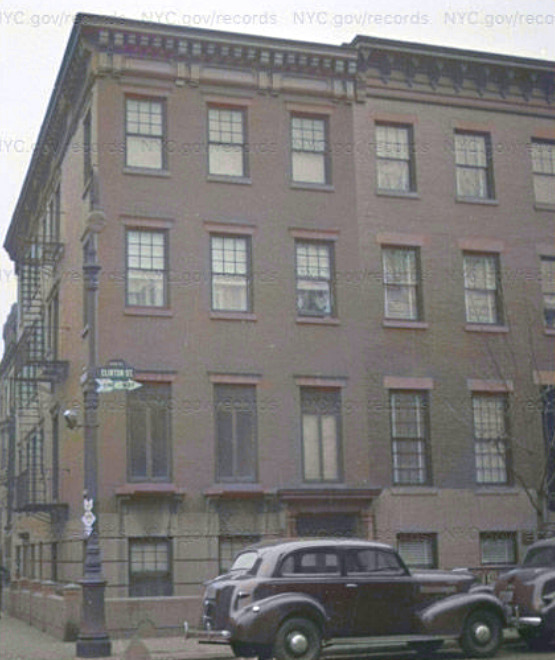
A new mapped cache of photos of New York City in 1939/1940, drawn from mundane tax-record photos of buildings.

It appears this is 169 Clinton Street. Though it’s difficult to be 110% sure as the buildings all look much the same. Also, both the site’s address-lookup and the 1939/40 in-photo numbering appear to be astray in terms of matching with house numbers. While the corner location, door, windows, roof-line and adjacent windows all suggest it’s almost certainly 169, modern pictures show a large front door on the building immediately to the left side — a door that isn’t present here.

Lovecraft seen in front of 169. Possibly late spring 1925, judging by the leafy tree behind him. Evidently the exterior fire-escapes were added to the building in the 1930s. A city report on the local juvenile gangs stated there was almost no easy roof-access in Red Hook at that time, in contrast to Hell’s Kitchen. If there had been a fire Lovecraft would presumably have had to fling himself from the window, Dagon-style.

A few more facts on Arthur Leeds

25 Tuesday Aug 2020

Posted by asdjfdlkf in Historical context, New discoveries

≈ Leave a comment

After I had found new details of Arthur Leeds and the Canadian Army in the Bloch letters, another new biographical item has been found in the volume of Moe letters. In September 1930 Lovecraft remarked…

I’d like to see the old boy [Leeds] myself, & certainly hope he’ll look me up if his itinerant outfit traverses this part of the world. Hope his prosperity is permanent — he deserves some peace and freedom from anxiety after the long gruelling years of the past [post-war poverty in New York City]. But what a beastly shame his Old Cap Colliers were not waiting for him. (Letters to Maurice W. Moe, page 515)

From this it appears that Leeds likely departed New York City soon after the Great Depression hit, and went home to Canada. There he found that his precious childhood things had either been thrown out or given away. “Old Cap Colliers” indicates that Leeds had once collected this 1880s-90s dime novel series (a series, incidentally, whose plots and situations were later extensively mined to fuel the 1930s pulp character Nick Carter, Detective).

After that Leeds had evidently once again ‘run away with the circus’ in the form of setting off with some travelling theatre, but this time at a better salary and perhaps as the manager. That’s how I read Lovecraft’s comments, and the new data is bolstered by Lovecraft’s 1931 comment that… “Leeds has come on slightly better times, through his side-line of the drama”. It seems likely this travelling theatre working the eastern Canada / Chicago area, perhaps travelling alongside and shadowing a large circus and thus quite lucrative. That Lovecraft thinks of it as a “side-line” may indicate it was seasonal work.

But the Great Depression deepened and the job probably didn’t last more than a couple of seasons. S.T. Joshi notes that Leeds was back in Brooklyn, New York City, in June 1932. There he appears to have turned to dealing in used correspondence courses. At some point he began to live on the fringes of Coney Island, as I’ve detailed in another recent post. It would be logical to assume that he was able to pick up seasonal work at the famous Coney Island attractions, while having time to write in the winter.

All this augments my Leeds biography and photo, which is to be found in my book Lovecraft in Historical Context #4.

Photo of the Twin Islands

24 Monday Aug 2020

Posted by asdjfdlkf in Historical context, New discoveries

≈ Leave a comment

Back in May 2019 I posted here on the Twin Islands. They don’t appear on all maps, but they are on this one of Providence…

At that time I was unable to find an actual photo of them. The photo is now found, and it also looks like it has a date that more or less fits…

The cameraman was up on Fort Hill and the picture looks up the Seekonk which then curves around to the left and goes out of sight. As a strong lad Lovecraft was a keen rower in a boat on the Seekonk, and he went down past the bridge and landed on these islands…

I used to row considerably on the Seekonk … Often I would land on one or both of the Twin Islands — for islands (associated with remote secrets, pirate treasure, and all that) always fascinated me.” — Lovecraft letter to Rimel, April 1934.

Being rather tidal, presumably they had a quite Dagon-ish texture underfoot…

When at last I awaked, it was to discover myself half sucked into a slimy expanse of hellish black mire which extended about me in monotonous undulations as far as I could see, and in which my boat lay grounded some distance away. — “Dagon

Protected: Benefit St. map

23 Sunday Aug 2020

Posted by asdjfdlkf in Historical context, Maps

≈ Enter your password to view comments.

This content is password-protected. To view it, please enter the password below.

Friday ‘picture postals’ from Lovecraft: the India Wharf rail yards

21 Friday Aug 2020

Posted by asdjfdlkf in Historical context, Picture postals

≈ Leave a comment

In late December 1923 Lovecraft explored the India Wharf rail yards in Providence, ending up somewhere on the waterside between Fox Point and the rail bridge that crossed into East Providence.

We edged through ghastly channels between black silent freight cars on the India wharf at the southern tip of Providence’s east peninsula, a region I had never penetrated, though I had for twenty years or more wonder’d about it. It was an eldritch wiggle, like that of Alciphron in the tortuous crypts of Egypt, and at last we came out where pale phosphorescence effused from century’d rotting piles, and the distant harbour-lights bobb’d and twinkled away to the south, the far south, the south of dreams and templed isles, and curious ports, and pagodas of gold with savor of spice and incense around them. (Letters to Maurice W. Moe, page 510)

The context was that Morton was going home on the New York boat. In this case Lovecraft even tells us the name, the frigate Concord, seen here in Providence…

Both Morton and Loveman appear to have preferred to travel back from Providence this way. Though it appears to have taken Loveman a few tries to find the right passenger line and time of day to avoid the boorish crowd he had endured on his first such trip.

Lovecraft had first walked Morton up a long and insalubrious street that led to the New York docks, a street where as he put it…

where murther lurks in the alleys, and one stumbles over corpses in the gutters … a confused blur of pallid lamps and Hogarth vistas.

The latter must mean glimpses down alleys and entrances toward the riverside, as they walked up to Fox Point.

Once the luggage was stowed aboard, Morton found he had quite some time to wait until departure. Thus the pair appear to have slipped away down the adjacent freight lines. Presumably, over the Christmas break, the trains were backed up and not moving. There are two options for the exploration route. Either the pair threaded through the rail yards and a maze of freight trucks a relatively short way, to find the first good clear view over water to the south and the open sea. Or they walked the rails around to the industrial Wilkesbarre Pier and looked south from there, which seems far more unlikely.

Thus I’d say they were likely standing about here, in the chill and deepening dusk of 27th December 1923…

It’s interesting to think that an encounter with the black freight cars, arranged akin to “the tortuous crypts of Egypt”, could have informed the mood of his Houdini story “Under The Pyramids” in February 1924.

After seeing Morton off on the Concord, Lovecraft wrote that he walked back into town and took in a silent “cinema”. What might have been playing at that point in time? Salome and Lon Chaney’s While Paris Sleeps were both released at the start of 1923. There was no new Chaplin comedy feature in the second half of 1923, as Chaplin had made his first swerve into trying to be “serious” and it was a box-office disaster. The rest of the end-of-1923 fare seems very unappealing stuff. The Hunchback of Notre Dame (early September 1923) might still have been in cinemas, but Lovecraft had probably already seen it by then. Yet there was the German UFA silent feature The Street. This sinister cinema was released at the end of November 1923, and UFA was a big studio with USA distributors. Lovecraft had no German, but for a silent movie that wasn’t a problem. In The Street…

“The city is an expressionistic nightmare, a dangerous and chaotic place. The unfortunate man encounters thieves, prostitutes, and other predators. But the real threat [is that] The street itself is alive and watching.”

One can then imagine Lovecraft, as he fell asleep in the cinema as he often did, softly chuckling to himself… “Ha, I did it first!”

The Street, 1923.

← Older posts
Newer posts →


Please become my patron at www.patreon.com/davehaden to help this blog survive and thrive.

Or donate via PayPal — any amount is welcome! Donations total at Easter 2025, since 2015: $390.

Archives

  • March 2026
  • February 2026
  • January 2026
  • December 2025
  • November 2025
  • October 2025
  • September 2025
  • August 2025
  • July 2025
  • June 2025
  • May 2025
  • April 2025
  • March 2025
  • February 2025
  • January 2025
  • December 2024
  • November 2024
  • October 2024
  • September 2024
  • August 2024
  • July 2024
  • June 2024
  • May 2024
  • April 2024
  • March 2024
  • February 2024
  • January 2024
  • December 2023
  • November 2023
  • October 2023
  • September 2023
  • August 2023
  • July 2023
  • June 2023
  • May 2023
  • April 2023
  • March 2023
  • February 2023
  • January 2023
  • December 2022
  • November 2022
  • October 2022
  • September 2022
  • August 2022
  • July 2022
  • June 2022
  • May 2022
  • April 2022
  • March 2022
  • February 2022
  • January 2022
  • December 2021
  • November 2021
  • October 2021
  • September 2021
  • August 2021
  • July 2021
  • June 2021
  • May 2021
  • April 2021
  • March 2021
  • February 2021
  • January 2021
  • December 2020
  • November 2020
  • October 2020
  • September 2020
  • August 2020
  • July 2020
  • June 2020
  • May 2020
  • April 2020
  • March 2020
  • February 2020
  • January 2020
  • December 2019
  • November 2019
  • October 2019
  • September 2019
  • August 2019
  • July 2019
  • June 2019
  • May 2019
  • April 2019
  • March 2019
  • February 2019
  • January 2019
  • December 2018
  • November 2018
  • October 2018
  • September 2018
  • August 2018
  • August 2015
  • July 2015
  • April 2015
  • March 2015
  • February 2015
  • January 2015
  • December 2014
  • November 2014
  • October 2014
  • September 2014
  • August 2014
  • July 2014
  • June 2014
  • May 2014
  • March 2014
  • February 2014
  • January 2014
  • December 2013
  • November 2013
  • October 2013
  • September 2013
  • August 2013
  • July 2013
  • June 2013
  • May 2013
  • April 2013
  • March 2013
  • February 2013
  • January 2013
  • December 2012
  • November 2012
  • October 2012
  • September 2012
  • August 2012
  • July 2012
  • June 2012
  • May 2012
  • April 2012
  • March 2012
  • February 2012
  • January 2012
  • December 2011
  • November 2011
  • October 2011
  • September 2011
  • August 2011
  • July 2011
  • June 2011
  • May 2011
  • April 2011
  • March 2011
  • February 2011
  • January 2011
  • December 2010
  • November 2010
  • October 2010
  • September 2010
  • August 2010
  • July 2010

Categories

  • 3D (14)
  • AI (70)
  • Astronomy (70)
  • Censorship (14)
  • de Camp (7)
  • Doyle (7)
  • Films & trailers (101)
  • Fonts (9)
  • Guest posts (2)
  • Historical context (1,096)
  • Housekeeping (91)
  • HPLinks (77)
  • Kipling (11)
  • Kittee Tuesday (92)
  • Lovecraft as character (58)
  • Lovecraftian arts (1,628)
  • Lovecraftian places (19)
  • Maps (70)
  • NecronomiCon 2013 (40)
  • NecronomiCon 2015 (22)
  • New books (966)
  • New discoveries (165)
  • Night in Providence (17)
  • Odd scratchings (984)
  • Picture postals (276)
  • Podcasts etc. (431)
  • REH (184)
  • Scholarly works (1,470)
  • Summer School (31)
  • Unnamable (87)

Get this blog in your newsreader:
 
RSS Feed — Posts
RSS Feed — Comments

H.P. Lovecraft's Poster Collection - 17 retro travel posters for $18. Print ready, and available to buy — the proceeds help to support the work of Tentaclii.

Proudly powered by WordPress Theme: Chateau by Ignacio Ricci.