• About
  • Directory
  • Free stuff
  • Lovecraft for beginners
  • My Books
  • Open Lovecraft
  • Reviews
  • Travel Posters
  • SALTES

Tentaclii

~ News & scholarship on H.P. Lovecraft

Tentaclii

Category Archives: Historical context

Letters to Wilfred B. Talman – the second set of notes

20 Thursday Jul 2023

Posted by asdjfdlkf in Historical context, Odd scratchings

≈ Leave a comment

Below is my second set of notes on Lovecraft’s Letters to Wilfred B. Talman and Helen V. and Genevieve Sully. The book is a hefty 580-page slab, and I’m currently half way through and have reached October 1933. But in the notes below I open in April 1927 and run through to early July 1929.


Page 68. Lovecraft suggests, with a certain amount of levity, that he and some others should form a… “ways and means committee for inaugurating the counter-revolution & establishing the reign of American Fascism”. Said in the context of the context of a newly Soviet-ised, bloody-handed and internationalist communism.

Page 68. Lovecraft is familiar with the “little Benefit St. grocery”, which is likely to be gone soon.

Page 69. He gives more descriptive and demographic details on the slum area he has newly discovered on walks in Providence (see my first set of notes). Much later in the book, in 1934, he briefly notes it has been swept away by the city developers.

Page 70. “the unknown outside clawing at the rim of the known … There are things more terrible to the imagination than any phenomena connected with the nature, passions & aspirations of mankind”.

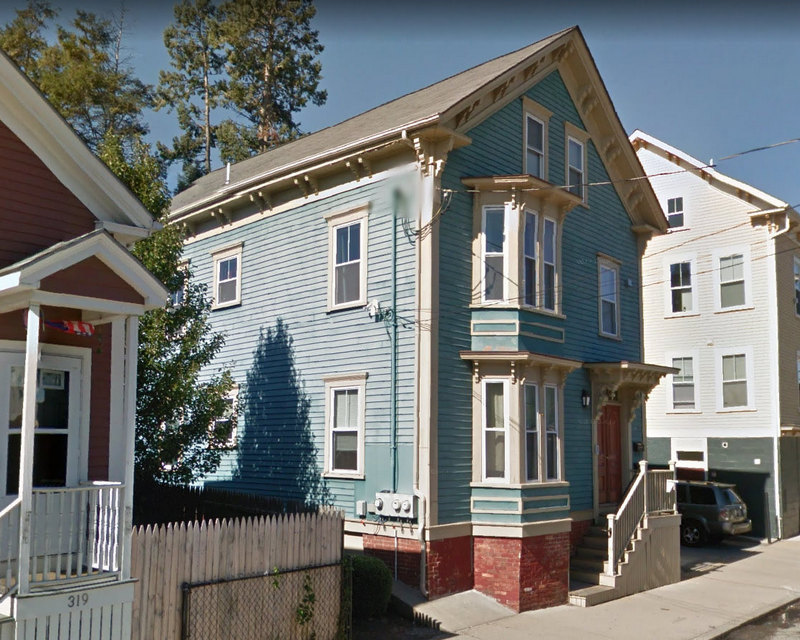
Page 71. Eddy Jr. is back, at least temporarily, invited over (probably not by Lovecraft himself) to a ‘gang’ meeting in Providence. Only in July 1932 (page 212) do we hear of Eddy again, when things seem to have been patched up between them and Lovecraft is visiting with the Eddys at their house. As I’ve established (Lovecraft Annual 2022), the Eddys were almost certainly then at 317 Plain Street, Providence (address given in a letter to Ghost Stories magazine for April 1929). This house can still be seen on Google StreetView. A delightful structure to British eyes at least, though perhaps rather mundane and samey in American eyes…

The similar next-door corner-house at No. 319 (seen here as the white one) sold in May 2023 for $225,000 (£171k). Pretty good by UK prices, it would likely be twice that in a comparable English city south of Crewe. New England seems a bit of a paradise by the standard of old England. Crazy-high professional salaries, but crazy-low house prices.

Page 76. Lovecraft had been reading about the modern-folkloric creature known as ‘The Jersey Devil’, and had “concluded that IT was an overgrown mosquito”. There is more on page 178-79.

Page 84. His distorted understanding of how own work begins to show up, since here he thinks “The Rats in the Walls” is “barren and obtrusively mechanical”. Similarly he thinks “The Horror at Red Hook” to be the “dullest” of his works (page 88) despite it being immediately picked up for hardback re-publication.

Page 84. A little more detail about the stock of ‘Uncle’ Eddy’s bookshop (see my essay in Lovecraft Annual 2022). Cook was about to invest in 70 old volumes of Harper’s magazine. Cook returns to Providence and Eddy’s on page 90.

Page 86. Lovecraft especially likes ‘survivals’ rather than ‘restorations’ in antiquities, and he makes the distinction between the two. A survival is “a lingering bit of the past [such as] the lane back of the Athenaeum” in Providence. Ah, so the mysterious little path at the side of the Athenaeum which I spotted in a photo recently may have led up to that olde lane?

Page 90. HPL was revising a tale called “In The Confessional” for de Castro. The original 1893 version of this survives, but Lovecraft’s revision of it is lost.

Page 91. January 1928. He “stopped reading” Amazing Stories “several months ago”. But will now have to glance at it again, since readers are still talking about a little something he wrote called “The Colour Out of Space” (September 1927, Amazing Stories).

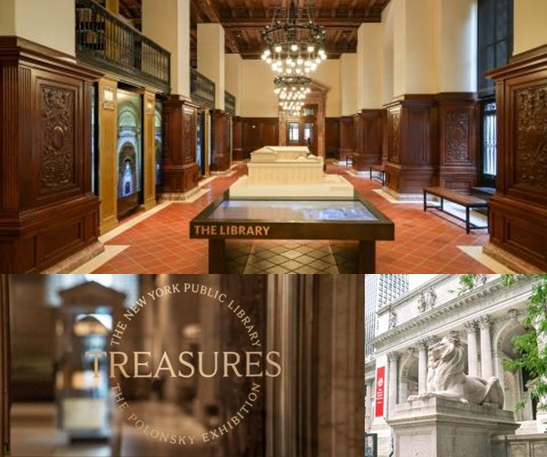
Page 95. Brooklyn libraries. The Montague branch library was the nearest to him in New York City, and he had a card for it… “though I actually spent more time at the NY one in 42nd St. and 5th Ave.” Still there today, the one with the lions outside…

Page 97. He read Witch Wood by John Buchan. One of Buchan’s novels best-liked by his fans, once they step beyond the usual Thirty-Nine Steps etc spy novels. A 1927 novel of devil-worship and evil forests in seventeenth-century Scotland. Apparently rather more subtle and interestingly macabre than the usual occultist devil-worship mumbo-jumbo, and influenced by Blackwood and Machen. Be warned, however, that according to S.T. Joshi… “The dialogue portions of John Buchan’s enormously long novel Witch Wood are almost entirely in Scots dialect”. Which is not easy reading, even for a Scot.

Page 98. “Sydney R. Burliegh, the goof responsible for that monstrosity [the Fleur-de-Lys building in Providence] […] he draws historical and traditional maps in the Ortelian manner […] I have his Providence one and am about to get his South Country one. He lives in a real colonial house on College Hill.” I can’t immediately find these maps online.

Page 101. June 1928. He hasn’t been out of the house for nearly six months. “I haven’t been out since Jany. 2nd [2nd of January], and don’t know when I can ever get out again”.

Page 102. The all-night lunch wagon was invented in Providence “about 50 or 60 years ago” [early 1870s?] and is “now a standard institution” in the city. This seems relevant to Lovecraft’s night-walks in his city, in terms of his coffee / donuts-supply logistics when cafes were shut. The street carts began as a service to the semi-nocturnal newspapermen of the city. Back then, daily newspapermen worked through the night to get ‘the early morning edition’ out.

Page 107. He sees the Boston Museum with Loveman, and especially their new historical room reconstructions including a “genuine Tudor room of 1490” and medieval English stained-glass.

Page 112. Old Everett McNeil was in “Sinjin’s Hospital”, but had then been transferred (once they found he was a war veteran) to the Naval Hospital. Lovecraft sends him letters with his “legal name” of Henry. Thus genealogists should search for a Henry in birth records.

Page 113. Lovecraft describes further correspondence with a ‘Harold’ at June 1929, who is described as an “exotic cultist” who reveals alleged prehistoric Mayan lore and secrets in his articles and pamphlets. Lovecraft found him to “shine to saner advantage” in his letters, and “he seems a remarkably pleasant chap — perhaps destined to become an interesting correspondent.” Page 116 mentions “Harold’s dashing psychic method of exploring the primal past”.

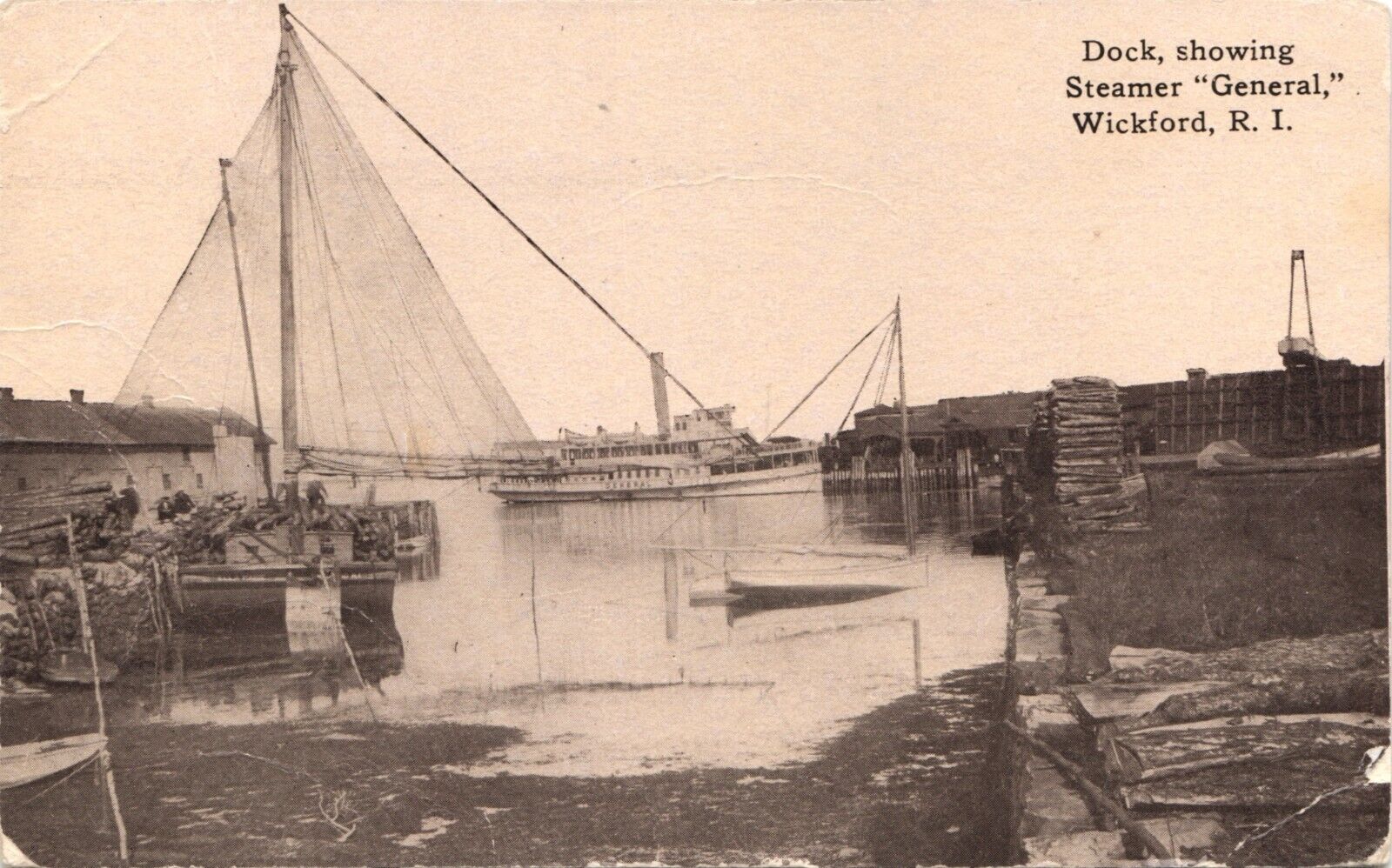
Page 117. Lovecraft sees Wickford again, and remarks that he had not seen it in 21 years. Which puts the first visit at circa 1908 at age 18. This must be the village of Wickford on Wickford Cove at North Kingstown, Rhode Island. About 14 miles south of Providence down the western shore and formerly “Updike’s Landing”. One assumes that this 1908 visit would have been seen on one of his epic solo trolley (tram) excursions at that time. Possibly he was in search of what another of his letters calls “the Pequod Path, ‘the great road of the country’, and just north of Wickford Harbor”. A snippet of biography which may interest Mythos writers. Another letter reveals its later charms… “we explored ancient Wickford with its crumbling wharves, great elms, & centuried white houses”.

Crumbling wharves at Wickford, Rhode Island.

The Fossil for April 2023

16 Sunday Jul 2023

Posted by asdjfdlkf in Historical context, Scholarly works

≈ Leave a comment

A new edition of The Fossil, journal for the history of amateur journalism. This April 2023 issue has some Lovecraft interest for items relating to Lovecraft’s friend Maurice W. Moe. There’s a reprint of Moe’s “Amateur Journalism and the English Teacher”, a newly discovered item. This was his address to the National Council of Teachers of English in 1914. Ken Faig, Jr. follows with a short biography of Moe, with a focus on his amateur journalism work.

Weather Influences

01 Saturday Jul 2023

Posted by asdjfdlkf in Historical context

≈ Leave a comment

New on LibriVox, an audiobook of Weather Influences (1904) by Edwin Grant Dexter of the University of Illinois. Being “An empirical study of the mental and physiological effects of definite meteorological conditions” published for the general reader by the reputable MacMillan publishing company. Thus this is relevant to Lovecraft, in terms of the effects that weather had on his very special physiology and biochemistry.

The book opens with a look at time-worn weather proverbs, animal weather lore, and “Weather Influences in Literature”. It may also interest those interested in the effects of the weather on mental states. The book is also of possible interest to those whose professional interests involve deciding the most receptive time to release new information.

Also online as a ebook in a good Wellcome Library scan. There was a review in the journal Nature in June 1905.

A more contemporary judgement is given in a 2015 article on Dexter, “Edwin Grant Dexter: an early researcher in human behavioral biometeorology”, which states that…

Dexter’s Weather influences, while demonstrating an exemplary approach to weather, health, and behavior relationships, came at the end of a long era of such studies, as health, social, and meteorological sciences were turning to different paradigms to advance their fields. For these reasons, Dexter’s approach and contributions may not have been fully recognized at the time and are, consequently, worthy of consideration by contemporary biometeorologists.

Lovecraftian Pipe Tobacco

18 Sunday Jun 2023

Posted by asdjfdlkf in Historical context, Lovecraftian arts

≈ Leave a comment

A little ahead of the annual ‘Silly Season’ for news… Love-drugs!

Now, I’m not one to go for all this ‘Lovecraftian beers’ malarkey of recent years. And nor would the alcohol-aghast Lovecraft, no doubt. But pipe tobacco has a certain interest, and a little more so following my recent work on Tolkien. He was an avid pipe-smoker, and perhaps the preeminent writer of fiction depicting the joys of pipe-smoking. Thus I was interested to hear of the new Cornell & Diehl’s Lovecraftian Pipe Tobacco series. It seems to be a tin containing a sampling of each of the seven fine ‘Lovecraftian’ blends. Presumably one then orders a bespoke ‘big-bag batch’ of the preferred blend.

As for Lovecraft and smoking, he must have inhaled a fair bit of nicotine in his time (smoking was then common) and especially in New York’s gangster-haunted or bohemian cafes and also at the larger Kalem meetings.

Mids’t them I sit with smoke-try’d eyes” — line from “On the Double-R Coffee House” (1st February 1925).

But, although his mother had urged him to (she “wished that her son might take up pipe smoking”), he had been put off it early and never sported a pipe…

Anent tobacco! I fancy you will be tired of it ere long. Lest you assign to me an excess of credit for conscious asceticism, let me say that perhaps the chief factor my abstinence from the beguiling weed is that I detest the d—d stuff most cordially! Its fumes are disgusting to me, hence — though I smoked when about twelve years old just to seem like a grown man — I left off as soon as I acquired long trousers; which formed a substitute symbol of independent adulthood. I cannot see yet, what anyone finds attractive about the habit of imitating a smoke-stack!

He did once muse on the aesthetic value of tobacco tins, in Selected Letters II. Considered humdrum and thrown away, but he thought that perhaps the best of them would not be overlooked in the future…

Small objects of utility — even the cheapest — have throughout history been sometimes so well made and happily conceived as to win a place in the field of art. Humble Greek and Roman lamps, the lowly commercial pottery of Corinth, every-day bits of Chinese and Japanese lacquer-ware — all sorts of things like this have always been highly esteemed as true, even if unpretentious, art, and have kept to this day an honoured place in museums. Your tobacco-tin undoubtedly belongs in greater or lesser degree to this solid tradition, and all one can say against it is that its wide-spread duplication is likely to lessen its hold on our [present-day] aesthetic sense through sheer accustomedness. Being taken for granted, it may acquire something of the staleness of a hackneyed piece of music; though it will never be less beautiful, or less abstractly appreciated by the analysts of beauty.

Texaco Star & R.E. Howard

12 Monday Jun 2023

Posted by asdjfdlkf in Historical context

≈ Leave a comment

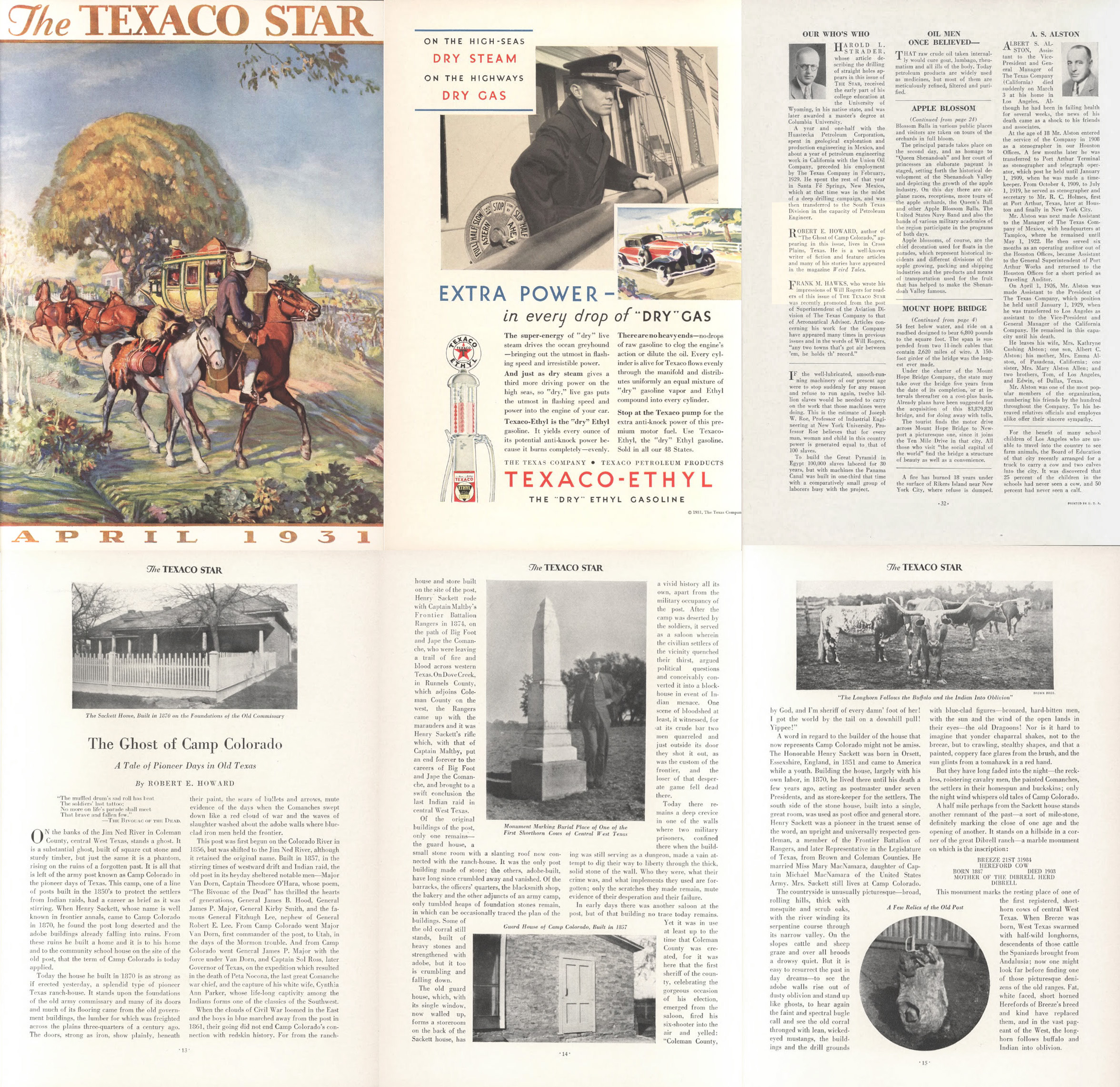
Talman’s Texaco Star trade magazine is online in a full 1913-1963 run, in archival scans at the University of Houston, Texas. This was the official free internal monthly magazine of the Texaco oil company, which he edited from 1930. The run appears to have been placed online in March 2021.

Sadly it can’t be searched across in full-text from a single search-box, and there are no TOCs alongside each issue. But scholars know that it was, under Talman’s editorship, home to some items linked with Weird Tales contributors. There’s a story about Everett McNeil which features him as a character, for instance. Lovecraft talked himself onto the mailing-list by the end of 1930 (for the historical and travel articles), and also considered how he might contribute travelogues. And here’s the Robert E. Howard article from April 1931. He doesn’t get the cover, but I’ve also included the front and back cover for context.

There’s also talk in the Talman letters about a forthcoming Providence article and map in the Star, though I haven’t got that far in the book yet.

Notes on Letters to Wilfred B. Talman – part one

06 Tuesday Jun 2023

Posted by asdjfdlkf in Historical context

≈ 2 Comments

I’m pleased to have bagged a bargain copy of the Talman letters, the full title of which is Letters to Wilfred B. Talman and Helen V. and Genevieve Sully. It’s a hefty 580-page slab, and I’ve made a start on it. Below you’ll find my first set of notes.


Lovecraft begins writing to Talman in early September 1925.

Page 17. Lovecraft calls the Kalem member Arthur Leeds… “a very throughout technician, and experienced in the art of practical suggestion”.

Page 18. He must have rated Myrta Alice Little’s intellect very highly, since in 1925 he ranks her in the nine top “active brains” he knows in amateurdom. His own is presumably the tenth. You’ll recall that in the summer of 1921 this tall beauty was Lovecraft’s faint but quite possible marriage prospect. She was religious, though, and soon married a handsome Methodist preacher.

Page 19. One of these “active brains” is British. An “Ernest Lionel McKeag”. Which one assumes he had at least some correspondence with. McKeag lived on until 1974 (other fannish sources say 1976) and wrote stories for British boys’ comics, true-life naval war-stories, and boys’ science-fiction and even two 1950s ‘lost race’ science-fiction books (published from Stoke-on-Trent of all places). Only his Lost City of the Sierras (1927) sounds like a candidate for a Lovecraft revision, but he seems more than capable of churning out his own tales for juveniles.

Page 19. In September 1925, ahead of Kadath, he describes the basic idea for it as… “extremely fantastic — the picaresque progress of a wandering spirit through the marvellous and undiscovered voids and worlds of the remotest universe”. Which makes it sound as if one of its roots was perhaps in “Iranon”.

Page 20. A large section here on the Moon, which would make an excellent appendix to the forthcoming book on Lovecraft and Astronomy. If it isn’t in already.

Page 22. Lovecraft explains the linkage of the signs of the Zodiac to the Babylonian cycle of the seasons and the human year. It didn’t quite hang true in some details, but I could see how it could do so with just a few tweaks. It’s remarkable that this way of understanding the zodiac constellations has escaped me until now. Again, another candidate for an appendix to the forthcoming book on Lovecraft and Astronomy. Could also be the basis for an interesting children’s picture book, if an illustrator is looking for a project.

Page 26. Lovecraft talks of his taking a Providence night-walk on or about 21st April 1926…

… night before last, during the course of which I discovered one of the most hellish slums ever imagined by mankind. It was in a place whose existence I had not before realised – the end of Chalkstone Ave. near Randall Sq. & the railway – and its dark hilly courts approach the very ultimates of blasphemous horror.

A little later in the book there is additional description, and Lovecraft states he plans to use the place in fiction some day.

Page 29. “The bottle idea […] I got it from that old hermit of 30 years ago in Phillipsdale”. Presumably he means the idea of ‘souls in bottles, with which one could converse’ used in “The Terrible Old Man” (1920) and later tweaked and adapted for Dexter Ward (1927), and that he had first heard the idea from a “hermit” circa age six. Phillipsdale being “a historic mill village along the Seekonk River in East Providence, Rhode Island”, and just across the river from College Hill. The idea of extracting and trapping a human essence is one that also crops up in folk-tales, and is by no means unique to East Providence. But an interesting early source, nonetheless. A quick and cursory search reveals no easily-found record of a “hermit” in Phillipsdale in the 1890s.

Page 31. “I ‘did’ […] Federal Hill — & was astonished by the great Italian churches”. This was presumably a trek made without Eddy, from whom he was at that time estranged (though later, in July 1927, there was a partial gathering of ‘the gang’ in Providence and Eddy was there). Surprisingly, he implies he had not seen these churches before, even distantly from the stagecoach when passing through. Perhaps they were relatively new erections?

Page 37. “Conan Doyle has some fair [weird fiction] stuff, too. “Mystery of Sasassa Valley”, “Captain of the Pole Star”, Round the Fire Stories.” The first was Doyle’s first published story, back in 1879. The next mentioned was 1883, in book form by 1890. Round the Fire Stories (1908) is a book of 17 tales. As the author says in his introduction, despite the cosy title these are actually his stories “concerned with the grotesque and with the terrible”. Thus none of the titles suggests that Lovecraft continued reading Doyle after circa 1909. This chimes with my finding that summer 1908 seems to have been when Lovecraft stopped reading Doyle’s Sherlock Holmes tales.

Page 44. The Old Corner Bookshop (‘Dana’s Old Corner Book Store’) had formerly been in Empire Street, Providence, and a comment from Lovecraft on the stock shows that he patronised it there “years ago”.

Page 50. Lovecraft gives his ideas for an extensive revision of Talman’s first version of “Two Black Bottles” (the final version of which is not included in this volume). The Lovecraft Encyclopedia has… “it seems clear that HPL has not only written some of the tale — especially the parts in dialect — but also made significant suggestions regarding its structure.” Horrorbabble has a free reading on YouTube, of the final version as published in Weird Tales in 1927.

Page 57. Lovecraft talks of “my version” of “Two Black Bottles”. Most likely he refers to the extensive outline/reworking given from page 50 onwards, rather than a story he had actually written from this.

Page 65. Room 328 at the New York Public Library was his favoured evening reading room for material on “Old Providence”. This was on the third floor…

Page 66. A gem of a find. Lovecraft did after all read his friend Everett McNeil’s fantasy / weird work. Many assume that Lovecraft had probably only read his later boys’ adventure novel Tonty. Well, it ain’t so…

Honest old Mac has written weird stuff — and by no means bad, either — but none of it has graced our Chicago contemporary [i.e. Weird Tales] as yet”.

Wish I’d had this quote when I wrote McNeil’s biography.

Page 65. A fabulous quote about Broadway in the morning light. Surprisingly this does not seem to have made it into the Selected Letters…

[In New York I] explore[d] obscure corners in the small hours […] I’ll never forget the sight of the newly-risen sun streaming in a glorious flood of molten gold up the length of Wall St. into still darkened Broadway one morning. It was as if all the past — the brilliant past of Dutch settlers and glamorous shipping and gay coffee-houses — were shining from a land outside time, & welling up from the sea into the dismal & shadowy present.

Page 66. Mention of James Howard Flower and especially his “gem” of a poem “With Shelley in My Soul”). A footnote reveals Flower was a Vermont revision client whose “Shelley” poem has “not been found”. Well, there’s the J. Howard Flower papers, 1899-1959 archive (no Lovecraft letters, it seems), and the James Howard Flower-Solitary Press Collection 1920-1945. This latter “Collection is unprocessed”, and also mis-titled as it should be “Solitarian Press”. “Collection consists of poetry, essays, pamphlets, and issues written by J. Howard Flower and others and printed by the Solitary [Solitarian] Press of Hartford, VT, founded by Flower.”).

Who was who among North American authors, 1921-1939 suggests that these items by Flower himself might be worth inspecting for signs of Lovecraft’s revision…

Florentine Sonnets (1918);
Flower of the Road (1919) (42 page chapbook of verse);
Songs of Love and Liberty (1920);
Under Blue Ascutney (1921);
Florentine Sonnets and Florentine Lyrics (1923)
Bobolinks at Dawn and Whippoorwills at Dusk (1923)

However, one can find that Lovecraft’s friend Walter J. Coates (Driftwind) was also a revisionist for the Solitarian Press. For instance in 1920 Coates revised the Press’s new book Oriental Songs and other Lyrics by one Henry Clay Webster. Thus it’s possible that Lovecraft was revising for those whom the Solitarian Press published, rather than for Flowers himself. Flowers was an ardent socialist from an early age, even a Stalinist by the 1950s, and does not seem the sort of person Lovecraft would have cared to deal with directly. My guess would be that Lovecraft could have been taking ‘overflow’ revision work for the Press from Coates, this being work which Walter J. Coates was unable to manage due to time or complexity.

Still… if anyone’s in Vermont and near the University, it might be worth an afternoon sifting through the 1919-1925 boxes of the Howard Flower-Solitary Press Collection. “Collection is unprocessed”.

Understanding H.P. Lovecraft’s Anxiety

01 Thursday Jun 2023

Posted by asdjfdlkf in Historical context, Scholarly works

≈ Leave a comment

There’s now another recent attempt to fathom Lovecraft’s possible and actual medical conditions, in the new dissertation “Understanding H.P. Lovecraft’s Anxiety Narratives through the Medical Humanities” (2023)…

“I argue that deciphering these writings as anxiety narratives will be giving a new insight about the author, as well as mental illness in general.”

For a Spanish university, in English. Free online, and under Creative Commons.

Interestingly, and somewhat in relation to this, I recently heard that the years 1908-11 are now deemed to have been the coldest years on record in the USA, a run which broke in the “notably fine summer of 1911” before the nation was plunged into the well-documented and bitter winter of the ‘1911–12 United States cold wave’. 1908 coincides quite well with the start of Lovecraft’s hermitage / mystery years of 1908-1916, and this makes me think that new attempts at diagnosis would necessarily have to closely consider the weather and temperatures of New England and also New York City.

The essay on the influence of the fluctuating seasonal temperatures on Lovecraft has yet to be written, I think. Or perhaps a timeline + graph might be a better format. Whatever the format, first one would have to track down the reliable non-‘adjusted’ data, ideally drawn from and referenced to primary data such as local newspapers of the period. I see there are now books on the history of New England weather, but they focus on the front-page headline events and have titles such as Mighty Storms of New England. I find that Lovecraft’s own favoured source, The Old Farmer’s Almanac, can only provide North Providence data back to 1945. Perhaps a Tentaclii reader knows where a good reliable and succinct week-by-week graph for pre-1938 North Providence might be had?

Intellectual Vagabondage (1925)

30 Sunday Apr 2023

Posted by asdjfdlkf in Historical context

≈ Leave a comment

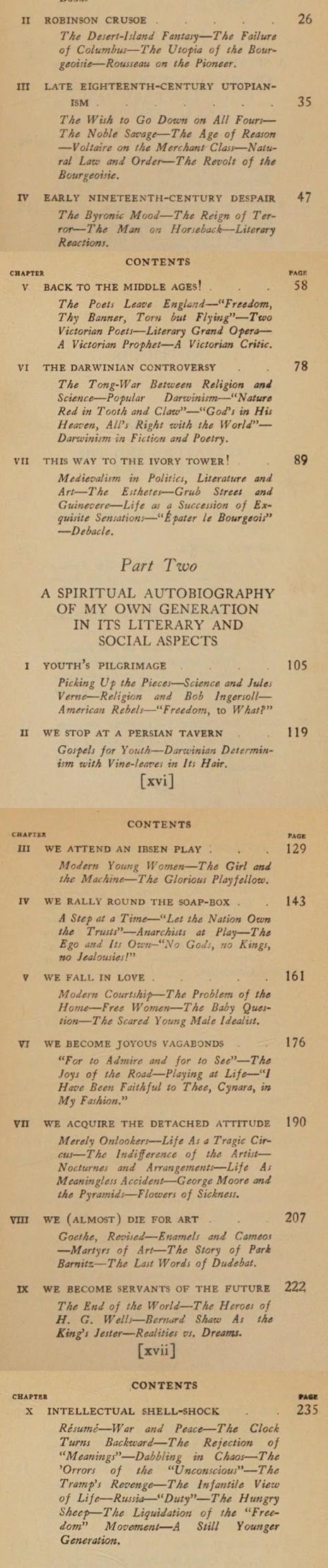
New on Archive.org, a useful layman’s survey of the intellectual landscape in which Lovecraft has steeped himself and was living through until the mid 1920s, with particular focus on American reception (or not) of such ideas and trends. Intellectual Vagabondage: an apology for the intelligentsia (1925) has an off-putting title, sounding now like some dour treatise against Marxism. But instead we find a crisp and accessible survey, written by one with ‘boots on the ground’ at the time, as can be seen here by the contents list…

Lovecraft was right, part 583

29 Saturday Apr 2023

Posted by asdjfdlkf in Historical context, Odd scratchings

≈ Leave a comment

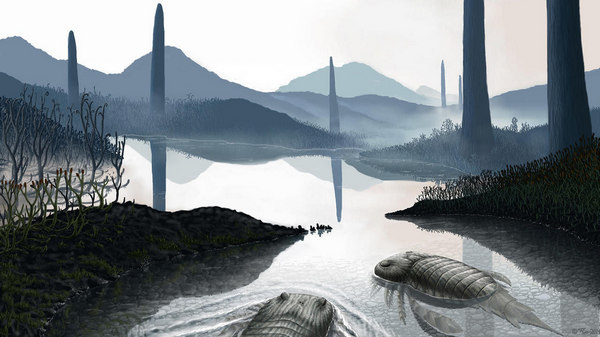
“Mystery prehistoric fossil verified as giant fungus”. 18 to 26 foot high, possibly higher when ‘flowering’ to shed spores. So far as we know Prototaxites did not have the ‘mushroom caps’ that they have today. Just the ‘stalks’.

Picture: “Pioneers of the land” by Plioart on DeviantArt.

I also note… “A new Palaeozoic plant closely allied to Prototaxites”, identified in Nature Geoscience in 2012… “It differs from Prototaxites only in its possession of internally differentially thickened tubes.” One must now assume that these were also fungi.

Therefore, Lovecraft’s depiction of towering and gigantic fungi in the “Palaeozoic” period of Earth’s prehistory now seems somewhat prescient…

The omnipresent gardens were almost terrifying in their strangeness, with bizarre and unfamiliar forms of vegetation nodding over broad paths lined with curiously carven monoliths. Abnormally vast fern-like growths predominated; some green, and some of a ghastly, fungoid pallor. […] Fungi of inconceivable size, outlines, and colours speckled the scene in patterns bespeaking some unknown but well-established horticultural tradition.” (“The Shadow out of Time”)

He doesn’t pin down what these inconceivably giant fungi looked like and, in his focus on giant fern forests later in the tale, he stays within the then-consensus of science until 1906. After 1906 the consensus rapidly breaks down as seed-bearing fossil plants are discovered. There were still giant fern forests, but they are no longer thought to have dominated the land.

But we do get the clear idea, early on in Lovecraft’s tale, that this is a Palaeozoic world where there are also gigantic fungi. Also that some of what he thinks of as distant ferns (“fern-like”) may in fact be fungi (“some of a ghastly, fungoid pallor”).

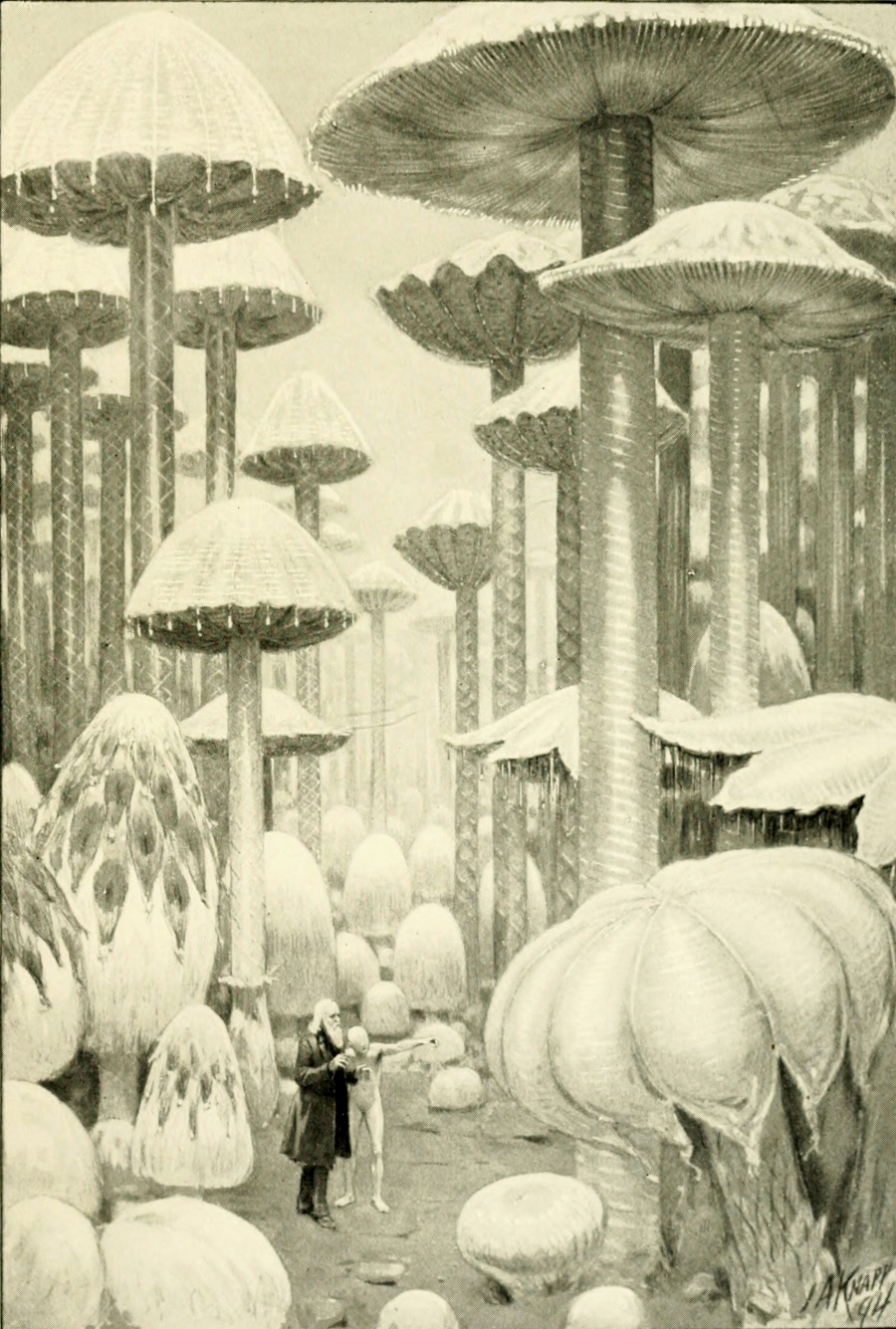
Gigantic fungi were sometimes known in 1930s science fiction, though also known far earlier in time by the Lovecraft Circle. A remark by Lovecraft shows that many in the Circle knew the illustrated fantasy book Etidorhpa (1895) by John Uri Lloyd…

that strange old novel “Etidorhpa” once pass’d around our Kleicomolo circle and perus’d with such varying reactions

Illustrations for ‘Etidorhpa’ (1895).

They would also have known Verne’s Journey to the Centre of the Earth (1864), in which the shores of the Central Sea harbour a forest of giant mushrooms. Also the fungi landscapes of the H.G. Wells novel The First Men in the Moon (1901).

But was Lovecraft ahead of science on placing giant fungi both in the distant prehistoric past and living above-ground? It seems so. The 1911 Britannica passage on Palaeozoic | Fungi give the strong impression they were small or microscopic, and elsewhere has… “The few and incomplete data which we at present possess as to Palaeozoic Fungi do not as yet justify any inferences as to the evolution of these plants”. So far as I can tell from some searches, nothing much changes in the science for many decades thereafter.

Notes on The Conservative – October 1915

20 Thursday Apr 2023

Posted by asdjfdlkf in Historical context

≈ Leave a comment

Notes on The Conservative, the amateur journalism paper issued by H.P. Lovecraft from 1915-1923.

Part Three: the October 1915 issue.

Lovecraft has now issued his third issue of his own amateur paper The Conservative. Is it a Halloween ‘horror’ issue? Let’s find out.

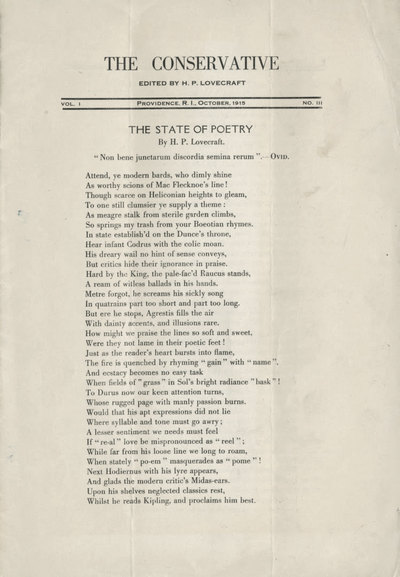
He opens with his poem on “The State of Poetry”, headed by a line from Ovid which translates for sense as “Ill-mated things have discordant offspring”. This might seem to some to hint at key themes in his future fiction. The poem ushers forward a series of would-be bards to perform for a king, each bard offering his own form of poetic ineptitude or gross error of topic. One suspects the readers of The Conservative would have been well be able to identify each amateur journalist thus given their turn on the stage. These are sometimes well masked, with names such as “Mundanus”, or even left un-named as mere Whitman-esque “degen’rate swine”.

Note the line of poetry “Ablest is he who in rhyming can reach / The Lofty coarseness of a Cockney speech”, something that Lovecraft had experienced in his own city of Providence at the astronomical Ladd Observatory, in the company of the “affable little cockney from England” John Edwards. Lovecraft ends his verse by suggesting the true poet will do best in chaste seclusion (such as his own, hem hem), restoring ancient times with his imaginative ‘fancy’ and learning much from the lost Golden Ages of creativity such as the England of Shakespeare or Johnson.

His essay “The Allowable Line” naturally follows from the poem. It is headed by another untranslated line from the Roman poet Horace. A line which translates for sense as “On discovering dazzling brilliance, disregard the flaws”. In the essay he continues his debate with Kleiner, begun in the previous issues and continued in correspondence, on the “allowable rhyme”. He tracks this through history, giving a basic outline of its once-common use in English poetry, and then the later emergence of stricter rhyming. In this we also have the sense that Lovecraft has read the work of all those he names, and with due attention. Not that he liked all of them, and for instance he calls Erasmus Darwin’s poetry “pompous”. Though if all he recalled, and hazily so (“Darwin’s ‘Botanick Garden’ … my early reading”) was The Economy of Vegetation, then he may not have realised that the slump in the middle of this book is likely the result of Darwin’s collaborator slotting in her own unheralded verses.

His “Editorial” bites back against the “insulting insects” that have begun to infest his mail-box, and he threatens to publish their letters with “original style, spelling, grammar” in future. The short article “The Conservative and His Critics” naturally follows, headed by more lines from Horace, which can be translated as “It is better, I warn you, not to make me touchy”. Then some short poetic ripostes to politically pro-German lines of wartime verse which had attracted Lovecraft’s special ire.

We then come to the meat of the issue, with the long essay “The Renaissance of Manhood”. Here Lovecraft forensically identifies the types of pacifists who oppose a just and necessary war, and suggests their motivations. One feels he will have more to say on the topic in future. Though as S.T. Joshi has observed, his own attempts at patriotic poetry will fail to rise above mediocrity.

The essay “Liquor and its Friends” reveals that he broadly subscribes at this time to the ‘trickle-down theory’. Those at the top of society must first set an example, “which will then work downwards, as if through gravity”.

His thoughts on “The Youth of Today” follow. He welcomes the postal approach of “schoolboys of today [who] fear not to speak as they think”, and here we learn of how he first encountered his new young protege David H. Whittier.

“Symphony and Stress” appears at first sight to examine another side of amateurdom, in which amateur papers were “the product of a small circle of cultivated ladies”. Yet mid-way he compares this to Lockhart’s anti-rum paper Chain Lightning which vividly recounts “unspeakable evil” among the alcoholics and “horrors utterly beyond the realization” of the sheltered ladies. All drawn from Lockhart’s experiences in his own town. Lovecraft ends by asking the ladies to forbear in their mild criticism of negative-minded “buzzards” in amateurdom. Each has their place, and may do good in their own way.

He briefly lauds some improving amateur papers from youths, and especially notes Basinet’s paper The Rebel. Lovecraft states he knows Basinet personally, but what goes unsaid is that the lad was one of the largely Irish group of Providence amateurs — later to be so ably documented by Ken Faig Jr. Here Lovecraft notes that Basinet has recently switched his leftist beliefs from socialism to anarchism. Dunn, of the same local group, is also noted in the context of discussions of the ever-vexed Irish question. Lovecraft seems to be of the opinion that “Ireland is now an equal and integral part of the British Empire” and thus (presumably) nothing more need be said.

A back-page poem by John Russell titled “Socialism” marks the end of the issue. Russell was a long-distance Lovecraft correspondent (West Tampa, Florida) from 1913 through 1925, encountered via a vehement debate in the pages of The Argosy. This 1915 poem foresees the “stagnant pool” that society would become if a wise man and a fool were to receive the same treatment and income in a vain attempt to enforce a socialist economy. Also the way that socialist leaders, inevitably authoritarian, would start to find underhand ways to “grab the most they could” from the masses.

The Halloween horrors that some Lovecraftians might have been expecting of an October issue are thus… not here. Yet in a way, it is a horror issue of a sort. There are “insulting insects” in Lovecraft’s mail-box; he details some of the very real “unspeakable evil” which emerges from alcoholism; and finally anticipates the looming horrors of socialism — horrors which were to become manifest soon after Trotsky’s Moscow coup in 1917.

Overall one has a strange sense of familiarity with the present day. An ugly mix of high-flying philosophical debate and pro-enemy sympathies during wartime; a hazy vision of socialism which seduces a vocal minority among the young; a mass of hide-bound reactionaries unwilling to adapt to the new modernity; while lone grassroots voices battle for the truth about ruined lives and families in their own town. Also a tendency among creatives toward a complacent withdrawal from it all, into a rose-tinted myopia in which beautiful and well-formed poetry is everything.

Providence Lost, Providence Regained

19 Wednesday Apr 2023

Posted by asdjfdlkf in Historical context

≈ Leave a comment

“Providence lost, regained IV”, being the final part of a recent set of blog posts which give…

the epilogue of my book, Lost Providence, entitled Providence Lost, Providence Regained. Published in 2017, the book is a history of the design of the modern-day capital of Rhode Island, specifically of its downtown.

The Story of Saxon and Norman Britain Told in Pictures

15 Saturday Apr 2023

Posted by asdjfdlkf in Historical context, Scholarly works

≈ Leave a comment

New on Archive.org, a key ‘picture-book history’ from a series that Lovecraft collected and enjoyed after he saw some of them offered at budget prices in the local Woolworth store. The upload of The Story of Saxon and Norman Britain Told in Pictures (1935) is of a good clear scan, and the 122Mb PDF file is freely available for download.

Also uploaded a few months ago “to borrow”, another in the series, The Story of Tudor and Stuart Britain Told in Pictures.

← Older posts
Newer posts →


Please become my patron at www.patreon.com/davehaden to help this blog survive and thrive.

Or donate via PayPal — any amount is welcome! Donations total at Easter 2025, since 2015: $390.

Archives

  • March 2026
  • February 2026
  • January 2026
  • December 2025
  • November 2025
  • October 2025
  • September 2025
  • August 2025
  • July 2025
  • June 2025
  • May 2025
  • April 2025
  • March 2025
  • February 2025
  • January 2025
  • December 2024
  • November 2024
  • October 2024
  • September 2024
  • August 2024
  • July 2024
  • June 2024
  • May 2024
  • April 2024
  • March 2024
  • February 2024
  • January 2024
  • December 2023
  • November 2023
  • October 2023
  • September 2023
  • August 2023
  • July 2023
  • June 2023
  • May 2023
  • April 2023
  • March 2023
  • February 2023
  • January 2023
  • December 2022
  • November 2022
  • October 2022
  • September 2022
  • August 2022
  • July 2022
  • June 2022
  • May 2022
  • April 2022
  • March 2022
  • February 2022
  • January 2022
  • December 2021
  • November 2021
  • October 2021
  • September 2021
  • August 2021
  • July 2021
  • June 2021
  • May 2021
  • April 2021
  • March 2021
  • February 2021
  • January 2021
  • December 2020
  • November 2020
  • October 2020
  • September 2020
  • August 2020
  • July 2020
  • June 2020
  • May 2020
  • April 2020
  • March 2020
  • February 2020
  • January 2020
  • December 2019
  • November 2019
  • October 2019
  • September 2019
  • August 2019
  • July 2019
  • June 2019
  • May 2019
  • April 2019
  • March 2019
  • February 2019
  • January 2019
  • December 2018
  • November 2018
  • October 2018
  • September 2018
  • August 2018
  • August 2015
  • July 2015
  • April 2015
  • March 2015
  • February 2015
  • January 2015
  • December 2014
  • November 2014
  • October 2014
  • September 2014
  • August 2014
  • July 2014
  • June 2014
  • May 2014
  • March 2014
  • February 2014
  • January 2014
  • December 2013
  • November 2013
  • October 2013
  • September 2013
  • August 2013
  • July 2013
  • June 2013
  • May 2013
  • April 2013
  • March 2013
  • February 2013
  • January 2013
  • December 2012
  • November 2012
  • October 2012
  • September 2012
  • August 2012
  • July 2012
  • June 2012
  • May 2012
  • April 2012
  • March 2012
  • February 2012
  • January 2012
  • December 2011
  • November 2011
  • October 2011
  • September 2011
  • August 2011
  • July 2011
  • June 2011
  • May 2011
  • April 2011
  • March 2011
  • February 2011
  • January 2011
  • December 2010
  • November 2010
  • October 2010
  • September 2010
  • August 2010
  • July 2010

Categories

  • 3D (14)
  • AI (70)
  • Astronomy (70)
  • Censorship (14)
  • de Camp (7)
  • Doyle (7)
  • Films & trailers (101)
  • Fonts (9)
  • Guest posts (2)
  • Historical context (1,095)
  • Housekeeping (91)
  • HPLinks (76)
  • Kipling (11)
  • Kittee Tuesday (92)
  • Lovecraft as character (58)
  • Lovecraftian arts (1,628)
  • Lovecraftian places (19)
  • Maps (70)
  • NecronomiCon 2013 (40)
  • NecronomiCon 2015 (22)
  • New books (966)
  • New discoveries (165)
  • Night in Providence (17)
  • Odd scratchings (984)
  • Picture postals (276)
  • Podcasts etc. (431)
  • REH (184)
  • Scholarly works (1,469)
  • Summer School (31)
  • Unnamable (87)

Get this blog in your newsreader:
 
RSS Feed — Posts
RSS Feed — Comments

H.P. Lovecraft's Poster Collection - 17 retro travel posters for $18. Print ready, and available to buy — the proceeds help to support the work of Tentaclii.

Proudly powered by WordPress Theme: Chateau by Ignacio Ricci.