• About
  • Directory
  • Free stuff
  • Lovecraft for beginners
  • My Books
  • Open Lovecraft
  • Reviews
  • Travel Posters
  • SALTES

Tentaclii

~ News & scholarship on H.P. Lovecraft

Tentaclii

Category Archives: Historical context

Further down Willoughby Street

16 Monday Aug 2021

Posted by asdjfdlkf in Historical context, New discoveries

≈ Leave a comment

In the second volume of his Letters to Family, H.P. Lovecraft reveals more about the location of his favourite cafe haunt “John’s” in Brooklyn in the mid 1920s. Readers of Tentaclii will recall I took a look for this location in my April 2021 post “Lunch in New York: Spaghetti in Breuckelen”. After that post I had a blog comment from ‘SJM’ pointing out a John’s in the Brooklyn tax-photos at…

185 Willoughby Street, corner Navy Street

… but I left the comment unapproved as I was fairly sure it was not the John’s. 185 Willoughby was a cafe and small corner-store relatively far up Willoughby Street and not especially close to Fulton. There are two photos of 185, one obviously showing changes after a few years.

The latter is from 1940s.nyc and feels like it’s perhaps a few years on after remodelling and gentrification associated with the new high-rise that has gone up in the background.

But a problem arises in this apparent identification… because on page 937 of Letters to Family Lovecraft states…

All three now set out for dinner — at the old Bristol Dining Room in Willoughby Street near Fulton, next door to the now defunct John’s, which was my Brooklyn headquarters for spaghetti in the old days. (July 1931)

Next door.

“Bristol” was the long-established Bristol’s Dining Room, with Mr. J. E. Bristol proprietor. He had a small chain of eight such in New York City by 1920. Can it be found? Well, there is this postcard picture, which appears in a book dedicated to such from the 1905-07 period in Brooklyn…
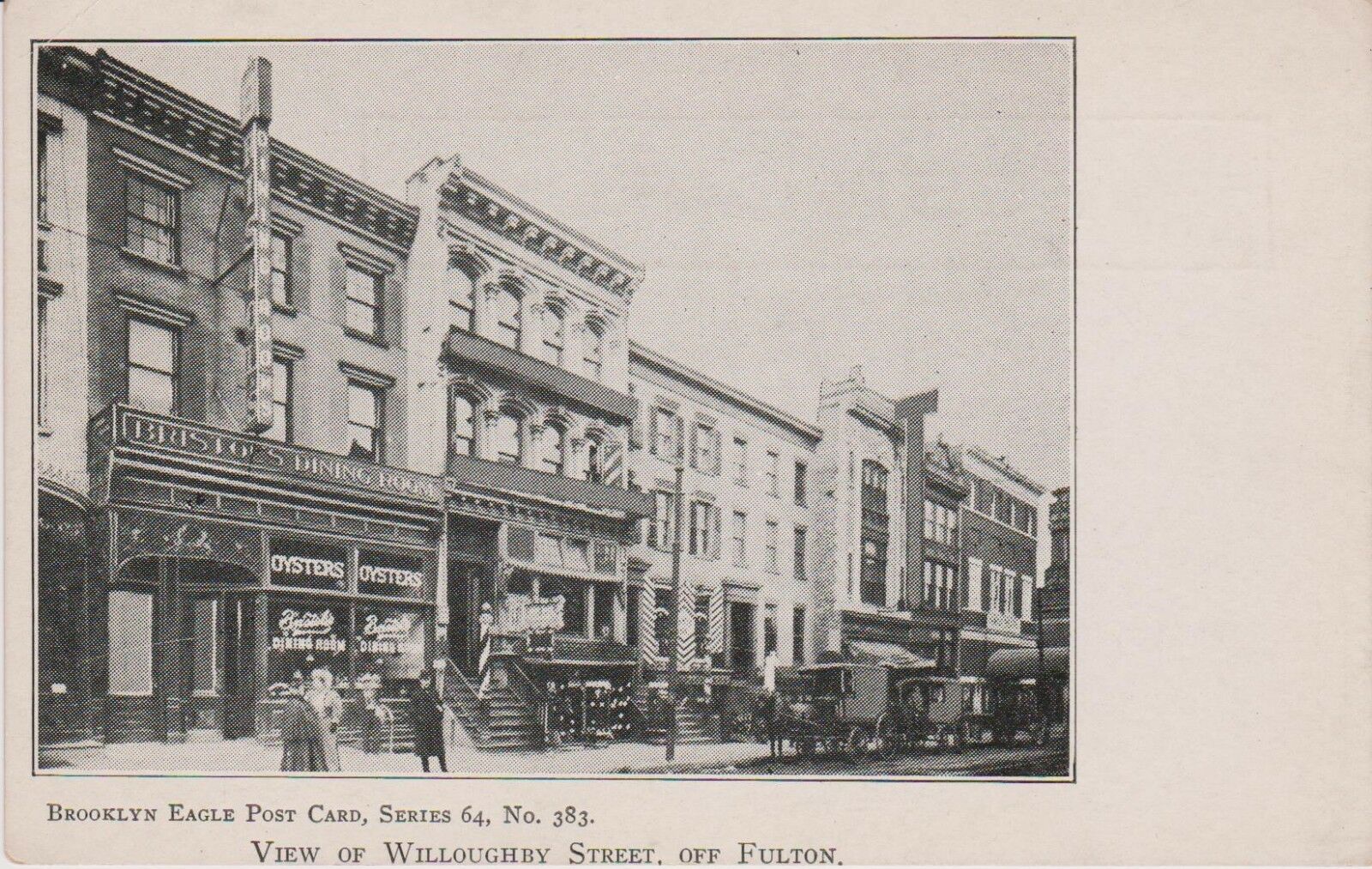
Here is the old Bristol’s Dining Room seen in all its oyster-purveying glory. As one can see, there is no architectural or street-furniture comparison to be found between the suggested site at 185 Willoughby and the postcard of Bristol’s Dining Room. If, as Lovecraft states, his old John’s was next to the Bristol’s Dining Room then it would either have been in the next-door barbers’ shop (barbering pole, outside) seen up steps on the right of the postcard, or is off to the immediate left and out of range of the camera.

Nor is there, on the 185 Willoughby or its adjacent 1940s.nyc pictures, any glimpse of a possible Bristol’s Dining Room next door. The clincher is that in summer 1931 Lovecraft talks of the “defunct John’s”. Therefore it would not be seen on a late 1930s / early 1940s tax picture. Most likely another nearby cafe took the name in the 1930s, perhaps hoping to profit a little on the name-recognition.

What then was the exact address of the Bristol’s Dining Room in Brooklyn in the mid 1920s? Could it have moved since 1900? Was there more than one in Brooklyn by that time? Those are possibilities. But regrettably the address cannot be discovered on the Web in public records or books, though those with access to pay-walled genealogy records might find it. Nor is there any 1920s branch advertising-map or suchlike to be found.

Can the architecture seen on the card be found on a virtual trot down Willoughby Street? Not on 1940s.nyc, so far as I can see.

So, it’s still a mystery.

Lovecraft and Michigan

11 Wednesday Aug 2021

Posted by asdjfdlkf in Historical context

≈ 4 Comments

A new question from a Patreon patron: “Did HPL ever mention the U.S. state of Michigan, or its city of Detroit?”


There is nothing to be found in the fiction or poetry, but small gleanings can be picked up elsewhere.

In his youth Lovecraft would have been aware of the astronomy work at the University of Michigan, and he mentions this in his essays “Are There Undiscovered Planets?” (c. 1906) and “Does ‘Vulcan’ Exist?” (also c. 1906 and about an as-yet undiscovered planet)…

Another remarkable ‘discovery’ was that made by Profs. Watson and Swift at Ann Arbor, Mich., during the eclipse of 1878, when both observers pointed out two objects, one as the hypothetical Vulcan

Lovecraft’s uncle Franklin Chase Clark had published a number of articles in the Detroit Medical Journal. Lovecraft also knew some the very early and tangled history of Detroit and noted its ill-fated Governor of the 1790s and his grisly end…

thirteen of the pirate Blackbeard’s men were subsequently hang’d near by — as well as the royal governor of Detroit, Henry Hamilton

This was as gory as some of the 1920s newspaper reporting it seems, The Unique Legacy of Weird Tales noting that…

Throughout the 1920s, newspapers and journals broke stories about alternative religions (almost always labelled as cults) that made extravagant claims about their ability to secure earthly power and riches for their followers. Additionally, tabloid-style papers like the New York Herald claimed that cultists were responsible for a variety of murders and disappearances (for example … a Detroit murder cult).

… and referencing as the source Phillip Jenkins, Mystics and Messiahs: Cults and New Religions in American History (Oxford University Press, 2000).

Lovecraft was later aware of Detroit as the home of the far more mass-murderous automobile cult. For instance, he writes…

Brattleboro came in the dead of midnight. The rail journey was at an end, and five miles of narrow hill road in a Detroit chaise brought me to the isolated Orton dwelling.

Houdini tried to get Lovecraft to visit Detroit, early in their business relationship. But Lovecraft demurred…

Our slippery friend Houdini, who was here early in the month, and rushed me to hell preparing an anti-astrological article to be finished before his departure — a matter of five days … He says he has a devilish lot more for me to do and has been trying to get me to meet him in Detroit at his own expense to talk things over — but I have maintained that I can do business best within sight of my native town’s Georgian steeples.

The amateur journalist and early Lovecraft collaborator Winifred V. Jackson seems to have had a connection, as she was married there for her first marriage. The amateur whose supernatural desert story provoked Lovecraft’s own “The Transition of Juan Romero” was from Michigan, or at least was educated there…

Philip B. McDonald graduated M.E. (Master of Engineering) from Michigan College of Mines. In Lovecraft’s The Conservative, McDonald was stated to be ‘Assistant Professor of Engineering English, University of Colorado’ in July 1918.

“The Transition of Juan Romero” being a quick ‘demo story’ for Lovecraft’s friends, to demonstrate how a ‘total makeover’ revision could be achieved. Hence the unusual desert setting, which had been in the original tale… and which I later discovered to be ‘Area 52’ of UFO fame.

Lovecraft had a late post-1933 correspondent-protege from Michigan, the telegraphist Richard F. Seawright (see Letters to Richard F. Seawright, 1992).

Major amateur journalist meetings were not unknown in the state, and Lovecraft had verbal and written reports from those who attended. Which may also have given him some impressions of the state…

I had an enjoyable visit from our good old colleague Mocrates the Sage [Moe], now on a visit to various eastern points after a sojourn at the Grand Rapids N.A.P.A. Convention.

Amateurs evidently gleaned some linguistic amusement from listening in on the local lingo during such convention visits, and Lovecraft reported that one…

James F. Morton, Jr., lent a climactic touch [to the end of one meeting of amateurs] with some inimitable stanzas on the pronunciation of English as practiced in various centres of culture, including Kalamazoo.

In chronicling the early interest in Lovecraft, S.T. Joshi observed substantial contributions from Detroit…

In 1958 the University of Detroit’s literary magazine, Fresco, devoted an entire issue to works by and about Lovecraft.

There was also Maurice Levy’s Lovecraft: A Study in the Fantastic (1988) from Detroit and the Wayne State University Press.

Netopian, 1921-27

11 Wednesday Aug 2021

Posted by asdjfdlkf in Historical context

≈ Leave a comment

On eBay, a run of The Netopian, 1921-27. This was the local Hospital Trust pictorial magazine which Lovecraft took and read. There are two runs in the archives in Providence, but neither has yet been scanned from paper. Likely to have at least a half-dozen pictures of interest to Lovecraftians, I’d guess.

The Bijou on Westminster St.

30 Friday Jul 2021

Posted by asdjfdlkf in Historical context, Picture postals

≈ Leave a comment

Added to my 2013 H.P. Lovecraft, ticket-seller post, a picture of my best-guess at the cinema where Lovecraft might have briefly been the ticket-seller. The Bijou on Westminster St.

Popular Mechanics 1902-2016

26 Monday Jul 2021

Posted by asdjfdlkf in Historical context

≈ Leave a comment

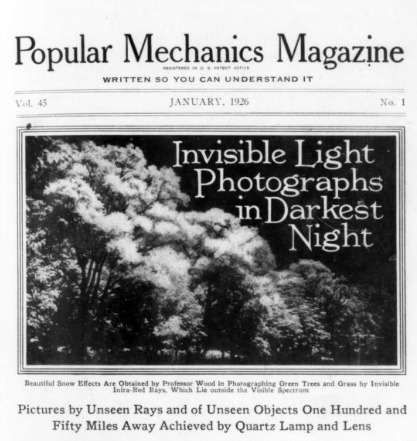
A run of Popular Mechanics magazine, 1902-2016 is being uploaded to Archive.org from microfilm, with 500 now uploaded (some still processing and just showing the cover). Including Lovecraft era titles. Such as this one from January 1926, just over a year before “The Colour Out of Space”…

Arthur Leeds on movie special effects, 1922

24 Saturday Jul 2021

Posted by asdjfdlkf in Historical context, New discoveries

≈ Leave a comment

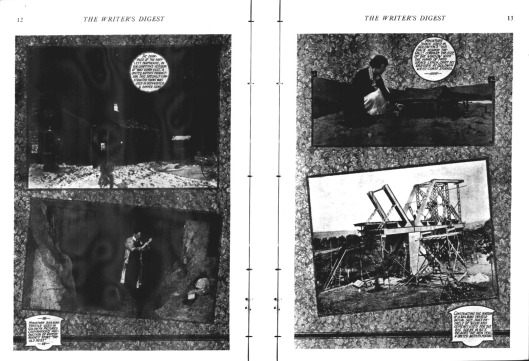
An article on special effects in movies, by Lovecraft’s friend and Kalem member Arthur Leeds. In the Writer’s Digest for July 1922, recently uploaded to Archive.org.

He had a number of practical and market-survey articles in Writer’s Digest from summer 1921 and into 1922, plus an interview-based article on George Allen England.

Frank Gruber’s The Pulp Jungle

22 Thursday Jul 2021

Posted by asdjfdlkf in Historical context

≈ Leave a comment

New on Archive.org in public PDF, The Pulp Jungle (1967) by Frank Gruber. A pithy and entertaining memoir of writing for the New York City pulps from 1927 and through the 1930s, as recalled in the mid 1960s. The uploader notes…

It’s now a rare book, long out-of-print and increasingly difficult to find on the second-hand market.

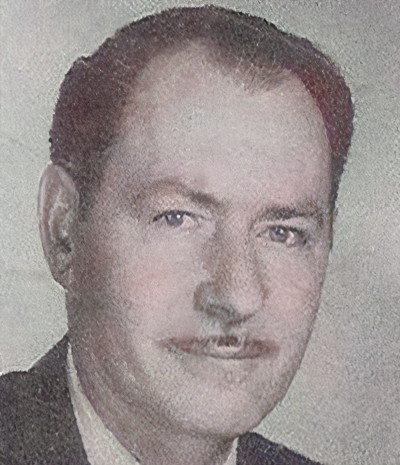
Frank Gruber, pulp writer.

Lovecraft and Pan

22 Thursday Jul 2021

Posted by asdjfdlkf in Historical context

≈ Leave a comment

Phil Hine on H.P. Lovecraft and Pan, the ancient mythic figure. The young Lovecraft was enraptured by the 18th century’s sylvan poetic evocations of Pan. Hine also discusses the story “The Temple” from a pagan perspective.

Popular Astronomy, 1893-1951

19 Monday Jul 2021

Posted by asdjfdlkf in Historical context, Scholarly works

≈ 1 Comment

Now being loaded onto Archive.org from microfilm, the U.S. Popular Astronomy journal, 1893-1951.

Notes on Letters to Family, Vol. II – part two

12 Monday Jul 2021

Posted by asdjfdlkf in Historical context, New discoveries

≈ Leave a comment

More notes on my reading of the second volume of H.P. Lovecraft’s Letters to Family, here mostly relating to 1926-1928.

There is an interesting description, re: a possible inspiration for “The Colour Out of Space”, of a ground curiously mineralised and as-if “powdered with star-dust” (page 604). He finds this in September 1926 scattered around the 1707 birthplace of the early astronomer David Rittenhouse (1732-1796), a homestead that had been encountered by chance as Lovecraft was lost while exploring the Wissahickon Valley. “Colour” was written some six months later.

Lovecraft saw the grand historical-adventure movie Ben Hur (page 602). Later he remarks on his break from cinema-going, between Aug-Sept 1927 and May 1928.

He recalls the Old Corner Bookshop (page 612). Presumably Dana’s Old Corner Bookstore in Providence, as he had sold some of his mother’s books to them and later regretted parting with one such when he saw it on display in the window.

He remarks that, like himself, his friend Loveman also had many young proteges… “He had with him one of his numberless prodigy-proteges, a quiet blond youth whose accomplishments seem to be, so far, appreciative rather than creative” (page 632).

In April 1928 Loveman had noticed that the old rooming house, 169 Clinton St. on the edge of Red Hook, appeared abandoned and with some windows smashed. However, in May 1928 Lovecraft and Loveman went to bid it a final goodbye… only to find it revived (a fresh coat of paint and “marks of rehabilitation”) and thus presumably under new ownership (pages 634 and 661).

By April 1928 the Kalem meetings had “almost dissolved” (i.e. dwindled to just a few attendees) but were strongly revived while Lovecraft was again living in New York City.

On discovering that some museums would make a good affordable plaster-casts for private display, he remarks… “it was my original design in youth to have a private museum of Greek & Roman casts”.

He discovers an old Antarctic adventure novel he has not yet read, titled Revi-lona: a Romance of Love in A Marvelous Land (1879) by a journalist of the time. An explorer finds love with sex-starved women in a tropical shangri-la amid the ice. Apparently very floridly written and yet ultimately conveying the rather cynical and anti-utopian sentiments of an American newspaperman. The implication is that Lovecraft has read most such novels, but that this is a new find for him. Not on Archive.org under that title.

“The Spence book on Atlantis that I read so hurriedly just before departing for my trip” (page 637). There is no footnote for this book, and both “Spence” and “Atlantis” are curiously missing from the index. Lewis Spence wrote five books about Atlantis, and the most likely in spring 1928 was the relatively new The History of Atlantis (1927), though it might have been the earlier The Problem of Atlantis (1924) or Atlantis in America (1925).

Lovecraft read at least one non-fiction book by Lewis Mumford on architecture. This was prior to Mumford’s efflorescence of ideas on tools, technologies and civilisation.

He knew, read and kept the magazine published by the Hospital Trust in Providence. This produced the fine Netropian journal, with many local history articles and local drawings from the 1920s. Copies apparently languish in paper at Brown and the Rhode Island School of Design, un-scanned.

He mentions reading and being impressed by a volume of poetry by Gessler, friend of his best friend Belknap Long, titled Kanaka Moon (1927). Not on Archive.org.

He found Morton’s full library very impressive when he saw it fully assembled and shelved at Paterson, and thought it better even than that of Cook. “I’ve never seen so fine a private Library” (pages 657 and 658).

Lovecraft finds he has a family-tree line named “Fish” (page 663), and this is some years before the writing of “Innsmouth”.

There was a time when $5 would buy you a custom original plot-synopsis by H.P. Lovecraft. In the spring of 1928 he was writing many such plots for one “Reed”, at the jobbing rate of a dollar per page (page 668). We later learn this client to be a “Mrs Reed” (page 676), now of course known to be his revision client Zealia Brown Reed.

Lovecraft revised the first chapter of McNeil’s historical-adventure novel The Shores of Adventure (1929). In which the boy hero earns and acquires his father’s super-sword.

In summer 1928 he notes “a resumption of the Providence Line of New York boats”, meaning passenger services from Providence — New York City.

Lovecraft discovered an old unchanged working colonial farmstead, “in full sight of the distant towers of Manhattan” and with its inhabitants oblivious to modernity of New York City (page 678).

The Goat with a Thousand Young

10 Saturday Jul 2021

Posted by asdjfdlkf in Historical context

≈ Leave a comment

Rock Hill Herald profiles the Lovecraft-contemporary known as the ‘Goat Gland King’, the sort of quack that Lovecraft appears to laugh at in several works. In this case, John Romulus Brinkley was active from 1916 into the early 1930s. He offered expensive quack treatments claiming that goat-gland transplants would “restore sexual vitality and fertility to impotent or ‘tired’ men”.

However as I’ve noted in “On Lovecraft’s glands”, while laughing at such things Lovecraft also held long-standing notions about ‘glands shaping personality’ and believed glandular compulsion to be the major factor driving various forms of sexual aberrancy. It appears to have followed, for him, that the more tiresome emotions could be ignored because they were just the passing result of “glandular secretion & hormonic discharge”.

These notions were not the result of some cranky middle-aged idée fixe but were more or less a normal take-up of the emerging science-based ideas of his time, half-baked though some of them may now seem. But he was perhaps unusual in extending his glandular thinking to aesthetic capabilities, which may have raised a few eyebrows among the reputable scientists in the field…

There are subtleties & overtones on my side that you can never get [on the] emotional & imaginative wave-lengths. […] we’re simply not built the same way & our glands simply don’t function the same way” (To Woodburn Harris, 1929).

One’s glandular state was then for him a kind of determinism. One had been ‘born that way’, and nothing could be done about it. But he once mused that this dulled state was perhaps not perpetually fixed. Some future eugenic improvement might open up people to new aesthetic experiences that they would otherwise be incapable of…

While nothing in our normal experience is ever likely to call forth any additional senses, it is not impossible that experiments with the ductless glands might open up a fresh sensitivity or two — and then what impressions might not pour in?” (To Ashton Smith, 1933).

In this he seems to vaguely anticipate the technocratic post-war ideas of Marshall McLuhan, who suggested that experiencing electronic media and information-flows might extended man’s “entire nervous system” and thus “produce an entirely different state of being” with access to expanded aesthetic senses. No need for those old 1930s goat-glands, just plug in your gleaming 1970s Home Cinematron screen.

“At last I came to the city itself – and here I still am!”

30 Wednesday Jun 2021

Posted by asdjfdlkf in Historical context

≈ Leave a comment

New to me, the HPLHS has a two-page Providence Sunday Journal replica newspaper sheet. It marks the moment that most people in Lovecraft’s Providence learned that a major author had been living among them. HPLHS are expert prop-makers, so despite the lack of yellowing I suspect you can be sure it’ll look and feel, and perhaps even smell, like a real fresh-and-inky 1940s city newspaper sheet.

You also get the reverse, which continues the long article.

← Older posts
Newer posts →


Please become my patron at www.patreon.com/davehaden to help this blog survive and thrive.

Or donate via PayPal — any amount is welcome! Donations total at Easter 2025, since 2015: $390.

Archives

  • March 2026
  • February 2026
  • January 2026
  • December 2025
  • November 2025
  • October 2025
  • September 2025
  • August 2025
  • July 2025
  • June 2025
  • May 2025
  • April 2025
  • March 2025
  • February 2025
  • January 2025
  • December 2024
  • November 2024
  • October 2024
  • September 2024
  • August 2024
  • July 2024
  • June 2024
  • May 2024
  • April 2024
  • March 2024
  • February 2024
  • January 2024
  • December 2023
  • November 2023
  • October 2023
  • September 2023
  • August 2023
  • July 2023
  • June 2023
  • May 2023
  • April 2023
  • March 2023
  • February 2023
  • January 2023
  • December 2022
  • November 2022
  • October 2022
  • September 2022
  • August 2022
  • July 2022
  • June 2022
  • May 2022
  • April 2022
  • March 2022
  • February 2022
  • January 2022
  • December 2021
  • November 2021
  • October 2021
  • September 2021
  • August 2021
  • July 2021
  • June 2021
  • May 2021
  • April 2021
  • March 2021
  • February 2021
  • January 2021
  • December 2020
  • November 2020
  • October 2020
  • September 2020
  • August 2020
  • July 2020
  • June 2020
  • May 2020
  • April 2020
  • March 2020
  • February 2020
  • January 2020
  • December 2019
  • November 2019
  • October 2019
  • September 2019
  • August 2019
  • July 2019
  • June 2019
  • May 2019
  • April 2019
  • March 2019
  • February 2019
  • January 2019
  • December 2018
  • November 2018
  • October 2018
  • September 2018
  • August 2018
  • August 2015
  • July 2015
  • April 2015
  • March 2015
  • February 2015
  • January 2015
  • December 2014
  • November 2014
  • October 2014
  • September 2014
  • August 2014
  • July 2014
  • June 2014
  • May 2014
  • March 2014
  • February 2014
  • January 2014
  • December 2013
  • November 2013
  • October 2013
  • September 2013
  • August 2013
  • July 2013
  • June 2013
  • May 2013
  • April 2013
  • March 2013
  • February 2013
  • January 2013
  • December 2012
  • November 2012
  • October 2012
  • September 2012
  • August 2012
  • July 2012
  • June 2012
  • May 2012
  • April 2012
  • March 2012
  • February 2012
  • January 2012
  • December 2011
  • November 2011
  • October 2011
  • September 2011
  • August 2011
  • July 2011
  • June 2011
  • May 2011
  • April 2011
  • March 2011
  • February 2011
  • January 2011
  • December 2010
  • November 2010
  • October 2010
  • September 2010
  • August 2010
  • July 2010

Categories

  • 3D (14)
  • AI (70)
  • Astronomy (70)
  • Censorship (14)
  • de Camp (7)
  • Doyle (7)
  • Films & trailers (101)
  • Fonts (9)
  • Guest posts (2)
  • Historical context (1,096)
  • Housekeeping (91)
  • HPLinks (77)
  • Kipling (11)
  • Kittee Tuesday (92)
  • Lovecraft as character (58)
  • Lovecraftian arts (1,628)
  • Lovecraftian places (19)
  • Maps (70)
  • NecronomiCon 2013 (40)
  • NecronomiCon 2015 (22)
  • New books (966)
  • New discoveries (165)
  • Night in Providence (17)
  • Odd scratchings (984)
  • Picture postals (276)
  • Podcasts etc. (431)
  • REH (184)
  • Scholarly works (1,470)
  • Summer School (31)
  • Unnamable (87)

Get this blog in your newsreader:
 
RSS Feed — Posts
RSS Feed — Comments

H.P. Lovecraft's Poster Collection - 17 retro travel posters for $18. Print ready, and available to buy — the proceeds help to support the work of Tentaclii.

Proudly powered by WordPress Theme: Chateau by Ignacio Ricci.