• About
  • Directory
  • Free stuff
  • Lovecraft for beginners
  • My Books
  • Open Lovecraft
  • Reviews
  • Travel Posters
  • SALTES

Tentaclii

~ News & scholarship on H.P. Lovecraft

Tentaclii

Category Archives: Historical context

‘Picture postals’ from Lovecraft: the almanacs

07 Friday Jan 2022

Posted by asdjfdlkf in Astronomy, Historical context, New discoveries, Picture postals

≈ 1 Comment

As we move into the New Year, it seems apt to take a look at the annual almanacs which H.P. Lovecraft cherished. Not quite postcards, of course, but still pictorial.
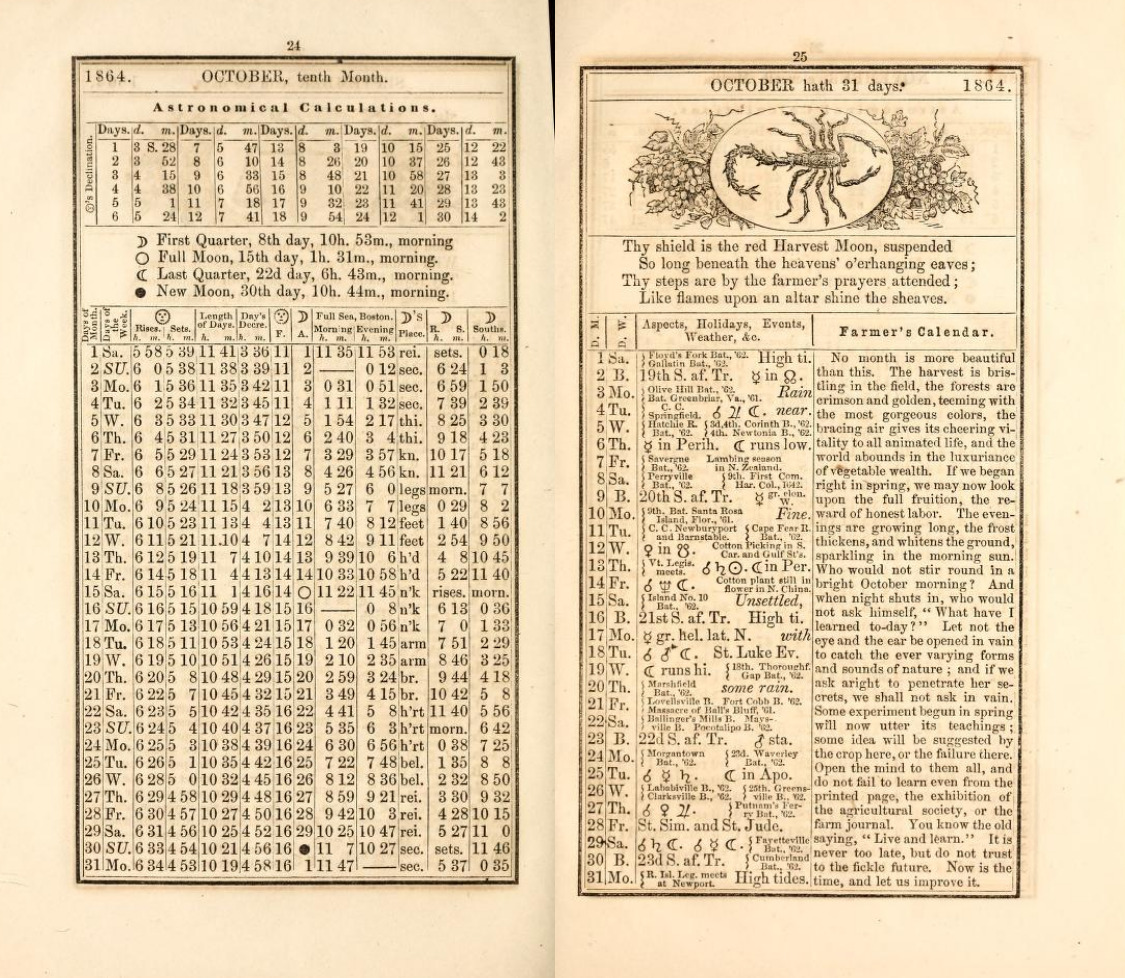
He inherited, and then further developed, a substantial collection of such old country almanacs. He writes in a letter that this family collection, when first passed down to him…

went back solidly only to 1877, with scattering copies back to 1815

Trying to complete this set eventually became a keen occasional hobby, though he had some luck there. He was allowed to root among the home storage attic of his sometime-friend Eddy’s book-selling uncle, and he descended the ladder with many a rare old copy. Which Uncle Eddy then sold him at a very affordable price. This haul appears to have spurred his ambitions, and he wrote…

I am now trying to complete my family file of the Old Farmer’s Almanack

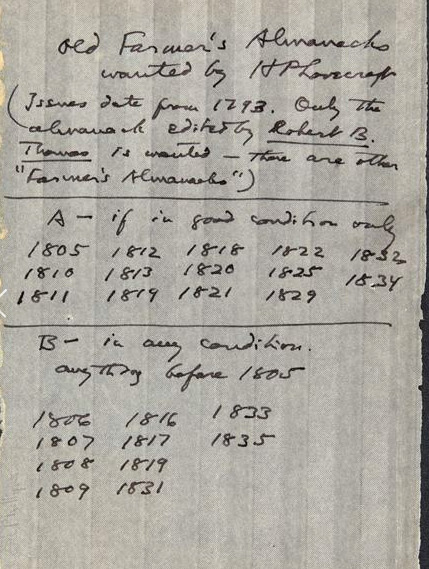
Here we see Lovecraft’s collecting ‘wants list’, as he tried to complete the set…
What, exactly, was this publication? Archive.org now has a small selection of scans of this Old Farmer’s Almanack, and thus we can get a better idea of what Lovecraft found between the pages. To be specific, he inherited and collected old copies of the Old Farmer’s Almanack edited by Robert B. Thomas. (It can’t be linked, as the URL is malformed, but if you paste this into the Archive.org search-box you should get it: creator:”Thomas, Robert Bailey, 1766-1846″ )

There were other publications of the same or similar title, but Old Farmer’s Almanack was Lovecraft’s mainstay. Which is not say he wasn’t delighted to discover that other similar almanacs were still publishing, out in the countryside…

It sure did give me a kick to find Dudley Leavitt’s Farmer’s Almanack [Leavitt’s Farmer’s Almanack, improved] still going after all these years. The last previous copy I had seen was of the Civil War period. But of course my main standby is Robt. B. Thomas’s [Almanack]

Thomas’s Old Farmer’s Almanack had begun publication in 1793. As we can see from the above list, Lovecraft was especially keen to get hold of anything before 1805 and in any condition. Many of these used the old long-S in the text…

I can dream a whole cycle of colonial life from merely gazing on a tattered old book or almanack with the long S.

This dream had first occurred very early in his life, and at age five the family Almanack had made a lasting impression…

my earliest memories — a picture, a library table, an 1895 Farmer’s Almanack, a small music-box

Evidently then this annual was taken and consulted in his home at that time. Also cherished and kept, since we know he was able to read the entire set…

[As a boy] I read them all through from 1815 to the present, & came early to think of every turn & season of the year in terms of the crops, the zodiac, the moon, the ploughing & [harvest] reaping, the face of the landscape, & all the other primeval guideposts which have been familiar to mankind since the first accidental discovery of agriculture in the Tigris-Euphrates Valley.

Nor did he overlook the rustic pictures…

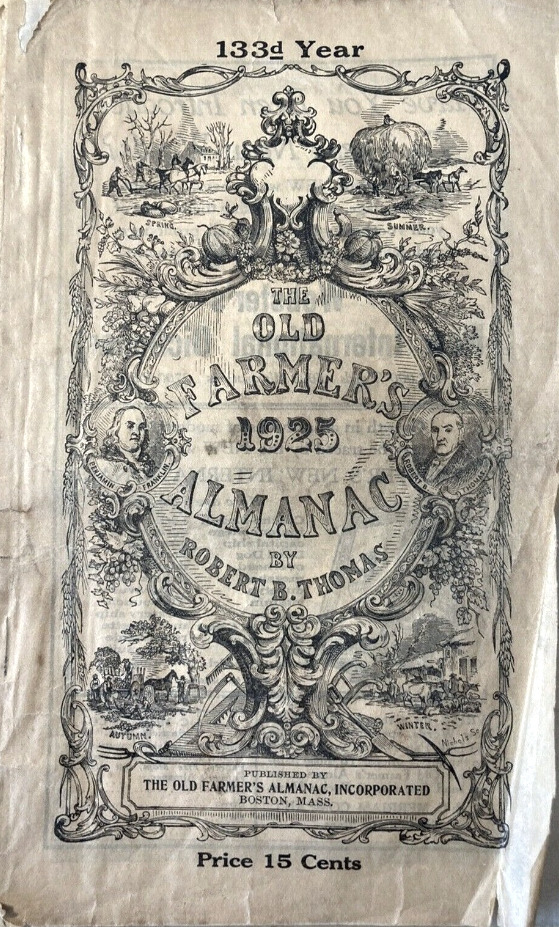
I am always fond of seasonal pictures, & dote on the little ovals on the cover of the ancient Farmer’s Almanack — spring , summer, autumn, & winter

On his travels he later found places where the homely traditions and moon and star-lore of the Farmer’s Almanack were still followed, such places as Vermont…

That Arcadian world which we see faintly reflected in the Farmer’s Almanack is here a vital & vivid actuality [in rural Vermont]

The publication was indeed a useful one. For instance it enabled Lovecraft to anticipate with ease the year’s lesser heavenly events…

Sun crosses the equinox next Wednesday at 7:24 p.m. according to the Old Farmer’s Almanack — which we have had in our family, I fancy, ever since its founding in 1793.

Having sent some introductory astronomy books, Lovecraft also sent young Rimel a copy of the latest Old Farmer’s Almanac for the coming year of 1935. In a later letter to Rimel of 28th January 1935, Lovecraft explicitly recommends the publication for astronomy use. The Almanac being…

capable of assisting the study of astronomy quite a bit.

The weather predictions found in its pages were perhaps of less use. Or at least, they had become so by the late 1970s. In 1981 Weatherwise magazine made a tally of sixty forecasts across five years. They found the month-by-month Almanack forecast to be little better than chance by then. How accurate the monthly weather forecasts might have been in the 1895-1935 period and in Providence remains to be determined. It might be quite interesting to tally that, with perhaps a leeway of two days. But to do so one would likely need to go back to the original journal / newspaper summaries of the month’s actual weather, rather than trust any recently ‘rectified’ computer-created data for those decades.

The Almanacks also contained a wealth of rather more reliable factual information. Such as the dates of the year’s key elections, court days, festival and saint’s days, tides, recurring natural events (usual time of lambing, bringing in cows for the winter etc), anniversary dates for sundry historical events, lists of Presidents, the standard weights and measures, distances, nutritional values of various crops and fodder, together with small amusements such as riddles and poetry. Short articles could also be present. Most importantly for Lovecraft’s huge flow of parcels and letters, the little booklets also appear to have given the latest postal regulations in a concise form.

In format they were rather like Lovecraft’s stories, then. A whole lot of sound facts garnished with a few slivers of delicious speculation (meaning the weather forecasts, rather than monsters and cults). Indeed, one might see something of the ‘carnivalesque’ at work in such publications. The use of a small inversion, that by its amusing ridiculousness serves to bolster the belief in the facticity of the rest of the structure.

The latest annual Almanack was also ever-present in Lovecraft’s own study, as he wrote to Galpin in 1933…

You may be assur’d, that my colonial study mantel has swinging from it the undying Farmer’s Almanack of Robert B. Thomas (now in its 141st year) which has swung beside the kindred mantels of all my New-England forbears for near a century & a half: that almanack without which my grandfather wou’d never permit himself to be, & of which a family file extending unbrokenly back to 1836 & scatteringly to 1805 still reposes in the lower drawer of my library table [evidently Lovecraft had by this time added 1876-1836 to the “family file”] … which was likewise my grandfather’s library table. A real civilisation, Sir, can never depart far from the state of a people’s rootedness in the soil, & their adherence to the landskip & phaenomena & methods which from a primitive antiquity shap’d them to their particular set of manners & institutions & perspectives.

This mantel-hanging had been a long-standing practice. For instance it was noted by his earliest visitor, when Lovecraft was emerging from his hermit phase. Rheinhart Kleiner recalled of his curious visit to the darkened room that…

An almanac hung against the wall directly over his desk, and I think he said it was the Farmers’ Almanac.

Lovecraft even kept up the tradition during the hectic New York years, writing in late 1924…

the Old Farmer’s Almanack … of which I am monstrous eager to get the 1925 issue
In that era the Almanacks were very often personalised and annotated quite heavily by their users, and a rural man’s personal collection grew to form a sort of natural diary and personal time-series for useful farm data. In 1900 40% of the American people still worked on the land, so such things were vital.

So far as I’m aware we have none of Lovecraft’s own copies today, so we don’t know if he also marked and noted them in various ways. Or if he had inherited copies that had been so marked by his relatives.

He also hints at being aware of and valuing another such publication. For instance, when he remarked on the discovery of the planet Pluto he wrote…

the discovery of the new trans-Neptunian planet …. I have always wished I could live to see such a thing come to light — & here it is! …. One wonders what it is like, & what dim-litten fungi may sprout coldly on its frozen surface! I think I shall suggest its being named Yuggoth! …. I shall await its ephemerides & elements with interest. Probably it will receive a symbol & be treated of in the Nautical Almanack — I wonder whether it will get into the popular almanacks as well?

In his early newspaper columns on astronomy he also appears to refer to this same publication…

The motions of these satellites, their eclipses, occultations, and transits, form a pleasing picture of celestial activity to the diligent astronomer; and are predicted with great accuracy in the National Almanack. [I assume here a mis-transcription by the newspaper editor of “National” for “Nautical”, or perhaps a correction to its shorthand name in the district].

Indeed, both Almanacks feature in Lovecraft’s “Principal Astronomical Work” list, among the vital accessories needed for a study of the night-sky…

Accessories:

Lunar Map by Wright.
Year Book — Farmer’s Almanack.
Planispheres — Whitaker & Barrett-Serviss.
Atlas by Upton — Library.
Opera glasses — Prism Binoculars.
Am. Exh. & Want Almanac. [meaning the American Ephemeris & Nautical Almanac, as “Exh.” is “Eph.” and “Want” should be “Naut”]

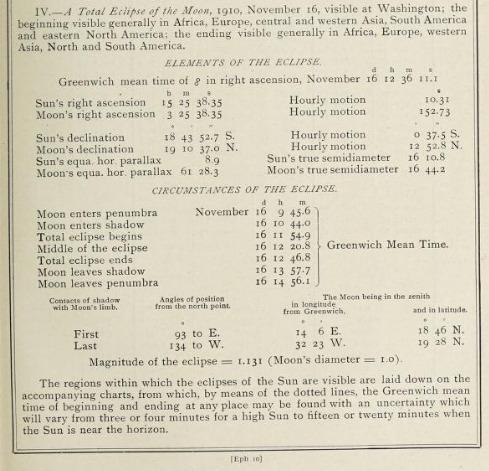
This Nautical Almanac is also on Archive.org, so we can peep inside a copy of that from 1910. Forthcoming eclipses were noted over several pages. Here, for instance we see all the details needed to observe a total eclipse of the Moon in November 1910, the beginning visible from “eastern North America”. I think we have a hint here about what Lovecraft was likely to have been doing in the late evening of 16th November 1910…
Archive.org also has The Old Farmer and his Almanack, a 1920 book which surveyed the topic with erudition. Lovecraft was heartily pleased to discover and read it shortly after publication.

Almanacks occur only once (and very trivially) in Lovecraft’s poetry. The one use in his fiction is more intriguing. In “The Picture in the House” (December 1920) a book is noted…

a Pilgrim’s Progress of like period, illustrated with grotesque woodcuts and printed by the almanack-maker Isaiah Thomas

The sharp-eyed will have spotted that Lovecraft might have meant to imply that this “Thomas” could have been the ancestor of the Robert B. Thomas of Old Farmer’s Almanack fame. That might be how some savvy bookmen took it at the time, but it is not so. For Lovecraft would have known that there was a real “almanack-maker Isaiah Thomas” and that he was no relation. Robert B. Thomas himself tells us this fact, in recalling his early years of trying to get a start in publishing almanacks…

I wanted practical knowledge of the calculations of an Almanack. In September, I journeyed into Vermont to see the then-famous Dr. S. Sternes, who for many years calculated Isaiah Thomas’s Almanack, but failed to see him. … In the fall, I called on Isaiah Thomas of Worcester (no relation) to purchase 100 of his Almanacks in sheets, but he refused to let me have them. I was mortified and came home with a determination to have an Almanack of my own.

Thus my feeling is that Lovecraft knew of these snubs and also, probably while reading his The Old Farmer and his Almanack (1920), had learned that Isaiah Thomas had sustained a sideline in publishing booklets containing the worst sorts of “astrology, palmistry, and physiognomy”. Thus, later that same year Lovecraft gave curmudgeonly old Isaiah Thomas a small poke in his fiction, by implying that Isaiah had marred a classic book with “grotesque” pictures — so “grotesque” that the resulting book ended up resting next to Pigafetta’s account of the Congo and its cannibals.


Update: The Nautical Almanac. Hathi now have the full run of the Nautical Almanac online.

McNeil as photographer

05 Wednesday Jan 2022

Posted by asdjfdlkf in Historical context

≈ Leave a comment

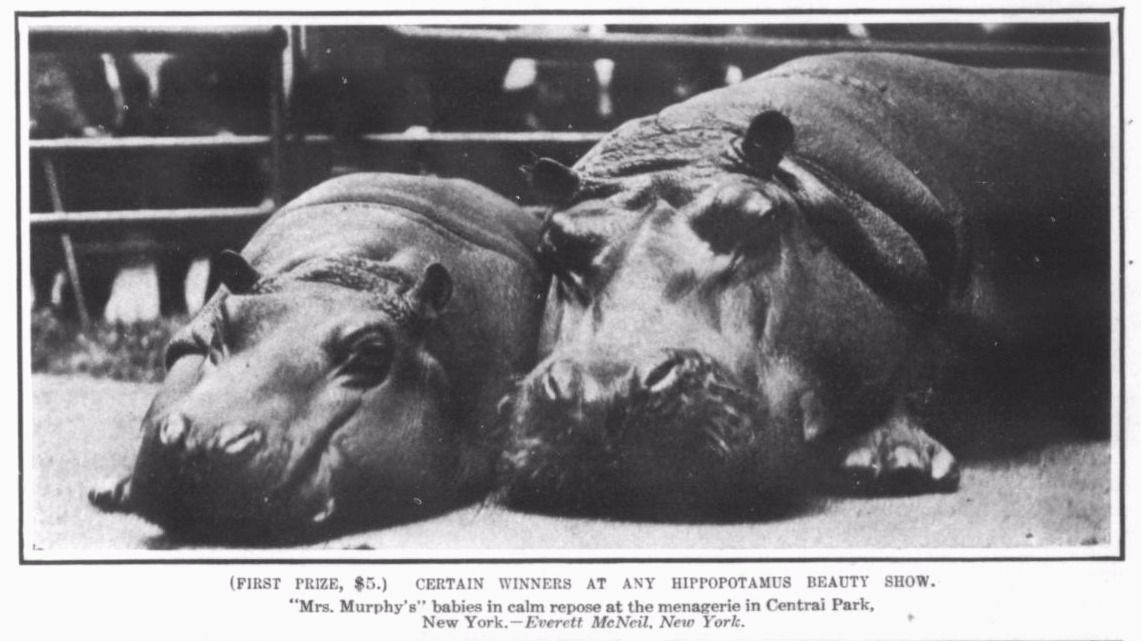
I’ve found a little more evidence that Lovecraft’s friend Everett McNeil was rather a good cameraman, at least with still subjects. I spotted that he won $5 in a Leslie’s Illustrated Weekly photography contest for August 1909. $5 was a healthy amount in 1909. This was about the time he was successfully entering the movie-making business, then located in New York City. He was a few years into having ‘made it’ in New York City, and to be able to make good pictures like this one imagines he might have then invested in a better camera and developing equipment. He appears to have often entered prize contests in writing, probably influenced by his farming father David McNeil who had been a regular winner of most of his district’s agricultural produce prizes. Now we know that his son also entered photographic contests.

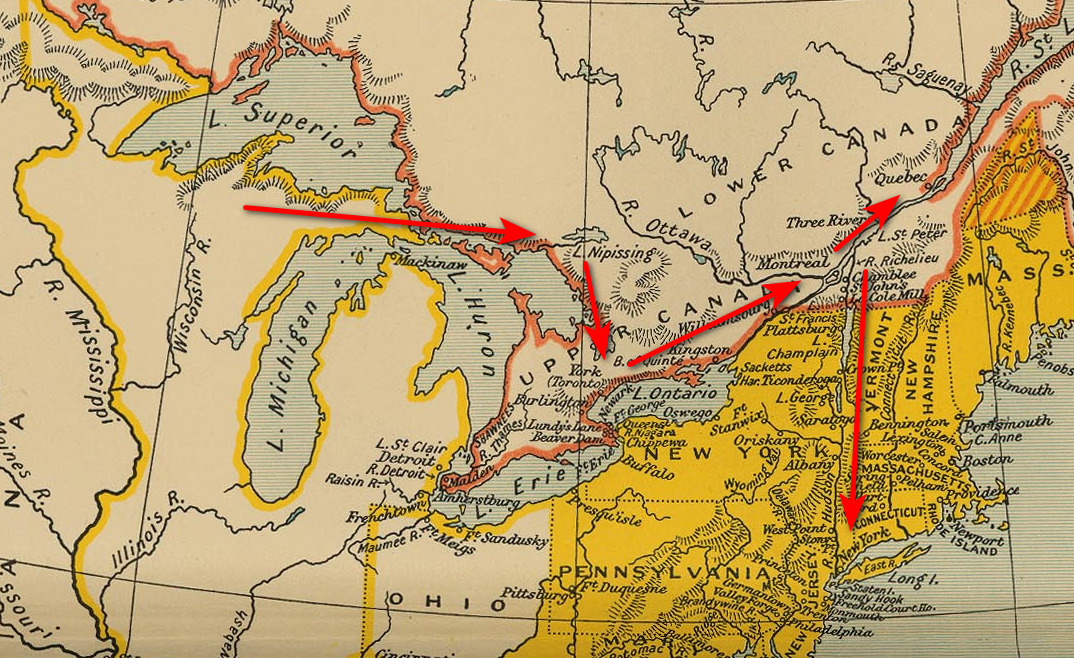
The Lovecraft circle knew that McNeil had ‘walked to New York’ circa 1894, and I rather suspect he earned his way as a travelling photographic portraitist. Possibly going from his home in Wisconsin to Quebec and then down the Hudson Valley to reach New York. In a letter Lovecraft indicates that McNeil had known the city of Quebec well at some point, and the life of a young itinerant photographer was realistically depicted in his story “The Photographing of Billy Oreamnos” (1909). In this a young man travels in rural Canada with his camera and gear…

… in search of Canadian dollars and dimes in exchange for more or less artistic photographs of the natives.

In 1912 a magazine published McNeil’s professional-quality architectural pictures of General Knox’s headquarters. McNeil’s later fine self-portrait with his New York City room as surrounding background (see my book on him) also shows a professional’s skill in composition and lighting.

I can’t be more certain than that about a possible early career in photography. But these fragments of evidence do seem to point that way. He was around age 32 when he left for his long walk to New York, and it was likely a ‘now or never’ try at reaching and ‘sticking’ in the big city. A photographic skill would be a natural method by which to pay one’s way, and the civilised English-speaking parts of what is now eastern Ontario might have offered good prospects — better than the stolid monotony of the Ohio farmlands and then the hillybilly backroads of the Pennsylvania mountains.

A likely route to New York

Encyclopaedia Britannica 1926

05 Wednesday Jan 2022

Posted by asdjfdlkf in Historical context, Scholarly works

≈ Leave a comment

Newly liberated into the public domain, the Encyclopaedia Britannica 1926 supplement in three chunky volumes. They form “an entirely new survey of the march of events”, as the Preface has it.

These became the latest supplement to the 11th edition, and they provide a useful updating and snapshot of various emerging fields as they were understood in the ‘prime Lovecraft years’ of 1910-1926 (the dates given in the Preface). Lovecraft owned the 9th edition (1875-89), and its “A Guide to Systematic Reading In…”, the 9th edition being especially revered for its very high standards of scholarship. The dates of the 9th may seen antediluvian to us, but on most matters he was only about 20-25 years behind the current volumes… until 1926. Presumably for more modern topics he was able to consult the latest edition, and its most recent supplements, at the Public Library in Providence or New York City.

Sword-and-Sorcery Studies

04 Tuesday Jan 2022

Posted by asdjfdlkf in Historical context, REH, Scholarly works

≈ Leave a comment

At DMR Brian Murphy offers a useful new article “Things That Are Undone and Ought Not To Be: A Sword-and-Sorcery Studies Wish List”.

A good ‘Not Conan or R.E. Howard’ critical survey of the genre in pre-PC comics would certainly be welcome, ideally including British (Karl the Viking etc) and European titles (e.g. in editor Toutain’s Heavy-Metal-alike magazines). And a lavish coffee-table book of related pinball-table art, perhaps with a DVD slotted in the back with the playable pinball table ROMs on it.

To his list I’d add:

* a survey-study of vintage paperback cover-art (as published) and its artists, though if the permissions could be obtained is perhaps doubtful now and one would have to rely on ‘fair use’ for covers;

* a close study of the curiously tepid cultural receptions and contexts of The Lord of the Rings in its ‘fallow period’ between publication and mass take-up. Say 1952-72, to add two years of run-up and take-off at either end;

* perhaps a study of the uses / re-workings sword-and-sorcery authors made of traditional works which were (by their time) effectively in the public domain (folklore, semi-fictional history, Arthur, Norse tales, Arabian Nights, the Northern fairy-tales, Ovid and ancient myth etc). They too had a ‘public domain’, though it was different than ours.

Cats and Creativity in the 18th century

02 Sunday Jan 2022

Posted by asdjfdlkf in Historical context, Scholarly works

≈ Leave a comment

Found while updating my bibliography of North Staffordshire folklore, an item which seems relevant to two of Lovecraft’s abiding interests. In the newly published book of essays on Human-Animal Interactions in the Eighteenth Century ($ paywall), Chapter 12 is “‘For I Will Consider My Cat Jeoffry’: Cats and Creativity in Eighteenth-Century Britain”…

Cats became very popular pets during the eighteenth century, especially in the cities, as Britain gradually moved from being a predominantly agrarian society to an increasingly urbanised world. Yet cats did not lose their magical powers, as many popular folklore tales bore witness. Cats, purring by the fireside, were familiar domestic friends, whilst retaining their relative feline aloofness and ‘strangeness’. Their alliance of opposing characteristics was a source of great literary and intellectual creativity. Thus cats conveyed ‘electric’ messages….

Giant Penguins

01 Saturday Jan 2022

Posted by asdjfdlkf in Historical context, Lovecraftian arts, Scholarly works

≈ Leave a comment

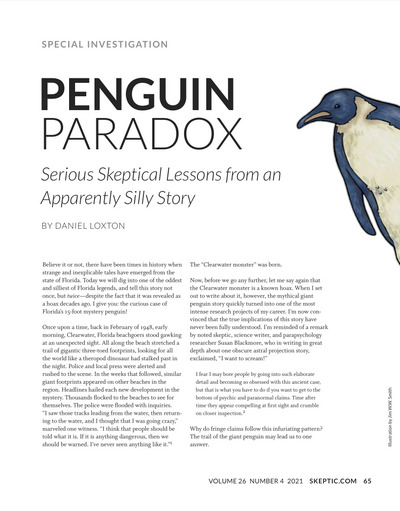
In 1948 a giant penguin, fifteen feet tall, was haunting the coast of Florida. There were strange tracks on the beach to prove it. Supposedly. Was it a Lovecraftian hoax, a la the giant penguins in At The Mountains of The Madness? The latest edition of Skeptic magazine goes in search of the truth, in a detailed 13 page investigation.

Meanwhile, over on DeviantArt, a delightfully stylised set of new posters for Lovecraft stories by Jared Boyer. With the “Mountains” one visualising the albino penguins.

“a vast number of old books & papers”

31 Friday Dec 2021

Posted by asdjfdlkf in Historical context

≈ Leave a comment

Newly for open sale, “a remarkable collection”…

of 244 H.P. Lovecraft items, with over 200 rare amateur press appearances dating as early as 1914 and nearly 20 miscellaneous appearance by Lovecraft or directly relating to his writing.

Longitude Lane

21 Tuesday Dec 2021

Posted by asdjfdlkf in Historical context

≈ 3 Comments

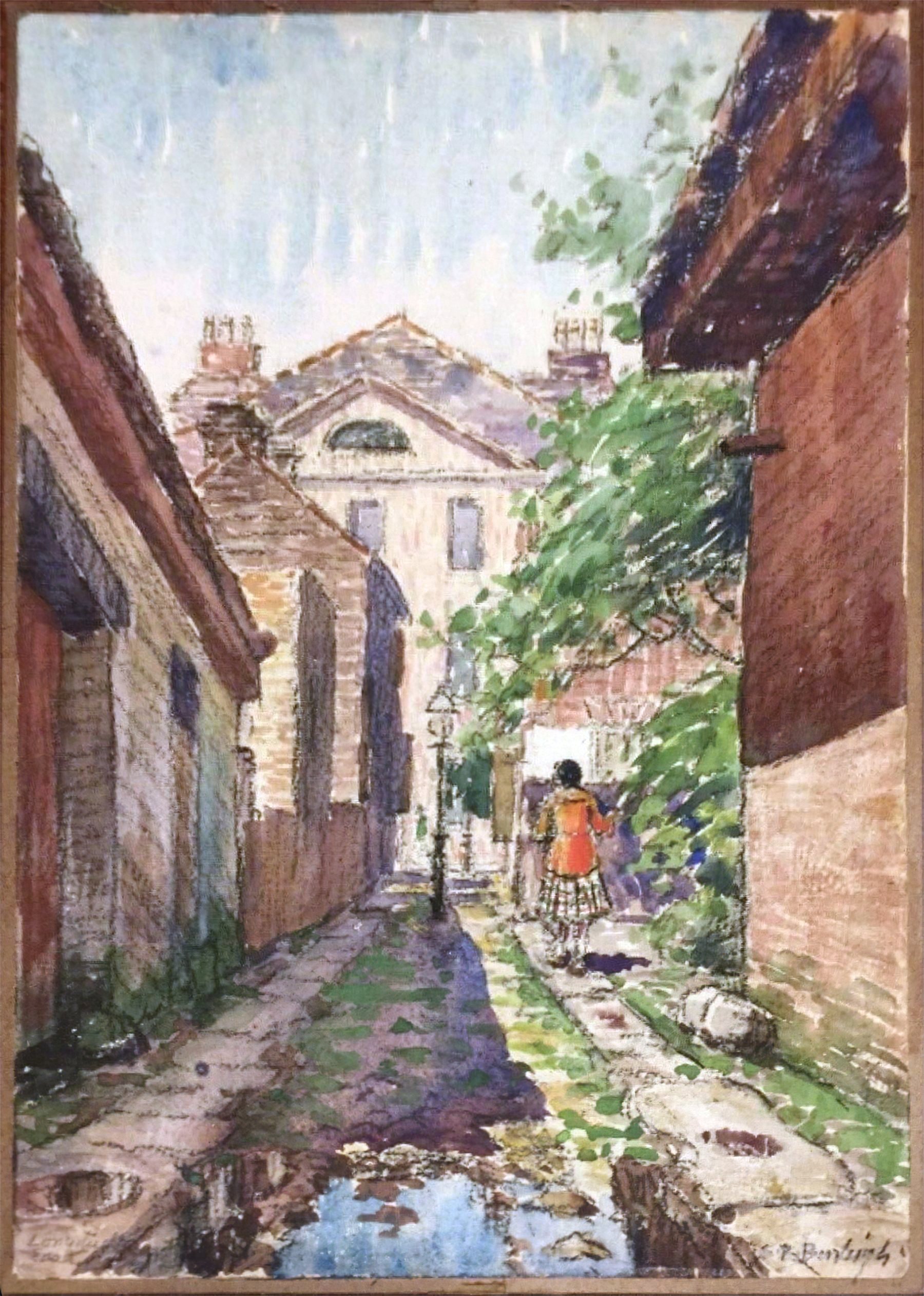
Newly popped up on eBay, the original study for “Longitude East” in Charleston, meaning Longitude Lane looking east, near Adger’s Wharf. By Sydney Richmond Burleigh (1853-1931, founder of the Providence Art Club).

His dates and the girl’s clothes suggest the post-Victorian period, so this seems more or less as Lovecraft saw and described it on his trips…

We soon come to Longitude-Lane, leading back to Church-Street … turning into Longitude-Lane, we pass by the moss-grown brick walls of abandon’d cotton warehouses; noting the cobblestones set for mules’ feet, the flagstones for the dray-wheels, and the snubbing-posts at the warehouse doors. One of these posts is an old ship’s cannon. To the writer this place has a melancholy charm of a very acute sort.” (H.P. Lovecraft, on Charleston, in Collected Essays Vol. 4: Travel)

Lovecraft…

recognised that the heart of colonial Charleston is the relatively small area south of Broad Street between Legare and East Bay, including such exquisite thoroughfares as Tradd, Church, Water, and the like; the alleys in this section — Bedon’s Alley, Stolls Alley, Longitude Lane, St. Michael’s Alley — are worth a study all their own.” (S.T. Joshi, I Am Providence)

One even wonders if Lovecraft’s hymns to Charleston reached the ears of Burleigh in Providence, and sent him down there himself in his old age. Though doubtless such charming and warm places had already been discovered by older artists who were averse to the Providence winters.

“A Descendant of the Vikings”

19 Sunday Dec 2021

Posted by asdjfdlkf in Historical context, New discoveries

≈ Leave a comment

I’ve been pleased to discover a new and previously unknown story by Lovecraft’s friend and fellow writer Everett McNeil. I wrote the book on McNeil and his career in fiction and movie writing, and I never found a hint of “A Descendant of the Vikings” (written circa 1906, as it was announced then, and published 12th December 1907 in The Youth’s Companion).

It’s a boy’s hunting tale in one large broadsheet page, in which Norwegian boy Thor hunts a killer grizzly bear for a 200 dollar reward.

McNeil had grown up in Dunkirk, a small Wisconsin town of 2,000 New Englanders and Norwegians — so he would have known many lads like this.


Also new on Archive.org, the trade-journal The Writer for October 1924 announced that McNeil was one of the Triple-X prize winners. Winning a $100 prize for another unknown story titled “The Lost Dutchman”. The $5,000-total open contest appears to have been to launch the successful Triple-X men’s action-adventure fiction magazine from Fawcett.

I’d suspect this tale related to The Lost Dutchman mine, and that on publication it became the snappier titled “The Lost Gold of Mad Wolf Gulch”. It appeared as a two-parter published in Triple-X magazine for January 1925 and February 1925. I had known about this one from listings, and it sounds like a western with a mining element. He was also keen on real wolf attacks (his mother had often told her real-life tale of experiencing attack). So I wouldn’t be surprised if a starving wolf pack made an appearance in “The Lost Gold of Mad Wolf Gulch”. Assuming Fawcett paid the prize on publication, McNeil might have had the cheque cashed by March 1925, easing his worrisome financial situation a bit in time for springtime 1925. So the prize payment adds another small bit of data to the story of the Kalem Club during the years that Lovecraft was in New York.

Triple-X proved a useful market for McNeil, and he landed the following there. Thus showing ‘the gang’ that ‘the old fuddy-duddy’ could still hold his own in a substantial new action-adventure magazine…

* “Battle of the Stings”.
* “The Vale of Vengeance”.
* “The Lost Gold of Mad Wolf Gulch”.
* “California’s First Gold” (appears to have been his vivid six-page history of the earliest gold strike, later included in a 1928 schools reader).
* “The Duping of Scarnose” (posthumous).

Friday ‘Picture Postals’ from Lovecraft: Stars and Time in Providence

17 Friday Dec 2021

Posted by asdjfdlkf in Astronomy, Historical context, Picture postals

≈ 2 Comments

An amusing bit of trivia has spurred this week’s ‘Picture Postals’, but has led me to a subtle but potentially quite deep observation about the nature of time in Lovecraft’s Providence.

One of the two precision clocks at the heart of the Ladd Observatory was called “Howard”, which might have tickled Howard Phillips Lovecraft when he was observing and studying there. As many will know, as a youth he lived nearby, had his own key, and was permitted free access at any time. The clock was a “Howard Astronomical Regulator No. 74”, to be precise.

The “Howard” sidereal clock (measuring stellar or cosmic time) was and still is accompanied in the Ladd’s Clock Vault by a “Molyneaux mean time clock” (measuring solar time, or everyday ‘civil time’).

Once the Ladd was opened and running, from September 1893 Professor Upton of the Observatory operated a wired…

system that transmitted telegraph time signals from precision clocks at Ladd Observatory throughout Providence and to other nearby cities.

The source-time for the signal was calculated by Ladd’s observation of the stars, thus giving exact ‘cosmic’ time. Knowing this gives a certain subtle spin to Lovecraft’s famous phrase of “when the stars were right”. In Providence, the stars were always right, since the stars (and presumably “Howard” as the site’s master star-clock) set the exact time for the city and its neighbours.

For the 1895 academic year Brown University invested in their own $100 “Howard”, precisely set by the Ladd Observatory time…

A very valuable Howard clock has recently been placed in the Steward’s office. It is regulated by Ladd Observatory standard time, and is thus kept as near correct as possible. The clock is connected with the bell-ringer’s room, so that now the college bell will be rung at exactly the right time.

The Ladd’s time-wires also went down to City Hall and to all points, via the services of a time-distribution contractor named the Rhode Island Protective Company.

Soon everyone had their exact time by the stars. One wonders if the wires are still there, presumably having gone down the hill under the earth rather than on poles that might be toppled in high winds. A possibility for a Mythos writer to explore, perhaps.

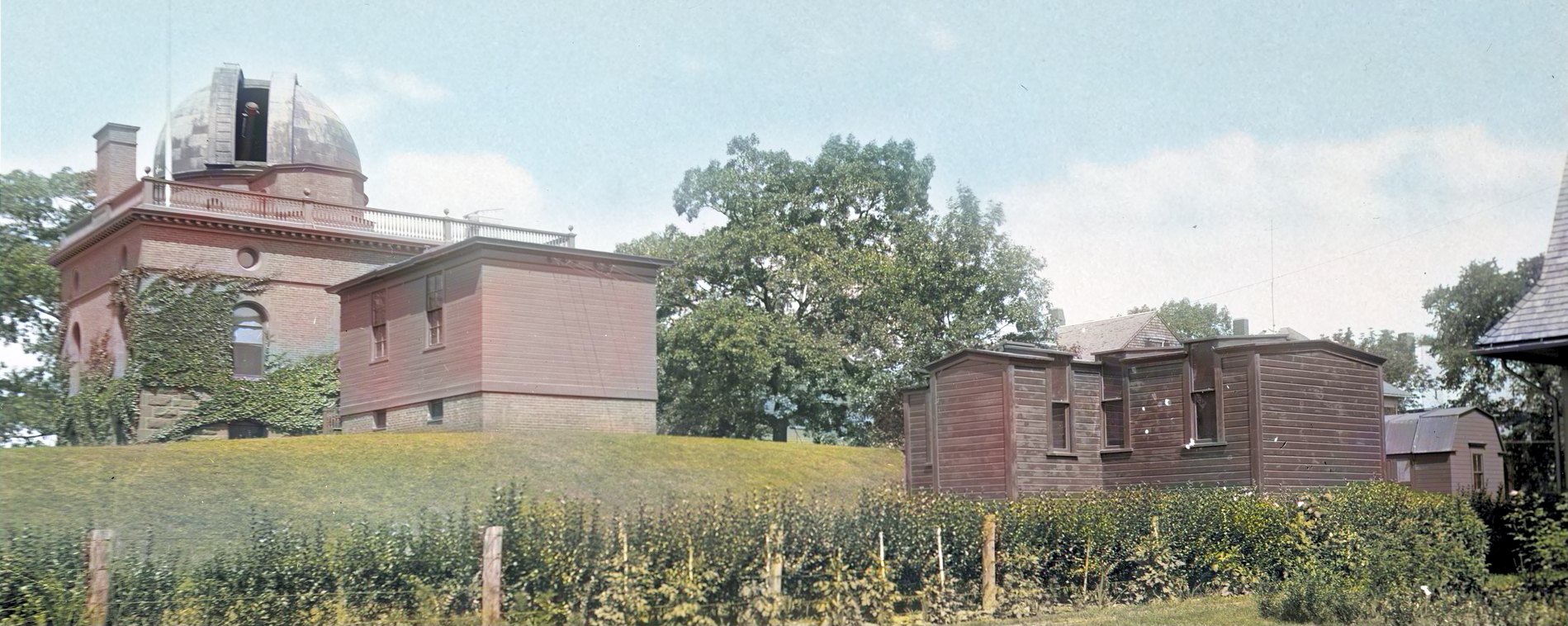
Here we see my colourising of an unusual view of the back of the Ladd, which corresponds with Lovecraft’s own isometric view as drawn in his boyish hand in 1904.

City documents show that the source of the city’s 1893-1916 wired time-transmissions was the square wooden-clad extension block, in which a “Seigmuller transit instrument” and the wired transmission unit was housed. Lovecraft’s drawing shows the observation-hole shutters on the block’s roof.

Note that Lovecraft has also drawn the path out back, which goes through an obvious gate to the small building with the curved roof. This can also be seen on the above photo, behind the later wireless transmissions hut (as war approached, the U.S. Naval Observatory transmitted exact time to the nation by radio from 1916 and thus took over Ladd’s local role).

What the small building with the curving roof was appears to be unknown, and later city plans for Ladd do not encompass it. But obviously Lovecraft thought it important enough to include on his drawing and there it appears to be part of the site. My guess would be it was a teaching room for the first-year Brown University Astronomy students, something that Professor Upton was keen to include from the first. Possibly with its own roof-flaps which could open to allow night observing, items which seem to be present on Lovecraft’s drawing of it. If so, being a hut-like structure with a stove for warmth, it would also be the obvious place to double-up as an impromptu kitchen — for making a hot early breakfast after a long cold night of traversing the astral coldness.

Even more on Harlem

12 Sunday Dec 2021

Posted by asdjfdlkf in Historical context

≈ Leave a comment

Further to my request-essay on Lovecraft and Harlem and a later small update, I’ve now discovered that a lengthy 1934 letter to F. Lee Baldwin has just over a page from Lovecraft on the Harlem of the early 1930s. It’s in the Baldwin letters in pages 65-67. Curiously Harlem does not appear in the index. Nor is it folded into New York City in the index.

I was previously able to get some of the letter, but now have all of it as I have the book. There Lovecraft notes…

Black Harlem itself I largely know from ‘bus windows — the coach lines from Providence passing down Lenox or upper 7th Avenue through the heart of the district.

It seems to be implied that these long-distance bus trips occurred after his mid-1920s New York sojourn, and were part of his occasionally visiting New York City in the 1930s. Evidently he preferred the soaring ‘elevated’ as a more magisterial means to enter New York, but sometimes his travels must have deposited him at a location that meant had had to take the bus into the city.

He gives Baldwin a good account of the boundaries, history, demographics and inter-group rivalries of the Harlem area. I would guess much of this was gleaned in conversation when his friend Morton was living in the city, with certain aspects drawn from Whitehead and Sechrist — who were very familiar with the various origin-groupings and inter-group rivalries involved. Although generally Lovecraft was also remarkably well-informed about the demographics and locales of the city beyond Harlem. One even wonders if there was some sort of long-forgotten annual detailed demographic map for the city, being published in the 1920s and 30s? One might of course also credit his slow daily osmosis of information from the newspapers, week in week out, and his cuttings files — which must have been quite extensive by 1934. Such a pity they’ve not survived. Apparently Brown Library had the HPL press “clippings” collection in 1944, but their whereabouts appears to be unknown today.


Also in the Baldwin letters, and relevant to my recent ‘Rhoby’ post, is Lovecraft mentioning another small data point… that she was also an accomplished artist in terms of drawing and painting. He was lamenting that the talent for drawing did not appear to have descended to the male line, namely himself.

The Thing in the Moonlight

11 Saturday Dec 2021

Posted by asdjfdlkf in Historical context, Podcasts etc.

≈ Leave a comment

An unusual ‘letter + story’ reading from Horrorbabble, “The Thing in the Moonlight” by H.P. Lovecraft, new on YouTube…

“The Thing in the Moonlight” is a short story based on one of H.P. Lovecraft’s dreams by Chapman Miske, first published in the January 1941 edition of Bizarre magazine. This recording includes both the letter Lovecraft sent to Donald Wandrei detailing the dream, and the short story itself.

The text is very short, and hardly a story. Derleth later ranked and published it as a “fragment”. But Horrorbabble reads it and the letter at 11 minutes.

Who was Chapman Miske? He was co-editor of Scienti-Snaps with Walter E. Marconette, and being duplicated this title would now be termed a fanzine. But obviously one of quality. Scienti-Snaps had earlier done something similar for Lovecraft by publishing one of several versions of the ‘Lovecraft as Roman’ dream, as “The Very Old Folk” in Summer 1940. This was accompanied by the bio-article “H.P. Lovecraft: Strange Weaver” and the poem “The Nightmare Lake”.

Scienti-Snaps was then renamed Bizzare in Summer 1940, and given a more news-stand appearance. But it failed after one issue. Hevelin Fanzines has Bizarre #1 scanned. Here is the Hannes Bok cover and the first page of the Lovecraft appearance.

Regrettably Hevelin Fanzines doesn’t appear to have the Scienti-Snaps issue for Summer 1940, the ‘Lovecraft Special’. However, its “H.P. Lovecraft: Strange Weaver” article is to be found collected in the book A Weird Writer in Our Midst.

← Older posts
Newer posts →


Please become my patron at www.patreon.com/davehaden to help this blog survive and thrive.

Or donate via PayPal — any amount is welcome! Donations total at Easter 2025, since 2015: $390.

Archives

  • March 2026
  • February 2026
  • January 2026
  • December 2025
  • November 2025
  • October 2025
  • September 2025
  • August 2025
  • July 2025
  • June 2025
  • May 2025
  • April 2025
  • March 2025
  • February 2025
  • January 2025
  • December 2024
  • November 2024
  • October 2024
  • September 2024
  • August 2024
  • July 2024
  • June 2024
  • May 2024
  • April 2024
  • March 2024
  • February 2024
  • January 2024
  • December 2023
  • November 2023
  • October 2023
  • September 2023
  • August 2023
  • July 2023
  • June 2023
  • May 2023
  • April 2023
  • March 2023
  • February 2023
  • January 2023
  • December 2022
  • November 2022
  • October 2022
  • September 2022
  • August 2022
  • July 2022
  • June 2022
  • May 2022
  • April 2022
  • March 2022
  • February 2022
  • January 2022
  • December 2021
  • November 2021
  • October 2021
  • September 2021
  • August 2021
  • July 2021
  • June 2021
  • May 2021
  • April 2021
  • March 2021
  • February 2021
  • January 2021
  • December 2020
  • November 2020
  • October 2020
  • September 2020
  • August 2020
  • July 2020
  • June 2020
  • May 2020
  • April 2020
  • March 2020
  • February 2020
  • January 2020
  • December 2019
  • November 2019
  • October 2019
  • September 2019
  • August 2019
  • July 2019
  • June 2019
  • May 2019
  • April 2019
  • March 2019
  • February 2019
  • January 2019
  • December 2018
  • November 2018
  • October 2018
  • September 2018
  • August 2018
  • August 2015
  • July 2015
  • April 2015
  • March 2015
  • February 2015
  • January 2015
  • December 2014
  • November 2014
  • October 2014
  • September 2014
  • August 2014
  • July 2014
  • June 2014
  • May 2014
  • March 2014
  • February 2014
  • January 2014
  • December 2013
  • November 2013
  • October 2013
  • September 2013
  • August 2013
  • July 2013
  • June 2013
  • May 2013
  • April 2013
  • March 2013
  • February 2013
  • January 2013
  • December 2012
  • November 2012
  • October 2012
  • September 2012
  • August 2012
  • July 2012
  • June 2012
  • May 2012
  • April 2012
  • March 2012
  • February 2012
  • January 2012
  • December 2011
  • November 2011
  • October 2011
  • September 2011
  • August 2011
  • July 2011
  • June 2011
  • May 2011
  • April 2011
  • March 2011
  • February 2011
  • January 2011
  • December 2010
  • November 2010
  • October 2010
  • September 2010
  • August 2010
  • July 2010

Categories

  • 3D (14)
  • AI (70)
  • Astronomy (70)
  • Censorship (14)
  • de Camp (7)
  • Doyle (7)
  • Films & trailers (101)
  • Fonts (9)
  • Guest posts (2)
  • Historical context (1,095)
  • Housekeeping (91)
  • HPLinks (76)
  • Kipling (11)
  • Kittee Tuesday (92)
  • Lovecraft as character (58)
  • Lovecraftian arts (1,628)
  • Lovecraftian places (19)
  • Maps (70)
  • NecronomiCon 2013 (40)
  • NecronomiCon 2015 (22)
  • New books (966)
  • New discoveries (165)
  • Night in Providence (17)
  • Odd scratchings (984)
  • Picture postals (276)
  • Podcasts etc. (431)
  • REH (184)
  • Scholarly works (1,469)
  • Summer School (31)
  • Unnamable (87)

Get this blog in your newsreader:
 
RSS Feed — Posts
RSS Feed — Comments

H.P. Lovecraft's Poster Collection - 17 retro travel posters for $18. Print ready, and available to buy — the proceeds help to support the work of Tentaclii.

Proudly powered by WordPress Theme: Chateau by Ignacio Ricci.