• About
  • Directory
  • Free stuff
  • Lovecraft for beginners
  • My Books
  • Open Lovecraft
  • Reviews
  • Travel Posters
  • SALTES

Tentaclii

~ News & scholarship on H.P. Lovecraft

Tentaclii

Category Archives: Astronomy

New book: El Astronomicon Y Otros Textes

13 Monday Dec 2021

Posted by asdjfdlkf in Astronomy, New books, Scholarly works

≈ Leave a comment

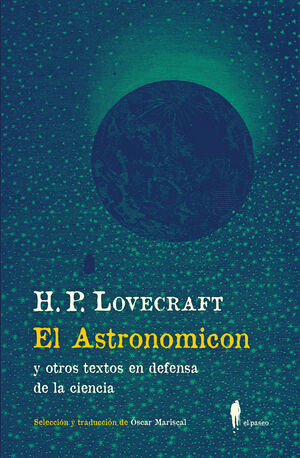
A new Lovecraft translation from El Paseo in Spain, El Astronomicon Y Otros Textes En Defense De La Ciencia (‘The Astronomicon and Other Texts in Defence of Science’).

For the first time in Spanish, the writings on astronomy and science of the genius of fantastic literature, H.P. Lovecraft. Includes his astronomy manual and controversial science writings.

“Controversial”? Possibly some extracts from the letters, then, I’d guess? Musing on the sciences and pseudo-sciences of the day?

S. T. Joshi’s blog brings additional translation news. New volumes of Arthur Machen in Portuguese, and Wilum Pugmire in German.

‘Picture postals’ from Lovecraft: “Rhoby”

03 Friday Dec 2021

Posted by asdjfdlkf in Astronomy, Historical context, Picture postals

≈ Leave a comment

This fine postcard evokes the rural world in which the wife of Lovecraft’s maternal grandfather, and later Lovecraft’s mother, came of age. A small public library, barely bigger than a chicken-coop, with a chicken-yard to one side. Possibly eggs were sold for a nominal amount, as an enticement to children to join the library. The location is North Scituate which is about six miles west of the very centre of Providence. Robie (known to Lovecraft as ‘Rhoby’) — Robie Alzada Place (1827–1896) — is the one who gives the place the connection to Lovecraft. S.T. Joshi, in I Am Providence, notes of her…

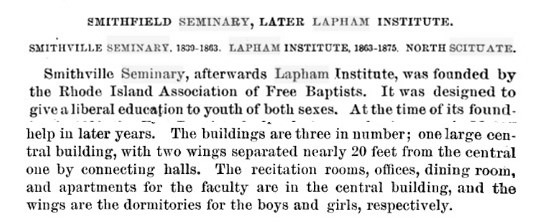
Of Whipple Phillips’s wife Robie [married Jan 1856] very little is known. Lovecraft states that she attended the Lapham Institute (cited by Lovecraft as “Lapham Seminary”) in North Scituate, Rhode Island … but does not supply the date of her attendance.

Lovecraft explained the somewhat convoluted family line, to Moe in a letter…

These [ancestors] marry’d, respectively, Stephen Place and Jeremiah Phillips — and in the next generation Sarah’s daughter Rhoby Place (nam’d for her aunt) marry’d Rhoby’s son Whipple Phillips …. these espoused cousins becoming my mother’s parents.

The Lovecraft family ‘Commonplace Book’ contained much information about Robie’s Place family and ancestors at nearby Foster, R.I. de Camp’s biography of Lovecraft, perhaps leaning on oral evidence that has not come down to us, has…

In 1855, he and his younger brother James fell in love with two local girls, Robie Alzada Place and her cousin Jane Place. Said Whipple to James: “You take Jane and the farm, while I take Robie and go to Providence to seek my fortune.

The newly married couple then lived a few miles further west, at Foster, in the homestead built there by her father Stephen Place and in which Robie had been born. (Lovecraft’s mother was also to be born at the Foster house). One might then suspect that the unmarried Robie had regularly travelled the few miles from Foster to North Scituate for her schooling. But a little research reveals a new data point. It was a boarding school with large boarding facilities for girls, and she may thus have been staying there in the week and then going home at weekends…

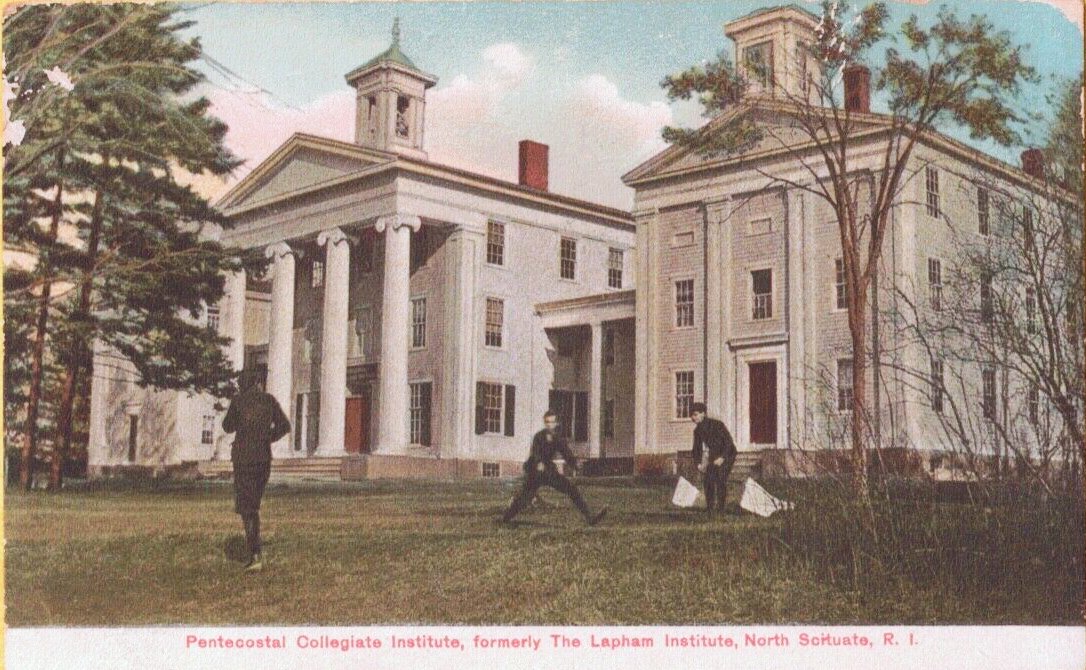
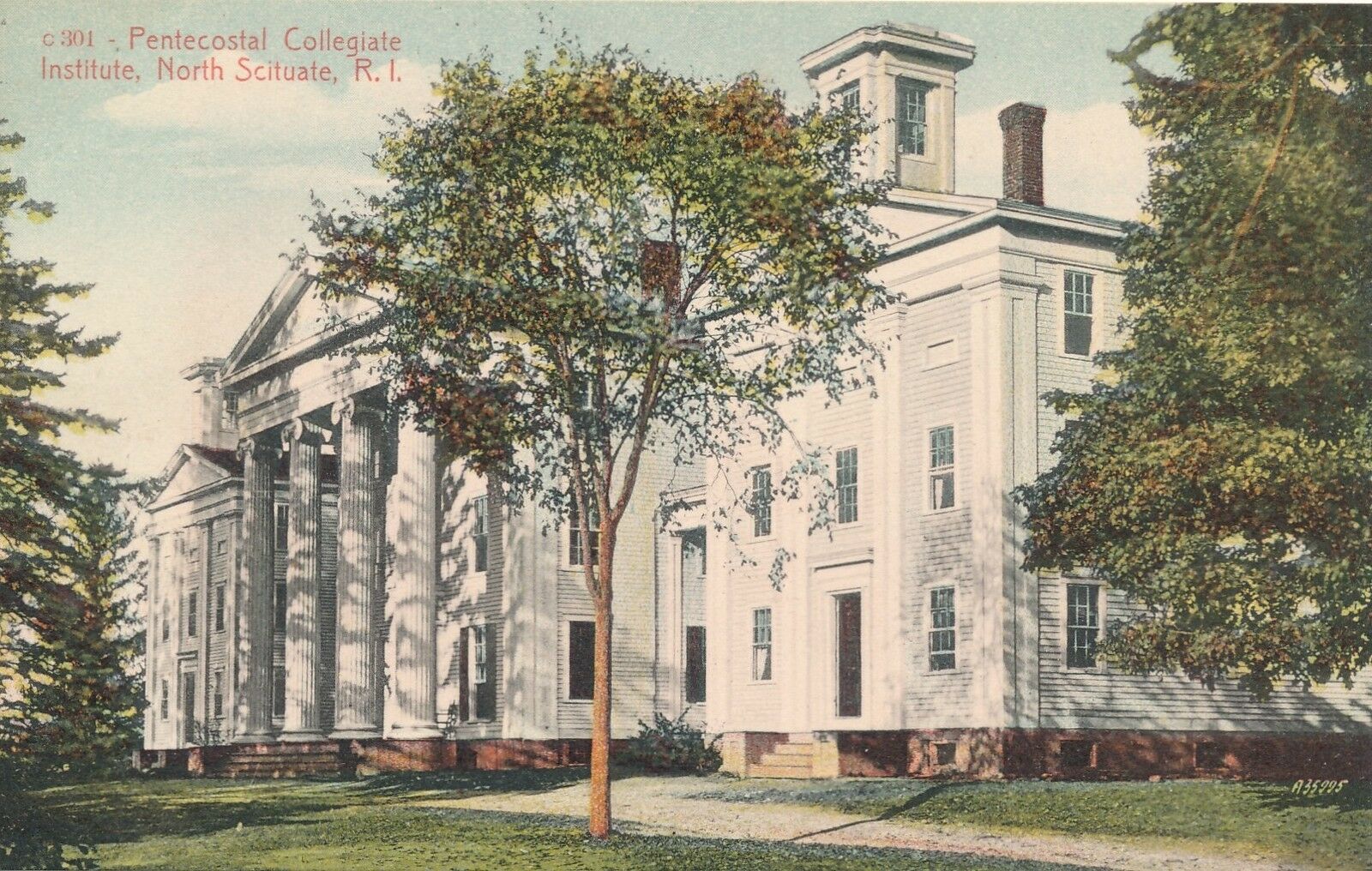
Her most likely attendance dates centre on circa 1845-50, with Lovecraft himself suggesting from “1845” in one letter. The school would have been known as the “Smithville Seminary”, here seen circa 1900 and with the frontage much unchanged. One assumes a school library matching that of the town itself, and perhaps with some connection between the the two libraries.

Did Lovecraft ever visit? He certainly passed through the general district at his leisure on his 21st birthday. Since he had treated himself to an epic all-day tram (‘car’) ride. This first sent him out of Providence and…

riding westward through the picturesque countryside of my maternal ancestors” (letter to F. Lee Baldwin, 1934)

On his return from New York his family history researches may have taken him there in pursuit of memories of Robie and her schooling, and especially her astronomical work. We know that in the mid 1920s, after returning from New York, he made several long and intensive ‘gleaning’ expeditions to Foster and Greene and roundabouts in search of family history.

However, he may not have found much. By 1923 the Institute had passed through several hands and the old Baptist records and yearbooks had undoubtedly been removed to Baptist archives. By 1923 it had become established as the Watchman Institute, though there were bad fires there in 1924 and 1926 and “both wings burned down” according to one history. One has to wonder if there was much there for Lovecraft and his aunt to glean circa 1926-28, other than a brief stroll past the smoke-stained frontage and around the charred grounds.

But Lovecraft might have learned something of the texture of the old life, in Foster and North Scituate, nearer to home. Because his near-lifelong Providence barber came from North Scituate, and one thus imagines that the barber’s memories of the place and its gleaming ‘school on the knoll’ came up from time to time in the barber’s chair…

Had my hair cut yesterday by the same old barber who removed my flowing curls in 1894. He’s a good old R.I. Yankee of the 7th generation of North Scituate settlers.” (May 1926)

There was also a fine new observatory in North Scituate, albeit 75 years later and private. Lovecraft’s “The September Sky” newspaper astronomy column (1st September 1914) concluded by noting the opening of the then-new observatory there…

Of particular interest to Rhode Islanders is the opening of Mr. F. E. Seagrave’s new private observatory in North Scituate, about two miles north of the village. The building stands on an eminence 342 feet above sea-level, free from the smoke and lights of the city, and commanding a magnificent view of the celestial vault.

The observatory had formerly been on 119 Benefit Street, Providence, but there appears to be no evidence of the young Lovecraft being invited to visit the new one on Peeptoad Road. But Robie might have done so, and before the building of the observatory there. Robie had been a Baptist, but that did not then preclude also being an astronomer with a substantial library and presumably a telescope to match. Lovecraft told Moe in a 1915 letter…

My maternal grandmother, who died when I was six, was a devoted lover of astronomy, having made that a speciality at Lapham Seminary, where she was educated; and though she never personally showed me the beauties of the skies, it is to her excellent but somewhat obsolete collection of astronomical books that I owe my affection for celestial science. Her copy of Burritt’s Geography of the Heavens is today the most prized volume in my library.

Robie’s Smithville Seminary was itself on a knoll, perhaps good enough for observing. But back in circa 1845-55 (before the building of the observatory), could Mr. Seagrave’s apparently excellent 342-feet high observing hill have also been one regularly visited by parties of local amateur astronomers — Robie among them?

Lovecraft’s first letter in its magazine context

01 Wednesday Dec 2021

Posted by asdjfdlkf in Astronomy, Historical context

≈ Leave a comment

Currently on eBay, H.P. Lovecraft’s first publication. In Scientific American for 25th of August 1906. In those days Scientific American was about science, not politics.

Interesting to note that this had a cover featuring the New Croton Dam (construction 1892-1906), given the later subject-matter of “The Colour out of Space”. The Dam and its vast lake gathered and sent the first out-of-city supply of water to New York City.

Lovecraft proposed a multi-observatory photographic method of discovering a planet beyond Neptune, at the edge of the solar system. He goes so far as to suggest, basic on his own cosmic observations, that a spot known to him at “50 units” out would be the place to start. The planet Pluto (yes, it is a planet) is sometimes at that distance, a textbook stating it…

averages 40 astronomical units from the Sun, but it ranges from 30 units to 50 units.

It might be interesting for the forthcoming book on Lovecraft’s astronomy to determine: i) when and how he was making the observations that led him to propose “50 units”; and ii) if Pluto was indeed at 50 units out at that time.

‘Picture Postals’ from Lovecraft: ‘Saturn in Nantucket’

22 Friday Oct 2021

Posted by asdjfdlkf in Astronomy, Historical context, Picture postals

≈ Leave a comment

“One of the principal features today is the Maria Mitchell Observatory in Vestal St. (formerly Goal Lane), which adjoins the birthplace of the celebrated female astronomer (professor at Vassar) whose name it bears. The observatory is modern — a memorial to Prof. Mitchell. I had a good chance to observe Saturn through its excellent 5” telescope.” (to J. Vernon Shea, 10th February 1935)

“I had an excellent view of Saturn” (to Arthur Harris, 1st September 1934)

He had once had a fever-vision of flying to Saturn…

though I often dream of things of the most bizarre and vivid sort … the only well-defined delirium I ever had was in 1903 … [I] mumbled things about flying to Mars and Saturn.

In summer 1934 the observatory’s observers (Margaret Harwood and John Heath) were noted for their work on discovering variable asteroids, and the observatory seemingly benefited from the general oversight of the Harvard College Observatory. The 1908 (“modern”, to Lovecraft’s thinking) elevation plans for the place show that the apparently twee external ‘garden house’ appearance actually hides hidden depths…

Pictures missing

Which may interest Mythos writers, as in “how far down does it go…”? Google StreetView shows the Observatory much as it was, though with side extensions. It appears to be open to interested visitors.

The resort town also has the Loines Observatory, which allows public viewing and is often confused with the Maria Mitchell Observatory, but the first dome there was not open until 1968…

“Since its establishment in 1968 and 1998, Loines Observatory’s two domes house multiple telescopes for research and public astronomical programs”.

‘Picture postals’ from Lovecraft: Museum of Natural History, Roger Williams Park

26 Friday Mar 2021

Posted by asdjfdlkf in Astronomy, Historical context, Picture postals

≈ 1 Comment

Newly coloured, a huge picture of The Museum of Natural History, Roger Williams Park, Providence. 1906, Lovecraft was then aged 16 and deeply investigating astronomy — so much so that the following year Prof. Upton of Brown personally introduced the young Lovecraft to Percival Lowell.

Only when record-pictures are this size and glass-plate clarity can one see certain details. The lizard-creature atop the building, for instance…

Or the wry humour in placing an “I Speak Your Weight” machine next to a short bench which looks about wide enough to accommodate one very fat person.

On the opposite side of the entrance-steps is what appears to be a huge lump of concrete, but I would guess was more likely a very fossil-rich accretion full of fossils… and thus designed to attract the sort of children interested in fossil-hunting. Another small but interesting detail is the British-English use of the wording “rubbish” on what today would be a ‘trash’ bin.

Lovecraft may have become overly familiar with the Museum’s exhibits by 1906, but it appears to have had local and visiting exhibitions and these could have been a continuing draw. He surely returned to it in the Autumn of 1916, when the famous astronomer Prof. Percival Lowell (he of the ‘Martian canals’ theory) exhibited there…

a remarkable collection of astronomical photographs … in the form of glass transparencies, exhibited in a darkened room, and illuminated from behind, so that they stand out with vivid clearness

There were 150 of these and they formed a “blockbuster” show, attracting over 1,300 visitors on the first day in Providence…

Currier of Brown University was at the museum all afternoon answering questions with regard to the 150 transparencies

I was uncertain of the 1916 date for this show, before, but Popular Astronomy for 1916 confirms it. The journal reprinted a newspaper report from Providence…

Lovecraft claimed lack of belief of Lowell’s ‘canal’ theories (“I never had, have not, & never will have the slightest belief in Lowell’s speculations” he wrote in 1916), though his surviving articles show more ambivalence. But he surely cannot have been sniffy enough about the theories to have missed this major local show of the Lowell Collection, in his favourite local park and running from circa 9th-23rd October 1916. Many of the pictures by Lowell and his highly skilled assistants were not again equalled in topographical detail until the 1960s. Also, Lovecraft would have been aware that by 1915 Lowell had theorized and had begun the search for “Planet X” (Pluto)…

in a manner not wholly dissimilar to that advised by Lovecraft himself in his letter to the Scientific American of July 1906. (S.T. Joshi, Primal Sources)

Rather amazingly the Lowell Collection of planetary photographs does not seem to have been digitized for modern public use. Perhaps there is a worry that they might still be mis-used re: the ‘Martian canals’? Nor are there even any pictures of what the Lowell exhibition looked like to the visitor of 1916.

Lowell died unexpectedly in November 1916, and Lovecraft penned a short poetic ‘elegy’ so turgid that it could even be intended to be read as some sort of sardonic snub in a coded 18th century manner. It ends by imagining Lowell ascending to the heavens and becoming a star, adding… “a new brilliance to the Southern Cross!” Could this be Lovecraft’s snippy allusion to the criss-cross of Lowell’s ‘canals’ theory, and also that Lowell had things ‘upside down’? Because the simple four-star Southern Cross is only visible ‘down under’ in places such as Australia. Apparently all Australians know that an observer can draw ‘imaginary lines’ out from the cross, to find the direction south at night.

Ladd Observatory, 1890

24 Wednesday Mar 2021

Posted by asdjfdlkf in Astronomy, Historical context

≈ Leave a comment

The Ladd Observatory, Providence, in a key architects’ drawing of summer 1890. The year of Lovecraft’s birth. It’s from a very poor Google Books scan, with fine details in the sky blown out and most of the small penmanship unreadable, so is not ideal. But it’s the best available. This is what was started with…

Lovecraft knew the Ladd from summer 1903, aged 13, and on Halloween of that year noted that the telescope was haunted by a ‘colour out of space’ where there should be no colour…

The telescope is a 12 inch equatorial, but does not perform in the manner that a glass of its size should. Chromatic aberration is the principal defect. Every lunar crater and every bright object is surrounded by a violet halo.

Fly me to the moon…

16 Tuesday Feb 2021

Posted by asdjfdlkf in Astronomy, Historical context, Kittee Tuesday

≈ 1 Comment

In his boyhood article “Can the Moon Be Reached by Man” (October 1906) H.P. Lovecraft opens with the observation that…

In 1649 a Frenchman named Jean Baudoin published a book entitled: A Trip from the Earth to the Moon.

The footnotes in Collected Essays reveals that this was actually a translation of a book by the Englishman Francis Godwin (1562-1633). Though it does not seem likely the boy Lovecraft had yet read either Godwin or Baudoin, since I have found that he was likely borrowing his opening fact from Jules Verne’s From the Earth to the Moon. In Chapter II of this novel Verne has a French speaker addresses the Gun Club in Baltimore, reminding them of various great French ‘firsts’ in the field…

Permit me,” he continued, “to recount to you briefly how certain ardent spirits, starting on imaginary journeys, have penetrated the secrets of our satellite. In the seventeenth century a certain David Fabricius boasted of having seen with his own eyes the inhabitants of the moon. In 1649 a Frenchman, one Jean Baudoin, published a “Journey performed from the Earth to the Moon. At the same period Cyrano de Bergerac published that celebrated ‘Journeys in the Moon’ which met with such success in France.”.

We know that Verne’s From the Earth to the Moon was in Lovecraft’s library in book form. But the young Lovecraft was presumably unaware, in 1906, that Verne had conveniently omitted to inform readers that the work was a translation from the Englishman Francis Godwin (1562-1633, possibly the great uncle of the writer Jonathan Swift). Nor is the reader told that Bergerac, also lauded by Verne’s orator, had actually been parodying the English Godwin. Had Lovecraft known of the English author or the Swift connection in 1906, then he would surely have been mentioned these facts. In his Anglophile fervour he might even have upbraided Verne for his cheek. Not that it would have mattered much to most readers of the Pawtuxet Valley Gleaner, of course.

Godwin had been the Bishop of Hereford at the time he wrote the book circa the 1620s, the tale of a fantastical voyage to the Moon titled The Man in the Moone: or A Discourse of a Voyage Thither. Godwin’s tale was published posthumously in 1638, and tells off a voyage accomplished by the man being carried to the Moon by a flock of powerful one-footed swans (not geese, as one modern encyclopaedia wrongly has it). One might think that his sounds somewhat similar to the dream-leap to the Moon that Carter experiences in Lovecraft’s “Dream Quest”, …

Verily, it is to the moon’s dark side that they go to leap and gambol on the hills and converse with ancient shadows […] upon a signal, the cats all leaped gracefully with their friend packed securely in their midst

This method of flight is also broadly similar to Godwin, in its distributive aspect. Godwin has his hero invent a mechanical device that evenly distributes his weight among the especially powerful swans.

Thus it seems worth asking if Lovecraft happened upon Francis Godwin during his intensive New York research for Supernatural Literature? Or perhaps in his conversations with the members of his New York circle who we know where collecting and reading early science-fiction? If so, the discovery would be conveniently timed, re: the writing of “Dream Quest”. But the publication dates do not fit. The first modern edition of Godwin’s Moone was in 1937, just before Lovecraft’s death. He may have known of it, as it was not only known among cloistered academics but also covered by popular articles such as the one in Flying Magazine (dated February 1937, and likely appearing on the newstands earlier). There had also been a long review-article in 1931 (“Bishop Godwin’s Man in the Moone“, Review of English Studies), which may well have become known to his circle — but again this was far too late to have influenced “Dream Quest” and its visit to the Moon.

However, my feeling is that he would have been encountered references earlier via his study of his favourite poet Samuel Butler. For instance, the author of the Poetical Works of Samuel Butler footnotes an allusion in Hudibras as relating to… “Bishop Godwin … getting to the Moon upon ganzas or wild swans”. Lovecraft knew Samuel Butler well and had “ploughed through” even the toughest of his poems, and his Hudibras was a special favourite. Lovecraft owned the extensively footnoted 1864 edition of this large and allusive work. The 1864 edition’s annotator does not actually name “swans” in this case, but he refers to the Bishop and his ganzas (a fictional super-powerful breed of swan) on page 286…

There is also the more general theory, lightly held my many learned men until the 17th century, that many types of birds migrated to the Moon in winter. Again, this was the sort of early proto-scientific theory that Lovecraft would have been aware of. As for finding cats on the Moon, as in Dream-quest, the 12 year old Lovecraft already delighted in the idea of other nearby worlds populated by his beloved cats, and so this seems to have been his original idea, part whimsy and part science — the idea of creatures on Venus or Mars was then still a topic on which reputable scientists could speculate in the press.

The Spoor of Cthulhu

09 Wednesday Dec 2020

Posted by asdjfdlkf in Astronomy, Odd scratchings

≈ Leave a comment

On its journey to the Kuiper belt, the New Horizon spacecraft passed by Pluto, delivering stunning images of the Cthulhu region. The high-altitude mountain chains in its eastern part resemble the snow-covered alpine summits, but instead of water, this frost contains methane. However, how these icy patches were deposited remained unclear…

Lovecraft would, I imagine, be delighted at both the mystery and the naming.

Friday ‘Picture Postals’ from Lovecraft: the Ladd Observatory

11 Friday Sep 2020

Posted by asdjfdlkf in Astronomy, Picture postals

≈ Leave a comment

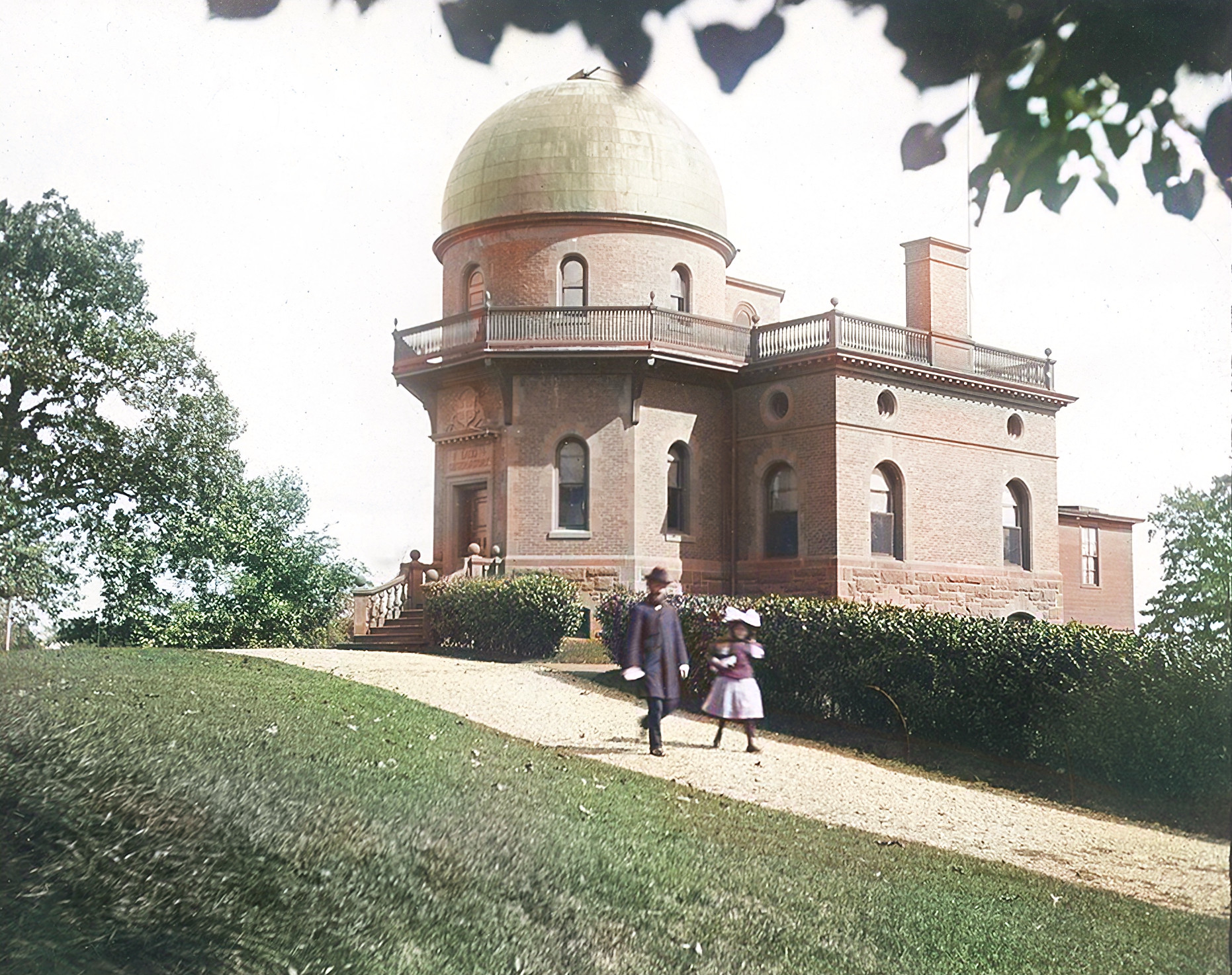
Here we see an especially cosmic haunt of the the young Lovecraft, the Ladd Observatory at Brown. Albeit in the bright morning and not star-surrounded and in silhouette at night.

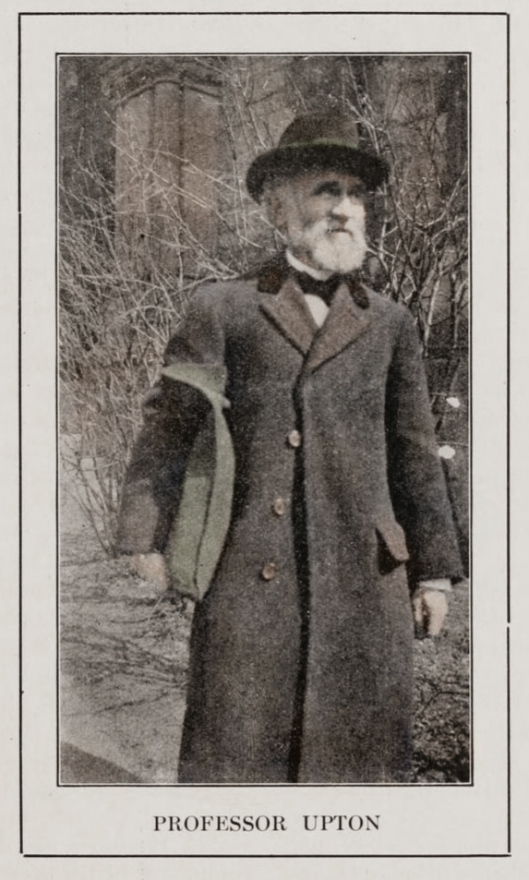
It’s quite possible that we see here the young Professor Upton. Most likely also one of his daughters (either Eleanor or Margaret), come to bring him home for a hot breakfast after a chilly and arduous night of observing.

“The late Prof. Upton of Brown, a friend of the family, gave me the freedom of the college observatory, (Ladd Observatory) & I came & went there at will on my bicycle.” — H.P. Lovecraft.

Below we see Prof. Upton in his Brown obituary picture of 1914, pictured in his old age — perhaps made circa 1909-1913.

Lovecraft and Webster’s

13 Thursday Aug 2020

Posted by asdjfdlkf in Astronomy, Historical context

≈ Leave a comment

This post is a small follow up to my recent post on Lovecraft’s Dictionary. Lovecraft used Webster’s in the form of Webster’s International, 1890, and continued to do so to the end of his life. But he wrote to Dwyer in 1927 that he had — as a boy — used Webster’s unabridged illustrated edition of 1864. There…

I became utterly infatuated with the pages of illustrations with the pages of illustrations of “Philosophic and Scientific Instruments” in the back of Webster’s unabridged of 1864.

Webster’s unabridged appears to have gone through numerous ever-expanding printings after 1864, all seemingly generally nodded to as “the 1864”. At each printing the illustrations at the back were often varied, being incrementally improved. For instance the pages on the 1880/86 edition of “the 1864” lack the appeal of the same pages in the 1890s editions…

This suggests Lovecraft’s family had an 1890s edition of “the 1864”. I say “1890s” because one can find eBay and Archive.org examples of the International which have title page dates from 1888 through 1895, and it appears it would probably be the work of a small thesis to work out the tangled printing history. But S.T. Joshi has “1891” in Lovecraft’s Library. Thus it appears on the face of it that what Lovecraft calls “the 1864” in his letter to Dwyer is in fact the the 1890 edition of “the 1864”. And that what in the 1930s he called the “1890” actually saw its second and final volume appear in 1891. To confuse matters further, there was evidently also an 1895 edition, which is the one most people now consult from that period on Archive.org.

If all this is correct then Lovecraft was likely “utterly infatuated” with the illustrations collected at the end of the second volume which appeared in 1891, these being presumably the same as the following 1895 edition illustrations…

In part then, this central illustration of a telescope may be what started Lovecraft on his cosmic journey, as he revisited the illustrations after he had finished with his chemistry obsession…

Further on in this rear illustrated section of the 1895 printing one can find all manner of curious ocean life and fungi.

Incidentally, in the same 1927 letter to Dwyer he remarks on a possible sequel or continuation to his recent “The Call of Cthulhu”. In response to Dwyer’s tabulation of the approaches so-far used at the more cosmic end of fiction, Lovecraft muses briefly on a future cosmic story he might write and remarks…

I think I shall write about the place that Cthulhu came from.

One wonders if this might have been somehow entangled with the other story he tells Dwyer he wants to write, in which his Red Hook lodging-house was to be depicted as some sort of malign sentient entity.

The pageant of Benefit Street down through the years (1945)

21 Tuesday Jul 2020

Posted by asdjfdlkf in Astronomy, Historical context

≈ Leave a comment

Some years ago I linked to the book While Benefit Street was young (1943), and I noted that another book by the same author was not yet online. The other book has now appeared at Archive.org. The Pageant of Benefit Street down through the years (1945) was written by someone who had lived on the street as a child, being then a few years older than Lovecraft.

Lovecraft almost ended up living on that street in 1933, his choice then being between 66 College Street with his aunt or a lone room in the Seagrave Mansion on Benefit Street. An astronomy newspaper column by Lovecraft (Sept 1914) suggests a reason for the second possible choice…

Mr. Seagrave, who is connected with the astronomical department of Harvard University, and who is one of the foremost astronomers of the present time, formerly had an observatory on Benefit Street in this city.

… the implication being that there was still some connection between Seagrave and Lovecraft via astronomy. Frank Evens Seagrave (1860 – August 1934) was still alive at that point and aged 74. Although a letter from Lovecraft, considering his options, implies the old man had by then moved out…

the old Seagrave mansion where the noted astronomer F. E. Seagrave dwelt & had his private observatory until 1914

Given that Lovecraft had the offer of a room there, we might plausibly assume that Mr. Seagrave was letting rooms in his old place to suitably refined but impoverished old gents of Providence. And especially so if they had a connection with Brown or astronomy.

‘Picture postals’ from Lovecraft: the Hayden Planetarium

12 Friday Jun 2020

Posted by asdjfdlkf in Astronomy, Historical context, Picture postals

≈ 1 Comment

H.P. Lovecraft spent Christmas and New Year 1935/36 visiting New York City and, as he told Robert Bloch in a letter, his “high point” stop was the new Hayden Planetarium. This was a just-opened New York marvel, built and fitted out in double-quick time with the aid of the philanthropist Charles Hayden. It had opened on the 2nd October 1935. Those were the days when one could go from drawing-board to opening day in 18 months, even in New York City.

The above leaflet describes the institution as it was in the 1940s, and is just about readable. The top postcard shows a charcoal drawing by Walter Favreau.

The Planetarium had a huge 700+ seat circular projection chamber, and permanent/temporary exhibition galleries on the history of astronomy and the solar system. It was far more than a planetarium, being creatively masterminded throughout by the pioneering cosmic artist and multi-media designer Walter Favreau. As such it was far more than a quick 90-minute in-and-out popcorn show for Lovecraft. It had several giant meteorites on display, and was the sort of place a keen astronomer and science-fiction writer might spend a day and an evening. Lovecraft went twice, and probably lingered. His comment that it “seems to be crowded at all hours” might suggest that at least one of his visits was in the evening.

His fiction writing days were over by this point, having written “The Haunter of the Dark”, but the Hayden Planetarium went on to inspire many others of genius. As Lovecraft told Bloch, the institute was “the most impressive educational device I had ever encountered”. Over the subsequent years and decades it became a vital place for interesting new generations in outer space and the stars, and also provided work for many early space artists. By 1952 it had seen about five million visitors.

Here is Lovecraft in a letter to Galpin of January 1936, describing his two visits…

On two occasions — once with Sonny [Belknap Long] & once with Sonny & Wandrei — I visited the new Hayden Planetarium of the Am.[erican] Museum, & found it a highly impressive device. It consists of a round domed building of 2 storeys. On the lower floor is a circular hall whose ceiling is a gigantick orrery — shewing the planets revolving around the sun at their proper relative speeds. Above it is another circular hall whose roof is the great dome, & whose edge is made to represent the horizon of N.Y. as seen from Central Park.

In the centre of this upper hall is a curious projector which casts on the concave dome a perfect image of the sky — capable of duplicating the natural apparent motions of the celestial vault, & of depicting the heavens as seen at any hour, in any season, from any latitude, & at any period of history.

Other parts of the projector can cast suitably moveable images of the sun, moon, & planets, & diagrammatick arrows & circles for explanatory purposes. The effect is infinitely lifelike — as if one were outdoors beneath the sky. Lectures — different each month (I heard both Dec. & Jan. ones) — are given in connexion with this apparatus.

In the corridors on each floor are niches containing typical astronomical instruments of all ages — telescopes, transits, celestial globes, armillary spheres, &c. — & cases to display books, meteorites, & other miscellany. Astronomical pictures line the walls, &c; at the desk may be obtained useful pamphlets, books, planispheres, &c.
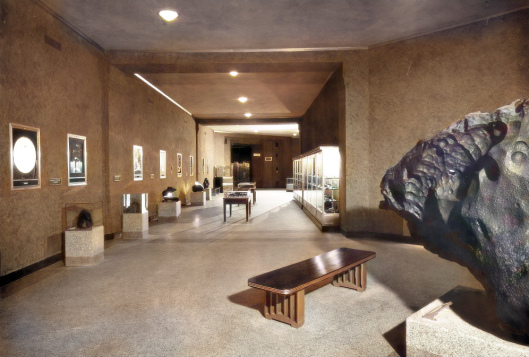
The institution holds classes in elementary astronomy, & sponsors clubs of amateur observers. Altogether, it is the most complete & active popular astronomical centre imaginable. It seems to be crowded at all hours — attracting a publick interest in astronomy which did not exist when I was young.
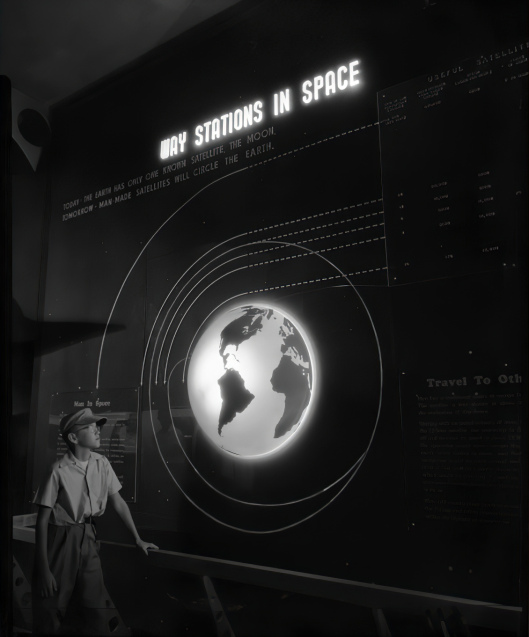
One of the backlit displays of the 1950s.

Doubtless Lovecraft would have thought of how much his grandmother Robie (Rhoby) would have admired such a place…

My maternal grandmother, who died when I was six, was a devoted lover of astronomy, having made that a specialty at Lapham Seminary, where she was educated.

As a boy he inherited her astronomy books and, it seems, some of her equipment.


Lovecraft does not mention the giant hallway paintings, indicating only that “Astronomical pictures line the walls”. One might imagine dull diagrams. But it seems that many were either quite visionary or were early imaginative ‘space art’ in the Chesley Bonestell manner, and by the noted dinosaur and prehistoric artist Charles R. Knight who was here branching out into star mythology. Here we get an idea of the scale of the visionary hallway art, which was apparently also boxed and backlit for added effect.
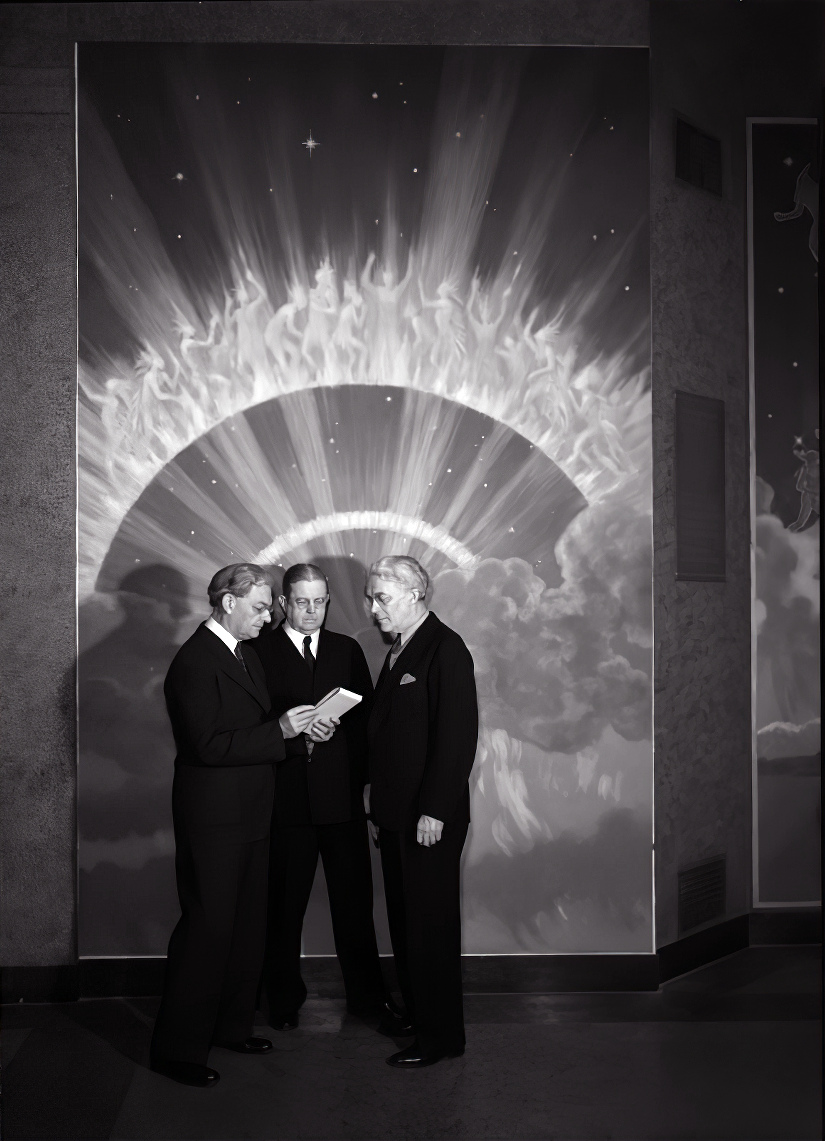
On the right, scientific director of the Hayden Planetarium, Dr. Clyde Fisher. On the left, probably the artist and designer Walter Favreau.

There were apparently others. Lovecraft might have especially relished a large-scale hallway painting made from this 1934 pre-production miniature by Walter Favreau of the ‘Destruction of New York’. The place’s lead designer and artist Favreau was especially interested in presenting cosmic catastrophe, and his planetarium sky-show apparently ended by illustrating five different ways the earth might one day perish. One ending featured a gigantic alien moon hurting toward the earth.
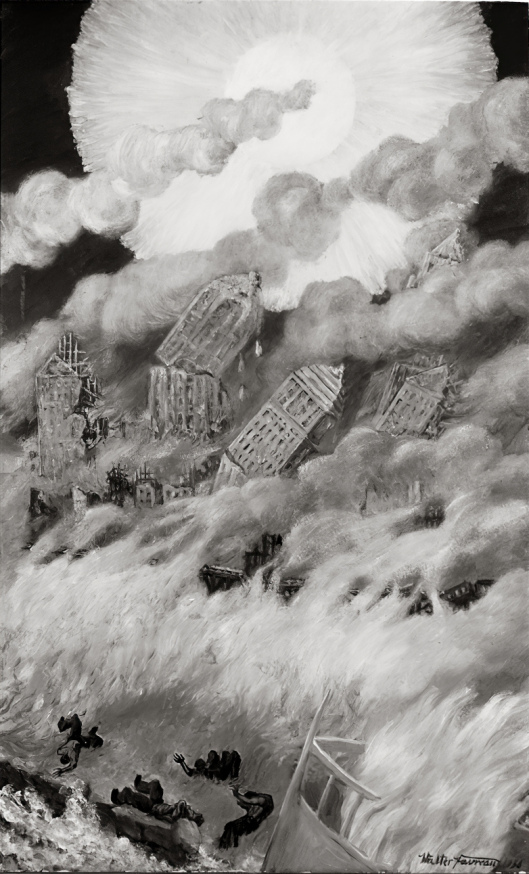
The idea that the sun would suddenly engulf our earth became a replacement for a previous doomsday scenario well-known in Lovecraft’s youth and young manhood. Here is H. G. Wells in 1931, remembering the way that this false scientific consensus be-numbed and hobbled the optimism of the late Victorians and early Edwardians, and indeed the world…

… the geologists and astronomers of that time told us dreadful lies about the “inevitable” freezing up of the world — and of life and mankind with it. There was no escape it seemed. The whole game of life would be over in a million years or less. They impressed this upon us with the full weight of their authority, while now Sir James Jeans in his smiling [book] Universe Around Us waves us on to millions of millions of years. Given as much as that man will be able to do anything and go anywhere, and the only trace of pessimism left in the human prospect today is a faint flavour of regret that one was born so soon.

This is from his 1931 preface to a new edition of his famous book The Time Machine (1895). Wells refers to the idea that the Sun only had a limited store of material to burn, and must inevitably cool as it would use this up before another million years had gone by — and with its depletion the Earth was also forever cooling and would relatively soon become inhospitable to life. Here is the Wells of 1894, noting the consensus of his day…

On the supposition, accepted by all scientific men, that the earth is undergoing a steady process of cooling …” (“Another Basis for Life”, Saturday Review, 22nd December 1894).

Possibly Lovecraft was influenced by this gloomy theory as late as early 1918, as he wrote to Kleiner then that… “In a few million years there will be no human race at all”.

Back home in Providence in the Autumn of 1936 the impoverished and increasingly ill Lovecraft was being misled in a different but no less calamitous way. He laboured at his desk not on new cosmic fiction, but on ‘Suggestions for a Reading Guide’. This being a long and involved general survey which was set to be the concluding chapter of Anne Tillery Renshaw’s Well Bred Speech — Lovecraft was effectively ghost-writing the book from her short chapter outlines for this textbook guide to English usage. He broke his health to get it finished, staying awake for 60 hours at a stretch and eating out of ancient tins unearthed from the back of his pantry. His ‘Suggestions’ chapter was discarded by Renshaw. But he slipped in one paragraph on the need for basic books on astronomy, mentioning the need to own a good star-atlas and planisphere…

The best contemporary star-atlas is Upton’s, but a quicker working knowledge of the constellations can be obtained by the use of a small revolving planisphere, such as is sold for a quarter at the new Hayden Planetarium in New York.

This one is from the Hayden in the 1950s, but they had looked much the same a decade or so earlier…
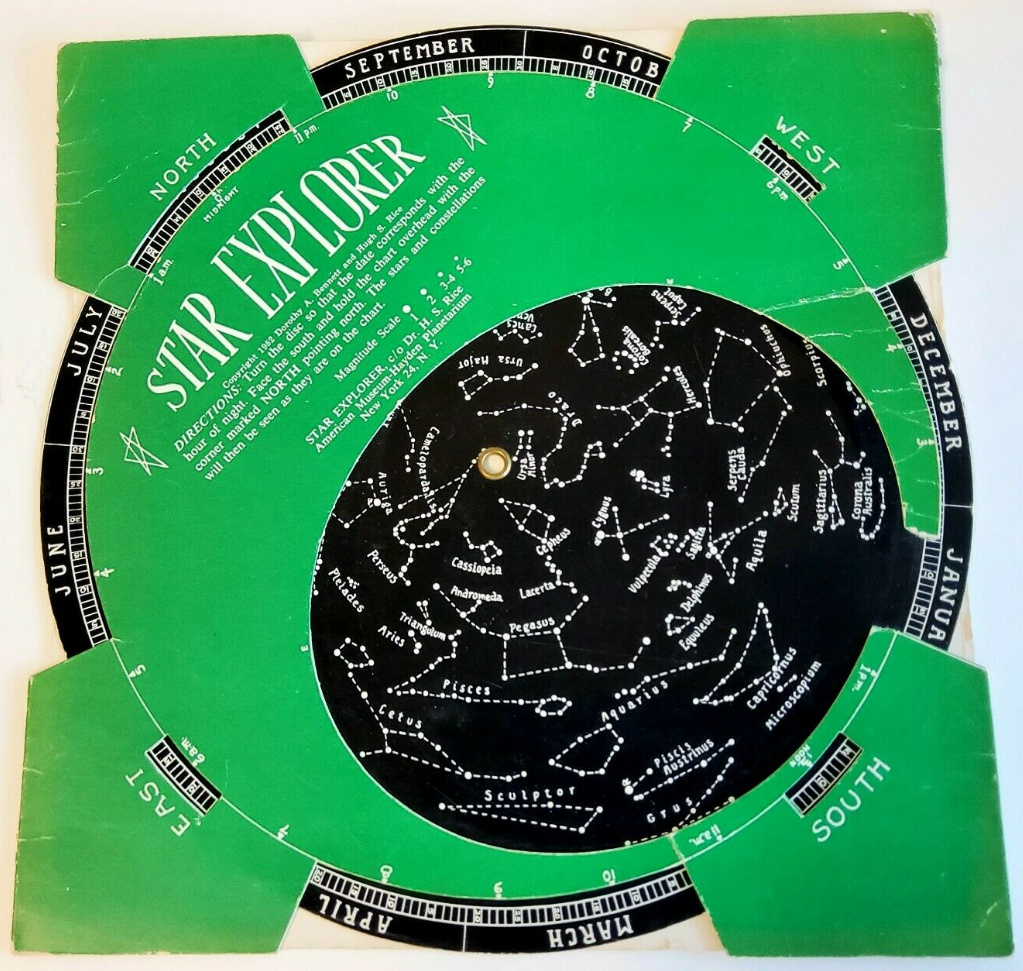
S.T. Joshi notes in I Am Providence…

Lovecraft bought two 25¢ planispheres [at the Hayden] and charitably gave them to [Belknap] Long and Donald Wandrei, so that they would make fewer mistakes in citing the constellations in their stories.

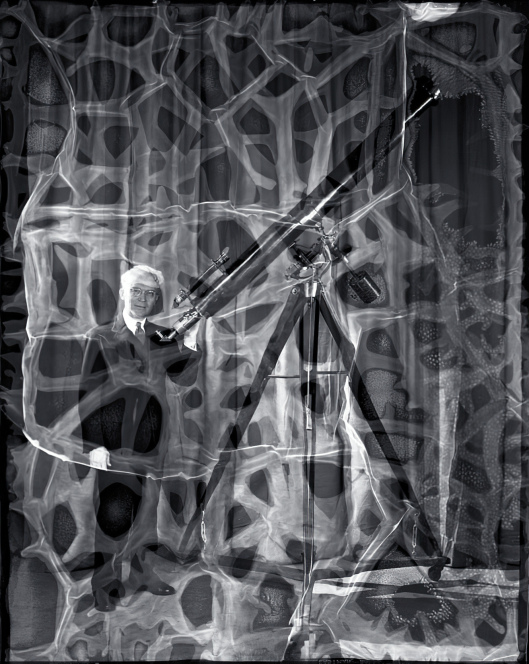
Finally here is the first scientific director of the Hayden Planetarium, Dr. Clyde Fisher. He was also the put-upon general manager for the first two years, but then a professional house manager was brought in and he was given the happier job of Curator of Astronomy. His portrait has since taken on a most Lovecraftian cast. Seemingly through natural decay in the archives, rather than the creeping invasion of cosmic outer entities, but you never know…

Further reading:

* “The Man Who Plays God”, a 1950 Mechanix Illustrated profile of the pioneering artist and designer Walter Favreau who masterminded the creative and presentational aspects of the Hayden Planetarium, including designing the sky-shows.

* More can also be found at the Hayden Planetarium website. It still exists, and welcomes donations in these difficult times. They might also welcome funding to locate and digitise their Sky: Magazine of Cosmic News, which began November 1936. It evidently featured a range of artists, not always purely astronomical. Here is a 1938 edition of Sky responding to the famous War of the Worlds broadcast…

* The current magazine of their parent Museum is Rotunda, which might welcome a good scholarly article on Walter Favreau. Favreau has evidently been utterly forgotten, even by the many assiduous historians of the space arts, space education and early multimedia. He appears to have begun his career as a toy-maker and tinkerer-inventor in New York City in the early 1910s, had a studio in the late 1920s at 20 East 41st Street making scale-models for architects, and was still being referred to as the creative director of the Planetarium in 1952 — when he was busy constructing a 32-foot scale-model of a von Braun moon rocket. One would expect to find him being at least mentioned in the substantial recent history of the form, Theaters of Time and Space: American Planetaria 1930-1970 (Rutgers University Press, 1987, 2005), whose author had a Doctoral Student Grant-in-Aid of Research for sustained work in the Hayden archives. Rather surprisingly this book has no mention of the USA’s leading planetarium artist of the period, though does find space for several sections on ‘planetariums and gender’.

← Older posts
Newer posts →


Please become my patron at www.patreon.com/davehaden to help this blog survive and thrive.

Or donate via PayPal — any amount is welcome! Donations total at Easter 2025, since 2015: $390.

Archives

  • February 2026
  • January 2026
  • December 2025
  • November 2025
  • October 2025
  • September 2025
  • August 2025
  • July 2025
  • June 2025
  • May 2025
  • April 2025
  • March 2025
  • February 2025
  • January 2025
  • December 2024
  • November 2024
  • October 2024
  • September 2024
  • August 2024
  • July 2024
  • June 2024
  • May 2024
  • April 2024
  • March 2024
  • February 2024
  • January 2024
  • December 2023
  • November 2023
  • October 2023
  • September 2023
  • August 2023
  • July 2023
  • June 2023
  • May 2023
  • April 2023
  • March 2023
  • February 2023
  • January 2023
  • December 2022
  • November 2022
  • October 2022
  • September 2022
  • August 2022
  • July 2022
  • June 2022
  • May 2022
  • April 2022
  • March 2022
  • February 2022
  • January 2022
  • December 2021
  • November 2021
  • October 2021
  • September 2021
  • August 2021
  • July 2021
  • June 2021
  • May 2021
  • April 2021
  • March 2021
  • February 2021
  • January 2021
  • December 2020
  • November 2020
  • October 2020
  • September 2020
  • August 2020
  • July 2020
  • June 2020
  • May 2020
  • April 2020
  • March 2020
  • February 2020
  • January 2020
  • December 2019
  • November 2019
  • October 2019
  • September 2019
  • August 2019
  • July 2019
  • June 2019
  • May 2019
  • April 2019
  • March 2019
  • February 2019
  • January 2019
  • December 2018
  • November 2018
  • October 2018
  • September 2018
  • August 2018
  • August 2015
  • July 2015
  • April 2015
  • March 2015
  • February 2015
  • January 2015
  • December 2014
  • November 2014
  • October 2014
  • September 2014
  • August 2014
  • July 2014
  • June 2014
  • May 2014
  • March 2014
  • February 2014
  • January 2014
  • December 2013
  • November 2013
  • October 2013
  • September 2013
  • August 2013
  • July 2013
  • June 2013
  • May 2013
  • April 2013
  • March 2013
  • February 2013
  • January 2013
  • December 2012
  • November 2012
  • October 2012
  • September 2012
  • August 2012
  • July 2012
  • June 2012
  • May 2012
  • April 2012
  • March 2012
  • February 2012
  • January 2012
  • December 2011
  • November 2011
  • October 2011
  • September 2011
  • August 2011
  • July 2011
  • June 2011
  • May 2011
  • April 2011
  • March 2011
  • February 2011
  • January 2011
  • December 2010
  • November 2010
  • October 2010
  • September 2010
  • August 2010
  • July 2010

Categories

  • 3D (14)
  • AI (70)
  • Astronomy (70)
  • Censorship (14)
  • de Camp (7)
  • Doyle (7)
  • Films & trailers (101)
  • Fonts (9)
  • Guest posts (2)
  • Historical context (1,095)
  • Housekeeping (91)
  • HPLinks (74)
  • Kipling (11)
  • Kittee Tuesday (92)
  • Lovecraft as character (58)
  • Lovecraftian arts (1,626)
  • Lovecraftian places (19)
  • Maps (70)
  • NecronomiCon 2013 (40)
  • NecronomiCon 2015 (22)
  • New books (966)
  • New discoveries (165)
  • Night in Providence (17)
  • Odd scratchings (984)
  • Picture postals (276)
  • Podcasts etc. (431)
  • REH (184)
  • Scholarly works (1,469)
  • Summer School (31)
  • Unnamable (87)

Get this blog in your newsreader:
 
RSS Feed — Posts
RSS Feed — Comments

H.P. Lovecraft's Poster Collection - 17 retro travel posters for $18. Print ready, and available to buy — the proceeds help to support the work of Tentaclii.

Proudly powered by WordPress Theme: Chateau by Ignacio Ricci.