Free audio book of Wayne June reading “The Willows” (1907) by Algernon Blackwood, one of Lovecraft’s favorites. Unabridged and running over two hours. Only free for a limited time, so download it while you can.


07 Tuesday May 2013
Posted in Podcasts etc.
Free audio book of Wayne June reading “The Willows” (1907) by Algernon Blackwood, one of Lovecraft’s favorites. Unabridged and running over two hours. Only free for a limited time, so download it while you can.
06 Monday May 2013
Posted in Historical context
Curtis F. Myers is an incredibly tough Lovecraft correspondent to crack. This is the best I can come up with. What we have to work with is…
“Curtis F. Myers, 70 Clifton Ave, Clifton NJ”
There is a 70 Clifton Ave but no online record for it except some OCR false-positives for the small startup firm Electronic Mechanics, Inc. which was actually a mile away at “70 Clifton Blvd.”, located there from 1935 until around 1945/6. One interesting possibility is that Barlow may have mistranscribed “Ave” from Lovecraft’s “Blv”. That’s a faint line of enquiry, but one worth pursuing.
A small startup electronics company was at that address, developing new types of radio components using the mineral mica: “Electronic Mechanics, Inc., 70 Clifton Blvd, Clifton, N.J.” Delbert E. Replogle was founder and president of Electronic Mechanics Inc. Communications (Vol.25, p.98) reported in 1945…
“ELECTRONIC MECHANICS CELEBRATES 10th. ANNIVERSARY. Electronic Mechanics, Inc., Clifton Blvd., Clifton, New Jersey, is now celebrating its tenth anniversary.”
This would mean the firm was established 1935. Official documents do indeed say it was formed 20th September 1935. So it was a small startup, and it was…
“engaged in manufacturing and machining insulating materials composed of mica and glass.” […] “Early in 1938 it became apparent that the New York company required expanded working quarters”
The firm then moved its operation to a factory in Paterson, although seems to have kept its offices at 70 Clifton Blvd. until the mid/late 1940s. The firm made a bundle of money on war contracts, but didn’t pay enough tax and so was pursued by the government for back taxes in 1950. It had made some key buyout purchases in the late 1940s, and became Molecular Dielectrics in a merger in the early 1960s. We also get Replogle’s name from a Quaker journal: “Delbert E. Replogle, Ridgewood, N. J., President of Electronic Mechanics, Inc.” is listed in the Friends Journal, 15th Feb 1961.
The firm was working with bonding mica to glass (to make glass-bonded mica ceramic insulation for radio and radar units, branded until 1942 as Mycalite then renamed Mykroy). So one wonders if they drew on the expertise of Morton, Lovecraft’s friend and mineralogist expert. Morton was only a few miles away at the Paterson Museum.


The American Institute of Electrical Engineers Yearbook of 1944 has one “Shima, Rindgh” giving the “70 Clifton Blvd” address as his address “for mail”, while he lived at an address elsewhere. So Replogle was obviously happy for his workers to get mail there.
So do we have any likely candidates who could have been working there? Kenneth W. Faig Jr. suggests in the Lovecraft Annual 2012 a Curtis F. Myers (b. 1897) as the likely candidate Lovecraft correspondent. He is recorded on the 1930 census at 31 Harrison Place, Clifton N.J. (one block from Clifton Av., one mile from 70 Clifton Blvd.), working as a machinist in a woolen mill. It’s perhaps not too much of a long shot to suggest that this Myers may have made a move to being a machinist in a hot new local startup in 1935, working with mineral/glass fibres. Working with animal fibres and working with mineral/glass fibres apparently requires similar skills.
If that was him, then quite how he came to know Lovecraft is still a mystery. Electronic Mechanics, Inc. were manufacturers not retailers, so it’s unlikely Lovecraft was writing to them to get radio spares (even he could have afforded them in 1936/7, when he could barely afford food). My hunch would be that Myers was simply a fan of weird fiction who had written to Lovecraft, and that Lovecraft had kindly written back. There is no online trace of this Myers as any kind of author or fan writer.
06 Monday May 2013
Posted in Historical context
I think I may have discovered yet another lost Lovecraft correspondent, and another Barlow mistranscription of a name on the 1937 correspondence addresses of H.P. Lovecraft…
“Horatio L. Smith, 36 Dodd St, Montclair NJ.”
This is likely to be Horatio E[lwin] Smith (1886-1946) of Columbia University. Montclair is a leafy suburb some 15 miles from Columbia. He wrote on Poe, and was a literary academic at Brown University 1926-c.1934.

Smith (above) studied under John Erskine (A Memory of Certain Persons, p.141, noted in passing) at John Hopkins, where he took a LL. D. [Doctor of Laws in English].
Horatio E. Smith was the author of the article “Poe’s Extension of His Theory of the Tale” in the 1st August 1918 edition of Modern Philology. This is possibly how his name first came to the attention of H.P. Lovecraft. If so, Lovecraft would have no doubt remarked on a name so strikingly similar to a major writer of Poe’s time…
“During Poe’s lifetime, one of the most popular English writers of poetry, essays, novels and tales was Horace or Horatio Smith (1779-1849).” (Burton R. Pollin, “Figs, Bells, Poe, and Horace Smith”, Poe Newsletter, June 1970).
The history of the French dept. at Amherst College supplies a useful academic biography that confirms my initial research…
“Horatio Elwin Smith, a 1908 graduate of the College, was hired to teach French literature [circa 1919]. /their footnote: Smith held a doctorate from Johns Hopkins that was awarded in 1912./ He had taught at Yale for the previous six years [living at 837 Orange St] and specialized in the analysis of nineteenth-century texts. He wrote articles on Stendhal, Balzac, Sainte-Beuve and Poe, as well as a book on the literary criticism of Pierre Beyle [his thesis]. In addition, he wrote a textbook on advanced French Composition. Under Smith the curriculum in French would see its first course in “Modern French Criticism,” which was dedicated to the writings of Sainte-Beuve, Taine, and Renan. Smith would leave Amherst in 1926 to become Chair of Romance Languages at Brown University [Providence], before assuming the same title a few years later [circa 1934] at Columbia University, where he became the editor of [the academic journal] Romanic Review [the Columbia University journal for the study of Romance literatures, seemingly serving as editor for the 1937-1947 issues].
The move to Brown University in 1926 suggests that, if Lovecraft had not noted Smith’s 1918 Poe article in 1918 or 1919, he could have learned of Smith later via a newspaper or journal profile of the incoming professor.
Smith also published a book in French “La fortune d’une oeuvre de jeunesse de Stendhal en Amerique” (1927). The Amherst College French dept. history notes he was… “named ‘Chevalier de la Legion d’Honneur’ by the French government.” Seemingly this was for his work with the YMCA in France during the First World War.
By 1942 Smith was noted as… “Prof. Horatio E. Smith, chairman of the Columbia department of Romance languages”, and was on the Modern Language Association’s Commission on Trends in Education. His widely cited reference work the Columbia Dictionary of Modern European Literature appeared after his death, in 1947. It had notable early research summaries on the writers of Dada and surrealism.
One wonders what happened to Smith’s papers and correspondence in 1946? Still preserved in some dusty boxes at Columbia, perhaps?
05 Sunday May 2013
Posted in Lovecraftian arts, Odd scratchings
Lovecraft and LOLcats, the perfect combination…


03 Friday May 2013
Posted in Odd scratchings, Scholarly works
Further to my recent Lovecraft timeline idea which I posted here, it seems a group in London is on the case…
HTML5 (history) timeline creation web app. Fixed-Price – Est. Budget: $5,500.00. Posted April 8 2013, delivery 31st May 2013. “We’re a London based group of designers, historians and consultants who want a prototype (history) timeline creation web app…”
So I shall hold off my own timeline in the hope that they have something in beta by late summer.
03 Friday May 2013
Posted in Odd scratchings, Scholarly works
It occurs to me that Lovecraftian researchers could now have a keyword search-engine for Lovecraft’s own library, plus books he is known to have read. If we want it. Since most of these books are now in the public domain and have been scanned by Google, and are consequently now free on Archive.org, Gutenberg, or Hathi. Rather than just a list of Web links, the best option would be to:
i. go through the second edition of the book Lovecraft’s Library, Google-ing the titles and getting the Web URLs for the full plain text if it exists online.
ii. plug this URL-list into a free Google Custom Search personalised search-engine.
Alternatively, someone could create a commercial product on a DVD which serves the same function. This might have the benefit of including PDF digital facsimiles, as well as referencing the stripped plain text of the books. Such a product could also acquire and scan any public domain volumes unavailable online. Feel free to take this idea and run with it, with the suggestion that you can probably save yourself a lot of work by commissioning someone via elance.com or similar. I imagine that $200 or so would entice some student to spend a few days doing the grunt-work of looking up the Lovecraft’s Library titles and getting the URLs.
02 Thursday May 2013
Posted in Odd scratchings
I was thinking of doing a basic “core-facts” Lovecraft timeline. As a big desktop-based side-scroller timeline for the Web. With three strands running parallel to each other: his life events / dates for writing and publication of the works / relevant general-history dates. Sadly timeline creation software is still as crap as it was in 2007, the last time I went looking for it in a serious way. The software is either geared toward: genealogists (ugly, fiddly, expensive); arcane computer-coding nerds (ugly, fiddly to install, always in beta); or business owners or schoolkids who just want a dozen items on a dinky little timeline (can sometimes be pretty, but can’t handle hundreds of items / side-scrolling / slick zooming in-and-out). Anyone have experience of a good timeline software, for the sort of finished Web history timeline that I’m envisioning? I’m thinking I may have to code it in javascript and HTML, as I did in 2007 🙁
01 Wednesday May 2013
Posted in Historical context, Lovecraftian arts
I had a quick look at the facts on the job of movie-house ticket seller that Lovecraft once had in Providence.

The Lovecraft scholarship:
“Brobst has confirmed that HPL [Lovecraft] worked briefly as a ticket agent in a movie theater in downtown Providence” (An H.P. Lovecraft Encyclopedia, pp.24-25)
“I asked Harry K. Brobst about the story, and he confirmed it, stating that Lovecraft admitted to him that he held such a job and saying that he actually liked it at the start but that it did not last very long [this was] in the early days of the [Great] depression, perhaps 1929-30.” (S.T. Joshi, A Dreamer and a Visionary, p.317).
The context:
“In this era [1900-1929] Providence was a great show town, and vaudeville, burlesque, summer stock [theater], and movies rivaled sports for the attention of the populace. The major entertainment houses — all built during this time — were the elegant, all-purpose Albee (1919) […]; Fay’s Theater (1912), a popular vaudeville spot […]; the Strand (1915) […]; the Majestic (1917) […]; and Loew’s State Theater (1928), a splendidly appointed movie house […]. In addition to these, there were a half-dozen smaller, less glamorous entertainment houses in the central city.” (“The Age of Optimism: 1900-1929”, Providence City Archives website).
In 1921 there were… “five downtown Providence theatres: the Strand, the Emery, the Modern, Fays, and the Rialto” that showed the movie Chaplin’s The Kid (Gerald A. DeLuca).
Possible movie theaters in Providence in 1929:
UPMARKET:
MAJESTIC: 201 Washington Street, one of the leading first-run cinemas, wired for sound 1926, and “could seat 3,000″ — so they’d need a lot of ticket-takers.
STRAND: The Strand Theatre was located directly behind Providence’s Biltmore Hotel. It opened 12th June 1915 as a movie theatre […] Briefly known as the Paramount Theater in the 1930’s” (William Charles D’atri). Lovecraft liked the place very much, and had known and patronised it much in the later 1910s.
EMERY: Reopened 1926 on 79 Mathewson Street, “Completely refurnished, redecorated and re-established as a modern theatre, a marvel of the decorator’s art.”
VICTORY: aka Keith’s/Empire. 260 Westminster Street. Upmarket first-run movie theatre, renovated 1924.
RKO ALBEE: 320 Westminster Street, classy Hollywood movies, large and with luxurious decor.
MIDDLE MARKET:
FAYS: 60 Union Street at Fountain Street. Lively frequently changing mix of vaudeville and cinema, seems to have been an “all the family” theater.
CAPITOL: 569 Westminster, ill-fated, in a slow decline over the decades because just outside the downtown area.
DOWNMARKET:
MODERN: 440 Westminster Street, said to have specialised in “sensation” movies.
UPTOWN THEATRE: aka Columbus “[had] a long career as primarily a second-run [movie] house catering to a large adjacent ethnic Italian population in Providence’s Federal Hill neighborhood.” Unlikely, once you’ve read “The Haunter of the Dark”.
BIJOU / EMPIRE: 368 Westminster Street, which until 1930 seems to have been a dubious dive … “In a 1996 Providence Journal article on old Providence theatres, writer Michael Janusonis wrote that “…the hoity toities referred to it as ‘the sinkhole of depravity’ or just ‘The Sink’”.
It appears to have staged scantily-clad “musical revues” in the 1920s. Sometime in spring 1930 it became… “a second-run [movie] house and changed the name to the EMPIRE.” (Gerald A. DeLuca). “‘Cheri’ was one of the last musical revues to play the Bijou. That was in March 1930. Shortly after that Spitz [the owner] converted it into a second-run [movie] house and changed the name to the EMPIRE. It was under this title that the theatre operated until about six months ago [1949] when it was shuttered for good.” (Boxoffice magazine, January 7, 1950, via Gerald A. DeLuca) Not to be confused with the movie theater at 260 Westminster Street.
So there you have it. Take your pick. My hunch would be he was at the BIJOU/EMPIRE. It was hiring at the right time around March/April 1930 after a rename and makeover, and when the weather meant that Lovecraft was inclined to venture forth from his usual winter hermitage. The venue’s previous very seedy reputation might have meant it needed both brand new ticket-takers, and a certain level of sober “class” behind the glass. On a map it looks like it was a fairly short walk from his home, a walk of perhaps a mile and half.
The Great Depression had started 29th October 1929, and Lovecraft was not inclined to commit himself to venture out in the cold weather of a Nov-March New England winter. So April 1930 seems the likely date for his cinema job. Because he left on a trip to Charleston, S.C. on 28th April 1930 (“Account of a Visit to Charleston, S.C.”). “Lovecraft’s travels for the spring-summer of 1930 began in late April.” (S.T. Joshi, A Dreamer and a Visionary, p.285). One wonders if the cinema job of a few weeks in the early spring of 1930 would have given him the funds, toward the end of the month, to pay for his ticket on the long Charleston trip?
Further reading:
Roger Brett, Temples of Illusion: The Golden Age of Theaters in an American City, Brett Theatrical, 1976. (A “detailed history of all the old downtown area theatres of Providence from 1871 to 1950.” 309 pages).
Flickr set of photographs of 450 Rhode Island theaters and movie houses.
30 Tuesday Apr 2013
Posted in Historical context
Stacy Tolman of Providence (1860-1935):
 Portrait of Tolman.
From 1889 Tolman was a teacher at the Rhode Island School of Design, head of the dept. of drawing and painting there until 1905, thereafter teaching the anatomy class. He had his studio in the Fleur de Lys building in Providence from 1895.
The Etcher (c.1887-90), Stacy Tolman of Providence. The man depicted is the printmaker William Henry Warren Bicknell, friend and fellow student:

The Musicale (c.1887), Stacy Tolman of Providence:

Yard View, Providence (undated), Stacy Tolman of Providence:

The Interlude (1890), Stacy Tolman of Providence:
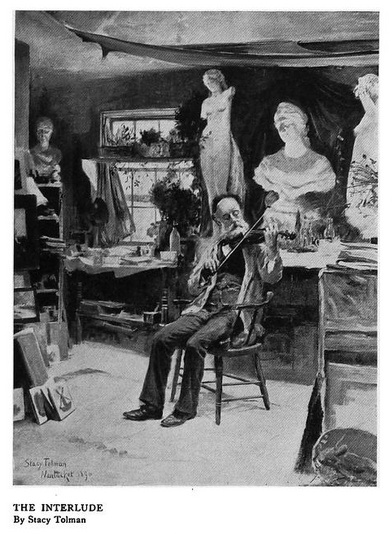
This evokes several Lovecraft stories such as “The Terrible Old Man”, “The Music of Erich Zann”, and “Hypnos”.
His late work, presumably in the 1920s, apparently showed the evidence of impressionism. One presumes that toward the end of his life Providence gave Tolman a major retrospective exhibition, which Lovecraft would have likely seen (unless he was away in New York at that point). I can’t find one, but there was a 1935 list catalogue for a Memorial Exhibition of Paintings, Drawings and Etchings by Stacy Tolman.
It is quite probable he was a teacher of Lovecraft’s Providence correspondent (and probable local friend) Frederick Allen Wesley, who studied at the Rhode Island School of Design as evidenced by the 1903 yearbook (and probably also studied there in later years)…

There is an ink drawing of Wesley by Tolman, not yet available online…
Rhode Island Historical Society–Graphics Dept.:
ACCESS RESTRICTED. APPOINTMENT REQUIRED
1. Ink drawing, “Frederick Allen Wesley” (call# Graphics XXB Painting T652 1)
Given this, one wonders if Lovecraft’s friend Wesley was the model for the artist in “The Call of Cthulhu”…
“who had latterly been studying sculpture at the Rhode Island School of Design and living alone at the Fleur-de-Lys Building near that institution. Wilcox was a precocious youth of known genius but great eccentricity”
Note that the last “A.W.” initials of Henry Anthony Wilcox are the same as those of Frederick A. Wesley, and that Lovecraft has a tendency to slip his friends into his stories.
One wonders if the Tolman portrait of Wesley will show something of Lovecraft’s description of Wilcox in “The Call of Cthulhu” as a…
“thin, dark young man of neurotic and excited aspect”
Articles:
Ralph Davol, “An Appreciation of Stacey Tolman“, Brush and Pencil, an illustrated magazine of the arts today, Vol.7, Dec. 1900, pp. 163-172.
John. I.H. Baur, “A Painter of Painters: Stacy Tolman”, American Art Journal, Jan 1979, pp.37-48. 14 illustrations.
30 Tuesday Apr 2013
Posted in Historical context
There appears to be an extant portrait picture of the obscure Lovecraft correspondent from Providence, Frederick Allen Wesley of 6 Hammond Street….
Rhode Island Historical Society–Graphics Dept.:
ACCESS RESTRICTED. APPOINTMENT REQUIRED
1. Ink drawing, “Frederick Allen Wesley” (call# Graphics XXB Painting T652 1) [ink drawing by Stacy Tolman]
Source: Unveiled: a directory and guide to 19th century born artists active in Rhode Island, and where to find their work in publicly accessible Rhode Island collections, by Elinor L. Nacheman. (2007).
Stacy Tolman. (1860-1935) [portrait]. “He was an early member of the Providence Art Club, and Providence Watercolor Club. His studio, previously used by Charles Walter Stetson, was in the Fleur de Lis Building, in Providence with Sidney Burleigh, George Whitaker, Chester Dodge, Frank Mathewson, and Gertrude Parmelee (Cady). Tolman traveled to Europe and the Middle East to paint, and exhibited at the National Academy of Design, and Pennsylvania Academy of Fine Arts.”
This would seem to link Wesley in some way with the Providence Art Club? And/or to the art scene of the Fleur-de-Lys Studios building (a building which also features in “The Call of Cthulhu”).
Possibly Wesley was an artist or designer himself. I have found a “Wesley, Fred A.” in Rhode Island School of Design Year Book 1903 – Volumes 25-28 – Page 69, taking a course there…

He appears to be taking the first and presumably foundational course, and so was presumably a junior student. If he had been born 1885 (as Ken Faig has found) then in 1903 he would have been of the right age to be an 18 year old freshman at the Rhode Island School of Design. Tolman was then a leading teacher there. One wonders if Wesley might in time have become an assistant apprenticed to Stacy Tolman or one of the other artists in the Fleur-de-Lys Studios?
30 Tuesday Apr 2013
Posted in Historical context
Lovecraft correspondent Fred Anger planned an index to Weird Tales and an edition of Lovecraft’s Fungi from Yoggoth, both with Louis C. Smith. It seems that Smith has long been a minor and almost total mystery to Lovecraftians. But he can now be fairly easily traced through his fannish activities, although his birth and death dates, and his post-war occupation, remain elusive.
John Cheng’s book Astounding Wonder: Imagining Science and Science Fiction in Interwar America (University of Pennsylvania Press, 2012) names Smith as… “Louis C. Smith on the Berkeley-Oakland side of San Francisco” and details on page 217 some of Smith’s early fannish involvement…
“In 1928 Aubrey MacDermott, Clifton Amsbury, Lester Anderson, and Louis C. Smith on the Berkeley-Oakland side of San Francisco Bay began meeting monthly as the Eastbay Science Correspondence Club (ESCC). Raymond Palmer, originally a Chicago SCC member, suggested a national merger [with his own organisation and they became the] Eastbay Scientific Association, merged into one club under a constitution drafted by Dennis, Clements, and A. B. Maloire of Chehalis, Washington.”
Cheng appears to be drawing here on Joseph L. Sanders’s Science Fiction Fandom (1994), although I am unable to access his footnotes.
Harry Warner Jr.’s book All our yesterdays: an informal history of science fiction fandom (1969) noted on page 59 and 67 respectively that…
“Louis C. Smith had dozens of custom-bound volumes that he entitled ‘Fantastic Fiction….’ and that “Louis C. Smith kept a card index in the thirties that contain facts on more than a thousand books” but that is all I have been able to access online.
Evidently Lovecraft was not dealing with a couple of vapid star-gazing schoolboys. Smith was serious about bibliographic undertakings.
Smith also contributed letters to the Jerome Siegel (1914-1996) fanzine Science Fiction, and had a letter in the very first issue in November 1932.
Smith had an article or letter in the August 1934 issue of The Fantasy Fan, in which he noted that “A. Merritt is of French Huguenot ancestry”. Smith and his friend Fred Anger provided “An Interview with E. Hoffman Price” published in The Fantasy Fan, December 1934.
Smith contributed an article on “Phillip M. Fisher, Jr.” to Fantasy Magazine, August 1935. In 2011 this was due to be reprinted as an introduction to the book Strange Ocean Vistas of Philip M. Fisher (George A. Vanderburgh’s Lost Treasures from the Pulps #12) but this is a volume that although prepared seems to have been delayed.
An article “Phantasy’s Trend” by Louis C. Smith appeared in The Phantagraph fanzine of February 1936.
The Futile Press’s The Science Fiction Critic (December 1936/January 1937, “Volume One, Number Six”) contained work by a “Frederik and Louis C. Smith”, the Smith item titled “Fantasiana”. One wonders if the “Frederik” was Smith’s friend Fred Anger. It seems likely he was. The Science Fiction Critic fanzine was edited by Claire P. Beck, and that particular edition was the first issued from her new address at Lakeport, California.
Smith had a column titled “Fantastica” in the fanzine Helios (Oct-Nov-Dec 1937).
According to the online The FictionMags Index Smith had letters published in Weird Tales: “Feb, Dec 1933, Dec 1934, Aug 1935, Nov 1936”.
Smith had a column published in the Tesseract fanzine: December 1936; and January 1937 (titled “Authorsophy”, stated as being… “a column by Louis C. Smith which quotes Edmond Hamilton, E. E. Smith and others”); and March 1937; and October 1937 (titled “Science in Fiction”). Tesseract was apparently the product of The Science Fiction Advancement Association of San Francisco, with which Smith was presumably involved since he was evidently living in the city. In 1941 Smith was noted in a SF fanzine as living in San Francisco…
“recent news from America is that that eternal infernal bibliography-in-preparation bug has now bitten old-time fan Louis C. Smith and Fantasia-editor Louis Goldstone, both of San Francisco.” (Futurian War Digest, 1941, No.14).
This quip probably refers to Smith’s venture with co-editor Jack Riggs, on a 28 page index of SF pulp stories: Unknown Index: Fantasy Fiction in Three Sections, Table of Contents, Index of Titles, Alphabetical List of Authors, Berkeley, Calif., 1944 or 1946. A book record at Worldcat describes this work as an… “Index to the 39 issues of Unknown and Unknown Worlds.”

The cover of this work actually gives us an address: “1620 Chestnut Street, Berkley-2- California”
However, this may have been Jack Riggs rather than Smith’s address, since the 1941 Fanzine Yearbook in section two of Le Zombie (January 1942) gives the title and address of Smith’s own fanzine:
“TELLUS Louis C. Smith, 1845 Prince Street, Berkeley, California. Mimeographed; monthly; two; 16 pages; 10 cents.”
Tellus is in the Special Collections Department, University of Iowa Libraries… “Tellus. Nos. 1, 2 (1941), 3 (1942), 4 (1943), 5 (1944), 6 (1945)”
This fanzine run might be usefully inspected for any article by Smith remembering his contact with Lovecraft or his circle. It might also give biographical details for his friend Fred Anger.
Smith’s home was also a venue for weekly fannish SF meetings in his city, according to a footnote to an article in Astounding Science Fiction in 1942 (Volume 28, Issue 6, page 110)…
“Every single member is an Astounding SF fan, which isn’t as astounding as it may seem. We meet every Friday evening at 1845 Prince Street in Berkeley with Louis Smith as director.”
All goes rather quiet on the Louis C. Smith front after this. But in 1971 a paper was presented to the first Popular Culture Association National Conference (East Lansing, MI, April 8-10, 1971) by a Louis C. Smith, titled “John Clark Ridpath and Popular History – Neglected and Forgotten”. Ridpath was a popular historian 1869-85. It might suggest that Louis C. Smith became a academic or more likely an academic librarian, since he obviously had the bibliographic bug in him.
29 Monday Apr 2013
Posted in Historical context
Lovecraft correspondent Fred Anger (William Frederick Anger, probably b. 15th Sept 1920) was a young Lovecraft fan and letter writer to the pulps. The Lovecraft Encyclopedia states he planned an index to Weird Tales and an edition of Fungi from Yoggoth, both with Louis C. Smith, neither of which appeared. He contributed an interview to The Fantasy Fan fanzine.
Here are two fragments of Anger’s youthful letters to pulps…
“Fred Anger, of Berkeley, California, writes: “Weird Tales is certainly improving steadily. Every new copy gets better and better; evidently there is no end to your progress. The first installment of The Trail of the Cloven Hoof is as good a piece of weird fiction as it is possible to find. Mr. Eadie has given us nothing but the best in all the years he has been writing. The Trail of the Cloven Hoof equals if not excels The World-Wrecker of several years ago. Congratulations, Mr. Eadie. Through the Gates [of the Silver Key?… his letter is incomplete, at least in the digital source I have access to]” — “By Air Mail,” a letter to Weird Tales, September 1934, Vol.24, No.3.
John Cheng’s book Astounding Wonder: Imagining Science and Science Fiction in Interwar America (University of Pennsylvania Press, 2012) quotes Anger on page 62, as being representative of writers to the pulp letters pages…
“Readers were not naive about letters columns. Some readers questioned the validity and representative character of published exchanges. “I hardly think that the small cross-section of the Science Fiction readers as represented by your Discussions is quite a fair example of the readers as a whole,” wrote Fred Anger, 2700 Webster Street, Berkeley, California. “It is inclined to be prejudiced and it is not a customary editorial policy to print letters which really express opinions.”
Cheng does not say to which pulp Anger was writing here, nor does he footnote the quote. It was not Weird Tales, but rather an SF pulp with letters pages titled “Discussions”. Presumably this must have been Amazing Stories. This might suggest Anger was a hard SF as well as a fantasy-horror fan. I have found an online indication that his letter was published in a 1935 issue of Amazing Stories.
Anger appears to have been very antagonistic to Robert Bloch, then of about the same age…
“Another fellow named Fred Anger never missed a chance to criticize Bloch” (Gary Romeo, “Stars of the Pulps”, Sand Roughs #5, Winter Solstice, 2002).
This was apparently because Bloch didn’t like Conan and had called R.E. Howard’s character “Conan the Cluck” in print.
The Lovecraft correspondence with Anger seems accounted for, and safely in the Selected Letters and held in a public collection…
“H.P. Lovecraft Correspondence: Minneapolis, University of Minnesota, United States. The collection consists of 5 holograph postcards (Aug. 31, 1934 to Sept. 2, 1926), 10 holograph letters (Aug. 14, 1934 to Aug. 14, 1935), 1 typescript letter (Jan. 16, 1936), one chain letter (typescript and holograph, undated), one typescript letter signed by August Derleth (April 21, 1968). The letters and postcards are written to Fred Anger from Lovecraft, mostly from his home in Providence, Rhode Island. They relate to their common interests in writing weird fiction and issues relating to publishing their work. Transcriptions of the materials have been made and are available in the archives.”
I have found a further note (.xls file) that this was an…
“Acquisition Donated to the Archives by William F. Anger in 1973”
One assumes that the letter from August Derleth (April 21, 1968) was to alert Anger of the importance of his old Lovecraft letters and items? If so it would likely have Anger’s home address in 1968. Has anyone ever checked this archive, other than perhaps Derleth? Its presence at Minneapolis might suggest that Anger was around Minneapolis, Minnesota in the 1970s? Or perhaps was an alumnus of the university?
Generally lacking in the older Lovecraftian printed literature is a death date for Anger, although I Am Providence states 1920-1997. I have found a Polish listing of correspondents which states “1997”, and interestingly this also notes that Anger personally knew Clark Ashton Smith.
Presumably this 1997 death date was drawn either from Joshi or from Ken Hill’s information given on the alt.horror.cthulhu discussion group in 2008…
“William Frederick Anger, born in 1921, according to AN H.P. LOVECRAFT ENCYCLOPEDIA […] I don’t find any references to him after the 1930’s. The Social Security Death Index lists a William F. Anger, born 15 September 1920, died 2 September 1997; last known residence, Buffalo, N.Y.; social security number issued in New York State.”
This is the only mention of Anger on that alt.horror.cthulhu thread. An open genealogy website confirms that “William F Anger’s last known residence is at Buffalo, Erie County, NY (New York) 14203.” Another database usefully states…
“William F Anger, died 09/02/1997 buried at Bath National Cemetery in Bath, NY.”
This has enabled me to find a picture of his gravestone at Bath National Cemetery (Plot: R, 0, 53), the inscription of which tells us that he served in the U.S. Navy during the Second World War…

Presumably the U.S. Navy archives may have more details of his war service. YN3 indicates he was a “Petty officer third class” in the Navy.
None of this proves that the East Coast Anger is the same as as the West Coast Anger. But my hypothesis would be that after California fandom in the 1930s, where he apparently knew Clark Ashton Smith personally, Anger served in the Navy in the 1940s. He then possibly (my guess) took advantage of the post-war G.I. Bill to get an university education, and went to live in the East Coast. Given that he was a Lovecraft fan I wonder if he may have tried for Brown University? What he did on the East Coast for fifty years, if indeed he was living around New York from circa 1947 to 1997, I have as yet been unable to discover. There seems to be not a whit of him in the fannish record that’s available online.