
HPLinks #83.
* New to me and now open-access, “Teratonymy: the weird and monstrous names of H.P. Lovecraft”, from the academic journal Names (September 2010). Freely available online.
* A long abstract for an advanced undergraduate presentation at Oberlin, “Letters from the Abyss: Epistolary Form and the Unknowable in Lovecraft’s Cosmic Horror” (2025). A rare focus on the influence of letter-writing on the structuring of Lovecraft’s fiction…
“Nineteenth-century Gothic texts such as Dracula and Frankenstein use written correspondence to create realism, build trust, and establish clear lines of communication between narrator and reader. This study argues that Lovecraft reworks these same forms to produce the opposite effect: confusion, fragmentation, and uncertainty.”
* A recent virtual conference on Mediterranean Antiquity in the Work of H.P. Lovecraft (April 2026). This included papers, not yet available online, such as…
— H.P. Lovecraft and the Dark Side of Antiquity.
— Cthulhu and Polyphemus.
— Civilization, Decline, and Hybridizations: Trajectories of ‘Decadence’ in Greco-Roman Cultures and Lovecraft’s Fiction.
— Roman History Through the Lens of Lovecraft?
* A reminder to readers that the deadline for the Armitage Symposium is fast approaching. Submit by 24th May 2026.
* The Journal of Dracula Studies once again rises from the dead, and has a new Call for Papers.
* Deep Cuts considers the 1970s booklet Winifred Virginia Jackson — Lovecraft’s Lost Romance (1976) by R. Alain Everts & George T. Wetzel. And also Lovecraft’s Daughter (1983) by R. Alain Everts. The latter being Sonia’s teenage ‘flapper’ daughter.
* The boy Lovecraft’s attention was turned towards Greek/Roman myth by reading Hawthorne’s Wonder Book and Tanglewood Tales. Now there’s a sumptuous new $100 illustrated Wonder Book Illuminated Edition, complete with essays by Guillermo del Toro and others.
* Dark Worlds Quarterly has a new post surveying The Cthulhu Mythos in the pulp magazine Strange Tales.
* From France, the audio ‘Lovecraft Integrale’ series of podcasts, which appear to be straightforward free high-quality human readings of Lovecraft in French, with music. My guess is that they’re meant to showcase the abilities of the maker’s Audio360 studio in Paris? Freely available online, no region-blocking.
* From Moscow, a Russian book whose English title might be The mythology of Lovecraft: From Cthulhu and cosmic horror to the Necronomicon and forbidden cults (2026). Appears to be a mix of biography, criticism and mythos-systematizing, with dashes of philosophy? The reviewer states… “it seems that this is the first time his mythology has been analysed in such detail in Russian”

* SpraguedeCampFan reviews Weird Tales: 100 Years of Weird, 1923-2023 (2023).
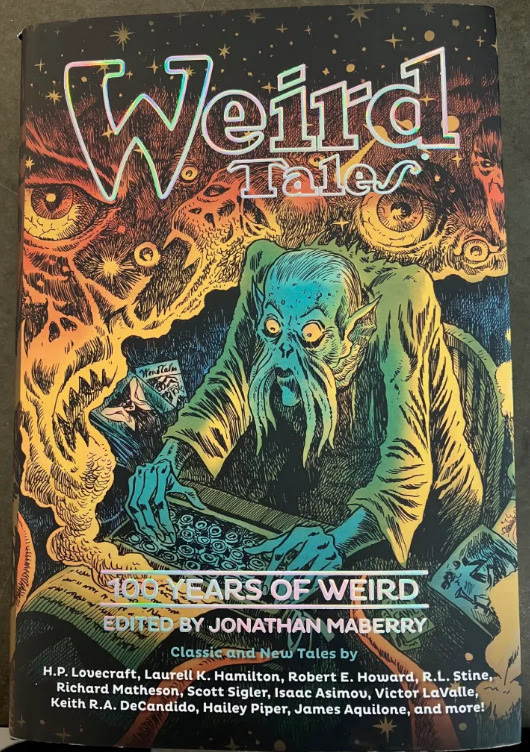
I see that this table-trembling 500-page hardback can now be had as a rather more lightweight Kindle ebook. Speaking of which, I read that Amazon is ceasing all re-install support and book-sales to its previous Kindle ereader devices… so watch out for that.
* A horrid front-cover that doesn’t inspire confidence, but I see there’s a new short book on Amazon titled Lovecraft on Civilization: Selected Writings.
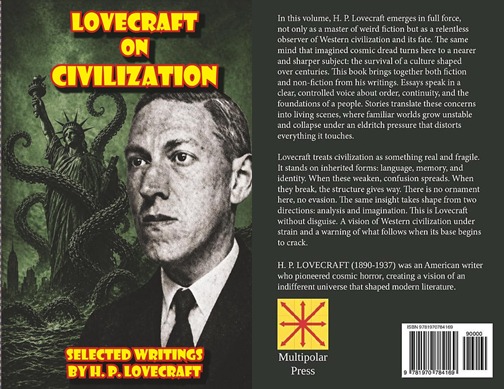
It might be something quickly copy-pasted from the Selected Letters and banged together with some online essays? Or perhaps it’s something more considered and curated, and only marred by that cover? Who knows, as there’s no Kindle ebook free sample. Buyer beware.
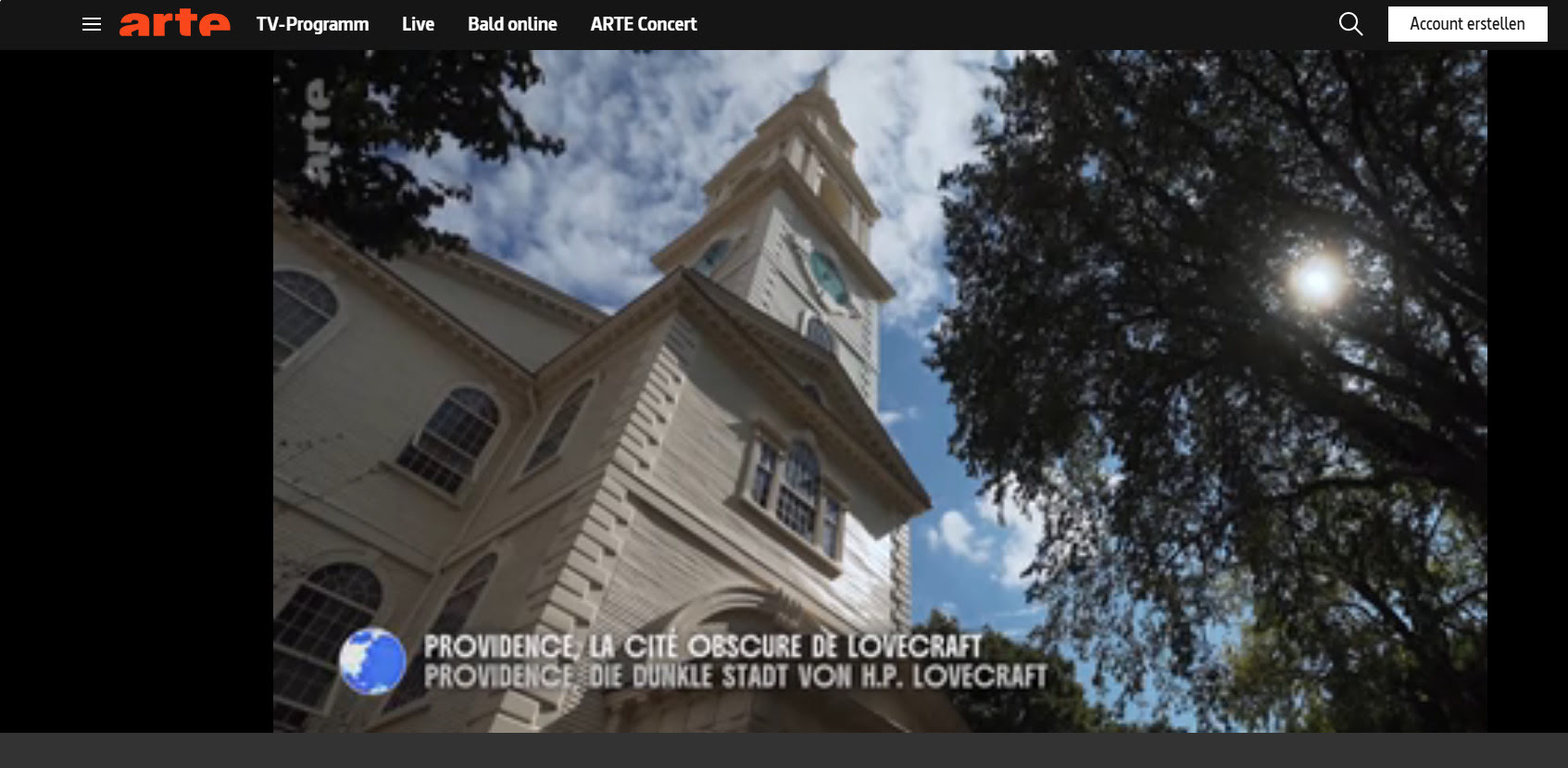
* Seemingly from Germany (it’s in German, anyway) on the ARTE channel and online, the short 14 minute on-location documentary Providence, die dunkle Stadt von H.P. Lovecraft. The ARTE video plays for me, with no region-blocking, captchas or sign-in.
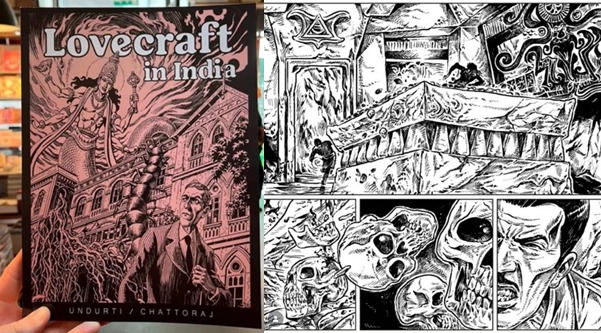
* An unusual new book, Lovecraft in India. A little digging reveals it to be a graphic novel, rather than a scholarly look at the publication history, reception and local adaptations. Available now from Gosh comics in London.
* Regard Critique reviews the new Metal Hurlant (the French edition of ‘Heavy Metal’) Lovecraft special-issue. The reviewer finds that Druillet has his…
extracts from his delirious illustrated Necronomicon [reprinted from the old Lovecraft special, but this time] accompanied by a complete analytical text on the links between the graphic designer and the author of Providence by Alex Nikolavitch.” And there is also… “a fascinating interview with the mangaka Gou Tanabe”.
* In Japan, the famous horror-manga creator Gou Tanabe has launched his long-form graphic novel adaptation of The Case of Charles Dexter Ward. The first instalment has now appeared in Japanese.
* Talking of comics, in case you hadn’t noticed, a vast and seemingly completist collection of vintage ‘fanzines and magazines about comics’ are flooding onto Archive.org as good scans.
* On DeviantArt, Peru’s GeniusXX is having fun depicting the Great Race and other Lovecraft monsters. He appears to be taking requests.
* A small fact about Lovecraft’s environs that I had not previously fully appreciated. It was male Brown University students who would have thronged up and down College Street (confined to the south sidewalk, the northerly one being traditionally reserved for residents) during term-time. Brown was then segregated by gender, it appears. Here is Lovecraft on the point…
I fear your colleague’s Providentian geography is all wet. Cushing St. is a full quarter-mile north of here; & instead of going up the great hill, slopes gradually downward from near its summit over the eastward plateau on top. (Like Barnes St. — which is not far away). It is around this street that Pembroke College, the female department of Brown University, clusters — whereas College St. (commonly called ‘College Hill’) tops the main & exclusively masculine part of the institution.” — Lovecraft to Galpin, November 1933.
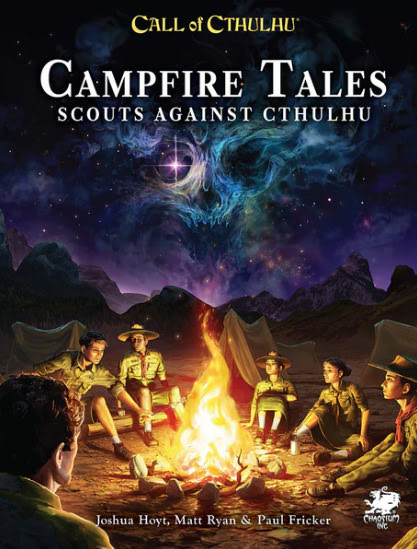
* And finally, talking of hearty young lads, new at the HPLHS Store is the RPG book Campfire Tales: Scouts Against Cthulhu.
— End-quotes —
Slightly late (the astronauts are back and being received at the White House), but this week here are some quotes from Lovecraft on travel to the Moon. Lovecraft was aware, as early as 1920, of a plan to send a rocket-ship to the Moon…
“Speaking of astronomical things — is either of youse guys interested in (a) the supposed new trans-Neptunian planet [Pluto], (b) the talk of telegraphic communication with Venus or Mars, and (c) the Goddard plan for sending a rocket to the moon? If so, just speak up! Grandpa has heaps to say about all these things!” — Lovecraft to Galpin, April 1920.
He refers to space pioneer Robert Goddard’s paper A Method for Reaching Extreme Altitude (March 1920), which saw Goddard mercilessly mocked by the usual suspects.
“‘Space ships’ of the traditional scientifictional sort are perhaps a little beyond probability (the obstacles to their operation being really much greater than popular science indicates), but I certainly think that some rocket voyage to the moon (whose extreme nearness puts it in a separate category) will be attempted — first with an untenanted projectile, & later perhaps with a human cargo. Whether any living being could survive such a voyage & return is another matter.” — Lovecraft to Natalie H. Wooley, November 1933.
[In sending an editor] “an account of my vivid and active career I did not think it necessary to mention […] my voyage up the Oxus, nor my visit to Samarcand, […] but I did hint of certain travels through the aether in the dark of the moon, and give broad suggestions regarding certain queerly-dimensioned cities of windowless onyx towers on a planet circling about Antares …” — Lovecraft to Frank Belknap Long, December 1927.