
HPLinks #81.
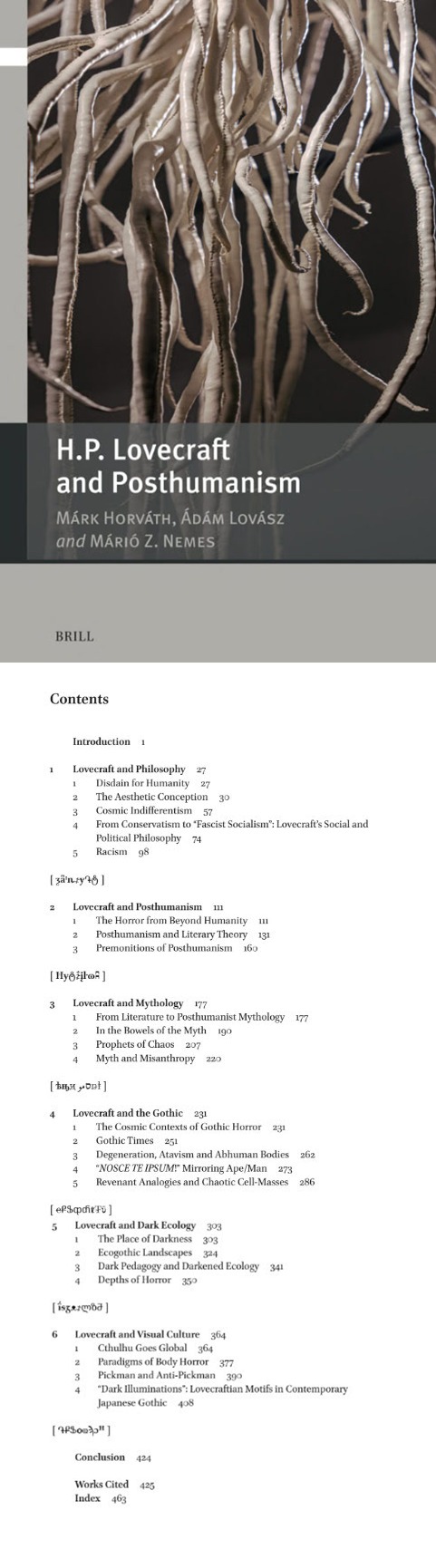
* A new £150 academic book from Brill / Walter de Gruyter, H.P. Lovecraft and Posthumanism (2026). No sign of it yet on Amazon UK, but the ebook version is apparently published. Here are the contents…
* This week a geodynamics scientist looks closely at the geology in “At The Mountains of Madness”. Lovecraft’s…
geology is not decoration — it is the engine of the plot. The story advances through stratigraphy, fossils, field observations, and the slow realization that rocks are not simply background scenery, but records of worlds vastly older than humanity. In that sense, the horror is profoundly geological: it emerges from time, burial, preservation, and the idea that the Earth has existed far longer than we would like. From a geological perspective, one of Lovecraft’s sharpest intuitions was to present Antarctica as (geo)dynamic rather than static […] Lovecraft understood, instinctively, that the rock record is unsettling. A cliff is never just a cliff; it is a stack of vanished environments. A fossil is never just a shape in stone; it is evidence that the world used to be structured differently.
* HorrorBabble has a free six-hour audio reading of The Complete Hyperborean Cycle by Clark Ashton Smith: Audiovisual Edition on YouTube.
* The REH Foundation Press has issued a special fundraiser book for the Howard house repairs, First Passage: Early Drafts of Beloved Yarns (2026).
* Now officially free and online, the four-volume Encyclopedia of Pulp Heroes (2017).
* Forthcoming from the University of Wales Press, Coasts and the Gothic (2027), including a chapter on “Weird Tales of the China Coast”…
The weird tales of the treaty ports and coastal waters of China, written in the early years of the twentieth century, provide an evocative and understudied examination of life in the harbours and coasting vessels of […] urban port cities like Hong Kong, Shanghai, and Yangtai.
* S.T. Joshi has issued a new edited collection of lesser-known vintage horror tales, One of Cleopatra’s Nights: Tales and Poems of Egyptian Horror (2026). Available as a budget ebook, and it also includes some modern horror poems on the topic of Ancient Egypt.
* New from Italy, an Italian-language book Il secolo di Cthulhu: Omaggio misterioso a Lovecraft (‘The Century of Cthulhu: Writings in Honor of the Centennial’).
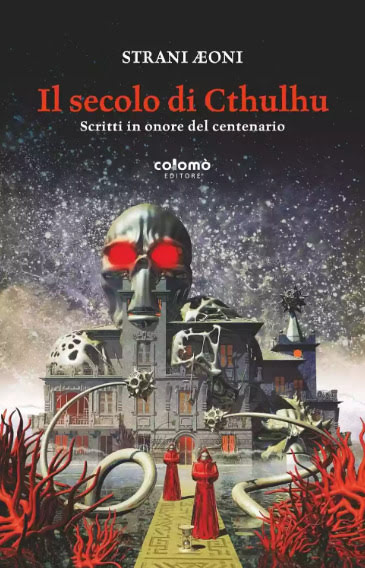
Apparently it opens with essays on the history of the famous tale, followed by stories. The lead essay… “reconstructs the birth of The Call of Cthulhu as a web of influences — from Margaret Murray to Lord Dunsany to Arthur Machen”. The fiction authors appear to have been asked to take as their departure point the real-life mysterious disappearance of an iconic early Italian fan-painting… “Karel Thole’s original painting for the cover of Monsters on the Street Corner“.
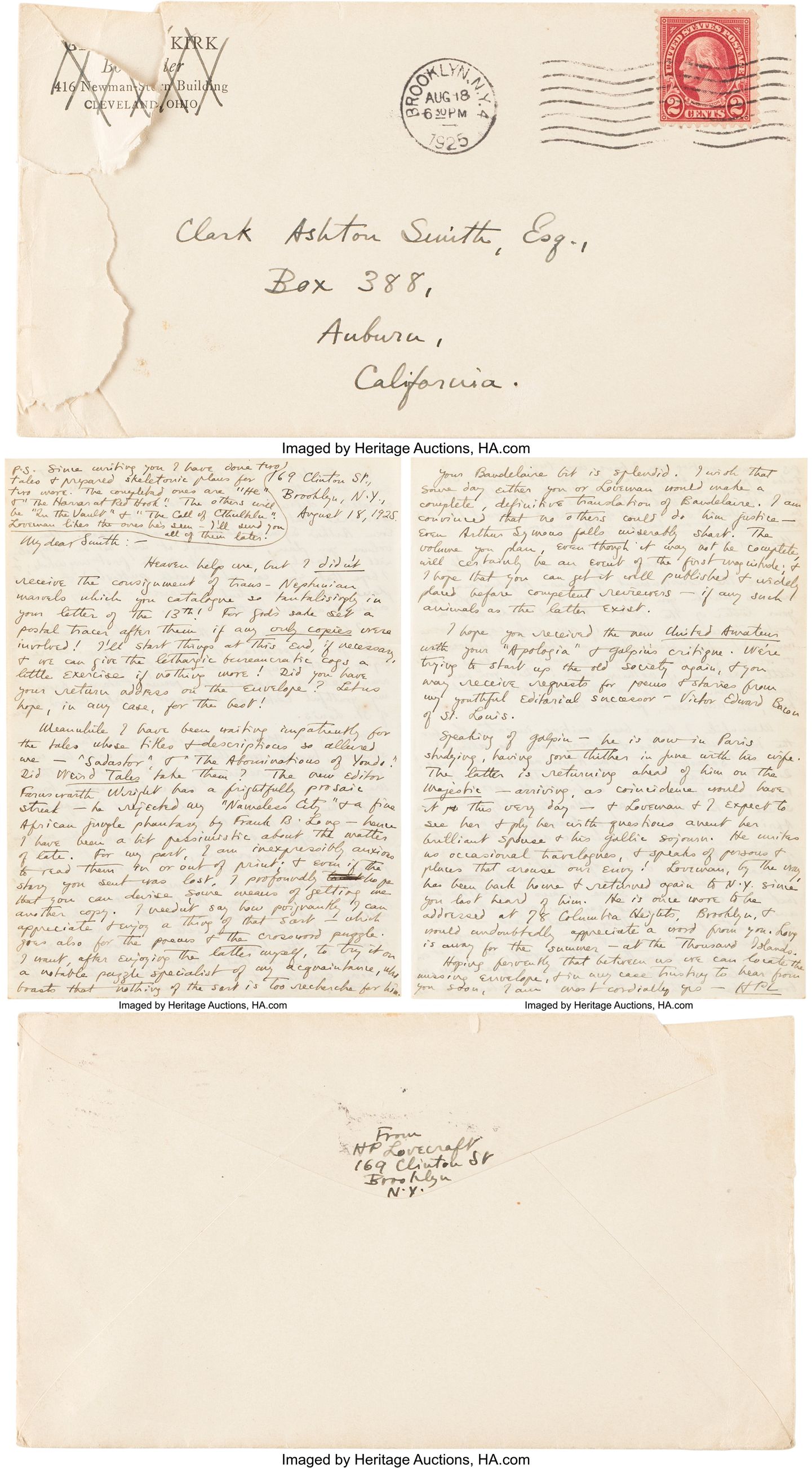
* Up for auction, The David Aronovitz Collection of Important Science Fiction and Fantasy. A two-part auction, in May and then December 2026. Including an August 1925 Lovecraft letter sent from Red Hook to Clark Ashton Smith…
* In a new interview, the manga creator Junji Ito talks Lovecraft, Osamu Dazai, and his latest vinyl-exclusive audio drama. The latter being his audio tale of…
an old melody on an unmarked vinyl record becomes an inexplicable source of terror, [and which] is now a vinyl-exclusive audio drama named In Old Records.

* An interesting Python-based attempt to make local software that automatically generates an OldTimeRadio show, which may interest some. Feed it real weird-science news, and from this it auto-writes a script, adds narration and voice-acting, then adds music and SFX. Sadly the narrator’s voice is generated via the Kokoro AI model, so… good luck getting it working on Windows. I must have tried to install/run a dozen different packages that claimed to offer Kokoro, and all failed or were stymied (each in a different way). The only working Kokoro TTS I have is included in the NovelForge 4.0 novel-writing software, which is straightforward Windows software with a no-hassle install.
* Talking of audio production tools which may interest Lovecraftian creatives, there’s now a 6Gb ‘fine-tune’ of the worthy Stable Audio sound-effects generator, called Stable Audio X and it works in ComfyUI. Stable Audio was trained on the vast Freesound.org archive of free sound-effect recordings. Apparently the X fine-tune of Stable Audio can not only do prompt-to-SFX-audio, but can also auto-create an accompanying foley soundtrack for a video (if you feed it a video).
* Talking of AI tools, yes… we can now re-style images so they more-or-less evoke Providence at night in Lovecraft’s time. Here’s ‘Lovecraft returns home up College Street at night, in the late 1920s’. Made with two Nano Banana day-to-night re-styles of a vintage public-domain image, plus my Photoshop-addition of HPL and the black bag he often carried.
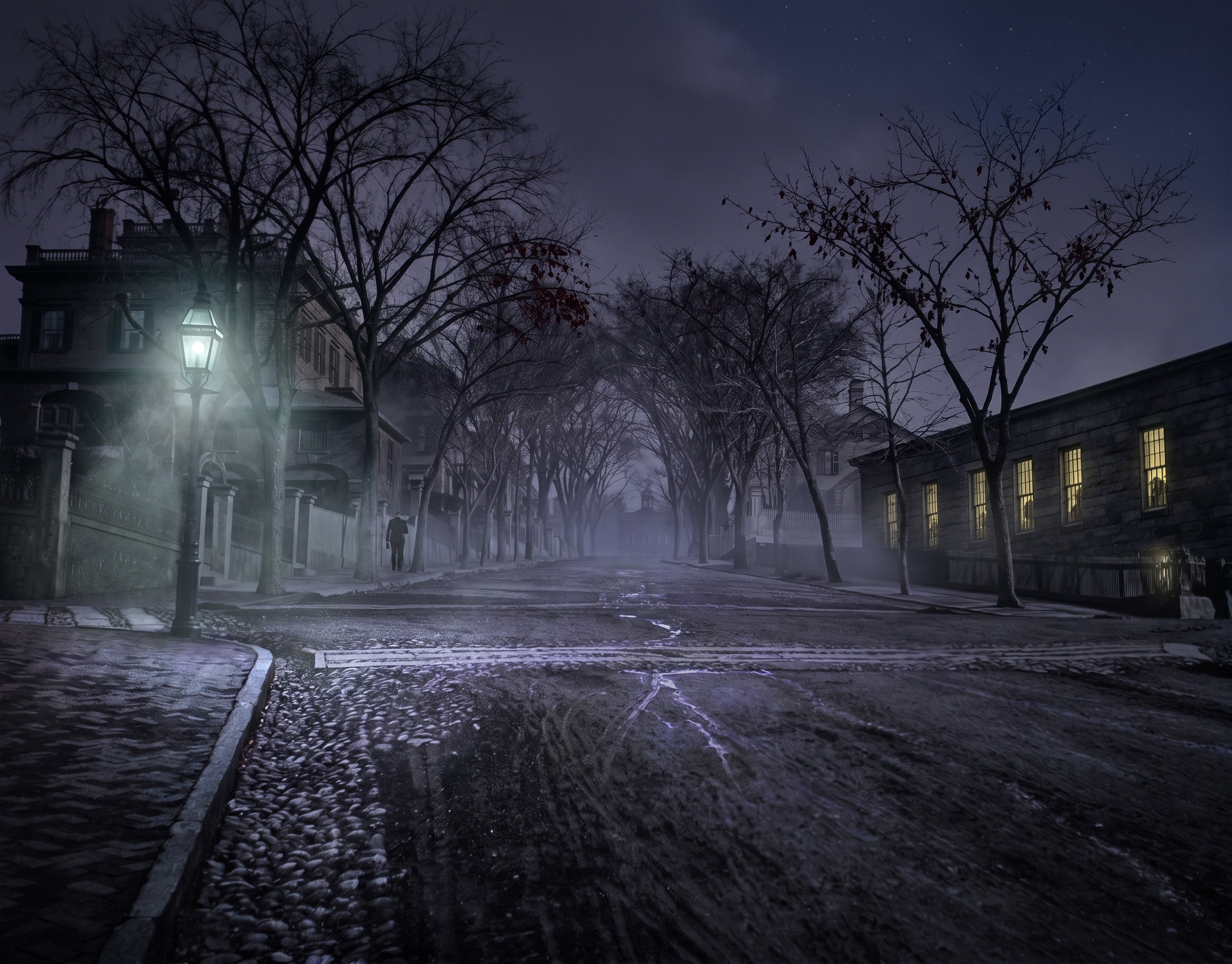
Three short extracts from “Aletheia Phrikodes” (1916) by H.P. Lovecraft, seem to fit the picture…
Hard by, a yawning hillside grotto breathes
From deeps unvisited, a dull, dank air
That sears the leaves on certain stunted trees
[…]
I was afraid when through the vaulted space
Of the old tow’r, the clock-ticks died away
Into a silence so profound and chill
That my teeth chatter’d — giving yet no sound.
[…]
Methought a fire-mist drap’d with lucent fold
The well-remember’d features of the grove,
Whilst whirling ether bore in eddying streams
The hot, unfinish’d stuff of nascent worlds
— End-quotes —
“By 1901 or thereabouts I had a fair knowledge of the principles of chemistry […] Then my fickle fancy turned away to the intensive study of geography, geology” — Lovecraft to Galpin, August 1918.
[As a boy] “Much in the universe baffled me, yet I knew I could pry the answers out of books if I lived & studied longer. Geology, for example. Just how did these ancient sediments & stratifications get crystallised & upheaved into granite peaks? […] I became uncomfortably conscious of what I didn’t know. Tantalising gaps existed everywhere.” — Lovecraft to Vernon Shea, February 1934.
“an old-fashioned but not seriously misleading introduction to geology still unsurpassed for beginners is Geikie’s old Geology Primer. Another peculiarly congenial veteran is Winchell’s Walks and Talks in the Geological Field” — Lovecraft’s ghost-written Suggestions for a Reading Guide, probably indicating the key geology books he knew as a boy.
“I am not insensible of the importance of mineralogy in science; being well aware that the history of the planet and the details of many of its most vivid catastrophes lye hid in the chemical constitution and physical environment of its various sorts of rock. The science of geology, that primary branch of learning of which mineralogy is a division, is indeed something in which I might with ease become interested under the proper set of chance conditions; insomuch as it is directly concern’d with that main stream of cosmick pageantry which begins in blank aether and free electrons and ends in the perfection of Nordick man and Georgian architecture. Where mineralogy fails to get a grip on me is in the fact that it is a secondary science; an affair mainly of classification, with relatively slight direct linkage to the dramatick stream of pageantry of elemental conflict and mutation which appeals to the cosmic curiosity or interest-sense of the incurable layman.” — Lovecraft to his mineralogist friend Morton, October 1930.
“There is material for ineffable phantasy in the rocks & inner abysses of Mother Earth.” — Lovecraft to C.A. Smith, March 1933, in a letter headed as written at the “Hour of the Opening of the Under Burrows”.