• About
  • Directory
  • Free stuff
  • Lovecraft for beginners
  • My Books
  • Open Lovecraft
  • Reviews
  • Travel Posters
  • SALTES

Tentaclii

~ News & scholarship on H.P. Lovecraft

Tentaclii

Monthly Archives: September 2022

Digital Art Live #71

10 Saturday Sep 2022

Posted by asdjfdlkf in 3D, Odd scratchings

≈ Leave a comment

Now available, free on Gumroad, the “Battle” issue of Digital Art Live magazine. May be of special interest to R.E. Howard readers and the heroic fantasy RPG crowd. Also has a 12-page centre ‘pull-out’ on the Poser 12 software, to lighten things up in the middle.

Howard Days 2023 – dates and theme

10 Saturday Sep 2022

Posted by asdjfdlkf in Odd scratchings, REH, Scholarly works

≈ Leave a comment

The 2023 R.E. Howard ‘Howard Days’ event has dates, 28th & 29th April 2023. This should mean somewhat cooler weather than Texas in a baking June…

Moving the event to late April will provide everyone with a more inviting environment and make the outdoor activities more pleasant.

Elsewhere I read the general state-weather summary…

The temperatures in Texas in April are comfortable with low of 55°F and and high up to 73°F. You can expect about 3 to 8 days of rain.

Sounds super, I wish I could be there. Book early, as I’m guessing this change will cause others to think likewise and lead to a big jump in attendance. Also because the April weather will make it easier to get “big name” Guests, and more than one. The better weather might even entice a band or two of costumed re-enactors?

They also have the 2023 theme announced, “100 Years of Weird Tales”, celebrating the founding of the unique magazine in 1923.

Voluminous at NecronomiCon

09 Friday Sep 2022

Posted by asdjfdlkf in Astronomy, Lovecraftian arts, Podcasts etc.

≈ Leave a comment

A new Voluminous podcast, in this case a live audience reading of Lovecraft’s letters. Voluminous: Live from NecronomiCon reads from the Hartmann letters…

an exchange of letters published in the newspaper between a local astrology enthusiast and the astronomically inclined HPL.

Hamilton and Kipling

08 Thursday Sep 2022

Posted by asdjfdlkf in Historical context, Kipling, Podcasts etc., Scholarly works

≈ Leave a comment

If you want a taste of what Weird Tales readers found so alluring about ‘star’ author Edmond Hamilton, his “The Metal Giants” (Weird Tales, December 1926) is now a new one-hour reading on Librivox.

Lovecraft called the crowd-pleasing formula writer “indefatigable & repetitious” and he assured a correspondent that, if he were to enter the field of ‘interplanetary fiction’… “you may depend upon it that I shall not choose Edmond Hamilton [as a model]”. That said, in 1926 Lovecraft did admire his “The Monster-God of Mamurth” tale, and I recall that they met at some point and got on well. He was also surprised to find he liked the Hamilton tale “Child of the Winds” in the May 1936 Weird Tales (“Hamilton(!!)” he exclaimed in a letter).

While searching for the name, I found more evidence for the influence of Kipling’s seminal “With The Night Mail” on science-fiction…

“… an article in the February 1922 Science and Invention, ‘10,000 Years Hence’. Howard Brown provided a stunning illustration of floating health cities (like huge health farms) kept aloft in the upper atmosphere by power rays drawing their energy from the sun. Gernsback described how these cities could be directed to move around the Earth [keeping pace with the sun], a concept one might believe inspired two later noted works of science fiction, Edmond Hamilton’s “Cities in the Air” (1929) and James Blish’s Earthman, Come Home (1955), were it not that neither author knew of the article.”

The above is from the pulp/early SF survey book The Time Machines, Liverpool University Press, which does not mention Kipling even once.

Ah, but these authors would have known of Kipling, the obvious source for such ideas. The direct inspiration being drawn from “With The Night Mail” will be obvious to anyone who has read it. Kipling’s cloud-breakers + permanently aloft sun-powered airships = “Cities in the Air”. Kipling’s giant and ascending ‘consumptive’ hospital airships = hospital cities in the upper atmosphere.

Since the article and Hamilton’s “Cities in the Air” (much enjoyed by pulp readers of the time, it seems) are now public domain, they might even be overhauled and retro-fitted to fit with Kipling’s “With the Night Mail” / Aerial Board of Control universe. In fact, much else that was published in the 11 issues of Gernsback’s short-lived Air-Wonder Stories seems on the face of it to be fair game for such a thing.

On Kipling as an influence on 20th century SF writers

07 Wednesday Sep 2022

Posted by asdjfdlkf in Kipling, Odd scratchings

≈ 3 Comments

Kipling was… “the first modern science fiction writer” — John W. Campbell, editor of the seminal Astounding magazine and pioneer of hard science-fiction.

What Kipling was doing in “With the Night Mail”… “had never been done before. There is no such subtlety in the contemporary proto-SF of H.G. Wells and Jules Verne. I think we may safely credit him with inventing the style of exposition that was to become modern SF’s most important device for managing and conveying information about imaginary futures”. — “Rudyard Kipling Invented SF!”, by Eric S. Raymond.

“With The Night Mail”… “anticipated the style and expository mechanics of Campbellian hard science fiction fourteen years before Hugo Gernsback’s invention of the ‘scientifiction’ genre and twenty-seven years before Heinlein’s first publication.” Eric S. Raymond, A Political History of SF (2000).

“With The Night Mail” is… “an amazing tour-de-force of inspired genius […] the sort of thing that Verne or Wells would never have dreamed of doing […] Kipling, in 1905, is doing things that science fiction as a genre wouldn’t achieve until Robert Heinlein arrived in the late 1940s.” — Bruce Sterling.

Kipling… “is for everyone who responds to vividness, word magic, sheer storytelling.” — Poul Anderson.

Kipling was… “a master of our art.” — Gordon R. Dickson.

“He was a superb and painstaking craftsman, the most completely well-equipped writer of short stories ever to tackle that form in the richest of languages.” … “”With the Night Mail” is an astounding vision … his influence on 20th century SF writers was probably greater than anyone else’s, except Wells … he was a master at making the fantastic seem credible”. — John Brunner.

“When you read Kipling, you’re there, [he] builds a total sensory impression that surpasses the language” [which is partly why he will never be taught in schools] — C.J. Cherryh.

“what a good writer he was … the work is superb and he could make words sing. [On looking into the leftist political claims that had dissuaded me from reading him,] I found that most of his supposed sins had been vastly overstated.” — George R.R. Martin.

At SF conventions… “I found that so many SF writers could see his sterling merit that I felt vindicated” [in my early love of Kipling, despite my mundane Eng. Lit. teachers who ignored him] — Anne McCaffrey.

Heinlein was also strongly influenced by the “Night Mail” style and viewpoint, but I can as yet find no quote from him on this point.


The 1980s anthology Heads to the Storm (ed. David Drake) features stories by later SF and fantasy authors, all inspired by Kipling, along with many tributes.

Leeman Kessler showreel

06 Tuesday Sep 2022

Posted by asdjfdlkf in Podcasts etc.

≈ Leave a comment

Former Lovecraft impersonator Leeman Kessler has a short YouTube Voice Acting Reel showcasing his talents.

H.P. Lovecraft – an animated biography

05 Monday Sep 2022

Posted by asdjfdlkf in Lovecraftian arts

≈ Leave a comment

H.P. Lovecraft – an animated biography, new on YouTube. As you can see here, very toony, but not without charm.

“The Hunters from Beyond”

04 Sunday Sep 2022

Posted by asdjfdlkf in Podcasts etc.

≈ Leave a comment

New from master audiobook reader Horrorbabble and free on YouTube, “The Hunters from Beyond” by Clark Ashton Smith.

Also new, an audio reading of “Beyond the Great Wall”, a Smith poem that appeared in Asia magazine in 1924.

Review: Call of Cthulhu starter

03 Saturday Sep 2022

Posted by asdjfdlkf in Lovecraftian arts

≈ Leave a comment

I rarely feature RPGs here, though Robowieland’s cogent short new “Review of the 40th Anniversary Call of Cthulhu Starter Set” may be of interest. Perhaps to those who were thinking of getting the budget Starter Set just to see what tabletop RPG-ing with Lovecraft is like, or even giving the Set as a Christmas gift.

News from Germany

03 Saturday Sep 2022

Posted by asdjfdlkf in Odd scratchings

≈ Leave a comment

The Deutsche Lovecraft Gesellschaft have a report on August activity.

They saw a large increase in formal members, and together had a “very lively” 109-person celebration of Lovecraft’s birthday. That was from August 18th to 21st, at “the Miskatonic University in Duderstadt”, Germany…

“After the years of social deprivation caused by the pandemic, this gathering of like-minded and great people was really energizing. It can go on like this!”

Congratulations. Sounds like an unusual mix of “students and lecturers” and “numerous rounds of games” (RPGs). They have the 2023 dates for the next one already, 27th-30th July 2023. Registrations open 15th September 2022.

The English translation of their fully open-source Lovecraft RPG has slowed over the summer, but now seems to be back on track again and some new helpers.

Also noted is that… “The Festa publishing house is taking its Conan series out of the program. This is due to expiring contracts.” Festa appears to offer chunky German Conan paperbacks, and I think I also saw a Kull…

Lovecraft was right, part 796

02 Friday Sep 2022

Posted by asdjfdlkf in Historical context, Odd scratchings, Scholarly works

≈ 3 Comments

Or, at least, he might not have been wrong when he held to the idea…

“That the human race started on some plateau in central Asia is almost certain” (Selected Letters III, p. 412)

Lovecraft was not alone in this. I note that in the 1920s Roy Chapman Andrews (the model for Indiana Jones) took an expedition to Mongolia, intending to find there the first traces of the human race. Also, the discovery of proto Indo-European (c. 4000 B.C.) had put the origins of the European languages mostly in a massive ancient migration to the Caucasus from the western Eurasian steppe, which would then place Mongolia as a theoretical lost origin-point further east. Apparently some linguists still see evidence for a distant Mongolian relationship for proto Indo-European, circa 12,000 B.C. So by the standards of his time, Lovecraft seems to have been thinking along the right lines.

But after Lovecraft’s death the consensus on human origins later shifted to Africa, based on the new post-war fossils, even though “consensus” should be a dirty word in rational science. Now comes a hint from this week’s New Scientist magazine (“The Search for Ancestor X”) that ideas may be changing based on new evidence…

The problem is that we appear to have fundamentally misunderstood the way human evolution works. “The idea humans originated from a small region [of Africa] doesn’t make much sense,” says Lounes Chikhi at the University of Toulouse, France. Chikhi says the genetic signals in living humans imply that H. sapiens emerged as a “metapopulation” spread over a wide geographical area where several “subpopulations” were interconnected by genetic exchange [presumably by early trade?]. Each of these subpopulations was characterised by a subtly distinct genetic signature — and potentially a subtly distinct look. [The article concludes that, on present evidence,] Ancestor X could have lived almost anywhere within a truly vast geographical region. … “it could have been in west Asia. It could even have been in east Asia. We just don’t know yet.” [the latter quote is from Chris Stringer at the Natural History Museum in London].

Friday ‘picture postals’ from Lovecraft: Purgatory and Paradise

02 Friday Sep 2022

Posted by asdjfdlkf in Historical context, Picture postals

≈ Leave a comment

In the last weeks of summer, a trip to the beach with Lovecraft.

The old coastal town of Newport was one of H.P Lovecraft’s favourite places, and the place hosted him for one of the last local trips ever made in his life. It was near to Providence, but was still somewhat costly to reach in summer. It became more affordable to him during the Great Depression, and we know from the Cole letters that he often took the cheap and juddering older boat “Sagamore” from the Providence waterfront to Newport, sometimes in the company of cattle on the lower deck (Galpin letters, p. 62). Lovecraft tells us she had been “re-modelled” for the Providence – Newport – Block Island run which she started in 1928. On the lower and presumably widened decks of this formerly sleek little boat Lovecraft encountered “freight and cattle”. We know it was juddering because Lovecraft tells us he could not write on board, due to the vibration.
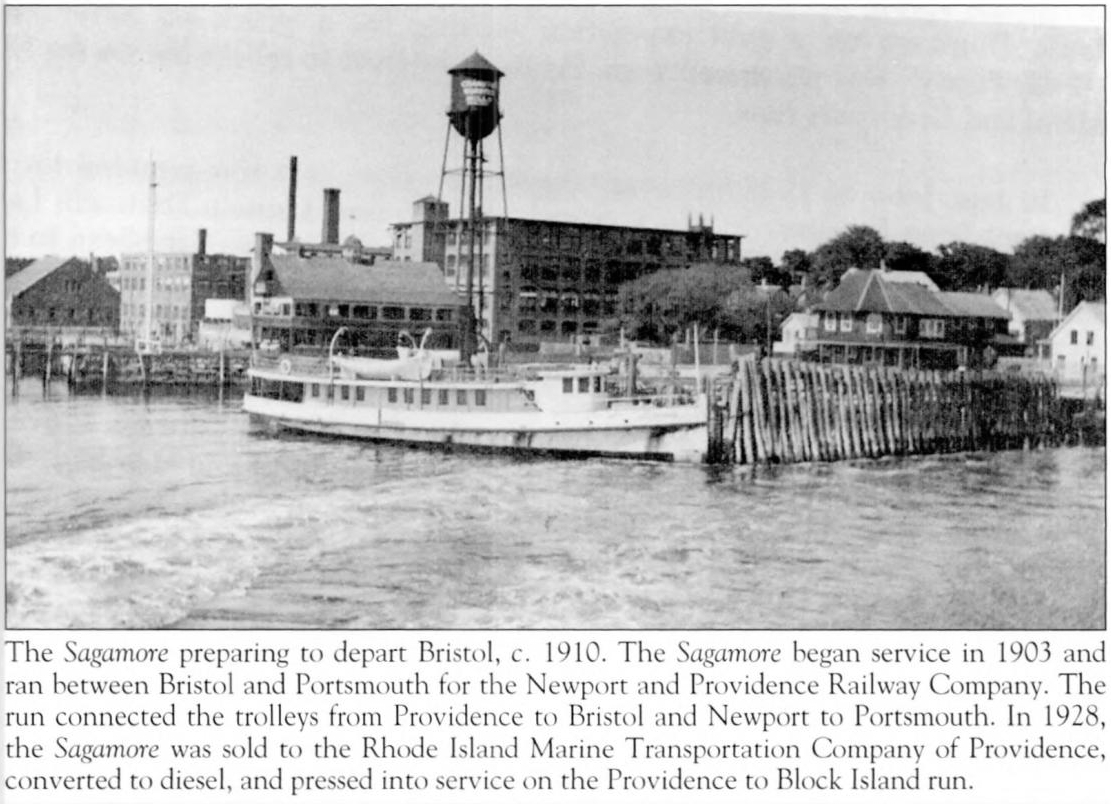
In the depths of the Great Depression this offered a fare as low as 15-cents for a day’s round-trip, and on one occasion he went for three days in a row. This was the route of the “Newport boat” which features in the famous “The Call of Cthulhu”. This could have been, at the time of “Cthulhu”, the “New Shoreham” passenger boat. As seen below, along with its Providence dockside.

The “Newport boat” landing and departure point, Providence.

Though in 1932 he mentioned to Cole that the upmarket 75-cent “Mount Hope” boat was competing with the far cheaper “Sagamore” (the cattle-carrying boat). With at least one guest, for instance Helen Sully in July 1933, he and his guest would take the better of the two Newport boats. So the Sully trip was very likely on the “Mount Hope”, which was warmer. The cheaper boat came back later and was thus colder on the way back, and there was also the risk of encountering cattle on deck. As can be seen here, the “Mount Hope” was a far more substantial passenger proposition than the small “Sagamore”…

Possibly there were even three services at the time of “Cthulhu”, since the “Mount Hope” seems to have made the run as early as the mid 1900s and was still being photographed on the same run in 1934. So the “Newport boat” at the time “Cthulhu” was written could have been either “Mount Hope” or the “New Shoreham”.

Anyway, enough of untangling the boats. Let’s get to the beach. Emerging from hibernation in spring, Lovecraft would take one or other Newport boat and then might hike out from the town “into the Bishop Berkeley country … some four miles beyond Newport beach on the road to Middletown”, through green fields of what he termed “sportive lambkins”. He enjoyed the coastline, beaches and rocks that lay behind and away from the town and the tourists.

Here we see James A. Suydam’s establishing view of this especially favoured place at the back of Newport, the “Paradise Rocks”. The “Hanging Rock” end of these gives a wide firm cleft for sitting and also views to nearby places named by locals “Paradise” and “Purgatory”. The end rock reminds one of the “sizeable table-like rock” in “The Dunwich Horror”.

A detail from a further painting shows the rock’s relation to the wide beaches and ocean, complete with one of Lovecraft’s “sportive lambkins”…

I once had a blog post on these two places, but sadly it was one of the few to perish when the blog blew up. However, I find that I can now recover the sketch-view from that post. This apparently shows “Paradise” (below the artist) and “Purgatory” (a deep cleft, down in the high headland seen across the beach/salt-grass).

Lovecraft visited many times, but also had at least three extended visits with his rock-appreciating geologist friend Morton. There was a Lovecraft-Morton visit in late June 1930, and again in the hot late August of 1932 when they explored the rocky cliffs and knoll and…

discussed the cosmos with Dean Berkeley’s shade

This being a reference to the British philosopher Bishop George Berkeley, a thinker who had especially enjoyed Newport’s “Hanging Rock” two hundred years earlier in circa 1728-32. Berkeley believed, among other things that “reality isn’t separate from perception” and he was a deep thinker on language who was later compared to Wittgenstein. The “Hanging Rock” being where, as Lovecraft put it…

Berkeley used to sit reading, writing, or meditating

In Selected Letters II Lovecraft gives a correspondent precise directions on how to find the place, once out of the town. One then has to assume that the area was not much signposted, and there would be no-one from whom to ask directions.

Here a detail of the “lip” at the “head” of the rocks, where one might perilously picnic or perhaps write competitive poems (Lovecraft recalls such a contest here, with the ocean-loving Wandrei)…

A rough study in oils by the local macabre and stained-glass artist John La Farge (1835–1910) also usefully indicates the highest-point elevation, of the sort on which Lovecraft might have “discussed the cosmos”…
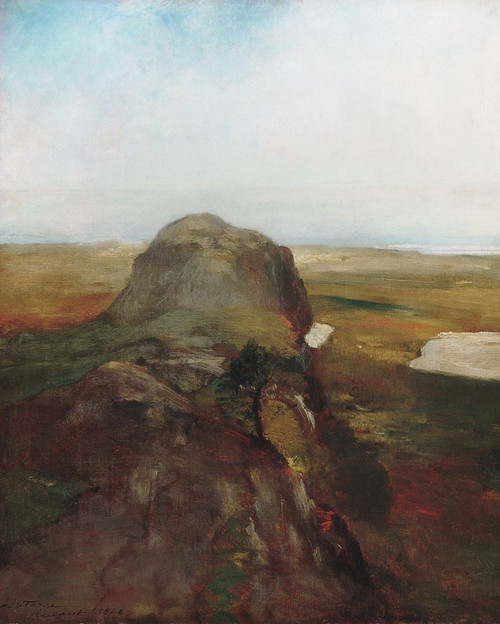
we looked down from our exalted perch — a perch which 200 years ago was a favourite of Dean (later Bishop) Berkeley as he composed his famous Alciphron … We had splendidly hot weather all along — thermometer around 90˚.

← Older posts
Newer posts →


Please become my patron at www.patreon.com/davehaden to help this blog survive and thrive.

Or donate via PayPal — any amount is welcome! Donations total at Easter 2025, since 2015: $390.

Archives

  • March 2026
  • February 2026
  • January 2026
  • December 2025
  • November 2025
  • October 2025
  • September 2025
  • August 2025
  • July 2025
  • June 2025
  • May 2025
  • April 2025
  • March 2025
  • February 2025
  • January 2025
  • December 2024
  • November 2024
  • October 2024
  • September 2024
  • August 2024
  • July 2024
  • June 2024
  • May 2024
  • April 2024
  • March 2024
  • February 2024
  • January 2024
  • December 2023
  • November 2023
  • October 2023
  • September 2023
  • August 2023
  • July 2023
  • June 2023
  • May 2023
  • April 2023
  • March 2023
  • February 2023
  • January 2023
  • December 2022
  • November 2022
  • October 2022
  • September 2022
  • August 2022
  • July 2022
  • June 2022
  • May 2022
  • April 2022
  • March 2022
  • February 2022
  • January 2022
  • December 2021
  • November 2021
  • October 2021
  • September 2021
  • August 2021
  • July 2021
  • June 2021
  • May 2021
  • April 2021
  • March 2021
  • February 2021
  • January 2021
  • December 2020
  • November 2020
  • October 2020
  • September 2020
  • August 2020
  • July 2020
  • June 2020
  • May 2020
  • April 2020
  • March 2020
  • February 2020
  • January 2020
  • December 2019
  • November 2019
  • October 2019
  • September 2019
  • August 2019
  • July 2019
  • June 2019
  • May 2019
  • April 2019
  • March 2019
  • February 2019
  • January 2019
  • December 2018
  • November 2018
  • October 2018
  • September 2018
  • August 2018
  • August 2015
  • July 2015
  • April 2015
  • March 2015
  • February 2015
  • January 2015
  • December 2014
  • November 2014
  • October 2014
  • September 2014
  • August 2014
  • July 2014
  • June 2014
  • May 2014
  • March 2014
  • February 2014
  • January 2014
  • December 2013
  • November 2013
  • October 2013
  • September 2013
  • August 2013
  • July 2013
  • June 2013
  • May 2013
  • April 2013
  • March 2013
  • February 2013
  • January 2013
  • December 2012
  • November 2012
  • October 2012
  • September 2012
  • August 2012
  • July 2012
  • June 2012
  • May 2012
  • April 2012
  • March 2012
  • February 2012
  • January 2012
  • December 2011
  • November 2011
  • October 2011
  • September 2011
  • August 2011
  • July 2011
  • June 2011
  • May 2011
  • April 2011
  • March 2011
  • February 2011
  • January 2011
  • December 2010
  • November 2010
  • October 2010
  • September 2010
  • August 2010
  • July 2010

Categories

  • 3D (14)
  • AI (70)
  • Astronomy (70)
  • Censorship (14)
  • de Camp (7)
  • Doyle (7)
  • Films & trailers (101)
  • Fonts (9)
  • Guest posts (2)
  • Historical context (1,095)
  • Housekeeping (91)
  • HPLinks (76)
  • Kipling (11)
  • Kittee Tuesday (92)
  • Lovecraft as character (58)
  • Lovecraftian arts (1,628)
  • Lovecraftian places (19)
  • Maps (70)
  • NecronomiCon 2013 (40)
  • NecronomiCon 2015 (22)
  • New books (966)
  • New discoveries (165)
  • Night in Providence (17)
  • Odd scratchings (984)
  • Picture postals (276)
  • Podcasts etc. (431)
  • REH (184)
  • Scholarly works (1,469)
  • Summer School (31)
  • Unnamable (87)

Get this blog in your newsreader:
 
RSS Feed — Posts
RSS Feed — Comments

H.P. Lovecraft's Poster Collection - 17 retro travel posters for $18. Print ready, and available to buy — the proceeds help to support the work of Tentaclii.

Proudly powered by WordPress Theme: Chateau by Ignacio Ricci.