
I found an interesting snippet about the post-Lovecraft activity of Winifred Virginia Jackson (1876-1959), a Lovecraft collaborator and amateur journalism colleague from 1918-21. In 1924 Jackson was…
[William Stanley] Braithwaite’s partner and treasurer in the [publishing] house of Brimmer” (George Hutchinson, The Harlem Renaissance in Black and White, Harvard University Press, p.359).
Braithwaite was… “a self educated black man” (Hutchinson, page 360) and editor-in-chief and founder of his publishing imprint of B. J. Brimmer (c. 1922-1927). One early Brimmer book that Lovecraft may have especially noted was Arthur H. Hayward’s Colonial Lighting (spring 1923), since Lovecraft was fascinated by the history of the lamps of the Colonial era. However, Lovecraft may not have had his attention drawn to the book by Jackson herself, as An H.P. Lovecraft Encyclopedia states… “there is no evidence HPL met or corresponded with her after July 1921”.
The Brimmer book-list appears to have been rather uncommercial. Braithwaite was apparently persuaded or obliged to include books by Virginia herself, her sister-in-law Elizabeth Rhodes Jackson (who had “married a Boston architect”, presumably Winifred’s brother), and other now long-forgotten Boston authors and poets. After about 1925 Brimmer appears to have struggled to keep going. Hutchinson’s claim that the Brimmer imprint lasted until “1927” may be stretching it a bit, since the book The William Stanley Braithwaite Reader states the firm folded by spring 1925. The formal filing for bankruptcy may have been in 1927, but the company was effectively defunct long before that.
If Lovecraft had been romantically involved with the older and glamorous Winifred Virginia Jackson (as some rather fancifully surmise) and had followed through, it’s amusing to think that he could have ended up having his first book published by a black man. Who was, so the surmises claim, also Winifred’s lover.
However, it’s been pointed out that Braithwaite had “white” on his birth certificate, and a newspaper photograph has him looking indistinguishable from white, but the matter is apparently still debatable in certain circles. Evidently Lovecraft at first understood him to be black, on his reading in the newspaper of an award Braithwaite had been given as a “negro poet”. Most likely Braithwaite technically was so, if judged according to the very strict colour-lines of the era. But today he would obviously not be considered so, and presumably the two young men had never met in person at that time. A 1921 letter from Lovecraft states clearly that he had no further contact from Winifred’s partner Braithwaite “after 1919”, and presumably thus he never met him. Some modern academics also claim Jackson herself was black, because she had a few poems published in a black journal of the 1920s, but photos and other records well known to Lovecraftians show she was very obviously white. Nor did Lovecraft see the publications of either Jackson or Braithwaite after circa 1920 — so all-in-all there can be no question that ‘he should have known’ about the Harlem Renaissance that way.
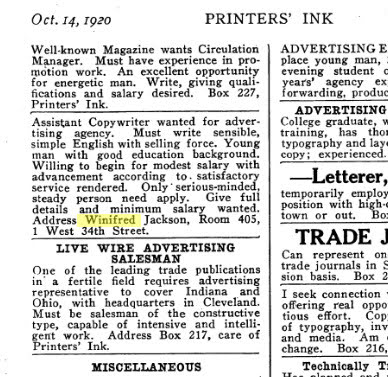
I also found some possible evidence of Jackson’s activity during the time she knew Lovecraft. An advert in Printer’s Ink for 14th Oct 1920 suggests that Jackson may, if the same Winifred Jackson, have been involved in a New York copywriting agency some years before Lovecraft arrived in the city. If so then evidently her radical sympathies did not mean that she could not work for a New York ad agency…
Lovecraft and Braithwaite came into a brief literary contact in February 1930. Braithwaite then produced an annual Anthology Of Magazine Verse. A letter shows that Braithwaite had evidently expressed an anthologist’s interest in an F.B. Long poem that had appeared in Weird Tales. Long had been sent a letter via Weird Tales asking if there were others of that quality to be found in the back-issues. Long had passed the enquiry to his friend Lovecraft who had a complete set of the magazine and an expert’s knowledge of the poetry in it. Lovecraft politely declined to put his own name and poetry forward and could only suggest Clark Ashton Smith — but he recalled that Braithwaite had already recently anthologised Smith. Lovecraft also added a kicker by slyly recommending Moe’s Doorways to Poetry (a cherished Moe-Lovecraft project), and he remarked… “There is no doubt but that you will receive a copy upon its issuance”. Was there then a review or note on this in the Anthology? Probably not, since CORE states of the Anthology… “Publication suspended 1930”, suggesting that Long’s poem may never have made it to the Anthology and that any review or notice of Doorways to Poetry would never have appeared there.
Interesting post. I see that Brimmer published the first novel of James Gould Cozzens, Conflict (1924). Cozzens was reputed to be quite a bigot and was quoted in Time magazine in the 1950s as having said in an interview: “I like anybody if he’s a nice guy, I’ve just never met many negroes who were nice guys”. This quote (the accuracy of which is disputed) seriously hurt Cozzens’ popularity. How ironic that he got his first break from an African-American.
Also, I came across this magazine cover illustration recently:
http://www.philsp.com/data/images/y/youngs_193005.jpg
As you can see the magazine included a story by Winifred Virginia Jackson. (Sorry if this well known, I’m not familiar with all the Lovecraft scholarship on and off the Internet.)
Thanks for that, Nemo. That quote is apparently something said off-the-record, but used in a Time interview from 2nd Sept 1957 by one Patrick J. Murphy – although it appears that none of the academic authors to be found using it at Google Books identify its actual source, still less footnote it. P.J. Murphy – apparently once a critic and story writer – seems to have vanished into the mists of of obscurity among a crowd of namesakes.
I’ve always thought Lovecraft had a major crush on Jackson. His most explosive racist comments were reserved for the time he discovered she had married African-American poet and critic William Stanley Braithwaite. His outburst is in the letters to Kleiner or Galpin, I can’t recall. There is a Winifred poem in Braithwaite’s collection – referenced http://www.bartleby.com/272/42.html. Horace Jordan was also African-American, if memory serves – m. 1915-1919. Keep Blogging !