
HPLinks #104.
* McFarland’s website claims to have the book H.P. Lovecraft and Modern Philosophy “in stock”, though I note that Amazon UK knows nothing about the book at present. McFarland’s page for the book also indicates the contents…
– Phenomenological and Lovecraftian Excavation of Meaning.
– Heideggerian Ruminations and Lovecraftian Ruination.
– Alien Dispossession in Lovecraft and Merleau-Ponty’s Embodied Phenomenology.
– The Genesis and Decomposition of the Self in Levinas and Lovecraft.
– Multiple Alterities: The Weird Interpellation.
– Welcome to the Cthulhucene.
* A new article in French in the psychiatric journal L’Evolution Psychiatrique, “Reve et creation: du phenomene onirique dans ses rapports a la fonction subjective de la creativite chez l’ecrivain HP Lovecraft et le peintre G. Garouste” (‘Dream and Creation: The Dream Phenomenon in its Relation to the Subjective Function of Creativity in the Works of the Writer H.P. Lovecraft and the Painter G. Garouste’). The article… “draws on a rigorous reading of his numerous written accounts — particularly his correspondence — regarding the function of [dreams on Lovecraft’s] artistic practice. […] notably a letter to Clark Ashton Smith” (from a Google ‘Quick Read’ AI summary, the article itself being blocked by a captcha).
* Details of a Spanish PhD thesis Revising Paganism in the Fiction of H.P. Lovecraft (2025). This has a…
classification, description, and detailed explanation of these [pagan] elements and their origins in the anthropology of his time [plus a survey of the] influence that paganism had on the genesis of his pantheon of fictional deities and his mythopoetic cosmogony”, and goes on to suggest parallels with modern pagan notions such as cyclical time.
* The journal Studies in Gothic Fiction appears to have left Cardiff University Press (no longer listed on their journals page, website dead). But Cardiff’s online repository now has Studies in Gothic Fiction 7, seemingly newly out-of-embargo and available under Creative Commons. This was a Lovecraft special issue. No unified TOCs for this issue, regrettably, but search reveals…
– Introduction: adapting Lovecraft in weird times.
– Weird experience: transformations of space/place in Lovecraftian LARP.
– Narrative archaeology: excavating object encounter in Lovecraftian video games.
– Gamifying fictions of defeat: adaptations of Lovecraft to games media.
– Sherlock Holmes and the Miskatonic monstrosities (book review).
– “‘His madness held no affinity’: reimagining Arkham Asylum”, from which…
The Gothic madhouse present in H.P. Lovecraft’s fiction is not a dimly lit padded cell situated in a former manor house. Rather, Lovecraft gives little description to his mental hospitals, which is curious given the many narrators who end up in such institutions. […] this article compares the depiction of asylums in two fictions by Lovecraft: “Beyond the Wall of Sleep” (1919), and “The Thing on the Doorstep” (1933), considered alongside [Batman in the form of] Grant Morrison and Dave McKean’s Arkham Asylum: A Serious House on Serious Earth (1989), and Dan Slott’s serial Arkham Asylum: Living Hell (2004).
* Ginger Nuts of Horror has a new review of the recent Welsh Mythos anthology, Cthulhu Cymraeg: The Night Country Review.
* According to the latest Locus magazine, PS Publishing have the Darrell Schweitzer edited anthology Lovecraft’s Dreamlands set for November 2026. I also see PS has Robert Silverberg’s Ghosts and Things due in October 2026, a follow on from his Monsters and Things collection. Neither book has details on PS’s forthcoming titles page, as yet.
* Deep Cuts digs up another post-Lovecraft lost tale from the pulps, this being the EC-horror comics-like tale “Fiend of Fire” (1952) by Eando Binder… “it has never been included in collections of the Binders’ pulp fiction, as far as I’ve been able to determine”.
* In the latest Inks: The Journal of the Comics Studies Society, “Documenting Fandom: A Content Analysis of 1970s American Comics Prozines” (open-access, but blocked by a captcha)
* This week DMR surveys Great Illustrators of Edgar Allan Poe.
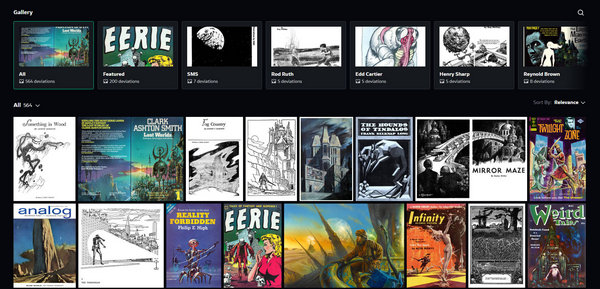
* A relative newcomer to DeviantArt, Mark Fuller Dillon is posting fine old pulp illustrations and golden-age paperback covers, along with a few classic comic-book covers, and he now has over 500 items.
* Eldritch Prayers I: An Anthology of Cthulhu Mythos Poetry and Art appeared in 2025. Duotrope’s Submission Manager Platform currently has details of what appears to be Eldritch Prayers II (Cthulhu Mythos Poetry Anthology). With a stated June 2027 opening date for submissions, and some details…
… we are going to try using Kickstarter with stretch goals to increase the payment to the poets. We hope to have the book ready to print by the end of the Kickstarter Campaign (October [2027?] with Halloween in everyone’s minds).
* And finally, Bethaniel is an excellent freeware offline copy-editor and proof-reader. On testing I find it handles a 60,000 word novel in an hour without problems, and also interfaces very sweetly with Microsoft Word. If you run a strict firewall, on install you need to lower the firewall to get both the .GGUF and the Llama.cpp CUDA models to install. It’s one of those annoying ‘install and then have the software silently download Gb’s of unknown models, to make it work’ bits of software. But it’s fine once it’s working, and it will then run on your GPU rather than CPU… assuming you have a graphics card with 12Gb VRAM or more. Bethaniel is of course verboten to the anti-AI zealots, but may be a god-send if you have very long texts to fix.
— End-quote —
Lovecraft on proofreading.
“… our good old friend W. Paul Cook of the Recluse Press — and boy! how he did back me up! In the face of all sorts of troubles and delays and blunders on the part of his office force, he turned out what is undoubtedly the finest piece of bookmaking ever produced in amateur journalism; so that he really ought to have had an equal share in the dedication. Above all, he was ineffably patient with my hyper-critical proofreading, so that we have produced that rarest of literary marvels — a volume absolutely without typographical errors.” — Lovecraft to Talman, June 1928, on producing a posthumous book of the poetry of the Anglo-Canadian poet and fellow amateur journalist John Ravenor Bullen.
“Thanks for the set of proofreading symbols — which I am filing in my professional department beside the other card you so kindly sent. Wish I could get a chance to turn proofreading to financial advantage!” — Lovecraft to Talman, dated October 1932 in Selected Letters IV, but possibly mis-dated from 1931 (see quote below).
“I suppose proof-reading is merely a light indoor sport with you [i.e. with Derleth] …. yet at that one has to keep a sharp eye open for tricky, almost imperceptible errors. My biggest job in that line was the Dartmouth College history which I did (making certain revisions in the proofs) in the autumn of 1931.” — Lovecraft to Derleth, January 1934.
“Just now all my writing is in abeyance [due to] the large book job which I went to Hartford to [learn about, it involves] revision and proofreading (aided by your chart of symbols) of a long history of Dartmouth College — and I may add that it has kept me tied down for a fortnight with a concentration which may or may not have been responsible for the sick-headache-and-bum-digestion spell out of which I am only just now pulling. I finished the damn thing last Tuesday, and got it off by parcel post Friday.” — Lovecraft to Talman, October 1931. The book was the History of Dartmouth College, 1932, and Lovecraft was paid only $50 for the work.