Cattle-boats and andwheres

I’ve started in on the new and enlarged book of Lovecraft-Galpin letters (thanks to my Patreon patrons for the purchase). These are fronted with the Cole letters, which at first glance promise to be very dull amateur journalism business. But they very soon liven up. Lovecraft starts writing ‘as-if an 18th century gent’ to the new son of the Cole family, and later letters are from New York or illuminate the poverty of the early 1930s. I’m up to about 1934 so far.

We get the name of the 50-cent boat that Lovecraft took to Newport in the depths of the depression, the summer passenger boats having engaged in a price-war. It was not, as it turns out, the salubrious and gleaming liner of postcard dreams. His old tub doubled as the Providence-Newport cow-boat, meaning that Lovecraft shared the journey with moo-ing and slightly bemused cattle. The boat came back later to Providence than the more expensive competitor, and presumably without the cows to provide body-heat, and so Lovecraft found it could be cold even in August.

Also, the book gives the solution to the small problem of the ‘andwheres’. It turns out this curious word was Lovecraft’s own coinage. His friends, being given the whistle-stop tour of Providence in the early 1930s, heard his constant repetition of “And where, but in Providence, would you see such a fine…” used of grassy lanes in the heart of the city, quaint back-street courtyards, relic backyard barns, sublime semi-rural vistas, etc. His friends found this phrase wearing, and so he abbreviated the outburst to a simple one-word “Andwhere…”. This found its way into his letters, when he calls a choice forgotten nook or grassy relic lane an ‘andwhere’ type of place. Thus it was similar, in inventive quality and topophiliac pleasure, to Vita Sackville-West’s later coinage of “through-leaves”. This indicated a small-but-special enjoyment encountered on a walk… such as kicking through dry leaves or running a picked-up stick along iron railings.

‘Picture postals’ from Lovecraft: At the market

Here we see the Providence farmers’ market, more or less as Lovecraft would have know it as a teenager. I’ve added a missing bit at the bottom of the picture, by pasting it in from a near-duplicate b&w view. The card is dated 1909, although there is a somewhat similar close-up picture in the archives dated 1904. Which may indicate that the picture itself is perhaps 1904-08? Anyway, when Lovecraft was a teenager.

I guess adolescent summer night-walks in the city could theoretically have brought him to the market just as it was setting up at the crack of dawn — and thus offered him the opportunity to snaffle the best-and-freshest? Judging by one title on a postcard, which reads ‘Fruit Market’, fruits were a speciality of this market. Lovecraft is often thought of as a devoted store-candy lover, but he was also quite partial to fruits and fruit-cocktails.

I don’t know if the market also sold more mundane winter foods, such as potatoes. But I imagine that the Lovecraft family’s market-day shopping, as opposed to the lighter store shopping, was perhaps not something done by Lovecraft himself in his later teenage years. Strapping lad he may have been, and with muscles developed by rowing on the nearby and difficult Seekonk, but it was then common to have the heavier household staples delivered to one’s home.

Whatever its wares, the market place was evidently one of his frequent and favourite ‘passing through’ places. Here he celebrates the place in fiction, in his Dexter Ward

He liked mostly to reach this point in the late afternoon, when the slanting sunlight touches the Market House and the ancient hill roofs and belfries with gold, and throws magic around the dreaming wharves where Providence Indiamen [i.e. the old long-distance trading/passenger ships] used to ride at anchor. After a long look he would grow almost dizzy with a poet’s love for the sight, and then he would scale the slope homeward in the dusk past the old white church and up the narrow precipitous ways…” (“The Case of Charles Dexter Ward”)

The above picture looks toward the distant dome of the State House and is thus an unusual view, and it may need some orientation. Here we see a useful bird’s-eye view, as if looking down from College Hill. The cameraman’s view across to the state house is indicated by my red line.

‘The Old Brick Row’ is thus off-camera to the right, on the postcard seen above. As many will recall, Lovecraft later wrote a public poem for this one-time landmark set of buildings. He also wrote a long public letter on the buildings that lay at “the historic meeting place of bay and hill” and which held behind them “richly mellow old-world lanes”. This was published abridged in his local Sunday newspaper. A scan of his original is now to be easily found in full on the Brown repository.

This cherished row had been a welcoming sight when he returned to his city after New York, the “incomparable colourful row of 1816 warehouses in South Water street”. The row would have faced Lovecraft as he left the business district and paused on the wide bridge area to gear himself for the climb up College Hill. It has to be said that these facades appear to be rather mundane, on what seems to be the only postcard showing them. Possibly his word “colourful” then referred to the many subtle ways that time had touched and varied the red Georgian bricks, mingled in poetic double-meaning with the antiquarian’s concept of ‘local colour’.

Interestingly his poem on the old “East India Brick Row”, like Dexter Ward, also evokes the sun and ‘fire’ in this place. Here he evokes the sun as it stuck and coloured the buildings that once ran along the side of the marketplace…

No one remembers when they did not shew
   The dawn’s bright ingots like an open chest,
Or when, near dusk, they were not there to glow
   With hinted wonders from a fire-lashed west.

They are the sills that hold the lights of home;
   The links that join us to the years before;
The haven of old questing wraiths that roam
   Down long, dim aisles to a familiar shore.

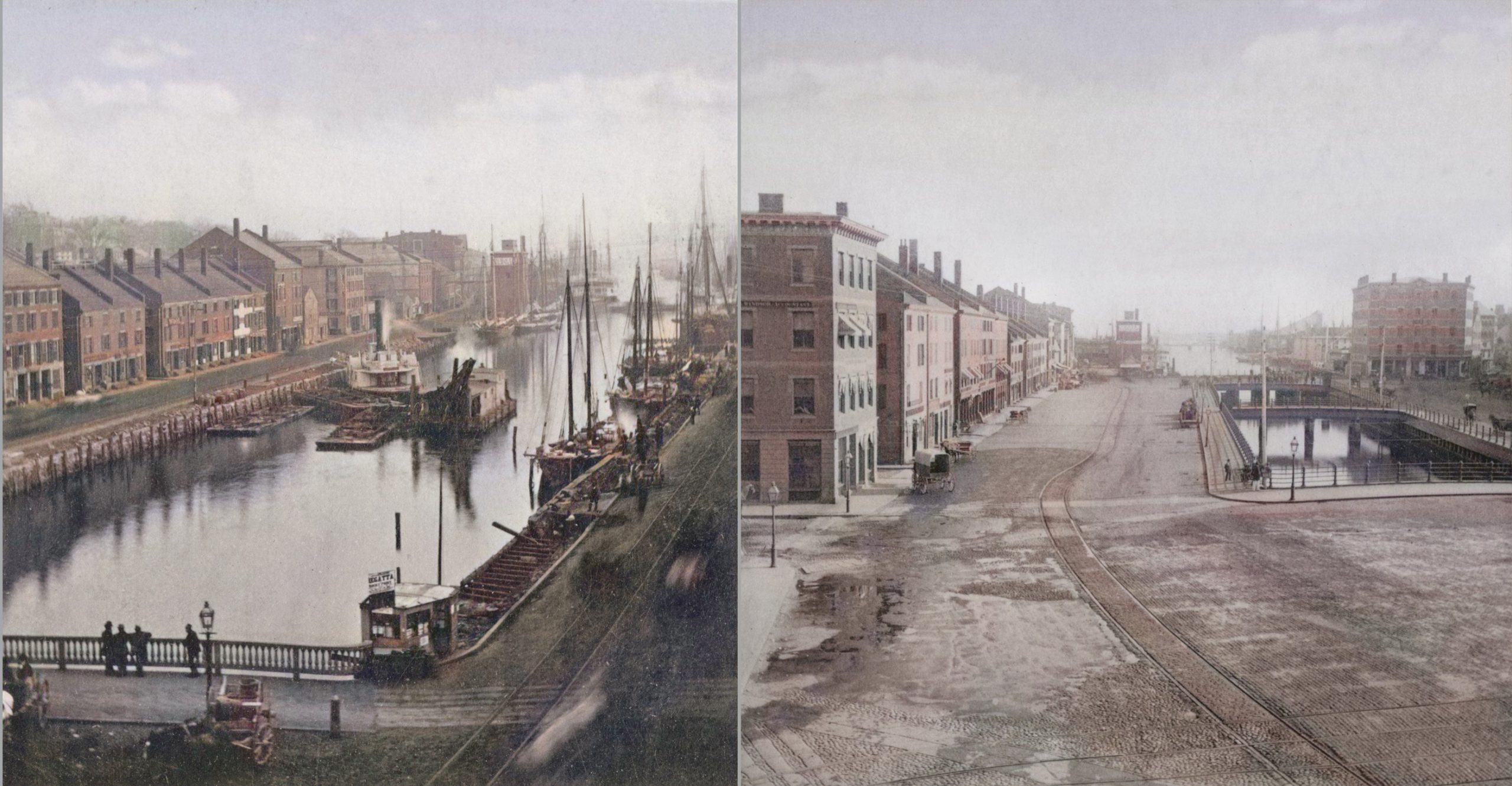
Below we see South Water street before and after the partial ‘covering’ of the shipping channel, so as to make the enlarged market area needed to serve the rapidly growing city. This work evidently served to prevent the tall trading ships from coming right up into the heart of the city. Here the last facade of the Old Brick Row is glimpsed on the left, and we see the full run of the row on the right-hand picture.

Stereo-views, here newly restored and colourised by me, and placed side by side for comparison. With thanks to Boston Public Library.

Lovecraft also evokes this long harbour at the end of his “Observations on Several Parts of America”. On finally returning back home at dawn he finds the city…

quiet and mystical with dawn-haze and elder memories … A fresh salt wind came up from the harbour, over the roofs of the centuried warehouses and the Old Market House of 1773; and down the narrow, curving line of the old town street by the shoar I glimpsed the chimneys and gambrel roofs of mouldering houses known to ancient captains…

February 2022 on Tentaclii

The winter has definitely turned the corner here in the English Midlands, and another February is over. The land is not yet in the sunny season of “sportive lambkins”, as Lovecraft once put it. But after four pounding and bitter northerly wind-storms, it’s now all calmed down again. During the final wind-storm it got so cold that I had to put the heater on for the first time this winter, for a few hours. But now our birds and plants are definitely saying that a sustained spring is just around the corner. The pandemic measures are also removed here in the UK, and a relative freedom also appears to be around the corner. One thing not being removed is costs, which are soaring everywhere and likely to go higher. As always, Tentaclii readers can help me to to enjoy the spring a bit more please, by giving a few $’s a month via Patreon or by boosting their donation. Or by buying my books and other fundraiser items.

In Lovecraft scholarship this month, I noted that the Polish Litteraria Copernicana journal was a Lovecraft special-issued titled “Lovecraftiana”. I linked the forthcoming ‘Symposium from the Untold Depths: Lovecraft and the Popular’ in the UK. S.T. Joshi will be in the UK in May, and giving at least one museum lecture here. This month I also completed a substantial piece for his Lovecraft Annual 2022 and submitted it.

On forthcoming books, there was news in The Fossil that the book Adventurous Liberation: H.P. Lovecraft in Florida is moving forward and the author stated it has “gone to the editor for final review”. Ken Faig, Jr.’s forthcoming book Lovecraftian People and Places has listed at Hippocampus.

In small historical context posts at Tentaclii, I was pleased to find a picture of leading New York educator Angelo Patri, who helped Lovecraft’s friend Everett McNeil at a crucial time. I stumbled on “Desultory Notes on Cats” (1844) by Edgar Allen Poe and it proved to be an obvious (if regrettably short) precursor to Lovecraft’s own essay. I was pleased to find a clear overhead photo of a favourite Lovecraft letter-writing spot on the Seekonk river, albeit from 1972 rather than 1932.

I noted a Ladd Observatory Event in Providence that appears to be an annual ‘open observing night’. I’m uncertain if a visitor can obtain access at other times, still less ease themselves into the observing chair. Most probably not the one Lovecraft would have used, but still.

In my ‘Picture Postals’ posts I took a visual look at Lovecraft’s visit to New Orleans; with maps and pictures I tested to destruction the possibility that the High Bridge was the site at which Lovecraft observed the 1925 eclipse; I looked at Lovecraft’s final attendances of public lectures at Brown, and found a glimpse of an inner lounge; and I also looked at the Yale quadrangles he enjoyed.

Over in Europe, Lovecraftian theatre seems to be still alive despite the pandemic. There was an announcement of a Lovecraft opener for the Kreuzgangspiele in May, and “Lovecraft, Mon Amour” will have another staging in April. The acclaimed Portuguese director Edgar Pera has also produced a new Lovecraft movie. There was also a touch of theatre activity in New York, where the Write Act Repertory called for Lovecraft plays.

Here in the UK the ITV TV station is apparently making a Lovecraft documentary of some sort, which will be interesting if there’s some costume drama added. In the USA a TV-movie adaptation of “Dreams in the Witch House” is said to be due in 2022.

In fiction I noted the new Dreamlands anthology New Maps of Dream (2021). I also noted a couple of Tolkien related items, which may have interested some readers.

In art the new ‘Dream by Wombo’ art-AI has interesting possibilities for weird art and illustration. Though the results are sadly ‘non-commercial use’ according to the two guys who are Wombo. The newspaper El Pais gave the world a very simple and pleasing Lovecraft caricature via a comic-strip. Chaosium offered a new video profile of their key artist Loic Muzy, titled ‘Illustrating Cthulhu’.

I didn’t look for anything game-related this month, but there’s likely to have been activity there both in videogames and RPGs.

In audio, the Voluminous podcast this month featured Lovecraft’s letters to fellow amateur journalist Edward Cole. Librovox popped out an unexpected public-domain reading of of Henry S. Whitehead’s “Editorial Prejudice Against the Occult” (1922), which gives a snapshot of magazine editor prejudice against the sort of stories that his friend Lovecraft was beginning to write. I also looked at Eno as weirdist and worked out an initial-listening set of albums for the instrumentals, from which one might pick out a refined playlist. I found the unusual archive of historic ‘Rhode Island Fish Sounds’ in audio, though sadly not under Creative Commons.

Audio software was also a focus this month, which may have been of interest to readers who are also into podcasting and spoken-word production. As part of getting a historic interview into text, after a little research I was able to upgrade my tools. I found the desktop Nuance Dragon Professional 15 does pretty good offline AI auto-transcription from a podcast .MP3 file. I finally got rid of Audacity as an editor, and now have the equally freeware replacement Ocenaudio. And I discovered that Izotope RX is a great AI repair kit for various common glitches in spoken-word audio. Those faced with an old interview, which has echo and other problems, may find things like Izotope RX’s ‘Dialogue De-reverb’ module especially useful.

I’ve completed the next issue of Digital Art Live which will be on ‘Plants’, especially 3D-model alien plants. As a side-post I noted here on Tentaclii that Dark Worlds Quarterly has been doing a fine ongoing series on plant monsters in the pulps and golden age comics.

Ok, that’s it for the short and cold month of February. Onward into March…

Symposium from the Untold Depths

Symposium from the Untold Depths: Lovecraft and the Popular, 25th March 2022, online. Seems to be a joint postgrad symposium linking students at Birmingham University and Manchester Met (MMU), England.

It has three interesting sounding talks…

* Post-Millenial Lovecraftian Humour.

* From Thalassophobia to a Thalassic Feeling in H.P. Lovecraft’s Oceanic Weird Fiction.

* ‘A Greek Influenced by Grimm’: H.P. Lovecraft’s Classical Reception