News from Germany

The Deutsche Lovecraft Gesellschaft have a report on August activity.

They saw a large increase in formal members, and together had a “very lively” 109-person celebration of Lovecraft’s birthday. That was from August 18th to 21st, at “the Miskatonic University in Duderstadt”, Germany…

“After the years of social deprivation caused by the pandemic, this gathering of like-minded and great people was really energizing. It can go on like this!”

Congratulations. Sounds like an unusual mix of “students and lecturers” and “numerous rounds of games” (RPGs). They have the 2023 dates for the next one already, 27th-30th July 2023. Registrations open 15th September 2022.

The English translation of their fully open-source Lovecraft RPG has slowed over the summer, but now seems to be back on track again and some new helpers.

Also noted is that… “The Festa publishing house is taking its Conan series out of the program. This is due to expiring contracts.” Festa appears to offer chunky German Conan paperbacks, and I think I also saw a Kull

Lovecraft was right, part 796

Or, at least, he might not have been wrong when he held to the idea…

“That the human race started on some plateau in central Asia is almost certain” (Selected Letters III, p. 412)

Lovecraft was not alone in this. I note that in the 1920s Roy Chapman Andrews (the model for Indiana Jones) took an expedition to Mongolia, intending to find there the first traces of the human race. Also, the discovery of proto Indo-European (c. 4000 B.C.) had put the origins of the European languages mostly in a massive ancient migration to the Caucasus from the western Eurasian steppe, which would then place Mongolia as a theoretical lost origin-point further east. Apparently some linguists still see evidence for a distant Mongolian relationship for proto Indo-European, circa 12,000 B.C. So by the standards of his time, Lovecraft seems to have been thinking along the right lines.

But after Lovecraft’s death the consensus on human origins later shifted to Africa, based on the new post-war fossils, even though “consensus” should be a dirty word in rational science. Now comes a hint from this week’s New Scientist magazine (“The Search for Ancestor X”) that ideas may be changing based on new evidence…

The problem is that we appear to have fundamentally misunderstood the way human evolution works. “The idea humans originated from a small region [of Africa] doesn’t make much sense,” says Lounes Chikhi at the University of Toulouse, France. Chikhi says the genetic signals in living humans imply that H. sapiens emerged as a “metapopulation” spread over a wide geographical area where several “subpopulations” were interconnected by genetic exchange [presumably by early trade?]. Each of these subpopulations was characterised by a subtly distinct genetic signature — and potentially a subtly distinct look. [The article concludes that, on present evidence,] Ancestor X could have lived almost anywhere within a truly vast geographical region. … “it could have been in west Asia. It could even have been in east Asia. We just don’t know yet.” [the latter quote is from Chris Stringer at the Natural History Museum in London].

Friday ‘picture postals’ from Lovecraft: Purgatory and Paradise

In the last weeks of summer, a trip to the beach with Lovecraft.

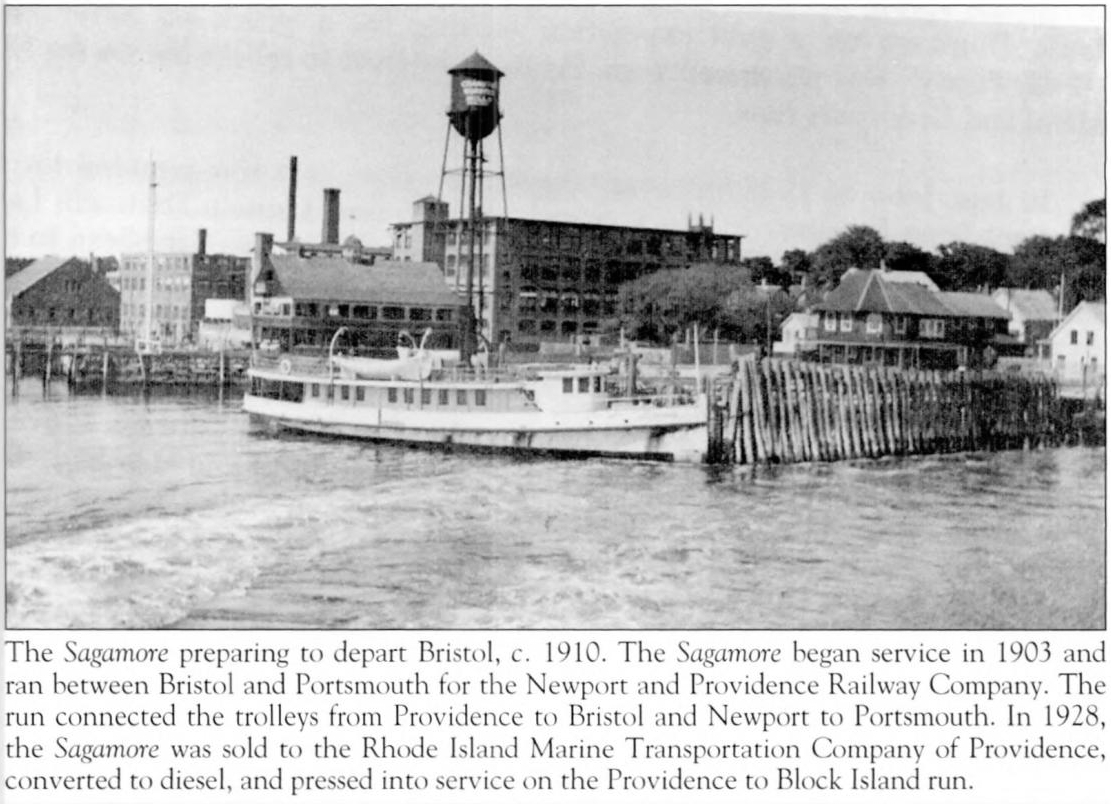
The old coastal town of Newport was one of H.P Lovecraft’s favourite places, and the place hosted him for one of the last local trips ever made in his life. It was near to Providence, but was still somewhat costly to reach in summer. It became more affordable to him during the Great Depression, and we know from the Cole letters that he often took the cheap and juddering older boat “Sagamore” from the Providence waterfront to Newport, sometimes in the company of cattle on the lower deck (Galpin letters, p. 62). Lovecraft tells us she had been “re-modelled” for the Providence – Newport – Block Island run which she started in 1928. On the lower and presumably widened decks of this formerly sleek little boat Lovecraft encountered “freight and cattle”. We know it was juddering because Lovecraft tells us he could not write on board, due to the vibration.

In the depths of the Great Depression this offered a fare as low as 15-cents for a day’s round-trip, and on one occasion he went for three days in a row. This was the route of the “Newport boat” which features in the famous “The Call of Cthulhu”. This could have been, at the time of “Cthulhu”, the “New Shoreham” passenger boat. As seen below, along with its Providence dockside.

The “Newport boat” landing and departure point, Providence.

Though in 1932 he mentioned to Cole that the upmarket 75-cent “Mount Hope” boat was competing with the far cheaper “Sagamore” (the cattle-carrying boat). With at least one guest, for instance Helen Sully in July 1933, he and his guest would take the better of the two Newport boats. So the Sully trip was very likely on the “Mount Hope”, which was warmer. The cheaper boat came back later and was thus colder on the way back, and there was also the risk of encountering cattle on deck. As can be seen here, the “Mount Hope” was a far more substantial passenger proposition than the small “Sagamore”…

Possibly there were even three services at the time of “Cthulhu”, since the “Mount Hope” seems to have made the run as early as the mid 1900s and was still being photographed on the same run in 1934. So the “Newport boat” at the time “Cthulhu” was written could have been either “Mount Hope” or the “New Shoreham”.

Anyway, enough of untangling the boats. Let’s get to the beach. Emerging from hibernation in spring, Lovecraft would take one or other Newport boat and then might hike out from the town “into the Bishop Berkeley country … some four miles beyond Newport beach on the road to Middletown”, through green fields of what he termed “sportive lambkins”. He enjoyed the coastline, beaches and rocks that lay behind and away from the town and the tourists.

Here we see James A. Suydam’s establishing view of this especially favoured place at the back of Newport, the “Paradise Rocks”. The “Hanging Rock” end of these gives a wide firm cleft for sitting and also views to nearby places named by locals “Paradise” and “Purgatory”. The end rock reminds one of the “sizeable table-like rock” in “The Dunwich Horror”.

A detail from a further painting shows the rock’s relation to the wide beaches and ocean, complete with one of Lovecraft’s “sportive lambkins”…

I once had a blog post on these two places, but sadly it was one of the few to perish when the blog blew up. However, I find that I can now recover the sketch-view from that post. This apparently shows “Paradise” (below the artist) and “Purgatory” (a deep cleft, down in the high headland seen across the beach/salt-grass).

Lovecraft visited many times, but also had at least three extended visits with his rock-appreciating geologist friend Morton. There was a Lovecraft-Morton visit in late June 1930, and again in the hot late August of 1932 when they explored the rocky cliffs and knoll and…

discussed the cosmos with Dean Berkeley’s shade

This being a reference to the British philosopher Bishop George Berkeley, a thinker who had especially enjoyed Newport’s “Hanging Rock” two hundred years earlier in circa 1728-32. Berkeley believed, among other things that “reality isn’t separate from perception” and he was a deep thinker on language who was later compared to Wittgenstein. The “Hanging Rock” being where, as Lovecraft put it…

Berkeley used to sit reading, writing, or meditating

In Selected Letters II Lovecraft gives a correspondent precise directions on how to find the place, once out of the town. One then has to assume that the area was not much signposted, and there would be no-one from whom to ask directions.

Here a detail of the “lip” at the “head” of the rocks, where one might perilously picnic or perhaps write competitive poems (Lovecraft recalls such a contest here, with the ocean-loving Wandrei)…

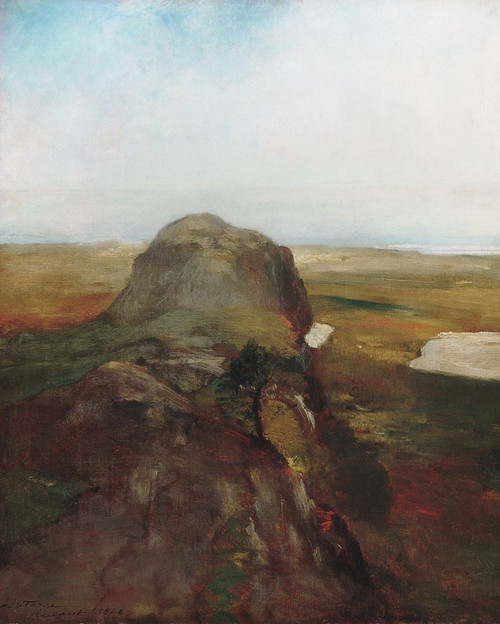
A rough study in oils by the local macabre and stained-glass artist John La Farge (1835–1910) also usefully indicates the highest-point elevation, of the sort on which Lovecraft might have “discussed the cosmos”…

we looked down from our exalted perch — a perch which 200 years ago was a favourite of Dean (later Bishop) Berkeley as he composed his famous Alciphron … We had splendidly hot weather all along — thermometer around 90˚.

News from France

My thanks to Gregory for letting me know that the French magazine Actuality: The Universe of Books has a new article “Lovecraft, Cthulhu and the Old Ones enter the Pleiades”. Here “Pleiades” is a play on the name of the famous French publishing house, Bibliotheque de la Pleiade. Who have now revealed (I translate)…

We are currently preparing an edition of the works of H.P. Lovecraft”, confirms La Pleiade. … “The work is in progress”.

This is not to be confused with the sumptious Mnemos multi-volume edition of Lovecraft now emerging…

Mnemos will soon publish the 4th volume of a gigantic translation, at the end of September [2022] … accompanied by the required scholarly apparatus.

The final third of the article turns into a short interview with the main translator for Mnemos, David Pathe-Camus…

I challenge you to read a text such as “Nyarlathotep” and not think about our own time. It reads like it was written just for us. Lovecraft had a keen awareness of the human condition. [In a way, his work] foreshadows the currents that will come after it — such as existentialism or the absurd.

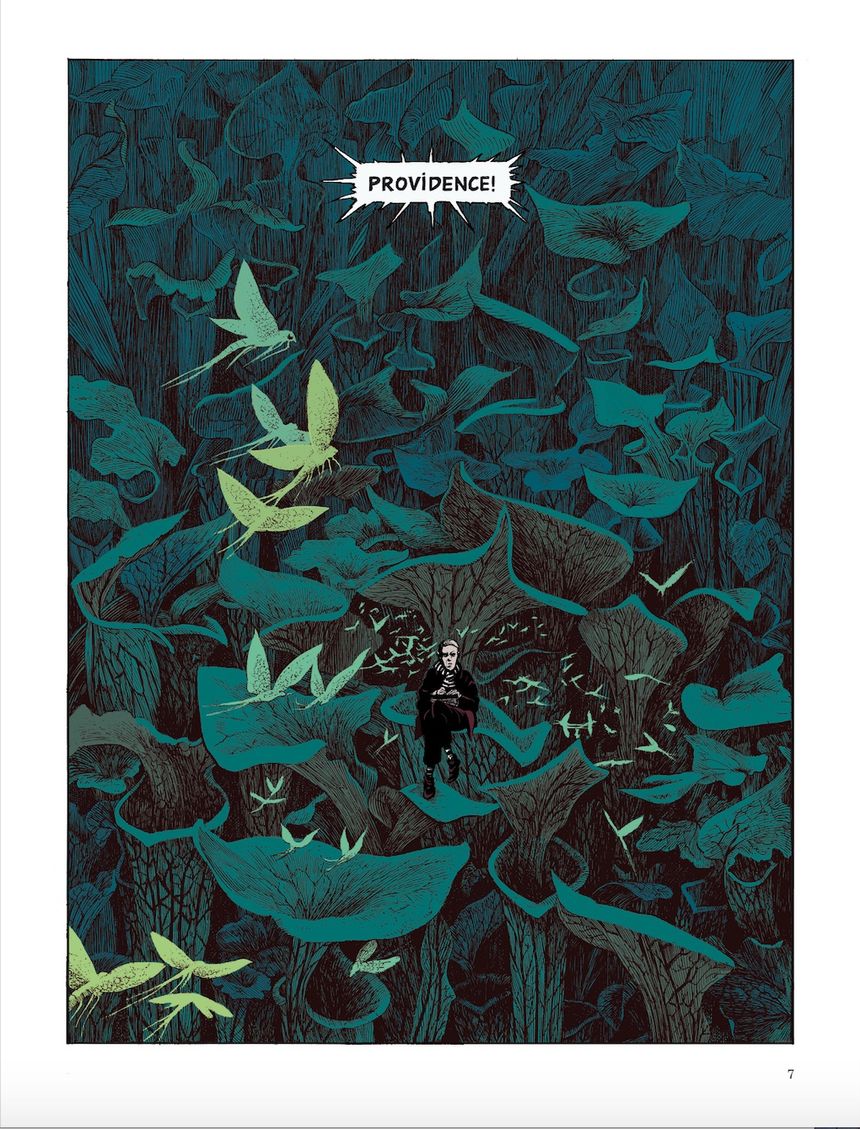
The same article also notes A Bestiary of the Twilight (Le Bestiaire du Crepuscule, June 2022), a French ‘BD’ (i.e. oversized graphic novel, often in hardcover) which…

takes HPL as the main character

Update: Le Bestiaire du Crepuscule has been re-titled as The Monstrous Dreams of Mr. Providence for the English edition, and since summer 2022 can now be enjoyed by English readers.

August on Tentaclii

The nice summer weather continues here, for now.

However, I find I am increasingly likely to be in need of a regular $300+ income a month, and within the next two months. If anyone can use my talents in a reliably paid way, please contact me. I’m very accomplished in information — discovering, evaluating, comparing, and packaging it into a readable form. Along with suitably sourced pictures. Elsewhere I’m currently a part-time magazine editor-writer. If you’ve always wanted a monthly magazine or substantial newsletter for your own special niche interest, or you need a researcher for a historical book or project, then now’s the time to shout. Please also mention me to others, such as editors, who might have some regular paid home-work to offer.

In August Tentaclii did not have a great deal of activity, because I was off the ‘daily posting’ schedule. But I did manage the first part of my “Notes on the Wandrei letters”. For which I found and colorised two good vintage photos of the Roman sculpture gallery at the New York Met, a place so enjoyed by Lovecraft and Loveman. Lovecraft’s comment on this place also seemed to indicate he was aware of Loveman’s homosexuality, which was quite a find. Also found in these letters were new names for Lovecraft’s favoured Providence book shops, “Gregory’s, Tyson’s”.

In scholarship, I released my copiously annotated and corrected edition of Kipling’s seminal science-fiction story “With The Night Mail”. Also a PDF with the Letters of E. Hoffman Price to H.P. Lovecraft, for HPL’s Birthday — though the latter was far more about simple image-processing and assemblage than scholarship. I also looked into an interesting question from my Patreon patron, “Did HPL read Sherlock Holmes?” and assembled the relevant facts for him here at Tentaclii.

My ‘Open Lovecraft’ page had a little updating this month, linking to open-access scholarship. I reviewed The Lovecraft Annual 2021 at length, and along the way made many new discoveries about Lovecraft’s Red Hook house-mate (I almost typed mouse-mate) Alexander D. Messayeh. I discovered he hailed from Babylon, and made a living dealing in the rarest antiquities of the ancient world. Make of that what you will, Mythos writers.

Two big summer conventions, the Pulpfest and NecronomiCon, came and went. In journals, the annual Pulpster #31 journal was released at Pulpfest. Possibly the Lovecraft Annual also shipped in time for the Armitage Symposium wing of the NecronomiCon to discuss over breakfast. But I’m not yet aware of any convention report from that side of NecronomiCon which might mention that. If I’d been there you’d have a 15,000-word report by now.

New books this month included H.P. Lovecraft: An Introduction to His Life and Writings; and Pulp Power: The Shadow, Doc Savage, and the Art of the Street & Smith Universe. I was pleased to find I can now access the Hippocampus Press website from the UK, without needing a VPN.

In Lovecraftian arts, I was delighted to feature the incredible “Welcome to Arkham — the (HO) Model City”, a labour-of-love in miniature. There is also much Lovecraftian art activity over in the red-hot new ‘industry’ of art-generating AIs.

In screen media, S.T. Joshi’s blog brought news of a forthcoming Dunsany documentary, being made in Providence no less. Guillermo del Toro’s forthcoming horror TV show Cabinet of Curiosities revealed which Lovecraft tales had been filmed. In 3D, I gave a makeover to the old Meshbox 3D HPL figure, which is used in the Poser software. There was the usual level of activity in videogames and RPGs, but those are rarely noted on Tentaclii.

Elsewhere, a “Battle” issue of Digital Art Live magazine has been finished, which should appeal to the Conan crowd when it appears in a few days. And yes, I noted the calls at Howard Days, to help promote the new Image Books Conan (now that Marvel are done with him).

I also updated my book of a few years ago, on Sir Gawain and the Green Knight and North Staffordshire, and released it as a temporary holiday-reading freebie (until 28th August).

That’s it for August. As always, please consider becoming my Patreon patron if you’re not already. Even a dollar or two helps in the current precarious circumstances.

Forthcoming Dunsany documentary

S.T. Joshi’s blog has updated. He’s been doing a lot of travelling, and eventually reached Providence where he reports that in a studio there…

Christopher Nightingale, a young Englishman is working on what promises to be a superb documentary on Lord Dunsany

S.T. spent three hours there being interviewed on Dunsany. If this is the same “Christopher Nightingale”, the award-winning “Composer, Orchestrator & Musical Supervisor”, then the film’s music should be a treat.

New book: Copiously annotated and corrected edition of “With The Night Mail”

Newly published, my labour-of-love “With the Night Mail”, annotated edition. Available now as a .PDF file. $2 on Gumroad, but the first 30 Tentaclii readers can get it free by using coupon-code tentaclii at the checkout. Or if you’ve feeling generous, you can pay the $2 and skip the coupon. I’m hoping that this Gumroad ‘formula’ may eventually start to produce a much-needed bit of extra income.

Blurb:

This is the best version of Kipling’s famous “With The Night Mail” (1905), the first ‘hard’ science-fiction story. Still a fabulous steampunk read, today.

Here newly and fully annotated with 4,600 words of precise scholarly annotations. Several important new discoveries are made, including the identity of “little Ada” — she was a real pilot! All four earliest versions have been checked and cross-referenced, and the modern corrupted text has been carefully cleaned. Differences between editions are noted in the footnotes.

There are 145 footnotes, explaining the technology, lingo, and places. One footnote even discovers a long ‘new’ section of dialogue about the risk of plague, unseen since the first publications in 1905 — and never reprinted until now!

This .PDF is thus as close as we will get to a definitive version of the seminal story that launched the entire genre of hard science-fiction, and which opened the highly influential Gollancz yellow-jacket survey anthology One Hundred Years of Science Fiction (1969).

As a bonus, there are four new full-page colour illustrations including one of “George”. This labour-of-love e-book is 28 pages in total, delivered to you as a .PDF file. It may interest RPG gamers, as well as scholars and readers.

As you can tell, I’ve at last been able to see all four of the earliest editions. And my gosh… many differences! And with errors in places, in some modern editions, even including a handful in the free version on the site of The Kipling Society. Anyway, regular Tentaclii readers know my approach… copious attention to detail, deep historical research, resulting in many fascinating footnotes. Enjoy.