Return to Copps Hill

This Friday ‘Picture Postals’ post is a sequel to my 2019 Copp’s Hill Burying Ground post.

Lovecraft wrote to Galpin and Belknap Long, in early February 1923. He told them of how, on the 14th of December 1922, he had travelled to Boston to stay with Cole and his delightful young family, in order to attend a Hub Club meeting. The following day he explored in the North End…

I proceeded to Hull-Street [from the nearby church], and up the steps to that fascinating necropolis which thro’ some singular fate I had never before seen — the Copp’s Hill Burying Ground. Here are interr’d some of the most illustrious Colonial dead of the Province, including the Mathers, who are interesting to me from my possession of Cotton Mather’s “Magnalia Christi Americana”. But the chief charm of the scene is in the entire broad effect; the bleak hilltop with its horizon of leaden sky, harbour masts, and Colonial roofs. In sight are many houses of the early 18th century, to say nothing of the rebel frigate “Constitution”, which defends the harbour from attack. Over the sod was a thin coat of snow, thro’ which the slabs peer’d grimly whilst black leafless trees claw’d at a sinister lowering sky. In fancy I could conjure up the Boston of the late 17th century with its narrow, hilly, curving streets and quaint wooden and brick houses.

I’ve now found more and better/larger pictures.

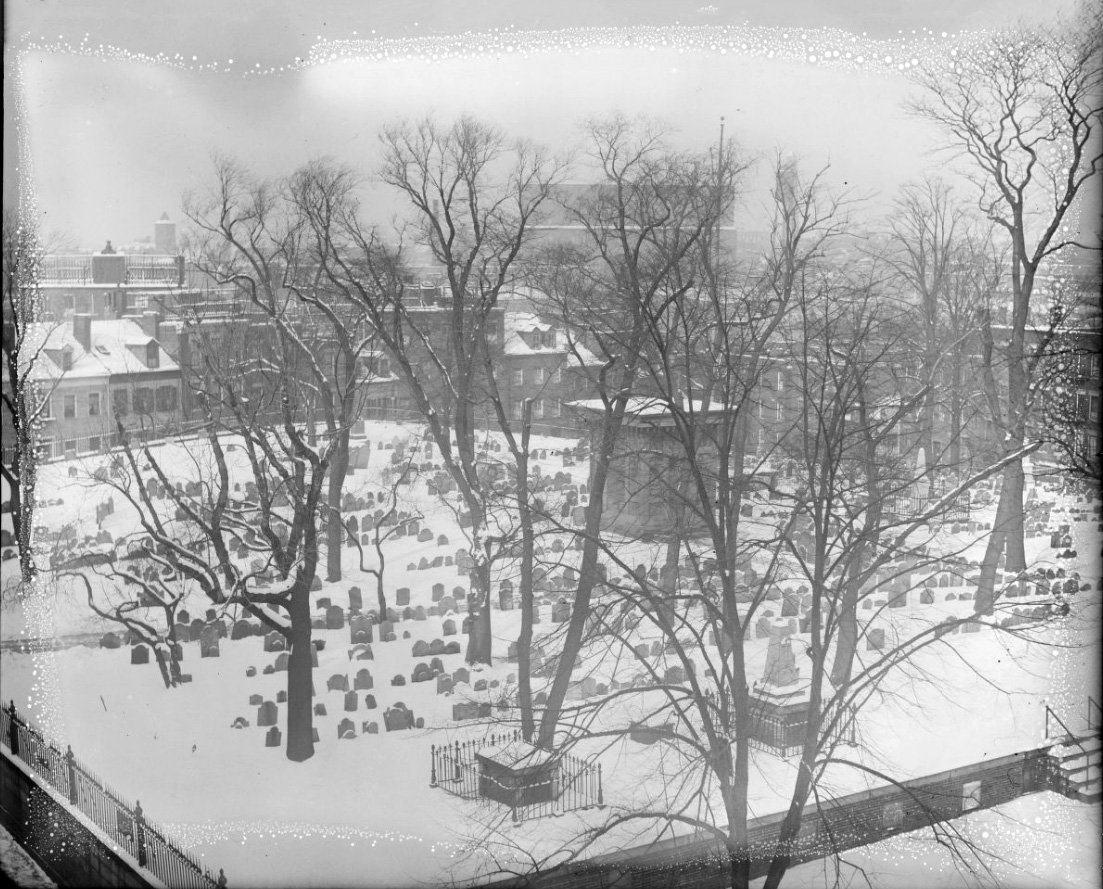
Copp’s Hill in winter, with snow on the ground as it was when Lovecraft visited.

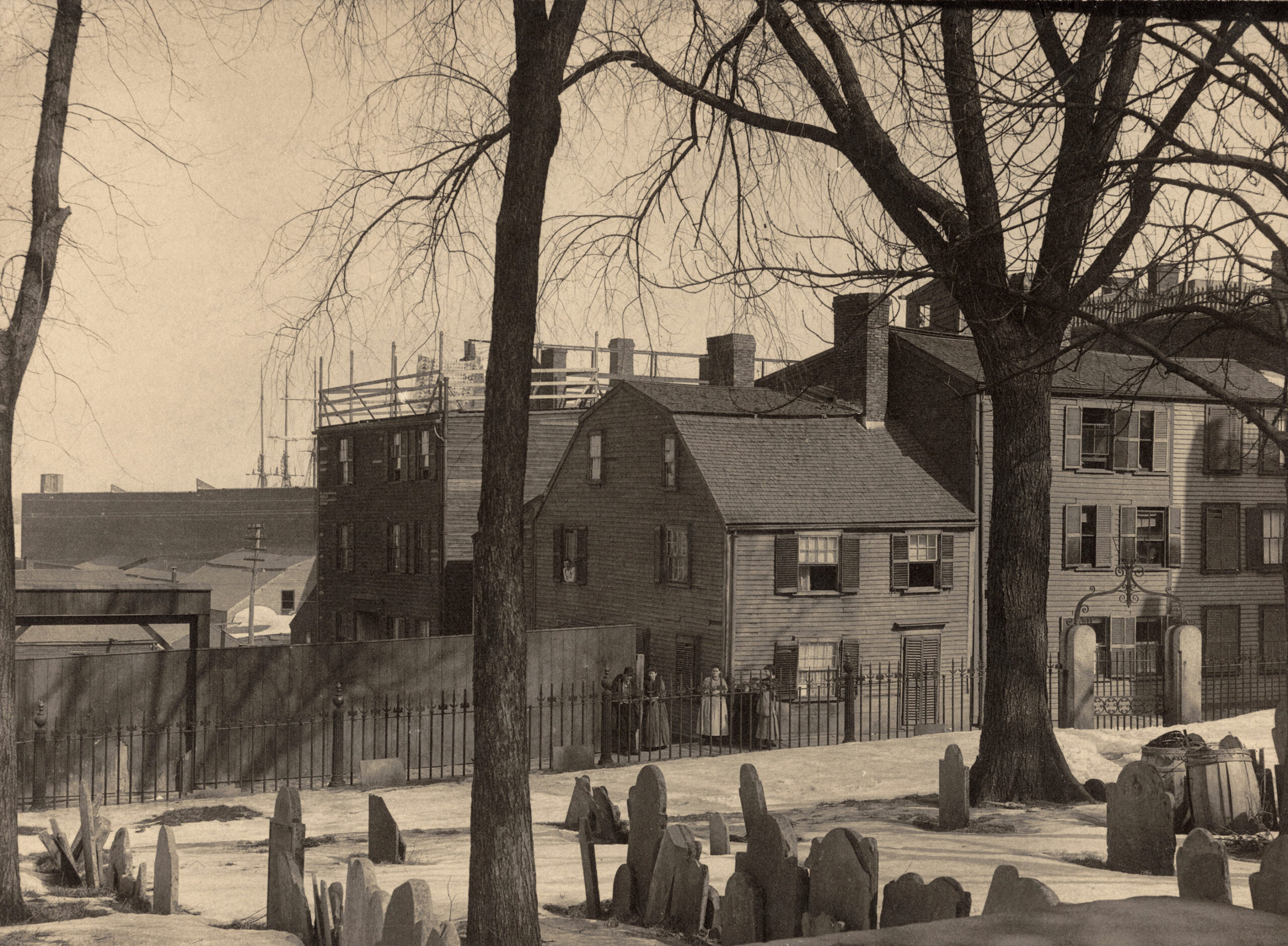
Looking across to Charter St., ship masts just about to be seen beyond the house roofs.

Backs of Charter Street.

Another view which has a glimpse of a ship and also water, behind the houses.

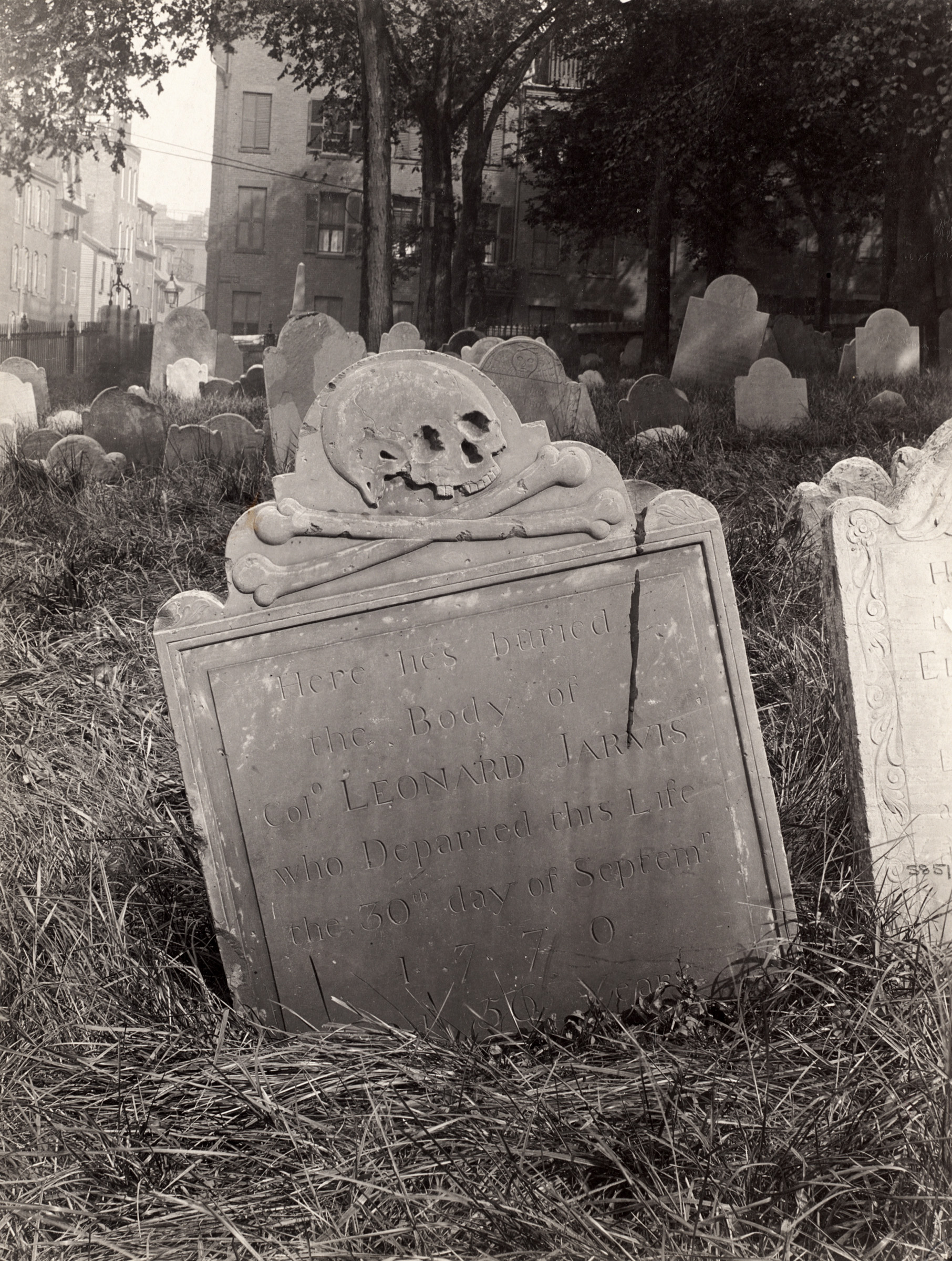
Some of the skull gravestones Lovecraft would have seen…

Lovecraft later had Pickman paint a scene of…

“a dance on Copp’s Hill among the tombs with the background of today.” (from “Pickman’s Model”).

The grave of Cotton Mather.

Tentaclii in January

Thanks again for reading Tentaclii for another month, especially such a grim month as January. And thanks also to those who have donated recently, or who continue to do so. You made my Christmas and New Year a little merrier that it might otherwise have been.

In ‘Picture Postals’ I riffled through the growing online archives of the city of Boston. I came up with a tour of the Ancient Greek sculpture galleries in Boston, more or less as they would have been seen and enjoyed by the young Lovecraft (relevant to his later breakthrough poem “The City”); I took a ride on the Boston Elevated railway and Subway (“Pickman’s Model”, “At The Mountains of Madness”, and “Nyarlathotep”); and dived down into the Boylston St. subway (“Pickman’s Model”). Further, I found an evocative picture of the Reading Room of the Boston Public Library (Lovecraft knew it because he comments on a painting and some Grail tapestries he’d seen there), and I took a look at shops and old houses near Lovecraft’s bit of Clinton Street, New York City.

As a request from a Patreon patron I made a quick survey-list for his chosen topic of “Does HPL have any ‘lost’ manuscripts?”, as well as pointing him to a Lovecraft Annual article on the topic. My thanks to Martin A. for a couple of queries and suggestions on that post.

In books this month the French had their sixth volume of their sumptuous new ‘complete H.P. Lovecraft’, and the seventh and last volume is due next month. Congratulations to all concerned on (nearly) completing such a monumental project. In other books, S.T. Joshi’s new Horror Fiction Index was released, which appears to be a handy time-saving ‘story finding aid’ on which others will no doubt be able to build in future. It’s the sort of thing that perhaps needs to be made into a collective wiki-like enterprise in due course, I’d suggest. I was also pleased to see that the latest (and possible last) incarnation of the definitive Arthur C. Clarke biography had at last made it to the Kindle as an ebook.

I trawled Google News and confirmed that Derleth and Eddy Jr. have indeed slipped into the Public Domain in Canada, in perpetuity. Canada’s sneaky new ’70 year law’ change is not retrospective.

In events, the London Lovecraft Festival and the 28th Annual H.P. Lovecraft Film Festival both had dates or rosters, and there were also Tentaclii posts trailing the forthcoming Howard Days and Pulpfest.

In scholarly journals I was pleased to spot a new Crypt of Cthulhu #114 (July 2022), which I had missed hearing about. One blogger also noted in passing that the Crypt editor’s Eldritch Tales ‘zine is up and running again. In academic journals I noted Inklings: Jahrbuch fur Literatur und Asthetik, and ALPH: Approaches to Literary Phantasy, both new to me. Over in Tolkien-land I produced the first two issues of Tolkien Gleanings, free in PDF, which does for Tolkien what Tentaclii does for Lovecraft. Regrettably Tolkien Gleanings has yet to prompt even one purchase of my recent Tolkien books. Sadly people have simply stopped spending on such small purchases, in the face of enormous energy and food bills and rising mortgages. The buyers who used to think nothing of spending $50 a month on an ebook, a bit of software, a magazine, and a useful service on Fivver, have all gone.

I was pleased to release an expanded free PDF of “The Family of Author Sydney Fowler Wright” in collaboration with Ken Faig Jr. Both Tolkien and Wright are (were) local lads, so I’m able to put my local knowledge to some use there.

Not much this month in Lovecraft arts, other than noting the HPL Historical Society Lapel Pins and a few nice vintage book covers. Though there is a wave of AI-generated art out there, if you care to look. In audio the latest Voluminous podcast was a huge one (I still haven’t been brave enough to venture in, and it may have to wait for a long six-hour rail journey), while the Cromcast podcast surveyed “R.E. Howard’s Poetry Pals”. Librivox had an album’s worth of readings in January, all free and under Public Domain.


John Buscema : artist & inker

New on Archive.org is John Buscema : artist & inker a little book from the 2000s. It appears to have been aimed at school libraries and 9-12 year olds — in the days when they could also have Conan comics on the shelves. Buscema was of course a mainstay artist of Savage Sword of Conan, among others. If you ever wanted to give a local schools talk / slide-show on the man and his art, perhaps even as part of Howard Days 2023, this could give you a head-start on getting to the heart of the biography in a way accessible to children.

Also new on Archive.org, and for the first time, a scan of the 1944 collection Creeps by Night. For many this would have given them their first taste of Lovecraft, here represented by “Erich Zann”.

Volume six of the new French translation

The French should today be unboxing their sixth volume of the complete H.P. Lovecraft. This is the new French translation from Mnemos. The book shipped last week, if the Amazon UK date can be trusted.

Not quite the final volume in the sumptuous set. The last will be Vol. 7 in March 2023, which is either “About Lovecraft” or “Lovecraft’s Circle” depending on how you translate its title.

Paul Kidby exhibition

I was never into Terry Pratchett’s Discworld, having been unable to get past page 60 on what was supposed to be the best book to start with. But many love the rambling series, especially if they grew up with it. In the UK there’s a “Denizens of Discworld – 30 Years of Paul Kidby’s Illustrations” exhibition, at the Saint Barbe Museum & Art Gallery in Hampshire.

The exhibition contains a completely new selection of works, none of them seen in the last exhibition St Barbe organised with Paul in 2012, which subsequently toured across the UK and Ireland. Most have never been publicly exhibited before.

Until 18th February 2023. Between Southampton and Bournemouth, on the south coast of England. I’m guessing this new show may also tour.

Greeks in Boston

This week on ‘Picture Postals from Lovecraft’, more from Boston. H.P. Lovecraft once recalled the time when he was a lad who was becoming interested in the wider world…

As soon as possible I procured an illustrated edition of Bulfinch’s Age of Fable, and gave all my time to the reading of the text, in which the true spirit of Hellenism [the Ancient Greek world] is delightfully preserved, and to the contemplation of the pictures, splendid designs, and half-tones of the standard classical statues and paintings of classical subjects. Before long I was fairly familiar with the principal Grecian myths, and had become a constant visitor at the classical art museums of Providence and Boston. I commenced a collection of small plaster casts of the Greek sculptural masterpieces, and learned the Greek alphabet and the rudiments of the Latin language.

The ‘old’ Boston Museum.

For Boston this meant the Museum of Fine Arts building on Copley Square, demolished in 1909. It was most likely best known by him in his middle-childhood circa 1898-1902 (age 8-12).

Some of the interior photographs currently available make the displays look extraordinarily dull, especially the painting galleries. What then was the attraction for the lad? Well, we know from the above memoir that the young Lovecraft once had an intense passion for classical sculpture and he was often seen haunting the sculpture hall in his own city. His city’s Museum had an entrance hall and exhibit of Greek sculptures, something I’ve posted about here before. As a boy he was fervent to see this when it opened as…

a recently opened exhibit of Greek antiquities at the Rhode Island School of Design

… and thus he pestered his family until he was taken there in 1897.

Therefore the next logical step for the family would be to take him to what is now known to archivists as the “old museum” in Boston, the pre-1909 Museum of Fine Arts.

before long I was fairly familiar with the principal Grecian myths and had become a constant visitor at the classical art museums of Providence and Boston

The attraction there would have been what was obviously a large and very fine collection of sculpture from Greece. He might have seen it from perhaps circa 1898 and onwards. On my assumption that the local 1897 visit in Providence came first, and then the trip(s) to Boston later.

Here then is a glimpse of what the young Lovecraft would have seen in the museum at Boston…

Entrance doors.

Main sculpture hall.

He must have been rapturous with all this, as he then had an “infatuation with the classical world” as S.T. Joshi puts it. This later fed into the setting though not the sentiment for his breakthrough poem “The City” (1919). Of which I have an annotated version from 2019.

This same Museum had several galleries of rather more stolid sculpture from Ancient Egypt.

Quite possibly Lovecraft also later encountered old favourites in the new post-1909 museum building at Boston, which opened in 1909 as the old one came tumbling down. However, on probable re-visits circa 1919, his sense of exhilaration would not have been the same. Evidently some of the Puritan darkness of New England had seeped into his views by 1918, as seen when he remarked in his essay The Literature of Rome

The Hellenes [Greeks], with their strange beauty-worship and defective moral ideas, are to be admired and pitied at once, as luminous but remote phantoms.

More cheerfully, he would in later years have been looking out for the work of his own ancestor in the Museum…

Samuel Casey, Jun. — my great-great-great-granduncle — was a silversmith of such art and skill that pieces of his work are in both the Boston Museum of Fine Arts and the Metropolitan Museum of New York.

I have a counterfeiter as a great-great-grand-uncle about whom I’ll tell you some time. He was also a silversmith — with pieces surviving in the Metropolitan Museum of N. Y., the Boston Museum of Fine Arts, & elsewhere.