Pulp fiction of the ’20s and ’30s

New on Archive.org “to borrow”, a scan of Pulp fiction of the ’20s and ’30s (2013). The press appear to have kept it in hardcover only, according to Amazon UK, and it’s now thoroughly out-of-print there. No sign of it on eBay either. Thus, it looks like I’m not dinging anyone’s wallet by linking to it here. The contents include, among others…

* On Pulp Fiction and Weird Tales

* Robert E. Howard and the Creation of the Sword-and-Sorcery Sub-genre

* Cthulhu’s Empire: H.P. Lovecraft’s Influence on His Contemporaries and Successors (Joshi)

* Nostalgia in H.P. Lovecraft

* Henry Kuttner: Often-Overlooked Pillar of the Weird Tale

* The Fantastic Pulp Fiction of Frank Belknap Long

Out Of Mind (1998)

New to me, the well-made film Out Of Mind: The Stories of H.P. Lovecraft (1998), now in full on YouTube at 720px…

Made for Canadian television in 1998, the film offers an encounter with Lovecraft and enters into his world. Engaging in a kind of ‘game’ around the writer, the film playfully winks at some of the themes characteristic of his work: the occult, cursed books, monstrous creatures. Out of Mind draws its inspiration from Lovecraft’s personal correspondence and many of his stories, carrying the viewer through a labyrinth ‘beyond the wall of sleep’.

Also to be had on Archive.org. As well as being a 57 minute TV movie it was also released on VHS tape, but Amazon UK knows nothing of it.

Texaco Star & R.E. Howard

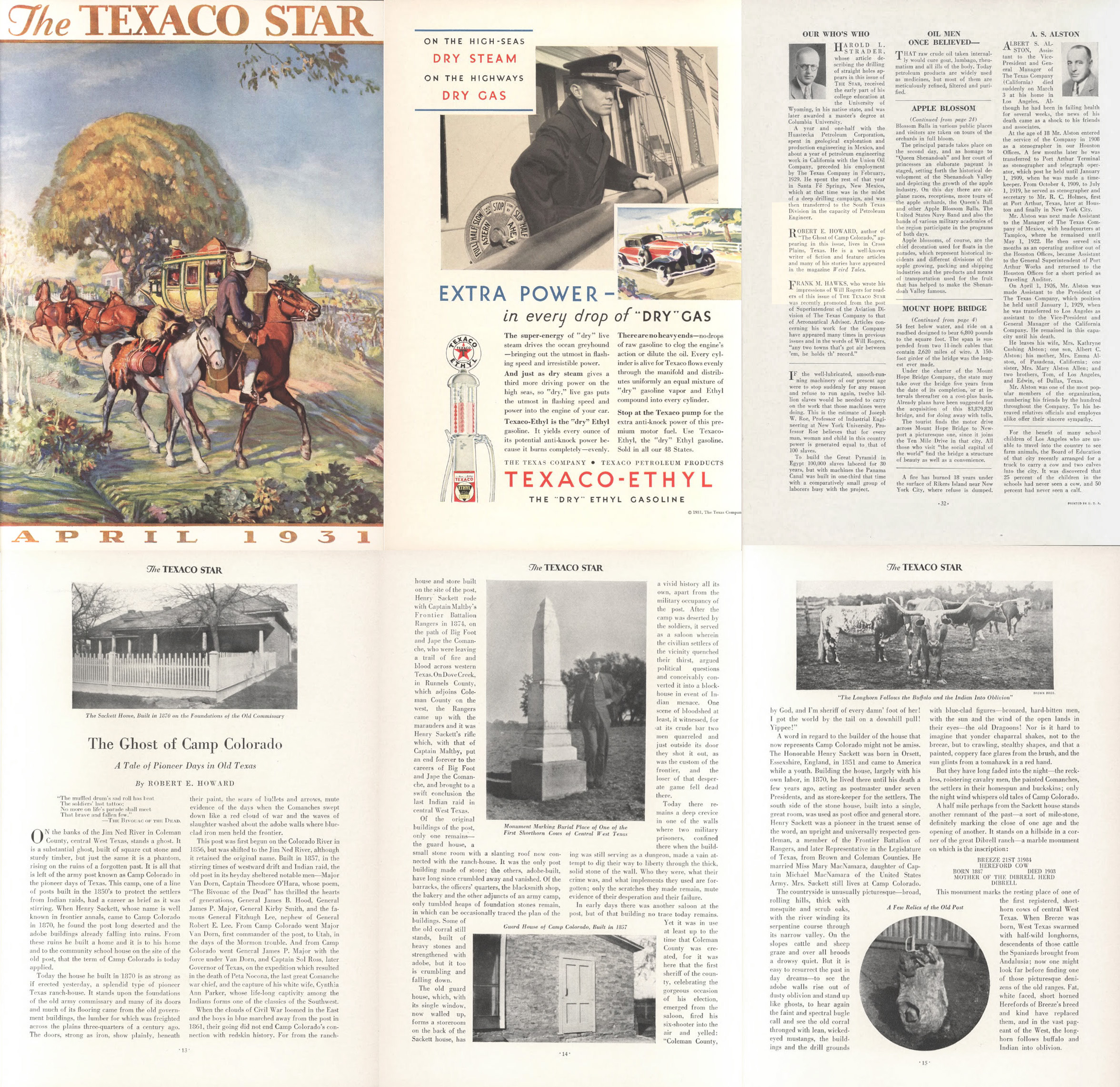
Talman’s Texaco Star trade magazine is online in a full 1913-1963 run, in archival scans at the University of Houston, Texas. This was the official free internal monthly magazine of the Texaco oil company, which he edited from 1930. The run appears to have been placed online in March 2021.

Sadly it can’t be searched across in full-text from a single search-box, and there are no TOCs alongside each issue. But scholars know that it was, under Talman’s editorship, home to some items linked with Weird Tales contributors. There’s a story about Everett McNeil which features him as a character, for instance. Lovecraft talked himself onto the mailing-list by the end of 1930 (for the historical and travel articles), and also considered how he might contribute travelogues. And here’s the Robert E. Howard article from April 1931. He doesn’t get the cover, but I’ve also included the front and back cover for context.

There’s also talk in the Talman letters about a forthcoming Providence article and map in the Star, though I haven’t got that far in the book yet.

Non-Euclidian Lovecraft at Calgary

From the University of Calgary, a short online news-puff, “A century later, pulp magazines still leave their mark on genre fiction”. This points out that the University is home to…

The Bob Gibson Collection of Speculative Fiction, which contains more than 28,000 published items, including runs of more than 400 pulp magazines like Weird Tales.

And that this is especially appreciated by…

Dr. Anthony Camara, PhD, an associate professor in the Department of English. […] Camara is currently working on an article about non-Euclidian and higher dimensional geometry in Lovecraft’s “The Dreams in the Witch House” from the July 1933 issue of Weird Tales.

Meanwhile, over at Northern Illinois University, the Horatio Alger Fellowship for the Study of American Popular Culture.

Dagon and Dr. Emmerson’s Nocturnes

The maker of the well-regarded videogame Dagon (September 2021) has revealed his next game, Dr. Emmerson’s Nocturnes, billed as an… “original approach to bringing literature into the interactive medium”.

I see there have also since been two paid DLC add-ons for Dagon, “The Eldrich Box” and “The Little Glass Bottle”. Those who have the free game from 2021, but missed hearing about these, may want to nab them.

The maker has also reported that all of the money made on the paid DLCs for Dagon (an impressive $30k+) has now gone to worthy charities. Yes… even a 30-minute free game, from a tiny Polish studio, can make big money these days on the DLC alone.

Also in games, Learn to Play Call of Cthulhu, Online in June 2023. One seat left, and probably gone by the time you read this. But a nice idea at $15, and with perhaps the potential to raise some money for charity along the way.

The Arcade and the Seekonk

This week on ‘picture postals’, two of Lovecraft’s favourite local places.

‘The Arcade’ which he had known since earliest youth, in a newly colourised stereo picture.

And a very nice scan, also new on eBay, of the driveway along the shore of the Seekonk in Providence. I’d seen this before, but usually as a poor CardCow scan. This scan is excellent.

In Lovecraft’s infant years the drive was then along the shore alongside Swan Point Cemetery. Local ‘calls for action’ confirm this, calling for it to become part of a longer drive. In time this longer drive came, and by Lovecraft’s middle childhood the ride also ran along the shoreline at Blackstone Park. Thus the location of the view is actually about a mile away from his later favourite spot in the wooded bluff above York Pond. But the picture still gives a flavour of the Seekonk, and doubtless he and his pals ventured this far up from Blackstone on occasions.

You’ll recall that it was the Seekonk which gave rise to horrible dreams of it being completely drained to mud and slime, and thus to “Dagon” and the Mythos.

New from Germany

News from Germany, translated…

* “The knowledgeable Lovecraft translator Andreas Fliedner and [the publisher] Festa Verlag have now decided to present all of Robert Aickman’s stories in a new translation. A real stroke of luck for the German-reading audience. The first volume, Dark Gates [Dunkle Pforten], was recently published.”

* “From 2nd to 4th June, the Lovecraftian theatre show “The Shadow over Innsmouth – A Tale by Lovecraft” will be performed three times in English at the Brotfabrik in Bonn, Germany.” Supported by the regional Ministry of Culture too, something that here in the UK would likely cause fainting fits among the Sacred Order of the Perpetually Offended — followed by a speedy cancellation of the funding.

* A German audio appreciation of Wilum Pugmire’s Sesqua Valley & Other Haunts.

Notes on Letters to Wilfred B. Talman – part one

I’m pleased to have bagged a bargain copy of the Talman letters, the full title of which is Letters to Wilfred B. Talman and Helen V. and Genevieve Sully. It’s a hefty 580-page slab, and I’ve made a start on it. Below you’ll find my first set of notes.


Lovecraft begins writing to Talman in early September 1925.

Page 17. Lovecraft calls the Kalem member Arthur Leeds… “a very throughout technician, and experienced in the art of practical suggestion”.

Page 18. He must have rated Myrta Alice Little’s intellect very highly, since in 1925 he ranks her in the nine top “active brains” he knows in amateurdom. His own is presumably the tenth. You’ll recall that in the summer of 1921 this tall beauty was Lovecraft’s faint but quite possible marriage prospect. She was religious, though, and soon married a handsome Methodist preacher.

Page 19. One of these “active brains” is British. An “Ernest Lionel McKeag”. Which one assumes he had at least some correspondence with. McKeag lived on until 1974 (other fannish sources say 1976) and wrote stories for British boys’ comics, true-life naval war-stories, and boys’ science-fiction and even two 1950s ‘lost race’ science-fiction books (published from Stoke-on-Trent of all places). Only his Lost City of the Sierras (1927) sounds like a candidate for a Lovecraft revision, but he seems more than capable of churning out his own tales for juveniles.

Page 19. In September 1925, ahead of Kadath, he describes the basic idea for it as… “extremely fantastic — the picaresque progress of a wandering spirit through the marvellous and undiscovered voids and worlds of the remotest universe”. Which makes it sound as if one of its roots was perhaps in “Iranon”.

Page 20. A large section here on the Moon, which would make an excellent appendix to the forthcoming book on Lovecraft and Astronomy. If it isn’t in already.

Page 22. Lovecraft explains the linkage of the signs of the Zodiac to the Babylonian cycle of the seasons and the human year. It didn’t quite hang true in some details, but I could see how it could do so with just a few tweaks. It’s remarkable that this way of understanding the zodiac constellations has escaped me until now. Again, another candidate for an appendix to the forthcoming book on Lovecraft and Astronomy. Could also be the basis for an interesting children’s picture book, if an illustrator is looking for a project.

Page 26. Lovecraft talks of his taking a Providence night-walk on or about 21st April 1926…

… night before last, during the course of which I discovered one of the most hellish slums ever imagined by mankind. It was in a place whose existence I had not before realised – the end of Chalkstone Ave. near Randall Sq. & the railway – and its dark hilly courts approach the very ultimates of blasphemous horror.

A little later in the book there is additional description, and Lovecraft states he plans to use the place in fiction some day.

Page 29. “The bottle idea […] I got it from that old hermit of 30 years ago in Phillipsdale”. Presumably he means the idea of ‘souls in bottles, with which one could converse’ used in “The Terrible Old Man” (1920) and later tweaked and adapted for Dexter Ward (1927), and that he had first heard the idea from a “hermit” circa age six. Phillipsdale being “a historic mill village along the Seekonk River in East Providence, Rhode Island”, and just across the river from College Hill. The idea of extracting and trapping a human essence is one that also crops up in folk-tales, and is by no means unique to East Providence. But an interesting early source, nonetheless. A quick and cursory search reveals no easily-found record of a “hermit” in Phillipsdale in the 1890s.

Page 31. “I ‘did’ […] Federal Hill — & was astonished by the great Italian churches”. This was presumably a trek made without Eddy, from whom he was at that time estranged (though later, in July 1927, there was a partial gathering of ‘the gang’ in Providence and Eddy was there). Surprisingly, he implies he had not seen these churches before, even distantly from the stagecoach when passing through. Perhaps they were relatively new erections?

Page 37. “Conan Doyle has some fair [weird fiction] stuff, too. “Mystery of Sasassa Valley”, “Captain of the Pole Star”, Round the Fire Stories.” The first was Doyle’s first published story, back in 1879. The next mentioned was 1883, in book form by 1890. Round the Fire Stories (1908) is a book of 17 tales. As the author says in his introduction, despite the cosy title these are actually his stories “concerned with the grotesque and with the terrible”. Thus none of the titles suggests that Lovecraft continued reading Doyle after circa 1909. This chimes with my finding that summer 1908 seems to have been when Lovecraft stopped reading Doyle’s Sherlock Holmes tales.

Page 44. The Old Corner Bookshop (‘Dana’s Old Corner Book Store’) had formerly been in Empire Street, Providence, and a comment from Lovecraft on the stock shows that he patronised it there “years ago”.

Page 50. Lovecraft gives his ideas for an extensive revision of Talman’s first version of “Two Black Bottles” (the final version of which is not included in this volume). The Lovecraft Encyclopedia has… “it seems clear that HPL has not only written some of the tale — especially the parts in dialect — but also made significant suggestions regarding its structure.” Horrorbabble has a free reading on YouTube, of the final version as published in Weird Tales in 1927.

Page 57. Lovecraft talks of “my version” of “Two Black Bottles”. Most likely he refers to the extensive outline/reworking given from page 50 onwards, rather than a story he had actually written from this.

Page 65. Room 328 at the New York Public Library was his favoured evening reading room for material on “Old Providence”. This was on the third floor…

Page 66. A gem of a find. Lovecraft did after all read his friend Everett McNeil’s fantasy / weird work. Many assume that Lovecraft had probably only read his later boys’ adventure novel Tonty. Well, it ain’t so…

Honest old Mac has written weird stuff — and by no means bad, either — but none of it has graced our Chicago contemporary [i.e. Weird Tales] as yet”.

Wish I’d had this quote when I wrote McNeil’s biography.

Page 65. A fabulous quote about Broadway in the morning light. Surprisingly this does not seem to have made it into the Selected Letters

[In New York I] explore[d] obscure corners in the small hours […] I’ll never forget the sight of the newly-risen sun streaming in a glorious flood of molten gold up the length of Wall St. into still darkened Broadway one morning. It was as if all the past — the brilliant past of Dutch settlers and glamorous shipping and gay coffee-houses — were shining from a land outside time, & welling up from the sea into the dismal & shadowy present.

Page 66. Mention of James Howard Flower and especially his “gem” of a poem “With Shelley in My Soul”). A footnote reveals Flower was a Vermont revision client whose “Shelley” poem has “not been found”. Well, there’s the J. Howard Flower papers, 1899-1959 archive (no Lovecraft letters, it seems), and the James Howard Flower-Solitary Press Collection 1920-1945. This latter “Collection is unprocessed”, and also mis-titled as it should be “Solitarian Press”. “Collection consists of poetry, essays, pamphlets, and issues written by J. Howard Flower and others and printed by the Solitary [Solitarian] Press of Hartford, VT, founded by Flower.”).

Who was who among North American authors, 1921-1939 suggests that these items by Flower himself might be worth inspecting for signs of Lovecraft’s revision…

Florentine Sonnets (1918);
Flower of the Road (1919) (42 page chapbook of verse);
Songs of Love and Liberty (1920);
Under Blue Ascutney (1921);
Florentine Sonnets and Florentine Lyrics (1923)
Bobolinks at Dawn and Whippoorwills at Dusk (1923)

However, one can find that Lovecraft’s friend Walter J. Coates (Driftwind) was also a revisionist for the Solitarian Press. For instance in 1920 Coates revised the Press’s new book Oriental Songs and other Lyrics by one Henry Clay Webster. Thus it’s possible that Lovecraft was revising for those whom the Solitarian Press published, rather than for Flowers himself. Flowers was an ardent socialist from an early age, even a Stalinist by the 1950s, and does not seem the sort of person Lovecraft would have cared to deal with directly. My guess would be that Lovecraft could have been taking ‘overflow’ revision work for the Press from Coates, this being work which Walter J. Coates was unable to manage due to time or complexity.

Still… if anyone’s in Vermont and near the University, it might be worth an afternoon sifting through the 1919-1925 boxes of the Howard Flower-Solitary Press Collection. “Collection is unprocessed”.

Journal of Ursula K. Le Guin Studies

The University of Northern Iowa is planning a new journal, UKL: The Journal of Ursula K. Le Guin Studies, and currently has a call for papers for the first issue.

You’ll recall that le Guin (real name Ursula Kroeber) was one of the best fantasy writers of the late 1960s and early 1970s, with her ‘Earthsea’ fantasy series (A Wizard of Earthsea, The Tombs of Atuan, The Farthest Shore). And she was equally highly regarded in science-fiction circles for her two classic novels of the same period, The Left Hand of Darkness and The Lathe of Heaven.

Forthcoming: ‘Horror in Architecture: The Reanimated Edition’

Horror in Architecture: The Reanimated Edition (2024)…

A new edition of this extensive visual analysis of horror […] in the built environment. Spanning the realms of art, design, literature, and film, this newly revised and expanded edition compiles examples from all areas of popular culture

The publisher’s page has it as being in dead tree and “2023” at present, and with an ebook due in February 2024. But Amazon UK says February 2024 for both.

The 2013 edition only mentioned Lovecraft three times, very much in passing and among other names. The most substantial mention is when the idea of “putrefaction” is said to be exemplified by “the cursed De La Poer family of Lovecraft’s The Drowned”. One hopes that more will be said about Lovecraft in the 2024 edition, and that such errors will be corrected.