
A preview of the fine cover for the forthcoming Historical Lovecraft anthology (2011), which has been open for submissions for a few days now. Not to be confused with the Lovecraft Classic Horror Anthology.

07 Tuesday Sep 2010
Posted in Lovecraftian arts
A preview of the fine cover for the forthcoming Historical Lovecraft anthology (2011), which has been open for submissions for a few days now. Not to be confused with the Lovecraft Classic Horror Anthology.
06 Monday Sep 2010
Posted in Lovecraftian arts
Some strange things turn up on Etsy: how about a 6,000 year-old meteorite, carved into Loveraftian shapes, and placed under glass as a paperweight? Unfortunately the maker has also added some hippy-dippy crystals, but the basic concept is sound…
“Made with Hardened PVC, actual 4000 to 6000 year old Meteorite, fine Magnifying Glass Dome, Swarovski crystals, wood and felt base. Tiny Pink areas slightly fluoresce with Black Light. In with the Meteorite is a complex setting. Is it an Alien, Cthonian life form, Volcanic formations or, something even more terrifying…”

05 Sunday Sep 2010
Posted in Lovecraftian arts, Odd scratchings
The prestigious and beautifully-produced book series Library of America series is shortly to issue a slip-cased edition of Lynd Ward, Lynd Ward: Six Novels in Woodcuts

At least one of his novels, Gods’ Man : A Novel in Woodcuts is in the public domain, although it appears that the estate of Lynd Ward still makes claims (possibly spurious, since its copyright was not renewed) upon it.
04 Saturday Sep 2010
Posted in Lovecraftian arts, Odd scratchings
Viktor Wynd’s Little Shop of Horrors, London…
“The shop is perhaps best seen as an attempt to recreate or reinterpret with twenty first century sensibilities a 17th century Kunstkamera, a collection of objects assembled on a whim on the basis of their aesthetic or historical appeal, there is no attempt at creating or explaining any metanarratives or educating anyone, merely a display of naturalia and artificialia designed to give pleasure to the creators of the museum, who hope that you too will enjoy it.”

“Surprising numbers of our visitors wish to spend their time in trying to work out what is real and what is not. A distinction that we do not see, nor understand. Up until the Nineteenth century to call something original was to insult it, for if no one has done something before there’s probably a good reason, and so many people have done so much since then, and much of it to be regretted, that to be original or to claim to have something that is original can only really be seen as unlikely and extremely pretentious.”
03 Friday Sep 2010
Posted in Lovecraftian arts
The first issue of Salon Futura magazine is now online, sporting a 3D-rendering of Cthulhu’s watery abode. The free magazine is aiming for monthly publication, and is…
“a new and hopefully somewhat different magazine devoted to the discussion of science fiction, fantasy and other forms of speculative literature.”

02 Thursday Sep 2010
Posted in Lovecraftian arts
A substantial new Alan Moore interview in The Skinny today, which has chunky sections on Lovecraft and Moore’s new graphic novel Neonomicon, which is set in Moore’s modern-day version of Lovecraft’s Red Hook…
“I wanted to do a story that modernised Lovecraft [ and via a blending with a police procedural approach ] actually put back some of the objectionable elements that Lovecraft himself censored, or that people since Lovecraft, who have been writing pastiches, have decided to leave out. Like the racism, the anti-Semitism, the sexism, the sexual phobias […] It is one of the most unpleasant stories I have ever written. It certainly wasn’t intended as my farewell to comics, but that is perhaps how it has ended up. It is one of the blackest, most misanthropic pieces that I’ve ever done. I was in a very, very bad mood.”
“why is Cthulhu […] humanoid? This is one of the questions we answer in the course of Neonomicon. And we do tell, I believe, a credible modern Lovecraft story”

Creative Commons portrait of Alan Moore by Javier Moreno, touched up by me and made B&W.
01 Wednesday Sep 2010
Posted in Scholarly works
The first issue (2010) of the academic journal Studies in Gothic Fiction is available. It’s an open-access full-text ejournal, so the contents are free.

31 Tuesday Aug 2010
Posted in Lovecraftian arts
Lovely cover-artwork for a new French graphic novel, Grands Anciens (Old Ones) by Bojan Vukic and Jean-Marc Laine. The myth of the Kraken is given the Lovecraftian treatment, filtered through Herman Melville…
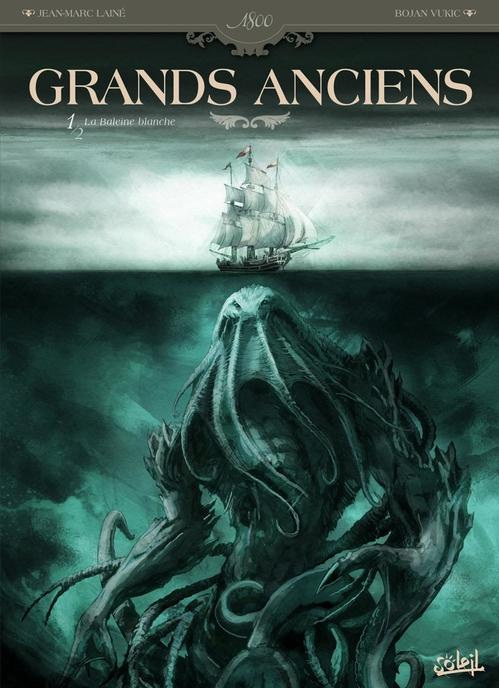
“New England, 1850. Ishmael is a young sailor who dreams of joining a whaling ship and going on an adventure on the high seas. One night in New Bedford, a fishing port overlooking the ocean, he met Herman Melville, a strange man who tells him the wildest stories — including that of the young captain Ahab, who once decide to go hunting the giant sea Kraken. But to raise it he first needed to find a certain sailor, a survivor of the Kraken attacks, who had kept a secret book of incantations and ungodly knowledge. Once this book is used, it conjures up ‘the Kraken’, which turns out to be far more monstrous than the worst nightmares of sailors or the dreams of human history.”
ActuaBD has interior art samples, and very nice they look too…

The first few pages are here…

A ‘making of’ set of character-sketches and pencil pages are here…

And I found a few more interior pages on a French book site…


31 Tuesday Aug 2010
Posted in Lovecraftian arts, Odd scratchings
Just what you need for a crisp cold Autumn (Fall), Creepy Knits, artfully knitting together Cuddly Cthulhu with the face-hugger concept from Alien…


31 Tuesday Aug 2010
Posted in Historical context
Gongnardia has a new review/appreciation of The Mound, Lovecraft’s 29,000-word novella which was ghost-written for his revision client Zealia Bishop, who apparently never paid him for it. His work for Zealia Bishop was built around the barest of plot ideas and outlines — “slim plot synopses”, as they are referred to in the notes to Lord of a Visible World: an autobiography in letters. Undertaken late 1929, the tale has a modern man discovering the manuscript of a 16th century conquistador explorer in the Old West (Oklahoma). A vast underground civilization of extraterrestrial beings is encountered, and in the process a large sweep of geological ‘deep’ time is described. This makes The Mound (written 1929-30) an interesting “trial run” for Lovecraft’s own novella At the Mountains of Madness (written Feb/Mar 1931). This is one I don’t seem to remember reading as a youth, and it’s not one I’ve so far encountered in my current re-reading of Lovecraft.
The story doesn’t seem to have been done as an audio book, either free or commercially. But it is online here. The full and complete manuscript version only appeared as a critical edition in print in 1989, in The Horror in the Museum and Other Revisions
30 Monday Aug 2010
Posted in Films & trailers
Grim Reviews has a long and very positive review of the new indie movie Pickman’s Muse
“Pickman’s blood curdling paintings are left to the imagination. The same goes for the spectral representatives of Starry Wisdom, who manifest as shadows in glass and swirl through the night. Adapting Lovecraft is unique in that many of his well described horrors can, theoretically, be brought to life on the screen. However, the long track record of disappointing gore and soggy monsters in Lovecraftian film making does not always mean directors should deploy the Providence author’s creatures directly. The maker of Pickman’s Muse realizes this, and he succeeds in casting a spell upon the viewer’s imagination, where images and sounds suggest terrors far scarier than actually pulling the curtain back all the way would.”
“Pickman’s Muse is a darkly beautiful journey, rendering its Lovecraftian elements in the vice grip of pure atmosphere. In a time when major directors are looking at giving Lovecraft’s work a multi-million dollar treatment that will surely include overt action and shocks, Robert Cappelleto shows Lovecraftian cinema may be best in the artistic fog of unknowable phantoms.”
Sounds very promising. Unfortunately the film’s being promoted with an incredibly ugly MySpace page, rather than a proper website. One would have thought the producers could have got a local web design house to make a decent site for free, in exchange for a prominent promo-badge on the front page. Ditto for the film’s poster. But the film was apparently made for a slightly unbelievable $5,000, and I guess they’re trying to save money wherever possible.
The trailer is available on YouTube…
[youtube=http://www.youtube.com/watch?v=bC65IofE1sw&fs=1&hl=en_US]
30 Monday Aug 2010
Posted in Films & trailers, Lovecraftian arts
Dejan Ognjanovic at Temple of the Ghoul has his hands on the script for del Toro’s forthcoming movie adaptation of At the Mountains of Madness, written by Guillermo Del Toro and Matthew Robbins. The first-act script-structure was ‘revealed’ by Latino Review in 2007 (although that could have been a hoax — certainly no-one reputable seems to have followed up on it). I’d imagine there are also several radically different versions of the script now floating around, as often happens for major Hollywood movies — some of these possibly being old and/or prototype scripts that were rejected and that won’t be filmed? Anyway, this is the gist of what Dejan writes:—
“It’s not as bleak as Lovecraft’s novel […]. story takes place in 1939, at the very beginning of World War 2 […]. Those who expect a certain meaning and symbolism […] cosmic horror – loads of atmosphere, suspense, build-up… Well, not much of that, sadly […] This script takes Lovecraft’s concept of Shoggoths – large blobs of intelligent protoplasm which can assume any shape (including human) – and runs with it to lengths that Lovecraft never bothered with [and] the bigger picture they belong to is paid just a brief lip service, in a couple of lines of dialogue you might just miss while checking your text messages. […] The Old Ones have very little to do [and at] the very end there is (yet another) appearance of Cthulhu itself! […] very little subtlety preserved […] More action, action and action than in the entire Lovecraft’s opus. [… There’s relatively little stress on atmosphere. […] Very little space for poetry and weird, alien beauty of the landscape […] Don’t expect a long and complex retelling of the history of the Old Ones […] The section from the novel when the expedition goes deep, deep, insanely deep into the bowels of the Mountains of Madness is entirely gone. […] The submerged city in the deep caverns, too. None of that here. And very little exploring of the city above, as well. It seems like they discover the bas-reliefs with the Old Ones’ history in the first building they come across, and that’s it.”
How very disappointing. I really hope that what sounds like a dumbed-down rehash of “Alien vs. Predator meets The Thing” isn’t the script they’re going to shoot. Yet, if it is, why did del Toro encounter such resistance from the Hollywood execs to filming it? It sounds like just the sort of thing that the mouth-breathing idiots in cinema audiences will lap up. Although perhaps we shouldn’t underestimate how dumb movie studio executives can be.
I suspect that Ognjanovic has an old script — since, at the 2010 Comic-Con in Summer 2010, del Toro went into detail about his work on the script with Matthew Robbins — he’s on record as saying…
“We are rewriting slightly the screenplay we’ve had for 12 years,” he told MTV News. “Matthew and I believe that a screenplay like that you have to tackle again every so often. We tackled it last about two years ago, [when] Matt and I felt like we needed to rewrite some stuff. Matt is my greatest writing partner because we keep updating anything we haven’t shot, we keep saying, ‘Let’s do another rewrite.’ So we’re going to do another rewrite in the next couple months.’ [because] “There [are] movies that have come out that have done things that are similar to some of the stuff we were trying,” he further explained.