Lovecraft’s typewriter

As a boy Lovecraft had had a “Simplex Typewriter”. Later, as an adult, Lovecraft owned and used the same Remington typewriter all his life. In 1975 L. Sprague De Camp called it a… “1906 Remington”. He went on to say that…

“When it wore out, he had it rebuilt. But this occured only at long intervals, since he could only rarely afford such costly repairs.”

S.T. Joshi tells us in A Dreamer and a Visionary: H.P. Lovecraft in his time that the typewriter was a… “rebuilt 1906 Remington” and that… “he purchased it with his own money in 1906”. In I Am Providence, this is “the 1906 Remington” (p.57) and some pages further on it is mentioned as “rebuilt”.

Donald Clarke’s A Life of Fantasy and Horror: H.P. Lovecraft gives us the date of delivery, which he presumably has from the letters [yes, it’s in the Moe letters, p. 226]…

“On July 6, 1906, Lovecraft received a used Remington typewriter.”

So, “rebuilt”, “used”? He appears to have had it rebuilt later in his life. But was it really used when he purchased it? Could one have purchased a used 1906 Remington in 1906? Or was it a new 1906 model that he later had rebuilt when he could afford it?

One solution to this conundrum may be that used machines were common. Busy telegraphy or typing-agency offices in New York would no doubt hammer the machines for six months and then discard them for new ones, selling them to local refurbishers to fit a new platen and keys. That way it could still have been both a 1906 model and rebuilt to be sold used to Lovecraft in July 1906.

This is the sort of ad he might have purchased from, which is from 1905 and shows a Remington.

So let’s assume that it was possibly a 1905 or 1906 model Remington Standard. They all seem to have looked much the same anyway. So much so, that one wonders if there were even some dubious refurbishers who sold last year’s Standard model as “this year’s model, refurbished” to unsuspecting aspiring writers who wanted a bargain. They were marked only with serial numbers, not dates. So although Lovecraft had his Remington in 1906, that doesn’t mean it has to have been made in 1906.

This is a 1910 Remington Standard, giving a flavour of the sort of scene at which Lovecraft might have sat down to type…

And here’s a 1907 ad for Remington which might have appealed to Lovecraft’s love of ancient Egypt (and which interestingly hints visually that New York might be imagined as the heir of ancient civilisations). The sand had been completely cleared away from the Sphinx only in 1905, allowing it to be seen fully for the first time since Antiquity….

Here’s an attic-hauled 1907 Remington in the 2000s, showing us what Lovecraft’s typewriter might look like today if it ever turned up…

Incidentally, it seems Lovecraft had previously had a Remington rifle in his firearms collection, and later wrote in a letter of his regret at giving it away. Possibly his admiration for the rifle was partly why he chose Remington as his typewriter brand? Although it does seem that Remington was then the “top choice” among typewriters.

Lovecraft also purchased a $50 astronomical telescope that same summer. His established interest in astronomy swiftly found its way on to the keys of the typewriter — a mere ten days after the Remington’s delivery he rattled out a letter that would win him his first national print publication, in the letters pages of the Scientific American. In the letter he proposed a method of discovering new planets beyond the orbit of Neptune.

Whisperer in Darkness review from Film Threat

The first carefully critical review (that I’ve seen) for the feature-length The Whisperer in Darkness. Tom Cruise isn’t in it, apparently. Darn.

Film Threat concludes…

“Branney nails the spirit of Lovecraft. Through voice-over narratives and frightened faces, The Whisperer in Darkness conveys a sense of human sanity being unraveled by too much forbidden fruit.”

There’s a new dedicated set of Web pages for the movie. The DVD should be out around… “October of 2011”.

The Tentaclii Summer Story Challenge 2011

Here’s a bit of fun for the summer. I’ve written a brief Lovecraftian story idea/outline, in the manner of the short entries in Lovecraft’s Commonplace Book. The challenge is to write a short story that fleshes it out and gives it a strong conclusion, much like the challenge that Lovecraft occasionally had from his ghost-writing commissioners. There may be prizes!

“A scientific or scholarly protagonist discovers that each person’s mind contains the trigger for each person’s exact date of death. This is due to the gradual layered accumulation of dream-memories over a lifetime. The human mind is born with only a certain finite capacity to retain and hold these faint and fleeting memories of past dreams, and when the mind is full of these — then death is swiftly triggered by making the body an ‘attractor’ for some form of evil or harm. But the protagonist creates a device to capture and siphon off his own dream-memories into bell-jars or some other storage devices, and by this he hopes for immortality.

Only after some months does he realise that he cannot contain his siphoned dream-memories in artificial vessels (they begin to fester and mingle there, and in doing so open up dimensional-portals which threaten to allow unspeakable hybrid dream-entities into the world, entities which he thinks he sees scratching and whispering at the glass of the bell-jars, etc). He decides that his festering dream-memories must be passed into the mind of another human, where he hopes they may be better contained. While researching how to do this, he is led to understand that it is only the balancing and calming factor of the faint dream-memories in the human mind that is keeping the human race from seeing the true cosmic horror of their situation in the universe. He has condemned himself to madness by removing too many of his dream-memories, but yet he cannot restore them (in their corrupted form) to his mind.

Can he accomplish the transfer of his now-diseased dream-memories into another, before his dream-memory deprived brain is engulfed by the shattering awareness of the nature of the horrors pressing against the glass of the bell-jars? And what will happen to the chosen recipient?”

Eldritch!

A long interview with Aaron Alexovich and Drew Rausch of the new Eldritch! webcomic, which is now available

Eldritch! is a horror book. A dark, brutal, MESSY horror book, but with a lot of humor built in… The story’s about Anya Sobczek, an angry punk-rock science major who discovers her teenage occultist brother is full of black tentacles and ancient, awful powers. There’s a lot of Lovecraft in it, obviously… Lots of monsters…”

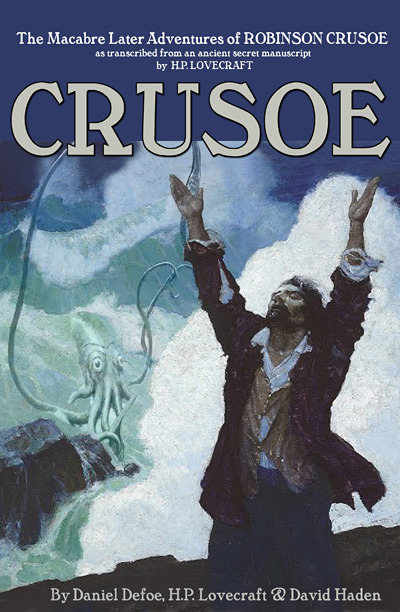
CRUSOE : the Macabre Later Adventures of Robinson Crusoe – new Kindle revision

I have a new revision of the Kindle ebook CRUSOE : the Macabre Later Adventures of Robinson Crusoe, available now. This has had some minor revisions, and the benefit of three extra passes of close proof-reading. I’ve also dropped the price to a special ‘summer sale’ price of $0.99 plus your local sales tax. Ideal summer reading for those going on cruises or visiting small tropical islands!

Houdini: Art and Magic

A review of the exhibition Houdini: Art and Magic (The Jewish Museum, New York, 2010), which has now transferred to the Skirball Center in Los Angeles until 4th September 2011. There’s an accompanying book, from Yale University Press.

Lovecraft and Houdini had connections, not least in the long story Imprisoned with the Pharaohs (1924). Lovecraft ghost-wrote this for $100 (paid in advance, for the only time in Lovecraft’s life), based on an after-dinner tale invented by Houdini but which he claimed as true. Lovecraft seems to have considered it improbable and badly formed, and was pleased to be told in confidence that it was actually a fabrication, since he could then let his imagination rip on the tale. Although often talked of as a minor story, and as having a little too much of the travelogue about it, Michel Houellebecq’s 1991 book on Lovecraft said Pharaohs contained some of Lovecraft’s… “most beautiful verbal extravagances”. This was, of course, also the story whose manuscript Lovecraft fatefully left and lost on a train, and which he then had to spend some of his honeymoon re-typing — possibly to the detriment of his marriage.

Lovecraft also admired Houdini for his tireless debunking of spiritualists and other faux-mystic charlatans. Houdini is known to have socialised with Lovecraft, occasionally dining with him after shows, and in one of his letters Lovecraft recalls being taken out by Houdini to the incongruous theatrical event of a Noel Coward play in 1924. Houdini personally arranged for Lovecraft to have a meeting with a newspaper publisher, with a view to some employment, but nothing came of it.

Lovecraft later had a further very healthy payment of $75 for a ghost-written Houdini article attacking and debunking astrology. Houdini’s sudden death due to a student prank, in 1926, put an end to the prospects of more collaborations and income — such as the planned The Cancer of Superstition, a book debunking superstitious beliefs. Lovecraft had apparently already drafted this in basic outline form, and started researching magic and witchcraft for it. Possibly some of this research found its way into his The Horror at Red Hook.

Pages of passion

Miskatonic Books blog today on the importance of the passionate genre book collector. Collectors pass-from-hand-to-hand otherwise neglected works, and equally importantly write articles about them, until one day changing tastes and new audiences eventually combine to bring the work to the attention of a wider readership…

“The purpose of the book collector is a considerable one. Genre fiction written within the small press will one day be seen as treasures by many rather than few. And we, as collectors, are simply the caretakers of these treasures. For example, society is just now starting to see the real influence that H.P. Lovecraft’s fiction has had on American literature, film and art nearly a half-century after his death.”

I think there may be a little more to say on the subject though. I mean in this ‘age of abundance’ and ebooks, is there such a thing now as pseudo-scarcity promoted by small publishers? And is this antiquated business model actually damaging to some sorts of authors? I mean, I can see the value of the beautifully printed and acid-free small-press book for passing the work on to the far future. And there are some types of books that require print but which only have perhaps 50 interested people and libraries in the world, such as Blurb POD photobook photo-essays on obscure topics. As for contemporary fiction, I think Cory Doctorow points the way to the future. Actually give away multi-format ebooks or sell then at very low sub-$2 prices, but then also sell an affordable print-on-demand paperback edition and a sumptuous top-of-the-line $300 hardback for collectors.