An Epicure in the terrible – 2nd Ed. now available

Now available from Hippocampus Press, according to their Facebook wall…

a revised and updated version of Schultz & Joshi’s 1991 classic An Epicure in the terrible: a centennial anthology of essays in honor of H.P. Lovecraft.

$20 + shipping, which is much better than the silly “from $358.96″(!) that was your choice for a used first edition on Amazon or elsewhere.

The old introduction is free on S.T. Joshi’s website and the full contents list is here.

Bruce Pennington exhibition in London

Bruce Pennington (1944-), there’s a name that’s a blast from the past. He did a great many British paperback covers in the 1970s, which I collected from the second-hand book stores as a youngster in the 1980s, although no non-Derleth Lovecraft as far as I can see. He has an exhibition on now in London (ends 27th Aug 2011). There are originals and also A3-sized digital prints at just £25 each.

He published the book collections Eschatus (Paper Tiger, 1976) and Ultraterranium (Paper Tiger, 1991).

Lovecraft and sympathy for the Devil

In 1924 Lovecraft wrote…

‘Take a werewolf story, for instance — who ever wrote a story from the point of view of the wolf, and sympathising strongly with the devil to whom he has sold himself?’ — H.P. Lovecraft in the letters columns of Weird Tales, March 1924. Quoted in Darrell Schweitzer, Discovering Classic Fantasy Fiction, p.126.

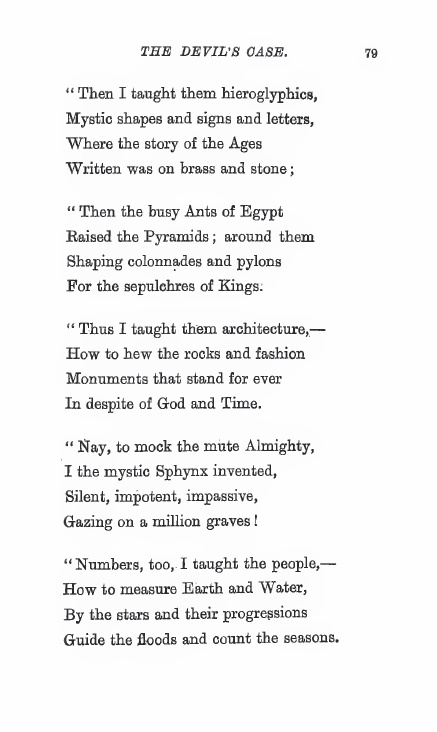
In this respect it’s interesting that a decadent writer called Robert Buchanan published a long decadent poem as a book, The Devil’s Case (1896). In it Buchanan sympathises with the Devil, portraying him both as a magician and a scientist/skeptic. Regrettably for the modern reader it comes with an offputtingly teduous late-Victorian preamble and it has much ‘poeticky’ language, but there are many very effective and vivid passages. Arkham House reprinted one of his long poems, but sadly not this one.

Here is Buchanan’s Devil in The Devil’s Case, recalling his time as a scientist/architect in Ancient Egypt. This would seem to have obvious relevance to “Nyarlathotep” (1920)…

Given Lovecraft’s dislike of 19th century literature it’s perhaps understandable that Lovecraft does not appear to have even known about some of the Victorian fantasy novelists such as William Morris (or possibly he assumed from summaries that they were more like children’s fairy tales, or just felt them not to be weird or horrific enough for mention in Supernatural Literature). But Lovecraft was apparently fairly informed on the Decadents and poetry. Indeed he went through a Decadent “phase” up until about 1922/23. So it seems strange he appears never to have mentioned Robert Buchanan. Archibald Stodart-Walker’s book Robert Buchanan, the poet of modern revolt: an introduction to his poetry had appeared in 1901. Also Harriet Jay’s Robert Buchanan: some account of his life, his life’s work, and his literary friendships had appeared from Unwin in 1903, and Henry Murray’s Robert Buchanan: a critical appreciation, and other essays in 1901 — so it wasn’t as if the author had been forgotten in the 1910s. Much of Buchanan’s early work was conventional, but his The Book of Orm (1870) and especially its section of poems titled “The Devil’s Mystics” might have been on Lovecraft’s list had he read about it. Certainly Orm was described in Chapter 12 of Lafcadio Hearn’s Appreciations of Poetry (1916)…

Buchanan’s Orm is represented to be an ancient Celt, who has visions and dreams about the mystery of the universe, and who puts these visions and dreams, which are Buchanan’s, into old-fashioned verse.

a very remarkable beauty, a Celtic beauty of weirdness [of “The Ballad of Judas Iscariot”]

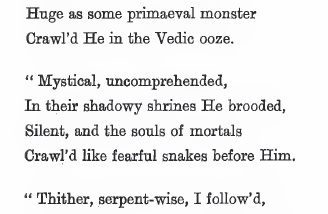
But Lafcadio Hearn’s essay appears to resolutely steer matters toward the ponderous ‘Christian meanings’, and he very oddly neglects to even mention that Buchanan ever published The Devil’s Case. If this book chapter was all that Lovecraft ever read about or by Buchanan (Hearn gives a large chunk of Judas Iscariot), then it may well have been enough to strike the name off Lovecraft’s list of works to investigate. Still, there does appear to be at least one very striking point of correspondence between the “The Devil’s Case” and “Nyarlathotep” (see above), and also some rather Lovecraftian language in places such as…

Edison in Providence, 1896

Edison was commonly referred to as “The Wizard of Menlo Park”, and his Vitascope presentation had come to Providence when Lovecraft was six years old. It played to virtually the entire town for a month, twelve hours a day. See Charles Musser, The Emergence of Cinema: the American screen to 1907. University of California Press, 1994. p.125.

I would imagine the shows were fronted with a film of Edison himself. One thus wonders if the childhood memory of the huge Edison on the screen might have been a spur to the dream that inspired “Nyarlathotep”?

The Vault to be prepped for a movie pitch

The Hollywood Reporter reports that Johnny Depp had bought the film rights to The Vault

the underwater sci-fi story centers on a group of divers who, off the coast of Nova Scotia, uncover a sarcophagus with unusual remains and inadvertently unleash an ancient evil.

Said evil apparently has links to the Great Pyramid, Stonehenge, and the Easter Island statues, etc. Nostrodamus gets a name check, rather than the Necronomicon. But in general it sounds fab and rather Lovecraftian and reminds me of Lovecraft’s story “The Temple” (1920). Apparently it’s out now as an ongoing comic-book series

A great looking and believable [comic] series, it creates a real sense of danger and is the kind of adventure we rarely see in today’s spandex-epic driven market. — Broken Frontier.

The concluding third comic-book installment is due in October 2011 (don’t read the promo blurb for #3, if you don’t want a huge plot spoiler landed on you by the marketing idiots). Let’s hope the Hollywood machine doesn’t twist a movie version into just another forgetable Alien vs. Predator, or some dumb non-cosmic “it’s the Devil!” stuff.

Lovecraft and Maxfield’s

A quick tracking-down of the site of Lovecraft’s famous ice-cream eating contests, which I had pictured as being in urban New York. But seemingly not…

21, Federal Street [Warren, Rhode Island]. “Bosworth Mansion” or “Maxfields” c.1840: 2 story gable roof Greek Revival house possibly designed by architect Russell Warren for Judge Alfred Bosworth; known for years as “Maxfields” a popular local ice-cream parlor.”

“After digesting Warren’s quiet lanes and doorways we went across the tracks to Aunt Julia’s, where we tanked up on twelve different kinds of ice cream — all they’re serving at this time of year.” — Selected Letters: 1932-1934.

This was owned by Julia A. Maxfield’s whose father was apparently Louis Warren Taft, and was of an old Rhode Island family. It seems from the mention of “Aunt Julia” that she was related to a member of the Lovecraft Circle. It seems, though, that the “Bosworth Mansion” was not the actual site of the parlour. The parlour was apparently in a nearby building, presumably in the grounds and maybe looking more like a wooden Summer House?…

From: Ruth Marris Macaulay, John Chaney. Warren. Arcadia, 1997.

Or possibly it was a veranda-like extension at the back of the house, which Wandrei’s (then nearly 20 years-old) memories seem to imply. Although I think I would rather trust the memories of the local historians and local people that the parlour was actually some distance from the main house.

Possibly Julia A. Maxfield didn’t actually work there either, but employed her relatives to do so, since there is mention of a Charles Redfern Maxfield Snr. being the manager of an ice-cream parlour in Warren in the 1920s.


Thanks to Chris Perridas for snagging this from an auction-house blurb on the parlour…

From the 1944 Arkham House book Marginalia by H.P. Lovecraft, there is a section titled “The Dweller in Darkness” by Donald Wandrei. In that piece he explains the history and story behind the first 1927 trip to Maxfields:—

We took a bus for Warren, Rhode Island, where they promised a great treat. At Warren we walked to an establishment called Maxfield’s in a rambling old Colonial house. Its specialty was ice-cream, and it developed that our pilgrimage was solely for the purpose of consuming ice-cream.

There were thirty-two varieties on the menu. “Are they all available?” asked Lovecraft.

“No,” said the waiter, “only twenty-eight today, Sir.”

“Ah, the decay of modern commercial institutions,” said Lovecraft dolefully. “Thirty-two varieties are advertised but only twenty-eight are prepared for the famished pilgrims.”

We each ordered a double portion of a different flavor, and by dividing each other’s choice, we enjoyed three flavors with each serving. The trams came on and on — chocolate, vanilla, peach, black raspberry, pistachio, black walnut, coffee, huckleberry, strawberry, orange, plum, mint, burnt almond, and exotic types whose names I do not recall. The ice-cream was superior; there was no doubt of its being of the finest quality. But on the twenty-first variety I was beyond capacity. I watched with awe while the remaining flavors arrived in the same huge portions, and Lovecraft and Morton ate on with undiminshed zest, interspersing the astonishing meal with a wealth of literary allusions on the origins of ice-cream, its preparation in Italy, its appeal to famous men, the distinctions between meringues, ice-creams, and ices. I managed to sip each flavor for the record of twenty-eight, but I was a weak runner-up to the champions. I would estimate that Lovecraft and Morton consumed between two and three quarts of ice-cream apiece on that gastronomic triumph.

The occasion was so memorable that we wrote a short note of appreciation of the twenty-eight varieties and our enjoyment, signed it, and left it at the table. A year later when we visited Warren, we were surprised to find our tribute decorating a wall. Lovecraft was both amused and delighted but all he said was, “What a disapointment that the other four varieties were not available.”

Lovecraft and ice-cream

Grim Reviews gives Lovecraft an early birthday present by imagining a new ice-cream…

Ice cream was one of Lovecraft’s few real pleasures, along with cats and walking and looking at buildings — the small cheap or free pleasures of genteel poverty. It’s also perhaps another example of Lovecraft being subtly attracted to that which he feared — he was fearful of fainting in cold weather, but loved ice-cream.

It seems that, in Lovecraft’s time, the ice-cream trade was a fairly new thing. At least in its safe and modern form. The U.S. Association of Ice Cream Men had only been formed in 1917, following health regulations which standardised production and made eating it less likely to give one the runs. The popsicle was first invented in 1920. The first ice-cream pot-filling machines were sold in 1920, and the first automatic electric freezer was sold in 1923. So Lovecraft really was on the cusp of the commercial ice-cream revolution. The first dedicated ice-cream freezer wasn’t even on the market until 1926.

Interestingly for a horror writer, ice cream is remarkably similar (at least, when you say it with a mouthful of chocolate & vanilla) to “I scream”. Apparently Lovecraft would have heard the phrase “I Scream for Ice Cream!” from those selling it on the streets of New York. I think it was sold by young lads on tricycles with an ice-box on the front, before the advent of the big ice-cream vans in the 1950s?

The birthday is on 20th August, O Creative Ones Who Wish To Celebrate — when Lovecraft would have been 121.

Ion ISC02 Document Scanner

The Ion ISC02 Document Scanner (aka the ‘Ion Book Saver’) is now listed on Amazon USA (since 15th July). Still no idea when (if ever) it will ship, and the website still says “coming soon”. It allows the quick personal scanning of books, and saves them onto the built-in SD card. This is going to sell like hot cakes, especially to those with large scholarly libraries they want to make searchable, if Ion can wade through the inevitable lawyers and actually bring it to market.

On Monsters

Due in October and now available for Amazon pre-order in the UK (only), the paperback of Stephen T. Asma’s On Monsters: An Unnatural History of Our Worst Fears (Oxford University Press). Ironically the hardback can had new, right now from third-parties on Amazon UK, and for just about the same price with shipping as the paperback will sell for when it eventually comes out in the UK. And it can currently be picked up for about $11 on Amazon USA. No sign of a Kindle edition for the UK, yet — which is rather ironic since that’s where Oxford University Press is based. If they have held off from a Kindle edition in the UK for fear of eating into paperback sales, then they just don’t understand their buyers. Anyway, On Monsters looks like an excellent book and has had good reviews. It apparently has very little to say about Bigfoot, the Loch Ness Monster, etc, which is encouraging. Although it does also look at human monsters such as psychopaths and authoritarian ideologues, so it’s not all supernatural monsters. The Telegraph‘s review is here.

Kingsport, City in the Mists (2nd edition)

Thanks to W.H. Pugmire for alerting me to the fact that there was a second enlarged edition of Kingsport, City in the Mists (1991, 2003)…

I just realised that there is an updated edition of Chaosium’s Kingsport, City in the Mists, that I don’t have! How I ache for it! Just beginning work on my new Kingsport story, hopefully soon to be a novelette.

It’s a gaming book, but an excellent one that’s much more of a guide/encyclopaedia for Kingsport — packed with details and maps about Kingsport, and as such it’s incredibly useful for writers. I used it when making my “The Monoliths under the Sea”. The 1991 and 2003 editions now sell for silly used prices on Amazon and eBay. I looked on the Chaosium website, but it’s unavailable there. It just seems incredible that publishers can let a desireable book like this go out-of-print, in the age of print-on-demand and eReaders, when they (and the authors) could be getting income from it.