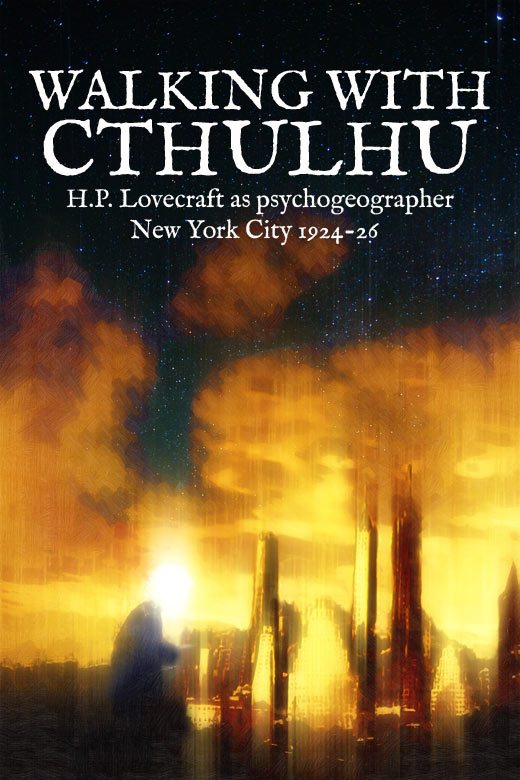
Published: Walking With Cthulhu : H.P. Lovecraft as psychogeographer, New York City 1924-26

My new book is here! Walking With Cthulhu : H.P. Lovecraft as psychogeographer, New York City 1924-26. 55,000 words, 198 pages. Illustrated.

Another good haul of new discoveries! Including two new possible sources for Cthulhu. All heavily referenced and footnoted.

Buy a new paperback copy here! Kindle user? It’s also on the USA Kindle Store and the U.K. Kindle Store.


CONTENTS:

Timeline of Key Dates.

Introduction: A Walk in New York.

SURFACE: Walking the Streets of the City:

1. H.P. Lovecraft and the psychogeographers.

2. H.P. Lovecraft’s night walks in New York: psychogeographic techniques

3. The nature of the New York streets.

4. A note on H.P. Lovecraft and immigrants.

5. H.P. Lovecraft’s New York coffee houses and ice-cream parlours.

UNDERGROUND: On the Monstrous, Occult, and Hidden:

6. H.P. Lovecraft and the subway.

7. It emerged from the subways!

8. On mystical and occult New York.

9. On H.P. Lovecraft and Franz Boas

10. New York as R’lyeh, sunken city of Cthulhu.

“Nyarlathotep” annotated.

Bibliography.

Index.

Teaching literature as history

Scott Herring calls for a new academic approach that might ferry the study of English Literature back from the land of limbo. It’s an approach that the history-venerating Lovecraft would have approved of…

History gives us the facts, sort of, but from literary works we can learn what the past smelled like, sounded like, and felt like, the forgotten gritty details of a lost era. Literature brings us as close as we can come to reinhabiting the past. […]

The past is not another country; it is another life. The texture of daily living is different now than in the past, more different the further back we look, until we find people whose experiences created a psychology we might find baffling or rude. Many details that once made up the daily round are lost to us because people considered them too trivial to write down. […]

Let the dead French theorists lie. Instead, literary scholars can become guides to the physical reality of the past. If you think about it, that’s what we’ve been doing in class for the last hundred years […] Once ordinary people note that we’re doing something useful again, they might stop looking at us like we’re nuts.

That seems fine when the literature in question directly describes that re-imagined past. Such an apparently straightforward approach and lack of obscurantist clutter might well appeal to both students and administrators, if not to many English Lit academics. Although I can imagine the historical approach morphing into ‘Political Correctness 101’ in many left-leaning classrooms, with the life of the author wheeled in as Exhibit A for the prosecution. I can also see a great many authors being avoided altogether, to ‘avoid offending’, if one had to focus as much on the history as on the text.

A more interesting approach might be cross-disciplinary and tailored to each student. Let each student start by discovering their specific family history and tree, gaining basic research skills along the way — then spiral out from there into the relevant fiction, social histories, economics, topography, frameworks of ideas, visual representations, etc.

But what of science fiction? One might run into problems there, with a historical approach. Not because one can’t show that these forms and stories arise partly from the events and concerns present in their time-of-writing. But it seems a tall order to ask students to discover such factors independently, as a part of answering assigned essay questions. Students would need to be: pretty good historians already; able to read widely across many books (each with only a small nugget that tangentially illuminates the story in question); and generally have top-notch online search and information-handling skills. That level of ability is unreachable for all but the top 10% of dedicated students, at a time when history is being dropped in many (UK) schools, when the USA is playing tug-o-war with history in the classroom, and when online search-skills are only very cursorily taught (if at all) in the English-speaking world.

Conferences on the monstrous, 2011-2012

Some forthcoming conferences that may interest…

Monsters and The Monstrous 2011 (Oxford, UK, Sept 2011)

Monstrosity and Humanity conference (English Midlands, UK, Nov 2011)

Vampires: Myths of the Past and the Future (London, UK, Nov 2011)

The Monstrous Fantastic (Florida, March 2012)

The Monstrous City (New York, USA, March 2012) (See also the forthcoming Urban Monstrosities book)

Urban Fantasies: Magic and the Supernatural (Prague, Eastern Europe, March 2012)

Bram Stoker and Gothic Transformations (Hull, North of England, UK, April 2012)

Weird Tales sold to new owner

The modern Weird Tales magazine has been sold by Wildside Press to a new owner/editor. Or at least, the rights to use the brand name for a magazine. The new owner is Marvin Kaye, whose first issue of the magazine will apparently be a Cthulhu special in Feb 2012. SF Scope writes of Kaye…

“The 73-year-old Kaye edited the anthology Weird Tales, The Magazine That Never Dies, which Doubleday published in 1988. He is the author of 16 novels and six nonfiction books, in addition to plays and play adaptations. He has edited at least 30 anthologies, and won the World Fantasy Award for best anthology in 2006 for The Fair Folk.”

Rhode Island School of Design assigns Lovecraft to all freshmen

Rhode Island School of Design assigns Lovecraft as the first book in its first Common Reading Program. No, not as a dire warning about what might be lurking in the waters off Providence…

“And we thought it had many different entry points, many themes,” said Cavicchi, who suggested the book — which he had read in high school long before setting foot in Providence — to the rest of the committee that picked it. Themes like the role of place in the creative inspiration; the point of knowing one’s personal history; the ethics of manipulating nature; the limits of science and rationality … To me, the book is very layered. There is the horror story, but then there are all these other elements in and around the horror story.” On Sept. 12, right after RISD’s opening convocation, the freshmen will gather in groups for the first of many discussions on the book.”

New Justin Woodman book announced

Justin Woodman announces he’s working on a new book, to be titled Lovecraft’s Monsters: The Pulp Roots of the Paranormal

“A preliminary outline has been drafted, with some initial work already started on the early chapters. More of this later as I present some of the ideas and source material relevant to book in forthcoming posts (which I hope to upload on a basis of around 2-3 weekly).”

Sounds like it might be about the historical way in which pulp horror skewed and influenced the conceptions of paranormal investigators from the 1920s onwards?

The old Pennsylvania Station, New York City

When Mr. H.P. Lovecraft stepped down onto the platform of the Pennsylvania Station, on his first ever visit to New York in April 1922, he was surrounded by the neo-gothic imagination in the very architecture of the place. Architecture critic Vincent Scully once famously said of the station’s vaulting interior…

“One entered the city like a god”

Here the power of the literary imagination to change reality with the pen was literally all around him, as he walked up from the platforms into the area covered by the immense vaulted glass and steel roof. The gothic revival had been widely popularised via Walpole’s sensational horror novel (followed by others), and the great boom in ‘the neo-gothic in architecture’ that followed had in short order changed the very fabric of the larger cities…

There then appears to have been a transition into more and more immense Roman styles (no doubt also enjoyed by Lovecraft, who considered himself a sort of ‘Roman via Britain’) as if one were making the journey of civilisation from the underworld to the light in just a few minutes…

“murmurous with the immense and distant sound of time. Great, slant beams of moted light fell ponderously athwart the station’s floor, and the calm voice of time hovered along the walls and ceiling of that mighty room, distilled out of the voices and movements of the people who swarmed beneath. It had the murmur of a distant sea, the languorous lapse and flow of waters on a beach. It was elemental, detached, and indifferent to the lives of men… Few buildings are vast enough to hold the sound of time, and… there was a superb fitness in the fact that one which held it better than all others should be a railroad station.” — Thomas Wolfe , from You Can’t Go Home Again, describing the old Pennsylvania Station.

… but there was also that weird ceiling, like a giant alien spaceship, perhaps emblematic of the inheritance the West had had from places such as Byzantium?…